Last week I presented a workshop on strategic learning as an opening act to ASTD’s 2009 International Conference (ICE), which was followed by DAU/GMU’s Innovations in eLearning (IeL) conference. It was a study in contrasts, and a great learning experience.
Obviously, the focuses (yeah, focii, bugger it) are different. ICE is huge, and for all training and development, while the IeL conference is smaller and focused on elearning. There’s much more to see at ICE, but it’s also appears to be run as a revenue opportunity, where as IeL is designed to provide the latest thinking to a select community (DAU & GMU stakeholders), and appears to be a cost-center.
ICE should be able to be interpreted as a ‘state of the industry’ snapshot, representing the audience’s interests and needs. As such, there are some serious concerns. During the keynote on Blue Ocean Strategy (greatly descriptive, less prescriptive utility), colleagues overheard audience members asking “what’s in it for me?” I can’t think of anything more relevant to organizations than looking ahead and trying to come up with answers for the increasingly turbulent times!
There were some social media sessions, and people ‘getting’ the message, likewise some other topics, but there was similarly good attendance at pretty ordinary stuff. Sure, you do need to learn about assessment, and how to cartoon (a great session, BTW), but there wasn’t the sense of urgency I reckon should be felt.
The expo hall also was scarily populated with generic leadership training, university degrees, flashy examples of elearning that didn’t have much substance, and of course the ubiquitous ‘styles’ assessments (of which the less said, the better). That is, plenty of other reasons to worry about the current concerns of the average conference attendee. Aren’t they needing something more? Support/responsibility beyond the classroom?
Granted, these conferences are planned out close to a year in advance, so it may not reflect current concerns as much as those of half a year or more ago, but it seemed little different than one I attended several years ago. C’mon! There were plusses, of course, not least of which were chances to meet colleagues I’d heard of or interacted with but not had the pleasure of meeting face to face, including Rae Tanner, Dave Ferguson, Craig Wilkins, and Gina Schreck, as well as reconnecting with folks including Marcia Conner and Wendy Wickham. And I was pleased that there was WiFi access throughout the conference! Kudos to ASTD for getting that right. The lack of tweets from the conf can’t be laid at ASTD’s feet. And the team (e.g. Linda, et al), keep the sales pitches in sessions to a minimum.
The IeL conference, on the other hand, was a whole different story. Way smaller, and deliberately focused on technology-mediated learning & the cutting edge. The keynotes by Vint Cerf and Will Wright were both awesome in scope and depth, truly visionary stuff. The sessions were more targeted specifically at my interests, and again it was a great chance to hook up with some new colleagues, including Koreen Olbrish and Aaron Silvers, and similarly connecting with colleagues like Marks Oehlert & Friedman. And there was more tweeting of sessions in this small conference than ICE, but given the audience that wasn’t as unexpected as you’d think.
I can’t say that one conference was better than the other for me or for their audiences. I got to present what I was really interested in at ICE, versus doing a talk for IeL that met their request rather than my passion (tho’ it was within my capability and I did my usual due diligence to make it accurate, worthwhile, and at least moderately engaging). However, the good thing at IeL is that people were really looking not just at training, but at where they really needed to be for organizational learning, and how technology could help. And that’s the most important thing, to be looking ahead. What I missed at ICE was people really trying to do more than just their job. And I’m perfectly willing to be wrong about that.
It’s just that I think there’s a coming crisis in organizational learning, and the answers are not doing training better. Formal learning will be part of it, but training as it’s currently delivered will not, and there’s so much more. Here’s hoping that message starts getting heard.
 When I went around the room asking what people were hoping to get out of the day, a lot of mentions of LMS and elearning made me realize that the title of “elearning strategy” had perhaps misled people into thinking this was just about courses online, whereas I was going quite a ways further through my performance ecosystem. I took some time to explain that my vision of learning was far beyond courses, and included problem-solving, innovation, and more.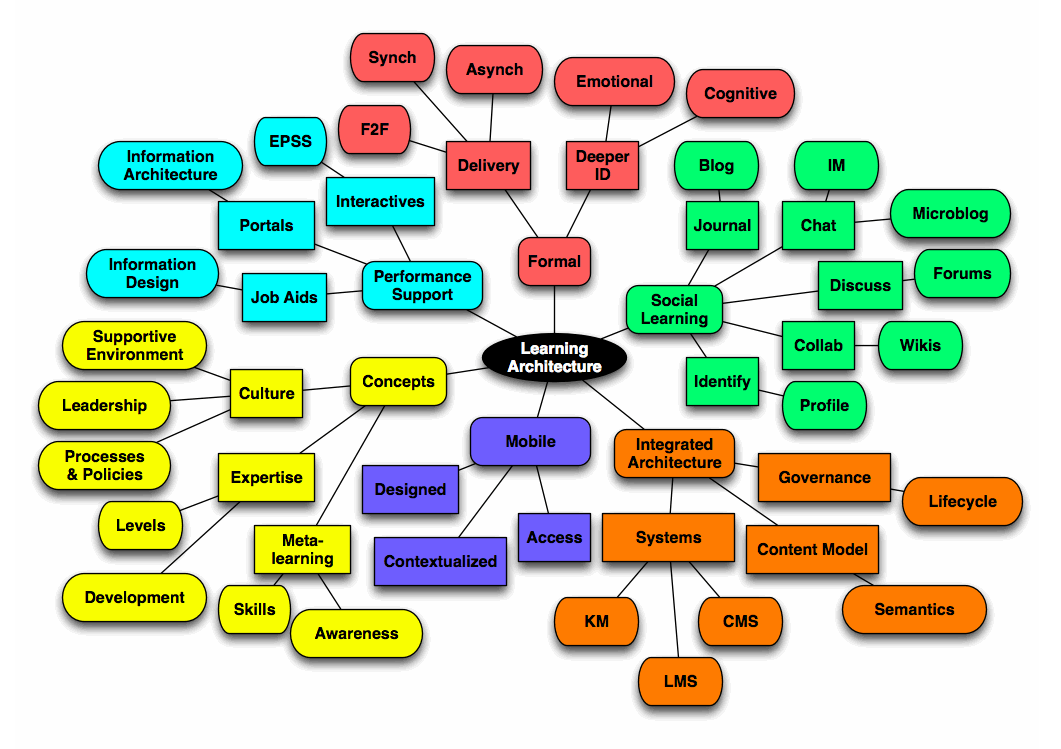
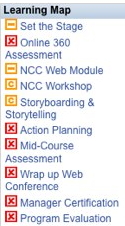 What I like about it is it takes a longer term view of skills. The sample he showed (and of course I realize it’s presented in the best light) was a learning map for a course, but with lots of components spread out over time (sample map shown). There’s a priori assessment, content, activities with managers, etc.; a mix of activity, practice, reflection, just the sort of model we should be designing. We know spaced practice matters, with reactivation, reflection, etc. It’s also valuable to go back to the workplace, and then check-in later to see how things are going. It’s a fuller picture of what learning’s about.