At the ASTD Middle East North Africa event, Dr. Palan opened the second day by weaving a well-illustrated talk about how leadership is changing, moving from transactional to transformational.
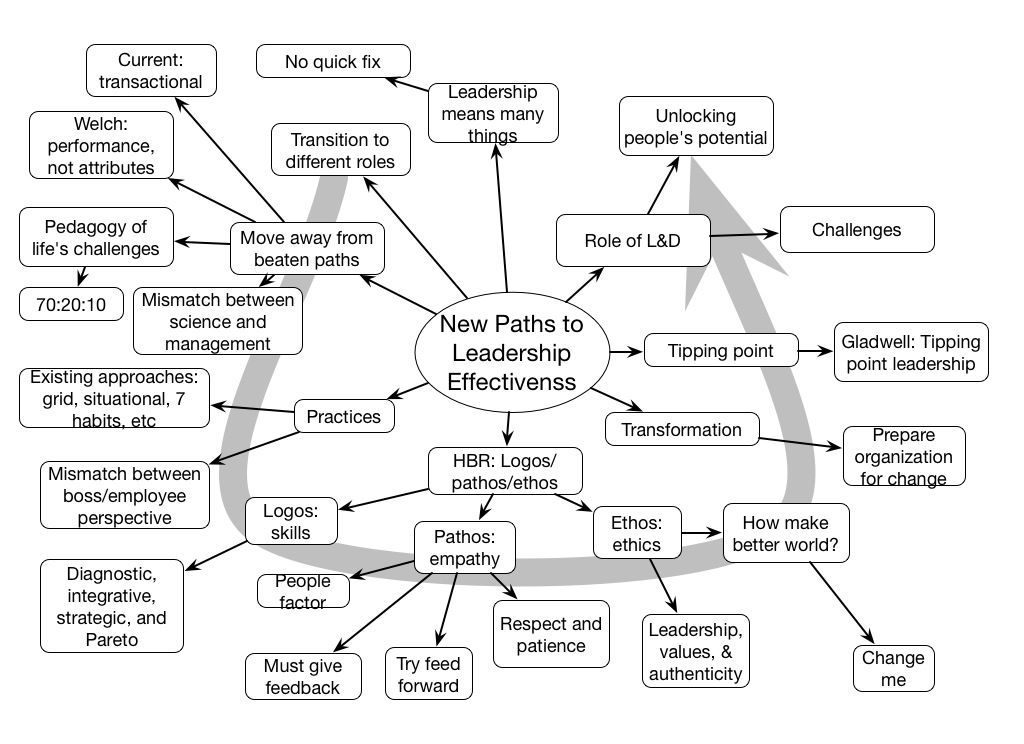
At the ASTD Middle East North Africa event, Dr. Palan opened the second day by weaving a well-illustrated talk about how leadership is changing, moving from transactional to transformational.
Today’s opening keynote for the ASTD Middle East North Africa event was ASTD’s leader, Tony Bingham. Tony did a clear and cogent argument for social media in organizations, without shootouts to Jay Cross, 70:20:10, Dan Pontefract, Marcia Connor, the Mayo Clinic, IBM, the CIA and more.
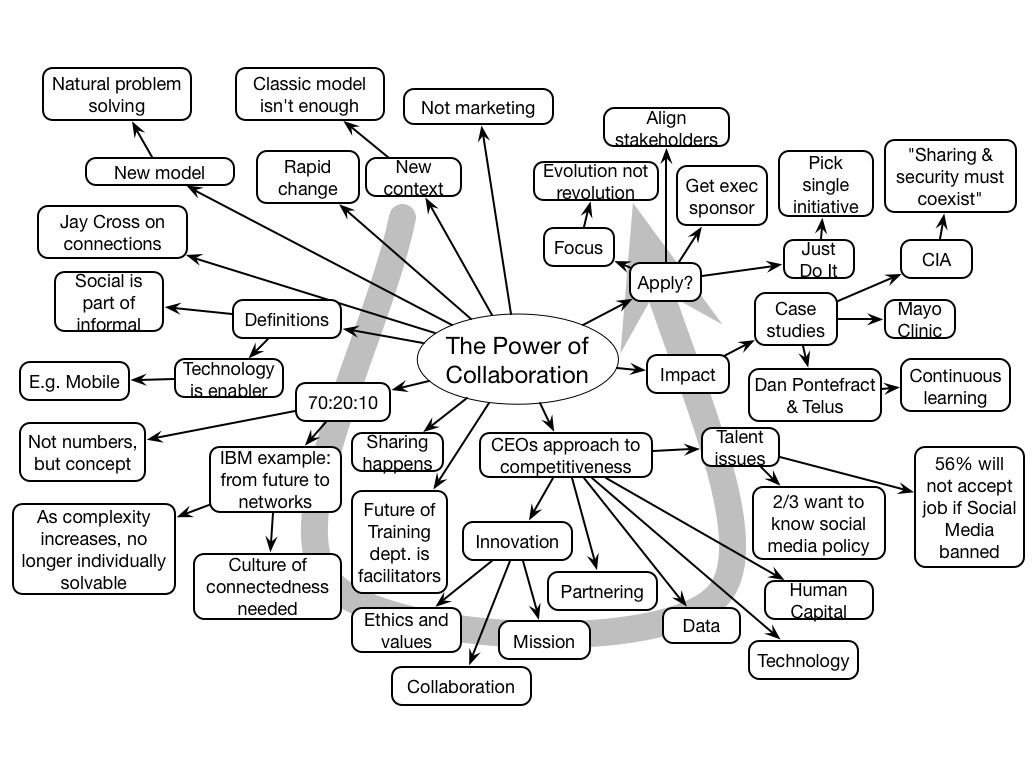
The Principals of the Internet Time Alliance decided to take a collective look ahead to the new year, and share our predictions. You‘ll see overlap but also unique perspectives:
Charles Jennings
 An increasing number of organisations, independent of size, nature or location, will acknowledge that their traditional training and development models and processes are failing to live up to the expectations of their leaders and workforce in a dynamic and global marketplace. Some will take steps to use their financial and people resources and exploit new ways of working and learning. Others will be hamstrung with outdated skills, tools and technologies, and will be too slow to adapt. A confluence of technology and improved connectivity, increasing pressures for rapid solutions and better customer service, and demands for higher performance, will force the hands of many HRDs and CLOs to refocus from models of ‘extended formal training‘ to place technology-enabled, workplace-focused and leader-led development approaches at the core of their provision. We will move a step or two closer to real-time performance support at the point of need.
Clark Quinn
 We‘ll see an increasing use of mobile, and some organizations will recognize the platform that such devices provide to move the full suite of learning support (specifically performance support and informal learning) out to employees, dissolving the arbitrary boundaries between training and the full spectrum of possibilities. Others will try to cram courses onto phones, and continue to miss the bigger picture, increasing their irrelevance. Further, we‘ll see more examples of the notion of a ‘performance ecosystem‘ of resources aligned around individual needs and responsibilities, instead of organized around the providing silos. We‘ll also see more interactive and engaging examples of experience design, and yet such innovative approaches will continue to be reserved for the foresightful, while most will continue in the hidebound status quo. Finally, we‘ll see small starts in thinking semantic use in technology coupled with sound ethnographic methods to start providing just such smart support, but the efforts will continue to be embryonic.
Harold Jarche
 People who know nothing about connectivism or collaborative learning will profit from MOOC‘s. Academics and instructional designers will tell anyone who wants to listen just how important formal training is, as it fades in relevance to both learners and businesses.The ITA will keep on questioning the status quo and show how work is learning and learning is the work in the network era – some will listen, many will not.
Jane Hart
 Many traditional-thinking organisations will waste a lot of time and energy trying to track social interventions in the hope that they can control and manage “social learningâ€. Whilst those organisations who appreciate that social learning is a natural and continuous part of working, will acknowledge that the most appropriate approach they can take is simply to support it in the workplace – both technologically and in terms of modelling new collaborative behaviours. Meanwhile, we will continue to see individuals and teams bypass IT and T&D departments and solve their learning and performance problems more quickly and easily using their own devices to access online resources, tools and networks.
Jay Cross
 2013 will be a great year. As William Gibson wrote, “The future‘s already here. It‘s just not evenly distributed yet.†The business world will become a bit more complex — and therefore more chaotic and unpredictable. Moore‘s Law and exponential progress will continue to work their magic and speed things up. Learning will continue to converge with work. Increasingly, workers will learn their jobs by doing their jobs. The lessons of motivation (a la Dan Pink) and the importance of treating people like people will sink in. Smart companies will adopt radical management, putting the customer in charge and reorganizing work in small teams. Senior people will recognize that emotions drive people — and there are other emotions in addition to passion. Happy workers are more engaged, more productive, and more fulfilled. What‘s not to like?
It is increasingly evident that as we unpack how we get the best results from thinking, we don’t do it alone. Moreover, the elements that contribute emphasize diversity. Two synergistic events highlight this.
First, my colleague Harold Jarche has an interesting post riffing off of Stephen Johnson’s new book, Future Perfect. In looking at patterns that promote more effective decision making, an experiment is cited. In that study, a diverse group of lower intelligence produces better outputs than a group of relatively homogenous smart folks. They quote Scott Page, saying “Diversity trumps ability”. Hear hear.
This resonated particularly in light of an article I discovered last week that talked about Tom Malone’s work on looking at what he calls “collective intelligence“. In it, Tom says “Our future as a species may depend on our ability to use our global collective intelligence to make choices that are not just smart, but also wise.” I couldn’t agree more, and am very interested in the wisdom part. Of interest in the article is a series of studies he did looking at what led to better outputs from groups, and they debunked a number of obvious factors including the above issue of intelligence. Two compelling features were the social perceptiveness of the group, e.g. how well they tuned in to what other members of the group thought, and how even the turn-taking was. The more everyone had an equal chance to talk (instead of a one-sided conversation), and the more socially aware the group, the better the output. Interestingly, which he correlated to the socially aware, was that the more women the better!
The point being that learning social skills, using good meeting processes, and emphasizing diversity, all actions similar to those needed for effective learning organizations, lead to better decision making. If you want good decisions, you need to break down hierarchies, open up the conversation channels, and listen. We have good science about practices that lead to effective outcomes for organizations. Are you practicing them?
This past weekend, we were doing some home work, and I had occasion to go to the hardware store. Several. Several times. What’s interesting to me was two different interactions and the possible implications.
So, first I needed some paint. The guy I worked with was quite helpful, asking questions. (Somehow, he always seemed to be up selling, but that’s beside the point.) Actually, we ended up short on the quantity of paint, but we got paint we liked. What I didn’t get a sense of, however, was the underlying reasoning behind his questions.
In a non-comparable situation, we were having trouble installing some flooring. The click and lock wasn’t going quite fine. So, on the pursuit of a tool and some baseboards, I made an extra point of asking for help from the expert. He asked some diagnostic questions, and proceeded to explain what he thought our problem had to be. In this instance, I felt like I understood the process better.
So they’re not the same: in one case I’m buying product, and in another I’m troubleshooting. But what occurred to me is the opportunity here for thinking out loud to be a customer-benefit. You’ve seen or can imagine the situation where the newer hardware store employee, stymied by the question, tracks down the ‘oldie’ who knows everything and gets the answer. It’s often very helpful to the customer to hear the oldie talk in a way that educates the youngster as well as the customer.
We’ve been advocating the Coherent Organization, and as Jay Cross rightly points out, this extends beyond the organization to the extended enterprise. What struck me was what the opportunity might be if every consumer-facing employee in an organization was coached in effective ‘thinking out loud’. There’d be internal benefits, of course, in having the wisdom of the ‘oldies’ available to the newer members of the team. But the real upside, it seems to me, is in the benefit to the customer. For one, the trust that comes from a willingness to share. It’d be hard to do if the major compensation is commission, as you wouldn’t want to be sharing those thoughts (cue the ClueTrain), but certainly you could be talking about tradeoffs between solutions and clue in the customer on what’s important in the evaluation.
I know I’d be more likely to return to a store that helps me learn about the products. Solution selling could be more than just a methodology, in this case it could be a significant upskilling of the customer base (and employee base). It’s moving the social network back to conversation, away from the media channels, but it’s a significant augment. What do you think would be the benefit of coaching on ‘thinking out loud’ to not only internal employees but customer-facing ones?6
I was engaging in a mobile strategy session with a small not-for-profit the other day, and naturally it became an overall technology strategy session, as you really can’t do mobile strategy without considering social media strategy, learning technology strategy, even enterprise technology strategy. Mobile is a platform for all of the above, and you
One of the questions they struggled with was their social media strategy, as they were (as many people are) struggling with their existing workload. And there are lots of elements that can, and should, play a role. But their problem was really much simpler.
They had a Facebook page, and a twitter account, and a blog they had a placeholder for, and they couldn’t figure out how they were going to populate these. They were naturally concerned about what to blog, what to put on the Facebook page, what they would tweet about, and how they’d get the content for it, and keep it up.
The interesting thing was as we discussed it, talking about what a wide variety of material would make sense: reviews of relevant articles, updates about courses, etc, they started realizing that the content they needed was regularly being produced already. One enthusiastic staff member was always sending emails about things they should pay attention to. They also had notices about courses they were offering. And there was a regular stream of events that occurred.
It became clear that there was a lot of content available from their various channels, what they needed was curation. I was reminded of the fabulous job David Kelly does in curating conferences, and it’s largely the same set of skills (here’s Jane Hart interviewing Dave on the topic). Curation in many ways seems just an external manifestation of Harold Jarche’s Personal Knowledge Management (an extension of the share part of seek-sense-share).
It seemed plausible that they could give a few hours a week to a young person eager to add ‘social media’ to their resume who would do a minor bit of editing and get this to their blog. They wondered whether Facebook should have the same, and in this case the answer appeared to be ‘yes’ (blog allows RSS, some folks don’t go onto Facebook), and then the tweet stream could be for shorter pointers, announcements from the posts, whatever.
The result was that they had a simpler path to a coherent approach than they had realized. There’s more: it’s an org change and there’d have to be the usual messaging, incentives, etc. It’s only a start, but it gets them going while they develop the longer term strategy integrating mobile, web, social media, etc. Do you have a social media strategy in place, and is there emergent content from within your organization?
As excited as I am about the Coherent Organization as a framework, it’s not done by any means. I riffed on it for a Chief Learning Officer magazine, and my Internet Time Alliance colleagues have followed up. However, I want to take it further. The original elements I put into the diagram were ad-hoc, though there were principles behind them. As a start, I wanted to go back and look at these elements and see if I could be more systematic about it.
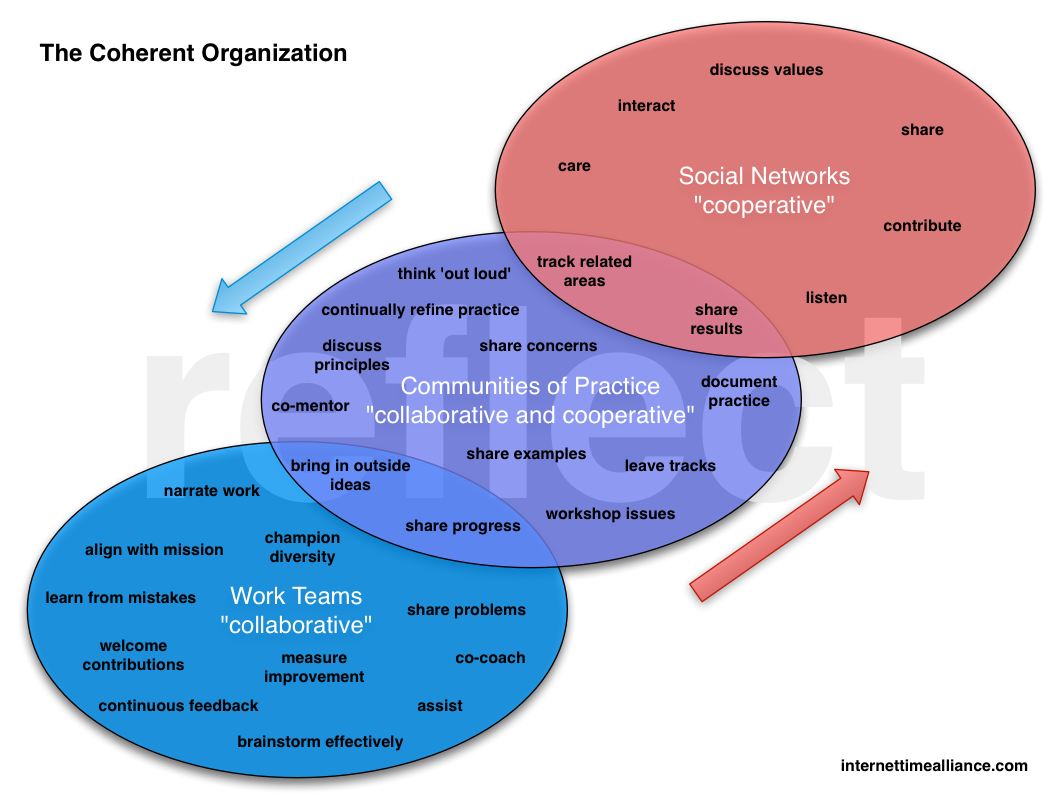 I had, as Harold’s original model provided the basis for, separate groups for Work Teams, Communities of Practice, and Social Networks. Within each were separate elements.
In Work Teams, I had included: share problems, co-coach, assist, brainstorm effectively, continuous feedback, welcome contributions, learn from mistakes, align with mission, narrate work, champion diversity, and measure improvement.
Under Communities of Practice I listed: document practice, leave tracks, workshop issues, share examples, co-mentor, discuss principles, continually refine practice, think ‘out loud’, and share concerns.
And in Social Networks I had put: share, contribute, listen, care, interact, and discuss values. I also had connecters between the groups, each ways, so Work Teams were connected to Communities of Practice by bringing in outside ideas and sharing progress, while Communities of Practice were linked to Social Networks by tracking related areas and sharing results.
What I couldn’t claim was that this was the exhaustive list. I’d put them in there with some thoughts of both putting in and taking out, but I wanted to go further.
What I did was separate out each of the three areas, and start grouping like terms together (I just took all the terms in the above diagram and dropped them into a new diagram, and started sorting). As I did so, some commonalities emerged. I ended up with the following diagram, which is very much a work in progress. What I’m trying to get to is the set of behaviors that would be essential for such an organization to succeed, ultimately coming up with a set of dimensions that might be useful as an assessment. What emerged is a characterization of several different areas within which behaviors fall, which is useful because then I can look for missing (or redundant) elements.
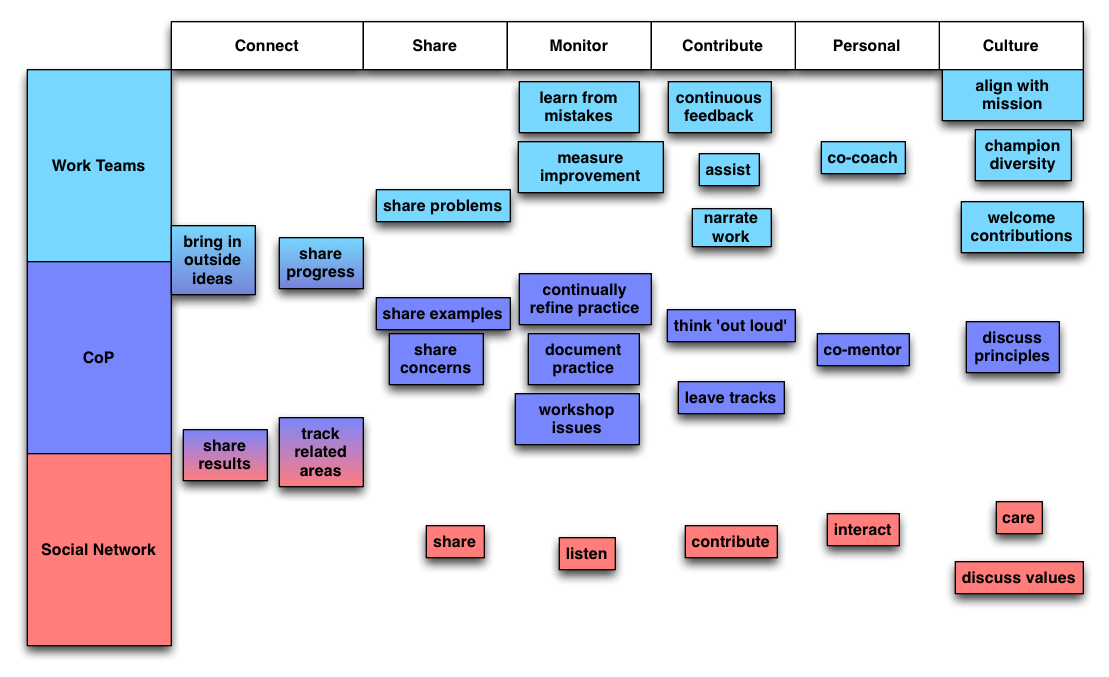 In addition to the connecting tasks, we see several overarching types of behaviors. Besides the connection between the areas, they grouped like I show here.
Sharing is individual putting out things, which is less pro-active and interactive than actually contributing. That distinction isn’t quite clear to me either, but sharing might be more pointers to things where contribute is a more substantial contribution. Which means my elements may not be properly categorized.
Monitoring is both watching what’s going on and pro-actively evaluating outcomes. Does this need to be broken out into two separate areas? Personal is where you’re working with a specific person (or recipient thereof). And the culture dimension is where you’re actively aware of and reviewing the underlying values behind what you’re doing.
By no means do I consider this ‘done’, but I share it as part of my commitment to practicing what I preach, thinking ‘out loud’. This will get refined. I most certainly welcome your thoughts!
#itashare
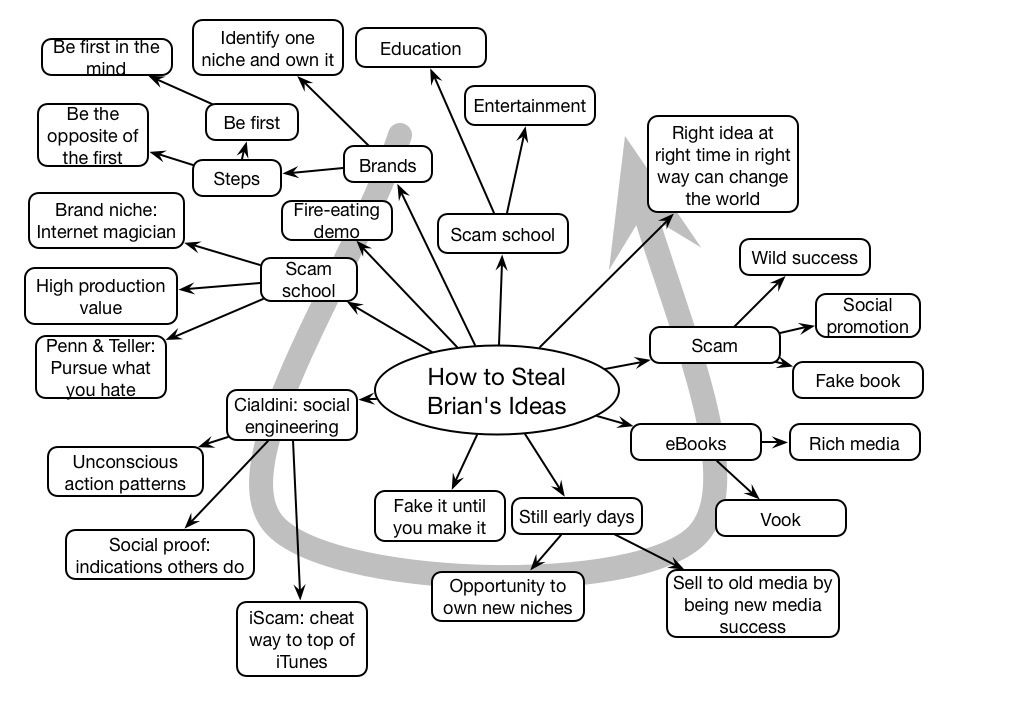
Brian Brushwood riffed off his success with Scam School and other scams to provide lessons about branding and new media opportunity.
I was having a discussion the other day with my ITA colleague Jay Cross, and the topic wandered over to how to use the social approaches we foster under the umbrella of the Coherent Organization to help organizations become one. And I went feral.
Do we work top down, or bottom up? In the course of the conversation it occurred to me that given the model we propose, that you can’t just have the broader social network create it, and you can’t even really build a community of practice (CoP). The smallest unit is the working group; how could we use that?
The thought that struck me was creating a working group who’s goal was to create a CoP around being a Coherent Organization. That is, they’d have to understand the principles, start defining and discussing it, document the opportunities, and start disseminating the ideas through the organization. Inherently, it has to be viral, and the most effective way to introduce a virus is by inoculation.
The idea then is that the mission of the working group is to develop a community of practice around understanding and implementing developing communities of practice. It’s a bit recursive or self-referential, but it’s the seed that needs to sprout. Seeding it is the action that’s needed to get it going, and then some feeding needs to happen. While it’s possible that a self-supported initiative could survive, having some external support may make sense in making this happen.
Yes, I’m assuming that the end result is desirable and possible. The former is, I think, reasonably well accepted (short form: working effectively is a necessary survival tactic, going forward), even if the path to get there isn’t. I’m suggesting that this is a path to get there. It’s not easy; it takes persistence, support, all those things that make organizational initiatives succeed, with an understanding of the strategies, policies, and cultural adjustments needed. Yet I’ll suggest that it is doable. Now, it’s time to do it!
#itashare
Among the many things my colleague Jane Hart does for our community is to compile the Top 100 Tools for learning each year. I think it’s a very interesting exercise, showing how we ourselves learn, and the fact that it’s been going on for a number of years provides interesting insight. Here are my tools, in no particular order:
WordPress is how I host and write this Learnlets blog, thinking out loud.
Keynote is how I develop and communicate my thinking to audiences (whether I eventually have to port to PPT for webinars or not).
Twitter is how I track what people find interesting.
Facebook is a way to keep in touch with a tighter group of people on broader topics than just learning. I’m not always happy with it, but it works.
Skype is a regular way to communicate with people, using a chat as a backchannel for calls, or keeping open for quick catch ups with colleagues. An open chat window with my ITA colleagues is part of our learning together.
OmniGraffle is the tool I use to diagram, one of the ways I understand and communicate things.
OmniOutliner often is the way I start thinking about presentations and papers.
Google is my search tool.
Word is still the way I write when I need to go industrial-strength, getting the nod over Pages because of it’s outlining and keyboard shortcuts.
GoodReader on the qPad is the way I read and markup documents that I’m asked to review.
That’s 10, so I guess I can’t mention how I’ve been using Graphic Converter to edit images, or GoToMeeting as the most frequent (tho’ by no means the only) web conferencing environment I’ve been asked to use.
I exhort you to also pass on your list to Jane, and look forward to the results.