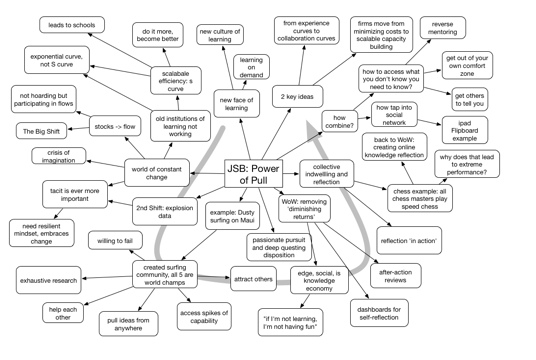
John Seely Brown has given the leading keynote to the DevLearn conference with an inspiring talk about how the world needs to move to scalable capacity building using collaboration (we’re totally in synch!)
Beyond Reason
Night before last, I had my ITA colleagues over for dinner. We’ve been conversing for close on two years, but other than Jay, I’d met each only once: Jane, I’d met last year when she was here, and Harold and Charles I’d each met several years ago briefly. I don’t think Harold and Charles had met before.
So how was it that if felt like old friends getting together? Quite simply, the varied conversations we’d had had created something more than just intellectual convergence.
Now, you have to understand, we have pretty typically met once a week, via voice or video conferencing during that time. We also have a Skype chat we keep open and there are conversations that continue most every day. We’ve also had one on one conversations by phone when needed or wanted. We share our travels, interests, issues, concerns, and more.
This is a friendship, built virtually but still connected by all the elements that make friendships: trust, authenticity, shared concerns, and mutual goals. And, yet, we still wrestle with, and advance, our understandings of the work we’re trying to do as well. We coordinate events, and gigs, working together as well as helping one another.
I mention this to reinforce the point that real communities can be built with virtual tools. With the right emotional connections, environment, and commitment, our cognitive commitments are effectively met , and perhaps even augmented, relative to meeting face to face. Sure, we’ll have a couple of days of face to face work to take care of some stuff that we’ve been working on, but we’ve built the relationships and done useful work as well, and it will continue.
To me, that is the power that’s on tap, the offer we must seize to the benefits of our organizations, and society. We welcome you to join us.
The role of the university?
Unhappy in many ways with the current status of education, particularly here in the US, I’ve been thinking a lot about what would make sense. What’s the role of K12, and then what’s the role of a university? Some thoughts recently coalesced that I thought I’d put out and see what reaction I get.
The issue, to me, covers several things. Now, I talked some time ago about my ongoing search for wisdom, and the notion of a wise curriculum coupled with a wise pedagogy very much permeate my thinking. However, I’m probably going to be a bit more mundane here. I just want to think what we might want to cover, and how.
Let me start with the premise that what needs to be learned to be a productive member of society needs to be learned before university, as not everyone goes further. If we truly believe (and we should) that 21st Century skills of learning, research, communication, leadership, etc, are skills everyone needs, then those are K12 goals. Naturally, of course, we also include literacy of many sorts (not just reading and writing), and ideally, thinking like a mathematician and scientist (not science and math).
However, if those are accomplished in K12 (when I’ve previously argued learning how to think might be the role of the university, and now think it’s got to be before then), then what is the role of university? Given that the half-life of knowledge is less than four years, focusing on preparing for a lifetime of performance is out of the question. Similarly, pursuing one fixed course of study won’t make sense anymore, as the fields are beginning to change, and the arbitrary categorizations won’t make sense. So what then?
I’m thinking of going back to the original Oxbridge model. In the old days, you were assigned a tutor (and advisor), and you met with that person regularly. They’d have a discussion with you, recommend some activities (read X, solve Y), and send you on your way. It was a customized solution. Since then, for a variety of reasons (scale, mostly), the model’s turned into a mass-production model. However, we now have the power of technology.
What if we moved to a system where individuals could spend some time exploring particular areas (like the first two years or so of college), and then put together a proposal of what they wanted to do, and how they’d pursue it, and the proposal would be vetted. Once approved, there’d be regular updates. Sure, there’d likely be some templates around for learning, but it’d be more self-directed, customizable, and put the appropriate responsibility on the learner.
I may be biased, as I designed my own major (UCSD’s Muir campus had a mechanism to design your own degree, and as they didn’t have a learning technology program…) as an undergraduate, and again you propose your research as a PhD candidate, but I think there’s a lot to recommend a learner taking responsibility for what they’re going to study and why. Granted, universities don’t do a good enough job of articulating why a program sequence has particular courses in it, but I think it’s even better if a learner at least has to review and defend it, if not choose it themselves.
Naturally, some domain-specific learning skills would emerge, but this would provide a more flexible system to match how specializations are changing so dynamically, serve as a model for life, and put the responsibility of faculty members more to mentorship and less to lecture. It would necessitate a change in pedagogy as well.
I think, in the long term, this sort of model has to be adopted. In the short term, it will wreak havoc with things like accreditation, but that’s not necessarily a bad thing, given the flaws we’re beginning to see in the existing system, both non- and for-profit. I reckon the for-profits might be able to move quicker, but there will be battles. And, of course, changing faculty minds reminds me of the old joke: “How many academics does it take to change a lightbulb?” “Change?” (And I *was* one!)
Naturally, this has implications for K12 too, as many have articulately argued that the pedagogy needs to change there as well, following the learners’ interests. Likewise the notion of educational publishing (where is that iPad replacement for my kid’s texts?). Those are topics for another day.
So, does this make sense? What am I missing?
ITA and DevLearn!
I’m excited to say that all the Internet Time Alliance (Jay, Jane, Harold, Charles, & myself) are all going to be at DevLearn this year. I’m excited because I’m looking forward to having us all together, given that normally Jane & Charles are in the UK, Harold’s hangs out above the east coast of Baja Canada, and Jay and I populate the west coast. At least, when we’re home. While we’re in touch every day, and have gotten together in subgroups, we never have we been together in one place! Practicing what we preach…
Of course, I’m also excited because DevLearn is always a great conference, and this year is shaping up to be the best yet. The eLearning Guild team (Brent, Heidi, David and the rest) continue to improve on the excellent job they always do, the exhibit hall is sold out, I’m sure the attendance will be high, and some of the folks who I’ve most been looking to meet will be there (Jane Bozarth, I’m looking at you ;). And, of course, my friends from previous conferences, Aaron, Marcia, Mark, Koreen, the list goes on. The keynotes look great (JSB, Marcia!), and the lineup of other speakers reads like a who’s who of elearning.
Given that the ITA will be together, we’ll be mind-melding for a couple of days afterwards. To that end, I strongly encourage you to find us and talk to us, individually or collectively, and let us know what you’re thinking, what your concerns are, what barriers you are facing, and so forth. We’ll be attending each others’ sessions, and others, as well as in all the usual places (expo halls, watering holes,…). Please give us a chance to meet you and hear from you.
Jane Hart will be speaking at 10:45 on Wed the 3rd, on The State of Learning in the Workplace Today (session 110). Jay Cross will be speaking at 4 PM on Working Smarter: Learning is the REAL Work! (session 310). Finally, I’ll be speaking on Thursday the 4th at 10:45 on Rethinking eLearning: Performer Augmentation (session 410). I reckon we’ll all be at each of our sessions. I will also be part of the Mobile Learning Jam at 3PM on Wed, speaking with Paul Clothier and Rovy Brannon on An ISD Discussion of Mobile Learning (though I don’t necessarily expect my ITA colleagues to be there for that session).
And, of course, please just do say hello. I look forward to meeting you or seeing you again!
Co-Curation
In a presentation yesterday by Dr. Deborah Everhart, talking about Web 2.0 and the future of teaching and learning at Berkeley’s new Center of Next Generation of Teaching and Learning, she used the familiar mechanism of transitions from Web 1.0 to Web 2.0. One of the transitions she described, from Buying to Self-Publishing sparked a thought. This was very much in the context of higher education, but it extends further.
For context, realize that we’re being inundated with knowledge. One of the roles of our personal learning networks is to follow people who sort through the memes coming along and reframe them into new ideas, posts and more. People like my ITA colleagues and many others (e.g. #lrnchat instigators) are worth following (virtual mentorships) because they are essentially serving as curators for knowledge.
So these people are self-publishing. In higher education, we think of authors of textbooks, although in a sense they’re curating knowledge as well. And we’re seeing movements where teams are beginning to author texts, not just for publishers but in open access contexts as well. If we extend this, communities are, increasingly, similarly curating information.
And, really, they’re co-curating. Wikipedia ends up being the ultimate co-curated body of knowledge. It’s co-creation, but because it’s pulling together bits of knowledge from other places. In the case of innovation, where experts are solving new problems, that’s co-creation, but capturing resources around topics and combining them is a combination of curation and creation, co-curation.
I note that this is not a new term, as librarians have been apparently using it for a while, but I think it’s an important concept in the overall context of learning together; co-creating libraries (have you ever received a request for the books you think are most critical for X :) of resources and references. It’s a part of the larger picture of creating personal learning environments, personal learning networks, and personal knowledge management.
When I reflect on the fabulous learning that comes from my networks (such as those listed above and ITFORUM), I am really really grateful to those who contribute so that we all learn together. Thanks!
The New Social Learning by Tony Bingham and Marcia Conner
Marcia Conner & Tony Bingham’s book The New Social Learning is, quite simply, a must-read if you are in either responsible for learning in, or running, a business. In short, eloquent, and yet highly readable chapters, they cover both the natural ways we learn, and how the new technologies both support and enhance these capabilities. The focus is clearly on organizational success.
After a opening that sets the stage of how the world’s changing, Tony and Marcia go through a series of tools and opportunities in systematic ways: community, video, twitter, wikis, virtual worlds, and face to face events. For each, they provide vibrant examples, core concepts, recommendations, and ways to address criticism. The elements are all relevant and apt.
If you’ve followed this blog at all, you know that social learning is the key to competitiveness and survival. This powerful book helps make abundantly clear just what is on offer. Illustrated with anecdotes and quotes from the major players jn the space (usual disclaimer), the message could not be clearer. They’ve done the homework to illuminate the way the world is moving.
I wish they had talked more about mobile, as I think that’s a dimension to this area that is going to be a serious game-changer. It’s implicit in their work, particularly talking about face-to-face, but could use emphasis.
Overall, this is a great complement to Jane Bozarth’s Social Media for Trainers, and our Working Smarter Fieldbook. Together, they provide the big picture and the practical guidance organizations need to take the next step in organizational development. Buy it, read it, apply it, and proselytize it. Let’s make the world a smarter place.
Social Media for Trainers (by Jane Bozarth)
Jane Bozarth’s Social Media for Trainers is a wonderfully handy, and important, book. It succinctly introduces why you would want to think about social media to augment training, introduces several of the major social media tools that represent categorical differences, and, for each, focuses on practical explanations about the tools, pluses and minuses, and classic ways to use them before, during, and after learning events.
As a disclaimer, let me note that not only am I mentioned in the book, but I also reviewed the manuscript for the publisher, so understand that I’m not completely unbiased. On the other hand, I can point to principle about why this book is so needed.
As I mentioned before, the key to deep learning is processing the information in a variety of ways, and social interaction around the content is a valuable form of processing. Consequently, social media can have a valuable role in training and learning. However, trainers are not always familiar or comfortable with social media, nor understand how they could practically be used.
This book provides just the concise information needed. The media are presented simply with examples and steps, the examples are clear and relevant, and appropriate disclaimers are made about the changing nature of the technology.
The nicest part, for me, is the last chapter where Jane reconnects the message back into the larger picture: of learning, of work, and of organizations. For one, she talks a bit about how social relates to learning, an important conception. And she makes the necessary link between augmenting formal learning and the informal learning power of social networks.
The last, in particular, is enabled by mobile. Jane does address mobile, as the social tools mentioned have mobile mechanisms. The mobile dimension extends the reach of the opportunities, and the learning experience, as well as opening up the possibilities of bridging the gap between informal and formal.
While I could make small tweaks (put the processing up front, mention personal reflection via blogs), overall this book is a ‘must own’ for trainer & instructional designers, and managers of same. This book complements Marcia Conner & Tony Bingham’s The New Social Learning, and our The Working Smarter Fieldbook, serving as the hands on guide to frontline use of social media.
Shifting perspectives
In the Internet Time Alliance chat, yesterday, we were discussing the apparently difficultly some are seeming to have with the necessary mind shifts to comprehend the benefits of social media for organizational learning. It seems to me that there are 3 roles and each has an associated shift.
‘Management’
The old thinking was that the thinking is done from the top and percolates down. Whatever skills are needed are brought in or identified and the learning unit develops it. There’s a direct relationship between the specific skills and the impact on the business.
The new thinking is that the goals are identified and made clear and then the employees are empowered to achieve the goals in the ways that seem best. They can provide input into the goals, and adapt the skillsets as needed.
The is important because of speed, productivity, and outcomes. First, the world is moving faster, and there is no longer time to plan, prepare and execute. It has also been demonstrated that employees are more productive when they’ve bought into the plan and have responsibility. It’s also the case that bringing more brains ‘online’ to help achieve goals ultimately makes better decisions.
The necessary components are that workers need a context where they can contribute safely and are empowered to work.
The Learning Unit
The old thinking was that the learning unit was about ‘training’. That the learning unit responded to identified skill needs, created training, delivered it, and then measured whether employees thought it was worthwhile. The focus was on courses.
The new thinking is that the learning unit is about ensuring that the necessary complement of skills and resources are available. That the responsibility is not just for formal learning, but performance support, and social interchange. That the role is facilitation, not delivery.
This is important because the workforce needs to be focused on the task, with the tools to hand, but the nature of the important work is changing. It’s no longer about doing something known, but about dealing with the unknown. Really, any time you’re problem-solving, research, design, creating new products and services, by definition you don’t have the answer and the skills necessary are meta-skills: how to problem-solve, get information, trial solutions, evaluate the outcomes. It’s about working together as well as independently.
The necessary components are to define and track the new skills, to provide an infrastructure where learners can take responsibility, and to track outcomes and look for opportunities to improve the environment, whether the performer skills, the tools, or the resources. Yes, there are still courses, but they’re only one component of a bigger picture, and they take a format that is conducive to these new skills: they’re active and exploratory.
The workforce
The old thinking was that they did what they were told, until they could do it without being told. The strategic thinking was done elsewhere, and they took a defined role.
The new thinking is that workers are told what the goals are, and have to figure out how to accomplish it, but not just alone. It’s a collaborative effort where there are resources and tools, and we contribute to the outcome while reviewing the work for opportunities to improve. Workers contribute at both the execution and the innovation level. They have to take responsibility.
This is important because, as stated above, what with automation, the work that really matters is shifting, and organizations that try to continue to sequester the important thinking to small sections of the organization will lose out to those that can muster larger brain trusts to the work.
The necessary components are leadership, culture, and infrastructure. Workers have to comprehend the goals, believe in the culture, and have the tools – individual and collective – to accomplish the goals.
Hopefully, the contrasts are clear, as are the opportunities. It’s the shift from hierarchy to wirearchy. What am I missing?
Enterprise Thinking, or Thinking Enterprise
I realize, with recent releases like Jane Bozarth’s Social Media for Trainers and Marcia Conner & Tony Bingham’s The New Learning (both recommended, BTW, reviews coming soon, with standard disclaimer that I’m mentioned in both) that the message is finally getting out about new ways to facilitate not just formal learning and execution, but informal learning and innovation. But there’s more needed. It takes new thinking at the top. You need to think about how the enterprise is thinking.
So what do you want for your enterprise thinking? Shows like The Office make us laugh because we identify with it. We know the officious types, the clueless, the apathetic, the malevolent, the greedy, the ones just marking time. They’re definitely not thinking about how to make the organization more successful, they’re thinking more about what will make their life most enjoyable, and there’s little or no alignment. That’s not what you want, I’ll suggest, but is what’s seen, in various degrees, in most places.
Instead, you (should) want folks who know what the goal is, are working towards it individually and collectively. That are continually looking for opportunities to improve the products, processes, and themselves. This is where organizations will derive competitive advantage.
How do you get there? It takes coordinating several things, including the dimensions of the learning organization: leadership, culture, and practices), and the information infrastructure for working well together. You need to have the tools, you need to understand the behaviors required, you need to know that working this way is valued, and you need to be informed as to what the goals are.
We want to be empowering people with the models that help understand the shifts that are happening and how to cope, so they’re part of the movement. They need to understand things like networks and complexity, so that they’re equipped to contribute at the next level.
It’s time to stop thinking patchwork (“we’ll just put in the tools”, or “we’ll move in the direction of more open leadership”), and starting thinking systemically and strategically. Identify and acknowledge where you are now, and figure out a path to get where you need to be. It’s not likely to be easy, but it’s clearly time to get started.
Brainstorming, Cognition, #lrnchat, and Innovative Thinking
Two recent events converged to spark some new thinking.
First, I had the pleasure of meeting up with Dave Gray, who I’d first met in Abu Dhabi where we both were presenting at a conference. Dave’s an interesting guy; he started XPlane as a firm to deliver meaningful graphics (which was recently bought by Dachis Group, and he’s recently been lead author on the book Gamestorming.
What Gamestorming is, I found out, is a really nice way to frame some common activities that help facilitate creative thinking. Dave’s all over creativity, and took the intersection of game rules and structured activities to facilitate innovative thinking, and came up with a model that guides thinking about social interaction to optimize useful outcomes. The approach incorporates, on a quick survey, a lot of techniques to overcome our cognitive limitations. I really like his approach to provide an underlying rationale about why activities that follow the structure implicitly address our cognitive limitations and are highly effective at getting individuals to contribute to some emergent outcomes.
I also happened to have a conversation with a lady who has been creating some local salons, particular get-togethers that have a structured approach to interaction (I’ve attended another such). Hers was based upon biasing the conversation to the creative side, a very intriguing approach. Not only was she thinking of leveraging this for tech topics, but she was also thinking about leveraging new technologies, e.g., a Second Life Salon.
Which got me thinking that there were some relationships between Dave’s Gamestorming approach and the salons . I wouldn’t be surprised to find salons in Dave’s book! Moreover, however, was that there are intriguing potentials from tapping into virtual worlds to remove the geographic constraints on such social interactions.
What was also interesting to me, reflecting on an early experience with the Active Worlds virtual world, your attention eventually focused on the chat stream, because that’s where all meaningful interaction really happened. Which is really what #lrnchat is, a chat. One of the nice properties of a chat is that you’re not limited to turn-taking. A problem in the real world is that the more people you add, the less time each gets to contribute in a conversation. In a simultaneous medium like #lrnchat, everyone can contribute as fast as they can, and the only limitations are on the participants ability to process the stream and contribute (which are, admittedly, finite). Still, it’s a richer medium for contribution, as I find I can process more chats in the same time only one person would talk (of course, the 140 char limit helps too).
The important thing to me is that social media have new capabilities to enable contribution, and achieve the innovation end that Dave’s excited about in ways that maximize the outcomes based upon new technology affordances that we are just beginning to appreciate. Can we do better than we’ve done in the past, leveraging new technologies? I think Dave’s model can serve for virtual as well as real events, and we may be able to improve upon the activities with some technology capabilities. To do so, however, means we really have to look at our capabilities in conjunction with new technologies. Yeah, I think we can have some fun with that ;).