Learnlets

Secondary

Clark Quinn’s Learnings about Learning

Signifying change

14 January 2020 by Clark Leave a Comment

I have a persistent interest in the potential for myth and ritual for learning. In the past I sought a synthesis of what’s known as good practice  (as always ;) in an area I don’t have good resources in. When I looked over 10 years ago, there wasn’t much. That’s no longer the case. There is now quite a bit available about signifying change with ritual.

Myth, here, is not about mistaken beliefs, but instead are stories that tie us to our place in the universe. Every culture has had its origin story, and typically stories that explain the earth, the sky, and more. Ritual is a series of repeated behaviors that signify your belief in those stories. And when you look at prayer, and transition ceremonies, you see how powerful these behaviors are in shaping behavior. Can we leverage this power for learning?

Barbara Myerhoff opined that ritual worked because your body bought into it before your mind did. Thus, the repeated behaviors build a ‘muscle memory’ that supports your purpose. And agreeing to perform the ritual at all is an implicit complicity in the story behind the ritual. Finally, having others also performing or having performed the ritual builds a social commitment.

There’s clear power, but can we do it systematically? The sources at the bottom suggest we can. My synthesis says the answer is yes. There are two important distinctions. One is whether it’s individual or collective. Are we having a single person commit, or having a group commit? In the former, they may be becoming a member of the community, but it’s about changing personal behavior regardless. In the latter, it’s about someone becoming a member of a group of practitioners. (And, to be clear, here I’m talking secular change.)

The other distinction is the scope of the change. Is this a small personal change, or is this a switch to an entire system of belief? Are we helping someone be more productive, or asking them to buy into our organizational culture? If we want to  transform people, signifying the change seems important.

Wwhat makes effective ritual is having a behavior that indicates allegiance to a system of belief. It’s essential that the behavior  signifies the change in some way.  It might be a part of the actions that the new desired change incorporate. So you mimic rolling out dough to cement your understanding of baking. Or it might be an iconic representation of some aspect of the belief, so drinking something specific as preparation.

The actual structure is suggested to be some initiating occurrence, like another instance (new client), or a particular time of day. Then there’s a process to be followed, typically with a preparation, a behavior, and a closing.

As usual, the process includes identifying the necessary elements, prototyping, testing, and iterating. Does it work with the audience, does it feel authentic, is it easy to do, are some of the questions to ask.

The materials I’ve found suggest ritual can be helpful. Two obvious roles are to successfully acknowledge their new status and/or sustain necessary mindsets and practices. When people have transformed, we want to acknowledge the change. And we want to help them continue to maintain and develop the new ability. Signifying change is an important component. We should be intentional about making that happen.

Three pointers:

How to design team rituals to accelerate change

Crafting effective ritual

Introducing Ritual Design (and more from the Ritual Design Lab here)


Cultural Comment Shift

19 November 2019 by Clark 2 Comments

I’ve been blogging now for over a decade, and one thing has changed. The phenomena is that we’re seeing a cultural comment shift; comments are now coming from shared platforms, not directly on the site. And while I try not to care, I’m finding it interesting to reflect on the implications of that, in a small way.

When I started, people would comment right on the blog. It still happens, but not in the way it used to. It wasn’t unknown for a post to generate many responses right in the post. And I liked that focused dialog.

These days, however, I get more comments on the LinkedIn announcement of the post rather than the post itself. And I don’t think that’s bad, it’s just interesting. The question is why.

I think that more and more, people want one place to go. With the proliferation of places to go: from Facebook and Twitter and LinkedIn to a variety of group tools and Instragram and Pinterest and…the list goes on. People instead are more likely to go where others are.

And that makes it increasingly easy to just view and comment in a place where I already am. And since that’s possible, it works. I wish I could automatically post directly to LinkedIn, but apparently that’s not of interest (APIs are a clear indicator of intent).

I think the lesson is, as I was opining about elsewhere, is to go where people are. Don’t try to set up your own community if you can get people to participate where they already are. Of course, that also implies having good places to go. We’re seeing certain platforms emerge as the ‘go to’ place, and that’s OK, as long as they work. The cultural comment shift is merely an indicator of a bigger cultural shift, and as long as we can ride it, we’re good.

On building trust

14 November 2019 by Clark 2 Comments

My post last week was on trust, and it triggered a question on LinkedIn: “Do you have any tips, processes, models, suggestions, etc. for building trust within a team?”  And while I wrote a short response there, I thought it would be worth it to expand on it.  So here’re some thoughts on building trust.

First, there was a further question: “You mentioned that it started with credentials. For example, did you all take turns going around and introducing yourselves?” No, it wasn’t introducing ourselves. Potential new candidates are scrutinized in a call, so existing members are aware of new members’ capabilities. In my case, I looked them up, or more usually their activities emerged in conversation. It develops authentically.

The most important thing was that there were activities underway, and people were contributing in an open, constructive, non-personal way.  There’s a focus on reinventing the organization, and an important activity underway was using the Business Model Canvas as a framework to explore opportunities. The activity was led by one of the team whose experience became abundantly clear, for example.

There also was acknowledgement of others’ contributions. Conversations would reference and build upon what others said. It was an implicit ‘yes and’, but also an occasional ‘but what about’.  That is, we were free to present alternative viewpoints. Sometimes they resolve and other times it’s ok to leave them hanging in the moment. The only agenda is the common good.

One critical element is that the leaders are very unassuming and solicitous of input, as well as sharing lessons learned. There is a lot of sharing of experience, connections, and more. There’re also personal notes about travel, concerns, and more. It’s very ‘human’.

It quickly was obvious that the group was a safe place where people had a shared goal but were also diverse. We’re diverse in geography, race, gender, and role, which forms a strong basis for good outcomes.  The culture’s established, and we naturally align. As Mark Britz says, we follow the systems, but they’re right from the start.

It goes back to the learning organization dimensions, particularly the environment: open mind, valuing diversity, time for reflection, and psychological safety. When it’s lived, it works. And that’s what’s happening. When you’re focused on building trust, get the culture right, and the rest follows.


Theory or Research?

17 July 2019 by Clark Leave a Comment

There’s a lot of call for evidence-based methods (as mentioned yesterday): L&D, learning design, and more. And this is a good thing. But…do you want to be basing your steps on a particular empirical study, or the framework within which that study emerged? Let me make the case for one approach. My answer to theory or research is theory. Here’s why.

Most research experiments are done in the context of a theoretical framework. For instance, the work on worked examples comes from John Sweller’s Cognitive Load theory. Ann Brown & Ann-Marie Palincsar’s experiments on reading were framed within Reciprocal Teaching, etc. Theory generates experiments which refine theory.

The individual experiments illuminate aspects of the broader perspective. Researchers tend to run experiments driven by a theory. The theory leads to a hypothesis, and then that hypothesis is testable. There  are some exploratory studies done, but typically a theoretical explanation is generated to explain the results. That explanation is then subject to further testing.

Some theories are even meta-theories! Collins & Brown’s Cognitive Apprenticeship  (a favorite) is based upon integrating several different theories, including the Reciprocal Teaching, Alan Schoenfeld’s work on examples in math, and the work of Scardemalia & Bereiter on scaffolding writing. And, of course, most theories have to account for others’ results from other frameworks if they’re empirically sound.

The approach I discuss in things like my Learning Experience Design workshops is a synthesis of theories as well. It’s an eclectic mix including the above mentioned, Cognitive Flexibility, Elaboration, ARCS, and more. If I were in a research setting, I’d be conducting experiments on engagement (pushing beyond ARCS) to test my own theories of what makes experiences as engaging and effective. Which, not coincidentally, was the research I was doing when I  was  an academic (and led to  Engaging Learning). (As well as integration of systems for a ubiquitous coaching environment, which generates many related topics.)

While individual results, such as the benefits of relearning, are valuable and easy to point to, it’s the extended body of work on topics that provides for longevity and applicability. Any one study may or may not be directly applicable to your work, but the theoretical implications give you a basis to make decisions even in situations that don’t directly map. There’s the possibility to extend to far, but it’s better than having no guidance at all.

Having theories to hand that complement each other is a principled way to design individual solutions  and design processes. Similarly for strategic work as well (Revolutionize L&D) is a similar integration of diverse elements to make a coherent whole. Knowing, and mastering, the valid and useful theories is a good basis for making organizational learning decisions. And avoiding myths!  Being able to apply them, of course, is also critical ;).

So, while they’re complementary, in the choice between theory or research I’ll point to one having more utility. Here’s to theories and those who develop and advance them!

Working virtually

18 June 2019 by Clark Leave a Comment

Of late, I’ve been involved in two separate initiatives that are distributed, one nationally, one internationally. And, as with some other endeavors, I’ve been using some tools to make this work. And, finally, it really really is. I’m finding it extraordinarily productive to be working virtually.

In both endeavors, there’s trust. One’s with folks I know, which makes it easy. The other’s with folks who have an international reputation for scholarly work, and that generates an initial acceptance. Working together quickly generates that.

Working

The work itself, as with most things,  comes down to communication, collaboration, and cooperation. We’ve got initiatives to plan, draft, review, and execute. And we need to make decisions.

We’re using one social media tool to coordinate. In both cases, we’re using Slack as the primary tool for asynchronous communications. We’re setting up meetings (sometimes with the help of Doodle), asking questions, updating on occurrences, and sharing thoughts.

We’re using different tools for synchronous sessions. In one, we’re using Zoom, Blue Jeans in the other. I like Zoom a bit better because when you open the chat or the list of participants, it expands the window. In Blue Jeans, it covers a bit of the screen. Both, however, handle video streams without a problem.

And, for both, we’re using Google tools to create shared representations. Documents, and occasionally spreadsheets, mostly. I’m experimenting with their draw tools; while they’re not as smooth as OmniGraffle, they’re quite robust. It’s even fun to be working together watching several of us editing a doc at the same time!

There are always the hiccups; sometimes one or another can’t attend a meeting, or we lose track of files, but nothing that doesn’t plague co-located work. One problem that’s unique is those folks who aren’t regular users of one or the other tools. But we’ve enough peer pressure to remedy that. And, of course, these are folks who are in tech…

Reflecting

One key element, I think, is the ‘working out loud’. It’s pretty easy to share, and people do. Thinking is largely out in the open. There’re subcommittees, for instance, that may work on specific issues, and some executive discussions, but  little you  can’t see.

And we’re unconsciously working in, and consciously working on, a desirable learning culture. We’re sharing safely, considering ideas fairly, taking time to reflect, and actively seeking diversity. We experiment, and we do serendipitously review our practices (particularly when we onboard new folks).

Most importantly, this is beginning to not only feel natural, but productive.  This  is the new world of work. Using tools to handle collaboration, coordination, and cooperation (the 3 c’s?).  We’re working, and evolving too!

And, a key learning for me, is that this doesn’t preclude being co-located. Though I wonder if that would actually hurt, since hallway conversations can progress things but there’re no trails. Unless, I suppose, if you commit to immediately capture whatever emerges. That’s a cultural thing.

This working virtually is a direction I think will be productive for organizations going forward. It’s social, it’s augmented, and it’s culturally sound. It’s not to say that I won’t welcome the chance to be co-located with these folks at some point. There might even be hugs between folks who’ve never met before (that happens when you interact in a safe space online). But the important thing is that it works, well. And what else needs to be said, after all?


Cognition external

12 June 2019 by Clark Leave a Comment

reading outsideI was thinking a bit about distributed cognition, and recognized that there as a potentially important way to tease that apart. And I’ll talk it out first here, and maybe a diagram will emerge. Or not. The point is to think about how external tools can augment our thinking. Or, really, a way that at least partly, we have cognition external.

The evidence says that our thinking isn’t completely in our head. And I’ve suggested that that makes a good case for performance support. But I realize it goes further in ways I’ve thought about it elsewhere. So I want to pull those together.

The alternative to performance support, a sort of cognitive scaffolding, is to think about representation. Here we’re not necessarily supporting any particular performance, but instead supporting developing thinking. I shared Jane Hart’s diagram yesterday, and I know that it’s a revision of a prior one. And that’s important!

The diagram is capturing her framework, and such externalizations are a way to share; they’re a social as well as artifactual sharing. It’s part of a ‘show your work‘ approach to continuing to think. Of course, it doesn’t have to be social, it can be personal.

So both of these forms of distributed cognition are externalizing our thinking in ways that our minds have trouble comprehending. We can play around with relationships by spatially representing them. We can augment our cognitive gaps both formally through performance support, and informally by supporting externalizing our thinking.  Spreadsheets are another tool to externalize our thinking. So, too, for that matter, is text.

So we can augment our performance, and scaffold our thinking. Both can be social or solitary, but they both qualify as forms of distributed cognition (beyond social). And, importantly, both then should be consciously considered in thinking about revolutionizing L&D. We should be designing for cognition external.  The tools should be there, and the facilitation, to use either when appropriate. So, think distributed, as well as situated, and social. It’s how our brains work, we ought to use that as a guide. You think?

A very insightful framework

11 June 2019 by Clark 1 Comment

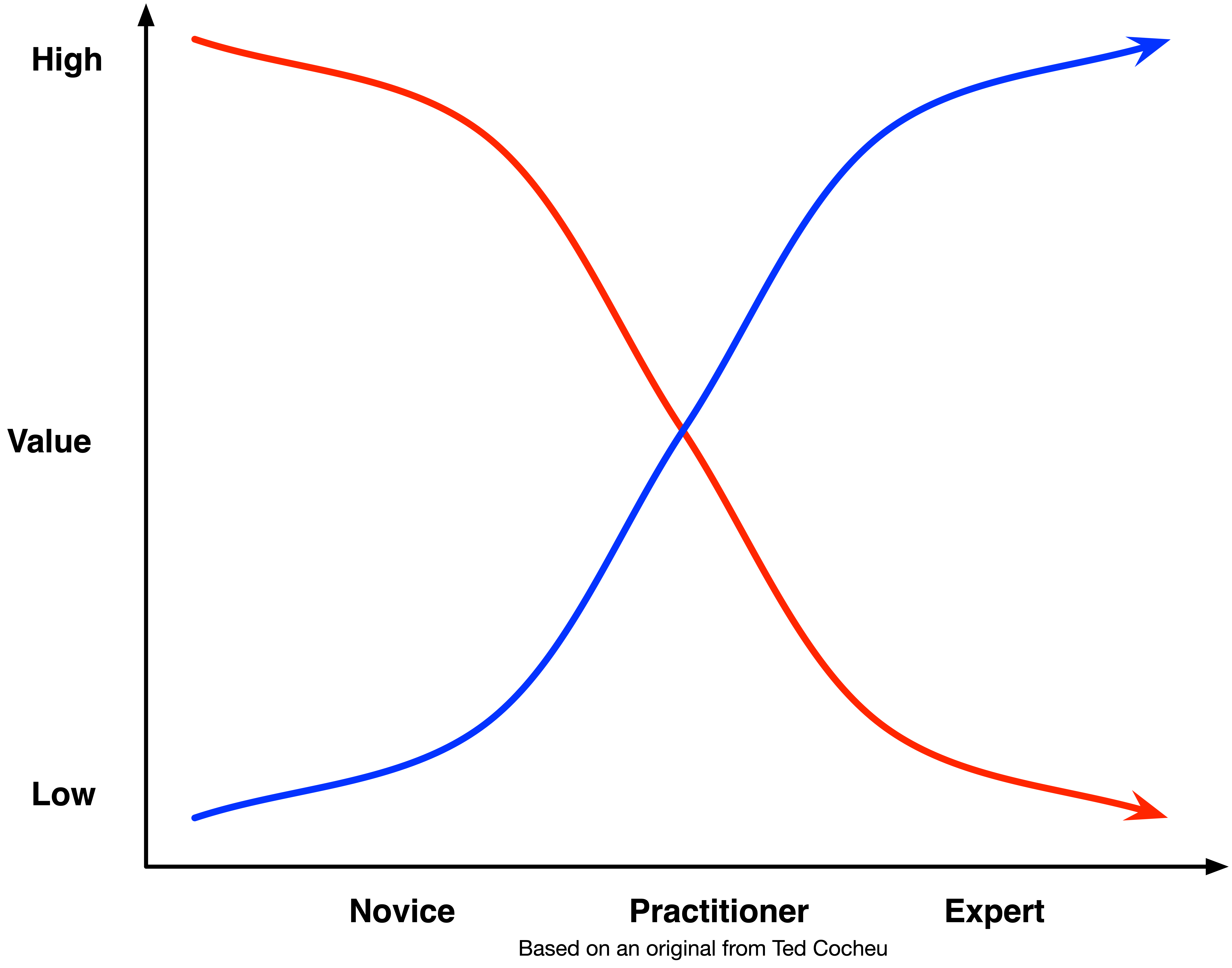
Jane Hart has just come up with something new and, to me, intriguing. Ok, so she’s a colleague from the Internet Time Alliance, and I’ve been a fan of her work for a while, but I think this is particularly good.  If you’ve read here before, you’ll know I love a good model (Harold Jarche’s Seek>Sense>Share comes to mind). So when I parsed her “from training to modern workplace learning”, it resonated in many ways.  So here’s her framework with some comments.

First, some context. If you’ve known my work at all, you know that I’ve been pushing a L&D revolution. And that’s about rethinking training to be about transformative experience design, performance support to be included, and informal learning to be also addressed. That’s  intellectricity! And it’s sometimes hard to tie them together coherently.

Jane’s always had a talent for drilling down into the practicalities in sensible ways. Her books, continually updated, have great specifics about things to do. This is a framework that ties it together nicely.

The thing I like is the way she’s characterized different activities. The categories of Discovery (informal learning), Discourse (social learning), and Doing (experiential learning) provides a nice handle around which to talk about elements, roles, and tasks. And, importantly, prescriptions.  And I really like the ‘meta’ layer, where she suggests skills for each vertical.

I’m not without quibbles, however small. For instance, with her use of microlearning, because of my concerns about the label rather than her specific intention. She told me personally that she means “short daily learning”, and I think that’s great. I just think of that as spaced learning ;). And I might label ‘discovery’ to be ‘develop’, because it’s about the individual’s continual learning. And I’m not sure there’s what I call ‘slow’ innovation there, creating a culture and practices about experimentation and exposure to the ‘adjacent possible’. But it’s hard for one diagram to capture everything, and this does a great job.

I admit that I haven’t parsed all the nuances yet. But as an advocate of diagrams  and frameworks, I think this is truly insightful  and  useful. (And she’s updated it so I’ve grabbed this copy which appears to have lost microlearning.)   I’m sure she, as well as I, welcome your thoughts!

Social Silliness

28 May 2019 by Clark 1 Comment

It’s that time again. Someone pointed me to a post that touted the benefits of social learning. And I’m a fan!  However, as I perused it, I saw that was a bit of social silliness. So, let me be clear about why.

It starts off mostly on the right foot, saying “playing off of the theory that people learn better when they learn collectively…” I’m a proponent of that theory. There are times when that’s not the most effective nor efficient approach, but there are times when it’s really valuable.

What follows in the article are a series of five tips about applying social learning. And here we go off the rails!  Let’s go through them:

  1. A Facebook Group Or A Forum, or both.  Well, yes, a group is a good idea. But Facebook is  not! Expecting everyone to have to be open to being on Facebook isn’t a good policy. While I’m on Facebook (and no, don’t connect to me there, that’s for personal relationships, not professional ones; go see me on LinkedIn ;), I know folks who aren’t and won’t be. Create your own group in your own tool, so folks know what’s being done with their data!
  2. Leaderboards. What? NOOOO!  That’s so  extrinsic  ;). Seriously, that’s the second most important tip?  Er, not. If you’re not making sure folks are finding intrinsic value in the community, go back and fix it. People (should) come because it’s worth it. Work to make it so. That’s hard, but in the end if you want to build community, start modeling and encouraging sharing, and make it safe.  Don’t do it on points.
  3. Surveys or polls. Ok, let’s put this in context. Yes, getting people to participate and collecting their opinions is good. Is this the third most important tip? No, but no points lost for this suggestion. However, let’s do it right. You can really decrease participation when you’re allowing ‘drive-by’ surveys. Have a policy, be clear, and do it  when it makes sense. This would be a subset of a more general principle about stimulating and leveraging the community, I reckon.
  4. Interactions between the L&D  Team and Employees.  This requires nuance. Not just any interactions. In a sense, L&D should be invisible, the hidden hand that keeps things moving. Facilitating, yes, where someone needs a nudge to contribute, someone else needs a nudge to  not contribute (in that way, or that often, or…), some statement needs some nuance, etc. But ultimately, the community should be interacting with each other, not L&D.
  5. elearning Courses that Require Teamwork. Back to my point above, yes,  sometimes. This is a good idea. And it can build the community skills that will carry over. You want a smooth segue from courses to community. The suggestion included, however, “only that employee can access that particular phase or section” is a lot of extra design. Why not just group assignments with facilitation to participate? It’s not a horrible idea, but not a general one.

Overall, this is nowhere near the first five tips  I would suggest about building community. I agree community’s big, but I’d be pushing:

Start small: get it working somewhere (particularly within L&D), then spread slowly to other groups.

Make it safe: ensure that there’re principles in place about what’s acceptable behavior, and that the relevant leader is sharing. If they don’t, will anyone really believe it’s safe?

Ensure value: make sure that people coming to the community will find reasons to return. To get it to critical mass, you need to nurture it. Start by seeding valuable information over time, and inviting (or incepting) some respected folk to contribute. And the surveys and polls are ways to find out what’s going on and reflect that back.  It takes effort to kick start it, but it’s critical to get people to stay engaged. As part of this:

Enable sharing: the ‘show your work‘ mentality should be encouraged. Get people showing what they’re doing (once it’s safe) enables long term benefits. This will start providing valuable content, and support the organization beginning to learn together.

Persist: success will depend on maintaining the support until the community reaches critical mass. That means a continual effort to make value, surface value until the community is doing this itself.

I’m not saying this is my official list, this is off the top of my head. However, when I look at these two lists, the problem for me is that the top list is tactical, but creating community is really a strategic initiative. Which means, it needs to be treated as such. No social silliness, it needs to be seriously addressed. So, what am I missing?

Quinnovations

16 April 2019 by Clark Leave a Comment

I was talking with my lass, and reminiscing about a few things. And, it occurs to me, that I may not have mentioned them all. Worse, I confess, I’m still somewhat proud of them. So, at the risk of self-aggrandizement, I thought I’d share a few of my Quinnovations. There’s a bigger list here, but this is the ‘greatest hits’ list, with some annotation. (Note, I’ve already discussed the game Quest for Independence, one of my most rewarding works.)

One project was a game based upon my PhD topic. I proposed a series of steps involved in analogical reasoning, and tested them both alone and then after some training. I found some improvement (arguing for the value of meta-learning instruction). During my post-doc, a side project was developing a game that embedded analogical reasoning in a story setting. I created a (non-existent) island, and set the story in the myths of the voodoo culture on it. The goal was a research environment for analogical reasoning; the puzzles in the game required making inferences from the culture. Most players were random, interestingly, at a test, but a couple were systematic.

With a colleague, Anne Forster, we came up with an idea for an online conference to preface a face-to-face event. This was back circa 1996, so there weren’t platforms for such. I secured the programming assistance of a couple of the techs in the office I was working for (Open Net), and we developed the environment. In it, six folks reknown in their area conducted overlapping conversations around their topic. This set up the event, and saw vibrant discussions.

A colleague at an organization I was working for, Access Australia CMC, had come up with the idea of competition for school kids to create websites about a topic. With another colleague, we brainstormed a topic for the first running of the event. In it, we had kids report on innovations in their towns that they could share with other towns (anywhere). I led the design and implementation of the competition: site and announcements, getting it up and running. It ended up generating vibrant participation and winning awards.

Upon my return to the US, I led a team to generate a learning system that developed learners’ understanding of themselves as learners. Ultimately, I conceived of a model whereby we profiled learners as to their learning characteristics (NB:  not learning styles) and adapted learning on that basis. There was a lot to it: a content model, rules for adaptation, machine learning for continuing improvement, and more. We got it up and running, and while it evaporated in 2001 (as did the organization we worked for), it’s legacy served me in several other projects. (And, while they didn’t base it on our system, to my knowledge, it’s roughly the same architecture being seen in Newton.)

Using the concept of that adaptive system, with one of my clients we pitched and won the right to develop an electronic performance support system. It ended up being a context-sensitive help system (which is what an EPSS really is ;).  I created the initial framework which the team executed against (replacing a help system created by the system engineers, not the right team to do it). The design wrote content into a framework that populated the manual (as prescribed by law)  and the help system. The client ended up getting a patent on it (with my name on too ;).

Last one I’ll mention for now, a content system for a publisher. They were going to the next generation of their online tool, and were looking for a framework to: incorporate their existing texts, guide the next generation of texts, and support multiple business models. Again pulling on that content structure experience, I gave them a structured content model that met their needs. The model was supposed to be coupled with a tech platform, and that project collapsed, meaning my model didn’t see the light of day. However, I was pleased to find out subsequently that it had a lasting impact on their subsequent works!

The point being that, in conjunction with clients and partners, I have been consistently generating innovations thru the years. I’m not an academic, tho’ I have been and know the research and theories. Instead, I’m a consultant who comes in early, applies the frameworks to come up with ideas that are both good and unique (I capitalize a lot on models I’ve collected over the years), and gets out quickly when I’m no longer adding value. Clients get an outcome that is uniquely appropriate, innovative, and effective. Ideas they likely wouldn’t have come up with on their own!  If you’d like to Quinnovate, get in touch!

Learning from Experimentation

5 February 2019 by Clark 3 Comments

At the recent LearnTec conference, I was on a panel with my ITA colleagues, Jane Hart, Harold Jarche, and Charles Jennings. We were talking about how to lift the game of Modern Workplace Learning, and each had staked out a position, from human performance consulting to social/informal. Mine (of course :) was at the far end, innovation.  Jane talked about how you had to walk the walk: working out loud, personal learning, coaching, etc.  It triggered a thought for me about innovating, and that meant experimentation. And it also occurred to me that it led to learning as well, and drove you to find new content. Of course I diagrammed the relationship in a quick sketch. I’ve re-rendered it here to talk about how learning from experimentation is also a critical component of workplace learning.

Increasing experimentation and even more learnings based upon contentThe starting point is experimentation.  I put in ‘now’, because that’s of course when you start. Experimentation means deciding to try new things, but not just  any things.  They should be things that would have a likelihood of improving outcomes if they work. The goal is ‘smart’ experiments, ones that are appropriate for the audience, build upon existing work, and are buttressed by principle. They may or may not be things that have worked elsewhere, but if so, they should have good outcomes (or, more unlikely, didn’t but have a environmentally-sound reason to work for you).

Failure  has to be ok.  Some experiments should not work. In fact, a failure rate above zero is important, perhaps as much as 60%!  If you can’t fail, you’re not really experimenting, and the psychological safety isn’t there along with the accountability.  You learn from failures as well as from successes, so it’s important to expect them. In fact, celebrate the lesson learned, regardless of success!

The reflections from this experimentation take some thought as well. You should have designed the experiments to answer a question, and the experimental design should have been appropriate (an A-B study, or comparing to baseline, or…).  Thus, the lesson extracted from learning from experimentation is quickly discerned. You also need to have time to extract the lesson! The learnings here move the organization forward. Experimentation is the bedrock of a learning organization,  if you consolidate the learnings. One of the key elements of Jane’s point, and others, was that you need to develop this practice of experimentation for your team. Then, when understood and underway, you can start expanding. First with willing (ideally, eager) partners, and then more broadly.

Not wanting to minimize, nor overly emphasize, the role of ‘content’, I put it in as well. The point is that in doing the experimentation, you’re likely to be driven to do some research. It could be papers, articles, blog posts, videos, podcasts, webinars, what have you. Your circumstances and interests and… who knows, maybe even courses!  It includes social interactions as well. The point is that it’s part of the learning.

What’s  not in the diagram, but is important, is sharing the learnings. First, of course, is sharing within the organization. You may have a community of practice or a mailing list that is appropriate.  That builds the culture. After that, there’s beyond the org.  If they’re proprietary, naturally you can’t. However, consider sharing an anonymized version in a local chapter meeting and/or if it’s significant enough or you get good enough feedback, go out to the field. Present at a conference, for instance!

Experimentation is critical to innovation. And innovation takes a learning organization. This includes a culture where mistakes are expected, there’s time for reflection, practices for experimentation are developed, and more.  Yet the benefits to create an agile organization are essential.  Experimentation needs to be part of your toolkit.  So get to it!


« Previous Page
Next Page »

Clark Quinn

The Company

Search

Feedblitz (email) signup

Never miss a post
Your email address:*
Please wait...
Please enter all required fields Click to hide
Correct invalid entries Click to hide

Pages

  • About Learnlets and Quinnovation

The Serious eLearning Manifesto

Manifesto badge

Categories

  • design
  • games
  • meta-learning
  • mindmap
  • mobile
  • social
  • strategy
  • technology
  • Uncategorized
  • virtual worlds

License

Previous Posts

  • April 2026
  • March 2026
  • February 2026
  • January 2026
  • December 2025
  • November 2025
  • October 2025
  • September 2025
  • August 2025
  • July 2025
  • June 2025
  • May 2025
  • April 2025
  • March 2025
  • February 2025
  • January 2025
  • December 2024
  • November 2024
  • October 2024
  • September 2024
  • August 2024
  • July 2024
  • June 2024
  • May 2024
  • April 2024
  • March 2024
  • February 2024
  • January 2024
  • December 2023
  • November 2023
  • October 2023
  • September 2023
  • August 2023
  • July 2023
  • June 2023
  • May 2023
  • April 2023
  • March 2023
  • February 2023
  • January 2023
  • December 2022
  • November 2022
  • October 2022
  • September 2022
  • August 2022
  • July 2022
  • June 2022
  • May 2022
  • April 2022
  • March 2022
  • February 2022
  • January 2022
  • December 2021
  • November 2021
  • October 2021
  • September 2021
  • August 2021
  • July 2021
  • June 2021
  • May 2021
  • April 2021
  • March 2021
  • February 2021
  • January 2021
  • December 2020
  • November 2020
  • October 2020
  • September 2020
  • August 2020
  • July 2020
  • June 2020
  • May 2020
  • April 2020
  • March 2020
  • February 2020
  • January 2020
  • December 2019
  • November 2019
  • October 2019
  • September 2019
  • August 2019
  • July 2019
  • June 2019
  • May 2019
  • April 2019
  • March 2019
  • February 2019
  • January 2019
  • December 2018
  • November 2018
  • October 2018
  • September 2018
  • August 2018
  • July 2018
  • June 2018
  • May 2018
  • April 2018
  • March 2018
  • February 2018
  • January 2018
  • December 2017
  • November 2017
  • October 2017
  • September 2017
  • August 2017
  • July 2017
  • June 2017
  • May 2017
  • April 2017
  • March 2017
  • February 2017
  • January 2017
  • December 2016
  • November 2016
  • October 2016
  • September 2016
  • August 2016
  • July 2016
  • June 2016
  • May 2016
  • April 2016
  • March 2016
  • February 2016
  • January 2016
  • December 2015
  • November 2015
  • October 2015
  • September 2015
  • August 2015
  • July 2015
  • June 2015
  • May 2015
  • April 2015
  • March 2015
  • February 2015
  • January 2015
  • December 2014
  • November 2014
  • October 2014
  • September 2014
  • August 2014
  • July 2014
  • June 2014
  • May 2014
  • April 2014
  • March 2014
  • February 2014
  • January 2014
  • December 2013
  • November 2013
  • October 2013
  • September 2013
  • August 2013
  • July 2013
  • June 2013
  • May 2013
  • April 2013
  • March 2013
  • February 2013
  • January 2013
  • December 2012
  • November 2012
  • October 2012
  • September 2012
  • August 2012
  • July 2012
  • June 2012
  • May 2012
  • April 2012
  • March 2012
  • February 2012
  • January 2012
  • December 2011
  • November 2011
  • October 2011
  • September 2011
  • August 2011
  • July 2011
  • June 2011
  • May 2011
  • April 2011
  • March 2011
  • February 2011
  • January 2011
  • December 2010
  • November 2010
  • October 2010
  • September 2010
  • August 2010
  • July 2010
  • June 2010
  • May 2010
  • April 2010
  • March 2010
  • February 2010
  • January 2010
  • December 2009
  • November 2009
  • October 2009
  • September 2009
  • August 2009
  • July 2009
  • June 2009
  • May 2009
  • April 2009
  • March 2009
  • February 2009
  • January 2009
  • December 2008
  • November 2008
  • October 2008
  • September 2008
  • August 2008
  • July 2008
  • June 2008
  • May 2008
  • April 2008
  • March 2008
  • February 2008
  • January 2008
  • December 2007
  • November 2007
  • October 2007
  • September 2007
  • August 2007
  • July 2007
  • June 2007
  • May 2007
  • April 2007
  • March 2007
  • February 2007
  • January 2007
  • December 2006
  • November 2006
  • October 2006
  • September 2006
  • August 2006
  • July 2006
  • June 2006
  • May 2006
  • April 2006
  • March 2006
  • February 2006
  • January 2006

Amazon Affiliate

Required to announce that, as an Amazon Associate, I earn from qualifying purchases. Mostly book links. Full disclosure.

We use cookies to ensure that we give you the best experience on our website. If you continue to use this site we will assume that you are happy with it.