Learnlets

Secondary

Clark Quinn’s Learnings about Learning

Search Results for: align

Culture Before Strategy

9 September 2015 by Clark Leave a Comment

In an insightful article, Ken Majer (full disclosure, a boss of mine many years ago) has written about the need to have the right culture before executing strategy.  And this strikes me as a valuable contribution to thinking about effective change in the transformation of L&D in the Revolution.

I have argued that you can get some benefits from the Revolution without having an optimized culture, but you’re not going to tap into the full potential. Revising formal learning to be truly effective by aligning to how we learn, adding in performance support in ways that augment our cognitive limitations, etc, are all going to offer useful outcomes. I think the optimal execution stuff will benefit, but  the ability to truly tap into the network for the continual innovation requires making it safe and meaningful to share. If it’s not safe to Show Your Work, you can’t capitalize on the benefits.

What Ken is talking about here is ensuring you have values and culture in alignment with the vision and mission.  And I’ll go further and say that in the long term, those values have to be about valuing people and the culture has to be about working and learning together effectively.  I think that’s the ultimate goal when you really want to succeed:  we know that people perform best when given meaningful work and are empowered to pursue it.

It’s not easy, for sure.  You need to get explicit about your values and how those manifest in how you work. You’ll likely find that some of the implicit values are a barrier, and they’ll require conscious work to address. The change in approach on the part of management and executives and the organizational restructuring that can accompany this new way of working isn’t going to happen overnight, and change is hard.  But  it is increasingly, and will  be, a business necessity.

So too for the move to a new L&D. You can start working in these ways within your organization, and grow it.  And you should. It’s part of the path, the roadmap, to the revolution.  I’m working on more bits of it, trying to pull it together more concretely, but it’s clear to me that one thread (and as already indicated in the diagrams that accompany the book) is indeed a path to a more enabling culture. In the long term, it will be uplifting, and it’s worth getting started on now.

Designing mLearning in Korean

3 September 2015 by Clark 1 Comment

It actually happened a while ago, but I was pleased to learn that  Designing mLearning  has been translated into Korean.  That’s kind of a nice thing to have happen!  A slightly different visual treatment, presumably    appropriate to the market. Who knows,  maybe I’ll get a chance to visit instead of just transferring through the airport.  Anyways, just had to share ;).

DesigningmLearningKorean

Modelling

2 September 2015 by Clark 1 Comment

So, I found an interesting inconsistency.  I had to submit my deck for my DevLearn workshop on Cognitive Science for Learning Design last week, but oddly, for every thing I was recommending I had a diagram, except for the notion of using models.  This is ironic, since diagrams can  be used to convey  models.  It bugged me, so I pondered.

And then I remembered that I gave a presentation years ago specifically on diagrams.  Moreover, in that presentation I had a diagram for a process for creating a diagram (Department of Redundancy Department).  So, I finally got around to trying to apply my own process to my lack of a model.  And voilà:

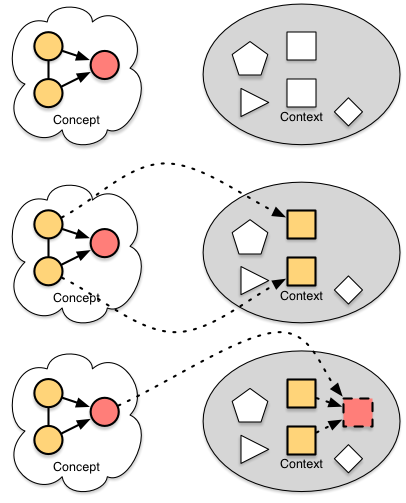
ModelReasoningThe process is to identify the elements, and the relationships, and then additional dimensions.  Then you  represent each, place them (elements first, relationships second, dimensions last), and tune.
Here the notion is that you have a mental model of a concept, capturing elements and causal relationships.  When you see a situation, you select a model where you can map the elements in the model to elements in the context.  Then you can use the model to predict what will happen or explain what happened. Which gives you a basis for making decisions, and adapting decisions to different contexts in principled ways.

Models  are a powerful concept I’ve harped on before, but now I’ve an associated diagram.  And I  like diagrams. I find mapping the conceptual dimensions to spatial dimensions both helps me get concrete about the models and then gives a framework to share with others.  Does this make sense to you, both the concept behind it, and the diagram to represent it?

I’ll be presenting this in the workshop, amongst many other implications from how our brains work (and learn) to the design of learning experiences.  Would love to see you there.

Community of improvement?

1 September 2015 by Clark 1 Comment

In a conversation I had recently, specifically about a community focused on research, I used the term ‘community of improvement’, and was asked how that was different than a community of practice. It caused me to think through what the differences might be.  (BTW, the idea was sparked by conversations with Lucian Tarnowski from BraveNew.)

First, let me say that a community of practice  could be, and should be, a community of improvement. One of the principles of practice is reflection and improvement.  But that’s not necessarily the case.  A community of practice could just be a place where people answer each other’s questions, collaborate on tasks, and help one another with issues  not specifically aligned with the community.  But there should be more.

What I suggested in the conversation was that a  community  should  also be about documenting practice,  applying that practice through action or design research, and reflecting on the outcomes and the implications for practice.  The community should be looking to other fields for inspiration, and attempting experiments. It’s the community equivalent of Schön’s reflective practitioner.  And it’s  more than just cooperation  or collaboration, but actively engaging and working to improve.

Basically, this requires collaboration tools, not just communication tools. It requires: places to share thoughts; ways to find partners  on the documentation, experimentation, and reflection; and support to track and share the resulting changes on community practices.

Yes, obviously a real community of practice should be doing this, but too often I see community tools without the collaboration tools. So I think it’s worth being explicit about what we would hope will accompany the outcomes.  So, where do we do this, and how?

#itashare

Concrete and Contextual

19 August 2015 by Clark 3 Comments

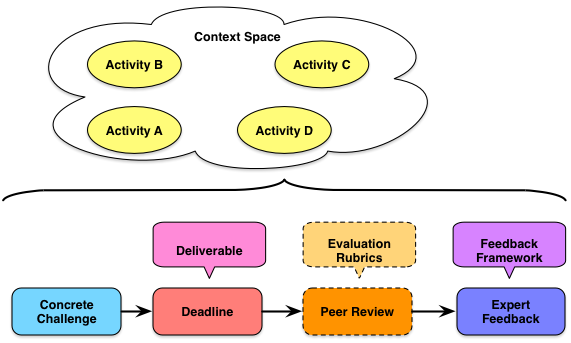
I’m working on the learning science workshop I’m going to present at DevLearn  next month, and in thinking about how to represent the implications of designing to account for how we work better when the learning context is concrete and sufficient contexts are used, I came up with this, which I wanted to share.

Concrete deliverables and multiple contextsThe empirical data is that we learn better when our learning practice is contextualized.  And if we want transfer, we should have practice in a spread of contexts that will facilitate abstraction and application to all appropriate settings, not just the ones seen in the learning experience.  If the space between our learning applications is too narrow, so too will our transfer be. So our activities need to be spread about in a variety of contexts (and we should be having sufficient practice).

Then, for each activity, we should have a concrete outcome we’re looking for. Ideally, the learner is given a concrete deliverable as an outcome that they must produce (that mimics the type of outcome we’re expecting them to be able to create as an outcome of the learning, whether decision, work product, or..).  Ideally we’re in a social situation and they’re working as a team (or not) and the work can be circulated for peer review.  Regardless, then there should be expert oversight on feedback.

With a focus on sufficient and meaningful practice, we’re more likely to design learning that will actually have an impact.  The goal  is to have practice that is aligned with how our learning works (my current theme: aligning with how we think, work, and learn). Make sense?

The New Business Imperative

28 July 2015 by Clark 7 Comments

Learning  is  the  new business imperative.  It is now an indisputable business reality: companies must become more nimble and agile. As things move faster, new processes arise, and the time to copy a new business approach drops, it becomes clear that continual innovation is the only way to not just survive, but thrive.  And this doesn’t, can’t, come from the status quo.

And if the answer isn’t known, as is inherent in situations like problem-solving, trouble-shooting, new product/service creation, and more, then this, too, is a form of  learning. But not the type addressed by training rooms or eLearning courses. They serve a role, but not this new one, this needed approach,  We need something new.

What we need are two things: effective collaboration and meta-learning. Innovation comes, we know, from collaboration.  Collaboration is the new  learning, where we bring complementary strengths to bear on a problem in a process structured to be optimally aligned with how our brains work.  And we need to create a culture and set of skills around continually  learning, which means understanding  learning  to learn, aka meta-learning.

Accelerating the development of these capabilities means doing things different and new. It means sowing the seeds by instigating a  learning  process that develops not only some specific needed capabilities, but also the meta-learning  and collaboration skills.  It means understanding, valuing, and explicitly developing the ability of people to learn alone and together. It means making it safe to share, to ‘work out loud’. And finally it means scaling up from small success to organizational transformation.

This is a doable, albeit challenging move, but it is critical to organizations that will excel.  Learning  is no longer a ‘nice to have’, or even an imperative, it is the only sustainable differentiator.  The question is: are you ready?  Are you making the new  learning  a strategic priority?

A Nurturing Culture #blimage

23 July 2015 by Clark 2 Comments

My colleague Jane Hart dobbed me (and several other colleagues) in for the #blimage challenge.  I usually resent when someone publicly asks me  to do something, but fortunately this is easy and, well, it is Jane ;).  She presented the following image and our task is to blog about it:

So my take is how things grow in  a nurturing environment.  Here plants are flourishing under the energy of the sun.  This to me is a metaphor for the benefits of creating a culture in which learning can flourish.  I’ve earlier detailed what the research says about the elements of a learning organization, and it’s clear that you  need a culture with several elements.

First, learning  independently has to be enabled. The resources to learn need to be there, as does the time for learning. Further, the ability to learn on one’s own shouldn’t be taken for granted; identify, model, evangelize, and develop these abilities.

In addition, learning is social.  The possibilities to learn together need to be facilitated.  There need to be ways to find individuals with complementary skills to learn together. This in particular means collaboration: learning while innovating on solving new problems, devising new solutions, and more.  It also means being willing to share. It has to be safe to ‘show your work’!  Again, don’t assume skills for learning together, but scaffold the development of these abilities.

It is really important that  leadership reinforces learning, both by supporting and more importantly by practicing visibly! There’s evidence that when leadership doesn’t share, others won’t truly believe it’s valued.

So there’s my blog on the image.  Two colleagues also were challenged with this image and have  replied; you can see what they came up with:

Jane Bozarth

Charles Jennings

Rather than dob in anyone in particular, I will simply recommend that you take  your own  stab, and here’s a proposed image:

Maze

I hope to hear what you come up with; drop a link in the comments if you do!


Locus of the Revolution?

15 July 2015 by Clark 1 Comment

If we’re talking about beginning to use IT in alignment with how we think, work, and learn, a question arises about who should be in the lead?  It could be HR, it could be L&D, it could be IT, or it could even be the business units that are taking advantage of the opportunity.  What makes sense?

In one sense, it’s about using IT well, and that theoretically is IT’s job.  They’re supposed to provide an infrastructure that supports the business. They typically have not only the back end engineers, but the front end designers for any custom applications, and should be evaluating any off-the-shelf solution for viability as well.  Of course, this typically isn’t the case, as an eminent IT guru opined to me that IT doesn’t understand people.  In general, IT folks are highly selected to be able to do things most people can’t, and they’re not necessarily valuable when they can think like other people.

Well, then, maybe it’s HR; the whole talent development perspective should include considering the tools to hand.  Unfortunately, HR isn’t particularly astute about people nor technology. They are more about administration and control than about empowerment and success.  The HR policies we  tend to see are almost  antithetical to the culture that most promotes innovation.

It could also be the business units themselves; they  are being seen to create solutions to self-learning and collaboration rather than wait for them to emerge from other environments.  And they certainly (should) understand their own needs.  Unfortunately, they’re not likely to really understand people  or IT either.  Too often they don’t realize what is effective.

Let’s be clear, there are successes in all the categories above, but they’re typically more from an astute leader rather than a systematic organizational strategy.  And that’s not a repeatable approach. We need better.

Ideally, L&D  should own it.  They (should) understand people, and be able to work with IT in a product relationship to develop a full performance ecosystem that integrates learning, performance support, and social into a coherent whole.  Where the environment is optimized for an organization to not just survive, but thrive. This comes from the people, but it requires knowing how to help people perform and deliver.

It requires new skill sets for sure, including working with IT, culture and change, facilitating innovation, performance consulting, and more (organizations like ATD & LPI are updating their competency definitions in these directions).  It requires getting strategic about metrics, impact, and business goals.  The vision of L&D being the critical core to organizational success through delivery of optimal execution and facilitation of continual innovation is what the Revolution is trying to achieve. This is a chance for L&D to move from the periphery to the center.  It’s worthwhile, but there isn’t infinite time; organizations need solutions, and they’ll get them wherever anyone can seize the opportunity to make a productive improvement. L&D has the opportunity, and here’s to hoping they don’t squander it.

Being Deliberate

14 July 2015 by Clark Leave a Comment

This past week, I took off a few days to get into the wilderness with some colleagues.  Five of us got dirty, smelly, and sweaty while hiking in the backcountry.  These are smart, successful, interesting, and funny folks, so the conversation was not PCâ„¢, but wise and witty.  And, of course, we got to places like this.1of10LakesSmall  But, in addition to beauty and wisdom, there was a lesson for me, too.

The first day out in the wilderness, the sky was threatening, and close to dinner time  it suddenly turned worse. I was rushing to finish pumping water, couldn’t find the bag for the outflow (to keep it separate from the inflow) and didn’t quite make it back to the tent before the skies opened up.  I got a bit damp, and worse when the zipper on the fly wouldn’t close. Every time I reached out to try again, I’d get even more drenched. The worry, of course, is that you get your down sleeping bag wet, and it will lose all insulation capability!

Well, the bag stayed dry, and the next morning  we dried everything out, and were fine for the rest of the trip.  The interesting opportunity for me, however, was how I proceeded from then on.

The next time I had to pump water, I took my time.  I very deliberately found a good place to sit, and took special care to work with setting up the inflow and then the outflow.  I did so similarly with firing up the stove and boiling water for dinner and breakfast. There was a pleasure in taking time to do it carefully and right.  Now, there are certain things I naturally do the deliberate  way, and other things I rush through.   My realization is that there’s value in thinking more carefully about which things to do deliberately, and there’s an inherent pleasure in doing the things right that matter to you.

There are the  arguments that the internet is making us stupider, and value in doing things the hard way. I think that the important thing is to choose for yourself  which things to ‘outsource’ or do just good enough, and those which to  take on and do a personally good job on.  For example, I used to work on my cars myself (I could rebuild a carburetor, gap a distributor, etc; skills that are irrelevant now :), but as things have changed it’s not a worthwhile role for me anymore.  So the lesson for me was to pay more attention to which things I’m doing carefully and which I will choose to decide quick enough is good enough (and which to have others or apps do).


The Learning Styles Zombie

23 June 2015 by Clark 5 Comments

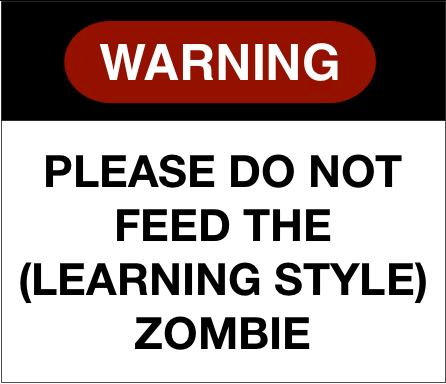
It’s June, and June is Learning Styles month for the Debunker’s Club.  Now, I’ve gone off on Learning Styles before (here, here, here, and here), but  it’s been a while, and they refuse to die. They’re like zombies, coming to eat your brain!

Let’s be clear, it’s patently obvious learners differ.  They differ in how they work, what they pay attention to, how they like to interact, and more. Surely, it make sense to adapt the learning to their style, so that we’re optimizing their outcome, right?

Er, no.  There is no consistent  evidence that adapting to learning styles works.  Hal Pashler and colleagues, on a study commissioned by Science in the Public Interest (read: a non-partisan, unbiased, truly independent work) found  (PDF) that there was no evidence that adapting to learning styles worked. They did a meta-analysis of the research out there, and concluded this with statistical rigor.  That is, some studies showed positive effects, and some showed negative, but across the body of studies suitably rigorous to be worth evaluating, there was no evidence that trying to adapt learning to learner characteristics had a  definitive impact.

At least part of the problem is that  the instruments people use to characterize learning styles are flawed.  Surely, if learners differ, we can identify how?  Not with psychometric validity (that means tests that stand up to statistical analysis). A commissioned study in the UK (like the one above, independent, etc) led by Coffield evaluated a representative sample of instruments (including the ubiquitous MBTI, Kolb, and more), and found  (PDF) only one that met all four standards of psychometric validity. And that one was a simple one of one dimensions.

So, what’s a learning designer to do?  Several things: first, design for what is being learned. Use the best learning design to accomplish the goal. Then, if the learner has trouble with that approach, provide help.  Second, do use a variety of ways of supporting comprehension.  The variety is good, even if the evidence to do so based upon learning style isn’t.  (So, for example, 4MAT isn’t bad, it’s just not based upon sound science, and why you’d want to pay to use a heuristic approach when you can do that for free is beyond me.)

Learners do differ, and we want them to succeed. The best way to do that is good learning experience design. We do have evidence that problem-based and emotionally aware learning design helps.  We know we need to start with meaningful objectives, create deep practice, ground in good models, and support with rich examples, while addressing motivation, confidence, and anxiety.  And using different media maintains attention and increases the likelihood of comprehension.  Do good learning design, and please don’t feed the zombie.

DoNotFeedLSZombie

« Previous Page
Next Page »

Clark Quinn

The Company

Search

Feedblitz (email) signup

Never miss a post
Your email address:*
Please wait...
Please enter all required fields Click to hide
Correct invalid entries Click to hide

Pages

  • About Learnlets and Quinnovation

The Serious eLearning Manifesto

Manifesto badge

Categories

  • design
  • games
  • meta-learning
  • mindmap
  • mobile
  • social
  • strategy
  • technology
  • Uncategorized
  • virtual worlds

License

Previous Posts

  • March 2026
  • February 2026
  • January 2026
  • December 2025
  • November 2025
  • October 2025
  • September 2025
  • August 2025
  • July 2025
  • June 2025
  • May 2025
  • April 2025
  • March 2025
  • February 2025
  • January 2025
  • December 2024
  • November 2024
  • October 2024
  • September 2024
  • August 2024
  • July 2024
  • June 2024
  • May 2024
  • April 2024
  • March 2024
  • February 2024
  • January 2024
  • December 2023
  • November 2023
  • October 2023
  • September 2023
  • August 2023
  • July 2023
  • June 2023
  • May 2023
  • April 2023
  • March 2023
  • February 2023
  • January 2023
  • December 2022
  • November 2022
  • October 2022
  • September 2022
  • August 2022
  • July 2022
  • June 2022
  • May 2022
  • April 2022
  • March 2022
  • February 2022
  • January 2022
  • December 2021
  • November 2021
  • October 2021
  • September 2021
  • August 2021
  • July 2021
  • June 2021
  • May 2021
  • April 2021
  • March 2021
  • February 2021
  • January 2021
  • December 2020
  • November 2020
  • October 2020
  • September 2020
  • August 2020
  • July 2020
  • June 2020
  • May 2020
  • April 2020
  • March 2020
  • February 2020
  • January 2020
  • December 2019
  • November 2019
  • October 2019
  • September 2019
  • August 2019
  • July 2019
  • June 2019
  • May 2019
  • April 2019
  • March 2019
  • February 2019
  • January 2019
  • December 2018
  • November 2018
  • October 2018
  • September 2018
  • August 2018
  • July 2018
  • June 2018
  • May 2018
  • April 2018
  • March 2018
  • February 2018
  • January 2018
  • December 2017
  • November 2017
  • October 2017
  • September 2017
  • August 2017
  • July 2017
  • June 2017
  • May 2017
  • April 2017
  • March 2017
  • February 2017
  • January 2017
  • December 2016
  • November 2016
  • October 2016
  • September 2016
  • August 2016
  • July 2016
  • June 2016
  • May 2016
  • April 2016
  • March 2016
  • February 2016
  • January 2016
  • December 2015
  • November 2015
  • October 2015
  • September 2015
  • August 2015
  • July 2015
  • June 2015
  • May 2015
  • April 2015
  • March 2015
  • February 2015
  • January 2015
  • December 2014
  • November 2014
  • October 2014
  • September 2014
  • August 2014
  • July 2014
  • June 2014
  • May 2014
  • April 2014
  • March 2014
  • February 2014
  • January 2014
  • December 2013
  • November 2013
  • October 2013
  • September 2013
  • August 2013
  • July 2013
  • June 2013
  • May 2013
  • April 2013
  • March 2013
  • February 2013
  • January 2013
  • December 2012
  • November 2012
  • October 2012
  • September 2012
  • August 2012
  • July 2012
  • June 2012
  • May 2012
  • April 2012
  • March 2012
  • February 2012
  • January 2012
  • December 2011
  • November 2011
  • October 2011
  • September 2011
  • August 2011
  • July 2011
  • June 2011
  • May 2011
  • April 2011
  • March 2011
  • February 2011
  • January 2011
  • December 2010
  • November 2010
  • October 2010
  • September 2010
  • August 2010
  • July 2010
  • June 2010
  • May 2010
  • April 2010
  • March 2010
  • February 2010
  • January 2010
  • December 2009
  • November 2009
  • October 2009
  • September 2009
  • August 2009
  • July 2009
  • June 2009
  • May 2009
  • April 2009
  • March 2009
  • February 2009
  • January 2009
  • December 2008
  • November 2008
  • October 2008
  • September 2008
  • August 2008
  • July 2008
  • June 2008
  • May 2008
  • April 2008
  • March 2008
  • February 2008
  • January 2008
  • December 2007
  • November 2007
  • October 2007
  • September 2007
  • August 2007
  • July 2007
  • June 2007
  • May 2007
  • April 2007
  • March 2007
  • February 2007
  • January 2007
  • December 2006
  • November 2006
  • October 2006
  • September 2006
  • August 2006
  • July 2006
  • June 2006
  • May 2006
  • April 2006
  • March 2006
  • February 2006
  • January 2006

Amazon Affiliate

Required to announce that, as an Amazon Associate, I earn from qualifying purchases. Mostly book links. Full disclosure.

We use cookies to ensure that we give you the best experience on our website. If you continue to use this site we will assume that you are happy with it.