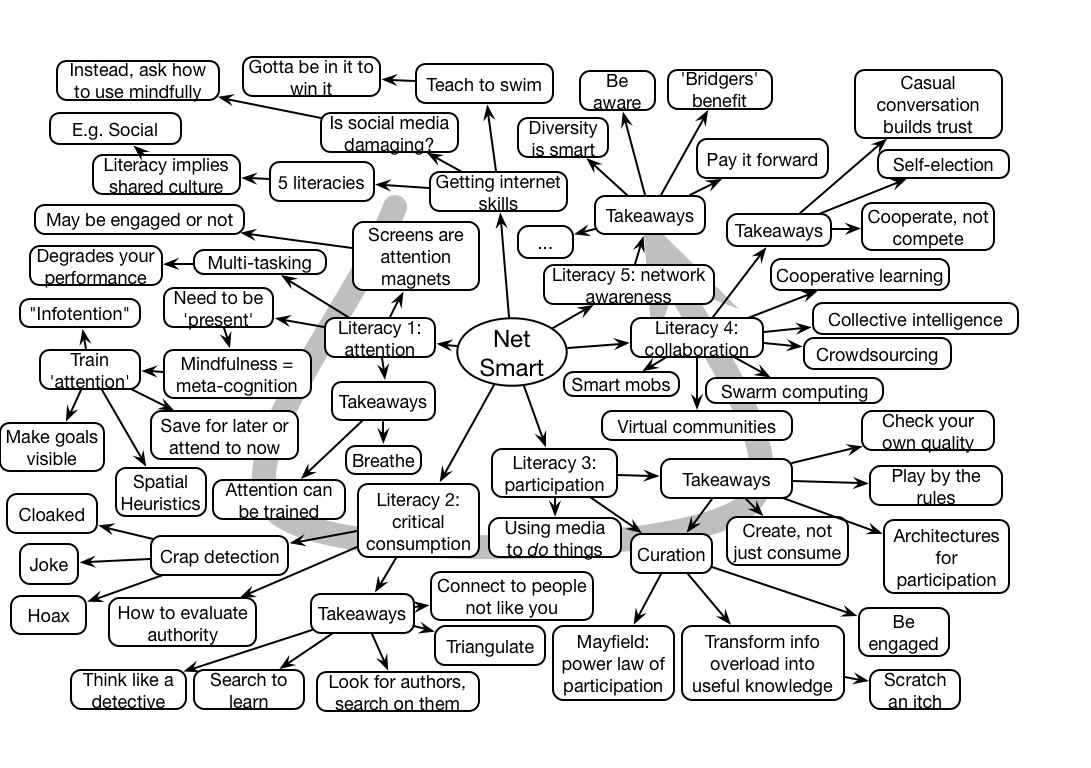
Howard Rheingold gave a fast-paced and inspiring talk on social network skills. With great examples and deep insight, he brought home powerful lessons on the power of people. His takeaways provided valuable lessons for individuals, schools, organizations, and society.
Search Results for: align
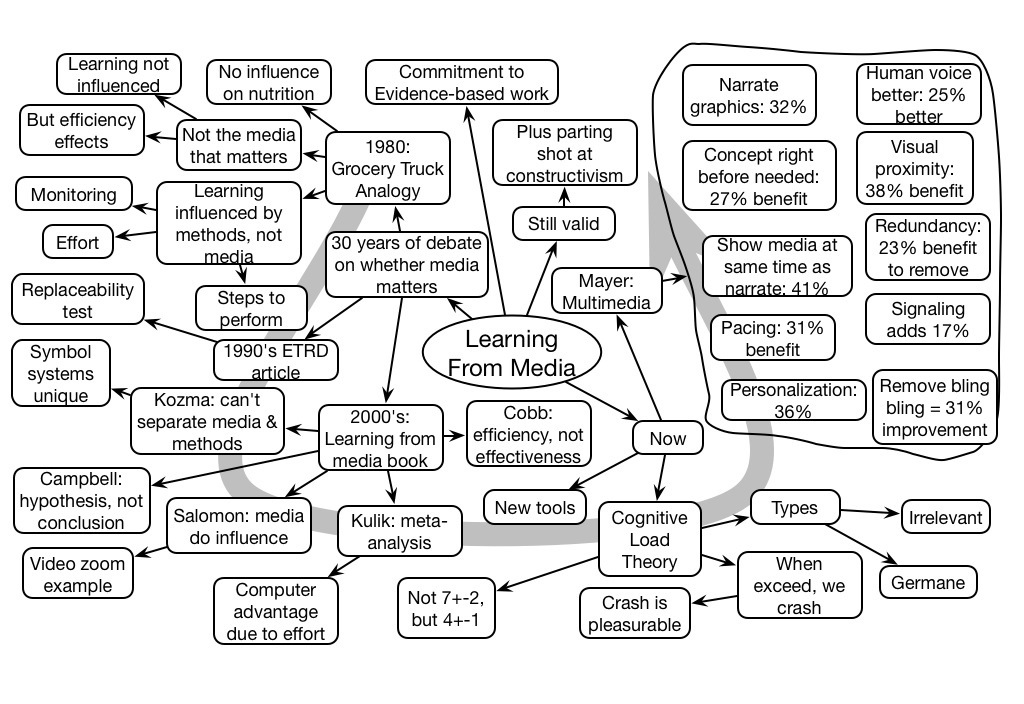
Richard Clark #AECT Keynote Mindmap
Richard Clark presented the research on media and learning, highlighting the 30 years of debate. He started talking about the importance of evidence, and summarized a variety of points of view and research, with a focus on John Sweller’s Cognitive Load Theory and Dick Mayer’s multimedia work. He finished with a potshot at constructivism.
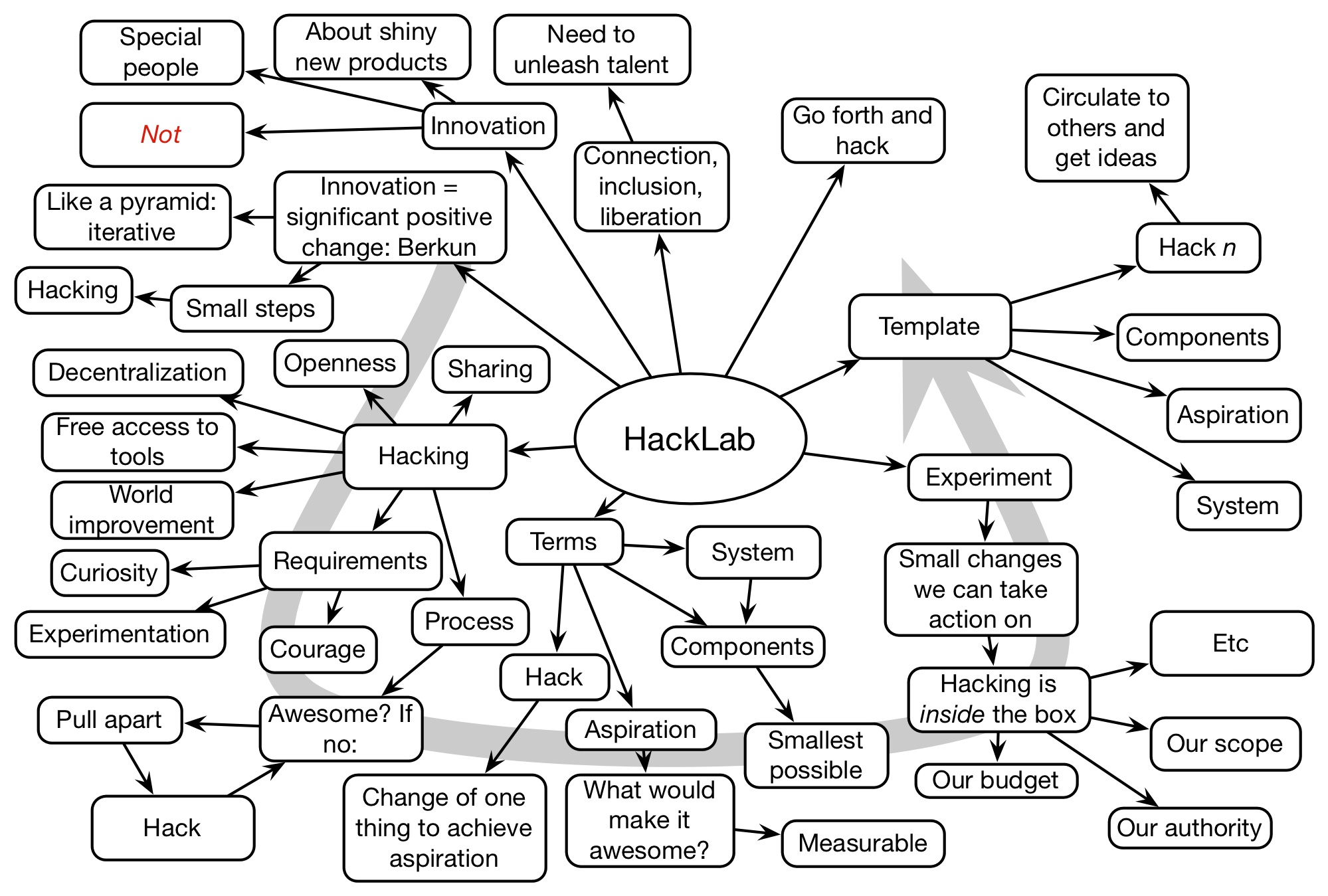
Jason Lauritsen & Joe Gerstandt #DevLearn Keynote Mindmap
Jason and Joe led a lively session inspiring us to innovate through small hacks. Their very pragmatic process is approachable and practical. A great closing to DevLearn.

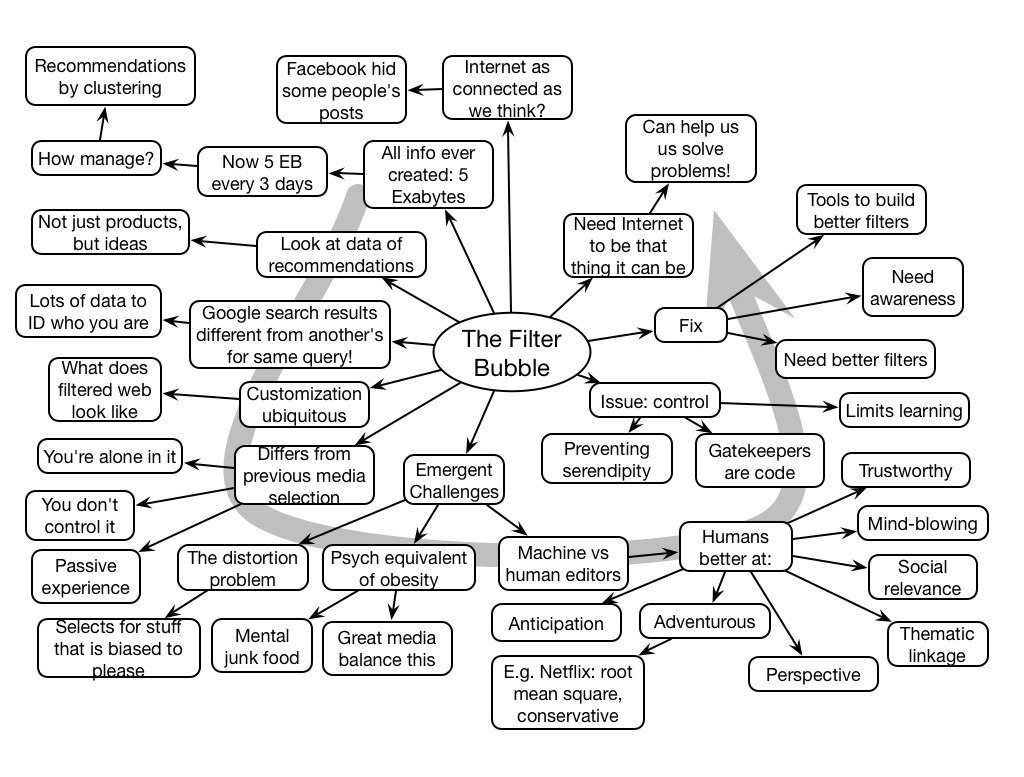
Eli Pariser #DevLearn Keynote Mindmap
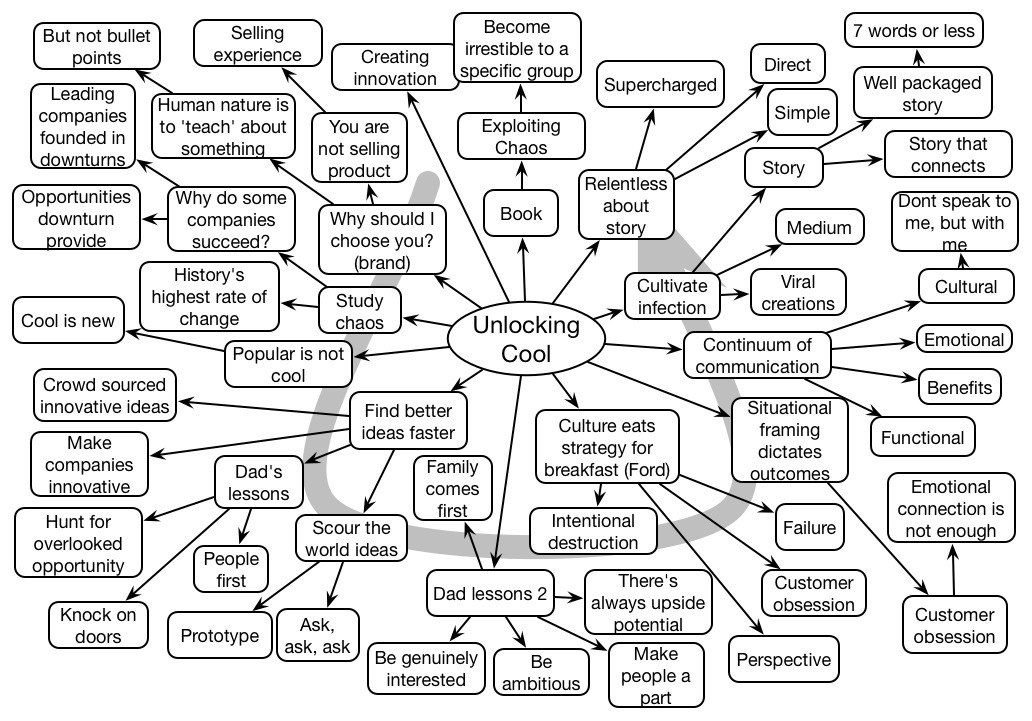
Jeremy Gutsche #DevLearn Keynote Mindmap
Moving forward
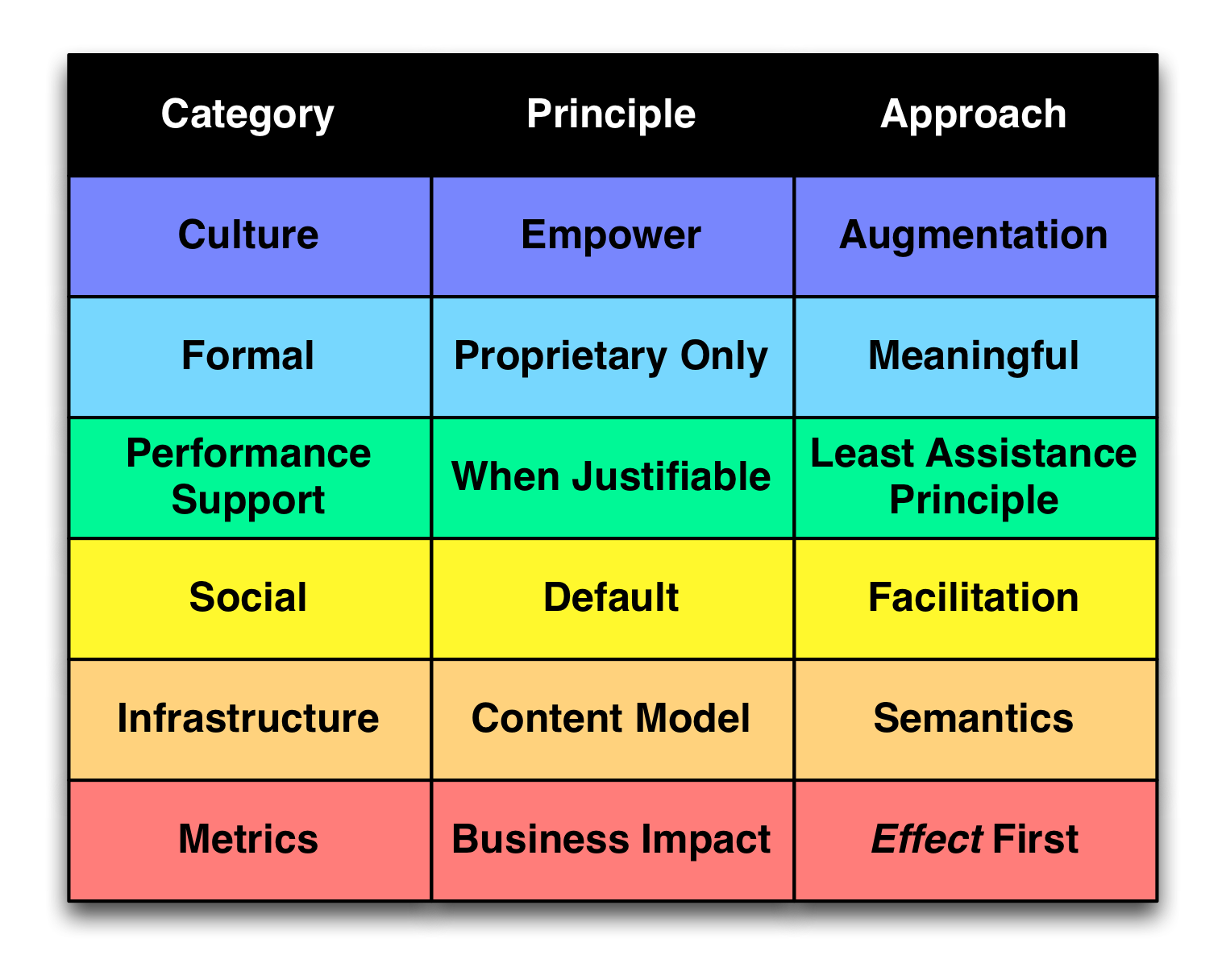
Last week, I talked about what L&D could (and should) look like. In thinking about how to move folks forwards, I’m working on looking at various ways to characterize the different elements, and what various levels of profession should be. One of my first stabs is trying to get at the necessary core principles, and the associated approach to be taken. Here’s the thinking:
We start with the culture of the organization. What the culture should be doing is empowering individuals, providing them with support for learning. And that is not to provide all the answers, but to support people discovering the answer. The goal is to not only address optimal execution, but increasingly to address continual innovation, which comes from cooperation and collaboration. The goal is to augment their existing capabilities with appropriate skills and tools to focus on accomplishing the work to hand. And not reintroducing things that already exist or can be found elsewhere.
That means that formal learning really should be focused on proprietary activities. Don’t design training on commercial tools, that exists. Save the effort to do a real course for those things that are fixed for long enough and specific to your organization. And make it meaningful: contexts that the user gets, skills that the user recognizes are needed, and that will make a real impact on the business. Done properly, with sufficient practice, it will take time and money: formal learning should be expensive, so use those precious resources where and when it really should be applied.
Performance support is more likely to add value in the moment, helping augment our limited memory and working memory capacity. When people need to be focused on the task, designing or curating resources to be used in the moment is a more cost-effective option, though again to be used appropriately. If things are changing too fast, or the situation’s unique, there are better options. And when you are developing or sourcing support, realize that less is more. Look to be minimalist, and your performers (and the bottom line) will thank you.
If things are changing too fast, or the situation’s new and unique (which will be happening more often), the network is likely to be your best resource and likely should be your first. The role here is to make sure that the network is available and vibrant. Facilitation of dialog, and skills, will make this solution the most powerful one in a company that intends to thrive.
The infrastructure, beyond the usual integration of tools, needs to take another level down, and start treating content as an asset that drives outcomes. The steps that matter are to get detailed about the content structures, the model, underneath, and the associated governance. At the end, it requires a focus on semantics, what labels we have and how we define and describe content to move forward into personalization and contextualization.
Finally, we need to measure what we’re doing, and we have to stop doing it on efficiencies. How much it costs us per seat hour doesn’t matter if that time in the seat isn’t achieving anything. We need to be measuring real business effects: are we increasing sales, decreasing costs or errors, solving problems faster, decreasing time to market, increasing customer satisfaction, the list goes on. Then, and only then, should we be worrying about efficiencies. Yes, we should be smart about our investments, but all the efficiency in the world about doing something inane is just kind of silly.
So, does this make sense? Any tuning or clarification needed? Feedback welcome.
What does change(d) look like?
In an post this past spring, I opined that we do have to change. One obvious related question is what that change would look like. What would an effective L&D unit be doing, and what would the employee/manager/exec experience be? This is a longer topic, but here’re some initial thoughts that I really would welcome your thoughts on.
I see employees experiencing less ‘training’. As I’ve said, effective training is expensive when done properly, and should be used only when significant skill shifts are needed. It should only be for proprietary approaches, otherwise you should use others’ materials. And it only is for upskilling new employees (and only when needed), or when a significant change is happening.
I’d expect to see more performance support, easily accessible via user-centric portals and search and delivered when and where needed. Similarly social would play a much more central role, arguably our first recourse. Employees would be tightly coupled to their work teams, and more loosely coupled to their communities of practice. Teams would be diverse and flexible, and group work would be the norm.
Resources would be sometimes created, sometimes crowd-sourced within (or without) the organization, and sometimes curated. Much curation would happen by individual in communities monitoring the larger network, individuals in teams bringing in relevant elements from their communities, and sharing back reflections and outcomes that inform the community while communities would share back to the larger network. This is the vision of the Coherent Organization.
Managers would be playing a leadership and mentoring & coaching role rather than a directive role. They’d be looking to share the vision of goals and rationale, and then supporting performance aligned towards this goal. Executives would be aligning manager visions with organizational goals, monitoring performance, and facilitating infrastructure to support effective communication and cooperation, and well as establishing and maintaining a learning organization culture.
The L&D unit would need to be monitoring the effectiveness of communication and collaboration, management, and leadership, as well as experimenting with new tools to support the work. The L&D unit becomes responsible for the learning to learn skills, the learning and performance tools, and the corporate culture.
If organizations are to successfully couple optimal execution with continual innovation, particularly in times of increasing change and decreasing resources, the mechanisms for success transcend training. Providing support when needed, and leveraging the power of people will be key. Does this make sense? Next step: how do you get there?
#itashare
A personal look at crowd sourcing
The last time I had a beard was right before college graduation. I was off in the wilderness, and when I came back my razor was busted. So, I grew a beard that was largely red, and in terms of being well behaved, well, it made Gabby Hayes look well-groomed. So I’ve been clean shaven since (see to the right).
Well, that’s changed. To make a long story short, I had an extended period of time away from family and razor, and grew it out. When I came back, the reviews went from mixed to positive, not a negative word. Now, of course, you seldom hear from those who don’t like a look (wonder how many people do not like Quinnovation as a company name), but the important people (my immediate family) either initially or grew to prefer the new look. (Maybe the more of my face I cover, the better ;)
Well, this creates a conundrum, because I’ve plenty of promo photos out there for various speaking engagements that now are no longer appropriate. It was time for a new official photo (it was anyways, this is close to a decade old, and I do not want to be the guy who’s photo is decades out of date).
The official way to do this is to hire someone, but I perused the local options, and either they were sidelining portraits on top of weddings, babies, etc, or they used stock backgrounds. The pre-beard shot above was taken by my friend and colleague Jay Cross, chose it out of several candidates, and liked the more natural setting. So I got my wife to take a bunch of shots, and we (with my daughter’s help) went through them. They were all flawed for various reasons (some problems she saw and I didn’t, and there begins the tale; it was a collaborative project and decision). We tried again, and finally found two we liked. How to decide?
So I went out to a small group of colleagues who I could trust would give me straight feedback, and they reliably preferred one. This was a relief. However, there was a problem: my face was kind of dark against the background. And, lo, one of them stepped up and offered to work on the photo.
She kindly took the shadow off my face, and did another lightening up the whole picture. The former was better, but I was concerned that there wasn’t sufficient contrast, so she also created one that had the background muted. Her contribution was so valuable. Now I had two more to choose from: the more natural one or the one with the muted background. How to answer this?
So I went out to four of the groups I have or was going to talk for, and asked them which they would prefer for their brochures or websites. Of the 3 that responded, they all preferred the natural background (my preference). I’d converged on a new headshot.
More importantly, I had avoided my usual blind decisions, and got contributions all along the way that made the outcome better. Throwing out ego and being willing to ask for help isn’t my natural approach, as I hate to impose, but I know I don’t mind helping colleagues and friends, so I stepped out of my comfort zone and I’m so grateful they stepped up.
The take-home lesson for me is the power of communication and collaboration: crowd sourcing works. You may not like the new look, but it’s where I’m at, and it’s a lot better picture than I’d had if I tried to do it alone.
Peter de Jager #PSS13 Keynote Mindmap
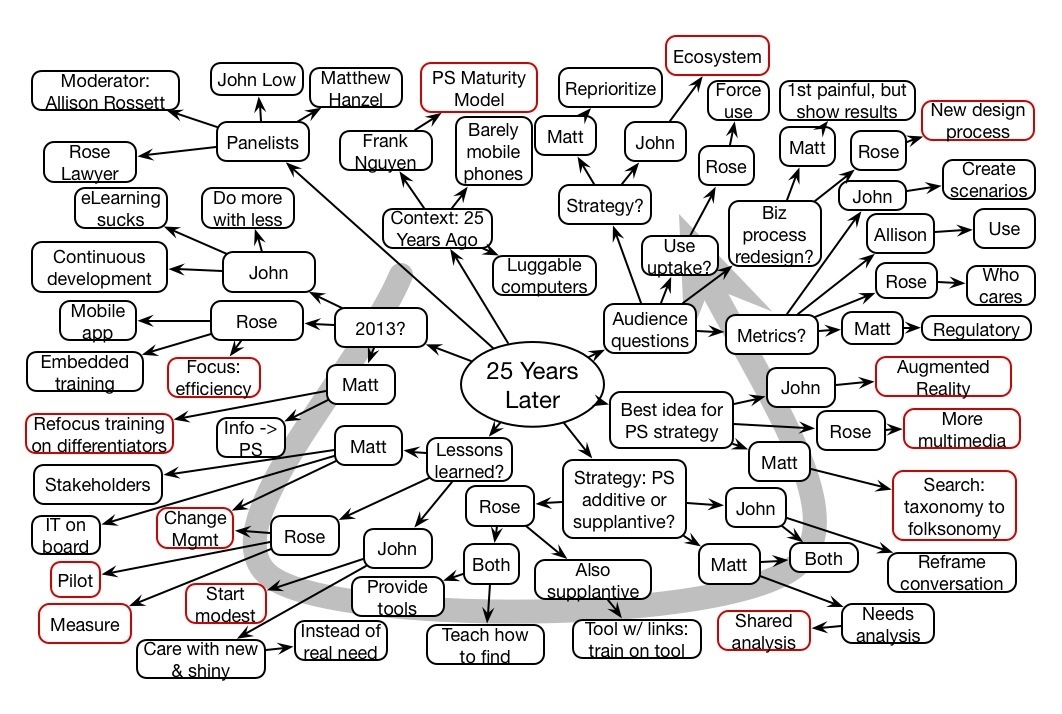
#PSS13 Opening Panel Mindmap
The opening session for the eLearning Guild’s Performance Support Symposium was an insightful panel moderated by Allison Rossett, with panelists Rose Lawyer of Huntington, John Low of Carney, and Matthew Henzel of American Express on their experiences with performance support (PS) initiatives. Interesting points included taking a holistic perspective, emphasizing change management, and future directions. I note that in some cases my interpretation is not their words :).