Learnlets

Secondary

Clark Quinn’s Learnings about Learning

Search Results for: align

ITA Predictions 2013

7 January 2013 by Clark 2 Comments

The Principals of the  Internet Time Alliance  decided to take a collective look ahead to the new year, and share our predictions. You‘ll see overlap but also unique perspectives:

Charles Jennings

cjAn increasing number of organisations, independent of size, nature or location, will acknowledge that their traditional training and development models and processes are failing to live up to the expectations of their leaders and workforce in a dynamic and global marketplace. Some will take steps to use their financial and people resources and exploit new ways of working and learning. Others will be hamstrung with outdated skills, tools and technologies, and will be too slow to adapt. A confluence of technology and improved connectivity, increasing pressures for rapid solutions and better customer service, and demands for higher performance, will force the hands of many HRDs and CLOs to refocus from models of ‘extended formal training‘ to place technology-enabled, workplace-focused and leader-led development approaches at the core of their provision. We will move a step or two closer to real-time performance support at the point of need.


Clark Quinn

cqWe‘ll see an increasing use of mobile, and some organizations will recognize the platform that such devices provide to move the full suite of learning support (specifically performance support and informal learning) out to employees, dissolving the arbitrary boundaries between training and the full spectrum of possibilities. Others will try to cram courses onto phones, and continue to miss the bigger picture, increasing their irrelevance. Further, we‘ll see more examples of the notion of a ‘performance ecosystem‘ of resources aligned around individual needs and responsibilities, instead of organized around the providing silos. We‘ll also see more interactive and engaging examples of experience design, and yet such innovative approaches will continue to be reserved for the foresightful, while most will continue in the hidebound status quo.  Finally, we‘ll see small starts in thinking semantic use in technology coupled with sound ethnographic methods to start providing just such smart support, but the efforts will continue to be embryonic.

Harold Jarche

hjPeople who know nothing about connectivism or collaborative learning will profit from MOOC‘s. Academics and instructional designers will tell anyone who wants to listen just how important formal training is, as it fades in relevance to both learners and businesses.The ITA will keep on questioning the status quo and show how work is learning and learning is the work in the network era – some will listen, many will not.


Jane Hart

Many traditional-thinking organisations will waste a lot of time and energy trying to track social interventions in the hope that they can control and manage “social learning”. Whilst those organisations who appreciate that social learning is a natural and continuous part of working, will acknowledge that the most appropriate approach they can take is simply to support it in the workplace – both technologically and in terms of modelling new collaborative behaviours. Meanwhile, we will continue to see individuals and teams bypass IT and T&D departments and solve their learning and performance problems more quickly and easily using their own devices to access online resources, tools and networks.


Jay Cross

jc2013 will be a great year. As William Gibson wrote, “The future‘s already here. It‘s just not evenly distributed yet.” The business world will become a bit more complex — and therefore more chaotic and unpredictable. Moore‘s Law and exponential progress will continue to work their magic and speed things up. Learning will continue to converge with work. Increasingly, workers will learn their jobs by doing their jobs. The lessons of motivation (a la Dan Pink) and the importance of treating people like people will sink in. Smart companies will adopt radical management, putting the customer in charge and reorganizing work in small teams. Senior people will recognize that emotions drive people — and there are other emotions in addition to passion. Happy workers are more engaged, more productive, and more fulfilled. What‘s not to like?


Refining Designing

3 January 2013 by Clark 3 Comments

A couple of months ago, I posted on thinking about designing, calling for designing ‘backwards and forwards’.  And it’s continued to percolate, rightly or wrongly.

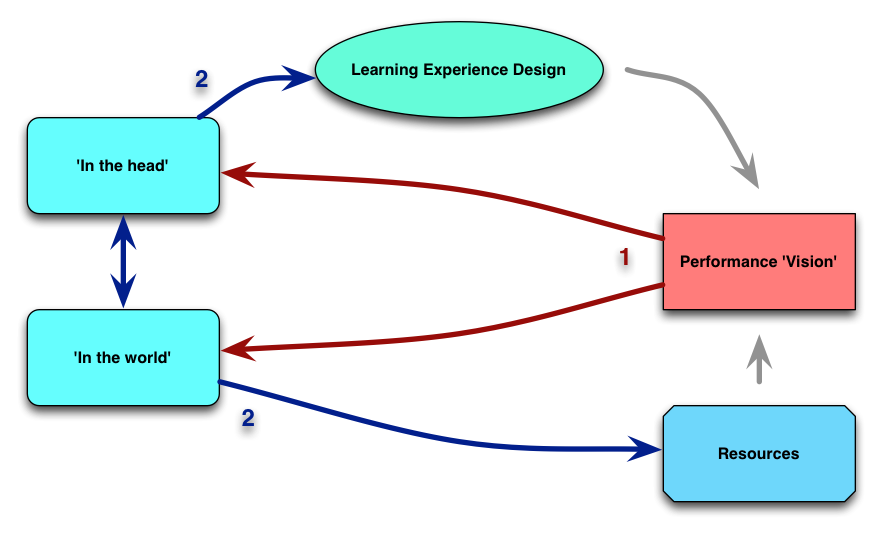
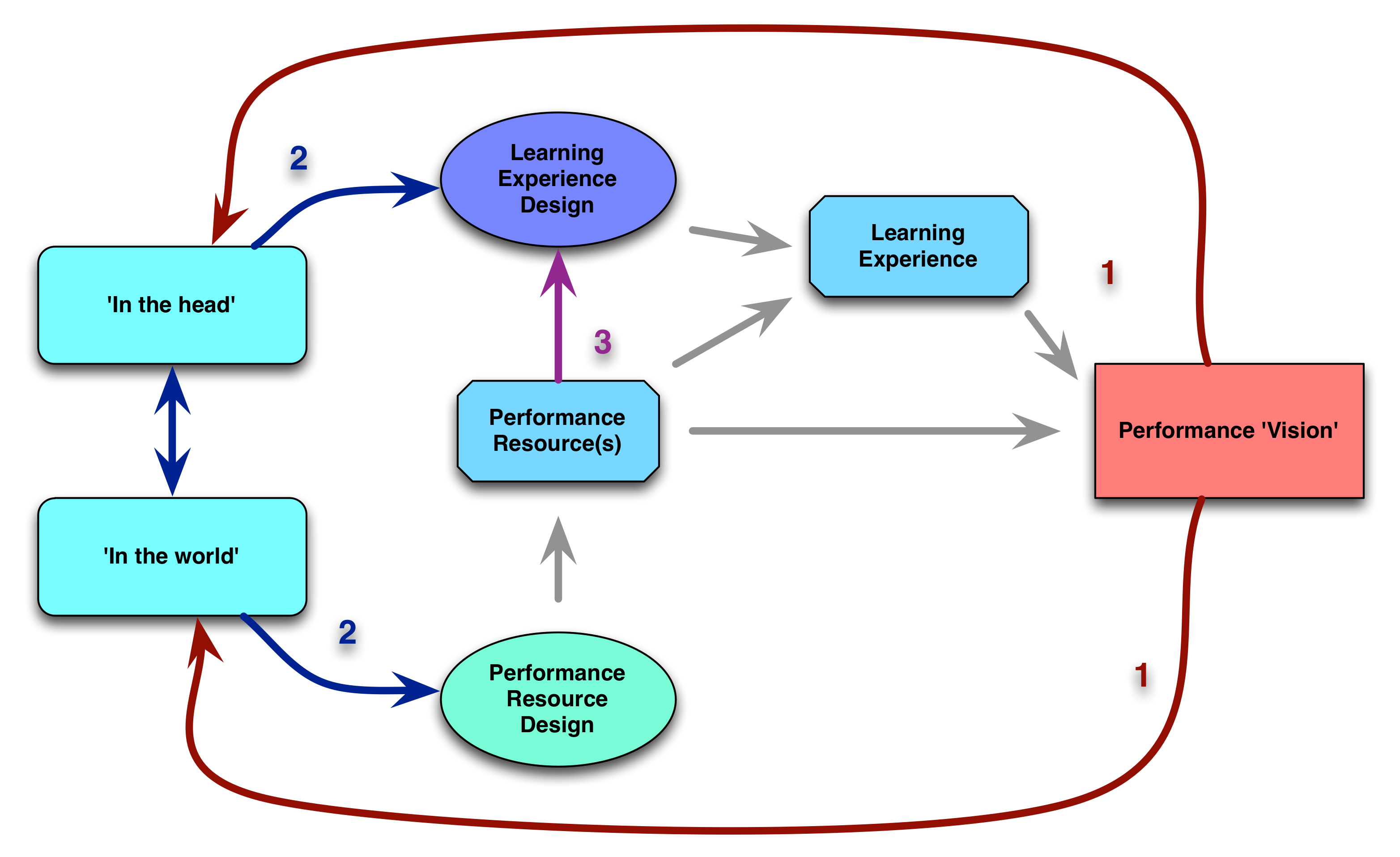
As I originally structured it, you worked backwards (1) from the ultimate performance you need to put information in the head, and in the world, and then designed forward (2) the combined learning experience, and the performance resource.  While the HPT movement thinks about this as well (they definitely talk about whether it should be a learning or performance support solution; I don’t know but assume they will do a mix if needed).  Which I don’t disagree with, but I realized I needed to address one issue.

designing backward from desired performanceIt occurred to me that when you design your resource(s), that has to happen first.  If there are resources, they should be included in the learning experience.  That is, you want to provide practice with the resources as part of the learning experience to develop the performer’s ability to use the resources in the performance situation.

Thus, I’ve ended up redesigning it such that performance resource(s) influence the learning experience design (3), and are available in the learning experience as well as in the performance environment.  It’s more complex, but more accurately captures the types of thinking we need to have as designers.  We need to create what’s in the world and then prepare what’s in the head to accommodate the new performance environment.

Which, of course, may actually need to be iterative. As Atul Gawande points out in his book, his checklists were rigorously trailed and refined. That sort of evaluation and revision should be part of our ongoing processes too.  We shouldn’t assume we’ll get it perfect the first time. And the existing environment prior to our intervention will also factor into our resource and experience design.

That said, does this conceptualization help?  I’m trying to find ways to represent design that helps reduce our overemphasis on all training being about trying to put everything ‘in the head’, and this, combined with my earlier thoughts on learning experience design, is part of my ongoing effort.  If, however, it’s either too confusing, or already common knowledge, I need to work more.  Feedback?


Detailing the Coherent Organization

13 November 2012 by Clark 11 Comments

As excited as I am about the Coherent Organization as a framework, it’s not done by any means.  I riffed on it for a Chief Learning Officer magazine, and my Internet Time Alliance colleagues have followed up. However, I want to take it further.  The original elements I put into the diagram were ad-hoc, though there were principles behind them.  As a start, I wanted to go back and look at these elements and see if I could be more systematic about it.

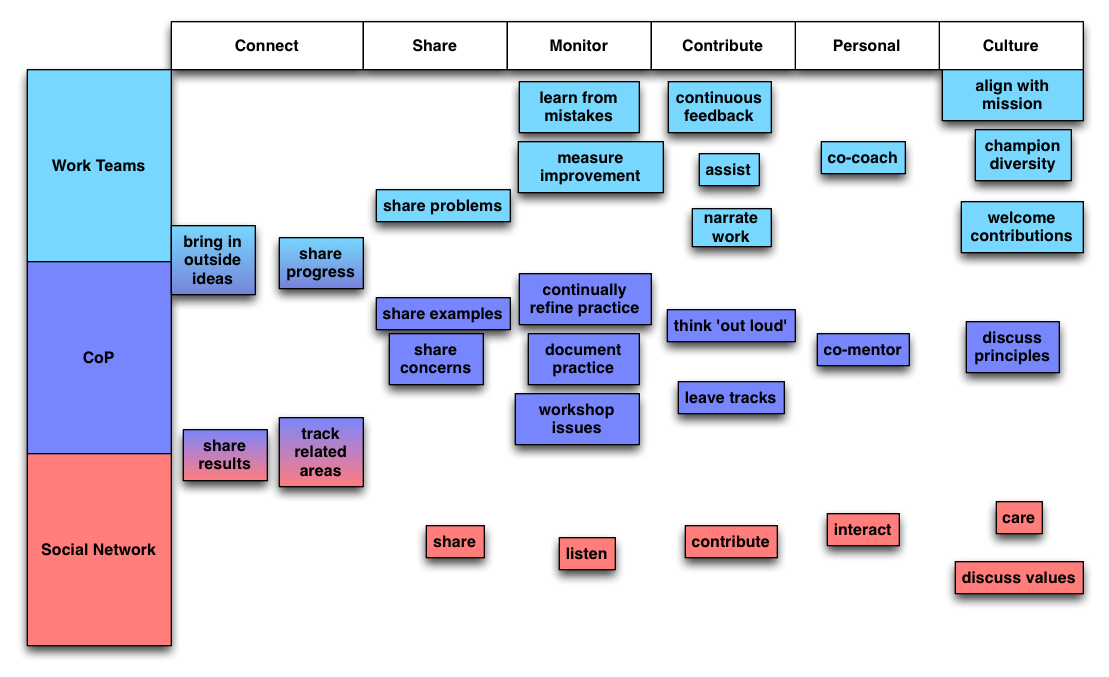
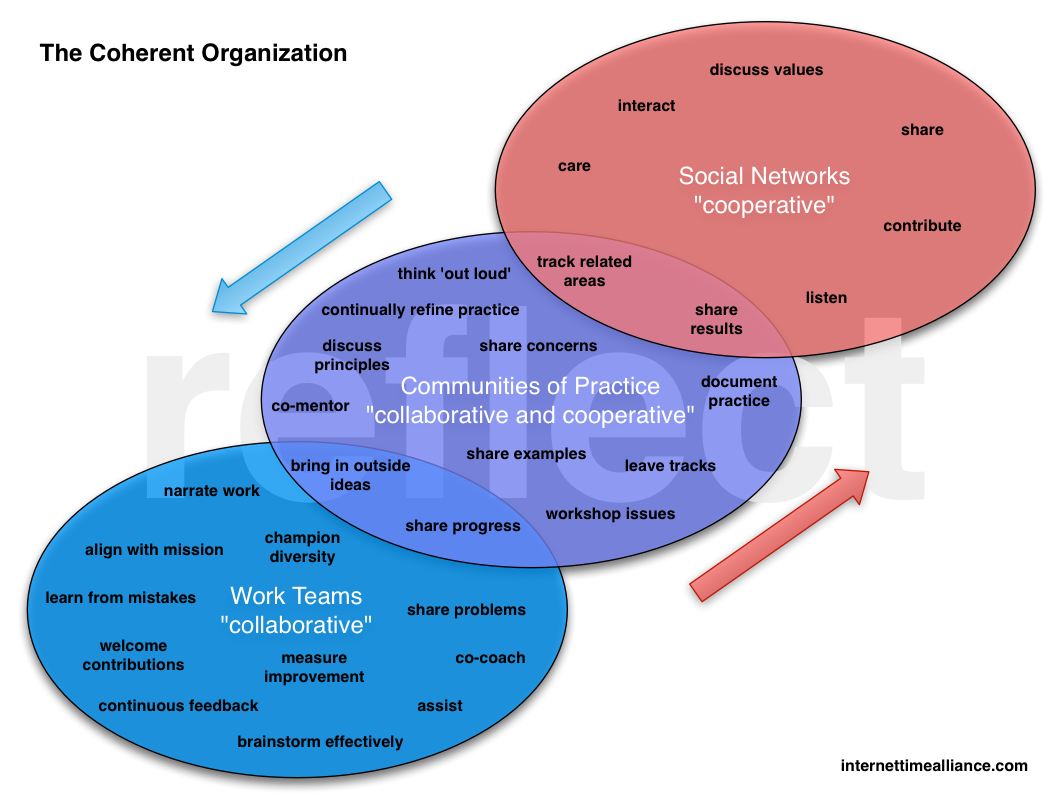
Working Collaboratively and cooperativelyI had, as Harold’s original model provided the basis for, separate groups for Work Teams, Communities of Practice, and Social Networks.  Within each were separate elements.

In Work Teams, I had included: share problems, co-coach, assist, brainstorm effectively, continuous feedback, welcome contributions, learn from mistakes, align with mission, narrate work, champion diversity, and measure improvement.

Under Communities of Practice I listed: document practice, leave tracks, workshop issues, share examples, co-mentor, discuss principles, continually refine practice, think ‘out loud’, and share concerns.

And in Social Networks I had put: share, contribute, listen, care, interact, and discuss values.  I also had connecters between the groups, each ways, so Work Teams were connected to Communities of Practice by bringing in outside ideas and sharing progress, while Communities of Practice were linked to Social Networks by tracking related areas and sharing results.

What I couldn’t claim was that this was the exhaustive list.  I’d put them in there with some thoughts of both putting in and taking out, but I wanted to go further.

What I did was separate out each of the three areas, and start grouping like terms together (I just took all the terms in the above diagram and dropped them into a new diagram, and started sorting). As I did so, some commonalities emerged. I ended up with the following diagram, which is very much a work in progress.  What I’m  trying to get to is the set of behaviors that would be essential for such an organization to succeed, ultimately coming up with a set of dimensions that might be useful as an assessment.  What emerged is a characterization of several different areas within which behaviors fall, which is useful because then I can look for missing (or redundant) elements.

Looking for emergenceIn addition to the connecting tasks, we see several overarching types of behaviors.  Besides the connection between the areas, they grouped like I show here.

Sharing is individual putting out things, which is less pro-active and interactive than actually contributing.  That distinction isn’t quite clear to me either, but sharing might be more pointers to things where contribute is a more substantial contribution.  Which means my elements may not be properly categorized.

Monitoring is both watching what’s going on and pro-actively evaluating outcomes.  Does this need to be broken out into two separate areas? Personal is where you’re working with a specific person (or recipient thereof).  And the culture dimension is where you’re actively aware of and reviewing the underlying values behind what you’re doing.

By no means do I consider this ‘done’, but I share it as part of my commitment to practicing what I preach, thinking ‘out loud’.  This will get refined.  I most certainly welcome your thoughts!

#itashare

Designing Backward and Forward

6 November 2012 by Clark 2 Comments

At the recent DevLearn, several of us gathered together in a Junto  to talk about issues we felt were becoming important for our field. After a mobile learning panel I realized that, just as mlearning makes it too easy to think about ‘courses on a phone’, I worry that ‘learning experience design’ (a term I’ve championed) may keep us focused on courses rather than exploring the full range of options including performance support and eCommunity.

So I began thinking about performance experience design as a way to keep us focused on designing solutions to performance needs in the organization.  It’s not just about what’s in our heads, but as we realize that our brains are good at certain things and not others, we need to think about a distributed cognition solution, looking at how resources can be ‘in the world’ as well as in others’ heads.

The next morning in the shower (a great place for thinking :), it occurred to me that what is needed is a design process  before we start designing the solution.  To complement Kahnemann’s Thinking Fast and Slow (an inspiration for my thoughts on designing for how we really think and learn), I thought of designing backward and forward.  Let me try to make that concrete.

Designing for PerformanceWhat I’m talking about is starting with a vision of what performance would look like in an ideal world, working backward to what can be in the world, and what needs to be in the head.  We want to minimize the latter.  I want to respect our humanity in a way, allowing us to (choose to) do the things we do well, and letting technology take on the things we don’t want to do.

In my mind, the focus should be on what decisions learners should be making at this point, not what rote things we’re expecting them to do.  If it’s rote, we’re liable to be bad at it.  Give us checklists, or automate it!

From there, we can design forward to create those resources, or make them accessible (e.g. if they’re people).  And we can design the ‘in the head’ experience as well, and now’s the time  for learning experience design, with a focus on developing our ability to make those decisions, and where to find the resources when we need them.  The goal is to end up designing a full performance solution where we think about the humans in context, not as merely a thinking box.

It naturally includes design that still reflects my view about activity-centered learning (which I’m increasingly convinced is grounded in cognitive research).  Engaging emotion, distributed across platforms and time, using a richer suite of tools than just content delivery and tests.  And it will require using something like Michael Allen’s Successive Approximation Model perhaps, recognizing the need to iterate.

I wanted to term this performance experience design, and then  as several members workshopped this with me, I thought we should  just call it performance design (at least externally, to stakeholders not in our field, we can call it performance experience design for ourselves).  And we can talk about learning experience design within this, as well as information design, and social networks, and…

It’s really not much more than what HPT would involve, e.g. the prior consideration of what the problem is, but it’s very focused on reducing what’s in the head, including emotion in the learning when it’s developed, using social resources as well as performance support, etc.  I think this has the opportunity to help us focus more broadly in our solution space, make us more relevant to the organization, and scaffold us past many of our typical limitations in approach.  What do you think?

Honored

3 November 2012 by Clark 6 Comments

At the recent DevLearn conference, David and Heidi (the two-cofounders of the eLearning Guild) punk’d me.  Under the pretense of having me assist the keynote speaker, they had me sit at the front of the stage with another purpose in mind.

As background, the Guild is explicitly labeled and designed to reflect the original concept of an association of  craftsmen  in a particular trade.  The notion is that elearning professionals will be members of the guild to stay abreast of new developments, and interact with their peers.  Inherent in this is the notion of participants starting as apprentices and moving gradually to the center of a community of practice.  Consequently, the Guild hosts a number of things: online conferences (forums), Learning Solutions (an online magazine), research reports, discussion forums on LinkedIn, and of course their excellent conferences.

eLearning Guild Award

Heidi and David decided, apparently, that they wanted to reward those who were contributing, who were serving as defacto ‘masters’ of the community, following the historic traditions.  Consequently, they were reviewing who did what, who was writing, researching, and presenting, and apparently one name kept appearing at the top of the lists.   Mine.

Now, you have to understand that I have made no effort to see who was doing what; I see certain names regularly appear on their speaker lists, as well as new ones. I know a number of people have been involved in research, and they’re always getting new authors for the magazine. But I literally had no idea how much I did compared to others, so this was a complete surprise.

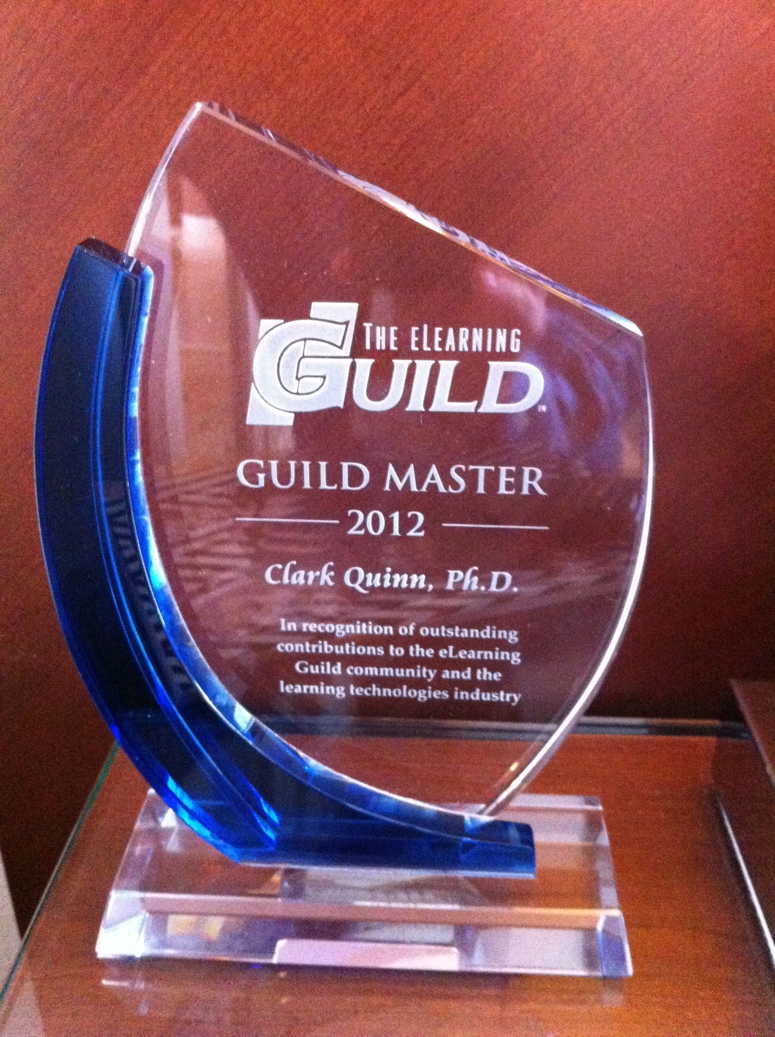
So they called me up on stage and bestowed upon me the honor of being the very first Guild Master, handed me this great chunk of gorgeous glass, all with me somewhat stunned and embarassed.  They have stated an intention to honor others at following conferences, which will be great.  I like how they view their role, think it’s valuable, and they strike the right balance in making a viable business that serves a community.  They continually experiment as well, and that’s a good thing.

Needless to say, I’m truly honored that they noticed and deemed me worthy.  It’s not always you get recognized for doing what you love, and when you do it’s humbling.  I’m very grateful to them, and the kind comments others have made subsequently.  And thanks to you for the feedback you’ve provided on my thoughts via this blog, helping me develop my understanding so I am better equipped for what I do. I  am passionate about helping people perform better through technology, and as I often joke “this is what I would be doing even if I were independently wealthy (and you’re welcome to make that happen :)”.

I am truly pleased if what I’ve contributed has helped, and can only hope that I can continue.

Dayna Steele #DevLearn Keynote Mindmap

2 November 2012 by Clark 1 Comment

Dayna used stories from her experience as a radio host to illuminate her points about how to be a rock star in life.

Jeffrey Ma #DevLearn Keynote Mindmap

1 November 2012 by Clark Leave a Comment

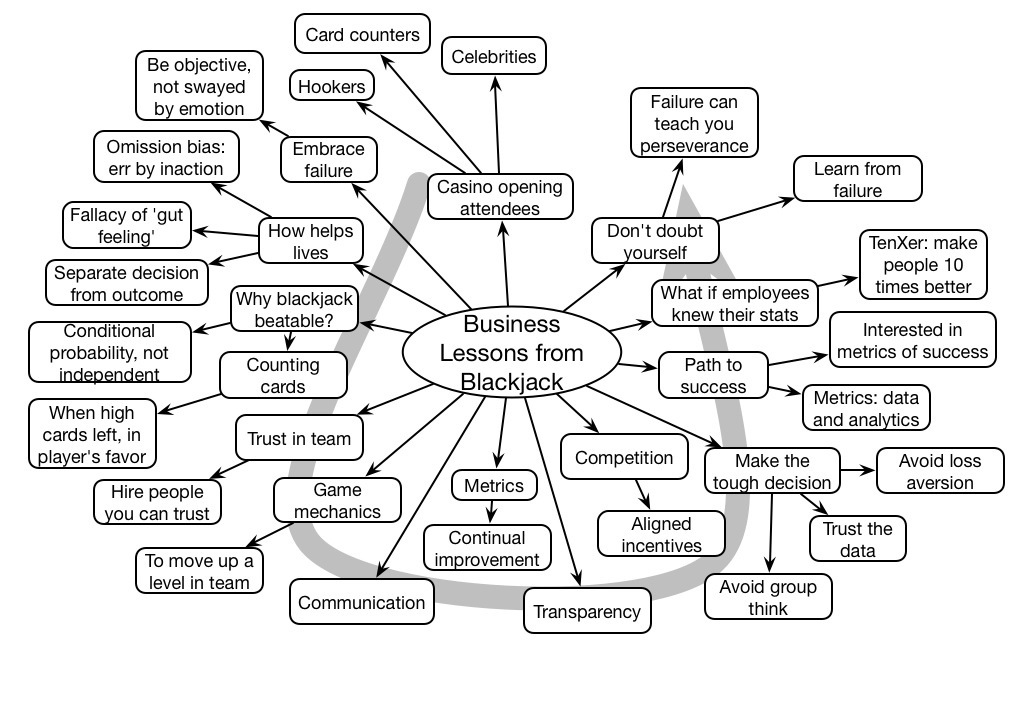
Jeffrey Ma gave a interesting talk on lessons from succeeding at blackjack that included both life lessons as well as lessons on data driven decision making.

20121101-131850.jpg

Alison Levine #DevLearn Keynote Mindmap

1 November 2012 by Clark Leave a Comment

It’s hard to capture the stories, humor, and riveting images of Alison’s inspiring talk, so I’ve only been able to record the lessons she passed on, but great stuff!

20121101-093957.jpg

Brian Brushwood #DevLearn Keynote Mindmap

31 October 2012 by Clark Leave a Comment

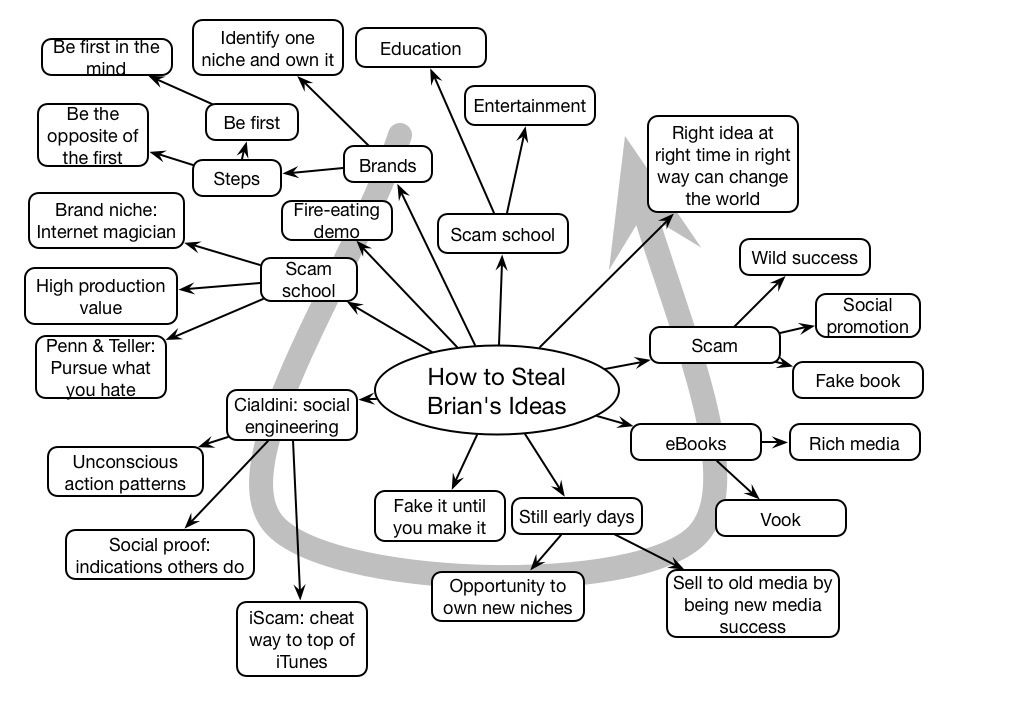
Brian Brushwood riffed off his success with Scam School and other scams to provide lessons about branding and new media opportunity.

20121031-171523.jpg

Jon Landau #DevLearn Keynote Mindmap

31 October 2012 by Clark Leave a Comment

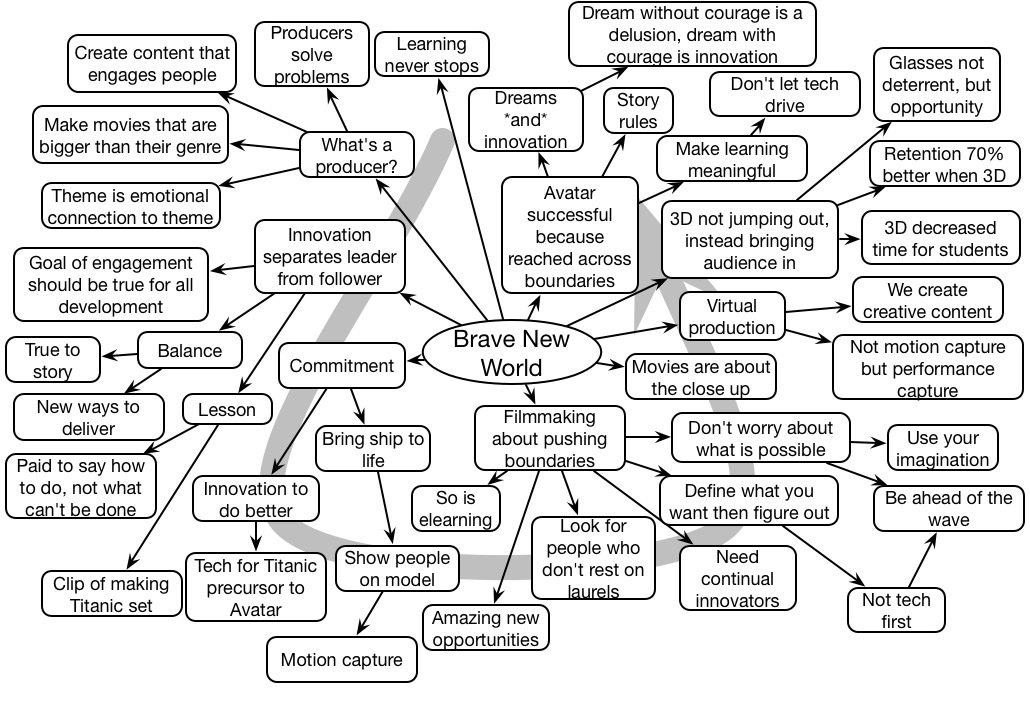
Jon Landau gave an inspiring keynote about the need to focus on the experience, and innovate to bring those visions to fruition, driving tech versus the other way around.

20121031-095917.jpg

« Previous Page
Next Page »

Clark Quinn

The Company

Search

Feedblitz (email) signup

Never miss a post
Your email address:*
Please wait...
Please enter all required fields Click to hide
Correct invalid entries Click to hide

Pages

  • About Learnlets and Quinnovation

The Serious eLearning Manifesto

Manifesto badge

Categories

  • design
  • games
  • meta-learning
  • mindmap
  • mobile
  • social
  • strategy
  • technology
  • Uncategorized
  • virtual worlds

License

Previous Posts

  • March 2026
  • February 2026
  • January 2026
  • December 2025
  • November 2025
  • October 2025
  • September 2025
  • August 2025
  • July 2025
  • June 2025
  • May 2025
  • April 2025
  • March 2025
  • February 2025
  • January 2025
  • December 2024
  • November 2024
  • October 2024
  • September 2024
  • August 2024
  • July 2024
  • June 2024
  • May 2024
  • April 2024
  • March 2024
  • February 2024
  • January 2024
  • December 2023
  • November 2023
  • October 2023
  • September 2023
  • August 2023
  • July 2023
  • June 2023
  • May 2023
  • April 2023
  • March 2023
  • February 2023
  • January 2023
  • December 2022
  • November 2022
  • October 2022
  • September 2022
  • August 2022
  • July 2022
  • June 2022
  • May 2022
  • April 2022
  • March 2022
  • February 2022
  • January 2022
  • December 2021
  • November 2021
  • October 2021
  • September 2021
  • August 2021
  • July 2021
  • June 2021
  • May 2021
  • April 2021
  • March 2021
  • February 2021
  • January 2021
  • December 2020
  • November 2020
  • October 2020
  • September 2020
  • August 2020
  • July 2020
  • June 2020
  • May 2020
  • April 2020
  • March 2020
  • February 2020
  • January 2020
  • December 2019
  • November 2019
  • October 2019
  • September 2019
  • August 2019
  • July 2019
  • June 2019
  • May 2019
  • April 2019
  • March 2019
  • February 2019
  • January 2019
  • December 2018
  • November 2018
  • October 2018
  • September 2018
  • August 2018
  • July 2018
  • June 2018
  • May 2018
  • April 2018
  • March 2018
  • February 2018
  • January 2018
  • December 2017
  • November 2017
  • October 2017
  • September 2017
  • August 2017
  • July 2017
  • June 2017
  • May 2017
  • April 2017
  • March 2017
  • February 2017
  • January 2017
  • December 2016
  • November 2016
  • October 2016
  • September 2016
  • August 2016
  • July 2016
  • June 2016
  • May 2016
  • April 2016
  • March 2016
  • February 2016
  • January 2016
  • December 2015
  • November 2015
  • October 2015
  • September 2015
  • August 2015
  • July 2015
  • June 2015
  • May 2015
  • April 2015
  • March 2015
  • February 2015
  • January 2015
  • December 2014
  • November 2014
  • October 2014
  • September 2014
  • August 2014
  • July 2014
  • June 2014
  • May 2014
  • April 2014
  • March 2014
  • February 2014
  • January 2014
  • December 2013
  • November 2013
  • October 2013
  • September 2013
  • August 2013
  • July 2013
  • June 2013
  • May 2013
  • April 2013
  • March 2013
  • February 2013
  • January 2013
  • December 2012
  • November 2012
  • October 2012
  • September 2012
  • August 2012
  • July 2012
  • June 2012
  • May 2012
  • April 2012
  • March 2012
  • February 2012
  • January 2012
  • December 2011
  • November 2011
  • October 2011
  • September 2011
  • August 2011
  • July 2011
  • June 2011
  • May 2011
  • April 2011
  • March 2011
  • February 2011
  • January 2011
  • December 2010
  • November 2010
  • October 2010
  • September 2010
  • August 2010
  • July 2010
  • June 2010
  • May 2010
  • April 2010
  • March 2010
  • February 2010
  • January 2010
  • December 2009
  • November 2009
  • October 2009
  • September 2009
  • August 2009
  • July 2009
  • June 2009
  • May 2009
  • April 2009
  • March 2009
  • February 2009
  • January 2009
  • December 2008
  • November 2008
  • October 2008
  • September 2008
  • August 2008
  • July 2008
  • June 2008
  • May 2008
  • April 2008
  • March 2008
  • February 2008
  • January 2008
  • December 2007
  • November 2007
  • October 2007
  • September 2007
  • August 2007
  • July 2007
  • June 2007
  • May 2007
  • April 2007
  • March 2007
  • February 2007
  • January 2007
  • December 2006
  • November 2006
  • October 2006
  • September 2006
  • August 2006
  • July 2006
  • June 2006
  • May 2006
  • April 2006
  • March 2006
  • February 2006
  • January 2006

Amazon Affiliate

Required to announce that, as an Amazon Associate, I earn from qualifying purchases. Mostly book links. Full disclosure.

We use cookies to ensure that we give you the best experience on our website. If you continue to use this site we will assume that you are happy with it.