Learnlets

Secondary

Clark Quinn’s Learnings about Learning

Search Results for: align

You know you’re mobile when…

26 July 2012 by Clark 3 Comments

I was thinking about the different ways you can be mobile, and I think it’s broader than most people think.  So I tried to capture it in a diagram.  For once, I’m not particularly happy with it, but in the spirit of ‘thinking out loud’…
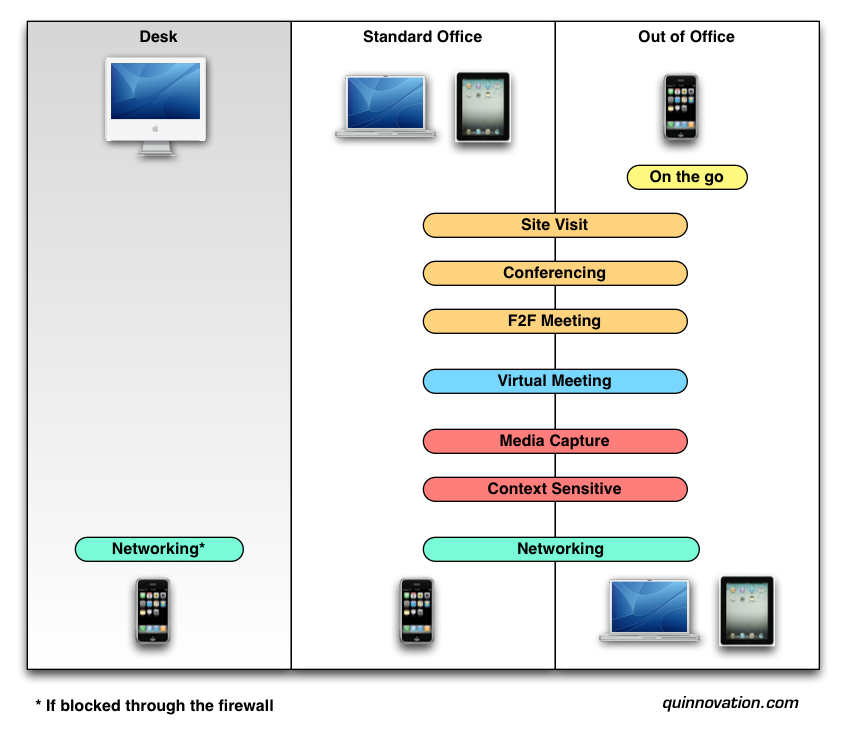
When are you mobile?

The notion is there that you’re mobile when you’re not at your desk with your desktop or even laptop. Now, sometimes you have a laptop with you, but increasingly I think it’ll be tablet or just a pocketable device (and see my earlier distinctions around those, particularly that laptops don’t typically count).  When you’re at your desk, you’re clearly using your desktop or laptop for work, and you’re not mobile.

With the caveat that if the organization is blocking access to some sites (e.g. any search term like ‘game’ or social media site like Facebook and Twitter), you’re highly likely to use your  mobile device to get around this. Rightly so, I must say. Increasingly your network is part of your brain and your solution set, and anyone who’d block it is keeping you from being as effective as possible. If they’re worried about, or you really aren’t using it for work purposes, the problem is  not the network.

Now, you can be out of your particular workspace but still in either your own office, a satellite office, or even in someone else’s office (e.g. client or partner’s office), but you’re in an office. You may be having meetings, making a site visit, whatever.  I reckon attending a conference or a workshop is similar.  There you are mobile, unless you’ve lugged your desktop with you (umm, no).  Again, increasingly it’ll be a tablet or a pocketable.

And there’s the particular situation of being ‘on the go’, when you’re actually in motion, in a way station (in a shop, restaurant, coffeeshop, or pub), or even some place where there’s no real seating (factory floor, for example).  There you’re far more likely to be using your pocketable device in opposition to the laptop or tablet.

You’ll still be accessing your social network, too.  More so; you’ll not only getting answers and assistance, but updating people as well.

There are a couple of unique situations.  One is attending a virtual meeting. At your desktop, you’d use it.  When in another context, you can use your laptop or your tablet.  It’s not quite as feasible with a pocketable device (though that will change).  Your mobile, but your part of an out-of-context or virtual context event, so it’s conceptually distinct, though practically it may not be.

The other is context-specificity. If the device is doing something unique because of where or when you are, it’s really a different situation than accessing just any content or capability you need.  Particularly if the interaction is context-specific.  And capturing  your context, with media, really is a different category.

The point I’m trying to make is that, particularly in the middle category, mobile is more ubiquitous than you think. You know you’re mobile when you’re  not at your desk.  And that’s an increasing amount of the time for most people.  Which is healthier anyway.
Emergent & Semantic Learning

10 July 2012 by Clark 2 Comments

The last of the thoughts still percolating in my brain from #mlearncon finally emerged when I sat down to create a diagram to capture my thinking (one way I try to understand things is to write about them, but I also frequently diagram them to help me map the emerging conceptual relationships into spatial relationships).

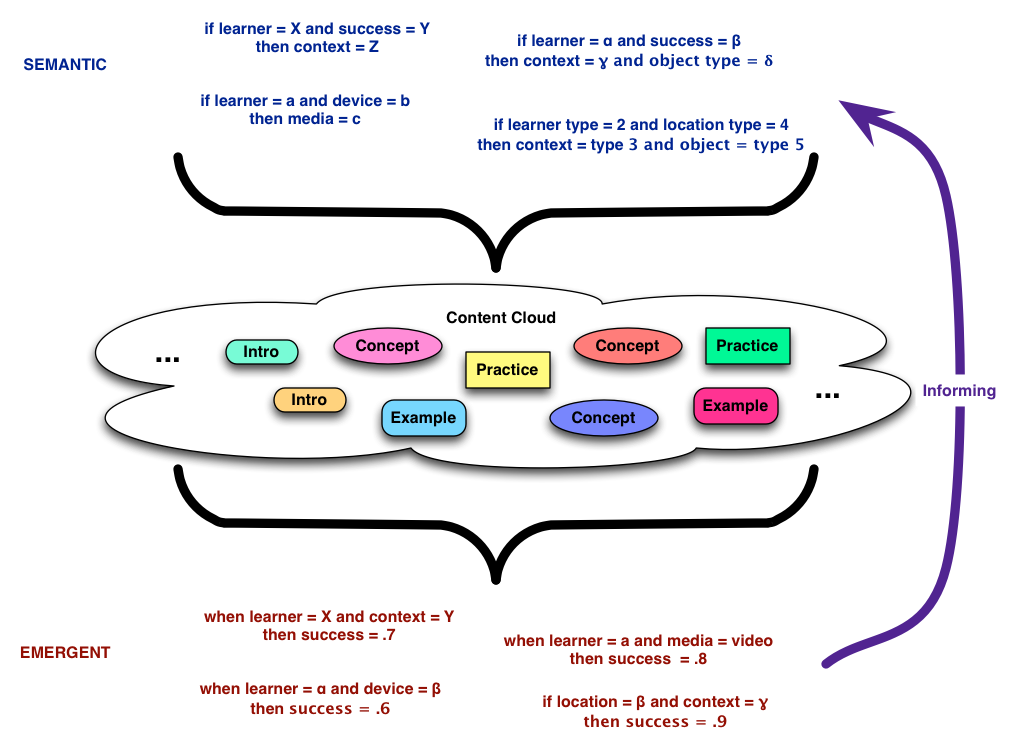
Semantic and Emergent rules for contentWhat I was thinking about was how to distinguish between emergent opportunities for driving learning experiences, and semantic ones.  When we built the Intellectricity© system, we had a batch of rules that guided how we were sequencing the content, based upon research on learning (rather than hardwiring paths, which is what we mostly do now).  We didn’t prescribe, we recommended, so learners could choose something else, e.g. the next best, or browse to what they wanted.  As a consequence, we also could have a machine learning component that would troll the outcomes, and improve the system over time.

And that’s the principle here, where mainstream systems are now capable of doing similar things.  What you see here are semantic rules (made up ones), explicitly making recommendations, ideally grounded in what’s empirically demonstrated in research.  In places where research doesn’t stipulate, you could also make principled recommendations based upon the best theory.  These would recommend objects to be pulled from a pool or cloud of available content.

However, as you track outcomes, e.g. success on practice, and start looking at the results by doing data analytics, you can start trolling for emergent patterns (again, made up).  Here we might find confirmation (or the converse!) of the empirical rules, as well as potentially  new patterns that we may be able to label semantically, and even perhaps some that would be new.  Which helps explain the growing interest in analytics.  And, if you’re doing this across massive populations of learners, as is possible across institutions, or with really big organizations, you’re talking the ‘big data’ phenomena that will provide the necessary quantities to start generating lots of these outcomes.

Another possibility is to specifically set up situations where you randomly trial a couple alternatives that are known research questions, and use this data opportunity to conduct your experiments. This way we can advance our learning more quickly using our own hypotheses, while we look for emergent information as well.

Until the new patterns emerge, I recommend adapting on the basis of what we know, but simultaneously you should be trolling for opportunities to answer questions that emerge as you design, and look for emergent patterns as well.  We have the capability (ok, so we had it over a decade ago, but now the capability is on tap in mainstream solutions, not just bespoke systems), so now we need the will.  This is the benefit of thinking about content as systems – models and architectures – not just as unitary files.  Are you ready?


Piecing together collaboration and cooperation: The Coherent Organization

3 July 2012 by Clark 8 Comments

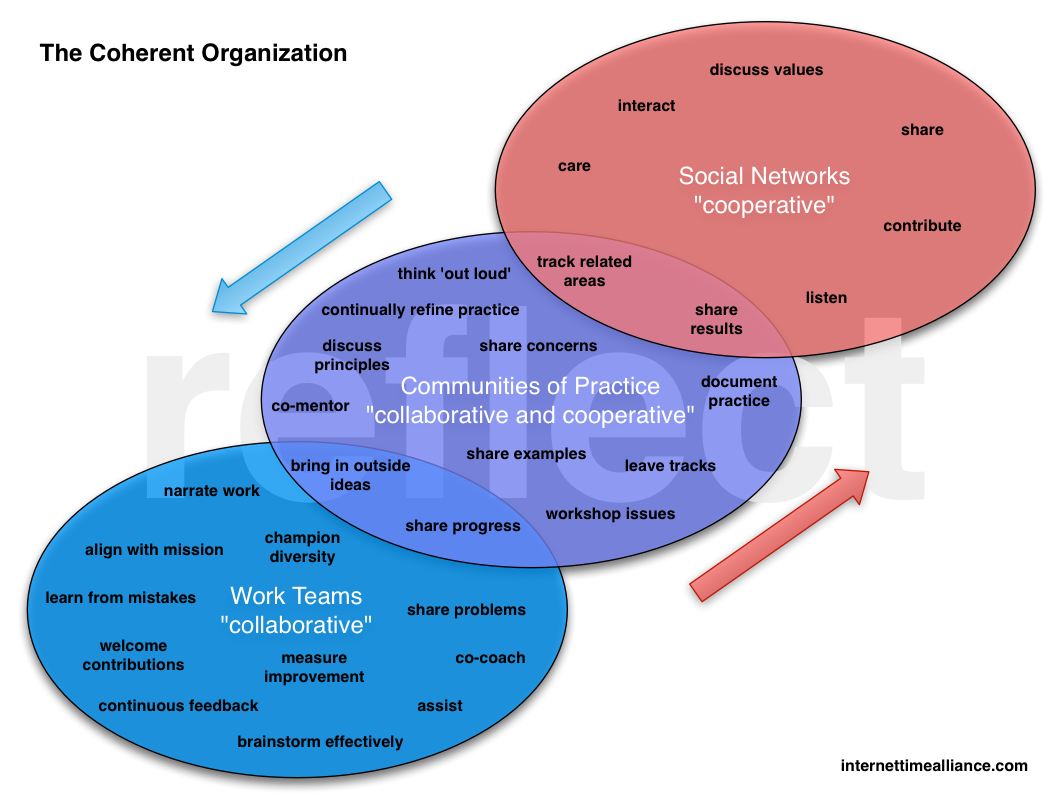
In an insightful piece, Harold Jarche puts together how collaboration and cooperation are needed to make organizations work ‘smarter’, integrating workgroups with the broader social network by using communities of practice as the intermediary.  This makes a lot of sense to me, and I was inspired to take a look at the practices within those categories.  (Jay Cross has explored different facets of the implications of this way of thinking and talks about how we are building on this.)

Working Collaboratively and cooperativelyIn this depiction,we see behaviors of effective collaboration within work groups, such as coaching each other, using good practices for brainstorming, the elements of a learning organization, being willing to admit to problems, and being willing to lose if you don’t lose the lesson.

At the next level, communities of practice need to continue to evolve their practices, sharing issues and working together to resolve them.  Within these communities, sharing pointers as well as deeper thoughts are mechanisms for ‘stealth mentoring‘ and explicit mentoring is valuable as well.

At the outermost level, social networks are about tracking what’s happening and who knows what, looking for developments in related fields as mechanisms for improving designs, and sharing practice is a way to give back to the community.

At the intersections, you need practices of both sharing outward and bringing inward, always looking for fresh inspiration and valuable feedback. The transparency provides real value in developing trust among the constituencies.

I put reflection underpinning all of these, as a core practice.  Reflection is absolutely critical to continual improvement in every area.

Note that the firewall tends to cross the middle of the diagram, and by blocking access you’re effectively cutting off a portion of the corporate brain!

This should not by any means be considered definitive, as it’s my first draft, but I think it helps (me, at least) think about what practices could accelerate an organization to be both effective and efficient, able to move nimbly to deliver ongoing customer delight by continual innovation while executing as well. We’re thinking about this as the ‘Coherent Organization’, aligning the flows of information, and aligning the work with the organizational goals.   As always, I welcome your feedback: what should be added, removed, modified, etc.

BJ Fogg #mLearnCon Keynote Mindmap

19 June 2012 by Clark Leave a Comment

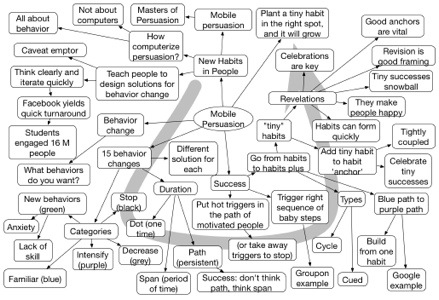
BJ Fogg, known from his work on persuasive technology, talked about making persistent behavior change via tiny habits. Very interesting research with important implications both personally and commercially.

20120619-100811.jpg

Jane Hart #iel12 Keynote Mindmap

7 June 2012 by Clark Leave a Comment

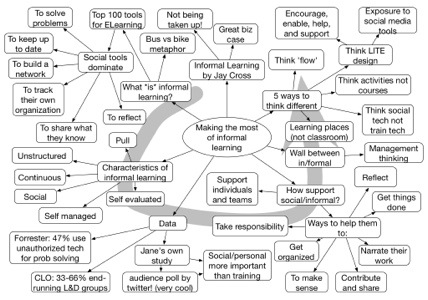
Jane Hart, in her personable style, told a compelling story of the what, why, and how of informal learning. She suggested it was about self-directed learning, that it’s already happening, but that there are valuable ways the L&D group can assist and support.

20120607-135315.jpg

Mitch Kapor #iel12 Keynote Mindmap

7 June 2012 by Clark Leave a Comment

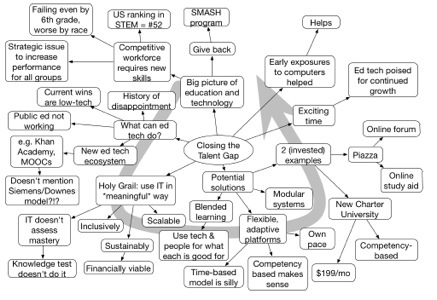
Mitch Kapor shared his passion for and belief in the need for computers to help address the problems in education. He was clearly concerned about the low ranking of the US in STEM, and talked about the promise of tech when used appropriately. He cited two examples he’s invested in.

20120607-094013.jpg

George Siemens #iel12 Keynote Mindmap

6 June 2012 by Clark Leave a Comment

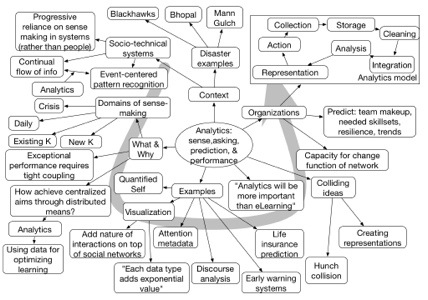
George Siemens delivered an enlightening talk contextualizing analytics, tying the need for more effective coupling in decision making with new types of data.

20120606-140617.jpg

Tony O’Driscoll #iel12 Keynote Mindmap

6 June 2012 by Clark Leave a Comment

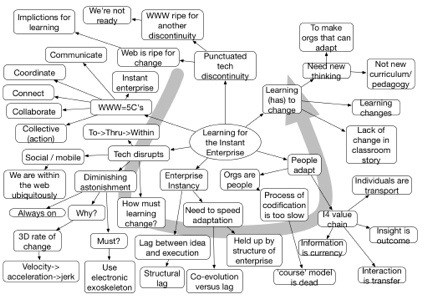
Tony O’Driscoll kicked off the Innovations in eLearning Symposium with an entertaining and apt tour of the changes in business owing to information change, and the need to adapt. My take was that organizations have to become in a more organic relationship with their ecosystem by empowering their people to engage and act. His final message was that the learning community are the folks who have to figure this out and engage.

20120606-093410.jpg

Taking the step

6 June 2012 by Clark 3 Comments

A while ago, I wrote an article in eLearnMag, stating that better design doesn’t take longer.  In it, I suggested that while there would be an initial hiccup, eventually better design doesn’t take longer: the analysis process is different, but no less involved, the design process is deeper but results in less overall writing, and of course the development is largely the same.    And I’m interested in exposing what I mean by the hiccup.

What surprised me is that I haven’t seen more movement.  Of course, if you’re a one-person shop, the best  you could probably do is attend a ‘Deeper ID’ workshop.  But if you’re producing content on a reasonable scale, you should realize that there are several reasons you should be taking this on.

Most importantly, it’s for effectiveness.  The learning I see coming out of not only training shops and custom content houses, but also internal units, is just not going to make a difference.  If you’re providing knowledge and a knowledge test, I don’t care how well produced it is, it’s not going to make a difference.  This is core to a unit’s mission, it seems to me.

It’s also a case of “not if, but when” when someone is going to come in with an effective competing approach.  If you can’t do better, you’re going to be irrelevant. If you’re producing for others, your market will be eaten. If you’re producing internally, your job will be outsourced.

Overall, it’s about not just surviving, but thriving.

Yes, the nuances are subtle, and it’s still possible to sell well-produced but not well-designed material, but that can’t last.  People are beginning to wake up to the business importance of effective investments in learning, and the emergence of alternate models (Khan Academy, MOOCs, the list goes on) is showing new ways that will have people debating approaches.  It may take a while, but why not get the jump on it?

And it’s not about just running a workshop. I do those, and like to do them, but I never pretend that they’re going to make as big a difference as could be achieved. They can’t, because of the forgetting curve.  What would make a big difference isn’t much more, however.  It’s about reactivating that knowledge and reapplying.

What I envision (and excuse me if I make this personal, but hey, it’s what I do and have done successfully) is getting to know the design processes beforehand, and customizing the workshop to your workflow: your business, your processes of working with SMEs, your design process, your tools, and representative samples of existing work. Then we run a workshop where we use your examples. Working through the process, exploring the deeper concepts, putting them into practice, and reflecting to cement the learning.  Probably a day.  People have found this valuable in an of itself.

However, I want to take it just a step further. I’ve found that being sent samples of subsequent work and commenting on it in several joint sessions is what makes the real difference.  This reactivates the knowledge, identifies the ongoing mistakes, and gives a chance to remediate them.  This is what makes it stick, and leads to meaningful change.  You have to manage this in a non-threatening way, but that’s doable.

There are more intrusive, higher-overhead ways, but I’m trying to strike a balance between high value and minimal intensiveness to make a pragmatic but successful change.  I’d bet that 90% of the learning being developed could be improved by this approach (which means that 90% of the learning being developed really isn’t a worthwhile investment!).  It seems so obvious, but I’m not seeing the interest in change.  So, what am I missing?

Positive Payload Weapons Presentation Mindmap

25 May 2012 by Clark Leave a Comment

The other evening I went off to hear an intriguing sounding presentation on Positive Payload Weapons by Margarita Quihuis (who really just introduced the session) and Mark Nelson. As I sometimes do, I mind mapped it.

Positive Payload Weapons presentation mind map

I have to say it’s an intriguing framework, but it appeared that they’ve not yet really put it into practice.  In short, as the diagram in the lower right suggests, weapons have evolved to do more damage at greater range (from knives one on one to atomic bombs across the world). What could we do to evolve doing more good at greater range?  From personal kudos to, well, that’s the open question.  They cited the Israel-Iran  Love Bombs  as an example, and the tactical  response.

Oh, yeah, the drug part is the serotonin you get from doing positive things (or something like that).

« Previous Page
Next Page »

Clark Quinn

The Company

Search

Feedblitz (email) signup

Never miss a post
Your email address:*
Please wait...
Please enter all required fields Click to hide
Correct invalid entries Click to hide

Pages

  • About Learnlets and Quinnovation

The Serious eLearning Manifesto

Manifesto badge

Categories

  • design
  • games
  • meta-learning
  • mindmap
  • mobile
  • social
  • strategy
  • technology
  • Uncategorized
  • virtual worlds

License

Previous Posts

  • March 2026
  • February 2026
  • January 2026
  • December 2025
  • November 2025
  • October 2025
  • September 2025
  • August 2025
  • July 2025
  • June 2025
  • May 2025
  • April 2025
  • March 2025
  • February 2025
  • January 2025
  • December 2024
  • November 2024
  • October 2024
  • September 2024
  • August 2024
  • July 2024
  • June 2024
  • May 2024
  • April 2024
  • March 2024
  • February 2024
  • January 2024
  • December 2023
  • November 2023
  • October 2023
  • September 2023
  • August 2023
  • July 2023
  • June 2023
  • May 2023
  • April 2023
  • March 2023
  • February 2023
  • January 2023
  • December 2022
  • November 2022
  • October 2022
  • September 2022
  • August 2022
  • July 2022
  • June 2022
  • May 2022
  • April 2022
  • March 2022
  • February 2022
  • January 2022
  • December 2021
  • November 2021
  • October 2021
  • September 2021
  • August 2021
  • July 2021
  • June 2021
  • May 2021
  • April 2021
  • March 2021
  • February 2021
  • January 2021
  • December 2020
  • November 2020
  • October 2020
  • September 2020
  • August 2020
  • July 2020
  • June 2020
  • May 2020
  • April 2020
  • March 2020
  • February 2020
  • January 2020
  • December 2019
  • November 2019
  • October 2019
  • September 2019
  • August 2019
  • July 2019
  • June 2019
  • May 2019
  • April 2019
  • March 2019
  • February 2019
  • January 2019
  • December 2018
  • November 2018
  • October 2018
  • September 2018
  • August 2018
  • July 2018
  • June 2018
  • May 2018
  • April 2018
  • March 2018
  • February 2018
  • January 2018
  • December 2017
  • November 2017
  • October 2017
  • September 2017
  • August 2017
  • July 2017
  • June 2017
  • May 2017
  • April 2017
  • March 2017
  • February 2017
  • January 2017
  • December 2016
  • November 2016
  • October 2016
  • September 2016
  • August 2016
  • July 2016
  • June 2016
  • May 2016
  • April 2016
  • March 2016
  • February 2016
  • January 2016
  • December 2015
  • November 2015
  • October 2015
  • September 2015
  • August 2015
  • July 2015
  • June 2015
  • May 2015
  • April 2015
  • March 2015
  • February 2015
  • January 2015
  • December 2014
  • November 2014
  • October 2014
  • September 2014
  • August 2014
  • July 2014
  • June 2014
  • May 2014
  • April 2014
  • March 2014
  • February 2014
  • January 2014
  • December 2013
  • November 2013
  • October 2013
  • September 2013
  • August 2013
  • July 2013
  • June 2013
  • May 2013
  • April 2013
  • March 2013
  • February 2013
  • January 2013
  • December 2012
  • November 2012
  • October 2012
  • September 2012
  • August 2012
  • July 2012
  • June 2012
  • May 2012
  • April 2012
  • March 2012
  • February 2012
  • January 2012
  • December 2011
  • November 2011
  • October 2011
  • September 2011
  • August 2011
  • July 2011
  • June 2011
  • May 2011
  • April 2011
  • March 2011
  • February 2011
  • January 2011
  • December 2010
  • November 2010
  • October 2010
  • September 2010
  • August 2010
  • July 2010
  • June 2010
  • May 2010
  • April 2010
  • March 2010
  • February 2010
  • January 2010
  • December 2009
  • November 2009
  • October 2009
  • September 2009
  • August 2009
  • July 2009
  • June 2009
  • May 2009
  • April 2009
  • March 2009
  • February 2009
  • January 2009
  • December 2008
  • November 2008
  • October 2008
  • September 2008
  • August 2008
  • July 2008
  • June 2008
  • May 2008
  • April 2008
  • March 2008
  • February 2008
  • January 2008
  • December 2007
  • November 2007
  • October 2007
  • September 2007
  • August 2007
  • July 2007
  • June 2007
  • May 2007
  • April 2007
  • March 2007
  • February 2007
  • January 2007
  • December 2006
  • November 2006
  • October 2006
  • September 2006
  • August 2006
  • July 2006
  • June 2006
  • May 2006
  • April 2006
  • March 2006
  • February 2006
  • January 2006

Amazon Affiliate

Required to announce that, as an Amazon Associate, I earn from qualifying purchases. Mostly book links. Full disclosure.

We use cookies to ensure that we give you the best experience on our website. If you continue to use this site we will assume that you are happy with it.