Learnlets

Secondary

Clark Quinn’s Learnings about Learning

Search Results for: align

70:20:10 Tech

6 March 2012 by Clark 3 Comments

At the recent Up To All Of Us event (#utaou), someone asked about the 70:20:10 model.  As you might expect, I mentioned that it’s a framework for thinking about supporting people at work, but it also occurred to me that there might be a reason folks have not addressed the 90, because, in the past, there might have been little that they could do. But that’s changed.

In the past, other than courses, there was little at could be done except providing courses on how to coach, and making job aids.  The technology wasn’t advanced enough.  But that’s changed.
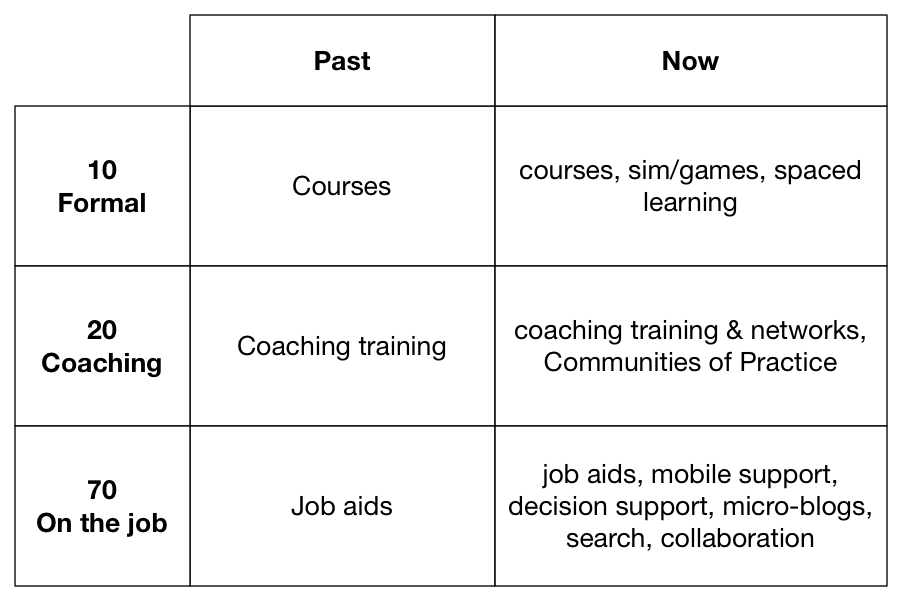
Tech help by 70:20:10 stageWhat has changed are several things.  One is the rise of social networking tools: blogs, micro-blogs, wikis, and more. The other is the rise of mobile.  Together, we can be supporting the 90 in fairly rich ways.

For the 20, coaching and mentoring, we can start delivering that wherever needed, via mobile.  Learners can ask for, or even be provided, support more closely tied to their performance situations regardless of location.  We can also have a richer suite of coaching and mentoring happening through Communities of Practice, where anyone can be a coach or mentor, and be developed in those roles, too.  Learner activity can be tracked, as well, leaving traces for later review.

For the 70, we can first of all start providing rich job aids wherever and whenever, including a suite of troubleshooting information and even interactive wizards.  We also can have help on tap freed of barriers of time and distance.  We can look up information as well, if our portals are well-designed.  And we can find people to help, whether information or collaboration.

The point is that we no longer have limits in the support we can provide, so we should stop having limits in the help we *do* provide.

Yes, other reasons could still also be that folks in the L&D unit know how to do courses, so that’s their hammer making everything look like a nail, or they don’t see it as their responsibility (to which I respond “Who else? Are you going to leave it to IT? Operations?”). That *has* to change. We can, and should, do more.  Are you?
UTAOU Sunday mindmap

27 February 2012 by Clark 1 Comment

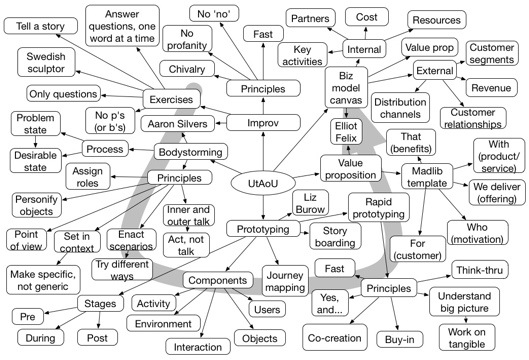
My mindmap of Sunday’s activities at Up To All Of Us.

20120227-075646.jpg

UTAOU Saturday Mindmap

26 February 2012 by Clark 1 Comment

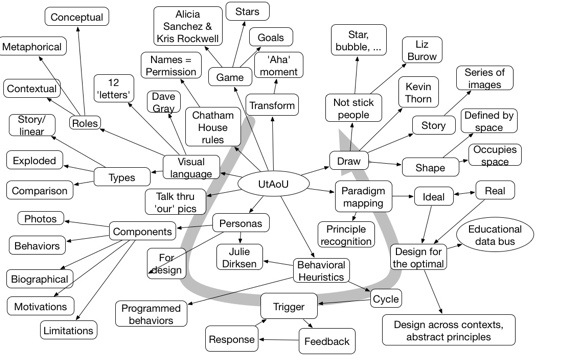
Here is my mindmap of the group sessions on Saturday from the Up To All Of Us event.

20120226-115747.jpg

Making it visible and viral

22 February 2012 by Clark 2 Comments

On a recent client engagement, the issue was spreading an important initiative through the organization.  The challenges were numerous: getting consistent uptake across management and leadership, aligning across organizational units, and making the initiative seem important and yet also doable in a concrete way.  Pockets of success were seen, and these are of interest.

For one, the particular unit had focused on making the initiative viral, and consequently had selected and trained appropriate representatives dispersed through their organization. These individuals were supported and empowered to incite change wherever appropriate.  And they were seeing initial signs of success. The lesson here is that top down is not always sufficient, and that benevolent infiltration is a valuable addition.

The other involvement was also social, in that the approach was to make the outcomes of the initiative visible. In addition to mantras, graphs depicting status were placed in prominent places, showing current status.  Further, suggestions for improvement were not only solicited, but made visible and their status tracked.  Again, indicators were positive on these moves.

The point is that change is hard, and a variety of mechanisms may  be appropriate.  You need to understand not just what formal mechanisms you have, but also how people actually work.  I think that too often, planning fails to anticipate the effects of inertia, ambivalence, and apathy.  More emotional emphasis is needed, more direct connection to individual outcomes, and more digestion into manageable chunks. This is true for elearning, learning, and  change.

In looking at attitude change, and from experience, I recognize that even if folks are committed to change, it can be easy to fall back into old habits without ongoing support.  Confusion in message, lack of emotional appeal, and idiosyncratic leadership only reduce the likelihood.  If it’s important, get alignment and sweat the details. If it’s not, why bother?

Social media budget line item?

13 February 2012 by Clark 3 Comments

Where does social media fit in the organization?  In talking with a social media entrepreneur over beers the other day, he mentioned that one of his barriers in dealing with organizations was that they didn’t have a budget line for social media software.

That may sound trivial, but it’s actually a real issue in terms of freeing up the organization. In one instance, it had been the R&D organization that undertook the cost.  In another case, the cost was attributed to the overhead incurred in dealing with a merger.  These are expedient, but wrong.

It’s increasingly obvious that it’s more than just a ‘nice to have’.  As I’ve mentioned previously, innovation is the only true differentiator.  If that’s the case, then social media is critical. Why?  Because the myth of individual innovation is busted, as clearly told by folks like  Keith Sawyer  and Steven Berlin Johnson.  So, if it’s not individual, it’s social, and that means we need to facilitate conversations.

If we want people to be able to work together to create new innovations, we don’t want to leave it to chance.  In addition to useful architectural efforts that facilitate in person interactions, we want to put in place the mechanisms to interact without barriers of time or distance.  Which means, we need a social media system.

It’s pretty clear that if you align things appropriately: culture, vision, tools, that you get better outcomes.  And, of course, culture isn’t a line item, and vision’s a leadership mandate.  But tools, well, they are a product/service, and need resources.

Which brings us to the initial point: where does this responsibility lie?  Despite my desire for folks who are most likely to understand facilitating learning (though that’s sadly unlikely in too many L& D departments), it could be IT, operations, or as mentioned above, R&D.  The point is, this is arguably one of the most important investments in the organization, and typically not one of the most expensive (making it the best deal going!). Yet there’s not a unified obvious home!

There are worries if it’s IT. They are, or should be, great at maintaining network uptime, but don’t really understand learning. Nor do the other groups, and yet facilitating the discussion in the network is the most important external role.  But who funds it?

Let’s be real; no one wants  to have to own the cost when there’re other things they’re already doing. But I’d argue that it’s the best investment an L&D organization could make, as it will likely have the biggest impact on the organization. Well, if you really are looking to move needles on key business metrics.  So, where do you think it could, and should reside?


Meta-mobile

2 February 2012 by Clark 3 Comments

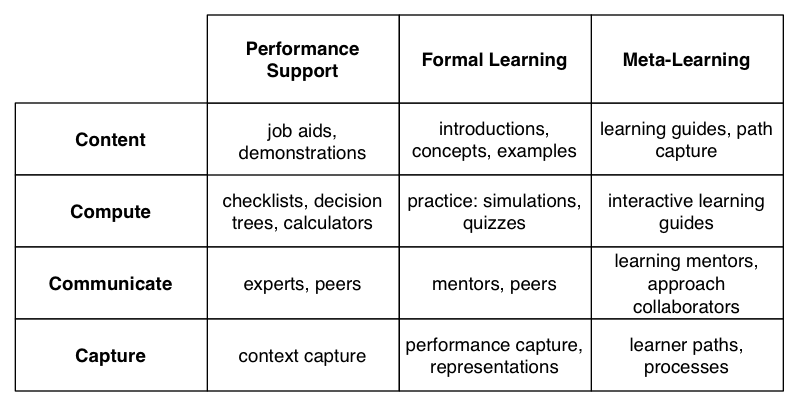
As a followup to my last post, I was thinking how you would use the different modes of mobile (the Four C’s): Content, Compute, Communicate, & Capture, to support the different layers of learning.

4C's by learning modeHere I’ve made a first attempt at trying to matrix the 3 layers of learning (performance, learning, meta-learning) by the 4 C’s of mobile.  It’s indicative, not exhaustive, but it helps me to try to get concrete about what you might do.

As you can see, there’s some overlap, and one questions is are there continuums between the layers. Is performance support categorically different than formal learning, or are their bridges?  Is meta-learning categorically different?  (I’m not sure I care too much, as long as I’m considering all!)

So, in the interest of learning and thinking ‘out loud’, I invite your feedback.

Layers of learning

1 February 2012 by Clark 3 Comments

As I think about slow learning and Sage at the Side, I want to think about a continuum of tech-enablement. I want to include performance support, formal learning, and meta-learning. One way to think about it is layering on support across the learning event.

Layering learning on top of eventsAs I talked about in Making Slow Learning Concrete, the idea is to have little bits of information layered on top of what you’re doing. Thus, the first level might be to have performance support, to optimize the outcome of the event.

However, a second layer, potentially wrapped before and after the event, would be to connect the essence of the performance to a learning framework. Perhaps not all events would have it, but it would connect the event: context and goals, to a learning framework.  It could be a conceptual model, and certainly could be feedback.

A third layer would be a meta-learning layer.  Looking at any resources used (and perhaps a different one this time than the last), some information could be provided that helped the learner understand their own learning.  It could be reflection support, a map of the learner’s actions, even connecting to a learning mentor, whatever would help them look at how they learned with the purposes of improving their own learning.

With this approach, we start de-coupling learning from a particular event, and start wrapping learning around our lives. I’ve used the label ‘slow learning’, but I really believe that this will feel slower, but actually will accelerate learners to competence faster than the ineffective methods we currently are using.  Lots of tuning to make an experience that feels natural and supportive, as opposed to intrusive, and some real system architecture issues, but I think this is doable, and certainly worth exploring.

Stop creating, selling, and buying garbage!

12 January 2012 by Clark 14 Comments

I was thinking today (on my plod around the neighborhood) about how come we’re still seeing so much garbage elearning (and frankly, I had a stronger term in mind).  And it occurred to me that their are multitudinous explanations, but it’s got to stop.

One of the causes is unenlightened designers. There are lots of them, for lots of reasons: trainers converted, lack of degree, old-style instruction, myths, templates, the list goes on. You know, it’s not like one dreams of being an instructional designer as a kid.  This is not to touch on their commitment, but even if they did have courses, they’d likely still not be exposed to much about the emotional side, for instance. Good learning design is not something you pick up in a one week course, sadly.  There are heuristics (Cat Moore’s Action mapping, Julie Dirksen’s new book), but the necessary understanding of the importance of the learning design isn’t understood and valued.  And the pressures they face are overwhelming if they did try to change things.

Because their organizations largely view learning as a commodity. It’s seen as a nice to have, not as critical to the business.  It’s about keeping the cost down, instead of looking at the value  of improving the organization.  I hear tell of managers telling the learning unit “just do that thing you do” to avoid a conversation about actually looking at whether a course is the right solution, when they do try!  They don’t know how to hire the talent they really need, it’s thin on the ground, and given it’s a commodity, they’re unlikely to be willing to really develop the necessary competencies (even if they knew what they are).

The vendors don’t help. They’ve optimized to develop courses cost-effectively, since that’s what the market wants. When they try to do what really works, they can’t compete on cost with those who are selling nice looking content, with mindless learning design.  They’re in a commodity market, which means that they have to be efficiency oriented.  Few can stake out the ground on learning outcomes, other than an Allen Interactions perhaps (and they’re considered ‘expensive’).

The tools are similarly focused on optimizing the efficiency of translating PDFs and Powerpoints into content with a quiz. It’s tarted up, but there’s little guidance for quality.  When it is, it’s old school: you must have a Bloom’s objective, and you must match the assessment to the objective. That’s fine as far as it goes, but who’s pushing the objectives to line up with business goals?  Who’s supporting aligning the story with the learner? That’s the designer’s job, but they’re not equipped.  And tarted up quiz show templates aren’t the answer.

Finally, the folks buying the learning are equally complicit. Again, they don’t know the important distinctions, so they’re told it’s soundly instructionally designed, and it looks professional, and they buy the cheapest that meets the criteria.  But so  much is coming from broken objectives, rote understanding of design, and other ways it can go off the rails, that most of it is a waste of money.

Frankly, the whole design part is commoditized.  If you’re competing on the basis of hourly cost to design, you’re missing the point. Design is critical, and the differences between effective learning and clicky-clicky-bling-bling  are subtle.  Everyone gets paying for technology development, but not the learning design.  And it’s wrong.  Look, Apple’s products are fantastic technologically, but they get the premium placing by the quality of the experience, and that’s coming from the design.  It’s the experience and outcome that matters, yet no one’s investing in learning on this basis.

It’s all understandable of course (sort of like the situation with our schools), but it’s not tolerable.  The costs are high:meaningless  jobs, money spent for no impact, it’s just a waste.  And that’s just for courses; how about the times the analysis isn’t done that might indicate some other approach?  Courses cure all ills, right?

I’m not sure what the solution is, other than calling it out, and trying to get a discussion going about what really matters, and how to raise the game. Frankly, the great examples are all too few. As I’ve already pointed out in a previously referred post, the awards really aren’t discriminatory. I think folks like the eLearning Guild are doing a good job with their DevLearn showcase, but it’s finger-in-the-dike stuff.

Ok, I’m on a tear, and usually I’m a genial malcontent.   But maybe it’s time to take off the diplomatic gloves, and start calling out garbage when we see it.  I’m open to other ideas, but I reckon it’s time to do something.

Performance Architecture

6 January 2012 by Clark 3 Comments

I’ve been using the tag ‘learning experience design strategy’ as a way to think about not taking the same old approaches of events  Ã¼ber ales.  The fact of the matter is that we’ve quite a lot of models and resources to draw upon, and we need to rethink what we’re doing.

The problem is that it goes far beyond just a more enlightened instructional design, which of course we need.  We need to think of content architectures, blends between formal and informal, contextual awareness, cross-platform delivery, and more.  It involves technology systems, design processes, organizational change, and more.  We also need to focus on the bigger picture.

Yet the vision driving this is, to me, truly inspiring: augmenting our performance in the moment and developing us over time in a seamless way, not in an idiosyncratic and unaligned way.  And it is strategic, but I’m wondering if architecture doesn’t better capture the need for systems and processes as well as revised design.

This got triggered by an exercise I’m engaging in, thinking how to convey this.  It’s something along the lines of:

The curriculum’s wrong:

  • it’s not knowledge objectives, it’s skills
  • it’s not current needs, it’s adapting to change
  • it’s not about being smart, it’s about being wise

The pedagogy’s wrong:

  • it’s not a flood, but a drip
  • it’s not knowledge dump, it’s decision-making
  • it’s not expert-mandated, instead it’s learner-engaging
  • it’s not ‘away from work’, it’s in context

The performance model is wrong:

  • it’s not all in the head, it’s distributed across tools and systems.
  • it’s not all facts and skill, it’s motivation and confidence
  • it’s not independent, it’s socially developed
  • it’s not about doing things right, it’s about doing the right thing

The evaluation is wrong:

  • it’s not seat time, it’s business outcomes
  • it’s not efficiency, at least until it’s effective
  • it’s not about normative-reference, it’s about criteria

So what does  this look like in practice?   I think it’s about a support system organized so that it recognizes what you’re trying to do, and provides possible help.  On top of that, it’s about showing where the advice comes from, developing understanding as an additional light layer.  Finally, on top of that, it’s about making performance visible and looking at the performance across the previous level, facilitating learning to learn. And, the underlying values are also made clear.

It doesn’t have to get all that right away.  It can start with just better formal learning design, and a bit of content granularity. It certainly starts with social media involvement.  And adapting the culture in the org to start developing meta-learning.  But you want to have a vision of where you’re going.

And what does it take to get here?  It needs a new design that starts from the performance gap and looks at root causes. The design process then onsiders what sort of experience would both achieve the end goal and the gaps in the performer equation (including both technology aids and knowledge and skill upgrades), and consider how that develops over time recognizing the capabilities of both humans and technology, with a value set that emphasis letting humans do the interesting work.  It’ll also take models of content, users, context, and goals, with a content architecture and a flexible delivery model with rich pictures of what a learning experience might look like and what learning resources could be.  And an implementation process that is agile, iterative, and reflective, with contextualized evaluation.  At least, that sounds right to me.

Now, what sounds right to you: learning experience design strategy, performance system design, performance architecture, <your choice here>?


Reflections 2011

21 December 2011 by Clark 1 Comment

On this, the shortest day of the year here in the northern hemisphere, it seems like a good time to reflect on the past year and look forward to the coming one.  It’s certainly been an interesting year, and a good one personally.  I feel there are lots of reasons to hope for good things to be coming too.  The opportunities are big.

First of all, mobile really has taken off.  I know that many people are still wondering about how to take advantage of mobile, but awareness of the opportunities are growing. I’ve conducted several mobile brainstorming sessions with clients who have started with some apps and are looking to go further. I think more should be thinking about mobile from a strategy perspective as well.  While an initial initiative or two is ok, you have to recognize that mobile is a platform upon which solutions are created, and consequently the approach should go beyond just individual development efforts.  Still, the benefits of supporting workers wherever and whenever they are can make some big impacts on organizational outcomes.

Another area of excitement is social and informal learning. Even firms that have big concerns about security and government scrutiny are finding that they need to address it, and are beginning steps. Hey, if the CIA can deal with it, your organization can.  With the ITA in particular we have been successful in getting some traction in this area, and hope to help more organizations come to grips in the coming year.  The chance to really accelerate innovation and more is hard to ignore.

And I personally am excited about more activity around content: about more quality design, more structure around the content, and more awareness of the need for architectural work around it. I was thrilled to hear more discussion about this in a number of forums, and I think the opportunities to capitalize on finely granulated and articulated content will provide flexibility and personalization going forward.

Finally, it does appear more organizations are getting the message about moving to a strategic position in terms of learning technology.  And, of course, that means getting strategic about learning (big ‘L’ learning), and then aligning with the overall organization strategy. Of course, such an effort will not only result in better outcomes for the organization but also more credibility for the L&D group.

I’m really grateful to all those who’ve had a role in the past year (and in my past, period) in co-developing new understandings, and I look forward to more opportunities in the coming year.


« Previous Page
Next Page »

Clark Quinn

The Company

Search

Feedblitz (email) signup

Never miss a post
Your email address:*
Please wait...
Please enter all required fields Click to hide
Correct invalid entries Click to hide

Pages

  • About Learnlets and Quinnovation

The Serious eLearning Manifesto

Manifesto badge

Categories

  • design
  • games
  • meta-learning
  • mindmap
  • mobile
  • social
  • strategy
  • technology
  • Uncategorized
  • virtual worlds

License

Previous Posts

  • March 2026
  • February 2026
  • January 2026
  • December 2025
  • November 2025
  • October 2025
  • September 2025
  • August 2025
  • July 2025
  • June 2025
  • May 2025
  • April 2025
  • March 2025
  • February 2025
  • January 2025
  • December 2024
  • November 2024
  • October 2024
  • September 2024
  • August 2024
  • July 2024
  • June 2024
  • May 2024
  • April 2024
  • March 2024
  • February 2024
  • January 2024
  • December 2023
  • November 2023
  • October 2023
  • September 2023
  • August 2023
  • July 2023
  • June 2023
  • May 2023
  • April 2023
  • March 2023
  • February 2023
  • January 2023
  • December 2022
  • November 2022
  • October 2022
  • September 2022
  • August 2022
  • July 2022
  • June 2022
  • May 2022
  • April 2022
  • March 2022
  • February 2022
  • January 2022
  • December 2021
  • November 2021
  • October 2021
  • September 2021
  • August 2021
  • July 2021
  • June 2021
  • May 2021
  • April 2021
  • March 2021
  • February 2021
  • January 2021
  • December 2020
  • November 2020
  • October 2020
  • September 2020
  • August 2020
  • July 2020
  • June 2020
  • May 2020
  • April 2020
  • March 2020
  • February 2020
  • January 2020
  • December 2019
  • November 2019
  • October 2019
  • September 2019
  • August 2019
  • July 2019
  • June 2019
  • May 2019
  • April 2019
  • March 2019
  • February 2019
  • January 2019
  • December 2018
  • November 2018
  • October 2018
  • September 2018
  • August 2018
  • July 2018
  • June 2018
  • May 2018
  • April 2018
  • March 2018
  • February 2018
  • January 2018
  • December 2017
  • November 2017
  • October 2017
  • September 2017
  • August 2017
  • July 2017
  • June 2017
  • May 2017
  • April 2017
  • March 2017
  • February 2017
  • January 2017
  • December 2016
  • November 2016
  • October 2016
  • September 2016
  • August 2016
  • July 2016
  • June 2016
  • May 2016
  • April 2016
  • March 2016
  • February 2016
  • January 2016
  • December 2015
  • November 2015
  • October 2015
  • September 2015
  • August 2015
  • July 2015
  • June 2015
  • May 2015
  • April 2015
  • March 2015
  • February 2015
  • January 2015
  • December 2014
  • November 2014
  • October 2014
  • September 2014
  • August 2014
  • July 2014
  • June 2014
  • May 2014
  • April 2014
  • March 2014
  • February 2014
  • January 2014
  • December 2013
  • November 2013
  • October 2013
  • September 2013
  • August 2013
  • July 2013
  • June 2013
  • May 2013
  • April 2013
  • March 2013
  • February 2013
  • January 2013
  • December 2012
  • November 2012
  • October 2012
  • September 2012
  • August 2012
  • July 2012
  • June 2012
  • May 2012
  • April 2012
  • March 2012
  • February 2012
  • January 2012
  • December 2011
  • November 2011
  • October 2011
  • September 2011
  • August 2011
  • July 2011
  • June 2011
  • May 2011
  • April 2011
  • March 2011
  • February 2011
  • January 2011
  • December 2010
  • November 2010
  • October 2010
  • September 2010
  • August 2010
  • July 2010
  • June 2010
  • May 2010
  • April 2010
  • March 2010
  • February 2010
  • January 2010
  • December 2009
  • November 2009
  • October 2009
  • September 2009
  • August 2009
  • July 2009
  • June 2009
  • May 2009
  • April 2009
  • March 2009
  • February 2009
  • January 2009
  • December 2008
  • November 2008
  • October 2008
  • September 2008
  • August 2008
  • July 2008
  • June 2008
  • May 2008
  • April 2008
  • March 2008
  • February 2008
  • January 2008
  • December 2007
  • November 2007
  • October 2007
  • September 2007
  • August 2007
  • July 2007
  • June 2007
  • May 2007
  • April 2007
  • March 2007
  • February 2007
  • January 2007
  • December 2006
  • November 2006
  • October 2006
  • September 2006
  • August 2006
  • July 2006
  • June 2006
  • May 2006
  • April 2006
  • March 2006
  • February 2006
  • January 2006

Amazon Affiliate

Required to announce that, as an Amazon Associate, I earn from qualifying purchases. Mostly book links. Full disclosure.

We use cookies to ensure that we give you the best experience on our website. If you continue to use this site we will assume that you are happy with it.