Learnlets

Secondary

Clark Quinn’s Learnings about Learning

Search Results for: align

Social Media Metrics

1 February 2011 by Clark 4 Comments

I continue to get asked about social learning metrics.   Until we get around to a whitepaper or something on metrics, here’re some thoughts:

Frankly, the problem with Kirkpatrick (sort of like with LMS’ and ADDIE, *drink*) is not in the concept, but in the execution.   As he would say, stopping at level 1 or 2 is worthless.   You need to start with Level 4, and work back.   This is true whether you’re talking about formal learning, informal learning, or whatever. Then, I’m not feeling like you have to be anal about levels 1-3, it’s level 4 that matters, but there’s plausibility that making the link makes your case stronger.   And I also like what I heard added at a client meeting: level 0, are they even taking the course/accessing the system?   But I digress…

So, let’s say you are interested in seeing what social media can do for your organization: what are you not seeing but need to?   If you’re putting in a social media system into a call center, maybe you want reduced time to problem solution, fewer customer return calls on the same problem, etc.   If you’re into an operations group, maybe you want more service or product ideas.   What is it you’re trying to achieve?   What would indicate the innovation that you’re looking to spark?
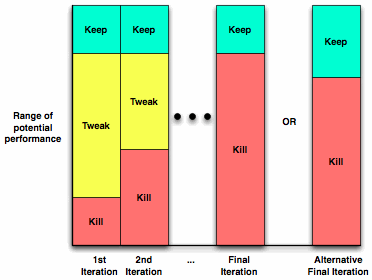
Parameters for keep,  tweak, or killThen, you need to find ways to measure those outcomes. You have three basic decisions to make in terms of a strategic initiative:

  • it’s working, yay, let’s keep it.
  • hmm, it’s kinda working, but we need to tweak it
  • oh oh, this is bleeding money, let’s kill it

You should set parameters before you launch the initiative that you think indicate the thresholds you are talking about.   The keep and kill thresholds likely have to do with the costs versus the benefits.   You may change those parameters on inspection of the results at any time, but at least you are doing it consciously.   And gradually your patience will or should fade.   Eventually you end up with either a leave or kill decision.

Frankly, even activity is a metric.   A vendor of a social media system uses that as a metric for billing (though I don’t think that two touches a month constitutes a meaningful interaction by a user), and if people are talking productively and getting value, you’ve got at least an argument that intangible benefits are being generated.   You could couple that with subjective evaluation of value, but overall I would like to argue for more meaningful outcomes.

And don’t think that you have to have only one. Depending on the size of the initiative and the different silos that are being integrated, you might have more.   You might check not only key business metrics, but look for impacts on retention and morale as well, if the benefits of improving work environments are to believed (and I do).   And, of course, there’s more than the installation and measuring: the tweaking for instance could involve messaging, culture, interface design, or more.

Metrics for informal learning aren’t rocket science, but instead mapping of best principles into specific contexts.   Your organization needs to find ways to facilitate social learning, as the innovation outcomes are the key differentiator going forward, as so many say.   You should be experimenting, but with impacts you’d like to have, not just on faith.
Roger Schank keynote mindmap

26 January 2011 by Clark 1 Comment

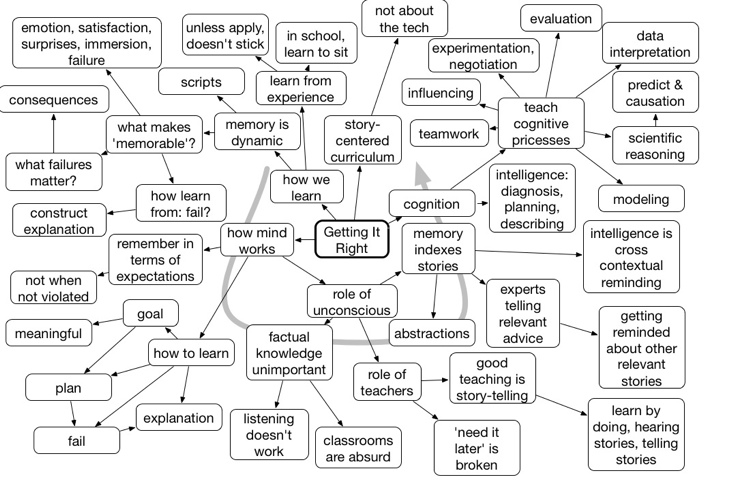
Today, Roger Schank keynoted the Learning Technologies UK conference, talking about cognitive science and learning. Obviously, I was in large agreement. And, as usual, I mid mapped it:

Talking on Games at Learning Technologies UK (26-27 Jan)

13 January 2011 by Clark 5 Comments

On short notice, I’ll be speaking on games at the UK’s Learning Technologies conference at the end of the month.   I’ve heard great things and always wanted to go, and now I get to.

I’ve met and talked with Donald Taylor, who manages it, and he instill confidence in the quality of the conference.   And looking at the lineup of speakers, I’m impressed and eager.   I see folks I’ve wanted to hear and meet (Cathy Moore and Clive Shepherd, for two), folks I know and want to spend more time with, and new folks to find out about.

And I’m keen to revisit games.   It’s been six years (!) since I put up my take on designing learning games, but I have continued to look at what’s out there.   And I mmodestly think that while there are some really great books out there, none really provides any improvement in what I focused on: why learning can and should be hard fun.

In particular, the alignment between what makes engaging experiences and what makes effective education practice is still the best model I’ve found to frame design, and my design process still provides systematic and pragmatic guidance about how to design them.   After all, it’s all well and good to talk about how wonderful games can be, but if you can’t reliably and repeatably do that for any learning objective, it’s kind of a waste. And I stick to my claim that you can’t give me a learning objective I can’t design a game for, but I reserve the right to raise the objective ‘high’ enough (in the taxonomic sense).

I truly believe games are important.   They are, quite simply, the best practice environment you can provide to develop the learning outcomes that will make a difference to your organization: the ability to make the right decisions.   Ok, the best next to mentored live practice, but that has problems of scale; mentors are hard to clone, and live practice can be costly.   Games can also serve as assessment environments.

So, I encourage you to attend the conference if you can, it looks quite good. And, if you do, I hope you introduce yourself.   Looking forward to it!

Happy New Year

3 January 2011 by Clark Leave a Comment

I have much to be grateful for at the start of this new year. I have had quite simply fabulous opportunities to engage, learn, and contribute. For that, I thank you.

I am always working to discover new ways to contribute, both alone as Quinnovation in learning experience design strategy, and with my colleagues in the Internet Time Alliance in helping organizations work smarter. I’m fortunate that a second book is due to be published on the 2nd of February, this time on mobile learning, to complement my first book on learning game design.

My latest thoughts are captured here, and I invite you to subscribe via RSS or email if you don’t already. It’s my alternative to a weekly ezine.

Fervent wishes for the coming year, hoping it is your best yet.

My path to ITA

22 December 2010 by Clark Leave a Comment

Internet Time Alliance logoAs my colleagues Harold and Jane have done, I thought I’d capture my learning journey that led me to the Internet Time Alliance.   I started out seeing the connection between computers and learning as an undergraduate, and designed my own degree. My first job out of college was designing and programming educational computer games, which led me back to graduate school and a Ph.D. in applied cognitive science to find out how to design learning solutions better.

That has been a recurrent theme across academic endeavors, some government-sponsored initiatives, and an internet startup: designing solutions that are innovative and yet pragmatic.   It was really brought home to me when we were recently discussing a new initiative, and while my colleagues were looking at the business opportunities, my mind was racing off figuring out how to design it.

This continued in my consulting, where I moved from designing the individual solutions to designing the processes and structures to reliably deliver quality learning experience design, what I’ve called learning experience design strategy.   However, as I’ve worked with organizations looking to move to the ‘next level’, as happened with and through some of my clients, I regularly found a recurrent pattern, that integrated formal learning with performance support and eCommunity (and some other steps).

So I was focusing on trying to help organizations look at the bigger picture.   And what I recognized is that most organizations were neglecting   eCommunity the most, yet as I learned more about this from my colleague Jay Cross, the social and informal learning were the big and missed opportunity. When Jay started talked about grouping together to address this part of the space, it made perfect sense to me.   The opportunities to have large impacts with challenging but not costly investments is a natural.   So here I am.   Based upon my previous work on games and now mobile, there are some design strategy opportunities that fall to Quinnovation, but I’m eager to help organizations through ITA as well.   Hope to talk to you in the new year about whatever is relevant for you from here.

Working Smarter Cracker Barrel

12 December 2010 by Clark Leave a Comment

My Internet Time Alliance colleague Harold Jarche is a clever guy. In preparation for an event, he makes a blog post to organize his thoughts. I like his thinking, so I’ll let him introduce my post:

Next week, at our Working Smarter event hosted by Tulser in Maastricht, NL, we will have a series of short sessions on selected topics. Each Principal of the Internet Time Alliance has three topics of 20 minutes to be discussed in small groups. My topics are listed below and include links to relevant posts as well as a short description of the core ideas behind each topic.

These are mine:

Mobile

Mobile ‘accessorizes‘ your brain.   It is about complementing what your brain does well by providing the capabilities that it does not do well (rote computation, distance communication, and exact detail), but wherever and whenever you are.   Given that our performers are increasingly mobile, it makes sense to deliver the capabilities where needed, not just at their desk.   The 4 C’s of mobile give us a guide to the capabilities we have on tap.

Working smarter is not just mobile capabilities, however, but also combining them to do even more interesting things.   The real win is when we capture the current situation, via GPS and clock/calendar, so we know where you are and what you are doing, to do things that are relevant in the context.

Even without that, however, there are big offerings on the table for informal learning, via access to resources and networks.

Social Formal Learning

Social learning is one of the big opportunities we are talking about in ‘working smarter’.   Most people tend to think of social learning in terms of the informal opportunities, which are potentially huge.   However, there are a couple of reasons to also think about the benefits of social learning from the formal learning perspective.

The first is the processing.   When you are asked to engage with others on a topic, and you have designed the topic well, you get tight cycles of negotiating understand, which elaborates the associations to make them persist better and longer.   You can have learners reflect and share those reflections, which is one meaningful form of processing, and then you can ask them to extend the relevant concepts by reviewing them in another situation together, asking them to come to a shared response. The best, of course, is when learners work together to discern how the concepts get applied in a particular context, by asking them to solve a problem together.

The additional benefit is the connection between formal and informal. You must use social learning tools, and by doing so you are developing the facility with the environment your performers should use in the workplace. You also have the opportunity to use the formal social learning as a way to introduce the learners into the communities of practice you can and should be building.

Performance Ecosystem (Workscape) Strategy

Looking at the individual components – performance support, formal learning, and informal learning – is valuable, but looking at them together is important as well, to consider the best path from where you are to where you want or need to go.   Across a number of engagements, a pattern emerged that I’ve found helpful in thinking about what we term workscapes (what I’ve also called performance ecosystems, PDF) in a systemic way.

You want to end up where you have a seamless performance environment oriented around the tasks that need to be accomplished, and having the necessary layers and components.   You don’t want to approach the steps individually, but with the bigger picture in mind, so everything you do is part of the path towards the end game.   Realizing, of course, that it will be dynamic, and you’ll want to find ways to empower your performers to take ownership.

Good to ‘go’

1 December 2010 by Clark Leave a Comment

Cover imageIt’s time for me to formally announce that the site for my forthcoming mobile learning book, Designing mLearning, is now live and ready to visit. On it, you’ll find the ‘about the book’ info, the gracious endorsements from some truly great and kind people, and more.
I’ll be speaking about the ideas quite a bit in the coming months.   I’ll be talking mobile at Online Educa in Berlin tomorrow, as well as presenting with my ITA colleagues on the future of organizational learning the day after.   I’ll be presenting a mobile design workshop at TechKnowledge in February, and more events are on the agenda (the Australasian Talent Conference in May in Sydney, and the Distance Teaching and Learning Conference in August in Wisconsin).

There will be an ebook, or so I’ve been promised (you have to admit that anything else would be, well, just crazy!). More info as it comes, but you can already pre-order the book through Amazon!   So, get going!

I hope to see you at one of the upcoming events, and if you get the book, I welcome your feedback.   I will have the first chapter available for download as soon as I can get it from the publisher.

And just a reminder, I still haven’t found a better guide to designing learning games than my previous book: Engaging Learning: Designing e-Learning Simulation Games. And I do keep track.

Death by reorg

22 November 2010 by Clark 1 Comment

Even if you haven’t experienced it, you’ve heard about it, seen it, and now it’s a epidemic. The familiar reorganization: changing management structures, reporting relationships, moving units around.   It can happen infrequently, but in many organizations it seems to be a regular occurrence: every 2 years, every year, or more frequently.   The expression ‘drive-by reorgs’ isn’t hard to countenance.

The reasons for reorganizations can be several, both pragmatic and political.   I remember reading a screed that suggests it’s inevitable: organizations will have to align to customers for a while, until efficiency falters, then they reorganize along operational lines until customer satisfaction drops.   Of course, there are the typical new manager reorganizations as well; it’s easy to hypothesize that they have to be seen to be doing something.   Even if, as Petronius Arbiter wrote about reorganization: “. . . a wonderful method it can be for creating the illusion of progress while producing confusion, inefficiency,and demoralization“.

However, it occurred to me to think that reorgs may be a symptom of an approach to management that’s seeing it’s last days.   My ITA colleagues have been talking about how we need to moving in a new direction, away from hierarchy to Jon Husband’s wirearchy.   Reorganizations restructure the top-down approach to guiding performance, where one person thinks for several.   The alternative is network approaches, where everyone understands the goals and is empowered to achieve the goals.

Really, if an organization is restructuring regularly, it’s probably a sign that it’s trying to adapt structurally to an environment that is increasingly chaotic.   And that approach just isn’t going to work anymore. Organizations have to become more flexible than rigid structures can accommodate, and more flexible management approaches are needed.

Seriously, Death by Reorganization (warning, PDF) is the potential endgame.   What is the alternative?   Creating a learning culture of trust and responsibility, empowered with resources, with leadership that embodies a clear vision and lives the sharing of learning.   Reorganizations could be the sign of failing leadership, rather than innovative leadership.   Where are you and your organization?

Higher^2 Education

15 November 2010 by Clark 3 Comments

I have just been at my first WCET conference, which is focused on higher ed distance eLearning. Mostly, it’s focused on those in the trenches, that is those who are charged with making it happen. This is not a bad thing, as these are good folks trying to do good work. What is missing, however, is a way to address the next level, and the one above that, in a systematic and effective way. And, yet, we must.

Let’s start with President Obama’s recent call to raise the level of US higher education.   And, frankly, there are more countries that need to heed the call of reforming post-secondary education.     I’ve talked before about the needed changes in higher ed, but even the short term changes are hard to see happening.

There were some inspiring talks, including Mark Milliron of the Gates Foundation, and a ‘debate’ between Peter Smith of Kaplan (and author of a new book on the topic of higher education) and David Longanecker of WICHE (WCET’s ‘parent’).   What became clear to me is that the goal of seriously raising the number of higher education graduates – whether associate, baccalaureate, or higher degrees – isn’t going to happen through incremental change. The problem is multi-faceted: the degrees available increasingly have little appeal, the pedagogies aren’t aligned to success, and the approaches don’t scale.

While the for-profit schools are providing competition to drive more market-focused courses, the time taken to get a program approved, and an institution accredited, provide barriers to being truly market-driven. That is of course, not the only goal, but things are moving faster than programs can be expected to cope.

I have to admit that I was also somewhat dismayed by a lack of pedagogical focus that mirrors the problems we see in corporate settings.   There seemed to be little leeway to challenge faculty members to raise quality levels of learning experience beyond just the traditional content model.

Finally, the resources dispersed across institutions are not well-aligned with a goal of pervasive quality that can be replicated across the curriculum.   Most institutions, even the big for-profits, seem to have approaches aligned for efficiency at the sake of effectiveness.

I admit big change is hard, but the stated goals are big, the need is big, and the opportunities are likewise.   It would take a massive infusion of resources, however, to make a big change within the system. Which led me, naturally, to think of a big change outside the system.

I started thinking about curricula as a separate thing from the learning activities (content and more), from the products of learning generated, and from the mentoring. In particular, the varied mentoring that would go into vetting the curricula, the choice of learning activities, and the feedback on the products.   The quick question is whether these could be disentangled from the academy.

Could we, in fact, either crowd source curricula or support self-definition and approval? Could the choice of resources and activities be scrutinized separately, both for quality and as an opportunity for lessons in becoming a self-capable learner in a discipline? Even system-selected?   And could the feedback on products come from an appropriate suite of stakeholders?

That’s a relatively radical proposition, I recognize, but when you need transformative outcomes, you may need transformative approaches…

More prosaically, I remain dismayed by the continuing lack of strategic thinking in higher education, particularly the public sector.   Small elements, like recognizing that the overall quality of teaching impacts an institution’s reputation, that devolving responsibility to domains will undermine a unified effort, that a systemic consideration of learning technology provides efficiencies as well as opportunities for effectiveness, etc. remain as missed opportunities.

What’s missing from what I see is a unified quality approach. What if Steve Job’s took on higher education? My take is that we’d see something like:

•     We will deliver a totally killer learning experience

•     We will not only develop your knowledge and skills, but you as a learner and performer

•     We will be a partner in your success

That, to me, is the value proposition that we can, and should, deliver. If we are not aligned with that, we are not really offering the services that an education provider should be shooting for.   Or an organization, for that matter.

So, are you aiming high enough? The time is now.

the Power of Pull

3 November 2010 by Clark 2 Comments

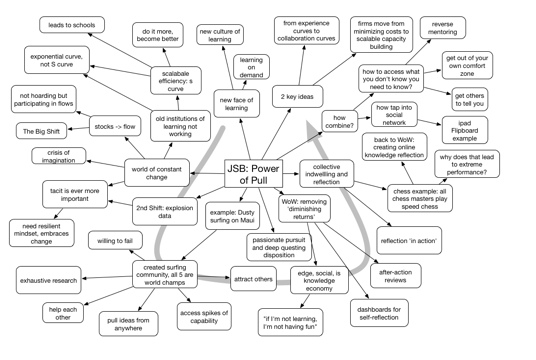
John Seely Brown has given the leading keynote to the DevLearn conference with an inspiring talk about how the world needs to move to scalable capacity building using collaboration (we’re totally in synch!)

John Seely Brown Keynote Power of Pull

« Previous Page
Next Page »

Clark Quinn

The Company

Search

Feedblitz (email) signup

Never miss a post
Your email address:*
Please wait...
Please enter all required fields Click to hide
Correct invalid entries Click to hide

Pages

  • About Learnlets and Quinnovation

The Serious eLearning Manifesto

Manifesto badge

Categories

  • design
  • games
  • meta-learning
  • mindmap
  • mobile
  • social
  • strategy
  • technology
  • Uncategorized
  • virtual worlds

License

Previous Posts

  • March 2026
  • February 2026
  • January 2026
  • December 2025
  • November 2025
  • October 2025
  • September 2025
  • August 2025
  • July 2025
  • June 2025
  • May 2025
  • April 2025
  • March 2025
  • February 2025
  • January 2025
  • December 2024
  • November 2024
  • October 2024
  • September 2024
  • August 2024
  • July 2024
  • June 2024
  • May 2024
  • April 2024
  • March 2024
  • February 2024
  • January 2024
  • December 2023
  • November 2023
  • October 2023
  • September 2023
  • August 2023
  • July 2023
  • June 2023
  • May 2023
  • April 2023
  • March 2023
  • February 2023
  • January 2023
  • December 2022
  • November 2022
  • October 2022
  • September 2022
  • August 2022
  • July 2022
  • June 2022
  • May 2022
  • April 2022
  • March 2022
  • February 2022
  • January 2022
  • December 2021
  • November 2021
  • October 2021
  • September 2021
  • August 2021
  • July 2021
  • June 2021
  • May 2021
  • April 2021
  • March 2021
  • February 2021
  • January 2021
  • December 2020
  • November 2020
  • October 2020
  • September 2020
  • August 2020
  • July 2020
  • June 2020
  • May 2020
  • April 2020
  • March 2020
  • February 2020
  • January 2020
  • December 2019
  • November 2019
  • October 2019
  • September 2019
  • August 2019
  • July 2019
  • June 2019
  • May 2019
  • April 2019
  • March 2019
  • February 2019
  • January 2019
  • December 2018
  • November 2018
  • October 2018
  • September 2018
  • August 2018
  • July 2018
  • June 2018
  • May 2018
  • April 2018
  • March 2018
  • February 2018
  • January 2018
  • December 2017
  • November 2017
  • October 2017
  • September 2017
  • August 2017
  • July 2017
  • June 2017
  • May 2017
  • April 2017
  • March 2017
  • February 2017
  • January 2017
  • December 2016
  • November 2016
  • October 2016
  • September 2016
  • August 2016
  • July 2016
  • June 2016
  • May 2016
  • April 2016
  • March 2016
  • February 2016
  • January 2016
  • December 2015
  • November 2015
  • October 2015
  • September 2015
  • August 2015
  • July 2015
  • June 2015
  • May 2015
  • April 2015
  • March 2015
  • February 2015
  • January 2015
  • December 2014
  • November 2014
  • October 2014
  • September 2014
  • August 2014
  • July 2014
  • June 2014
  • May 2014
  • April 2014
  • March 2014
  • February 2014
  • January 2014
  • December 2013
  • November 2013
  • October 2013
  • September 2013
  • August 2013
  • July 2013
  • June 2013
  • May 2013
  • April 2013
  • March 2013
  • February 2013
  • January 2013
  • December 2012
  • November 2012
  • October 2012
  • September 2012
  • August 2012
  • July 2012
  • June 2012
  • May 2012
  • April 2012
  • March 2012
  • February 2012
  • January 2012
  • December 2011
  • November 2011
  • October 2011
  • September 2011
  • August 2011
  • July 2011
  • June 2011
  • May 2011
  • April 2011
  • March 2011
  • February 2011
  • January 2011
  • December 2010
  • November 2010
  • October 2010
  • September 2010
  • August 2010
  • July 2010
  • June 2010
  • May 2010
  • April 2010
  • March 2010
  • February 2010
  • January 2010
  • December 2009
  • November 2009
  • October 2009
  • September 2009
  • August 2009
  • July 2009
  • June 2009
  • May 2009
  • April 2009
  • March 2009
  • February 2009
  • January 2009
  • December 2008
  • November 2008
  • October 2008
  • September 2008
  • August 2008
  • July 2008
  • June 2008
  • May 2008
  • April 2008
  • March 2008
  • February 2008
  • January 2008
  • December 2007
  • November 2007
  • October 2007
  • September 2007
  • August 2007
  • July 2007
  • June 2007
  • May 2007
  • April 2007
  • March 2007
  • February 2007
  • January 2007
  • December 2006
  • November 2006
  • October 2006
  • September 2006
  • August 2006
  • July 2006
  • June 2006
  • May 2006
  • April 2006
  • March 2006
  • February 2006
  • January 2006

Amazon Affiliate

Required to announce that, as an Amazon Associate, I earn from qualifying purchases. Mostly book links. Full disclosure.

We use cookies to ensure that we give you the best experience on our website. If you continue to use this site we will assume that you are happy with it.