Learnlets

Secondary

Clark Quinn’s Learnings about Learning

Search Results for: align

Tools and tradeoffs

28 January 2009 by Clark 2 Comments

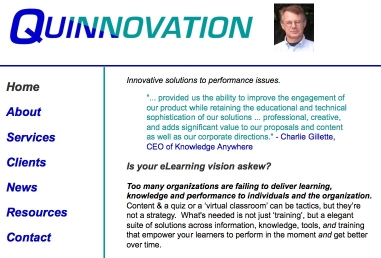
originalquinnovationsite1
Old Site

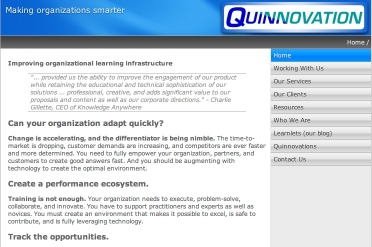
I’ve been busy updating my website.   The previous version was done by hand in an old version of Adobe’s DreamWeaver, and while it was very light and minimal, it wasn’t very ‘elegant’.   For instance, I’d had one problem that really bugged me, hadn’t been able to fix (though recently I managed to beat it into submission).   I had several options: continue to maintain it, pay someone to do a better job, or find some tool that makes it easy to make reasonable sites.   I got my mitts on a copy of RealMac’s RapidWeaver, and started to play around.

RapidWeaver uses templates: there are quite a few included, and you can pay for more.   I wasn’t completely happy with any, but by systematic exploration (aka messing around), I managed to make one I was happy with. (Recognize that the small size of the screenshots can make the old one look plausible, but it was a bit space-wasting; e.g. it’s still readable at 50%!)   I haven’t dived into the actual design behind the themes, as that takes me somewhere I don’t want to go.   Still, when I’d find things I thought it couldn’t do, I’d look deeper and find it.   It took quite a few attempts to get things the way I liked them, but it’s mostly quite clean.     Yes, I could delve into CSS and PHP and really get a handle on it, but that’s not the best investment of my time, and I could’ve stuck with DreamWeaver.   It’s enough that I understand what they do, without getting into the syntax of a specific site.
newquinnovationsite
New Site

The interesting thing to consider here, however, are the tradeoffs.   I wanted a decent starting point, and the application handling all the background work when I changed things around (like maintaining the navigation bar, adding the cookie crumbs, etc).   I didn’t want to have to tweak everything myself. If I were a professional web designer, I’d want power tools; if I were an amateur I’d want hand-holding.   As it is, I want something in-between.   RapidWeaver does a relatively elegant job of providing simplicity upfront but letting you open up the hood and mess about inside.   I had to get deep into the program to get done some things I wanted to get done, but it’s output is better than I was getting on my own.   Note that if you use it’s built-in ‘text and image’ pages, I don’t like how it looks.   I went to HTML pages (which I can handle).

The more general lesson is that there are no right answers, only tradeoffs.   Ideally, you get more power as you take on more learning.   Andrea diSessa termed this ‘incremental advantage’, where well-designed tool environments give you more power as a direct outcome of your willingness to explore.   HyperCard had this, as you could start with just draw tools, but then explore fields, buttons, and backgrounds (before you hit the ‘HyperTalk’ programming language wall).

There’s been notable progress in providing power tools (though too many people don’t even know about the concept of ‘styles’), but there’s still a pretty linear relationship between learning and power.   For example, as I have mentioned before, everyone wants the full game development tool that doesn’t require programming, though I argue it can’t exist.   It’s nice (and all too rare) when you get an elegant segue from templates through to being able to open up the underpinnings.

Understanding the tradeoff between ease of use and power is important in bringing knowledge, information, and tools to your learners, as well as your own learning tools.   You’ll want good defaults, and then the ability to customize.   Some of our tools are still not doing a good job of that, and the tutorials still tend to be focused on either product features or rote procedures, instead of helping you understand the software model underneath.   We could do a lot better!

Back to your user goals: you’ve got to know what you’re trying to do, how much you’re willing to learn about it, and live within what that gives you.   And I’d like feedback on the new website.     Put on your ‘potential customer’ goggles, prepared with what you’d want to know, and have a look; I welcome feedback to improve it!

The Quiver & The Gun

14 January 2009 by Clark Leave a Comment

(No, I’m not talking about weapons, or anthropological determination, sorry :).

Organizations have to be nimble; the environment we face is more like sitting in the ocean waiting to ride the ever-changing waves than it is striding down a concrete road.   Increasingly, in these chaotic times, changes are unpredictable.   There are changing tides, swells, weather, and the resulting waves.   You’d rather ride them than be tossed by them, but what do you do?   When it comes to waves, how do surfers cope, and what are the implications?

Beginning surfers typically have a board, a solution for riding waves.   And that’s ok, because there’re a limited number of wave conditions they should go out in.   Sometimes they get a good board for general small wave conditions, but sometimes for a variety of mistaken reasons they get something like a gun.   A gun is a board specifically for big fast waves.   It’s a board if you’re surfing on the North Shore of Oahu in winter. Not for beginners.

More experienced surfers start accumulating a quiver of boards for different conditions. Short boards, long boards, and a gun, etc.   Depending on their budget, storage space, and commitment to surfing, they could have two to as many as 8.   The pros have quivers in the teens, but they get them free and on-demand.   They’ll check the conditions, and then choose the appropriate board.

The analogy is that when you’re moving from just beginning to being able to adapt to a changing environment, you   need to have a suite of tools that provide the flexibility you need.   There isn’t a one-size-fits-all solution, just as there isn’t the perfect board.   There are boards that suit a wide variety of conditions, and if you’re small, cash-strapped, or whatever you may have to make do with one tool with most of the necessary capabilities, but when you’re serious, you need industrial-strength tools.

With my TogetherLearn colleagues, we’ve been evaluating tools for a while, and we’re not happy with any one. Consequently, we’ve a quiver of tools we use for different purposes, and we’re continually scanning for one that feature either better integration, or a more elegant delivery of capabilities.

There’s more, of course.   Experienced surfers sit and watch the waves for a while, choose a board, and then when they’re out they’re scanning the horizon for swells, and moving to get optimal position.   Once they’re riding, they’re watching how the wave changes and making spontaneous decisions.   Sometimes they come in and pick a different board before going back out.

And that’s before you figure out how to choose tools that suit your organization, proactively adapt your culture, and align with your business goals.   Surfers who want to get better get out in the water more, get more experience, and experiment.   Surfers who want to get better quickly get coaching.

I reckon the business environment is going to get more turbulent, and organizations are going to have to be more flexible, more nimble, be able to adapt and move faster.   That requires faster and more effective problem-solving.   We know that innovation isn’t the product of one person, but of collaboration and ongoing work, by people who are motivated and supported.   You need the right culture and the right infrastructure   to support that collaboration.   What’s your strategy?

Learning Organization Dimensions

12 December 2008 by Clark 7 Comments

After my post on Improving Organizational Learning Infrastructure, Daan Assen suggested that it was too limited in reference to the broader Learning Organization picture.   That’s valuable feedback, because I really mean it to be the learning organization culture and the technology infrastructure, the latter of which isn’t included traditionally in the learning organization work.   Clearly the label has some issues, as Stacy Doolittle also opined, suggesting architecture may be a better word than infrastructure.   Still, I’m not convinced that infrastructure isn’t the most inclusive term. Anyone have an opinion?

The reason I mention this, however, is that Daan pointed me to some work by Garvin & Edmondson that provides some nice characteristics of a learning organization.   It starts with three factors, a supportive environment, concrete processes and practices, and a leadership that reinforces learning.   I think this is a nice breakdown.

These components break up further, so for instance, a supportive learning environment is composed of: psychological safety, openness to new ideas, appreciation of differences, and time for reflection.   That latter one really strikes a chord with me, as that was a major barrier back when we were trying to get traction on meta-learning (and we’re not giving up!).

Concrete processes and practices breaks up into experimentation, information collection and analysis, and education and training.   I note that it doesn’t seem to capture more about informal learning than just providing the environment, and no mention is made of tools or infrastructure.   They may well have reasons for that, but it’s important to me to consider not only the environment, policies, and leadership, but also the channels.

Still, the particular focus on the supportive learning environment is a nice characterization.   You need safety, openness, appreciation, and reflection.   And your social networking tools will make very concrete any gaps in those.   When you see folks not sharing, not tolerating, and not having time, you know you’ve got a barrier.   It’s a mirror to see your organization.   So, what do you see looking back at you?

Collective intelligence patterns

10 December 2008 by Clark 4 Comments

I had the good fortune to get to meet Tom Malone way back when he was working on what makes computer games fun (cited in my book).   I stopped by PARC (then the geek’s Mecca), and got to bask in the environment that produced the GUI on top of Doug Engelbart’s mouse.

I knew Tom then went on to be a thought leader out of the Sloan School of Management, studying office work and then higher levels of activity, leading to a recent book “The Future of Work”.   I happened to meet him again at an event at IBM’s Almaden Research Center, and he was gracious enough to remember me and discuss his work (I challenged him about his ‘guilds’, since they still can’t get reasonable healthcare that businesses can get, don’t get me started).

I mention this backstory to show the trajectory of thought leadership he’s had (and yet still remain a really nice guy).   He just spoke at the celebration of Doug Engelbart’s work, and while I couldn’t attend, I was looking for blog postings and found his slide deck.

You (should) know I like models, and he’s gone beyond talking about how web 2.0 social networking can facilitate work, to actually analyze and distill some underlying principles. In his presentation on The Landscape of Collective Intelligence, he comes up with four characteristics of design patterns (or genes, as he calls them): What (strategy), Who (staffing), How (structure & process), & Why (incentives/alignment).   This is a really nice systematic breakdown into patterns tied to real examples.

For Who, he distinguishes between a hierarchical arrangement and a crowd, the latter being a more random structure.   He focuses on the latter.   For Why he breaks it out into Money, Love, & Glory.   For What, it’s Create a solution or Decide on an issue.   How is whether you’re having it independent or dependent.   The latter two work out to a nice little matrix with collection, collaboration, many-to-many, and group decision.

I really liked his statement that “failure to get motivational factors right is probably the single greatest cause of failure in collective intelligence experiments”.   That’s insightful, and useful.

The implications for informal learning are obvious, I’ll have to think more about formal learning.   Still, a great foundation for thinking about using networks in productive ways.   Definitely worth a look.

For the record…

2 December 2008 by Clark Leave a Comment

We interrupt your regularly scheduled blog for this important message:

I was talking with one of the bright and lively people at DevLearn 08 (the conference *rocked*), and we started talking about different folks’ ‘styles’. She was opining about a couple of well known consultants and their credibility. I naturally asked about her perception of mine, and she was surprised to find out I was an independent consultant, thinking I was some sort of academic.

That’s not an insult, as I have been an academic and I believe that the deep background I bring to bear is not only a benefit in the work I do but also in the way I educate my clients.   However, allow me to be very clear:

I am a consultant (and, I like to think, a very good one).   It’s how I support my mortgage, HMO, and family (in that order :).   I work with organizations that:

  • need to move beyond small and isolated stabs at elearning
  • are realizing the focus is on increasing organizational excellence
  • want to take full advantage of technology benefits to innovation and execution
  • don’t want to be swayed by a biased opinion
  • want advice about what makes sense for their context in the short, medium, and long term

I offer a reliable capability to assess a need, whether tactical or strategic, and find a sound (and typically innovative) yet pragmatic solution, whether improved design, a full plan, or ongoing assistance.   This is based upon a deep understanding of cognition and technology, a lateral thinking style, an ability to learn quickly and swiftly assess a situation, and a systematic bent that tends to explore alternatives and the associated trade-offs to yield a solution that’s not ‘off the shelf’. It’s also independent, so once you’ve got a plan, you can evaluate who’s best to implement it.   It’s about melding creativity with process to yield solutions, not just ideas.   I work through Quinnovation, and with my esteemed colleagues Jay Cross, Harold Jarche, and Jane Hart through TogetherLearn.

I hope that’s clear.   If you want to know more, I’m easy to find; drop me an email, or give me a call.

We now return you to your regularly scheduled blog.

Beyond the course

1 December 2008 by Clark 9 Comments

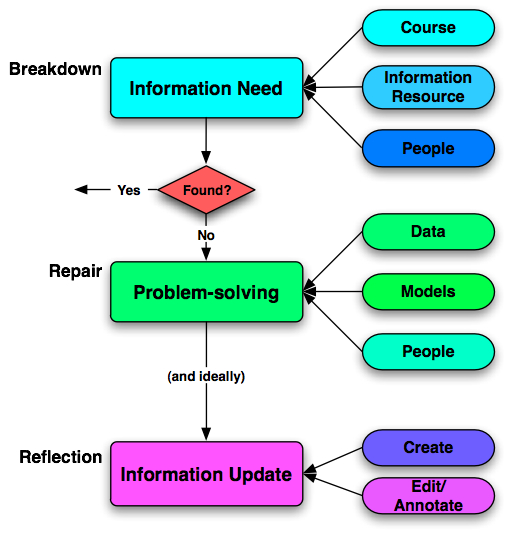
In the process of thinking through how to support informal learning, I was reminded of a diagram I created several years ago.   I started from an approach based upon philosophy that talked about acting in the world: you act in the world when you can, and when you have a breakdown you need to solve it, so you repair, and then reflect and learn so you can act more competently the next time (Ok, so it’s an idealized model). What it led me to think was that when we have a need, we first try to find the answer. If we don’t, then we have to do more extreme steps of actively trying to solve it, and then ideally we save that answer so that others don’t have to solve the same problem (see what I said about ‘ideal’?).

Without going into all the thinking (it’s elaborated more in several places, including this white paper; PDF), the point is that supporting people in performance includes not just courses, but content and job aids, and connections to people.   Note that when it moves from information need to problem-solving, the people will change because there isn’t an expert (or you’d have the answer already).

The interesting thing for me is that this provides a strong justification for using social networks in learning: wikis can be places where people can store the information about problems they’ve solved, discussion boards and profiles fill the need of finding expertise, blogs may support people in their problem-solving as well, serving as a way to share questions and get feedback.   The social network provides the rest of the support around the courses which really only serve the situation where a major skill-shift change is needed.

So, it’s probably just buttressing the obvious,   but I get a degree of comfort from taking a pre-existing model and using it to create a framework which then turns out to map to something I’m deeply involved in.   Does it make sense to you?

Coping personally, organizationally, and societally

18 November 2008 by Clark Leave a Comment

Having just come back from DevLearn (which rocked; my hearty thanks to all participants and organizers), and now engaged in the Corporate Learning Trends conference (free, online), I’m seeing some repeated themes, and interests.   It’s a busy time, since we‘re deeply engaged in the latter, but some messages are coming through so powerfully that I’ve got to reflect on them.

In this time of economic uncertainty or outright fear, one of the resonant themes is ‘how to cope’. Marcia Conner, one of our forward thinkers, is going to be talking about the topic of coping tomorrow at 10 AM PT, and I’m looking forward to it!I believe that’s important at the societal level as well.   We need to invest in our capabilities when things are down so we’re poised to capitalize on the upswing. Jay invited me to share his breakfast byte at DevLearn on the topic.

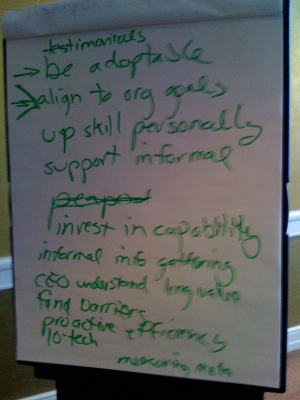
We brainstormed with the attendees, and came up with some interesting points.   At the personal level was to be nimble, strategic, and develop yourself.   Tony Karrer talked today about investing in knowing how to use the tools effectively, building upon all the tools that Robin Good and Jane Hart had described yesterday (simply amazing tools).

The organization level of that is to develop infrastructure and capability.   Dave Pollard today talked about moving from Knowledge Management 1.0 to 2.0, empowering people to self-help. What can you do to foster creativity and innovation on a shoestring when you can’t cope with full-fledged initiatives?   Can you get a small social networking tool initiative going that can help people help each other?

A couple of recurrent themes were selling this to management, and managing the proliferation of tools.   For the former, I reckon it’s about helping more than just novices, but providing self-help.   It depends, of course, on what your needs are and consequently what you choose to implement, but the outcomes can clearly be linked to organizational goals and problems, like reducing time-to-information, increasing productive collaboration, and sharing.   For the problem of tracking the tools, I think the key are the needed affordances.   I’ve been focused on finding the affordances of the tools, but it’s another thing to think about the affordances an organization needs and map tools into them.   Briefly, it’s about collaborative representations (prose, graphics), pointers to relevant topics, etc.   More work to be done here, I reckon.

These topics are being discussed at the Corporate Learning Trends social site this week (and ongoing, hopefully) and you can join in.

Note that I think these are relevant societally as well.   We developed some serious infrastructure through the WPA, and the Interstates, and it’s crumbling.   At some point you need to build it back up (rebuild differently?) to meet the needs.   That may increasingly be things like networks (and healthcare) as well as things like bridges.   I think this is key to thinking about how to invest for the tough times; focus internally until times get good again and be poised to rebound.   It’s like your body rebuilding while you’re asleep so you can restart the new day. Of course, you need to have hoarded the resources.   May be a way short-term shareholder returns damage long-term survivability?

Here’s hoping the economic situation is short and mercifully gentle, and that you all survive and prosper!

Medina keynote on Brain Rules at DevLearn 08

14 November 2008 by Clark 8 Comments

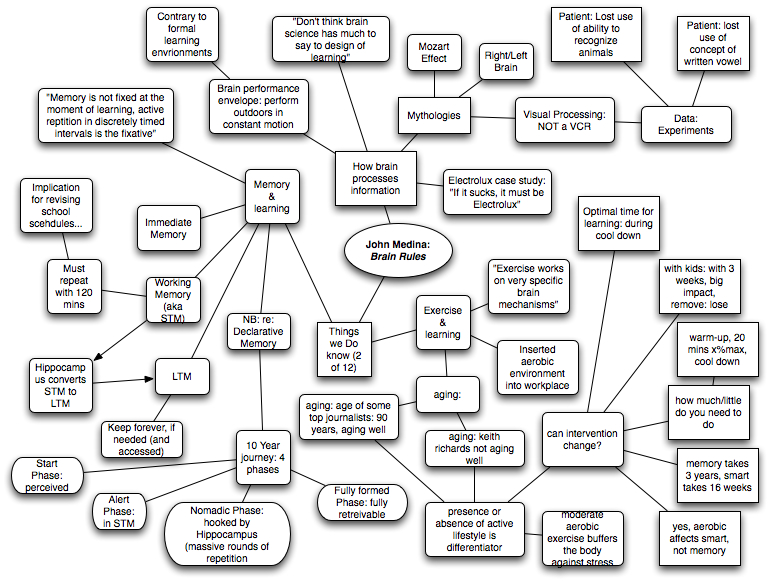
John Medina gave the closing keynote at DevLearn, based upon his book Brain Rules.   He covered two of his 12 rules, on memory, and on exercise.   He spoke fast, was enthusiastic, funny, and knowledgeable.   He talked about myths of learning, and said that he didn’t think there was a lot neuroscience had to say to learning design (thankfully, cf Willingham).

One of his points was that our brains evolved to provide ongoing performance guidance over hours of constant motion (evolutionarily).   This leads to implications that are contrary to most of our learning contexts!

His first rule was about memory, and he covered the basic model of cognitive models of memory, but then pointed out that it’s about 10 years from initial exposure to fixed memory, and requires extensive repetition.   During that period, distortion can occur. This explains the rule of thumb that you have to be doing something for 10 years before you can be considered an expert.   It probably takes 10 years of doing things before they’re solidified in useful experience to apply.

The second rule he covered was the relation between exercise and learning.   It was really exercise and thinking, and there’s a positive relationship.   The difference between sedentary and moderately active lifestyles is big in terms of mental acuity.   And reintroducing it for a reasonably short period (16 weeks) can reignite.   Memory improvements take longer, like 3 years.   It works for kids too, and if they stop, it drops off.

He made several observations how revising schools would work better, sadly too true.   So, repeat if you need it to stick (a great opportunity for mobile learning), and do get exercise for your own health, and maybe have an organizational incentive as well!   Here’s my concept map (it was hard as quick as he spoke, so didn’t get all the data):

DevLearn 08 Keynote: Tim O’Reilly

12 November 2008 by Clark 8 Comments

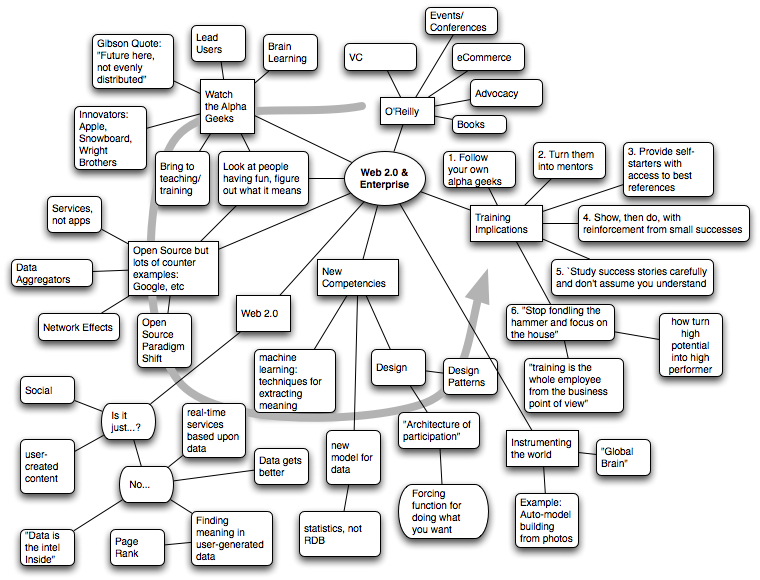
Tim O’Reilly, Web 2.0 guru, talked to us about what web 2.0 is and led us to his implications for what we do.   He started off talking about tracking the ‘alpha geek’.   These are the folks who manage to thrive and innovate despite us, rather than because of us.   He’s essentially built O’Reilly on watching what these folks do, analyzing the underlying patterns, and figuring out what’s key.

He talked about the stories that Web 2.0 is about open source, or social, were surface   takes, and by looking at leading companies, e.g. Google, there was something else going on. It’s not just user-generated content, but mining user-generated data for value, and then adding value on top of it.   “Data is the intel inside.”

This led him to key competencies going forward being machine learning, statistics, and design.   It isn’t about well-structured data, but about finding the nuggets in messy data.   And it is about design as an “architecture of participation” that gets users to act in the ways you’d like.

His take home message was six points that boil down to watching your alpha geeks, and use them to help guide what you should be doing, to help others achieve their potential.   An inspiring message in a very geek-cred way :).

I concept-mapped it:

Learnscaping on tap

7 November 2008 by Clark Leave a Comment

Over several months now, Harold Jarche, Jane Hart, Jay Cross, and I have been working on getting our arms around assisting people with the informal side of organizational learning.   Ever since Jay’s book, Informal Learning, people have wanted specific ways to go about supporting this component of the organizational environment.   And we’re close to a concrete solution.

The goal is to support organizations to start implementing web 2.0, in a lightweight way.   To do so, you need an environment and support to develop competency.   We wanted to address both.   You’ve got to be trying it out, to get it, but you don’t want a monolithic solution at the beginning.

We’re providing the services, of course.   We’ve been collaborating to develop a ‘best practices’ approach that we’ll couple with an experimental focus.   We’re already trialing it in a couple of instances, and have a couple more in process.

For the platform, we similarly want it to be lightweight: easy to trial, simple, easy to expand, but solid underpinnings.   And implementing the performance ecosystem suite of eCommunity capabilities.   Ning’s an example, but we needed more flexibility and control.   We’ve identified a partner to move forward with.

I’m excited, as it’s a great group to work with, positive attitude, heaps of experience, and understanding at both the vision, the strategic and the tactical level.   It’s also a real need, which I see again and again in organizations I assist.   We’re looking to get a placeholder site up Real Soon Now, and we’re working behind the scenes to get stuff ready. We’ll be talking about it at several places including DevLearn next week, and the Corporate Learning Trends conference.   You can read up more about it, and sign up for more information here.   Stay tuned!

« Previous Page
Next Page »

Clark Quinn

The Company

Search

Feedblitz (email) signup

Never miss a post
Your email address:*
Please wait...
Please enter all required fields Click to hide
Correct invalid entries Click to hide

Pages

  • About Learnlets and Quinnovation

The Serious eLearning Manifesto

Manifesto badge

Categories

  • design
  • games
  • meta-learning
  • mindmap
  • mobile
  • social
  • strategy
  • technology
  • Uncategorized
  • virtual worlds

License

Previous Posts

  • March 2026
  • February 2026
  • January 2026
  • December 2025
  • November 2025
  • October 2025
  • September 2025
  • August 2025
  • July 2025
  • June 2025
  • May 2025
  • April 2025
  • March 2025
  • February 2025
  • January 2025
  • December 2024
  • November 2024
  • October 2024
  • September 2024
  • August 2024
  • July 2024
  • June 2024
  • May 2024
  • April 2024
  • March 2024
  • February 2024
  • January 2024
  • December 2023
  • November 2023
  • October 2023
  • September 2023
  • August 2023
  • July 2023
  • June 2023
  • May 2023
  • April 2023
  • March 2023
  • February 2023
  • January 2023
  • December 2022
  • November 2022
  • October 2022
  • September 2022
  • August 2022
  • July 2022
  • June 2022
  • May 2022
  • April 2022
  • March 2022
  • February 2022
  • January 2022
  • December 2021
  • November 2021
  • October 2021
  • September 2021
  • August 2021
  • July 2021
  • June 2021
  • May 2021
  • April 2021
  • March 2021
  • February 2021
  • January 2021
  • December 2020
  • November 2020
  • October 2020
  • September 2020
  • August 2020
  • July 2020
  • June 2020
  • May 2020
  • April 2020
  • March 2020
  • February 2020
  • January 2020
  • December 2019
  • November 2019
  • October 2019
  • September 2019
  • August 2019
  • July 2019
  • June 2019
  • May 2019
  • April 2019
  • March 2019
  • February 2019
  • January 2019
  • December 2018
  • November 2018
  • October 2018
  • September 2018
  • August 2018
  • July 2018
  • June 2018
  • May 2018
  • April 2018
  • March 2018
  • February 2018
  • January 2018
  • December 2017
  • November 2017
  • October 2017
  • September 2017
  • August 2017
  • July 2017
  • June 2017
  • May 2017
  • April 2017
  • March 2017
  • February 2017
  • January 2017
  • December 2016
  • November 2016
  • October 2016
  • September 2016
  • August 2016
  • July 2016
  • June 2016
  • May 2016
  • April 2016
  • March 2016
  • February 2016
  • January 2016
  • December 2015
  • November 2015
  • October 2015
  • September 2015
  • August 2015
  • July 2015
  • June 2015
  • May 2015
  • April 2015
  • March 2015
  • February 2015
  • January 2015
  • December 2014
  • November 2014
  • October 2014
  • September 2014
  • August 2014
  • July 2014
  • June 2014
  • May 2014
  • April 2014
  • March 2014
  • February 2014
  • January 2014
  • December 2013
  • November 2013
  • October 2013
  • September 2013
  • August 2013
  • July 2013
  • June 2013
  • May 2013
  • April 2013
  • March 2013
  • February 2013
  • January 2013
  • December 2012
  • November 2012
  • October 2012
  • September 2012
  • August 2012
  • July 2012
  • June 2012
  • May 2012
  • April 2012
  • March 2012
  • February 2012
  • January 2012
  • December 2011
  • November 2011
  • October 2011
  • September 2011
  • August 2011
  • July 2011
  • June 2011
  • May 2011
  • April 2011
  • March 2011
  • February 2011
  • January 2011
  • December 2010
  • November 2010
  • October 2010
  • September 2010
  • August 2010
  • July 2010
  • June 2010
  • May 2010
  • April 2010
  • March 2010
  • February 2010
  • January 2010
  • December 2009
  • November 2009
  • October 2009
  • September 2009
  • August 2009
  • July 2009
  • June 2009
  • May 2009
  • April 2009
  • March 2009
  • February 2009
  • January 2009
  • December 2008
  • November 2008
  • October 2008
  • September 2008
  • August 2008
  • July 2008
  • June 2008
  • May 2008
  • April 2008
  • March 2008
  • February 2008
  • January 2008
  • December 2007
  • November 2007
  • October 2007
  • September 2007
  • August 2007
  • July 2007
  • June 2007
  • May 2007
  • April 2007
  • March 2007
  • February 2007
  • January 2007
  • December 2006
  • November 2006
  • October 2006
  • September 2006
  • August 2006
  • July 2006
  • June 2006
  • May 2006
  • April 2006
  • March 2006
  • February 2006
  • January 2006

Amazon Affiliate

Required to announce that, as an Amazon Associate, I earn from qualifying purchases. Mostly book links. Full disclosure.

We use cookies to ensure that we give you the best experience on our website. If you continue to use this site we will assume that you are happy with it.