Learnlets

Secondary

Clark Quinn’s Learnings about Learning

Search Results for: engag

“Engaging Learning” Book review

27 July 2006 by Clark Leave a Comment

I found a review of my book Engaging Learning, by Jon Alekson, who I don’t know. It’s a fair review; he gets what I’m trying to accomplish (making the learning experience more effective), but criticizes my writing as a bit heavy, and bemoans the lack of focus on graphics.

I’ll wear the first one, but remark that it’s remarkably light considering I was trained as an academic and rewarded for dense prose for many years. Besides, my editor praised my ‘warm tone’ :). Your mileage may vary.

As for the graphics, I’ll admit it doesn’t have as much as I’d like. On the other hand, you can actually play a couple of games mentioned in the book on the web (check out the ‘Examples’ here). I’m not a graphic designer, and had little to do in regards to the final appearance as they were done by professionals. And, on the pragmatic side, copyright permissions aren’t much fun.

I haven’t seen many reviews, so it was good to find this one.
Presentation Process

7 April 2026 by Clark Leave a Comment

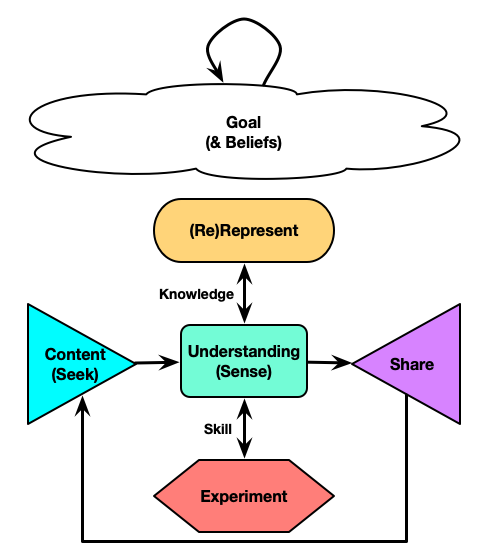
What is my process for creating a presentation? I realize that it’s at least two parts, that interact. First, there’s a story needing telling. What is it? What is the goal, and what story will get us there? Then, there’s the question of communicating the story. What are the important points to communicate? Together, it prompts some thinking on how to put it all together. It’s also to establish that creating a presentation is much different than just fronting up to an interview or conversation; there’s work!  So, this is a reflection on the presentation process.

So, first, there needs to be a story. It typically comes from something I want to talk about. There are a number of things that I talk about, being old and having ideas (strong opinions loosely held ;). That includes learning science, meaningful engagement, design processes, the performance ecosystem, and more (most of which I’ve written books on). Lately, that includes AI, though no book. Still, there’s an audience, and I confer with the organizing body about what’s the right topic.

From there, there’re two parts. One is figuring out what story to tell. In one sense, it’s reaching back to what I’ve said on it before, but…it’s also influenced by new thoughts. The world isn’t static, and so too my presentations generate afresh. I do start anew, unless I’m deliberately asked to redo a previous topic (and even then, I revisit). The main question is where do I want to end, and how do I want to get there.

The second part are the steps along the way. This means, basically, what points do I want to make, and how to make those points? I resort to two typical mechanisms, I confess. I’ll use images (read: photos) to communicate ideas (rather than bullet points). This is deliberate, as I believe (and I welcome research pro/con) that the lack of implicit connection opens up the attendees thoughts prior to me making the link. Then there are diagrams to communicate the underlying models. These, I’ve been led to know requires me to build them. Most are complex enough that it helps to start with a core and then elaborate.

Sometimes I provide some examples, usually in my discussion, but occasionally with screen captures. That’s a good thing, and I should do it more! Of course, there’s a small problem that sometimes I’m talking about things that are proprietary. Or, that are far enough ahead that they haven’t yet seen the light of day.

It’s important to recognize that this doesn’t happen linearly. I move forward, and backward, multiple times as I create a presentation. I move chunks around, change representations, etc. Really, presentations are a chance to reflect, and have even led to me changing my thinking (and so, my diagrams!). Research on design actually shows people cycling between bottom-up and top-down behaviors, and I resemble that remark! BTW, I could use AI in parts of this, except for the fact that the AI runs on stolen IP, amongst other problems, so not yet.

Also, I practice delivery. I do not shoot for an exact presentation, because those inevitably feel canned. I confess, I like TedTalks and good keynotes, but if they’re word-perfect, I do note that as well, negatively. What I want to ensure is that the message stays consistent, even though my presentation varies each time. That’s ok, and makes for a more natural presentation (and also allows for audience participation, so questions can be addressed). That’s not necessarily true for keynotes, which I do, but there’s evidence I do tell engaging and meaningful stories for those as well! So, some thoughts on presentation process. What did I miss? How does this reflect your process?

Going it alone?

31 March 2026 by Clark Leave a Comment

I’ve been an independent consultant for the past quarter century. Which would make you think I go it alone. And, occasionally, I do. I’ve written my books myself. I’ve gone into consulting engagements on my own. I typically do my presentations on my own. Yet, not really. And, it’s not what I recommend. So, why do we think we should be going it alone?

It’s easy to think I’ve done much of my activities alone (and sometimes it feels like it). Yet, when you think about it, it’s really not. I’ve had publishers and editors on books. Also, of course, I’m building on the work of others (that I cite; academic holdover). Plus, I’ve had folks provide feedback that has improved my thinking. That includes on presentations and articles, which tend to have editors as well, or at least program managers. And, then there’s the feedback by the victims, er, audience. And even consulting I’m engaging with the clients and having them help me understand the context and review drafts of reports before acceptance. It’s essentially not alone!

Folks thinking about social, like Mark Britz (co-author of Social By Design) or Harold Jarche (of Personal Knowledge Mastery fame) remind us that we’re better together. That can be what is determined either authoritatively or collectively, and then there’s what’s offered freely. Still, the benefits of working together, of social cognitive processing, are that we are highly likely to get better when we get others’ feedback.

Which is why I feel bad when I hear about the lone L&D practitioner in an org, or someone doing a course by themselves. Ok, for the former, ideally they’re interacting with the SMEs at least, but hopefully they’re also getting support in connecting with peers at events like conferences or chapter meetings. For the latter, there at least could be checkpoints where your work gets review and feedback. Heck Watts Humphrey noted this in software engineering, we should likewise worry about it. We need feedback to improve, and that comes from others. (In a tighter loop than quarterly.)

I also worry as people more and more seem to be choosing, or being ‘voluntold’, to use tools that minimize interaction. It’s already been seen that this diminishes personal development. It’s also concerning for building culture, and more. In short, we don’t want people not collaborating; that’s where new ideas come from! While some of the tools may help the less-than-average person be better in the moment, they’re not developing over time. That’s not a long-term path to success.

You simply shouldn’t be going it alone. You should continually be learning, and that means getting feedback. And, of course, learning to learn from that feedback in all forms, and reading or watching something can be that. It can be challenging (says the introvert) to work with others, but when it happens the outcome is almost always better. At least if you follow good process! So please, find someone to be your partner in your endeavors. I’m trying, I hope you will too!

Why aren’t things changing?

24 March 2026 by Clark Leave a Comment

Change is everywhere. We’ve heard again and again that the pace of change is increasing. Certainly we’re seeing more chaos in our society. Yet, some things don’t seem to change, L&D in particular. Why is that? Why aren’t things changing?

For one, I’m not alone in advocating for more. Jay Cross was promoting Informal Learning, and Marc Rosenberg was talking Beyond eLearning before I came out with Revolutionize L&D. Since then, (and, of course, before) there’s been a growing number of people talking about how we need to stop being ‘order takers’ and start being strategic about our energy and use of technology. Guy Wallace and the whole Performance Consulting industry is one facet. We see books from the likes of Lori Niles-Hoffman, Jess Almlie, and even Keith Keating, amongst others. We hear from folks as wise as Jane Bozarth, David Kelly, Connie Malamed, Ruth Clark, Will Thalheimer, Julie Dirksen, Don Taylor, Michael Allen, Nigel Paine, Megan Torrance, Matt Richter, and more (the list goes on). The message is pretty clear: only do courses when they make sense, and then do them well.

So why do we continue to see companies producing and consuming ‘info dump’ elearning? Training that’s just bullet points? Why do we have tools that continue to make it easy to put up content and add a knowledge test, let alone having ‘click to see more’? Why are there ice-breakers and ‘team-building’ activities that have no meaningful relation to the topic? Where’s the spaced learning? How come we continue to have learning experiences that are engaging, but not effective?

On reason, of course, is the industry. The vendors do tend to focus on producing ‘content’; even their touted uses of AI are to make content faster and cheaper (but the missing leg of the engineering stool is ‘better’, why is that?). Let’s track completions, rather than impact, eh? We don’t have to talk across silos that way, so it’s easier. And, it’s less work to make content tools than to engineer learning experiences. But…isn’t that our real mission?

Another reason, of course, is stakeholder awareness. There are expectations that we should build courses quickly, and that information leads to behavior change. Both are wrong, of course. But why do these beliefs persist? Aren’t we, and shouldn’t we be, extinguishing them? It’s more than a quarter century into the 21st one, you’d think folks would know better. Particularly when it affects their ability to succeed!

Our own awareness may be a barrier too. That is, there are lots of folks who come into ID without preparation. As Cammy Bean noted, folks are starting as the Accidental Instructional Designer. It’s also hard to buck the hierarchy when you’re new. And it’s rewarding to get high scores on our courses by attendees. Particularly if we don’t know better. Still, it’s painful to bear.

Now, I do believe, and see, gradual change. It is getting better. Yet, while I’m not known for patience, it’s still taking way too long! We have the opportunity to be making our orgs so much better. We could be extending learning, developing learning-to-learn skills, fostering innovation, and meeting real needs, instead of dumping information worthlessly. We’re wasting money! So, yes, I’m frustrated.  Are you? Why aren’t things changing? What am I missing?

My technology for performance

24 February 2026 by Clark Leave a Comment

I’ve talked in the past about my tools for learning, as Jane Hart’s survey prompts. Yet, Christy Tucker asks about software stacks (for consulting), and I realize there’s a different answer when I’m talking about doing versus learning. Yes, as Harold Jarche says, “work is learning and learning is the work”, but there are times I’m using tools to keep myself on track rather than to render my ongoing thinking. I augment my abilities with tech, and some is just about executive function rather than learning. So what is my technology for performance?

Personally, I use Apple’s Reminders to render ‘ToDos’. As I’ve said, if I’ve promised you something and it doesn’t get into my digital world, we never had the conversation. That also is true for Apple’s Calendar. I used to use them separately, but now I’m coordinating between them. I used to block out time to get things done, but I’ve now set up a cal.com to book time, and it looks at my calendar. So, I now use timing on reminders to get things done that are urgent, and save the calendar for time-specific things.

Financially, I use Quickbooks to send/receive invoices. I should switch, but haven’t yet. The problem is that you’re kind of locked in unless you change on your calendar boundary. I also use my bank’s app or website to dod things like send/receive payments. Occasionally I use PayPal, too.

I’d mention Notes, as a way to mull things, but that’s really learning. Though I do grab and store recipes there (and share with fam). Not that I make ’em all, but it’s where I can keep the ones I find online. Likewise I take notes on biz meetings with Notability, but again that’s not really performance, it falls more into the ‘learning category’. I do have some templates that I’ve created in Word, e.g. proposals, reports, and schedule of fees. Probably should migrate to a platform that’s more open. Libre? Open Office? There I go, standing up again…

Now, that’s for me, myself, and I, but I also do things with Elevator 9 and the Learning Development Accelerator (LDA). For both, I’m using Slack to talk to people. I have separate channels for both, but am glad they’re both using the one platform. Email too, of course. Teams was part of a a previous engagement, and am frankly glad to step away. I also use Zoom, a lot. Again, happy to not use Teams or Google Meet for that purpose.

Collaborative docs are different. They’re writing, but for others, so they begin to cross the chasm (really, it’s a continuum, but…). So, I’ve used Google Docs. I really haven’t collaborated using 360, because I don’t have that type of license. I also have used Apple’s Pages with the folks who do run Macs.

Usually, my browser’s for learning, but I also use it to get things done. That’s one of the reasons I recently made the switch from Safari to Vivaldi. For one, it’s a ‘Chrome’-equivalent browser, but doesn’t have the ownership probs that Brave suffers from. It also doesn’t have the ‘tracking’ problems Google introduces (it’s why my search engine is DuckDuckGo, too).  It’s problematic, in that it’s (too) customizable, for power users, but the defaults aren’t bad. Still learning about it, but I’ve mostly got it under control (e.g. I think I’ve a solution to the microphone issue that was bedeviling an LDA vid attempt). Though I’m reasonably tech savvy…

One other tool of note is Notion. I wouldn’t necessarily choose it myself, but it works. You can imagine I’m not keen on the strong pushes it (and everything else) are making towards AI, but it’s in use for LDA project and knowledge management, and it’s working. We’re a) probably not making full use, and b) could’ve used something simpler, but…we have someone familiar with it coaching us, so it’s all good.

So that’s my technology for performance. It’s not sophisticated, but it’s manageable, and affordable. Thoughts? Yours?

A celebration of the tablet

20 January 2026 by Clark Leave a Comment

OK, so I’ve been around for a few turns around the sun. And, I’ve seen a fair bit of change, in technology in particular. My first job out of college was programming these new-fangled ‘personal computers’. This came after holding down jobs programming mainframes (Algol/Burroughs 7600) and mini-computers (Pascal/PDP-11s). As such, I’ve watched as the computers have shrunk to pocket and wrist-size (and more, but that’s not in common use), while increasing in capability. But there’s one device that I forget to marvel at, and so here’s a celebration of the tablet.

Why tablets, why not smartphones? There’re overlaps; they’re both much more intimate than a desktop; they”re held and controlled by touch. Yet, there’s a difference. Ok, for me. For many around the world, the phone is their only internet connection. And we are seeing larger and larger phones. But while I carry my phone with me almost all the time*, a tablet is my preferred relaxation device. I use my laptop (as a desktop, it’s usually plugged into a monitor/keyboard/mouse unless I’m traveling) for work, and my phone goes with me everywhere. But, when I’m mostly looking to be mentally engaged, my tablet is the preferred option. So, why?

I haven’t pondered that except just before going to bed, but then I’m amazed as I contemplate it. Here’s a screen big enough to engage with, on a device that’s amazingly thin. On it, I have books I can read, and games I can play. I don’t watch movies on it usually, but I have when I’ve traveled. And of course there are the information resources: web, weather, & time, and ways to generate info: notes, a way to comment on PDFs. In short, it’s intimate but pretty much fully capable.

That’s not what my phone or desktop sport as abilities. My phone (I err on the side of a smaller one, to fit easily in my pocket) is intimate, but it’s not fully capable given its limited screen. On the other hand, m laptop is powerful, but not intimate. My tablet is both. Now, I’m not going down the road of a super powerful tablet that substitutes for a laptop, that’s a bridge too far. I like having a desktop to do full work. It’s just that for many things, e.g. pondering and querying, the tablet is better. I think it’s about time frames for task, and maybe the cognitive complexity.

Still, while I like all my devices, the laptop to me is akin to the computer as I know it. The phone is a useful devices for usage on a short time frame. It’s the device in-between that, for me, is the sweet spot. A place to escape, a place to do preliminary thinking, a place to reflect. I write this on my laptop, because writing long screeds is easier with a keyboard (I eschew the keyboard cases for my tablet, as I have a laptop), but the preliminary thinking came from my intermediate device. So here’s a celebration of the tablet, the device that wasn’t going to be. I’m glad it exists.

* Recently my phone had 1% charge, I’d not completely plugged it in. Thus, for my walk I went phone-less (m’lady had hers). It was mostly ok, just a few moments of reaching for it and realizing it wasn’t there!

Looking into 2026

6 January 2026 by Clark Leave a Comment

First, of course, happy new year! Relatively arbitrary deadline, but signification matters, and marking a new year is also a new chance. So, what’s happening? Here are some of the things I’m thinking about, looking into 2026!

So, first, a brief look back to set the stage. This was a year without any sustained engagements for Quinnovation, so that meant being a bit more agile. Not a problem, I was on lots of podcasts about a variety of things, and of course engaged with clients. I did spend considerable time and effort, however, in my side gigs.

For one, the Learning Development Accelerator (LDA) had a variety of things going on: conferences, books, webinars, podcasts, and more. Plus, they’re great people to work with! I think it’s a worthwhile investment of my time, focusing on helping people get more exposed to evidence-informed design.There are signs that we’re moving more that way (though it is a small case of two steps forward, one step back; learning styles and other myths still haunt our industry; there’s a continuing need!). I’ve also done some ‘free’ consulting to our platinum members, and that seems to be valuable for them, and I find it really rewarding!

I also continued to spend time with the Elevator 9 (E9) folks. They’re now ready for prime time (check ’em out!), but there’s been lots of work along the way. That includes developing a real platform, and I’m continuing to learn heaps about what goes into a startup. And why I haven’t been the one to do it! It’s been great, however, to be in association with folks who really do want to care about learning science; all too rare in the learning technology space (sadly).

Of course, my association with both continues.

With LDA, we’re already planning this coming year. We’re deep into thinking about what to do with the spring conference, and potential series for blog posts, and more. We already have our first Meet the Author on the schedule, and more are in the works.  There are some changes afoot, so stay tuned!

With E9, I will be using them again for my next mini-scenario workshop (with LDA) as a followon. Did it last year, as a trial, and it worked. Always room to improve, of course. Still, if you’re running a live event, and not following it up to extend the learning, why? There are other solutions – e.g. coaching – but please be doing something! There are worse solutions than E9, including nothing.

Of course, I’ll be doing more. I’ve been working on a couple of short books, likely eBooks (too short for print). I don’t want to go live yet about them, as they’re still in process. Of course they’d be with LDA Press. Besides online, I may be running a workshop or two live, too. As to conferences, well, I never say ‘never’, but right now there’s nothing I’m particularly excited about. We’ll see. And, of course, I’m always keen to help organizations, so do reach out if there are any ways I can be of assistance.

As you might expect, ideas continue to percolate. I’m always exploring more about technology, design, engagement, and more, and of course about learning. As always, you’ll probably hear about them here first, as this is where I learn ‘out loud’. There’re breadcrumbs from the past pointing forward, so it’s time to be looking into 2026. What are you seeing? In the meantime, stay curious my friends.

Thinking about motivation

18 November 2025 by Clark Leave a Comment

So, I haven’t been a big Self-Determination Theory (SDT) person, simply because I hadn’t really known about it. I learned about it enough to mention in my most recent tome (highlighting the importance of motivation in learning), but that’s about it. However, it’s been popping up more and more (not least with the Motivation Summit the LDA’s putting on; the live sessions will be past, but you can still register to watch the presentations and recordings thereof). And, I am increasingly thinking that there’s some real ‘there’ there, so here’s some thinking about motivation.

SDT posits, quite simply, that there are three consistent elements that contribute to motivation. They are:

  • Competence: the ability to do something, maybe with support, but also development to get better
  • Relatedness: other people who are there believing similarly and supporting you
  • Autonomy: the ability to be who you are

(These are my definitions, by the way, not the official ones, which are no doubt better.) Importantly, they’ve been verified by research across cultures, age ranges, and every other demographic difference. It’s pretty much a human universal. Also importantly, they have practical implications for how you do things.

Quite simply, motivation plays a role in pretty much everything we do! Our motivations include exercising, eating, and sleep; work tasks and job environment; and for us, intent to learn. It’s that latter I was tapping into for designing games, lo those many decades ago. I didn’t at the time know about the SDT framework (in fact, it hadn’t really emerged yet ;), but I was tapping into the elements when I was talking about goals, appropriate challenge, relevance, and more. So when I write about the education/engagement alignment, SDT is a higher-level framework. Simple alignment would have challenge = competence, goals = autonomy, relevance = relatedness. Social learning, too.

Increasingly, as ‘leadership’ becomes a topic, it plays a role as well. I’ve been interested in culture and social for many years as a function for L&D. Leadership is how you create a culture, by how you are socially. How well do you support those elements? I’m not a leadership expert, but I’m increasingly seeing those factors, crossed by types of situations being faced. For instance, in a crisis you have to make a decision, which reduces autonomy for others, but then you should rebuild it. Importantly, I’m finding out that efforts are yielding valuable outcomes, which alone is a reason to pay attention!

So, I’m looking more into it, as an aspect of making a good environment, organizationally and societally. If we’re thinking about motivation, we can start being wise about it. That is, not just for me, and you, but for others. Not just short term, but also long-term. And, explicitly considering our values. Which may be the most important part of it! I think the values that empirically lead to the best for all is a good basis. What say you?

Still the myths

11 November 2025 by Clark Leave a Comment

Over on LinkedIn, about the last site worth visiting (I do use Bluesky and Mastodon, but they’re not really ‘sites’ so much as channels), I am still seeing quotes about people believing in misinformation. Learning styles, generations, attentions spans dropping, etc, all these things that aren’t valid are still being touted. Despite our debunking efforts, it’s still the myths!

To be fair, we do seem to be seeing a bit of an ‘anti-science’ movement. Which would be not only silly, but sad! Sure, there are problems with science, but it still beats every other process we have. Anecdotes don’t surpass real evidence, and personal opinion isn’t superior to what proper research tells us.

For one, as Naomi Oreskes makes clear in her book Why Trust Science, what makes science work isn’t just the process. So, yes, scientists conduct experiments, and others review them, and it’s a collective decision to publish them. And, yes, bad papers are still submitted (I used to serve on editorial boards, and my rejection rate was about 95%; but it was a good journal ;). Also, it’s hard to bring in new viewpoints. What Oreskes points out, however, and aptly, is that over time, these processes advance our understanding. We may have fits and spurts, but for the long game we win. For instance, how are you able to read this offering of mine, over miles and minutes? Because science.

So, science denial is counter-productive, but it exists. Gale Sinatra and colleague Barbara Hofer, in their book Science Denial, outline the reasons how this happens. Based upon research into the situation, they document our minds have biases, and how we can be swayed. We can also have our own beliefs, and our tendency to confirmation bias means we only look for evidence that supports our views. Fortunately, they discuss ways to address these problems, but we need to put some of these into place (as with Brian Klaas’ recommendations for fighting corruption).

We have good data that there are things we should avoid. There really aren’t any psychometrically valid instrument for learning styles, and no evidence that should use them if we did. Categorizing people by generations is, basically, a form of stereotyping. Our attentions spans can engage for hours even, as we play games, read novels, watch movies, etc. And so on!

Sometimes, it feels hopeless. But I look and see that we’re getting more attention to learning science. It really is about communication, and it seems we’re (slowly) making headway. So, I’ll keep keeping on (heck, I wrote the book!), despite ‘still the myths’. Hopefully, fewer and less over time. Fingers crossed!

Conference season

28 October 2025 by Clark Leave a Comment

Conference season has commenced. Two are already in the books. Three I know about are coming up, and I’m playing a role in two. So, what’s up, and when? Here’s what I know.

So, first, the Learning Development Accelerator (LDA) is running the Creating a Motivating Work Environment Summit. This is in conjunction with the Center for Self-Determination Theory, so it’s scrutable. I’m not part of this, except as a participant. It follows the usual LDA format: access to videos created by the presenters, followed by live sessions at two different times. The videos are already up, and the live sessions are coming soon, Nov 3 – 7!  It’s all online, which makes it easy to attend, and the live sessions will be recorded. There’s a stellar lineup of speakers, naturally! I’m increasingly finding the value in the theory, so I look forward to the session. Caveat: I’m a Co-Director of the LDA, so I have a vested interest in the success, but I still think it’s of interest (at least to me).

Then, the Learning Guild is holding the next DevLearn conference, and I’ll be doing several things. My Wed is pretty full, as I’m starting by hosting a Morning Buzz on building a learning culture. Hosting isn’t the same as presenting, but instead just facilitating the conversation.  Then I’m presenting on the spacing of learning. I’ve been actively engaged in developing a spaced learning strategy, and will be sharing the key principles from learning science research. As well as what’s not (yet) known! I’ll be signing books right after that at the event bookstore. On Thursday, I’m part of a panel on AI (which will probably be interpreted as Generative AI), and will be my usual critical self ;). Of course, I’ll also be wandering the halls and expo. If you’re there, say hello!

Finally, the LDA is also running our second Learning Science Conference. (If you attended last year, you get a big discount!). It uses the same format asa the Motivation Summit, above, that is with specifically curated content in presentations, and live sessions Dec 8 – 12. It starts 3 Nov, and I’m active in this one too. I’ll again be presenting two sections. The first will be on getting information into, and out of, long-term memory, specifically generative and retrieval practice. I talked about the latter, last year, so I’m refining that (my own understanding evolves as does the field), and adding more on generative. Similarly with social and informal learning, which I’ll be presenting again. That is, I’ll be rehashing the old, and adding a bit new.

There’re new speakers, too. We’ve the honor of having Gale Sinatra and Jim Hewitt, and Rich Mayer will be doing a special session with Ruth Clark. Other presenters include my fellow co-Director, Matt Richter, along with Stella Lee and Nidhi Sachdeva. There’ll be special sessions, such as with Will Thalheimer.  Of course, we’ll have a debate, here with me going head to head with authors Bianca Baumann and Mike Taylor on marketing and motivation.  We also will have a panel with greats Julie Dirksen, Jane Bozarth, and Koreen Pagano. And more.

Sure, there’re lots of ways to get on top of learning science and good design. There’s the Serious eLearning Manifesto, books (e.g. my recommended reading list), blogs (like this one), magazines likeTraining, eLearn, journals, and more. However, getting together with your fellow practitioners, live or online, is a real boon, and so conference season is a great opportunity. Hope to see you somewhere soon!

« Previous Page
Next Page »

Clark Quinn

The Company

Search

Feedblitz (email) signup

Never miss a post
Your email address:*
Please wait...
Please enter all required fields Click to hide
Correct invalid entries Click to hide

Pages

  • About Learnlets and Quinnovation

The Serious eLearning Manifesto

Manifesto badge

Categories

  • design
  • games
  • meta-learning
  • mindmap
  • mobile
  • social
  • strategy
  • technology
  • Uncategorized
  • virtual worlds

License

Previous Posts

  • April 2026
  • March 2026
  • February 2026
  • January 2026
  • December 2025
  • November 2025
  • October 2025
  • September 2025
  • August 2025
  • July 2025
  • June 2025
  • May 2025
  • April 2025
  • March 2025
  • February 2025
  • January 2025
  • December 2024
  • November 2024
  • October 2024
  • September 2024
  • August 2024
  • July 2024
  • June 2024
  • May 2024
  • April 2024
  • March 2024
  • February 2024
  • January 2024
  • December 2023
  • November 2023
  • October 2023
  • September 2023
  • August 2023
  • July 2023
  • June 2023
  • May 2023
  • April 2023
  • March 2023
  • February 2023
  • January 2023
  • December 2022
  • November 2022
  • October 2022
  • September 2022
  • August 2022
  • July 2022
  • June 2022
  • May 2022
  • April 2022
  • March 2022
  • February 2022
  • January 2022
  • December 2021
  • November 2021
  • October 2021
  • September 2021
  • August 2021
  • July 2021
  • June 2021
  • May 2021
  • April 2021
  • March 2021
  • February 2021
  • January 2021
  • December 2020
  • November 2020
  • October 2020
  • September 2020
  • August 2020
  • July 2020
  • June 2020
  • May 2020
  • April 2020
  • March 2020
  • February 2020
  • January 2020
  • December 2019
  • November 2019
  • October 2019
  • September 2019
  • August 2019
  • July 2019
  • June 2019
  • May 2019
  • April 2019
  • March 2019
  • February 2019
  • January 2019
  • December 2018
  • November 2018
  • October 2018
  • September 2018
  • August 2018
  • July 2018
  • June 2018
  • May 2018
  • April 2018
  • March 2018
  • February 2018
  • January 2018
  • December 2017
  • November 2017
  • October 2017
  • September 2017
  • August 2017
  • July 2017
  • June 2017
  • May 2017
  • April 2017
  • March 2017
  • February 2017
  • January 2017
  • December 2016
  • November 2016
  • October 2016
  • September 2016
  • August 2016
  • July 2016
  • June 2016
  • May 2016
  • April 2016
  • March 2016
  • February 2016
  • January 2016
  • December 2015
  • November 2015
  • October 2015
  • September 2015
  • August 2015
  • July 2015
  • June 2015
  • May 2015
  • April 2015
  • March 2015
  • February 2015
  • January 2015
  • December 2014
  • November 2014
  • October 2014
  • September 2014
  • August 2014
  • July 2014
  • June 2014
  • May 2014
  • April 2014
  • March 2014
  • February 2014
  • January 2014
  • December 2013
  • November 2013
  • October 2013
  • September 2013
  • August 2013
  • July 2013
  • June 2013
  • May 2013
  • April 2013
  • March 2013
  • February 2013
  • January 2013
  • December 2012
  • November 2012
  • October 2012
  • September 2012
  • August 2012
  • July 2012
  • June 2012
  • May 2012
  • April 2012
  • March 2012
  • February 2012
  • January 2012
  • December 2011
  • November 2011
  • October 2011
  • September 2011
  • August 2011
  • July 2011
  • June 2011
  • May 2011
  • April 2011
  • March 2011
  • February 2011
  • January 2011
  • December 2010
  • November 2010
  • October 2010
  • September 2010
  • August 2010
  • July 2010
  • June 2010
  • May 2010
  • April 2010
  • March 2010
  • February 2010
  • January 2010
  • December 2009
  • November 2009
  • October 2009
  • September 2009
  • August 2009
  • July 2009
  • June 2009
  • May 2009
  • April 2009
  • March 2009
  • February 2009
  • January 2009
  • December 2008
  • November 2008
  • October 2008
  • September 2008
  • August 2008
  • July 2008
  • June 2008
  • May 2008
  • April 2008
  • March 2008
  • February 2008
  • January 2008
  • December 2007
  • November 2007
  • October 2007
  • September 2007
  • August 2007
  • July 2007
  • June 2007
  • May 2007
  • April 2007
  • March 2007
  • February 2007
  • January 2007
  • December 2006
  • November 2006
  • October 2006
  • September 2006
  • August 2006
  • July 2006
  • June 2006
  • May 2006
  • April 2006
  • March 2006
  • February 2006
  • January 2006

Amazon Affiliate

Required to announce that, as an Amazon Associate, I earn from qualifying purchases. Mostly book links. Full disclosure.

We use cookies to ensure that we give you the best experience on our website. If you continue to use this site we will assume that you are happy with it.