Learnlets

Secondary

Clark Quinn’s Learnings about Learning

Labeling 70:20:10

7 April 2015 by Clark 7 Comments

In the Debunker Club, a couple of folks went off on the 70:20:10 model, and it prompted some thoughts.  I thought I’d share them.

If you’re not familiar with 70:20:10, it’s a framework for thinking about workplace learning that suggests we need to recognize that the opportunity  is about much more than courses. If you ask people how they learned the things they know to do in the workplace, the  responses suggest that somewhere around 10% came from formal learning, 20% from informal coaching and such, and about 70% from trial and error.  Note the emphasis on the fact that these numbers aren’t exact, it’s just an indication (though considerable evidence suggests that the contribution  of formal learning is somewhere between 5 and 20%, with evidence from a variety of sources).

Now, some people complain that the numbers can’t be right, no one gets perfect 10 measurements. To be fair, they’ve been fighting against the perversion of Dale’s Cone, where someone added numbers on that were bogus but have permeated learning for decades and can’t seem to be exterminated. It’s like zombies!  So I suspect they’re overly sensitive to whole  numbers.

And I like the model!  I’ve used it to frame some of my work, using it as a framework to think about what  else we can do to support performance. Coaching and mentoring, facilitating social interaction, providing challenge goals, supporting reflection, etc.  And again to justify accelerated organizational outcomes.

The retort I hear is that “it’s not about the numbers”, and I agree.  It’s just  a  tool to help shake people out of the thought that a course is the only solution to all needs.  And, outside the learning community, people  get it.  I have heard that, over presentations to hundreds of audiences of executives and managers, they all recognize that the contributions to their success came largely from sources other than courses.

However, if it’s not about the numbers, maybe calling it the 70:20:10 model may be a problem.  I really like Jane Hart’s diagram about Modern Workplace Learning as another way to look at it, though I really want to go beyond learning  too.  Performance support may achieve outcomes in ways that don’t require or deliver any learning,  and that’s okay. There’re times when it’s better to have knowledge in the head than in the world.

So, I like the 70:20:10 framework, but recognize that the label may be a barrier. I’m just looking for any tools I can use to help people start thinking ‘outside the course’.  I welcome suggestions!

Thinking ‘out loud’

2 March 2015 by Clark Leave a Comment

I’m a big fan of the mantras of (variously) ‘show your work‘ or ‘working out loud‘. I think that the notion of showing what you’re doing helps other work with you to make it better, or learn from you if you do well.  This contributes to the success of the ‘coherent organization‘, where information flows in ways that are aligned with the goals of the organization.  But I want to extend it a bit.

Let me use an analogy: remember when your teacher asked you to ‘show your work’?  It wasn’t just the product, but the intermediate steps, and I’m sure that’s what Jane Bozarth is implying.  But it’s too easy for people to think it’s about making your work product available instead of one that’s marked up with the underlying thinking. In user interface work it was known as ‘design rationale’, where you kept a track of the assumptions and decisions along the way.

I’ve termed this ‘cognitive annotation’ at various  points (what, me create new phrases?).  And it’s really important for a number of reasons:

  • people can learn from what you thought and did
  • people can provide feedback if they notice any prior thoughts
  • and new people can avoid having a team revisit decisions

I have a couple of guilty pleasures that make this point quite clearly.  Lee Child is a writer who has a character called Jack Reacher (hence the movie, pretty entertaining  despite the wrong physical type to play the lead role).  This character is  ex-military police and quite capable in challenging situations. What makes this series more than usually interesting is that the character regularly outlines the situation, the thinking behind it, and the resulting actions taken.  In doing so, it’s often a format  like “most people think X, but because of Y, Z is a better choice”.

Another place this shows up is the recently finished television series  Burn Notice. In this case, a ‘burned’ spy is forced to freelance, and regularly gets in situations where again, the conventional wisdom is debunked.  With a regular approach of a ‘sting’, along with a dry humor and some larger-than-life characters, it’s fun, and interesting because of the underlying thinking that explains the choices made.

Granted, neither of these are situations I have any interest in being in, but it’s a nice twist and makes the stories more interesting.

In the real world, it can be hard to share underlying thinking if it’s a Miranda organization, but the benefits suggest that the effort to achieve a culture where such openness is ‘safe’ is a worthwhile endeavor. At least, that’s my thinking.

#itashare

70:20:10 and the Learning Curve

27 January 2015 by Clark 4 Comments

My colleague Charles Jennings recently posted on the value of autonomous learning (worth reading!), sparked by  a diagram provided by another ITA colleague, Jane Hart (that I also thought was insightful). In Charles’ post he also included an IBM diagram that triggered some associations.

So, in IBM’s diagram, they talked about: the access phase where learning is separate, the integration where learning is ‘enabled’ by work, and the on-demand phase where learning is ’embedded’. They talked about ‘point solutions’ (read: courses) for access, then blended models for integration, and dynamic models for on demand.  The point was that the closer to the work that learning is, the more value.

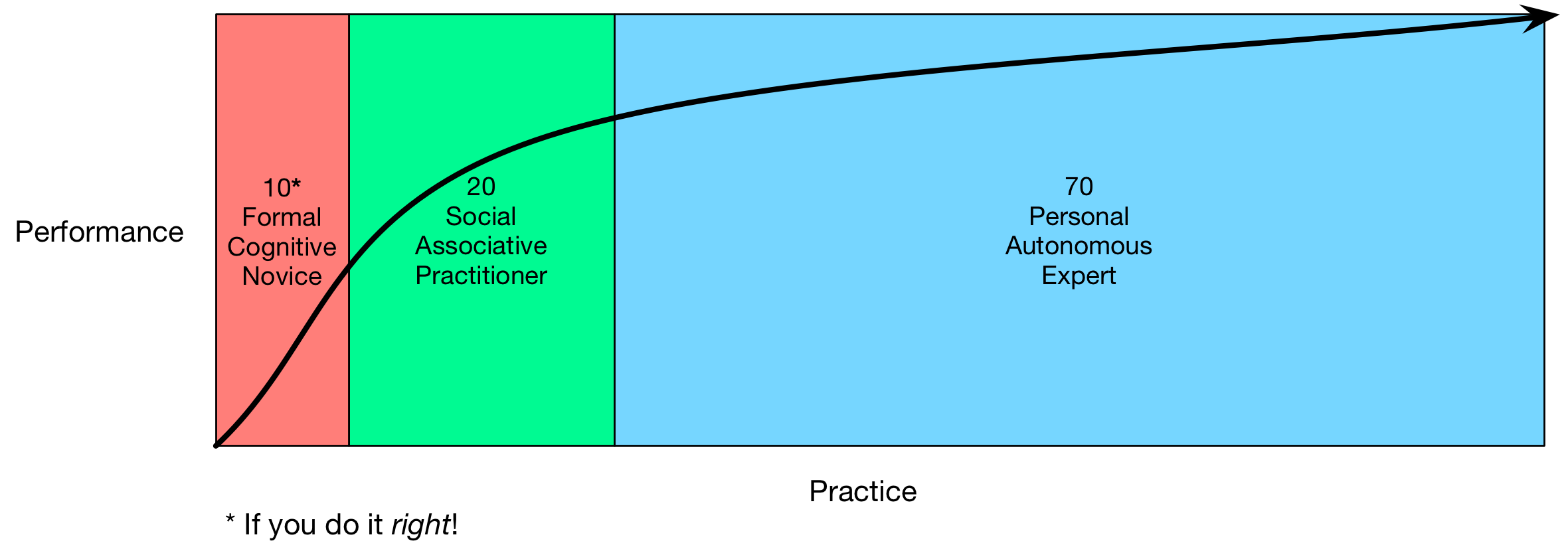
However, I was reminded of Fits & Posner’s model of skill acquisition, which has 3 phases of cognitive, associative, and autonomous learning. The first, cognitive, is when you benefit from formal instruction: giving you models and practice opportunities to map actions to an explicit framework. (Note that this  assumes a good formal learning design,  not rote information and knowledge test!)  Then there’s an associative stage where that explicit framework is supported in being contextualized and compiled away.  Finally, the learner continues to improve through continual practice.

I was initially reminded of Norman & Rumelhart’s accretion, restructuring, and tuning learning mechanisms, but it’s not quite right. Still, you could think of accreting the cognitive and explicitly semantic knowledge, then restructuring that into coarse skills that don’t require  as much conscious effort, until it becomes a matter of tuning a finely automated skill.

721LearningCurveThis, to me, maps more closely to 70:20:10, because you can see the formal (10) playing a role to kick off the semantic part of the learning, then coaching and mentoring (the 20) support the integration or association of the skills, and then the 70 (practice, reflection, and personal knowledge mastery  including informal social learning) takes over, and I mapped it against a hypothetical improvement curve.

Of course, it’s not quite this clean. While the formal often does kick off the learning, the role of coaching/mentoring and the personal learning are typically intermingled (though the role shifts from mentor to mentee ;). And, of course, the ratios in 70:20:10 are only a framework for rethinking investment, not a prescription about how you apply the numbers.  And I may well have the curve wrong (this is too flat for the normal power law of learning), but I wanted to emphasize that the 10 only has a small role to play in moving performance from zero to some minimal level, that mentoring and coaching really help improve performance, and that ongoing development requires a supportive environment.

I think it’s important to understand how we learn, so we can align our uses of technology to support them in productive ways. As this suggests, if you care about organizational performance, you are going to want to support more than the course, as well as doing the course right.  (Hence the revolution. :)

#itashare

Why L&D?

17 December 2014 by Clark 3 Comments

One of the concerns I hear is whether L&D still has a role.  The litany is  that  they’re so far out of touch with their organization, and science, that it’s probably  better to let them die an unnatural death than to try to save them. The prevailing attitude of this extreme view is that the Enterprise Social Network is the natural successor to the LMS, and it’s going to come from operations or IT rather than L&D.  And, given that I’m on record suggesting that we revolutionize L&D rather than ignoring it, it makes sense to justify why.  And while I’ve had other arguments, a really good argument comes from my thesis advisor, Don Norman.

Don’s on a new mission, something he calls DesignX, which is scaling up design processes to deal with “complex socio-technological systems”.   And he recently wrote an article about  why  DesignX that put out a good case why L&D as well.  Before I get there, however, I want to point out two other facets  of his argument.

The first is that often design has to go  beyond science. That is, while you use science when you can, when you can’t you use theory inferences,  intuition, and more to fill in the gaps, which you hope  you’ll find out later (based upon later science, or your own data) was the right choice.  I’ve often had to do this in my designs, where, for instance, I think research hasn’t gone quite far enough in understanding engagement.  I’m not in a research position as of now, so I can’t do the research myself, but I continue to look at what can be useful.  And this is true of moving L&D forward. While we have some good directions and examples, we’re still ahead of documented research.  He points out that system science and service thinking are science based, but suggests design needs to come in beyond those approaches.   To the extent L&D can, it should draw from science, but also theory and keep moving forward regardless.

His other important point is, to me, that he is talking about systems.  He points out that design  as a craft  works well on simple areas, but where he wants to scale design is to the level of systemic solutions.  A noble goal, and here too I think this is an approach  L&D needs to consider as well.  We have to go beyond point solutions – training, job aids, etc – to performance ecosystems, and this won’t come without a different mindset.

Perhaps the most interesting one, the one that triggered this post, however, was a point on why designers are needed.  His point is that others have focuses on efficiency and effectiveness, but he  argued that  designers have empathy for the users as well.  And I think this is really important.  As I used to say the budding software engineers I was teaching interface design to: “don’t trust your intuition, you don’t think like normal people”.  And similarly, the reason I want L&D in the equation is that they (should) be the ones who really understand how we think, work, and learn, and consequently they should be the ones facilitating performance and development. It takes an empathy with users to facilitate them through change, to help them deal with fears and anxieties dealing with new systems, to understand what a good learning culture is and help foster it.

Who else would you want to be guiding an organization in achieving effectiveness in a humane way?   So Don’s provided, to me, a good point on why we might still want L&D (well, P&D really ;)  in the organization. Well, as long as they also addressing the bigger picture and not just pushing info dump and knowledge test.  Does this make sense to you?

#itashare #revolutionizelnd

L&D and working out loud #wolweek

18 November 2014 by Clark 1 Comment

This week is Working Out Loud week, and I can’t but come out in support of a principle that I think is going to be key to organizational success. And, I think, L&D has a key role to play.

The benefits from working out loud are many. Personally, documenting what you’re doing serves as a reminder to yourself and awareness for others. The real power comes, however, from taking that next level: documenting not just what you’re doing, but why. This helps you in reflecting on your own work, and being clear in your thinking. Moreover, sharing your thinking gives you a second benefit in getting others’ input which can really improve the outcome.

In addition, it gives others a couple of benefits. They get to know what you’re up to, so it’s easier to align, but if your thinking is any good, it gives them the chance to learn from how you think.

So what is the role of L&D here? I’ll suggest there are two major roles: facilitating the skills and enabling the culture.

First, don’t assume folks know what working out loud means. And even if they do, they may not be good at it in terms of knowing how to indicate the underlying thinking. And they likely will want feedback and encouragement. First, L&D needs to model it, practicing what they preach. They need to make sure the tools are easily available and awareness is shared. Execs need to be shown the benefit and encouraged to model the behavior too. And L&D will have to trumpet the benefits, accomplishments, and encourage the behavior.

None of this is really likely to succeed if you don’t have a supportive culture. In a Miranda organization, no one is going to share. Instead, you need the elements of a learning organization: the environment has to value diversity, be open to new ideas, provide time for reflection, and most of all be safe. And L&D has to understand the benefits and continue to promote them, identify problems, and work to resolve them.

Note that this is not something you manage or control. The attitude here has to be one of nourishing aka (seed, feed, and weed). You may track it, and you want to be looking for things to support or behaviors to improve, but the goal is to develop a vibrant community of sharing, not squelching anything that violates the hierarchy.

Working out loud benefits the individual and the organization in a healthy environment. Getting the environment right, and facilitating the practice, are valuable contributions, and ones that L&D can, and should, contribute to.

#itashare

#DevLearn 14 Reflections

5 November 2014 by Clark 1 Comment

This past week I was at the always great DevLearn conference, the biggest and arguably best yet.  There were some hiccups in my attendance, as  several blocks of time were taken up with various commitments both work and personal, so for instance I didn’t really get a chance to peruse the expo at all.  Yet I attended keynotes and sessions, as well as presenting, and hobnobbed with folks both familiar and new.

The keynotes were arguably even better than before, and a high bar had already been set.

Neil deGrasse Tyson was eloquent and passionate about the need for science and the lack of match between school and life.    I had a quibble about his statement that doing math teaches problem-solving, as it takes the right type of problems (and Common Core is a step in the right direction)  and  it takes explicit scaffolding.  Still, his message was powerful and well-communicated. He also made an unexpected connection between Women’s Liberation and the decline of school quality that I hadn’t considered.

Beau Lotto also spoke, linking how our past experience alters our perception to necessary changes in learning.  While I was familiar with the beginning point of perception (a fundamental part of cognitive science, my doctoral field), he took it in very interesting and useful direction in an engaging and inspiring way.  His take-home message: teach not how to see but how to look, was succinct and apt.

Finally, Belinda Parmar took on the challenge of women in technology, and documented how  small changes can  make a big difference. Given the madness of #gamergate, the discussion was a useful reminder of inequity in many fields and for many.  She left lots of time to have a meaningful discussion about the issues, a nice touch.

Owing to the commitments both personal and speaking, I didn’t get to see many sessions. I had the usual situation of  good ones, and a not-so-good one (though I admit my criteria is kind of high).  I like that the Guild balances known speakers and topics with taking some chances on both.  I also note that most of the known speakers are those folks I respect that continue to think ahead and bring new perspectives, even if in a track representing their work.  As a consequence, the overall quality is always very high.

And the associated events continue to improve.  The DemoFest was almost too big this year, so many examples that it’s hard to start looking at them as you want to be fair and see all but it’s just too monumental. Of course, the Guild had a guide that grouped them, so you could drill down into the ones you wanted to see.  The expo reception was a success as well, and the various snack breaks suited the opportunity to mingle.  I kept missing the ice cream, but perhaps that’s for the best.

I was pleased to have the biggest turnout yet for a workshop, and take the interest in elearning strategy as an indicator that the revolution is taking hold.  The attendees were faced with the breadth of things to consider across advanced ID, performance support, eCommunity, backend integration, decoupled delivery, and then were led through the process of identifying elements and steps in the strategy.  The informal feedback was that, while daunted by the scope, they were excited by the potential and recognizing the need to begin.  The fact that the Guild is holding the Learning Ecosystem conference and their release of a new and quite good white paper by Marc Rosenberg and Steve Foreman are further evidence that awareness is growing.   Marc and Steve carve up the world a little differently than I do, but we say similar things about what’s important.

I am also pleased that  Mobile  interest continues to grow, as evidenced by the large audience at our mobile panel, where I was joined by other mLearnCon advisory board members Robert Gadd, Sarah Gilbert, and Chad Udell.  They provide nicely differing  viewpoints, with Sarah representing the irreverent designer, Robert the pragmatic systems perspective, and Chad the advanced technology view, to complement my more  conceptual approach.  We largely agree, but represent different ways of communicating and thinking about the topic. (Sarah and I will be joined by Nick Floro for ATD’s mLearnNow event in New Orleans next week).

I also talked about trying to change the pedagogy of elearning in the Wadhwani Foundation, the approach we’re taking and the challenges we face.  The goal I’m involved in is job skilling, and consequently there’s a real need and a real opportunity.  What I’m fighting for is to make meaningful practice as a way to achieve real outcomes.  We have some positive steps and some missteps, but I think we have the chance  to have a real impact. It’s a work in progress, and fingers crossed.

So what did I learn?  The good news is that the audience is getting smarter, wanting more depth in their approaches and breadth in what they address. The bad news appears to be that the view of ‘information dump & knowledge test = learning’ is still all too prevalent. We’re making progress, but too slowly (ok, so perhaps patience isn’t my strong suit ;).  If you haven’t, please do check out the Serious eLearning Manifesto to get some guidance about what I’m talking about (with my colleagues Michael Allen, Julie Dirksen, and Will Thalheimer).  And now there’s an app for that!

If you want to get your mind around the forefront of learning technology, at least in the organizational space, DevLearn is the place to be.


Belinda Parmar #DevLearn Keynote Mindmap

31 October 2014 by Clark Leave a Comment

Belinda Parmar addressed the critical question of women in tech in a poignant way, pointing out that the small stuff is important: language, imagery, context. She concluded with small actions including new job description language and better female involvement in product development.

IMG_0156.JPG

Beau Lotto #DevLearn Keynote Mindmap

30 October 2014 by Clark Leave a Comment

Beau Lotto gave a very interesting keynote that built from perceptual phenomena to a lovely message on learning.

IMG_0154.JPG

#DevLearn Schedule

24 October 2014 by Clark Leave a Comment

As usual, I will be at DevLearn (in Las Vegas) this next week, and welcome meeting up with you there.  There  is a lot going on.  Here’re the things I’m involved in:

  • On Tuesday, I’m running an all day workshop on eLearning Strategy. (Hint: it’s really a Revolutionize L&D  workshop  ;).  I’m pleasantly surprised at how many folks will be there!
  • On Wednesday at 1:15 (right after lunch), I’ll be speaking on the design approach  I’m leading  at the Wadhwani Foundation, where we’re trying to integrate learning science with pragmatic execution.  It’s at least partly a Serious eLearning Manifesto session.
  • On Wednesday at 2:45, I’ll be part of a panel on mlearning with my fellow mLearnCon advisory board members Robert Gadd, Sarah Gilbert, and Chad Udell, chaired by conference program director David Kelly.

Of course, there’s much more. A few things I’m looking forward to:

  • The  keynotes:
    •  Neil DeGrasse Tyson, a fave for his witty support  of science
    • Beau Lotto talking about perception
    • Belinda Parmar talking about women in tech (a burning issue right now)
  • DemoFest, all the great examples people are bringing
  • and, of course, the networking opportunities

DevLearn is probably my favorite conference of the year: learning focused, technologically advanced, well organized, and with the right people.  If you can’t make it this year, you might want to put it on your calendar for another!

Sharing pointedly or broadly

16 October 2014 by Clark 3 Comments

In a (rare) fit of tidying, I was moving from one note-taking app to another, and found a diagram I’d jotted, and it rekindled my thinking. The point was characterizing social media in terms of their particular mechanisms of distribution. I can’t fully recall what prompted the attempt at characterization, but one result of revisiting was thinking about the media in terms of whether they’re part of a natural mechanism of ‘show your work’ (ala Bozarth)/’work out loud’ (ala Jarche).

whether person to person or one to manyThe question revolves around whether the media are point or broadcast, that is whether you specify particular recipients (even in a mailing or group list), or whether it’s ‘out there’ for anyone to access.  Now, there are distinctions, so you can have restricted access on the ‘broadcast’ mode, but in principle there’re two different mechanisms at work.

It should be noted that in the ‘broadcast’ model, not everyone may be aware that there’s a new message, if they’re not ‘following’ the poster of the message, but it should be findable by search if not directly.  Also, the broadcast may only be an organizational network, or it can be the entire internet.  Regardless, there are differences between the two mechanisms.

So, for example, a chat tool typically lets you ping a particular person, or a set list. On the other hand, a microblog lets anyone decide to ‘follow’ your quick posts.   Not everyone will necessarily be paying attention to the ‘broadcast’, but they could.  Typically, microblogs (and chat) are for short messages, such as requests for help or pointers to something interesting.  The limitations mean that more lengthy  discussions typically are conveyed via…

Formats supporting unlimited text, including thoughtful reflections, updates on thinking, and more tend to be conveyed via email or blog posts. Again, email is addressed to a specific list of people, directly or via a mail list, openly or perhaps some folks receiving copies ‘blind’ (that is, not all know who all is receiving the message.  A blog post (like this), on the other hand, is open for anyone on the ‘system’.

The same holds true for other media files besides text.   Video and audio can be hidden in a particular place (e.g. a course) or sent directly to one person. On the other hand, such a message can be hosted on a portal (YouTube, iTunes) where anyone can see.  The dialog around a file provides a rich augmentation, just as such can be happening on a blog, or edited RTs of a microblog comment.

Finally, a slightly different twist is shown with documents.  Edited documents (e.g. papers, presentations, spreadsheets) can be created and sent, but there’s little opportunity for cooperative development.  Creating these in a richer way that allows for others to contribute requires a collaborative document (once known as a wiki).  One of my dreams is that we may have collaboratively developed interactives as well, though that still seems some way off.

The point for showing out loud is that point is only a way to get specific feedback, whereas a broadcast mechanism is really about the opportunity to get a more broad awareness and, potentially, feedback.  This leads to a broader shared understanding and continual improvement, two goals critical to organizational improvement.

Let me be the first to say that this isn’t necessarily an important, or even new, distinction, it’s just me practicing what I preach.  Also, I   recognize that the collaborative documents are fundamentally different, and I need to have a more differentiated way to look at these (pointers or ideas, anyone), but here’s my interim thinking.  What say you?

#itashare

« Previous Page
Next Page »

Clark Quinn

The Company

Search

Feedblitz (email) signup

Never miss a post
Your email address:*
Please wait...
Please enter all required fields Click to hide
Correct invalid entries Click to hide

Pages

  • About Learnlets and Quinnovation

The Serious eLearning Manifesto

Manifesto badge

Categories

  • design
  • games
  • meta-learning
  • mindmap
  • mobile
  • social
  • strategy
  • technology
  • Uncategorized
  • virtual worlds

License

Previous Posts

  • April 2026
  • March 2026
  • February 2026
  • January 2026
  • December 2025
  • November 2025
  • October 2025
  • September 2025
  • August 2025
  • July 2025
  • June 2025
  • May 2025
  • April 2025
  • March 2025
  • February 2025
  • January 2025
  • December 2024
  • November 2024
  • October 2024
  • September 2024
  • August 2024
  • July 2024
  • June 2024
  • May 2024
  • April 2024
  • March 2024
  • February 2024
  • January 2024
  • December 2023
  • November 2023
  • October 2023
  • September 2023
  • August 2023
  • July 2023
  • June 2023
  • May 2023
  • April 2023
  • March 2023
  • February 2023
  • January 2023
  • December 2022
  • November 2022
  • October 2022
  • September 2022
  • August 2022
  • July 2022
  • June 2022
  • May 2022
  • April 2022
  • March 2022
  • February 2022
  • January 2022
  • December 2021
  • November 2021
  • October 2021
  • September 2021
  • August 2021
  • July 2021
  • June 2021
  • May 2021
  • April 2021
  • March 2021
  • February 2021
  • January 2021
  • December 2020
  • November 2020
  • October 2020
  • September 2020
  • August 2020
  • July 2020
  • June 2020
  • May 2020
  • April 2020
  • March 2020
  • February 2020
  • January 2020
  • December 2019
  • November 2019
  • October 2019
  • September 2019
  • August 2019
  • July 2019
  • June 2019
  • May 2019
  • April 2019
  • March 2019
  • February 2019
  • January 2019
  • December 2018
  • November 2018
  • October 2018
  • September 2018
  • August 2018
  • July 2018
  • June 2018
  • May 2018
  • April 2018
  • March 2018
  • February 2018
  • January 2018
  • December 2017
  • November 2017
  • October 2017
  • September 2017
  • August 2017
  • July 2017
  • June 2017
  • May 2017
  • April 2017
  • March 2017
  • February 2017
  • January 2017
  • December 2016
  • November 2016
  • October 2016
  • September 2016
  • August 2016
  • July 2016
  • June 2016
  • May 2016
  • April 2016
  • March 2016
  • February 2016
  • January 2016
  • December 2015
  • November 2015
  • October 2015
  • September 2015
  • August 2015
  • July 2015
  • June 2015
  • May 2015
  • April 2015
  • March 2015
  • February 2015
  • January 2015
  • December 2014
  • November 2014
  • October 2014
  • September 2014
  • August 2014
  • July 2014
  • June 2014
  • May 2014
  • April 2014
  • March 2014
  • February 2014
  • January 2014
  • December 2013
  • November 2013
  • October 2013
  • September 2013
  • August 2013
  • July 2013
  • June 2013
  • May 2013
  • April 2013
  • March 2013
  • February 2013
  • January 2013
  • December 2012
  • November 2012
  • October 2012
  • September 2012
  • August 2012
  • July 2012
  • June 2012
  • May 2012
  • April 2012
  • March 2012
  • February 2012
  • January 2012
  • December 2011
  • November 2011
  • October 2011
  • September 2011
  • August 2011
  • July 2011
  • June 2011
  • May 2011
  • April 2011
  • March 2011
  • February 2011
  • January 2011
  • December 2010
  • November 2010
  • October 2010
  • September 2010
  • August 2010
  • July 2010
  • June 2010
  • May 2010
  • April 2010
  • March 2010
  • February 2010
  • January 2010
  • December 2009
  • November 2009
  • October 2009
  • September 2009
  • August 2009
  • July 2009
  • June 2009
  • May 2009
  • April 2009
  • March 2009
  • February 2009
  • January 2009
  • December 2008
  • November 2008
  • October 2008
  • September 2008
  • August 2008
  • July 2008
  • June 2008
  • May 2008
  • April 2008
  • March 2008
  • February 2008
  • January 2008
  • December 2007
  • November 2007
  • October 2007
  • September 2007
  • August 2007
  • July 2007
  • June 2007
  • May 2007
  • April 2007
  • March 2007
  • February 2007
  • January 2007
  • December 2006
  • November 2006
  • October 2006
  • September 2006
  • August 2006
  • July 2006
  • June 2006
  • May 2006
  • April 2006
  • March 2006
  • February 2006
  • January 2006

Amazon Affiliate

Required to announce that, as an Amazon Associate, I earn from qualifying purchases. Mostly book links. Full disclosure.

We use cookies to ensure that we give you the best experience on our website. If you continue to use this site we will assume that you are happy with it.