Learnlets

Secondary

Clark Quinn’s Learnings about Learning

Initial reflections on Slow Learning #change11

6 December 2011 by Clark 2 Comments

I have to say that I found the comments on my initial post very interesting and challenging.  A couple of themes have emerged that partly I want to elaborate on, and partly want to reflect upon.  I believe in, and do try, ‘learning out loud’, so I’ll both try to elaborate and draw myself up short.

One of the themes that emerged is the rejection of the GPS idea, and extolling a preference for getting lost (I did  explicitly mention that GPS’s do not  help you learn the terrain, but I’ll add that they could).  I want to unpack that a bit. One of the issues is, for me, where you want to learn, and where you don’t.  As a definitely curious individual (in both senses, I suppose :), there’s far too much of interest for me to be able to focus on it all. As a consequence, I want to decide on what I invest effort in, and what I don’t.  So, for instance, I’ve learned about keyboard shortcuts to use Word’s outline  capabilities, and I can understand where others would not (tho’ I admit to wishing everyone would learn styles, as a valuable model going forward!).  So, I think we’d use a mental GPS when it’s something we don’t want to learn, and we’d want a different relationship when we do.  If  we’re self-aware learners.

There’s also the issue of how the Sage on the Side  would operate? What curricula are being used?  Who’s providing the content?  I will admit that while I talk a constructivist game, I do tend to err too quickly to think about designed resources.  In my own defense, I will suggest that self-learning skills aren’t broadly distributed enough yet, and particularly for novices, there are times when they don’t know what they need and why it’s important.  I am very much a fan of guided discovery learning (not the unguided discovery learning that was used as a straw-man opponent to instructivist in the Kirschner, Sweller, Clark article), but I do believe guidance is necessary until learners demonstrate self-learning capability. And I definitely think we can and should be developing that capability, but I’m not sanguine that we’re very good at it yet.

However,  I’ve earlier talked about user generated curricula, and I think that’s really the way to go.   In the long term, the communities will take ownership of the paths to competency. I’m hoping, through something like Project Tin Can (horrible  name, but…), we can support defining broad paths to capability that are maintained by the community, and even self-proposed paths that are vetted by the community (says a guy who designed his own undergraduate major).

I admit that I’m trying to focus on a system that can be supporting a person in their goals with minimal human intervention. I want it to be one of the options on the table for the ‘sage’ to draw upon (e.g. the resources can be people, too), but I’m trying to make this scalable. Idealistically, I would like communities to become more other-supporting, but I think such a system would have desirable properties in terms of developing people over time.

As I think about it, I also anticipate some serendipity in the sage approach.  There’s some randomness in our cognitive architecture, and I’d like to see some similar probabilistic behavior in the system recommendations.  When we built the Intellectricityâ„¢ system, we had options ‘competing’ for the opportunity to be presented.  We also had machine learning in the background to improve the weighting.  This is where deep analytics and semantics could generate some real interesting outcomes.

And I definitely would hope that we would explicitly be working in a layer on top of the learning goals to address meta-learning or learning to learn, so we could move from providing guidance to merely suggesting resources.  So, for example, despite my time trying to improve my learning, there’s still room for improvement and I welcome any assistance I can get.  I’m mindful of Watts Humphrey’s work in software quality, where documenting your decisions and having them reviewed identified persistent mistakes, and allowed for continual improvement (resulting in large decreases in errors, much more accurate schedules, and other tangible benefits).  The approach is certainly applicable to other areas of design and work, and I think it’d be fascinating to have systemic support (because the overhead is high enough that I haven’t been able to instill it in myself ;).

Given that we’re all novices in some areas while experts in others, I think the notion of at least a bootstrap from some support makes sense to assist transition into a community of practice.  I don’t think this is fundamental opposition to rhizomes,connectivism, or anything else, but I welcome your thoughts.  I do think that the notion of a tree of trajectories may be too rigid, so I’ll have to ponder that, but I’d like to devolve that decision to the community of practice.

Going beyond just the notion of the system, I believe that we need to start thinking more broadly about our curricula, pedagogy, and more. That’s not new, but I do believe a shift from learning events to continual development is not only needed, but doable.  Given that each of us is a member of multiple communities, it may look more like a network, but that’s OK.


Slow Learning – #change11

3 December 2011 by Clark 18 Comments

This is a longer post launching my week in the #change11 MOOC (Massively Open Online Course).  

Our formal learning approaches too often don‘t follow how our brains really work.   We have magic now; we can summon up powerful programs to do our bidding, gaze through webcams across distances, and bring anyone and anything to pretty much anywhere. Our limitations are no longer the technology, but our imaginations. The question is, what are we, and should be, doing with this technology?

I like to look at this a couple of ways. For one, I like to ask myself “what would my ideal learning situation be”

Stop and ask yourself that.   Go ahead, I‘ll wait.   And feel free to share!

For me, that would be having a personal mentor traveling with me, looking at my tasks, providing both support in the moment, and developing me slowly over time.   I talked about how we might systematize that in a post titled Sage at the Side.   I also talked about this model as Layered Learning.   That is, layering on learning across our life.

It‘s part of what my colleague Harold Jarche talks about when saying “work is learning and learning is work”, the notion that as organizations start empowering workers to adapt to the increasing complexity, there will be no difference between work and learning, and we‘ll have to move away from the ‘event‘ model of learning and start integrating learning more closely into our activities.   We‘ll need to have a closer coupling between our activities and the resources, creating what Jay Cross calls a workscape and I‘ve termed the performance ecosystem.   That is, having the tools to hand, including job aids, people, and skill development, but in a more systemic way.

Think about that: how would you construct an optimal performance environment for yourself?   What would it look like?   Again, feel free to share.

Would it look like an LMS over here, training away over there, job aids scattered across portals, and social networks hierarchically structured or completely banned?   Would you have spray-and-pray (aka show up and throw up) training?   Online courses that are clicky-clicky bling-bling? Resources accessible by the way the organization is siloed?   Even the simple and well-documented matter of spaced learning is largely violated in most of the learning interventions we propagate.   In short, all of this is in conflict with how the human brain works!

Look at how how we learn naturally, before schooling (what I call the 7 C‘s of natural learning). We see that we learn by being engaged in meaningful activity, and working with others.   It‘s not about knowledge dump and test, but instead about coupling engaged activity with reflection.   I like Collins, Brown, & Holum‘s Cognitive Apprenticeship as a model for thinking more richly about learning.   Other learning models are not static (c.f. Merrill‘s trajectory through CDT to ID2 to Ripples), and I believe they‘ll converge where Cognitive Apprenticeship is (albeit perhaps my slightly adulterated version thereof).   It talks about modeling, scaffolding and release, naturally incorporating social and meaningful activity into the learning process.

Taking a broader look, too many of our systems have a limited suite of solutions to choose from, and ignore a number of features that we need.   The ADDIE process assumes a course, and still doesn‘t have any real support for the emotional engagement aspect. A step above is the HPT approach, which does look at the learning need and checks to see whether the solution might be a course, a job aid, realigning incentives, or some other things. However, it still doesn‘t consider, really, engagement, nor does an adequate job of considering when connecting to a person is a more valuable solution than designing content.

And while Gloria Gery‘s seminal work on Electronic Performance Support Systems suggested that these systems could not only provide support in the moment but also develop the learners‘ understanding, I still don‘t see this in any systems in practice. Even GPSs don‘t help you understand the area, they just get you where you‘re trying to go. So we are still missing something.

I‘m really arguing for the need to come up with a broader perspective on learning.   I‘ve been calling it learning experience design, but really it‘s more.   It‘s a combination of performance support and learning (and it‘s badly in need of some branding help). The notion is a sort-of personal GPS for your knowledge work. It‘s knows where you want to go (since you told it), and it knows where you are geographically and semantically (via GPS and your calendar), and as it recognizes the context it can provide not only support in the moment, but layers on learning along the way.   And I think that we don‘t know really how to look at things this way yet; we don‘t have design models (to think about the experience conceptually), we don‘t have design processes (to go from goal to solution), and we don‘t have tools (to deliver this integrated experience).   Yet the limits are not technological; we have the ability to build the systems if we can conceptualize the needed framework.

I think this framework will need to start with considering the experience design, what is the flow of information and activity that will help develop the learner (e.g. “If you get the design right, there are lots of ways to implement it”).   Then we can get into the mechanics of how to distribute the experience across devices, information, people, etc.   But this is embryonic yet, I welcome your thoughts!

Really, I‘m looking to start matching our technology more closely to our brains.   Taking a   page from the slow movement (e.g. slow X, where X = food, sex, travel, …), I‘m talking about slow learning, where we start distributing our learning in ways that match the ways in which our brains work: meaningfulness, activation and reactivation, not separate but wrapped around our lives, etc.

There‘s lots more: addressing the epistemology of learners, mobile technologies, meta-learning & 21st C skills, and deep analytics and semantic systems, to name a few, but I think we need to start with the right conceptions.   Some of my notions of design may be too didactic, after all, and we‘ll need to couple information augmentation with meaning-making to make real progress, but I think this notion of stepping back and reflecting on what we might want to achieve and where we‘re currently inadequate is an initial step.

And now the initiative is over to you. I look forward to your thoughts.

Readings

Collins, A., Brown, J.S., and Holum, A. (1991).   .   Cognitive Apprenticeship: Making Thinking Visible. American Educator, Winter.

Quinn, C. (2004).   Learning at Large.   Educational Technology, 44, 4, 45-49.

Quinn, C. (2009). Populating the LearnScape: e-Learning as Strategy. In M. Allen (Ed.) Michael Allen‘s eLearning Annual 2009. Pfeiffer, San Francisco.

Quinn, C. (2010). Rethinking eLearning.   Learning Solutions Magazine. April.

Quinn, C. (2010). Designing for an uncertain world. Learnlets. April.

Thalheimer, W. (2006).  Spacing Learning Over Time.  Work Learning Research.

Etienne Wenger-Trayner Keynote Mindmap

18 November 2011 by Clark 4 Comments

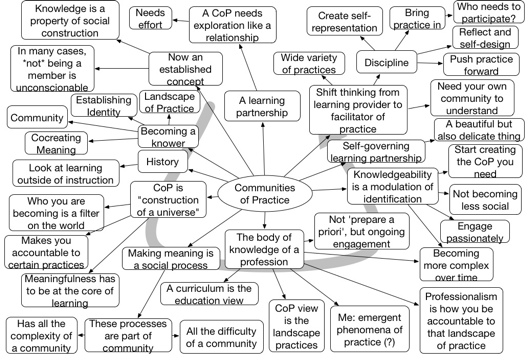
At the CSTD meeting, Etienne was the morning keynote, and gave a erudite exploration of the philosophical background and characteristics of Communties of Practice.

20111118-093907.jpg

Learning 2011 Interview Mindmaps

7 November 2011 by Clark 1 Comment

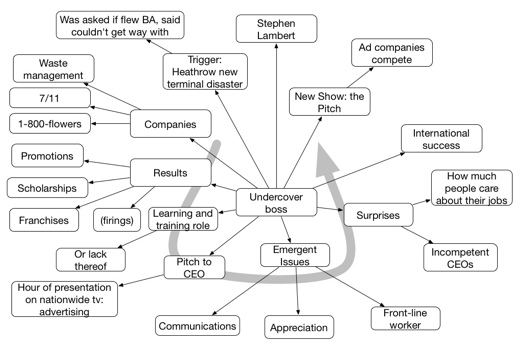
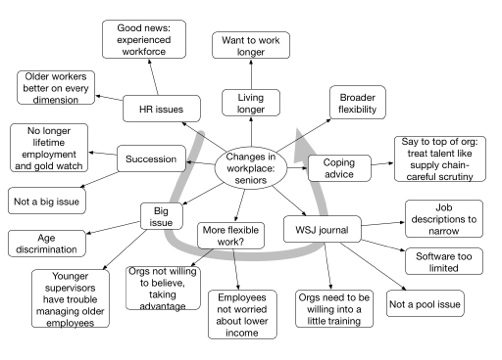
Elliot Masie has interviewed Stephen Lambert (Producer of Undercover Boss) and Peter Capelli (Managing the Older Worker). Here are the mindmaps:

20111107-112243.jpg

20111107-112256.jpg

Koulopoulos Keynote Mindmap

2 November 2011 by Clark 1 Comment

The afternoon keynote at DevLearn was an energizing and insightful visitation of innovation and the future by Thom Koulopolous.

20111102-172421.jpg

Book Review Pointer

21 October 2011 by Clark 1 Comment

In case you didn’t see it, eLearn Mag has posted my book review of Mark Warschauer’s insightful book, Learning in the Cloud.  To quote myself:

This is … a well-presented, concise, and documented presentation of just what is needed to make a working classroom, and how technology helps.

As one more teaser, let me provide the closing paragraph:

The ultimate message, however, is that this book is important, even crucial reading. This is a book that every player with a stake in the game needs to read: teachers, administrators, parents, and politicians. And not to put too delicate a point on it, this is what I think should be our next “man in the moon” project; implementing these ideas comprehensively, as a nation. He’s given us the vision, now it is up to us to execute.

I most strongly urge you, if you care about schooling, to read the book, and then promote the message.

Quinnovation ‘to go’

27 September 2011 by Clark 1 Comment

The travel schedule is booting up again, and I’ll be hither and yon speaking about this and that for a good part of the coming two months. More specifically:

  • From 2-3 Oct I’ll be running a two day elearning strategy  workshop at Learning 3.0 in Chicago.  If you want to get above the individual tactics and see how the pieces fit together, and work on a plan for you and your org, I hope to see you there.  Then on Tuesday the 4th, I’ll be talking about creating Engaging Learning.
  • Then, on 12 Oct in Laguna Niguel at the CLO Fall Symposium, I’ll be joining with my ITA colleagues Jay Cross and Jane Hart to talk about controversial issues for CLOs.  This will be fun and worthwhile, as we will be aiming at some sacred cows.
  • It’s off to Las Vegas at the beginning of November for DevLearn, where I’ll be running a mobile learning strategy session on the the 1st.  If you want to get beyond just designing a one-off, and look at the broader picture of how to make mobile a part of your solution, it’s the place to be.
  • That’s followed by Learning 2011 in Orlando Nov 6-9, where I’ll be hosting an author session for Designing mLearning.
  • I’m still not done, as I head later that week to DC to speak to the local ASTD chapter with a talk on mobile learning and a social learning workshop.  That latter will talk about both formal and  informal learning, as well as looking at the different tools.
  • And, to cap it off, I’ll be presenting at the Canadian Society for Training & Development’s annual conference in Toronto on Friday the 18th of November, looking forward and more broadly at the role of learning in the organization.

That may seem  like a lot (and it is), but traveling on only one continent will seem easy after this past May-August ;).  I hope to see you at one or more of these learning events!

Reflecting socially

23 September 2011 by Clark 5 Comments

About ten years ago, now, Jay Cross and I met and with some other colleagues, started what we called the Meta-Learning Lab. We’ve maintained our interest in meta-learning across our involvement now with the Internet Time Alliance, and a component we identified as one of the most valuable activities you can do is reflection.

We don’t mean just navel-gazing, of course, but instead we mean systematically stepping back and reviewing ongoing activity with a view towards looking for improvement. It’s baked into things like Watts Humphrey’s Personal Software Process, and without that level of rigor, it still has benefits.  Even more so if it’s shared.

So, blogging is one way of sharing your thoughts and getting feedback (as I do here).  The social processing  that happens when sharing is not just for formal learning, but for personal, self-directed learning as well.  Creating a representation of your understanding is valuable in and of itself, to make your thinking concrete, but sharing and getting feedback is even more powerful.

This isn’t just for individuals, of course, but also for teams.  If teams share their collective thinking (blogs again, or perhaps wikis), they can get feedback not just from each other but also from non-team individuals.  This improves the thinking.

And we can start using richer media than just text.  We can capture our understanding with images, audio or video, e.g. conducting interviews (you think differently creating a response to a deep question synchronously than asynchronously).  You can go out and create a video of something that communicates what you think.  You can even film a performance by the individual or team and bring it back for discussion. What a couple of high-tech firms have done, having outstanding performers talk about or perform on video, and adding their own reflections (‘directors notes’ versions), is really powerful for learners too.

Mobile gives us the capability to be more flexible in our communication capture and sharing, which decouples our thinking from the desktop.  We also may be able to review interactions in a social media system, messages and such, to reflect on our communication patterns and improve. And facilitating all this is, to me, one of the opportunities for the learning professional as we start a) expanding our responsibility for all performance, not just ‘training’, and b) start investing our efforts in proportion to the workplace impact (c.f. 70:20:10).

So, I encourage you to start reflecting personally, of course, but consider also reflecting socially, with your colleagues, teammates, and more.  Learning out loud is a key to moving forward faster and more effectively.

Working Smarter

12 September 2011 by Clark 2 Comments

Work smarter, not harder.

Have you heard that?  I did, in my first job out of college; my boss said it, but it wasn’t clear what it meant.  What does ‘work smarter’ mean?  I already thought I was working smarter.  Well, as I’ve learned (in conjunction with my ITA colleagues), it means a number of things that organizations can, and should, do.

So, what is known about when we work smarter? We work smarter under a number of conditions: when we have a clear goal of what we’re supposed to achieve and we recognize it’s importance; when we’re free to experiment, explore, and even fail; when we have colleagues to collaborate with; and  when we have the resources we need available ‘to hand’.  This provides some guidance about what an organization should be doing to optimize the likelihood of success.

We need to be doing meaningful work that we’re excited about.  We need to be connected to a vision, and understand how our role contributes.  There needs to be transparency above and below as well as ahead, so we can see how the parts are working together.

We also need a culture where that transparency is empowering, not threatening. It has to be safe to perform in public, to share our thoughts, and to both provide and receive help to others.  Where, when mistakes are made, the lessons are learned and shared.

We need to see it as important to contribute, and be enabled to communicate to the right people, and be able to work together to get the job done.  We need time to reflect as well, to take time to think about what we’re doing. We should be doing that publicly too. We need to learn out loud and together.

Finally, we need the tools available. We shouldn’t have to take time to go multiple places to get what we need, and use inconsistent interfaces to use them. We should have an environment where we’re focused on our tasks, and can get who and what we need to stay focused.

How to work smarter isn’t a mystery. The mystery is why  more organizations aren’t systematically breaking down the barriers to working smarter.  Are you ready to get going?

Social Cognitive Processing

6 September 2011 by Clark 4 Comments

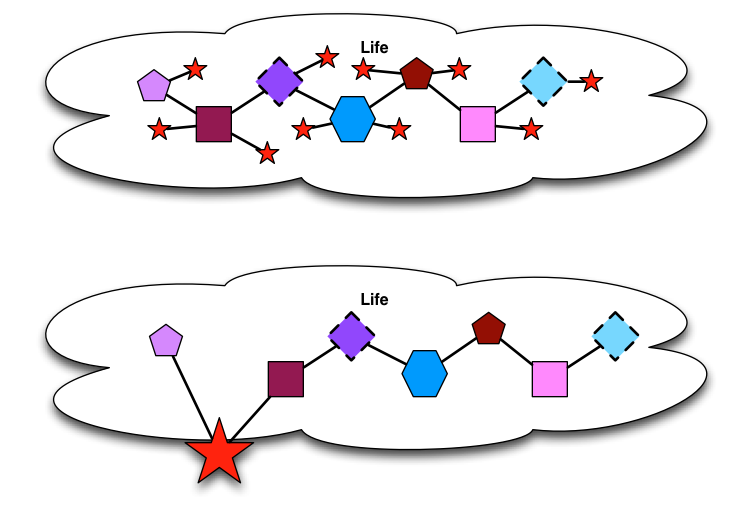
In an earlier post, I tried to convey the advantages of social activities in formal learning from the cognitive processing perspective, but my diagram apparently didn’t work for everyone.  I took another shot for a presentation I gave on mobile social at the Guild’s mLearnCon, and I thought I’d raise it here as well.

Cognitive reprocessing via social interactionI’m going through this diagram line by line, from the top.

If you go from just having an idea (first line) to trying to capture it as a product (next), whether a diagram or a screed, to communicate to some hypothetical reader, you find out that you might not have thought it out fully (the first benefit to having a personal journal, e.g. blogging).  And you do some processing to generate that product.

Then, if someone actually reads it, they  do some processing.

If they write a response, they do more processing to crystalize their thoughts.

Then, the author, when reading it, also does some more processing.

If someone else reads it, that person does some processing, and if they write  a comment, well, the process continues.

The author could then write a reply to one or both, and that causes even  more  processing. And so on.

And this is good.  Processing is part of learning, and focused processing is part of good learning design.  So, having learners capture and communicate their thoughts is a valuable learning activity.  It can be personal reflections, e.g. “what does this explain in my past” or “what will I do differently in the future”, or responses to a question.

If other learners are asked to read and constructively  comment (not just “great post”), you can get valuable learning outcomes.

Cognitive processing in group assignmentsThis extends to the social learning situation. Here, you have every learner contribute their initial  thoughts on a group assignment (recommended).

Then, every learner reads the other proposals, and they start to put out their integrated ideas.

As they negotiate a shared understanding as a group response, some great processing is happening.

Ultimately, they create an outcome that’s richer than what they’d create on their own.

If you’ve created the right  amount of ambiguity in the project, you’ll get some great discussions.  The processing benefits here are because the learners will bring somewhat different interpretations and experiences to the project, and that diversity allows a mre robust understanding to emerge.

Consequently, I suggest that social learning adds benefits to the learning experience beyond what individual assignments can achieve. You can mimic some of these effects by staging additional information, but it’s not quite as effective as individual learning (nor near as engaging).

So, does this make sense?  And, hopefully, inspire you to find ways to add social interaction into your learning experiences? It’s not unique to social media, but social media give you a channel to bring these benefits to learning whenever and wherever.

« Previous Page
Next Page »

Clark Quinn

The Company

Search

Feedblitz (email) signup

Never miss a post
Your email address:*
Please wait...
Please enter all required fields Click to hide
Correct invalid entries Click to hide

Pages

  • About Learnlets and Quinnovation

The Serious eLearning Manifesto

Manifesto badge

Categories

  • design
  • games
  • meta-learning
  • mindmap
  • mobile
  • social
  • strategy
  • technology
  • Uncategorized
  • virtual worlds

License

Previous Posts

  • April 2026
  • March 2026
  • February 2026
  • January 2026
  • December 2025
  • November 2025
  • October 2025
  • September 2025
  • August 2025
  • July 2025
  • June 2025
  • May 2025
  • April 2025
  • March 2025
  • February 2025
  • January 2025
  • December 2024
  • November 2024
  • October 2024
  • September 2024
  • August 2024
  • July 2024
  • June 2024
  • May 2024
  • April 2024
  • March 2024
  • February 2024
  • January 2024
  • December 2023
  • November 2023
  • October 2023
  • September 2023
  • August 2023
  • July 2023
  • June 2023
  • May 2023
  • April 2023
  • March 2023
  • February 2023
  • January 2023
  • December 2022
  • November 2022
  • October 2022
  • September 2022
  • August 2022
  • July 2022
  • June 2022
  • May 2022
  • April 2022
  • March 2022
  • February 2022
  • January 2022
  • December 2021
  • November 2021
  • October 2021
  • September 2021
  • August 2021
  • July 2021
  • June 2021
  • May 2021
  • April 2021
  • March 2021
  • February 2021
  • January 2021
  • December 2020
  • November 2020
  • October 2020
  • September 2020
  • August 2020
  • July 2020
  • June 2020
  • May 2020
  • April 2020
  • March 2020
  • February 2020
  • January 2020
  • December 2019
  • November 2019
  • October 2019
  • September 2019
  • August 2019
  • July 2019
  • June 2019
  • May 2019
  • April 2019
  • March 2019
  • February 2019
  • January 2019
  • December 2018
  • November 2018
  • October 2018
  • September 2018
  • August 2018
  • July 2018
  • June 2018
  • May 2018
  • April 2018
  • March 2018
  • February 2018
  • January 2018
  • December 2017
  • November 2017
  • October 2017
  • September 2017
  • August 2017
  • July 2017
  • June 2017
  • May 2017
  • April 2017
  • March 2017
  • February 2017
  • January 2017
  • December 2016
  • November 2016
  • October 2016
  • September 2016
  • August 2016
  • July 2016
  • June 2016
  • May 2016
  • April 2016
  • March 2016
  • February 2016
  • January 2016
  • December 2015
  • November 2015
  • October 2015
  • September 2015
  • August 2015
  • July 2015
  • June 2015
  • May 2015
  • April 2015
  • March 2015
  • February 2015
  • January 2015
  • December 2014
  • November 2014
  • October 2014
  • September 2014
  • August 2014
  • July 2014
  • June 2014
  • May 2014
  • April 2014
  • March 2014
  • February 2014
  • January 2014
  • December 2013
  • November 2013
  • October 2013
  • September 2013
  • August 2013
  • July 2013
  • June 2013
  • May 2013
  • April 2013
  • March 2013
  • February 2013
  • January 2013
  • December 2012
  • November 2012
  • October 2012
  • September 2012
  • August 2012
  • July 2012
  • June 2012
  • May 2012
  • April 2012
  • March 2012
  • February 2012
  • January 2012
  • December 2011
  • November 2011
  • October 2011
  • September 2011
  • August 2011
  • July 2011
  • June 2011
  • May 2011
  • April 2011
  • March 2011
  • February 2011
  • January 2011
  • December 2010
  • November 2010
  • October 2010
  • September 2010
  • August 2010
  • July 2010
  • June 2010
  • May 2010
  • April 2010
  • March 2010
  • February 2010
  • January 2010
  • December 2009
  • November 2009
  • October 2009
  • September 2009
  • August 2009
  • July 2009
  • June 2009
  • May 2009
  • April 2009
  • March 2009
  • February 2009
  • January 2009
  • December 2008
  • November 2008
  • October 2008
  • September 2008
  • August 2008
  • July 2008
  • June 2008
  • May 2008
  • April 2008
  • March 2008
  • February 2008
  • January 2008
  • December 2007
  • November 2007
  • October 2007
  • September 2007
  • August 2007
  • July 2007
  • June 2007
  • May 2007
  • April 2007
  • March 2007
  • February 2007
  • January 2007
  • December 2006
  • November 2006
  • October 2006
  • September 2006
  • August 2006
  • July 2006
  • June 2006
  • May 2006
  • April 2006
  • March 2006
  • February 2006
  • January 2006

Amazon Affiliate

Required to announce that, as an Amazon Associate, I earn from qualifying purchases. Mostly book links. Full disclosure.

We use cookies to ensure that we give you the best experience on our website. If you continue to use this site we will assume that you are happy with it.