Learnlets

Secondary

Clark Quinn’s Learnings about Learning

Search Results for: Reading Research

Thinking well and, well, not so well

3 May 2012 by Clark 1 Comment

A number of books have crossed my path for a variety of reasons, and there’re some lessons to be extracted from three of them.  All have to do with looking at how our brains work, and some lessons therefrom.  There have been quite a bit of kerfuffle about ‘brain-based learning’, of which too much is inappropriate inferences from neuroscience to learning.  What I’m doing here is not that, but instead reporting on three books, only one of which has an explicit discussion of implications for both education and work. Still, valuable insight comes from all three.

Let me get the negative stuff out of the way first, a book that a number of folks have been excited about, Joshua Foer’s  Moonwalking with Einstein, just did nothing for me. It’s a great tale well told, but the lessons were only cautionary. In it, a journalist gets intrigued enough with remembering to train sufficiently to win the US memory championships (apparently, globally, a relatively minor accomplishment).  He reveals many memory tools to accomplish this, and points out some potential fraud along the way.  He also concludes that despite this heightened ability, there is little relevance in the real world.  We have devices that can be our memory now, and the need for these skills is questionable at best.  All in all, little benefit except to be skeptical.

A second book, Daniel Kahnemann’s Thinking Fast and Slow, is a different story. Kahnemann, and his late long-time collaborator Amos Tversky, conducted some seminal research in how we make decisions (essential reading in my grad school career).  And the best way to convey how we do this, as Kahnemann tells us, is to postulate two separate systems. Not surprisingly one is fast, and one is slow.  The book is quite long, as Kahnemann goes through every phenomenon of these outcomes that they’ve discovered (often with collaborators), but each chapter closes with some statements that capture the ways your thinking might be wrong, and ways to compensate. It could use more prescriptions and less description (I started skimming, I confess), but understand the two systems and the implications are important.  It’s a well-written and engaging book, I just wish there was a ‘take home’ version.

The fast system is, essentially, intuition. This comes in many ways from your experience, and experts in a field should trust their intuition (there’s a strong argument here for hiring someone with lots of experience) in their area.  In areas where expertise is needed, and you don’t have it, you should go to the slow system, conscious rational thought.  Which is very vulnerable to fatigue (it taxes your brain), so complex decisions late in a day of decision are suspect.  If your decision is commonplace, you can trust the fast system, and many times you’ll be using the slow system just to explain the decision the fast system came up with, but we’re prone to many forms of bias.  It’s a worthwhile read, and tells us a lot about how we might adapt our learning to develop the fast system when necessary, and when to look to the slow system.

Finally, Cathy Davidson’s written Now You See It, a book that takes an attentional phenomena and builds a strong case for more closely matching learning and work to how we really think.  (I was pointed to it by a colleague who complained that my learning theory references are old; I still take my integration of learning theory as appropriate but nice to see that more recent work reflects my take on the best from the past. :) The phenomena is related to how our attention is limited and we need help focusing it.  For a dramatic demonstration of this phenomena, view this video and follow the instructions.  Her point is that what and how we pay attention does not reflect our current schooling systems nor our traditional work environments.  She uses this and myriad examples to make a compelling case for change in both.  On the learning side, she argues strongly for making learning active and meaningful (a view I strongly support), and start using the technology. On the other side, she talks about the new ways of working consonant with our Internet Time Alliance views.  It’s very readable, as it’s funny, poignant, apt, and more.

I highly recommend Cathy Davidson’s book as something everyone should understand.  Like I said, I wish there were a ‘Readers Digest Condensed‘ version of Kahnemann’s book.  It’s worth having a look at if you’re responsible for decisions by folks, however, and at least the first few chapters if you’re at all responsible for helping people make better decisions.

Slow Learning – #change11

3 December 2011 by Clark 18 Comments

This is a longer post launching my week in the #change11 MOOC (Massively Open Online Course).  

Our formal learning approaches too often don‘t follow how our brains really work.   We have magic now; we can summon up powerful programs to do our bidding, gaze through webcams across distances, and bring anyone and anything to pretty much anywhere. Our limitations are no longer the technology, but our imaginations. The question is, what are we, and should be, doing with this technology?

I like to look at this a couple of ways. For one, I like to ask myself “what would my ideal learning situation be”

Stop and ask yourself that.   Go ahead, I‘ll wait.   And feel free to share!

For me, that would be having a personal mentor traveling with me, looking at my tasks, providing both support in the moment, and developing me slowly over time.   I talked about how we might systematize that in a post titled Sage at the Side.   I also talked about this model as Layered Learning.   That is, layering on learning across our life.

It‘s part of what my colleague Harold Jarche talks about when saying “work is learning and learning is work”, the notion that as organizations start empowering workers to adapt to the increasing complexity, there will be no difference between work and learning, and we‘ll have to move away from the ‘event‘ model of learning and start integrating learning more closely into our activities.   We‘ll need to have a closer coupling between our activities and the resources, creating what Jay Cross calls a workscape and I‘ve termed the performance ecosystem.   That is, having the tools to hand, including job aids, people, and skill development, but in a more systemic way.

Think about that: how would you construct an optimal performance environment for yourself?   What would it look like?   Again, feel free to share.

Would it look like an LMS over here, training away over there, job aids scattered across portals, and social networks hierarchically structured or completely banned?   Would you have spray-and-pray (aka show up and throw up) training?   Online courses that are clicky-clicky bling-bling? Resources accessible by the way the organization is siloed?   Even the simple and well-documented matter of spaced learning is largely violated in most of the learning interventions we propagate.   In short, all of this is in conflict with how the human brain works!

Look at how how we learn naturally, before schooling (what I call the 7 C‘s of natural learning). We see that we learn by being engaged in meaningful activity, and working with others.   It‘s not about knowledge dump and test, but instead about coupling engaged activity with reflection.   I like Collins, Brown, & Holum‘s Cognitive Apprenticeship as a model for thinking more richly about learning.   Other learning models are not static (c.f. Merrill‘s trajectory through CDT to ID2 to Ripples), and I believe they‘ll converge where Cognitive Apprenticeship is (albeit perhaps my slightly adulterated version thereof).   It talks about modeling, scaffolding and release, naturally incorporating social and meaningful activity into the learning process.

Taking a broader look, too many of our systems have a limited suite of solutions to choose from, and ignore a number of features that we need.   The ADDIE process assumes a course, and still doesn‘t have any real support for the emotional engagement aspect. A step above is the HPT approach, which does look at the learning need and checks to see whether the solution might be a course, a job aid, realigning incentives, or some other things. However, it still doesn‘t consider, really, engagement, nor does an adequate job of considering when connecting to a person is a more valuable solution than designing content.

And while Gloria Gery‘s seminal work on Electronic Performance Support Systems suggested that these systems could not only provide support in the moment but also develop the learners‘ understanding, I still don‘t see this in any systems in practice. Even GPSs don‘t help you understand the area, they just get you where you‘re trying to go. So we are still missing something.

I‘m really arguing for the need to come up with a broader perspective on learning.   I‘ve been calling it learning experience design, but really it‘s more.   It‘s a combination of performance support and learning (and it‘s badly in need of some branding help). The notion is a sort-of personal GPS for your knowledge work. It‘s knows where you want to go (since you told it), and it knows where you are geographically and semantically (via GPS and your calendar), and as it recognizes the context it can provide not only support in the moment, but layers on learning along the way.   And I think that we don‘t know really how to look at things this way yet; we don‘t have design models (to think about the experience conceptually), we don‘t have design processes (to go from goal to solution), and we don‘t have tools (to deliver this integrated experience).   Yet the limits are not technological; we have the ability to build the systems if we can conceptualize the needed framework.

I think this framework will need to start with considering the experience design, what is the flow of information and activity that will help develop the learner (e.g. “If you get the design right, there are lots of ways to implement it”).   Then we can get into the mechanics of how to distribute the experience across devices, information, people, etc.   But this is embryonic yet, I welcome your thoughts!

Really, I‘m looking to start matching our technology more closely to our brains.   Taking a   page from the slow movement (e.g. slow X, where X = food, sex, travel, …), I‘m talking about slow learning, where we start distributing our learning in ways that match the ways in which our brains work: meaningfulness, activation and reactivation, not separate but wrapped around our lives, etc.

There‘s lots more: addressing the epistemology of learners, mobile technologies, meta-learning & 21st C skills, and deep analytics and semantic systems, to name a few, but I think we need to start with the right conceptions.   Some of my notions of design may be too didactic, after all, and we‘ll need to couple information augmentation with meaning-making to make real progress, but I think this notion of stepping back and reflecting on what we might want to achieve and where we‘re currently inadequate is an initial step.

And now the initiative is over to you. I look forward to your thoughts.

Readings

Collins, A., Brown, J.S., and Holum, A. (1991).   .   Cognitive Apprenticeship: Making Thinking Visible. American Educator, Winter.

Quinn, C. (2004).   Learning at Large.   Educational Technology, 44, 4, 45-49.

Quinn, C. (2009). Populating the LearnScape: e-Learning as Strategy. In M. Allen (Ed.) Michael Allen‘s eLearning Annual 2009. Pfeiffer, San Francisco.

Quinn, C. (2010). Rethinking eLearning.   Learning Solutions Magazine. April.

Quinn, C. (2010). Designing for an uncertain world. Learnlets. April.

Thalheimer, W. (2006).  Spacing Learning Over Time.  Work Learning Research.

Cognitive Task Analysis

19 September 2011 by Clark 2 Comments

While I argue strongly for stepping away more frequently from formally structured learning, not least because we overuse it, there are times when it is crucial.  As naysayers of informal learning like to point out, you wouldn’t want your pilot or heart surgeon to have picked up the task by reading a book. When performance is critical, you really want to understand what the important elements are, whether to train them or  provide support.

A technique for doing that is Cognitive Task Analysis (CTA).  This is not a shortcut, it’s deep in terms of the knowledge elicitation techniques, the analytical task, and the representation of results.  Based in decades of cognitive research, integrating work on mental models, expertise, and more, it provides a mechanism to try to unearth the tacit understanding experts hold. Because experts compile away their knowledge to the point that they no longer have access to it, it is hard to get at this knowledge, and it takes a rigorous process.

While useful for system design, CTA is also valuable for designing performance support, and training.  The deep elicitation process can derive what the task really is, and what should be in the learner’s head and what support can and should be available.  When I talk about the performance ecosystem, particularly for complex tasks, you want just this sort of support to determine what should be distributed across formal learning and performance support.

One of the problems with CTA is that there have been a number of different approaches, and they tend to be buried in academic papers or proprietary processes. The good news is that there’s now a book about CTA, Working Minds, by Beth Crandall, Gary Klein, & Robert Hoffman, academics and practitioners.  It boils down the divergence into a fairly reasonable set of steps, with techniques that can be used at each stage.  The bad news is, of course, that it still is a daunting read, with considerable depth.

If you’ve got performances that absolutely have to be right, you’ll want to do the analysis ala CTA, and use it to decide what really needs to be in training, checklists, etc.  This goes deeper than HPT even, tho’ I think it’s as weak when it comes to the benefits of social learning, but I reckon it’s for expert *performance*, not innovation. That’s another layer.  Still, a valuable tool in the quiver of supporting performance.

Please at least understand what CTA is, and know when you need it. You may not need to be an expert in it, but you should at least be aware.

Digital Helplessness(?)

5 August 2011 by Clark 3 Comments

Recently, I’ve been hearing quite a bit of concern over the possibility that reliance on digital, and increasingly mobile, technology may make us stupider.  And I don’t think this is just easy to dismiss.  In a sense, it could be a case of learned helplessness, where folks find themselves helpless  because after using the tools, folks might not have the information they need when they don’t have the tools.

Recently announced research    shows that folks change what they remember when enabled with search engines: they don’t remember the data, but instead how to find it.  Which could be a problem if they needed to know the data and are not digitally enabled in some context.

As has also been conveyed to me as a concern is whether folks might not engage in learning about their environs (e.g. when traveling), and in other ways miss out on opportunities to learn when dependent on digital devices.  Certainly, as I’ve mentioned before, I’ve been concerned  about how disabled I feel when dissociated from my digital support (my external brain).  Yet is there a concern?

My take is that it might be a concern if people are doing it unconsciously.  I think you could miss out (as m’lady points out when I am reading instead of staring out the window every moment as we take the train through another country :) on some opportunities to learn.

On the other hand, if you are choosing consciously what you want to remember, and what you want to leave to the device, then I think you’re making a choice about how you allocate your resources (a ‘good thing’).  We do this in many ways in our lives already, for instance how much we choose to learn about cooking, and more directly related, how much to learn about how to do formatting in a word processing program.

Yes, I’ve been frustrated without my support when traveling, but that’s chosen (which does not undermine my dismay at the lack of ability to access digital data overseas).  I guess I’m arguing for chosen helplessness :).  So, what are you choosing to learn and what to devolve to resources?

The role of the university?

27 October 2010 by Clark 7 Comments

Unhappy in many ways with the current status of education, particularly here in the US, I’ve been thinking a lot about what would make sense. What’s the role of K12, and then what’s the role of a university?   Some thoughts recently coalesced that I thought I’d put out and see what reaction I get.

The issue, to me, covers several things.   Now, I talked some time ago about my ongoing search for wisdom, and the notion of a wise curriculum coupled with a wise pedagogy very much permeate my thinking. However, I’m probably going to be a bit more mundane here.   I just want to think what we might want to cover, and how.

Let me start with the premise that what needs to be learned to be a productive member of society needs to be learned before university, as not everyone goes further.   If we truly believe (and we should) that 21st Century skills of learning, research, communication, leadership, etc, are skills everyone needs, then those are K12 goals. Naturally, of course, we also include literacy of many sorts (not just reading and writing), and ideally, thinking like a mathematician and scientist (not science and math).

However, if those are accomplished in K12 (when I’ve previously argued learning how to think might be the role of the university, and now think it’s got to be before then), then what is the role of university?   Given that the half-life of knowledge is less than four years, focusing on preparing for a lifetime of performance is out of the question.   Similarly, pursuing one fixed course of study won’t make sense anymore, as the fields are beginning to change, and the arbitrary categorizations won’t make sense. So what then?

I’m thinking of going back to the original Oxbridge model.   In the old days, you were assigned a tutor (and advisor), and you met with that person regularly. They’d have a discussion with you, recommend some activities (read X, solve Y), and send you on your way. It was a customized solution.   Since then, for a variety of reasons (scale, mostly), the model’s turned into a mass-production model.   However, we now have the power of technology.

What if we moved to a system where individuals could spend some time exploring particular areas (like the first two years or so of college), and then put together a proposal of what they wanted to do, and how they’d pursue it, and the proposal would be vetted. Once approved, there’d be regular updates. Sure, there’d likely be some templates around for learning, but it’d be more self-directed, customizable, and put the appropriate responsibility on the learner.

I may be biased, as I designed my own major (UCSD’s Muir campus had a mechanism to design your own degree, and as they didn’t have a learning technology program…) as an undergraduate, and again you propose your research as a PhD candidate, but I think there’s a lot to recommend a learner taking responsibility for what they’re going to study and why. Granted, universities don’t do a good enough job of articulating why a program sequence has particular courses in it, but I think it’s even better if a learner at least has to review and defend it, if not choose it themselves.

Naturally, some domain-specific learning skills would emerge, but this would provide a more flexible system to match how specializations are changing so dynamically, serve as a model for life, and put the responsibility of faculty members more to mentorship and less to lecture. It would necessitate a change in pedagogy as well.

I think, in the long term, this sort of model has to be adopted.   In the short term, it will wreak havoc with things like accreditation, but that’s not necessarily a bad thing, given the flaws we’re beginning to see in the existing system, both non- and for-profit.   I reckon the for-profits might be able to move quicker, but there will be battles.   And, of course, changing faculty minds reminds me of the old joke: “How many academics does it take to change a lightbulb?”   “Change?” (And I *was* one!)

Naturally, this has implications for K12 too, as many have articulately argued that the pedagogy needs to change there as well, following the learners’ interests.   Likewise the notion of educational publishing (where is that iPad replacement for my kid’s texts?).   Those are topics for another day.

So, does this make sense? What am I missing?

How I became a learning experience designer

25 January 2010 by Clark 9 Comments

Not meaning this to be a sudden spate of reflectiveness, given my last post on my experience with the web, but Cammy Bean has asked when folks became instructional designers, and it occurs to me to capture my rather twisted path with a hope of clarifying the filters I bring in thinking about design.

It starts as a kid; as Cammy relates, I didn’t grow up thinking I wanted to be a learning designer.   Besides a serious several years being enchanted with submarines (still am, in theory, but realized I probably wouldn’t get along with the Navy for my own flaws), I always wanted to have a big desk covered with cool technology, exploring new ideas.     I wasn’t a computer geek back then (the computer club in high school sent off programs to the central office to run and received the printout a day or so later), but rather a science geek, reading Popular Science and spending hours on the floor looking at the explanatory diagrams in the World Book (I’m pretty clearly a visual conceptual learner :).   And reading science fiction. I did have a bit of an applied bent, however, with a father who was an engineer and could fix anything, who helped my brother and I work on our cars and things.

When I got to UCSD (just the right distance from home, and near the beach), my ambition to be a marine biologist was extinguished as the bio courses were both rote-memorization and cut-throat pre-med, neither of which inspired me (my mom was an emergency room nurse, and I realized early on that I wasn’t cut out for blood and gore).   I took some computer science classes with a buddy and found I could do the thinking (what with, er, distractions, I wasn’t the most diligent student, but I still managed to get pretty good grades).   I also got a job tutoring calculus, physics, and chemistry with the campus office for some extra cash, and took some learning classes. I also got interested in artificial intelligence, too, and was a bit of a groupie around how we think, and really cool applications of technology.

I somehow got the job of computer support for the tutoring office, and that’s when a light went on about the possibilities of computers supporting learning.   There wasn’t a degree program in place, but I found out my college allowed you to specify your own major and I convinced Provost Stewart and two advisors (Mehan & Levin) to let me create my own program.   Fortunately, I was able to leverage the education classes I’d taken for tutoring, the computer science classes I’d also taken, and actually got out faster than any program I’d already dabbled in! (And got to do that cool ’email for classroom discussion’ project with my advisors, in 1979!)

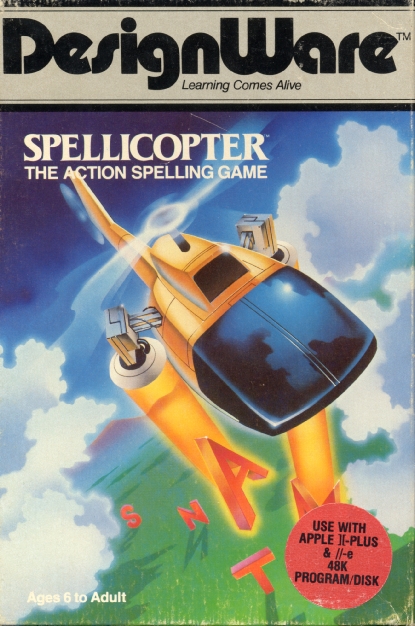
After calling around the country trying to find someone who needed a person interesting in computers for learning, I finally got hooked up with Jim Schuyler, who had just started a company doing computer games to go along with textbook publisher’s offerings.   I eventually managed to hook DesignWare up with Spinnaker to do a couple of home games for them before Jim had DesignWare start producing it’s own home games (I got to do two cool ones, FaceMaker and Spellicopter as well as several others).

However, I had a hankering to go back to graduate school and get an advanced degree.   As I wrestled with how to design the interfaces for games, I read an article calling for a ‘cognitive engineering’, and contacted the author about where I might study this.   Donald Norman ended up letting me study with him.

The group was largely focused on human-computer interaction, but I maintained my passion for learning solutions.   I did a relatively mainstream PhD but while focusing on the general cognitive skill of analogical reasoning, I also attempted an intervention to improve the reasoning.

Though it was a cognitive group, I was eclectic, and looked at every form of learning.   In addition to the cognitive theories that were in abundance, I took and TA’d for the behavioral learning courses.   David Merrill was visiting nearby, and graciously allowed me to visit him for a discussion (as well as reading Reigeluth’s edited overview of instructional design theories).   Michael Cole was a big fan of Vygotsky, and I was steeped in the social learning theories thereby.   David Rumelhart and Jay McClelland were doing the connectionist/PDP work while I was a student, so I got that indoctrination as well.   And, as an AI groupie, I even looked at machine learning!

I subsequently did a postdoc at the University of Pittsburgh’s Learning Research & Development Center, where I was further steeped in cognitive learning theory, before heading off to UNSW to teach interaction design and start doing my own research, which ended up being very much applied, essentially an action- or design-research approach.   My subsequent activities have also been very much applications of a broad integration of learning theory into practical yet innovative design.

The point being, I never formally considered myself an instructional designer so much as a learning designer.   Having worked on non-formal education in many ways, as well as teaching in higher education, my applications have crossed formal instruction and informal learning.   As the interface design field was very much exploring   subjective experiences at the time I was a graduate student, and from my game design experience, I very naturally internalized a focus on engaging learning, believing that learning can, and should, be hard fun.

I’ve synthesized the eclectic frameworks into a coherent learning design model that I can apply across technologies, and strongly believe that a solid grounding in conceptual frameworks combined with experiences that span a range of technologies and learning outcomes is the best preparation for a flexible ability to design experiences that are effective and engaging. Passionate as I am about learning, I do think we could do a better job of providing the education that’s needed to help make that happen, and still look for ways to try to help others learn (one of my employees once said that working with me was like going to grad school, and I do try to educate clients, in addition to running workshops and continuing to speak).

And, I’ve ended up, as I dreamed of, with a desk covered with cool technology and I get to explore new ideas: designing solutions that integrate the cutting edge of devices, tools, models, frameworks, all to help people achieve their goals.   I continue to think ahead about what new possibilities are out there, and work to improve what’s happening.     I love learning experience design (and the associated strategic thinking to make it work), believe there’s at least some evidence that I do it pretty well, and hope to keep doing it myself and helping others do it better.   Who’s up for some hard fun?

Ignoring Informal

14 October 2009 by Clark 4 Comments

I received in the mail an offer for a 3 book set titled Improving Performance in the Workplace.   It’s associated with ISPI, and greatly reflects their Human Performance Technology approach, which I generally laud as going beyond instructional design.   It’s also by Pfeiffer, who is my own publisher, and they’re pretty good as publishers go.   However, I noticed something that really struck me, based upon the work I’ve been doing with my colleagues in the Internet Time Alliance (formerly TogetherLearn).

The first volume is really about assessing needs, and design, and it includes behavioral task analysis and cognitive task analysis, and even talkes about engagement strategies in simulation and gaming, video gaming.   The second volume includes performance interventions, and includes elaerning, coaching, knowledge management, and more (as well as things like incentives, culture, EPSS, feedback, etc.   The third volume’s on measurement and evaluation.

All this is good: these are important topics, and having a definitive handbook about them is a valuable contribution (and priced equivalently, the whole set is bargain-priced at $400).   However, while I don’t have the book to hand to truly evaluate it, it appears that there are some gaps.

In my experience, some issues are not behavioral or cognitive but attitudinal.   Consequently, I’d have thought there might be some coverage.   There was a chapter in Jonassen’s old Handbook on Research in Ed Tech on the topic, and I’ve derived my own approach from that and some other readings. When they get into tools, they seem to miss virtual worlds, and they seem to have a repeat of the straw-man case against discovery environments (many years ago it was recognized that pure discovery wasn’t the go, and guided discovery was developed).   It bugs me that I can’t find the individual authors, but I do recognize the names of one of the editors.     But these aren’t the biggest misses, to me.

Overall, there seems to be no awareness of the whole thrust of social and informal learning.   Ok, so Jay’s book on Informal Learning is relatively new, and the concrete steps may still be being sorted out, but there’s a lot there.   Or perhaps it’s covered in Knowledge Management (after all, Marc Rosenberg’s been deeply involved in ISPI and wrote the Beyond e-Learning book).   Yet it seems a bit buried and muddled, and here’s why:

I’m working with a client now, and one of my tasks is surveying how they’re using social media.   A group responsible for technical training (and they’re an engineering organization) recognized that they weren’t able to keep up with the increasing quantity and quality of changes that were coming.   Rather than do a performance improvement intervention, they realized that another opportunity would be to start putting up information and inviting others to contribute.   They put up a wiki, and first maintained it internally, and then gradually devolved some of the responsibility out to their ‘customers’.

The point is, how does that fit into the traditional paradigm?   And yet, increasingly, we’re seeing and recommending approaches that go beyond the categories that fit here.   I wonder if their metrics include the outputs of enabling innovation.   I wonder if their interventions include expertise finders and collaboration tools. I wonder if their analyses include the benefits of ‘presence’.

Times are changing, faster and faster.   I think these books would’ve been the ideal thing, maybe 5 years ago.   Now, I think they’re emblematic of a training mindset when a larger perspective is needed.   These come into play after you’ve identified that a formal approach is needed.   They use a phrase of a ‘performance landscape’, but their picture doesn’t seem to include the concepts that Jay includes in his ‘learnscape’ and I as the ‘performance ecosystem’.

Teachers, read this book!

11 May 2009 by Clark Leave a Comment

I’ve been reading a few books about schools, since my lad’s made the transition from elementary to middle school and it’s been a bit of a battle.   When he’s being set assignments like coloring in a poster on math facts, I’m a wee bit concerned.   John Taylor Gatto’s Dumbing Us Down was a wakeup call (he won NY teacher of the year for a couple of years, and insightfully (and incitefully) criticizes our current school system.   So, when I noticed that Daniel Willingham (who’ve I talked about before) had a book out, I checked it out.

His Why Don’t Students Like School sounded like another tirade against schools, but it’s more positive than that. The subtitle tells you more: “A cognitive scientist answers questions about how the mind works and what it means for your classroom”.   It follows a format of:

  • question related to successful learning through teaching
  • the cogntive science research that underpins this question
  • specific recommendations for improving teaching

Fortunately, I could just skim the second part, which is the meat of the book, courtesy of my own PhD in cognitive science, and it was review.   But what really struck home was how he (as reviewers repeatedly point out) uses “clear and compelling language” to help the audience really understand what’s important.   He’s got great examples, and makes a large chunk of cognitive research comprehensible.   Which is not to say it’s a light read, but it’s accessible and clear.

More importantly, the third part of each chapter, his conclusions, are very concrete and actionable. If teachers followed these guidelines, they’d have happier learners and better learning outcomes.   What more do you want?   (Ok, well, curriculum reform, but this is aimed at teachers.)

He covers a lot of ground.   In nine chapters (this isn’t a long book, just deep and relevant), he covers motivation, learning styles, cognitive skills, and more. He answers the core questions and the ancillary questions that emerge. And, no, I don’t agree with him on quite all of it (e.g. on making content meaningful, he’s concerned that too familiar or interesting tasks may overwhelm the intrinsic lesson), but I suspect we’d find if we sat down that we’re agreeing furiously.

I have to say that if all my children’s teachers read this book, their schooling would be a lot better.   If all our children’s teachers read this book, schools would be a lot better.   So, if you’re a teacher, read this book.   If you work with teachers, know teachers, or influence teachers, get them to read this book.   And if you   design learning experiences, even if you don’t actually teach, you should read this book.

Cognitive science research oriented towards making better learning, in a digestable form.   It doesn’t get much better than this.   I have no higher praise for a book than “I wish I’d written it”, and I do.   Highly recommended.

Debugging

19 April 2009 by Clark 4 Comments

This starts out slightly technical, but eventually gets to the learning!

My first job out of college was designing and programming educational computer games (FaceMaker & Spellicopter may be the two best known titles).   When I went back to grad school, I went for the design side, though I’ve kept the ability to understand what technology does, and do a bit more than the average bear.

So when my internet connection started getting flaky, I realized I had a problem.   Not the basic problem, but because there were several comonents in the chain, and it’s hard to isolate one without substitute parts.   And, of course, when you have two potential culprits, it’s so typical to have the manufacturer of one blame the other, and vice versa!   Now, my DSL modem and my wireless router were both quite old, at least 4 years and maybe as old as 6 or more.   And I didn’t have a spare of either router or modem. What was I to do?

(Tech details)

For those who are curious, the DSL signal comes in on the phone line, and then the modem translates it into ethernet. That could go straight into the computer, but instead I have that go to a wireless router to serve all the devices in the house (currently 4 computers, a Wii, two DS’s, and my iPhone; when no one’s visiting!).   The phenomenom I was seeing was the connection starting to hang on various accesses.   Rebooting both router and modem solved the problem (rebooting only one never seemed to work), but only for a while (8-24 hours). BTW, this behavior was described both by the ATT guy and a guy at Fry’s as classic hardware going bad.

I called ATT, and they agreed to send me a new modem (I reupped for a year).   That came and I managed to get it installed.   Took several tries, since they forgot to tell me that the modem now stores it’s own account login details, so those detalis don’t need to be stored in the router!   Ahem.   That one bit of info, and I was up and running again.

For a while.   Then the flakiness happened again.   So off I went to Fry’s for a router. For a ridiculously low price they had a refurbished one available, so I nabbed it. Same brand, only a newer version of my old one, which I was happy with.

Taking that home, I finally accessed it’s settings, but couldn’t make it talk to the modem!   The lights on both modem and router said they were connected, but no traffic would go through.   And I couldn’t access the settings via wireless, and it took a long time for the settings page (you control the router through a web page it hosts internally).

I took the router back and exchanged it.   I was willing to bet that the first one was just flaky.   With the new one, the settings page came up almost instantly, and I could access it wirelessly as well.   OK, that seemed better.And the lights indicated everything was fine. But, no traffic was still going through!?!?

I was pretty sure that, it being the weekend, I couldn’t get help ’til Monday, but I searched the Netgear site anyways, and they said they had phone help 24 hours, so I called and got through.   The guy there first said he couldn’t help me by phone for a refurbished modem, but then proceeded to tell me just what the problem was (turns out he couldn’t walk me through online, but could give me the details, which was all I needed).   Of all crazy things, the modem and the new router both want the same URL!   He had me reset the router’s IP address to something different, and viola’, I’m online!

(End tech details)

The learning here is severalfold.   First, systematicity helps.   Now, I know that, but it’s nice to have a chance to practice it.   One of things I miss most about not programming anymore, besides the ability to create new experiences, is debugging.   I loved using logic to try and figure out what’s wrong, and testing, repairing, and so on. I used to work on cars with my Dad, and the same process would be followed.   I think systematic research and testing is a meta-learning skill, and one we really don’t teach in school, yet it’s critical!

Another meta-learning skill, or really attitude, is persistence. I didn’t have an option, because no internet connection would be a critical business issue.   Fortunately I had a connection, it was just flaky (and with all this online seminar action coming up!.   And I admit there were times when I was tempted to use bad language (or did), and/or had to take time out to cool off.   But I kept thinking, testing, talking, reading, and more.

Of course, the two critical pieces of information would’ve been devastating if I didn’t have them.   And I didn’t find either in a discussion forum, I talked to people, live. I’ve learned to be very clear about the steps I’ve already taken, and that helps to short-circuit what can often be very basic stuff (e.g. “did you plug it in, and are the lights lit”). I mentioned that I’d tried the manual, and my steps, which helps build credibility with the tech person (the router person commented that he thought I could do with just the instructions).

So, I think we could and should spend more time developing reasoning skills as well as rote knowledge (duh!), and help people learn to share their thinking to help identify the problems faced.

And now, here’s hoping it was the hardware and not a different problem!

Note that this ate up a lot of my time this past week, what with store, and time on tech support, etc, so this is also an apology for my lack of blogging this past week!

A wee bit o’ experience…

11 March 2009 by Clark 1 Comment

A personal reflection, read if you’d like a little insight into what I do, why and what I’ve done.

Reading an article in Game Developer about some of the Bay Area history of the video game industry has made me reflective.   As an undergrad (back before there really were programs in instructional technology) I saw the link between computers and learning, and it’s been my life ever since.   I designed my own major, and got to be part of a project where we used email to conduct classroom discussion, in 1978!

Having called all around the country to find a job doing computers and learning,   I arrived in the Bay Area as a ‘wet behind the ears’ uni graduate to design and program ‘educational’ computer games.   I liked it; I said my job was making computers sing and dance.   I was responsible for FaceMaker, Creature Creator, and Spellicopter (among others) back in 81-82.   (So, I’ve been designing ‘serious games’, though these were pretty un-serious, for getting close to 30 years!)

I watched the first Silicon Valley gold rush, as the success of the first few home computers and software had every snake oil salesman promising that they could do it too.   The crash inevitably happened, and while some good companies managed to emerge out of the ashes, some were trashed as well.   Still, it was an exciting time, with real innovation happening (and lots of it in games; in addition to the first ‘drag and drop’ showing up in Bill Budge’s Pinball Construction Set, I put windows into FaceMaker!).

I went back to grad school for a PhD in applied cog sci (with Don Norman), because I had questions about how best to design learning (and I’d always been an AI groupie :).   I did a relatively straightforward thesis, not technical but focused on training meta-cognitive skills, a persistent (and, I argue, important) interest.   I looked at all forms of learning; not just cognitive but behavioral, ID, constructivist, connectionist, social, even machine learning.   I was also getting steeped in applying cognitive science to the design of systems, and of course hanging around the latest/coolest tech.   On the side, I worked part-time at San Diego State University’s Center for Research on Mathematics and Science Education working with Kathy Fischer and her application SemNet.

My next stop was the University of Pittsburgh’s Learning Research & Development Center for a post-doctoral fellowship working on a project about mental models of science through manipulable systems, and on the side I designed a game that exercised my dissertation research on analogy (and published on it).   This was around 1990, so I’d put a pretty good stake in the ground about computer games for deep thinking.

In 1991 I headed to the Antipodes, taking up a faculty position at UNSW in the School of Computer Science, teaching interface design, but quickly getting into learning technology again.   I was asked, and I supervised a project designing a game to help kids (who grow up without parents) learn to live on their own. This was a very serious game (these kids can die because they don’t know how to be independent), around 1993.   As soon as I found out about CGIs (the first ‘state’-maintaining technology) we ported it to the web (circa 1995), where you can still play it (the tech’s old, but the design’s still relevant).

I did a couple other game-related projects, but also experimented in several other areas.   For one, as a result of looking at design processes,   I supervised the development of a web-based performance support system for usability, as well as meta-cognitive training and some adaptive learning stuff.

I joined a government-sponsored initiative on online learning, determining how to run an internet university, but the initiative lost out to politics.   I jumped to another, and got involved in developing an online course that was too far ahead of the market (this would be about 1996-1997).   The design was lean, engaging, and challenging, I believe (I shared responsibility), and they’re looking at resurrecting it now, more than 10 years later!   I returned to the US to lead an R&D project developing an intelligent learning system based on learning objects that adapted on learner characteristics (hence my strong opinions on learning styles), which we got up and running in 2001 before that gold rush went bust.   Since then, I’ve been an independent consultant.

It’s been interesting watching the excitement around serious games.   Starting with Prensky, and then Aldrich, Gee, and now a deluge, there’s been a growing awareness and interest; now there are multiple conferences on the topics, and new initiatives all the time.   The folks in it now bring new sensibilities, and it’s nice to see that the potential is finally being realized. While I’ve not been in the thick of it, I’ve quietly continued to work, think, and write on the issue (thanks to clients, my book, and the eLearning Guild‘s research reports).   Fortunately, I’ve kept from being pigeonholed, and have been allowed to explore and be active in other areas, like mobile, advanced design, performance support, content models, and strategy.

The nice thing about my background is that it generalizes to many relevant tasks: usability and user experience design and information design are just two, in addition to the work I cited, so I can play in many relevant places, and not only keep up with but also generate new ideas.   My early technology experience and geeky curiosity keeps me up on the capabilities of the new tools, and allows me to quickly determine their fundamental learning capabilities.   Working on real projects, meeting real needs, and ability to abstract to the larger picture has given me the ability to add value across a range of areas and needs.   I find that I’m able to quickly come in and identify opportunities for improvement, pretty much without exception, at levels from products, through processes, to strategy.   And I’m less liable to succumb to fads, perhaps because I’ve seen so many of them.

I’m incredibly lucky and grateful to be able to work in the field that is my passion, and still getting to work on cool and cutting edge projects, adding value.   You’ll keep seeing me do so, and if you’ve an appetite for pushing the boundaries, give me a holler!

« Previous Page
Next Page »

Clark Quinn

The Company

Search

Feedblitz (email) signup

Never miss a post
Your email address:*
Please wait...
Please enter all required fields Click to hide
Correct invalid entries Click to hide

Pages

  • About Learnlets and Quinnovation

The Serious eLearning Manifesto

Manifesto badge

Categories

  • design
  • games
  • meta-learning
  • mindmap
  • mobile
  • social
  • strategy
  • technology
  • Uncategorized
  • virtual worlds

License

Previous Posts

  • August 2026
  • July 2026
  • June 2026
  • May 2026
  • April 2026
  • March 2026
  • February 2026
  • January 2026
  • December 2025
  • November 2025
  • October 2025
  • September 2025
  • August 2025
  • July 2025
  • June 2025
  • May 2025
  • April 2025
  • March 2025
  • February 2025
  • January 2025
  • December 2024
  • November 2024
  • October 2024
  • September 2024
  • August 2024
  • July 2024
  • June 2024
  • May 2024
  • April 2024
  • March 2024
  • February 2024
  • January 2024
  • December 2023
  • November 2023
  • October 2023
  • September 2023
  • August 2023
  • July 2023
  • June 2023
  • May 2023
  • April 2023
  • March 2023
  • February 2023
  • January 2023
  • December 2022
  • November 2022
  • October 2022
  • September 2022
  • August 2022
  • July 2022
  • June 2022
  • May 2022
  • April 2022
  • March 2022
  • February 2022
  • January 2022
  • December 2021
  • November 2021
  • October 2021
  • September 2021
  • August 2021
  • July 2021
  • June 2021
  • May 2021
  • April 2021
  • March 2021
  • February 2021
  • January 2021
  • December 2020
  • November 2020
  • October 2020
  • September 2020
  • August 2020
  • July 2020
  • June 2020
  • May 2020
  • April 2020
  • March 2020
  • February 2020
  • January 2020
  • December 2019
  • November 2019
  • October 2019
  • September 2019
  • August 2019
  • July 2019
  • June 2019
  • May 2019
  • April 2019
  • March 2019
  • February 2019
  • January 2019
  • December 2018
  • November 2018
  • October 2018
  • September 2018
  • August 2018
  • July 2018
  • June 2018
  • May 2018
  • April 2018
  • March 2018
  • February 2018
  • January 2018
  • December 2017
  • November 2017
  • October 2017
  • September 2017
  • August 2017
  • July 2017
  • June 2017
  • May 2017
  • April 2017
  • March 2017
  • February 2017
  • January 2017
  • December 2016
  • November 2016
  • October 2016
  • September 2016
  • August 2016
  • July 2016
  • June 2016
  • May 2016
  • April 2016
  • March 2016
  • February 2016
  • January 2016
  • December 2015
  • November 2015
  • October 2015
  • September 2015
  • August 2015
  • July 2015
  • June 2015
  • May 2015
  • April 2015
  • March 2015
  • February 2015
  • January 2015
  • December 2014
  • November 2014
  • October 2014
  • September 2014
  • August 2014
  • July 2014
  • June 2014
  • May 2014
  • April 2014
  • March 2014
  • February 2014
  • January 2014
  • December 2013
  • November 2013
  • October 2013
  • September 2013
  • August 2013
  • July 2013
  • June 2013
  • May 2013
  • April 2013
  • March 2013
  • February 2013
  • January 2013
  • December 2012
  • November 2012
  • October 2012
  • September 2012
  • August 2012
  • July 2012
  • June 2012
  • May 2012
  • April 2012
  • March 2012
  • February 2012
  • January 2012
  • December 2011
  • November 2011
  • October 2011
  • September 2011
  • August 2011
  • July 2011
  • June 2011
  • May 2011
  • April 2011
  • March 2011
  • February 2011
  • January 2011
  • December 2010
  • November 2010
  • October 2010
  • September 2010
  • August 2010
  • July 2010
  • June 2010
  • May 2010
  • April 2010
  • March 2010
  • February 2010
  • January 2010
  • December 2009
  • November 2009
  • October 2009
  • September 2009
  • August 2009
  • July 2009
  • June 2009
  • May 2009
  • April 2009
  • March 2009
  • February 2009
  • January 2009
  • December 2008
  • November 2008
  • October 2008
  • September 2008
  • August 2008
  • July 2008
  • June 2008
  • May 2008
  • April 2008
  • March 2008
  • February 2008
  • January 2008
  • December 2007
  • November 2007
  • October 2007
  • September 2007
  • August 2007
  • July 2007
  • June 2007
  • May 2007
  • April 2007
  • March 2007
  • February 2007
  • January 2007
  • December 2006
  • November 2006
  • October 2006
  • September 2006
  • August 2006
  • July 2006
  • June 2006
  • May 2006
  • April 2006
  • March 2006
  • February 2006
  • January 2006

Amazon Affiliate

Required to announce that, as an Amazon Associate, I earn from qualifying purchases. Mostly book links. Full disclosure.

We use cookies to ensure that we give you the best experience on our website. If you continue to use this site we will assume that you are happy with it.