Learnlets

Secondary

Clark Quinn’s Learnings about Learning

Search Results for: align

Separate content from description

29 December 2020 by Clark 3 Comments

Once again facing folks who aren’t using styles, I was triggered to think more deeply about the underlying principle. That is, to separate content from description. It’s a step forward in what we can do with systems to bring about a more powerful human-aligned system.

And, as always, here’s the text, in case you (like me) prefer to read ;).


I‘ve ranted before about styles, but I want to make a slightly different pitch today. It‘s not just about styles, it‘s about the thinking behind it. The point is to separate content from description.

So, the point about styles is that they‘re a definition of formatting. You have elements of documents like headings at various levels, and body text, and special paragraphs like quotes, and so on. Then you have features, like font size, bolding and italics, color, etc. And what you see, too often, is people hand-formatting documents, choosing to do headers by increasing the font size, bolding, etc. And, importantly, having to go through and change them all manually if there‘s a desire for a change in look.  

The point of styles is instead merely to say this is a heading 1, this is a figure, this is a caption, and so on. Then, you separately say: heading 1s will be font size 16 bold and left-justified. Figures and captions will be centered, in font size 12. And so on. Then, should someone want to change how the document‘s formatted, you just change the definition of heading 1, and all the heading ones change.  

It goes further. You can define that all heading ones have a page break before (e.g. a new chapter in a book). And you can define new styles, like for a callout box (e.g. colored background), etc. You can have different heading ones for a book than for a white paper. And some styles can be based on others. So your headings can use the same font as your body text, and if you want it all to change, you change the source and the rest will change.  

Which is wonderful for writing, but the concept behind this is what‘s really important to get your head around. That is, separating out role from description. That‘s what‘s led me to be keen on content systems. The notion of pulling up content by description instead of hardwiring together content into an experience is the dream.  

It‘s all about beginning to use semantics, that is the meaning of things, as a manipulable tool. Many years ago, I led a project creating an adaptive learning system. We were going to have content objects defined by topic, and learning role, and tagged in terms of media, difficulty, and more. So you could   say: “pull a video on an example of diversity set in a sales office”. Our goal, with a suite of rules about what when to move up or back in difficulty, was to specify what learning content the learner should see next, etc.  

This is how adaptive platforms work. When Amazon or Netflix make a recommendation for you, there‘s not someone watching your behavior, instead it‘s a set of rules matching your particular actions to content recommendations. If you‘ve ordered a lot of British mysteries, and you haven‘t seen a particular series that lots of other people like, it‘ll be likely to be offered to you.  

This is the opportunity of the future. We can start doing this with learning (and coaching)!   We can start pulling together your learning goals, job role, current progress, current location (in time and space), etc, and offer you particular things that are appropriate for you. And, like our learning system, it might be recommendations of content, but you can choose others, or ignore, or…As Wayne Hodgins used to say, present the ‘right stuff‘: the right content to the right person at the right time in the right way….

The point being, just like styles, if we stop hardwiring things together, hand-formatting learning experiences, we can start offering personalized and even adaptive learning. Yes, there are technical backend issues, and more rigor in development, but this is the direction we can, and should, go. At least, that‘s my proposal, what say you?
Performance Ecosystem Maturity Model

22 December 2020 by Clark 3 Comments

Someone on LinkedIn asked about a way to evaluate orgs on their learning infrastructure. And I had developed a Performance Ecosystem Maturity Model as part of Revolutionize Learning & Development, but…I hadn’t presented it. At least not in full.  Here I rectify that; my holiday gift to you!

(A bit over 5 mins.)  And, of course, if you want help with it, let me know! Also, the prose (and the diagram):


Script

Hi, I‘m Clark Quinn, of Quinnovation. Recently, someone asked about an organizational learning maturity model. And, coincidentally, I had one. However, it was locked away in my book from 2018. So I want to present that model, and hope it‘s of use.  

In my book, Revolutionize Learning & Development, I pushed for the performance ecosystem, going beyond ‘the course‘ to talk about all the ways that L&D that could assist organizational learning. I posit that optimal execution is only the cost of entry, and the only sustainable differentiator is continual innovation. And I argued for what that meant. I want organizations to have a concrete picture of what this looked like.

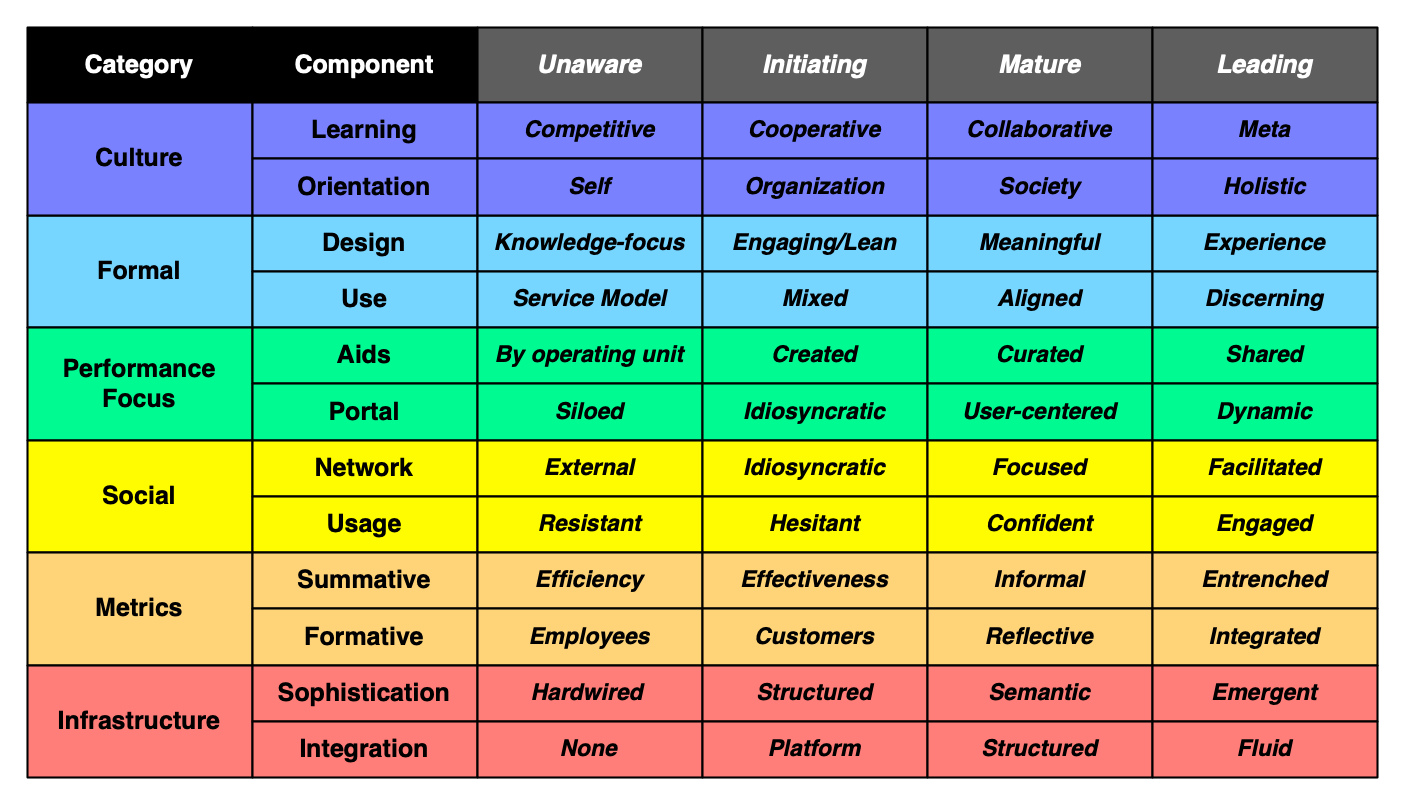
In the book I had a set of six categories, each with two components. So I created a ‘maturity model‘. The intent is to provide a tool whereby organizations can understand what the possibilities are, assess themselves, and prioritize directions to move and improve. Let‘s be clear, this is conceptual, not empirical. This is a proposal about what should be the elements, and an effort to consider what fits in each stage of each component.  

The first area is culture. How we‘re learning, and what our orientation is. And you‘ll see as we fill out the table, what this means. Starting with learning, we transition from a competitive environment, (which is unhealthy), through being willing to cooperate (say for team projects), to where we‘re collaborating of our own initiative, ending up where we‘re working to also improve our processes as well as our outcomes. And our orientation shifts from learning for our own benefit, to learning as an organization, then to where we consider the impacts on society, ending up where we‘re looking to ensure this works across those elements.

Then we look at the formal learning elements, how we design and who‘s using the learning. We start with the traditional knowledge dump, then on making it more engaging and lean, to where we‘re focusing on making it meaningful to the org and the individual, and finally creating transformative experiences. And we look at who‘s using the learning. It starts with taking orders for courses, through having some times where the effort is to truly address a need, to where our efforts are aligned with key organizational needs, and finally where we‘re being discerning about methods, measures, and outcomes.

We then consider going beyond the course to times when knowledge can be in the world, not in the head. We worry about resources and the ways people can get access to them. Instead of idiosyncratic aids, we move to having L&D creating support, and then recognizing the value of curation, and finally with a mixed initiative with everyone contributing. And we move from the siloed access to these resources, through an intermediate stage of some focused development, to a user-centric access based upon the users needs (not the originators location), ending at a dynamic matching of need to resource.  

We also start looking at informal learning, the continual innovation. This includes both the status of networks and the usage of those networks. It starts where if there‘s network usage, it‘s not org-originated, through some units having a system, to having an organizational focus on communication, and then actively facilitating social learning. And we move from the Miranda organization (where anything you say can and will be used against you), to where some folks are experimenting, to where people are comfortable contributing, and finally where folks recognize that active engagement is key to organizational thrival.

We also consider the use of metrics in the organization, both to evaluate and to improve. We should move from just looking at the cost of a butt in a seat for an hour to whether that time is benefiting the org. Then we incorporate informal learning, and finally where measurement‘s naturally part of our practices. We move our focus from internal to a broader picture, and start evaluating our processes themselves, and move to looking at these as a synergistic whole  

Finally, we look at our infrastructure, our underlying approach and our systematicity. We move from handcrafted solutions to systemic approaches, then looking to incorporate semantics, and finally looking at systems with emergent capabilities. And we move to look at our approaches as platforms, and then integrate those platforms, and finally allow our systems to adapt as conditions change.  

This is an updated version of the model in the book, and I think provides a useful framework for thinking about L&D. I hope this made sense, and is of interest. And I welcome feedback! Thanks for listening. You can find out more at Quinnovation.com, and at revolutionizelnd.com.  

Five trends for 2021

15 December 2020 by Clark 2 Comments

As frequently happens, I get asked for my predictions. And, of course, I have reservations. Here’s a video that provides the qualifications, and five trends for 2021 that I’d expect, or like, to see.

And the script:


Hi, I‘m Clark Quinn, of Quinnovation (a boutique learning experience design strategy consultancy). I was recently asked about what trends I thought would be seen next year.  

Two relevant quotes to set the stage. For one, Alan Kay famously said “the best way to predict the future is to invent it.” So I tend to talk about trends we should see. The other is “never predict anything, particularly the future.” I heard an expert talk about having looked at predictions and outcomes, and the noticeable trend is that it went as expected, with one unforeseen twist. So, expecting I‘ll get it wrong, here are some trends I‘m either expecting or keen to see:

The first trend I‘m seeing and think will continue is an emphasis on learning science. And that‘s all to the good! Admittedly, I‘m part of this, what with running a course on learning science and having a forthcoming book on the topic. But I‘m seeing more and more people talking about it, and not all hype and even mostly right! There are more books, the Learning Guild‘s regular research reports are good, the launch of an event past summer and an associated new society focused on evidence-based learning (the Learning Development Accelerator) are all signs of growing momentum.

Second, when there‘s a lot of hype about something, it tends to be followed by a backlash.  This may be farther out than 2021, but with all the buzz about AI, I think we might see some more awareness of limitations. Yes, it can do some very useful things, but it also isn‘t a panacea. We‘re seeing a growing awareness of the problems with bias in data sets, the limitations of ungrounded knowledge, and concerns about the human costs.  

Three. On a related note, then, I expect more emphasis on the importance of meaningful practice. This comes from learning science, but also the focus on engagement. Thus, the push for Short Sims, and better written multiple choice questions, and in general a focus on ‘do‘, not know.   Hopefully, we‘ll see tool vendors aligning their content and assessment capabilities towards designing scenarios and contextualized practice, along with specific feedback for each wrong answer and support for reflection.

Fourth, I hope for a push towards content systems as well. This, too, may not be in the short term, but ultimately we have to realize that hardwiring experiences may make sense for formal systems, but not for adaptive learning.LXPs are a good move here, even if misnamed (really, they‘re smart portals, not learning experience platforms). Ultimately, we‘ll be better off if we can deliver content by description and rules, like recommendation system, rather than by having to handcraft content to create a ‘one-size fits all‘ solution.  

Finally, I think that our collaboration tools haven‘t lived up to the promise of technology. They‘re very much oriented towards particular modes, instead of supporting really rich interaction. This, too, is more long term, but we really should be able to talk together while working to create representations that capture our evolving thinking. Easily and elegantly! There‘s real opportunity here to engage multiple representations in an elegant suite.  

So there you have it, a wishful list of five trends for 2021. So what do you expect, or hope, to see?

Foundations of Learning Science

8 December 2020 by Clark 1 Comment

Another video, this time (ok, again ;) about learning science.

They like me to do this to push the course, but I did hear the feedback on LinkedIn that the video format works. Nice to know. As always, also the script.

And, announcing one other thing…


I‘ve argued in an earlier post for the value of learning science, but I want to go a little deeper. I want to talk a little about the evolution, and a little bit about what‘s involved. It‘s about establishing the foundations of learning science.

And I‘ve mentioned in a previous post  that learning science is interdisciplinary, and relatively new. While education had been proceeding for a long time, the approaches were ad hoc. Experimental science itself didn‘t emerge ‘til the medieval ages at the earliest. My take is that most of school still replicated what had been done since the Prussians invented school, somewhat modeled on religious lectures. The notion of scientific education had yet to emerge.

The first real systematic study of learning came from the field of educational psychology. Here, the focus was on schooling, and included cultural and motivational factors.

A different approach came from behavioral psychology roots. During World War II, the military was faced with training many soldiers, and behavioral psychologists created the field of instructional design. Here, the focus was more on training, including the influence of media and elements of instruction.

Learning science as a field was arguably created when the International Society for the Learning Science was created in the 1990s, perhaps sparked by the creation of the Institute of the Learning Sciences at Northwestern University. This is an integrative approach that looks beyond schools and training to more forms of learning including informal learning and even machine learning.

Having been involved in one way or another with all of these, I tend to create a synthesis. I think the care is cognitive science: how we process information. While there are neural underpinnings, most of the results and prescriptions operate at the cognitive level, or above. Within the information processing cycle we cover core processes like attention, elaboration, and retrieval. This is our core mental architecture.

Interesting results for learning emerge from this architecture, including the role of models and examples, and the core importance of practice. A post-cognitive perspective reflects that our thinking isn‘t formally logical, but instead is emergent, distributed, and social.

Two other important areas are the emotional aspects of learning, and meta-learning. The former is more the conative area of intent to learn, e.g. motivation and anxiety, rather than the affective area of personality. The latter has to do with learning to learn, including looking at our own learning processes.

All these affect the elements that contribute to learning. Our introductions, concepts, examples, practice, and closings should reflect what‘s known about learning. And the components of science and engagement need to be elegantly integrated to yield the best outcomes.

Of course, these foundations of learning science are what I cover in the learning science courses I‘m offering through HR.Com and the Allen Academy. Stay tuned for more ;).

Measuring Impact (or not)

1 December 2020 by Clark 6 Comments

So I saw a twitter thread pointing to an argument about how ROI is dead. And, well, that’s largely okay with me. However, the trigger for the post was from the results of Chief Learning Officer 2020 State of Learning report.  And, when I saw them, I saw some problems. The question is whether we’re measuring impact, or not. I’d like to go through them and evaluate each.

(Back to my usual prose, as I need visual support for this. ;)

So, in the report, they indicated that the respondents indicated the demonstrated impact of training in these ways:

  • General training output data
  • Training output data aligned with corporate initiatives
  • Learner satisfaction with training
  • Employee satisfaction with training availability
  • Employee engagement
  • Business impact
  • Employee performance data
  • Planned to actual budget, expense, revenue data for training group
  • Stakeholder satisfaction with training data
  • ROI measures
  • Net promoter score
  • Employee satisfaction with company data

Yikes!  Some of these are problematic at best.  Let’s look at why some of these might not be good measures of impact. And, let’s be clear; impact should be about positively affecting the organization in a meaningful way. Moving needles like fewer errors, more revenue, reduced costs, happier employees and customers, etc.

So, first, what  is  general training output data? If it’s like what I saw in (then) ASTD’s State of the Industry report, it’s metrics like employees served per L&D employee or cost/seat/hour for training. Which might a useful measure of efficiency, if you can come up with a principled basis for what a good number would be, and then see if you’re above or below that. Unfortunately, what people do is just compare themselves to the industry average. Is that a good indicator? How do you know? Do you want to be just ‘better than average’?

Then, training output data  aligned with corporate  initiatives.  Again, hard to say what this means (and I can’t seem to find the report). However, it sounds like it’s still efficiency, just doing that for things the business thinks are important.

And we go worse: learner satisfaction with training? Er, research I’ve read and heard cited (I think it’s from Salas, et al, but memory fails)  says that’s not valid. There’s a .09 correlation between what learners think of learning impact, and it’s actual impact. That’s zero with a rounding error. That’s all about making learning ‘fun’ (instead of ‘hard fun’). Yes, you do want them to think it’s  also been a good experience if you’re focusing on LXD, but that’s secondary.

Similarly, with satisfaction with training availability. What’s that matter? That’s not  impact!

Some good things buried here: employee engagement should be good; more engaged employees is a good thing. As long as it’s not at the cost of something else, like, say, impact?  And business impact is obviously good, as is employee performance data. Presumably positive business impact, and employee performance improving.

Planned to … stuff is all about efficiency again. And that’s ok, but only  after impact. Otherwise, well, we’re not  costing too much…?!?

Satisfaction again not good.

And, to the original point of the article. ROI?  Yes, what it costs you to move a needle should be less than the cost of what the needle was costing you.  However, I could be doing things that return the biggest ROI without doing the most important things. They can be different (e.g. a small program with a better ROI but less overall impact). So it’s only secondary.

Finally, employee satisfaction with company data? I have no idea what that means? But, again, ‘satisfaction’ isn’t really meaningful unless it’s based on real impact.

I’ve complained before about L&D measurement. Here it is, right in front of us. The answer to the question of whether we’re measuring impact or not appears to be ‘mostly not’.  We’re still (largely) measuring the wrong things. And we wonder why we don’t have credibility. Please, please, start designing to improve measurable gaps, and then actually improve the outcome. Otherwise, you’ve no idea whether that bum in that seat for an hour is doing the organization any good, versus just not costing too much relative to the industry average.

Flow, workflow, and learning

10 November 2020 by Clark 3 Comments

On LinkedIn, a colleague asked “Why do people think that integrating content in the flow of work equals learning in the flow of work?” An apt question. My (flip) response was “because marketing”. And I think there’s a lot to that. But, a comment prompted me to think a little bit deeper, because ‘flow’ is its own meaningful concept and we need to be careful about meaning. So here are some reflections on flow, workflow, and learning.

The response that triggered my reflection was:

I can’t recall the last time I told someone that I was in the “flow” of work today and learned so much!!

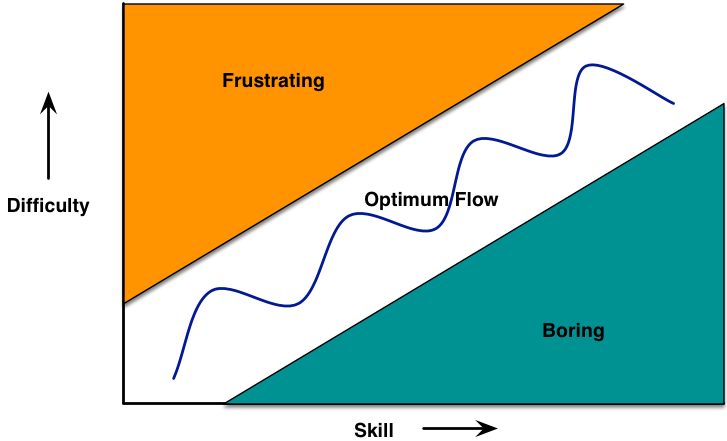
Flow state(Which is pretty funny!) The comment was a bit pointed, but it made me think about being in the ‘flow’ state, and the relationship with learning. I’ve previously pointed out how Csikszentmihalyi’s Flow and Vygotsky’s Zone of Proximal Development  (ZoPD) are essentially the same. If the difficulty is too far above your skill level, the experience is frustrating. If it’s too easy, it’s boring. And in between is the flow state, and where learning happens.

Now, when we’re in the ‘flow’ at work (which is different than being in the workflow), we’re performing optimally. And I’m not sure learning happens there. Similarly with the ZoPD. You’re working and I’m not sure learning happens  then. When I state that learning is action and reflection, I think reflection is a necessary component.

Now, the original complaint talked about learning in the workflow, and opined that content in the workflow won’t necessarily equal learning. Another comment pointed out what I believe is often conflated with “workflow learning”, and that’s performance support. There are lots of reasons that we might want content in the workflow to help us succeed, but it may have nothing to do with learning. If, indeed, learning is to happen, it might need some content, and feedback, and so actually break the flow!

Now, I also recognize that many times we’re in the flow of work, but not in the ‘flow’  zone. So, we could definitely be learning in the workflow. And it happens by deciding to look up the answer to some contextually relevant question. Or from a comment from a person. But it’s a bit different than being in the zone, and we’d like to be there in our work too!

And, I wonder whether Vygostky’s ZoPD really aligns with the Flow Zone, or if it needs to be coupled with some offline reflection. It’s certainly possible. Maybe the flow zone is a superset of the ZoPD. More to ponder.

There isn’t a real revelation here about flow, workflow, and learning, other than we have to keep our concepts straight. We need to recognize when we’re supporting performance, and when we’re learning. And we need to be clear about workflow, and being in the flow zone. And there may be more here to unpack. Thoughts?


Ritual

27 October 2020 by Clark 2 Comments

I’ve talked before about the power of ritual, but while powerful, it also seemed piecemeal. That is, there were lots of hints, but not a coherent theory. That has now changed. I recently found a paper by Nicholas Hobson & colleagues (Schroeder, Risen, Xylagatas, & Inzlicht; warning, PDF) titled  The Psychology of Rituals  that creates an integrated framework. And while my take simplifies it down, I found it interesting.

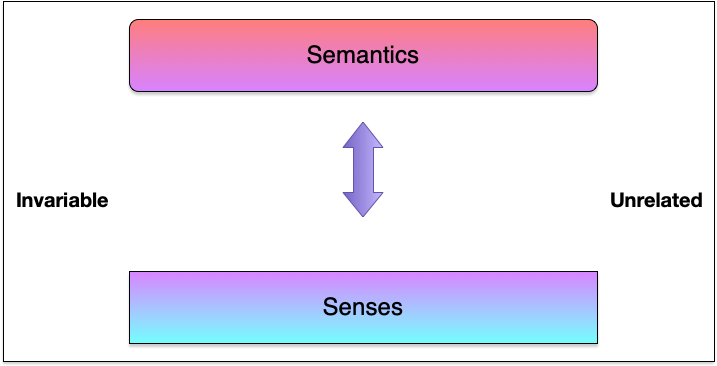
At core, what the model suggests is that there are two components that are linked together. The first element are things that involve the senses. The second element are the semantics we’re looking to create allegiance and adherence too. And there are important elements about this relationship.

There are a number of elements that are on tap for involving the senses. Certain movements, sounds, and words said or to be spoken can be used. There can also be food, drink, smells, and more. Objects also. Timing is an element; at the micro level of things in order, and at the macro level of the triggers for the ritual.

Semantics come, of course, from your needs. It can be about things you want people to believe, or a set of values you want people to subscribe to. Or, of course, both. From the design purpose, I’d suggest it’s about agreeing to be a member of a community of practice; to undertake certain actions when appropriate, and to uphold certain values.

Interestingly, according to their model, the relationship between the two is effectively arbitrary. That is, there is no intrinsic relationship between what you’re signifying, and how you do so. Rituals are about the practices. Which means you could in theory do just about  anything to make the relationship.

The other thing is that the ritual has to be invariable in its aspects. You define it, and so do it. Note that the execution can vary considerably; from several times a day to upon certain triggering conditions. So, for instance, having completed a course, or before engaging in certain activities.

While such a definition gives us lots of freedom, it also doesn’t necessarily serve as a guide for design. Still, thinking about it in this way does suggest the utility in developing deeply held beliefs and appropriately practiced behaviors. At least, that’s how I see it. You?

Learner-centered, or…

13 October 2020 by Clark 6 Comments

I saw a post the other day that talked about ’empathy’, and I’m strongly supportive. But along the way they cited another topic that I’ve had mixed feelings about. So I thought it was time to address it. I’m wondering about ‘learner-centered’, and it may seem churlish to suggest otherwise. However, let me make the case for an alternative.

First, ‘learner-centered’ (apparently also known as ‘student centered‘) is used to take the focus away from the teacher. And I approve. It’s too easy, without awareness, to put the emphasis on ‘teaching’, and you’re on a slippery slope to lectures and knowledge tests. I’m all for that. However, I’m worried about a down-side.

My worry, with learner-centered learning, is that we may become too accommodating. It could be too easy to cater to learners. For instance, one belief that persists is that learning should be ‘fun’. Which is wrong. We know that we need ‘desirable difficulty’ (ala Bjork). That’s why I’ve lobbied for ‘hard fun‘. We could also use learner-centered to make the case for adapting to preferred learning styles. Which, too, would be wrong.

Obviously, you can also argue that learners need meaningful learning, so a learner-centered approach would be appropriate. But I want to suggest another candidate. One that, I argue, leads to good outcomes without carrying any opportunity for baggage.

I’m arguing for ‘learning-centered’, not learner-centered. That is, the focus is on the learning needed, not on the learner. Which isn’t to say we leave the learner out of the equation, but the question then becomes: what does this mean?

I’m suggesting that the key is learning focused on:

  • meaningful outcomes
  • aligned design
  • addressing learners’ prior knowledge
  • addressing learners’ emotions: motivation, trust, anxiety, confidence

And, look, I get that folks talking about ‘learner-centered’ will argue that they’re talking about the same things. I just see it also carrying a greater potential for focusing on the learner  at the expense of learning. And, in general, I would expect to be wrong. That is, most folks aren’t going to go awry. But is there an alternative without the problems?

So, the question is whether ‘learning-centered’ has similar pitfalls, or is it more likely to lead to better outcomes? And I don’t know the answer. It’s just a concern that I’ve felt, and thought I’d raise. Now it’s your turn!  What are your thoughts on the phrase ‘learner-centered’?

Unpacking collaboration and cooperation?

1 September 2020 by Clark 8 Comments

My colleague, Harold Jarche (the  PKM guy), has maintained that cooperation is of more value than collaboration. And for good reason, because cooperation comes from internal motivation instead of external direction.   But this has bugged me, so I naturally tried to make a diagram that helps me think about it. So here’s a stab an unpacking collaboration and cooperation.

His argument, most convincingly can be summed up in this quote (I’ve simplified) he takes from Stephen Downes:

collaboration means ‘working together‘. That‘s why you see it in market economies…
cooperation means ‘sharing‘. That‘s why you see it in networks…

That is, when you’re offering to work together without some recompense, it’s a higher order.   And I agree.

However, I like to think of collaboration as a higher form of thinking. That is, working together to generate a new, negotiated understanding richer than any we could generate on our own. Cooperation means I point to something or give you some feedback, but we’re not necessarily engaged in creation.

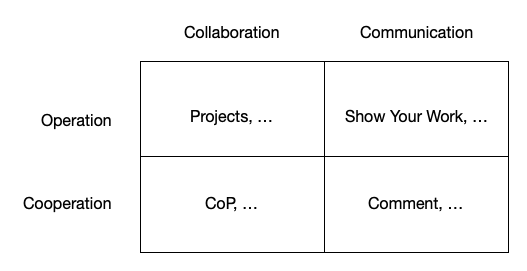
The question is how to reconcile this. And it occurred to me to pull it apart a bit. Because I’ve seen, heck I’ve  participated in exercises where we collaborate for the greater good. Sharing. So I wondered if I might tease out two dimensions.

I wondered whether there are two types of cognitive actions, e.g. collaboration and communication. That is, for one you’re just offering pointers or opinions, without necessarily having any skin in the game. In the other, you’re actively working with someone to generate a new interpretation.

That’s coupled with a second dimension, whether the goal has been dictated externally (e.g. here team, find a solution to this problem) or has emerged from the participant. It’s about locus of control.

You end up with different types of categories. If someone’s asked you to collaborate, it’s likely some sort of project team. Less intently, it may be a ‘show your work’ type of thing, where the organizational culture is supporting sharing, but it’s also an expectation.

On the other hand, you can be just contributing to others by commenting on their blog posts (hint hint, nudge nudge, wink wink). Or you could be part of a Community of Practice and actively trying to improve something.

And I could be totally missing the nuances he’s talking about.

I don’t know if this addresses the issue or not, but it’s my stab at unpacking collaboration and cooperation. And I share it, because I’m wrestling with it, and it’s how I learn out loud. I invite your thoughts.


Thinking Transformation

11 August 2020 by Clark Leave a Comment

This pandemic has led to everyone scrambling to work digitally. And it‘s not really a transformation (which shouldn‘t be ‘digital first‘), but rather just ‘move what we do online‘. And that‘s understandable. Over time, however, I think we want to shift our mindset. And, I think a previous exercise in thinking transformation is valuable here. I‘m talking mobile.

When I originally was talking about mobile, I was doing so from a perspective of augmenting our brains. The 4C‘s framework was a way to think about core mobile affordance from a point of view of what mobile offers. Then I moved on to the role the devices play in our (working) life. It‘s about not just courses on a phone, but:

  • Augmenting formal learning: extending it
  • Performance support: cognitive augmentation
  • Social: tapping into the power of social and informal learning
  • Contextual: mobile‘s unique opportunity

And, I suggest, these are valuable ways to think about using technology in general to support us. On principle, I like to think about how technology supports our thinking (not the other way around ;). To future-proof what I propose is one driver, so tech changes don’t undermine relevance. Further, since mobile is a platform – a strategy not just a tactic – focusing on fundamentals makes sense.

For instance, elearning shouldn‘t look like just a classroom online. That can and arguably should be part of it, but there‘s more. It‘s about extending formal learning, not just delivering it. And aligning with how we really learn, because it really does have to be effective.

Similarly, with folks working from wherever, thinking about the support they need is important. What tools, aids, guides, etc., will help them work more effectively without their prior context? Let’s change workflows to align better with what‘s known about how we work.

And making people available in useful ways for communication and collaboration is important. The demands of online meetings are becoming more prevalent and onerous. Zoom fatigue is a thing!   How can we optimize the experience?

Contextual is more uniquely mobile, taking advantage of where and when you are (and other contextual factors), but we probably do need to account for them more astutely. If your kids are in the other room, what does that do to your ability to work? Here, of course, is the greatest difference from mobile, but the mindset is still relevant.

So, for instance, when I ran a mobile course for the Allen Academy, we had a week dedicated to each of these elements (as well as kicking off a mobile mindset and closing on strategy). Given that it was still early in this new world, I didn‘t really push the thought of how this is a more general tactic. Of course, I now would.

And, given that I‘ll be running the course again, I definitely will! Look, mobile hasn‘t gone away, and we‘re possibly using mobile tools more now even though we‘re not on the road! So mobile‘s still relevant, and the mindset behind ‘thinking mobile‘ is even more relevant. I’ll be talking with Christopher Allen of Allen Interactions about it tomorrow (12 Aug) at 11AM PT, 2 Eastern (see below). And, if you‘re interested in the course, check it out!

« Previous Page
Next Page »

Clark Quinn

The Company

Search

Feedblitz (email) signup

Never miss a post
Your email address:*
Please wait...
Please enter all required fields Click to hide
Correct invalid entries Click to hide

Pages

  • About Learnlets and Quinnovation

The Serious eLearning Manifesto

Manifesto badge

Categories

  • design
  • games
  • meta-learning
  • mindmap
  • mobile
  • social
  • strategy
  • technology
  • Uncategorized
  • virtual worlds

License

Previous Posts

  • March 2026
  • February 2026
  • January 2026
  • December 2025
  • November 2025
  • October 2025
  • September 2025
  • August 2025
  • July 2025
  • June 2025
  • May 2025
  • April 2025
  • March 2025
  • February 2025
  • January 2025
  • December 2024
  • November 2024
  • October 2024
  • September 2024
  • August 2024
  • July 2024
  • June 2024
  • May 2024
  • April 2024
  • March 2024
  • February 2024
  • January 2024
  • December 2023
  • November 2023
  • October 2023
  • September 2023
  • August 2023
  • July 2023
  • June 2023
  • May 2023
  • April 2023
  • March 2023
  • February 2023
  • January 2023
  • December 2022
  • November 2022
  • October 2022
  • September 2022
  • August 2022
  • July 2022
  • June 2022
  • May 2022
  • April 2022
  • March 2022
  • February 2022
  • January 2022
  • December 2021
  • November 2021
  • October 2021
  • September 2021
  • August 2021
  • July 2021
  • June 2021
  • May 2021
  • April 2021
  • March 2021
  • February 2021
  • January 2021
  • December 2020
  • November 2020
  • October 2020
  • September 2020
  • August 2020
  • July 2020
  • June 2020
  • May 2020
  • April 2020
  • March 2020
  • February 2020
  • January 2020
  • December 2019
  • November 2019
  • October 2019
  • September 2019
  • August 2019
  • July 2019
  • June 2019
  • May 2019
  • April 2019
  • March 2019
  • February 2019
  • January 2019
  • December 2018
  • November 2018
  • October 2018
  • September 2018
  • August 2018
  • July 2018
  • June 2018
  • May 2018
  • April 2018
  • March 2018
  • February 2018
  • January 2018
  • December 2017
  • November 2017
  • October 2017
  • September 2017
  • August 2017
  • July 2017
  • June 2017
  • May 2017
  • April 2017
  • March 2017
  • February 2017
  • January 2017
  • December 2016
  • November 2016
  • October 2016
  • September 2016
  • August 2016
  • July 2016
  • June 2016
  • May 2016
  • April 2016
  • March 2016
  • February 2016
  • January 2016
  • December 2015
  • November 2015
  • October 2015
  • September 2015
  • August 2015
  • July 2015
  • June 2015
  • May 2015
  • April 2015
  • March 2015
  • February 2015
  • January 2015
  • December 2014
  • November 2014
  • October 2014
  • September 2014
  • August 2014
  • July 2014
  • June 2014
  • May 2014
  • April 2014
  • March 2014
  • February 2014
  • January 2014
  • December 2013
  • November 2013
  • October 2013
  • September 2013
  • August 2013
  • July 2013
  • June 2013
  • May 2013
  • April 2013
  • March 2013
  • February 2013
  • January 2013
  • December 2012
  • November 2012
  • October 2012
  • September 2012
  • August 2012
  • July 2012
  • June 2012
  • May 2012
  • April 2012
  • March 2012
  • February 2012
  • January 2012
  • December 2011
  • November 2011
  • October 2011
  • September 2011
  • August 2011
  • July 2011
  • June 2011
  • May 2011
  • April 2011
  • March 2011
  • February 2011
  • January 2011
  • December 2010
  • November 2010
  • October 2010
  • September 2010
  • August 2010
  • July 2010
  • June 2010
  • May 2010
  • April 2010
  • March 2010
  • February 2010
  • January 2010
  • December 2009
  • November 2009
  • October 2009
  • September 2009
  • August 2009
  • July 2009
  • June 2009
  • May 2009
  • April 2009
  • March 2009
  • February 2009
  • January 2009
  • December 2008
  • November 2008
  • October 2008
  • September 2008
  • August 2008
  • July 2008
  • June 2008
  • May 2008
  • April 2008
  • March 2008
  • February 2008
  • January 2008
  • December 2007
  • November 2007
  • October 2007
  • September 2007
  • August 2007
  • July 2007
  • June 2007
  • May 2007
  • April 2007
  • March 2007
  • February 2007
  • January 2007
  • December 2006
  • November 2006
  • October 2006
  • September 2006
  • August 2006
  • July 2006
  • June 2006
  • May 2006
  • April 2006
  • March 2006
  • February 2006
  • January 2006

Amazon Affiliate

Required to announce that, as an Amazon Associate, I earn from qualifying purchases. Mostly book links. Full disclosure.

We use cookies to ensure that we give you the best experience on our website. If you continue to use this site we will assume that you are happy with it.