Learnlets

Secondary

Clark Quinn’s Learnings about Learning

Search Results for: align

A solid education platform

19 June 2018 by Clark 4 Comments

In the past couple of days, I’ve come across two different initiatives to improve education. And certainly our education system can stand improvement. However, each one had the same major flaw, and leaves open an opportunity for improvement not to occur. Over a number of engagements I’ve developed the basis of what I think is a necessary foundation for a viable education platform. It’s time to toss it out and see what you all think.

So, one initiative had a proposal of 10 different areas they wanted people to contribute in. This included AI, and personalization, and ‘out of class’ credit, and more. Which is all good, make no mistake! However, nowhere was there the option of ‘a deeper pedagogy’. And that’s a problem. It’s all too easy to chase after the latest shiny object. It makes us feel like we’re both doing something constructive and keeping up with developments. (Not to mention how much fun it is to play with the latest things.) However, gilding bad design is still bad design! We need to make sure the foundation is strong before we go further.

The other initiative has three ways to contribute: lifelong learning, a marketplace, and emerging technology. And, again, the big gap is talking about the pedagogy to begin with.  With a marketplace, you might get some Darwinian selection process, but why not put it out there from the get-go? Otherwise, it’s just cool tinkering around a broken core.
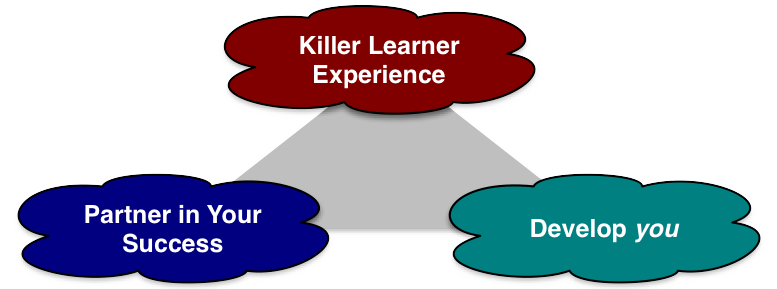
Three partsSo here’s where I pitch my 3 part story. Note that curriculum is broken too (I’m channeling Roger Schank: ‘Only two things wrong with education, what we teach and how we teach it’), and yet I’m not addressing that. Well, only a second layer of curriculum (see below ;). I think the choice of the first level curriculum is a big issue, but that changes depending on level, goals, etc. Here I’m talking about a platform for delivering the necessary elements of a supportable approach:

  1. The first element is a killer learning experience. What do I mean here? I mean an application-based learning approach. Even for so-called theory classes (e.g. typical higher ed), you  do something with this. And the experience is based upon minimal content, appropriate challenge, intrinsic motivation, and more. My claim: this is doable, even when you want to auto-mark as much as possible. Of course, there are still people in the loop.
  2. Which leads to the second element, we as the provider are a partner in your success. It’s not ‘sink or swim’, but instead we’re tracking your progress, intervening when it looks like you’re struggling, and accessible at your time and place. We’re also providing the necessary resources to succeed. And we’re not interested in a curve, we’re competency-based and want everyone to get where they can be.  We’re also making sure you’re getting what you need.
  3. And that’s the third element, we  develop you. That is, we’re not just developing your knowledge of the field, we’re also developing key success skills. That means we’re giving you chances to practice those skills as well,  and tracking them and developing them as well. This includes things like communication, collaboration, design research, and more. So-called 21C skills.

I suggest that with such an approach, and the right curriculum, you’re providing a full suite of what education  should  be about. And, I suggest, we can do this now, affordably. Technology is part of the picture, learning science is part of the picture, and the commitment to do the right thing is part of the picture. Also, I think this is viable at all levels. K12, higher ed, and workplace.

And, I’ll suggest, anything less really isn’t defensible. We have the know-how, we have the tools, all we need is the will. Yet, despite some notable steps in the right direction, we’re really not there. It’s time to put a stake in the ground. Who’s up for it?

Game Results

13 June 2018 by Clark Leave a Comment

The game we designed (as I talked about yesterday), Quest for Independence, was actually a fair bit of a hit. While we couldn’t talk to kids still, anecdotally we heard that the kids were playing it.  And, as the design intended, it led them to talk to the Care counselors. That was good enough, but there was more.

First, the Aussie science program  Quantum  had a bit on it. They even interviewed me (with a big production about bringing stuff to our house), but never used the footage.  They also couldn’t talk to the kids ‘in care’, but it turns out Quest was being used by kids  not in care!  High schools were using it to explore life after school as well. That was a nice outcome.

Another occurrence brought new action. Sometime after the game launched, I became aware of the Common Gateway Interface (CGI) standard for the web. What this did was allowed web pages to do backend processing based upon user actions, and then programmatically change the front end.  In short, web pages could react based upon what had happened before.

For  Quest, this meant that we could port it to the web!  That is, you started the game, the player’s actions were sent to the web, the program could calculate the outcome and render an appropriate new page, with the graphics assembled to represent the game variables, the current location, and more.  This was exciting.

Splash screenAnd, again, I had a student wanting to do a project. So the project was to take the game graphics, and the programming, and make the game web-playable. And lo, it was done; the game could be played over the web.  Most wonderfully, it  still can be!  (Yay, standards!)

Naturally, I wrote it up (with the student; a principle I always stuck to: even if I usually ended up writing it all, they got credit for their work and ideas).  And, as far as I know, it was the very first web-delivered serious game. At the least, without Flash.

The underlying principles in the game also became part of a couple of chapters, and ultimately the alignment between effective education and engaging experiences formed the core of my book on serious game design,  Engaging Learning.  

One final reflection is that working on this, on a project that really helped real kids, was still one of the most rewarding projects I’ve ever worked on.  It’s nice to help clients deliver outcomes, but saving lives that were at risk?  That’s just too good.  Anyone up for some more ‘hard fun’?

Designing a game

12 June 2018 by Clark Leave a Comment

When I was a young academic in Australia, a colleague asked me if I would talk to some folks about a game. He knew that I had designed games before returning to grad school, and had subsequently done one on my thesis research. This group, the Australian Children’s Welfare Agency, had an ‘After Care’ project to assist kids  who needed to live independently. They’d spent their budget on a video, comic book, and a poster, but now realized that the kids would play games at the Care centers. I had a talented student who wanted to do a meaningful honours project, and so I agreed.

Following best principles, we talked not only to the project leaders, and the counselors, but more. We weren’t allowed to talk to youth ‘in care’ (for obvious reasons), but they did get us access to some recent graduates. They gave us great insights, and later they playtested the prototype for fine-tuning.

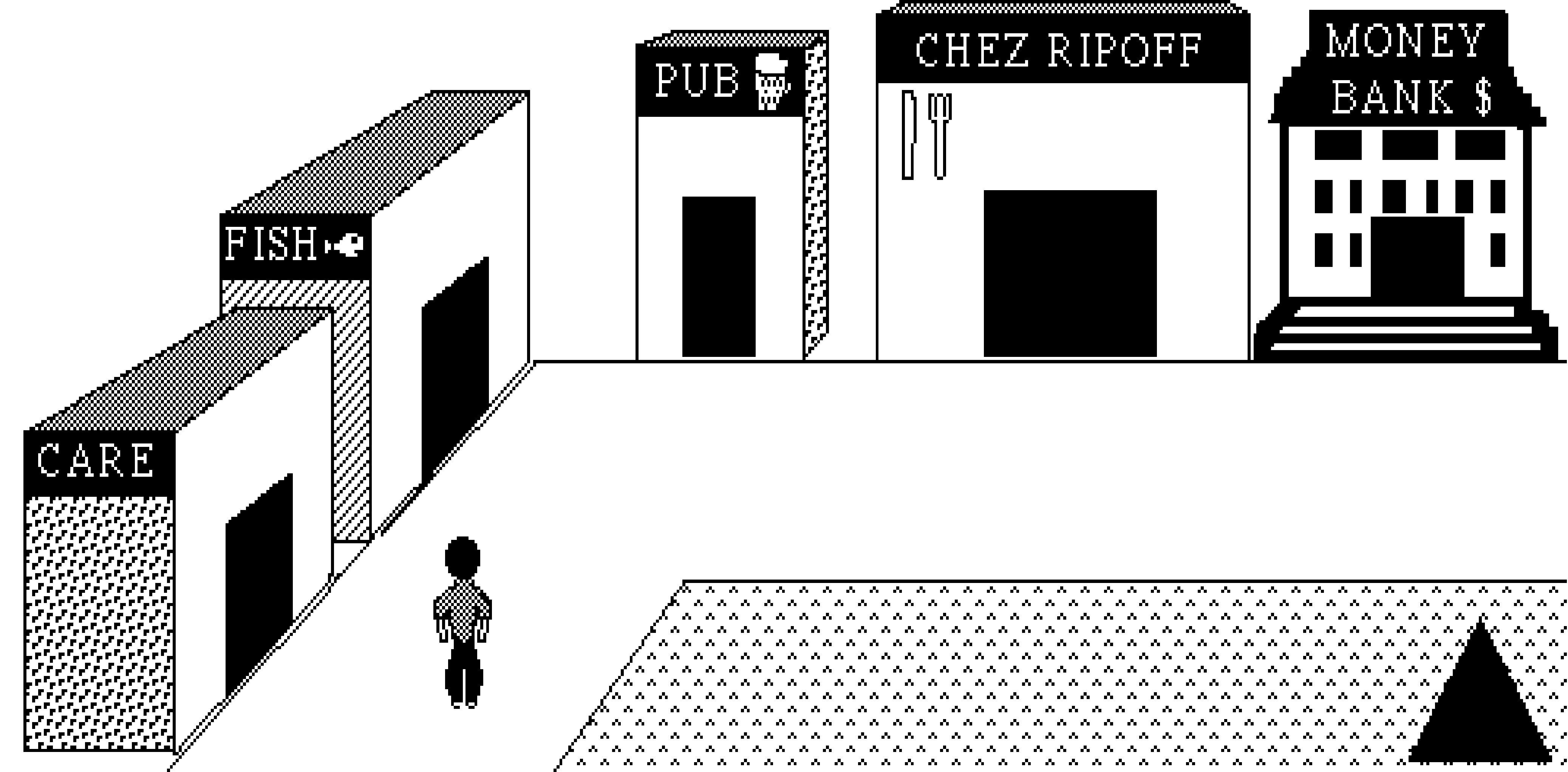
One of the lessons from this was important. The counselors told us that what these kids needed were to learn to shop and cook. While I  could have made a game for that, when we talked to the kids we learned that there was more.  (My claim: you can’t give me a learning objective I can’t make a game for, though I reserve the right to raise the objective in a taxonomic sense.)   They said what was important were the chains. That is, you could get money while you looked for a job, but… They wouldn’t give you money, however, they’d deposit in a bank account. BUT, to get that, you needed ID.  To get that, however, you needed references. And so on. So that was the critical focus.

I taught my interface design students HyperCard, to have a simple language to prototype in. This meant that we had an environment that we knew games could be built in.  My student did most of the programming, under my direction.  When that wasn’t quite sufficient to finish the development, I used some grant money to hire her for the summer to finish it.

early screenThe resulting play was good, but the design was lacking (neither my student nor I were graphic designers). I ended up going with the project team leaders to get philanthropic funding to add graphics. (Which introduced bugs I had to fix.)  They also had it ported to the PC, which ended up being a mistake.Their hired gun used a platform with an entirely different underlying model and wasn’t able to translate it appropriately. Ouch.

Later street

The resulting game, had some specific design features:

  • It was exploratory, in that the player had to wander around and try to survive.
  • It was built upon a simple simulation engine, which supported replay.
  • There were variables, like health and hunger and sleep that would get worse over time, driving action.
  • The audience was low literacy, so we used graphics to convey variable states, interface elements, and location.
  • Success was difficult. Jobs were difficult to obtain, and better jobs were even harder. And, of course, you had to discover the chains.
  • There was coaching: if you were struggling, the game would offer you the opportunity for a hint. If you continued to struggle, eventually you’d get the hint anyway.
  • There was also a help system, where the basics were laid out.
  • There were random events, like getting (or losing) money, or having drugs or sex. (We were trying to save lives, and didn’t worry about upsetting the wowsers.)

There was more, but this characterized some of the important elements.  In reflecting upon the experience, I realized the alignment between effective education and engaging experiences that means you can, and should, make learning  hard fun.  I wrote a journal article (with my student) that captured what I will  suggest are critical realizations (still!).

They held an event to launch the entire project, including the game (and they gave me a really nice sweater, and Dana something too ;).  Tomorrow, I’ll pass on some of the subsequent outcomes.

The Optimistic View

6 June 2018 by Clark Leave a Comment

In yesterday’s post, I quipped about how L&D wasn’t doing well, and I want to clarify my perspective. Because, you see, I’m an optimist!  I really only complain to create improvement. And so let me wax philosophical about why we can and should be hopeful about L&D.

Thumb upOrganizations need to learn. And they learn as a function of individuals learning, alone and together. This learning can be ineffective or effective; there are skills involved. And yet, assuming these skills isn’t a safe bet.

And this is a big picture: it’s as much about informal learning as it is formal. Or, so should it be. We need to be ensuring our formal learning is working, but learning is a continuum that extends beyond the course. Evidence shows that we learn through social interaction and through our own work experience.  If we only do formal, we’re missing a large part (estimates are around 80%).

And here’s the thing: who in the organization  besides L&D  should  be doing this?  Who else understands how we learn? Ideally, of course, we  do know this, but let’s make that a working assumption (if you want help here, that’s what I do ;).

So, if we take what we know about learning, individual and social, and apply that, what happens? If we share policies and practices around tools that facilitate learning (curation, creation, collaboration), what is the organizational benefit?  We can be facilitating and spreading best principles to optimize and accelerate organizational knowledge.

I want to suggest that facilitating the learning of the organization, particularly in this era of increasing change and competition, is  the key to organizational success.  Thus, L&D has the opportunity to be not peripheral but central!  And that, to me, is not only desirable, but right.

Hence, I’m optimistic.  And I’ll keep pushing us to achieve the potential that’s on the table. Ready to join me?

Nuances Matter

30 May 2018 by Clark 1 Comment

I’ve argued before that the differences between well-designed and well-produced learning, and just well-produced learning, are subtle. And, in general, nuances matter. So, in my recent book, the section on misconceptions spent a lot of time unpacking some terms. The goal there was ensuring that the nuances were understood. And a recent event triggered even more reflection on this.

Learnnovators, a company I’ve done a couple of things with (the Deeper eLearning series, and the Workplace of the Future project), interviewed me once quite a while ago. I was impressed then with the depth of their background research and thoughtful questions. And they recently asked to interview me on the book. Of course, I agreed. And again they impressed me with the depths of their questions, and I realized in this case there was something specific going on.

In their questions, they were unpacking what common concerns would be about some of the topics.  The questions dug in to ways in which people might think that the recommendations are contrary to personal experience, and more.  There were very specifically looking for ways in which folks might think to reject the findings.  And that’s important. I believe I had addressed most of them in the book, but it was worth revisiting them.

And that’s the thing that I think is important about this for our practice. We can’t just do the surface treatment. If we just say: “ok we need some content, and then let’s write a knowledge test on it”, we’ve let down our stakeholders.  If we don’t know the cognitive properties of the media we use, don’t sweat the details about feedback on assessment, don’t align the practice to the needed performance, etc., we’re not doing our job!

And I don’t mean you have to get a Ph.D. in learning science, but you really do need to know what you’re doing. Or, at least, have good checklists and quick reference guides to ensure you’re on track. Ideally, you review your processes and tools for alignment to what’s known. And the tools themselves could have support. (Ok, to a limit, I’ve seen this done to the extent of handcuffs on design.)

Nuances matter,  if you care about the outcomes (and if you don’t, why bother? ;).  I’ve been working on both a checklist and on very specific changes that apply to various places in design processes that represent the major ways folks go wrong. These problems are relatively small, and easy to fix, and are designed to yield big improvements. But unless you know what they are, you’re unlikely to have the impact you intend.

Cognitive and Learning Sciences

23 May 2018 by Clark 1 Comment

You’ll see a lot of vendors/sessions/webinars touting neuroscience or brain-based. And you really shouldn’t believe it.  Yes, our brains are composed of neurons, and we do care about what we know about brains.  BUT, these aren’t the right terms!  Ironically, we have to be smarter than that.  Why?

Library levelsNo argument that neuroscience is advancing, rapidly. With powerful tools like MRI, we can understand lots more about what the brain does. And as we do, our understanding overall advances. But  for our purposes, neural is the wrong level.

Yes, learning is really about strengthening neural links. However, we don’t address individual neurons. Instead our thinking is really patterns of activation  across neurons. So, we activate patterns. And, typically, if we’re addressing higher-level thinking than motor reactions (think: decisions about actions), we’re activating complex combinations of patterns.

To do so, we’re working at the symbolic level. Images representing concepts, diagrams, and  language. And this is the  cognitive level! It’s the level above neural.  And above that, the social.  And while it’s about the brain, saying it’s based on the brain is a muddy concept. Do you mean neural, or cognitive, or…? Clarity matters.

Cognitive science as a field was defined to be an integrative approach to everything about our thinking: consciousness, language, emotion, and more.  Departments of cognitive science tend to include psychologists, linguists, sociologists, anthropologists, philosophers, and, yes, neuroscientists.  For instruction, and other aspects like performance support and informal learning, however, cognitive (or social) is the right level.

And, to be clear, learning sciences are a subset of the cognitive sciences. So you really should have a working understanding of the basics of learning science if you’re designing courses. And of the bigger picture of cognitive science to do the new L&D.

Conceptual clarity  about  our field, is important  to our field. We need to know what we’re doing, and resist hype that is misleading if not flat-out wrong. It’s nice to think we’re doing cool stuff, but not if we don’t have the basics down. Invest in solid learning and performance design first. Then we can get fancy.

Hard Fun Projects

2 May 2018 by Clark Leave a Comment

As a basic premise of my book on designing engaging learning, I maintain that learning can, and  should, be ‘hard fun’. When you look at learning and engagement, you find this perfect alignment of elements. And, it occurred to me, that’s also true for good project work.  And here I don’t just mean coursework assignments (though that too fits), but organizational innovation should also be hard fun!

As I’ve stated before in various places, when you’re designing new solutions, problem-solving, trouble-shooting, doing research, etc, you don’t know the answer when you begin.  Therefore you’re learning when you do so!  It’s not formal learning, it’s informal, but it’s still learning.  So what works in learning should make sense for innovation too.

And in learning, the alignment I found between elements of effective education and engaging learning make sense.  Both require (amongst others):

  • clear goals
  • appropriate challenge
  • meaningfulness of the problem to the context
  • meaningfulness to the learners
  • experimentation
  • feedback

And those also define a meaningful project for solving in the workplace.

That is, first  you need to have a clear goal. The size and scope of the task should be within the reach, but not the grasp, of the team. The project has to have a clear benefit to the organization.  And the team should be appropriately constituted with skills and committed to the project. The methods required for the innovation will be experimentation and feedback.  Of course, you also need diversity on the team, safety to experiment, accountability for the results.  (Which is helpful for formal learning too!)

We can, and should, be setting up our projects to meet these criteria. We get better outcomes, research tells us. That not only includes the product of the work, but team engagement as well. This is also a possible start to creating a culture of experimentation and continual learning. Which also has long-term upsides.

This came to me because I was asked in an interview what were the most fun projects I’d done. I realized that working with folks together to address problems, like when I led a team to develop an adaptive learning system, fit the bill.  And that’s work I love, whether having a group together to collectively work out better design processes or performance and development strategy.  Folks who’ve worked with me similarly have found it valuable. So who’s up for some ‘hard fun’?

Myths in one week…

1 May 2018 by Clark Leave a Comment

Next week, I’ll be presenting on myths at ATD’s International Conference (Tues, 1PM).  Moreover, there’ll be a book signing at 4PM!  I hope to see you there, and, for more reasons than you might first imagine.

For one, ATD’s supposed to be supplying me with special bookmarks.  Always nice to have a book mark specific to the book, I reckon. I haven’t seen them yet, but if they’re leveraging the cool design work of Fran Fernandez they used for the book, they’ll be great.  But wait, there’s more…

Pick of debunker ribbonI’ve also arranged for some special ‘Debunk’ badge ribbons.  These limited edition collectors items (*ahem* :) are available to those who can show me their copy of the book (digital or print).  It’s to proudly wear on your badge showing you’re fighting on the side of learning science.  (As to the pic: the ribbon was not  supposed to be ‘cantelope’. Fortunately, the company is making it right so these ones have gone back. They will be orange, and the print and design will be the same. Fingers crossed they arrive in time!)

There are other ways to find out more.  You can of course buy the book; either through Amazon (Kindle too) or via ATD (PDF too). (Rumor has it that using the code ‘SPRINGBOOKS18’ at ATD will get you 10% off!)

Of course, there’s the ATD webinar for members on May 24th at 11AM PT (2PM ET). There’ll be one for the Debunker Club on June 6th at 10AM PT (1PM ET), details forthcoming.    Other webinars are in the works, so stay tuned.

And there’ll be interviews. Also forthcoming.  Yes, I’m trying to get the word out, but it’s for a good cause: better learning!

So, if you’re going to ICE, please do say hello (and safe travels).  I know San Diego (and love it): undergrad and grad school at UCSD, and brother still lives there, so I visit a lot. My recommendations: fish tacos (Rubios is a safe bet), carnitas (e.g. Old Town Mexican Cafe), and carne asada burritos (but only at a taqueria, not at a restaurant). There are some great local brews; Stone, Pizza Port, and Ballast Point all make a good drop.  Also, margaritas  if you can get them made properly, not with a mixer. Hope to see you there!

SMEs for Design

25 April 2018 by Clark Leave a Comment

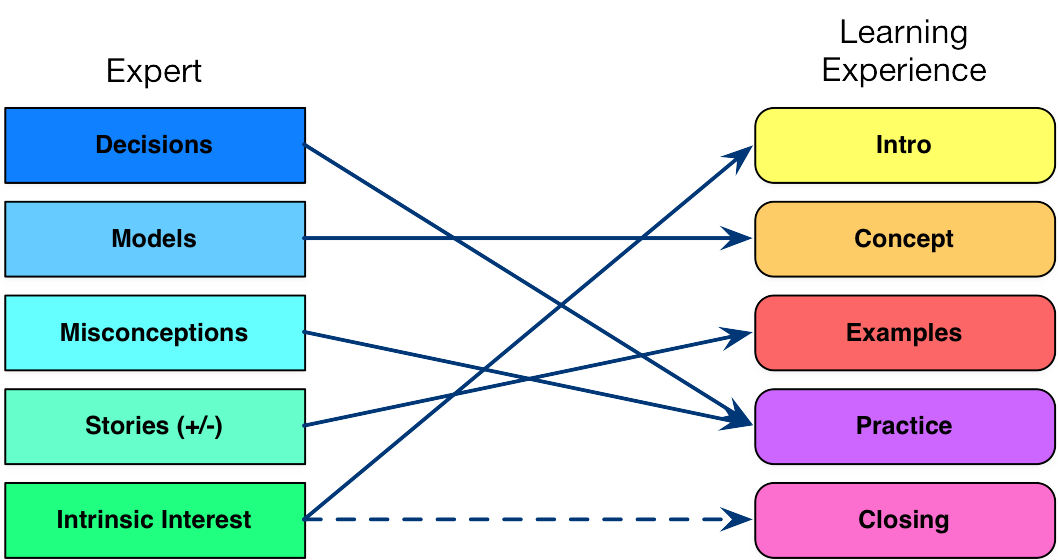
In thinking through my design checklist, I was pondering how information comes from SMEs, and the role it plays in learning design. And it occurred to me visually, so of course I diagrammed it.

The problem with getting design guidance from SMEs is that they literally can’t tell us what they do!  The way our brains work, our expertise gets compiled away. While they  can tell us what they know (and they do!), it’s hard to get what really needs to be understood.  So we need a process.

Mapping SME Qs to ID elementsMy key is to focus on the  decisions that learners will be able to make that they can’t make now. I reckon what’s going to help organizations is not what people know, but how they can apply that to problems to make better choices.  And we need SMEs who can articulate that. Which isn’t all SMEs!

That  also means that we need models. Information that helps guide learners’ performance while they compile away their expertise. Conceptual  models  are the key here; causal relationships that can explain what  did  happen or predict what  will happen, so we can choose the outcomes we want. And again, not all SMEs may be able to do  this part.

There’s also other useful information SMEs can give us. For one, they can tell us where learners go wrong. Typically, those errors aren’t random, but come from bringing in the wrong model.  It would make sense if you’re not fully on top of the learning.  And, again we may need more than one SME, as sometimes the theoretical expert (the one who can give us models and/or decisions) isn’t as in tune with what happens in the field, and we may need the supervisor of those performers.

Then, of course, there are the war stories. We need examples of wins (and losses).  Ideally, compelling ones (or we may have to exaggerate). They should  be (or end up) in the form of stories, to facilitate processing (our brains are wired to parse stories).  Of course, after we’re done they should refer to the models, and show the underlying thinking, but that may be our role (and if that’s hard, maybe we either have the wrong story or the wrong model).

Finally, there’s one other way experts can assist us. They’ve found this topic interesting enough to spend the years necessary to  be the experts.  Find out why they find it so fascinating!  Then of course, bake that in.

And it makes sense to gather the information from experts in this order. However, for learning, this information plays roles in different places.  To flip it around, our:

  • introductions need to manifest that intrinsic interest (what will the learners be able to do  that they care about?)
  • concepts need to be presenting those models
  • examples need to capture those stories
  • practice need to embed the decisions and
  • practice needs to provide opportunities to exhibit those misconceptions  before they matter
  • closing may also reference the intrinsic experience in closing the emotional experience

That’s the way I look at it.  Does this make sense to you? What am I missing?


Real (e)Learning Heroes

24 April 2018 by Clark Leave a Comment

Super logoWhile there are people who claim to be leaders in elearning (and some are), there is another whole group who flies under the radar. These are the people who labor quietly in the background on initiatives that will benefit all of us. I’m thinking in particular of those who work to advance our standards. And they’re really heroes for what they’ve done and are doing.

The initial learning technology standards came out from the AICC.  They wanted a way to share important learning around flight, an area with a big safety burden.  Thus, they were able to come together despite competition.

Several other initiatives include IEEE (which is pretty much  the US based effort on electric and electronic technology standards to the international stage), and the IMS efforts from academia.  They were both working on content/management interoperability, when the US government put it’s foot down. The Department of Defense’s ADL initiative decided upon  a  version, to move things forward, and thus was born SCORM.

Standards are good. When standards are well-written, they support a basis upon which innovation can flourish.  Despite early hiccups, and still some issues, the ability for content written to the standards to run on any compliant platform, and vice versa, has enabled advancements. Well, except for those who were leveraging proprietary standards.  As a better example, look how the WWW standard on top of the internet standards has enabled things like, well, this blog!

Ok, so it’s not all roses.  There are representatives who, despite good intentions, also have vested interests in things going in particular directions. Their motivations might be their employers, research, or other agendas.  But the process, the mechanisms that allow for decision making, usually end up working. And if not, there’s always the ADL to wield the ‘800 lb gorilla’ argument.

Other initiatives include xAPI, sponsored by ADL to address gaps in SCORM. This standard enables tracking and analytics  beyond the course. It’s no panacea, but it’s a systematic way to accomplish a very useful goal. Ongoing is the ICICLE work on establishing principles for ‘learning engineering’, and IBSTPI  for training, performance, and instruction.  Similarly, societies such as ATD and LPI try to create standards for necessary skills (their lists are appendices in the Revolution book).

And it’s hard work!  Trying to collect, synthesize, analyze, and fill in gaps to create a viable approach requires much effort both intellectual  and social!  These people labor away for long hours, on top of their other commitments in many cases.  And in many cases their organizations support their involvement, for good as well as selfish reasons such as being first to be able to leverage the outputs.

These people are working to our benefit. It’s worth being aware, recognizing, and appreciating the work they do.  I certainly think of them as heroes, and I hope you will do so as well.

« Previous Page
Next Page »

Clark Quinn

The Company

Search

Feedblitz (email) signup

Never miss a post
Your email address:*
Please wait...
Please enter all required fields Click to hide
Correct invalid entries Click to hide

Pages

  • About Learnlets and Quinnovation

The Serious eLearning Manifesto

Manifesto badge

Categories

  • design
  • games
  • meta-learning
  • mindmap
  • mobile
  • social
  • strategy
  • technology
  • Uncategorized
  • virtual worlds

License

Previous Posts

  • March 2026
  • February 2026
  • January 2026
  • December 2025
  • November 2025
  • October 2025
  • September 2025
  • August 2025
  • July 2025
  • June 2025
  • May 2025
  • April 2025
  • March 2025
  • February 2025
  • January 2025
  • December 2024
  • November 2024
  • October 2024
  • September 2024
  • August 2024
  • July 2024
  • June 2024
  • May 2024
  • April 2024
  • March 2024
  • February 2024
  • January 2024
  • December 2023
  • November 2023
  • October 2023
  • September 2023
  • August 2023
  • July 2023
  • June 2023
  • May 2023
  • April 2023
  • March 2023
  • February 2023
  • January 2023
  • December 2022
  • November 2022
  • October 2022
  • September 2022
  • August 2022
  • July 2022
  • June 2022
  • May 2022
  • April 2022
  • March 2022
  • February 2022
  • January 2022
  • December 2021
  • November 2021
  • October 2021
  • September 2021
  • August 2021
  • July 2021
  • June 2021
  • May 2021
  • April 2021
  • March 2021
  • February 2021
  • January 2021
  • December 2020
  • November 2020
  • October 2020
  • September 2020
  • August 2020
  • July 2020
  • June 2020
  • May 2020
  • April 2020
  • March 2020
  • February 2020
  • January 2020
  • December 2019
  • November 2019
  • October 2019
  • September 2019
  • August 2019
  • July 2019
  • June 2019
  • May 2019
  • April 2019
  • March 2019
  • February 2019
  • January 2019
  • December 2018
  • November 2018
  • October 2018
  • September 2018
  • August 2018
  • July 2018
  • June 2018
  • May 2018
  • April 2018
  • March 2018
  • February 2018
  • January 2018
  • December 2017
  • November 2017
  • October 2017
  • September 2017
  • August 2017
  • July 2017
  • June 2017
  • May 2017
  • April 2017
  • March 2017
  • February 2017
  • January 2017
  • December 2016
  • November 2016
  • October 2016
  • September 2016
  • August 2016
  • July 2016
  • June 2016
  • May 2016
  • April 2016
  • March 2016
  • February 2016
  • January 2016
  • December 2015
  • November 2015
  • October 2015
  • September 2015
  • August 2015
  • July 2015
  • June 2015
  • May 2015
  • April 2015
  • March 2015
  • February 2015
  • January 2015
  • December 2014
  • November 2014
  • October 2014
  • September 2014
  • August 2014
  • July 2014
  • June 2014
  • May 2014
  • April 2014
  • March 2014
  • February 2014
  • January 2014
  • December 2013
  • November 2013
  • October 2013
  • September 2013
  • August 2013
  • July 2013
  • June 2013
  • May 2013
  • April 2013
  • March 2013
  • February 2013
  • January 2013
  • December 2012
  • November 2012
  • October 2012
  • September 2012
  • August 2012
  • July 2012
  • June 2012
  • May 2012
  • April 2012
  • March 2012
  • February 2012
  • January 2012
  • December 2011
  • November 2011
  • October 2011
  • September 2011
  • August 2011
  • July 2011
  • June 2011
  • May 2011
  • April 2011
  • March 2011
  • February 2011
  • January 2011
  • December 2010
  • November 2010
  • October 2010
  • September 2010
  • August 2010
  • July 2010
  • June 2010
  • May 2010
  • April 2010
  • March 2010
  • February 2010
  • January 2010
  • December 2009
  • November 2009
  • October 2009
  • September 2009
  • August 2009
  • July 2009
  • June 2009
  • May 2009
  • April 2009
  • March 2009
  • February 2009
  • January 2009
  • December 2008
  • November 2008
  • October 2008
  • September 2008
  • August 2008
  • July 2008
  • June 2008
  • May 2008
  • April 2008
  • March 2008
  • February 2008
  • January 2008
  • December 2007
  • November 2007
  • October 2007
  • September 2007
  • August 2007
  • July 2007
  • June 2007
  • May 2007
  • April 2007
  • March 2007
  • February 2007
  • January 2007
  • December 2006
  • November 2006
  • October 2006
  • September 2006
  • August 2006
  • July 2006
  • June 2006
  • May 2006
  • April 2006
  • March 2006
  • February 2006
  • January 2006

Amazon Affiliate

Required to announce that, as an Amazon Associate, I earn from qualifying purchases. Mostly book links. Full disclosure.

We use cookies to ensure that we give you the best experience on our website. If you continue to use this site we will assume that you are happy with it.