Learnlets

Secondary

Clark Quinn’s Learnings about Learning

Search Results for: align

It’s here!

18 April 2018 by Clark Leave a Comment

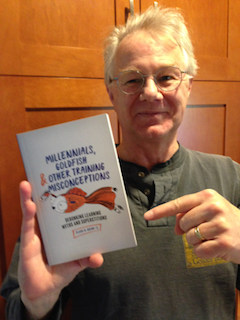
Book and MeSo, as you (should) know, I’ve written a book debunking learning myths. Of course, writing it, and getting your mitts on it are two different things!  I’ve been seeing my colleagues (the ones kind enough to write a blurb for it) showing off their copies, and bemoaning that mine haven’t arrived.  Well, that’s now remedied, it’s here! (Yay!)  And in less than a week will be the official release date!

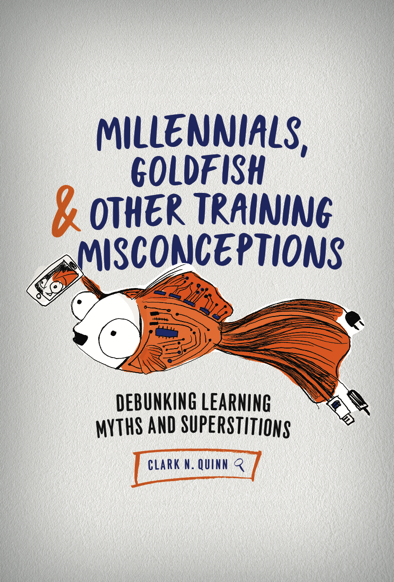
My publishing team (a great group) let me know that they thought it was a particularly nice design (assuring me that they didn’t say that to  all the authors ;), and I have to say it looks and feels nice.  The cover image and cartoons that accompany every entry are fun, too (thanks, Fran Fernandez)!  It’s nicely small, yet still substantial.  And fortunately they kept the price down.

You can hear more about the rationale behind the work  in a variety of ways:

I’ll be doing a webinar for the Asia Pacific region on Thursday 19 Apr (tomorrow!) 6PM PT (9AM Friday Singapore Time).

I’ll be presenting at ATD’s International Conference in San Diego on Tuesday, May 8th at 1PM.

(There will also be a book signing in the conference book store at 4PM. Come say hi!)

There’s a webinar for ATD on May 24th at 11AM PT (2PM PT).

Another webinar, for the Debunker Club (who contributed) on June 6 at 10AM PT, 1PM ET. Details still to come.

Also, Connie Malamed has threatened to interview me, as have Learnnovators.  Stay tuned.

So, you’ve no excuse not to know about the problem! I’d feel a bit foolish about such publicity, if the cause weren’t so important.  We need to be better at using learning science.  Hope to see you here, there, or around.

 

Tools and Design

11 April 2018 by Clark 2 Comments

I’ve often complained about how the tools we have make it easy to do bad design. They make it easy to put PPTs and PDFs on the screen and add a quiz. And not that that’s not so, but I decided to look at it from the other direction, and I found that instructive. So here’re some thoughts on tools.

Authoring tools, in general, are oriented on a ‘page’ metaphor; they’re designed to provide a sequence of pages. The pages can contain a variety of media: text, audio, video.  And then there are special pages, the ones where you can interact.  And, of course, these interactions are the critical point for learning. It’s when you have to act, to  do, that you retrieve and apply knowledge, that learning really happens.

What’s critical is  what you do.  If it’s just answering knowledge questions, it’s not so good.  If it’s just ‘click to see more’, it’s pretty bad.  The critical element is being faced with a decision about an action to take, then apply the knowledge to discriminate between the alternatives, and make a decision.  The learner has to commit!  Now, if I’m complaining about the tools making it easy to do bad things, what would be good things?

That was my thinking: what would be ideal for tools to support? I reasoned that the interactions should represent things we do in the real world.  Which, of course, are things like fill in forms, write documents, fill out spreadsheets, film things, make things.  And these are all done through typical interactions like drag, drop, click, and more.

Which made me realize that the tools aren’t the problem!  Well, mostly; click to see more is still problematic.  Deciding between courses of action can be done as just a better multiple choice question, or via any common form of interaction: drag/drop, reorder, image click, etc. Of course, branching scenarios are good too, for so-called soft skills (which are increasingly the important things), but tools are supporting those as well.  The challenge  isn’t inherent in the tool design.  The challenge is in our thinking!

As someone recently commented to me, the problem isn’t the tools, it’s the mindset.  If you’re thinking about information dump and knowledge test, you can do that. If you’re thinking about putting people into place to made decisions like they’ll need to make, you can do that. And, of course, provide supporting materials to be able to make those decisions.

I reckon the tool vendors are still focused on content and a quiz, but the support is there to do learning designs that will really have an impact.  We may have to be a bit creative, but the capability is on tap. It’s up to (all of) us to create design processes that focus on the important aspects.  As I’ve said before, if you get the design right, there are  lots of ways to implement it!

New and improved evaluation

10 April 2018 by Clark 6 Comments

A few years ago, I had a ‘debate’ with Will Thalheimer about the Kirkpatrick model (you can read it here).  In short, he didn’t like it, and I did, for different reasons.  However, the situation has changed, and it’s worth revisiting the issue of evaluation.

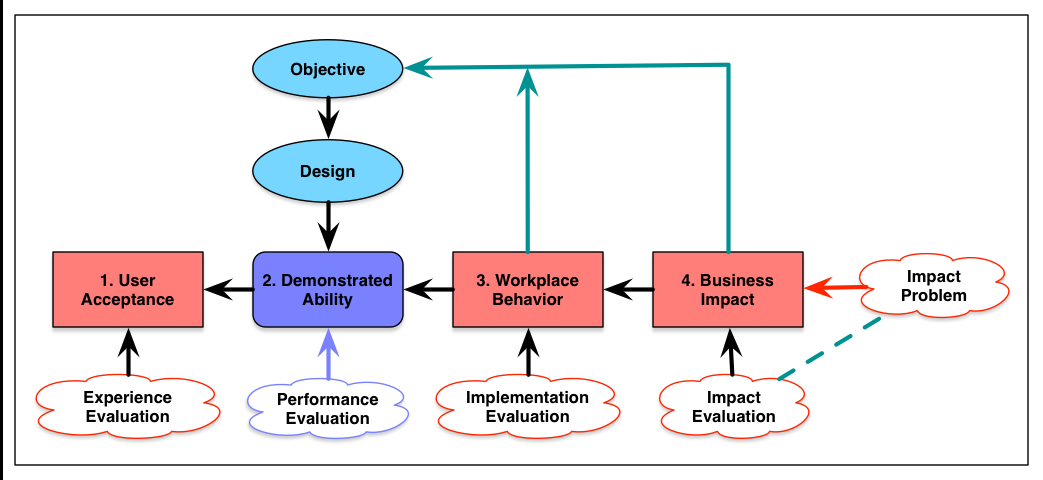
where kirkpatrick fitsIn the debate, I was lauding how Kirkpatrick  starts with the biz problem, and works backwards. Will attacked that the model didn’t really evaluate learning. I replied that it’s role wasn’t evaluating the effectiveness of the learning design on the learning outcome, it was assessing the impact of the learning outcome on the organizational outcome.

Fortunately, this discussion is now resolved. Will, to his credit, has released his own model (while unearthing the origins of Kirkpatrick’s work in Katzell’s).  His model is more robust, with 8 levels.  This isn’t overwhelming, as you can ignore some. Fortunately, there’re indicators as to what’s useful and what’s not!

It’s not perfect. Kirkpatrick (or Katzell? :) can relatively easily be used for other interventions (incentives, job aids, … tho’ you might not tell it from the promotional material). It’s not so obvious how to do so with his new model.  However, I reckon it’s  more robust for evaluating learning interventions. (Caveat: I may be biased, as I provided feedback.) And  should he have numbered them in reverse, which Kirkpatrick admitted might’ve been a better idea?

Evaluation is critical.  We do some, but not enough. (Smile sheets, level 1, where we ask learners what they think of the experience, has essentially zero correlation with outcomes.) We need to do a better job of evaluating our impacts (not just our efficiency). This is a more targeted model.  I draw it to your attention.


P&D Strategies

4 April 2018 by Clark 1 Comment

In an article, Jared Spool talks about the strategies he sees UX leaders using.  He lists 3 examples, and talks about how your strategies need to change depending on where you are in relation to the organization.  It made me think about what P&D strategies could and should be.signs

So, one of the ones he cited isn’t unique to UX, of course. That one is ‘continual mentoring’, always having someone shadowing the top person in a role. He suspects that it might slow things down a bit, but the upside is a continual up-skilling.  Back when I led a team, I had everyone have an area of responsibility, but someone backed them up.  Cynically, I called it the ‘bus’ strategy, e.g. in case someone was hit by a bus.  Of course, the real reason was to account for any variability  in the team, to create some collaborative work, to share awareness,  and to increase the team’s understanding..  This is an ‘internal’ strategy.

He cites another, about ‘socializing’ the vision.  In this one, you are collectively creating the five year vision of what learning (his was UX) looks like. The point is to get a shared buy-in to a vision, but also promotes the visibility of the group.  Here again, this is hardly unique to UX, with a small twist ;).  This is more an external strategy.  I suppose there could be two levels of ‘external’, outside P&D but inside the organization, and then an external one (e.g. with customers).

I’d add that ‘work out loud’ (aka Show Your Work) would be another internal strategy (at least to begin with).  Here, the P&D team starts working out loud, with the unit head leading the way. It both gets the P&D team experimenting with the new ways to do things, of course builds shared awareness,  and builds a base to start evangelizing  outside.

I’d love to hear the strategies you’ve used, seen used, or are contemplating, to continue and expand your ability to contribute to the organization.  What’s working?  And, for that matter, what’s not?

Diagramming Microlearning

21 March 2018 by Clark 5 Comments

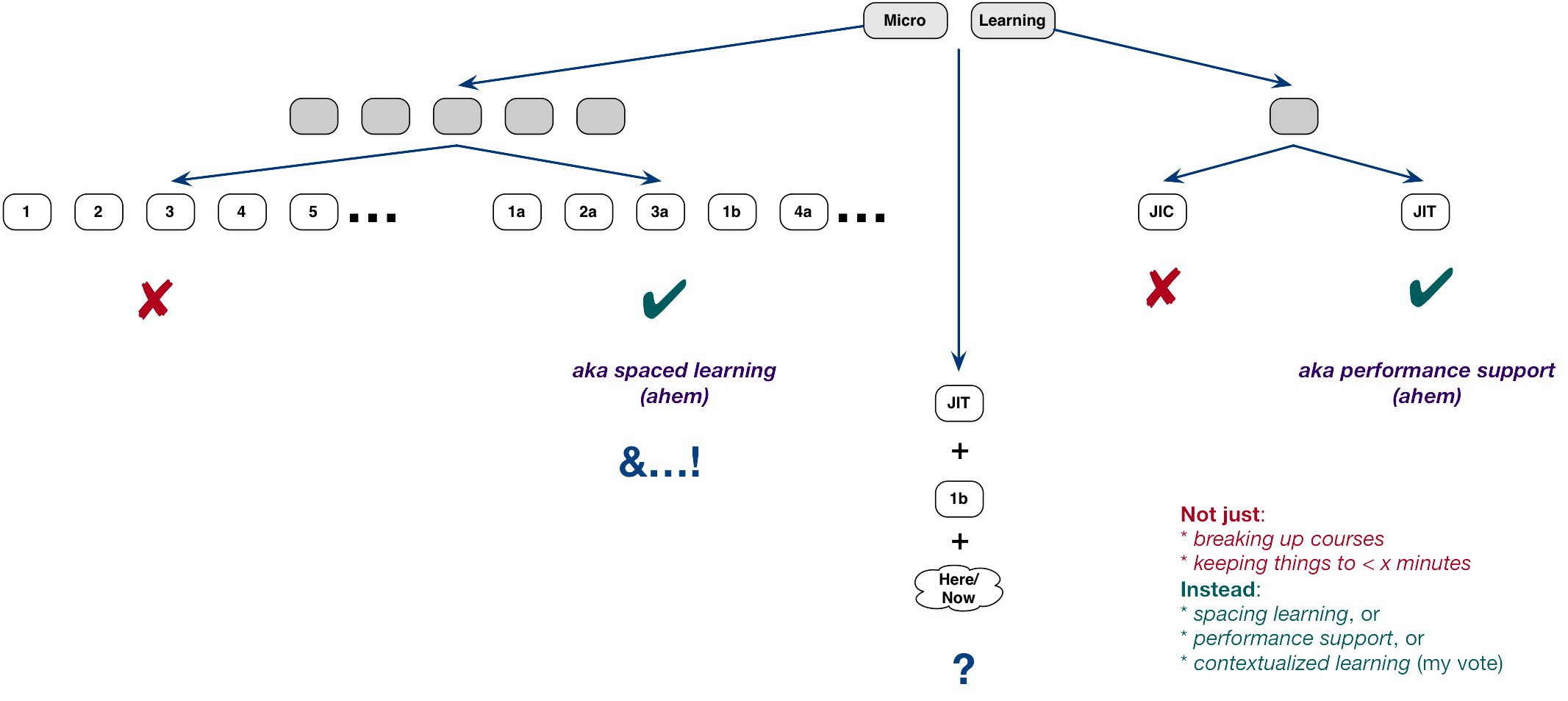
I’ll be giving an upcoming webinar where I make my case for defining microlearning.  And, as part of my usual wrestling with clarity, I created a diagram. I thought I’d share it with you.

Microlearning

What, you want me to walk you through it? :)

Microlearning is a portmanteau (technical term:  mashup) of micro and learning. Thus, it implies small bits of learning.  Here I’m mapping it out in several ways.  I’ve previously argued that there are three main ways, but let’s map the first two out. It’s either

  • a series of objects contributing to a learning experience
  • a one-off object that creates learning

And there are problems with both. Too often, folks talk about breaking an existing course down into small chunks, and I suggest that won’t work without some significant (!) effort.  Just breaking it up means something seen earlier can be forgotten, so you need to worry about knowledge atrophy and plan reactivation. And that’s just spaced learning!

And I think it’s unlikely that you can have a single object lead to any meaningful learning. However, such an object  can serve as support to succeed in the moment.  How-to videos, job aids, and the like all can be used to achieve an outcome.  And that’s just performance support!

What I think is the real untapped opportunity that could (and I say should) capture the moniker would be contextualized learning. Layering on a bit of learning  because of when and where you are that develops you over time. It’s combining the two, potentially, so you help someone in the moment but add in the bit that also makes it a learning experience.  There’s much more to this, but that’s the core idea.

My main issue here is that people are fast and loose with the term microlearning, and I’d like to make sure people are  either talking about spaced learning  or performance support (both good). And not talking about just breaking up a course into chunks that are nice to consume but not engineered to lead to retention and transfer (not so good).  Of course, better yet if we converge on contextualized learning!

Return on Wisdom

20 March 2018 by Clark Leave a Comment

In the early days of the internet, I had a chance to read one of the early translations of  The Japan That Can Say No.  The point I took away was the critique of short-term decision making driven by the need for shareholder returns.  I was pondering this the other day, as I wondered how organizations can look to make longer-term investments. And it led me to ponder the question of what the return is on wisdom.

So, the book was a sensation. At the time, the rumor was that it was written by two top Japanese. It wasn’t released in English, but instead was illicitly translated because of the scandalous claims.    Still, I thought the assessment of the problems with derivative financing and efficiency approaches were apt.  Are these approaches wise?

I use the term wisdom because I think we can, and need to, go beyond ‘smart’.  I was pursuing my own quest to transcend what I do, and came upon a nice view of wisdom from Sternberg. This one argues that we should make decisions with both short-  and long-term views, for not just us and ours, but for all people, with an explicit consideration of the value that we are following. Ok, so I’m a native Californian, but I don’t see a problem with this view. Smart is ‘in the moment’, wise is looking at the bigger picture.

I ponder this in the context of organizations continually looking to reduce costs through expediency. As an alternative, they could be looking at longer term approaches that help them get their workforce more intrinsically engaged.  Does outsourcing and layoffs end up being more costly than investing in better leadership and culture?

There are some answers.  Laurie Bassie’s research found that there was a correlation between high scores on handling people and business results.  Similarly, Towards Maturity finds that companies with good L&D practices are more likely to be successful.  It’s not surprising. When you provide meaningful work with enablement to succeed, you’re aligning the elements to succeed. It’s a path to a coherent organization. And, like with light, it’s more powerful.

There are arguments to move in wise directions. It may be hard if you’re driven by the need to produce short-term returns. Still, it’s the wise thing to do.

It’s ALIVE!

14 March 2018 by Clark 1 Comment

Ok, so this may be small news, but it’s still news (and I, at least, am excited!).  I’ve previously mentioned my forthcoming book:  Millennials, Goldfish, and other Training Misconceptions: Debunking Learning Myths and Superstitions.  It’s not out yet, though you can preorder.  What I’m excited about is that I’ve now put up the site for the book.

OK, whoop de doo. I get it, yet another site. Still, it’s exciting for me for several reasons:

  • a taster of the book is available for download (including Will Thalheimer’s intriguing Foreword)
  • it’s illustrated with some images from the comics (one for every entry)
  • you can download a list of the myths citations (at least the ones that actually debunk)
  • you can download the list of the recommended readings
  • there are links to all the mythbusters mentioned at the end
  • of course there are links to where you can preorder

And, I kind of like the URL I was able to grab: debunkinglearningmyths.com.

So, I don’t expect  you to get as excited as me, but I did feel I should at least let you know.

Myths book cover


Warning: Snake Oil

13 March 2018 by Clark 1 Comment

So this just appeared in my email this morning.  Can you tell what’s wrong?

“The next generation of L&D is here. Millennials are quickly becoming the majority of the world’s workforce. They will need training to become successful leaders. But, because they’ve grown up with mobile devices and digital technologies, they learn differently than previous generations. A solid understanding of millennial learning styles will help you create effective training programs.”

Dr Shmoos snake oil

Yep, snake oil. We’ve hit the myth jackpot!  How many can you spot?  This is the type of stuff marketers come up with that you can’t fight if you don’t know our brains (and more).  So let’s take it apart, shall we?  (This is  so  much fun!)

First, ‘next gen of L&D‘.  Um, maybe.  I don’t see things being done all that differently. It’s more evolution than revolution (despite my exhortations to the latter ;).  Still, no real myth yet.

Next, ‘millennials‘. And, yes, we have a winner!  The evidence says that there’re no meaningful differences between generations.  And if you think about it, it’s much more a continuum than discrete separations. It may be convenient, but it undermines people’s individuality. It’s really a mild form of age discrimination, dealing with people by the year they’re born instead of their unique circumstances. So, we’ve got our first myth. How much would you pay for this?  But wait, there’s more!

Need ‘leadership training’?  Er, yeah, so does pretty much everyone. Some folks may get there naturally, but that’s not the way to bet.  Moving on…

‘Learn differently’ because of growing up digital. This is the ‘digital natives’ story and the ‘digital learning’ story. And both have been debunked.  Turns out that folks who’ve grown up with digital technology aren’t necessarily any better at it. They don’t do better searches, for instance.  They  may be more comfortable, but that’s not what the claim is.  Again, this is sort of discrimination, categorizing people by their environment rather than their individual capability.

And, there’s the story that we’re now learning in fundamentally new ways.  Er, not. Our brains haven’t evolved that fast. We still need sustained and varied retrieval practice and feedback. No ‘knowledge downloads’ yet.  So here we have two, two, two myths in one! (Throwback: who recognizes  the reference?)  Keeping count? We’re up to three.  Now how much would you pay?  But wait, there’s still  more!

‘Learning styles’.  Ow!  The zombie that won’t die; kill it, kill it!  Back to the evidence: there’s no meaningful and reliable instrument to measure styles, so you couldn’t identify them.  And there’s no evidence that adapting to them helps either (which is implicit).  So really, this is  two more myths!  Wow, 5 myths in one paragraph. You’d be hard pressed to do better on purpose!

Manifesto badgeI worry who might fall prey to this marketing campaign.  I hate to tell you this, but there’s no there there.  You’d be far better off putting your effort in improving your learning design than buying into this misguided and misleading effort. If you want help with that, let me know (that’s what I do!), and there are plenty of resources (c.f. the Serious eLearning Manifesto).

Folks, my book on myths is coming out at the end of April. You can be prepared to defend yourself for the cost of just a few coffees. And, you can pre-order it now.  Our industry needs to get onto a proper basis. This is one small step, but one that needs to be taken.

Myths book cover


The necessary program?

14 February 2018 by Clark Leave a Comment

Things are moving faster, and careers are supposed to be changing more frequently. What does that mean for university degrees (or other employment preparation)?  Yes, university degrees aren’t necessarily  just employment preparation, but I’m thinking about a degree program that provides a useful preparation for the coming world. And I think it’s got several key components.

For one, anything we do, in working together and in meeting client needs,  must be aligned with how our brains work. Industrial design, interface design, learning design, marketing; increasingly everything  about  our products and services must be producing  experiences.  And, if the prognostications are to be believed, experiences that  transform  us.  Increasingly, organizations will need to work in such ways, and those that understand this will be core. Similarly, increasingly products and services will likewise need to adapt. At core, everything we do revolves around thinking,  and our brains aren’t changing. Understanding cognition is a sustainable value.

A second such areas is understanding information technology. Increasingly, the capability of computational systems to serve as configurable information processing machines is fundamental to society. It’s the perfect cognitive complement, doing well what our brains don’t, and vice-versa.  And while the technology continues to evolve, some core understandings don’t. Computational thinking is focused on breaking down problems into tractable steps, and that’s part of it. And understanding how AI works (e.g. machine learning, symbolic logic, neural nets, etc), and even quantum computing, are tools to solve problems. People need to understand computational technology to complement our cognitive capability, and it’s stable enough to again be a sustainable edge.

Then, the question is, what complements these to provide a solid foundation. I have two answers: one is design (e.g. design thinking), and the other is business. And I had trouble reconciling this until recently.  So, in some sense, design is an  outcome of our cognitive processes, and an application. (To design is human!)  But being systematic about it is a useful integration of the other two. For those who haven’t had experience in business, however, an overall understanding of business is key.  This suggests that a full bachelor’s program would include design  and business, while a master’s program could focus more specifically on the design (assuming some business experience).

Could these be minors on some other area people might want? It might be good to supplement this with specific interests whether bio, art, or what have you.  You do want to support people’s passions. But I’ll suggest that these elements  should be part of all folks preparation for life going forward.  So, what do you think?


Chief Cognitive Officer?

13 February 2018 by Clark Leave a Comment

Businesses are composed of core functions, and they optimize them to succeed. In areas like finance, operations, and information technology, they prioritize investments, and look for continual improvement. But, with the shift in the competitive landscape, there‘s a gap that’s being missed. And I‘m wondering if a focus on cognitive science needs to be foregrounded.

In the old days, most people were cogs in the machine. They weren‘t counted on to be thinking, but instead a few were thinking for the many. And those who could do so were selected on that basis. But that world is gone.

Increasingly, anything that can be automated should be automated.   The differentiators for organizations are no longer on the execution of the obvious, but instead the new advantage is the ability to outthink the competition. Innovation is the new watchword.   People are becoming the competitive advantage.

However, most organizations aren‘t working in alignment with this new reality. Despite mantras like ‘human capital management’ or ‘talent development’, too many practices are in play that are contrary to what‘s known about getting the best from people. Outdated views like putting information into the head, squelching discussion, and avoiding mistakes are rife. And the solutions we apply are simplistic.

Ok, so neuroscientist John Medina  says our understanding of the brain is ‘childlike‘.   Regardless, we have considerable empirical evidence and conceptual frameworks that give us excellent advice about things like distributed, situated, and social cognition. We know about our mistakes in reasoning, and approaches to avoid making mistakes. Yet we‘re not seeing these in practice!

What I‘m suggesting is a new focus.   A new area of expertise to complement technology, business nous, financial smarts, and more.   That area is cognitive expertise. Here I’m talking about someone with organizational responsibility, and authority, to work on aligning practices and processes with what‘s known about how we think, work, and learn. A colleague suggested that L&D might make more sense in operations than in HR, but this goes further. And, I suggest, is the natural culmination of that thought.

So I‘m calling for a Chief Cognitive Officer. Someone who‘s responsibility ranges from aligning tools (read: UI/UX) with how we work, through designing continual learning experiences, to leveraging collective intelligence to support innovation and informal learning.   Doing these effectively are all linked to an understanding of how our brains operate, and having it distributed isn‘t working.  The other problem is that not having it coordinated means it‘s idiosyncratic at best.

One problem is that there‘s too little of cognitive awareness anywhere in the organization.  Where does it belong?  The people closest are (or should be) the L&D (P&D) people.  If not, what’s their role going to be?  Someone needs to own this.

Digital transformation is needed, but to do so without understanding the other half of the equation is sort of like using AI on top of bad data; you still get bad outcomes.  It’s time to do better. It’s a radical reorg, but is it a necessary change?  Obviously, I think it is. What do you think?

« Previous Page
Next Page »

Clark Quinn

The Company

Search

Feedblitz (email) signup

Never miss a post
Your email address:*
Please wait...
Please enter all required fields Click to hide
Correct invalid entries Click to hide

Pages

  • About Learnlets and Quinnovation

The Serious eLearning Manifesto

Manifesto badge

Categories

  • design
  • games
  • meta-learning
  • mindmap
  • mobile
  • social
  • strategy
  • technology
  • Uncategorized
  • virtual worlds

License

Previous Posts

  • March 2026
  • February 2026
  • January 2026
  • December 2025
  • November 2025
  • October 2025
  • September 2025
  • August 2025
  • July 2025
  • June 2025
  • May 2025
  • April 2025
  • March 2025
  • February 2025
  • January 2025
  • December 2024
  • November 2024
  • October 2024
  • September 2024
  • August 2024
  • July 2024
  • June 2024
  • May 2024
  • April 2024
  • March 2024
  • February 2024
  • January 2024
  • December 2023
  • November 2023
  • October 2023
  • September 2023
  • August 2023
  • July 2023
  • June 2023
  • May 2023
  • April 2023
  • March 2023
  • February 2023
  • January 2023
  • December 2022
  • November 2022
  • October 2022
  • September 2022
  • August 2022
  • July 2022
  • June 2022
  • May 2022
  • April 2022
  • March 2022
  • February 2022
  • January 2022
  • December 2021
  • November 2021
  • October 2021
  • September 2021
  • August 2021
  • July 2021
  • June 2021
  • May 2021
  • April 2021
  • March 2021
  • February 2021
  • January 2021
  • December 2020
  • November 2020
  • October 2020
  • September 2020
  • August 2020
  • July 2020
  • June 2020
  • May 2020
  • April 2020
  • March 2020
  • February 2020
  • January 2020
  • December 2019
  • November 2019
  • October 2019
  • September 2019
  • August 2019
  • July 2019
  • June 2019
  • May 2019
  • April 2019
  • March 2019
  • February 2019
  • January 2019
  • December 2018
  • November 2018
  • October 2018
  • September 2018
  • August 2018
  • July 2018
  • June 2018
  • May 2018
  • April 2018
  • March 2018
  • February 2018
  • January 2018
  • December 2017
  • November 2017
  • October 2017
  • September 2017
  • August 2017
  • July 2017
  • June 2017
  • May 2017
  • April 2017
  • March 2017
  • February 2017
  • January 2017
  • December 2016
  • November 2016
  • October 2016
  • September 2016
  • August 2016
  • July 2016
  • June 2016
  • May 2016
  • April 2016
  • March 2016
  • February 2016
  • January 2016
  • December 2015
  • November 2015
  • October 2015
  • September 2015
  • August 2015
  • July 2015
  • June 2015
  • May 2015
  • April 2015
  • March 2015
  • February 2015
  • January 2015
  • December 2014
  • November 2014
  • October 2014
  • September 2014
  • August 2014
  • July 2014
  • June 2014
  • May 2014
  • April 2014
  • March 2014
  • February 2014
  • January 2014
  • December 2013
  • November 2013
  • October 2013
  • September 2013
  • August 2013
  • July 2013
  • June 2013
  • May 2013
  • April 2013
  • March 2013
  • February 2013
  • January 2013
  • December 2012
  • November 2012
  • October 2012
  • September 2012
  • August 2012
  • July 2012
  • June 2012
  • May 2012
  • April 2012
  • March 2012
  • February 2012
  • January 2012
  • December 2011
  • November 2011
  • October 2011
  • September 2011
  • August 2011
  • July 2011
  • June 2011
  • May 2011
  • April 2011
  • March 2011
  • February 2011
  • January 2011
  • December 2010
  • November 2010
  • October 2010
  • September 2010
  • August 2010
  • July 2010
  • June 2010
  • May 2010
  • April 2010
  • March 2010
  • February 2010
  • January 2010
  • December 2009
  • November 2009
  • October 2009
  • September 2009
  • August 2009
  • July 2009
  • June 2009
  • May 2009
  • April 2009
  • March 2009
  • February 2009
  • January 2009
  • December 2008
  • November 2008
  • October 2008
  • September 2008
  • August 2008
  • July 2008
  • June 2008
  • May 2008
  • April 2008
  • March 2008
  • February 2008
  • January 2008
  • December 2007
  • November 2007
  • October 2007
  • September 2007
  • August 2007
  • July 2007
  • June 2007
  • May 2007
  • April 2007
  • March 2007
  • February 2007
  • January 2007
  • December 2006
  • November 2006
  • October 2006
  • September 2006
  • August 2006
  • July 2006
  • June 2006
  • May 2006
  • April 2006
  • March 2006
  • February 2006
  • January 2006

Amazon Affiliate

Required to announce that, as an Amazon Associate, I earn from qualifying purchases. Mostly book links. Full disclosure.

We use cookies to ensure that we give you the best experience on our website. If you continue to use this site we will assume that you are happy with it.