Learnlets

Secondary

Clark Quinn’s Learnings about Learning

Search Results for: align

My policies

3 August 2017 by Clark 2 Comments

Like most of you, I get a lot of requests for a lot of things. Too many, really. So I’ve had to put in policies to be able to cope.  I like to provide  a response (I feel it’s important to communicate the underlying rationale), so I have stock blurbs that I cut and paste (with an occasional edit for a specific context).  I don’t want to repeat them here, but instead I want to be clear about why certain types of actions are going to get certain types of response. Consider this a public service announcement.

So, I get a  lot of requests to link on LinkedIn, and I’m happy to, with a caveat. First, you should have some clear relationship to learning technology. Or be willing to explain why you want to link. I use LinkedIn for business connections, so I’m linked to lots of people I don’t even know, but they’re in our field.

I ask those not in learntech  why they want to link. Some do respond, and often have a real reason (shifting to this field, their title masks a real role), and I’m glad I asked.  Other times it’s the ‘Nigerian Prince’ or equivalent. And those will get reported. Recently, it’s new folk who claim they just want to connect to someone with experience. Er, no.  Read this blog, instead. I also have a special message to those in learntech with biz dev/sales/etc roles; I’ll link, but if they pitch me, they’ll get summarily unlinked (and I do).

And I likely won’t link to you on Facebook.  That’s personal. Friends and family. Try LinkedIn instead.

I get lots of emails, particularly from elearning or tech development firms, offering to have a conversation about their services.  I’m sorry, but don’t you realize, with all the time I’ve been in the field, that I have ‘goto’ partners? And I don’t do biz dev: develop contracts and outsource production. As Donald H Taylor so aptly puts it,  you haven’t established a sufficient relationship to justify offering me anything.

Then, I get email with announcements of new moves and the like.  Apparently, with an expectation that I’ll blog it.  WTH?  Somehow, people think this blog is for PR.  No, as it says quite clearly at the top of the page, this is for  my  learnings about learning.  I let them know that I pay attention to what comes through my social media channels, not what comes unsolicited.  I also ask what list they got my name from, so I can squelch it. And sometimes they have!

I used to get a lot of offers to either receive or write blog posts. (This had died down, but has resurrected recently.)    For marketing links, obviously. I don’t want your posts; see the above: my learnings!   And I won’t write for you for free. Hey, that’s a service.  See below.

And I get calls with folks offering me a place at their event.  They’re pretty easy to detect: they ask about would I like to have access to  a specific audience,…  I have learned to quickly ask if it’s a pay to play.  It always is, and I have to explain that that’s not how I market myself.  Maybe I’m wrong, but I see that working for big firms with trained sales folks, not me. I already have my marketing channels. And I speak and write as a service!

I similarly get a lot of emails that let me know about a new product and invite me to view it and give my opinion.  NO!  First, I could spend my whole day with these. Second, and more importantly, my opinion is  valuable!  It’s the basis of 35+ years of work at the cutting edge of learning and technology. And you want it for free?  As if.  Let’s talk some real evaluation, as an engagement.  I’ve done that, and can for you.

As I’ve explained many times, my principles are simple: I talk ideas for free; I help someone personally for drinks/dinner; if someone’s making a quid, I get a cut.  And everyone seems fine with that, once I explain it. I occasionally get taken advantage of, but I try to make it only once for each way (fool me…).    But the number of people who seem to think that I should speak/write/consult for free continues to boggle my mind.  Exposure?  I think you’re overvaluing your platform.

Look, I think there’s sufficient evidence that I’m very good at what I do. If you want to refine your learning design processes, take your L&D strategy into the 21st century, and generally align what you do with how we think, work, and learn, let’s talk.  Let’s see if there’s a viable benefit to you that’s a fair return for me. Lots of folks have found that to be the case.  I’ll even offer the first conversation free, but let’s make sure there’s a clear two-way relationship on the table and explore it.  Fair enough?
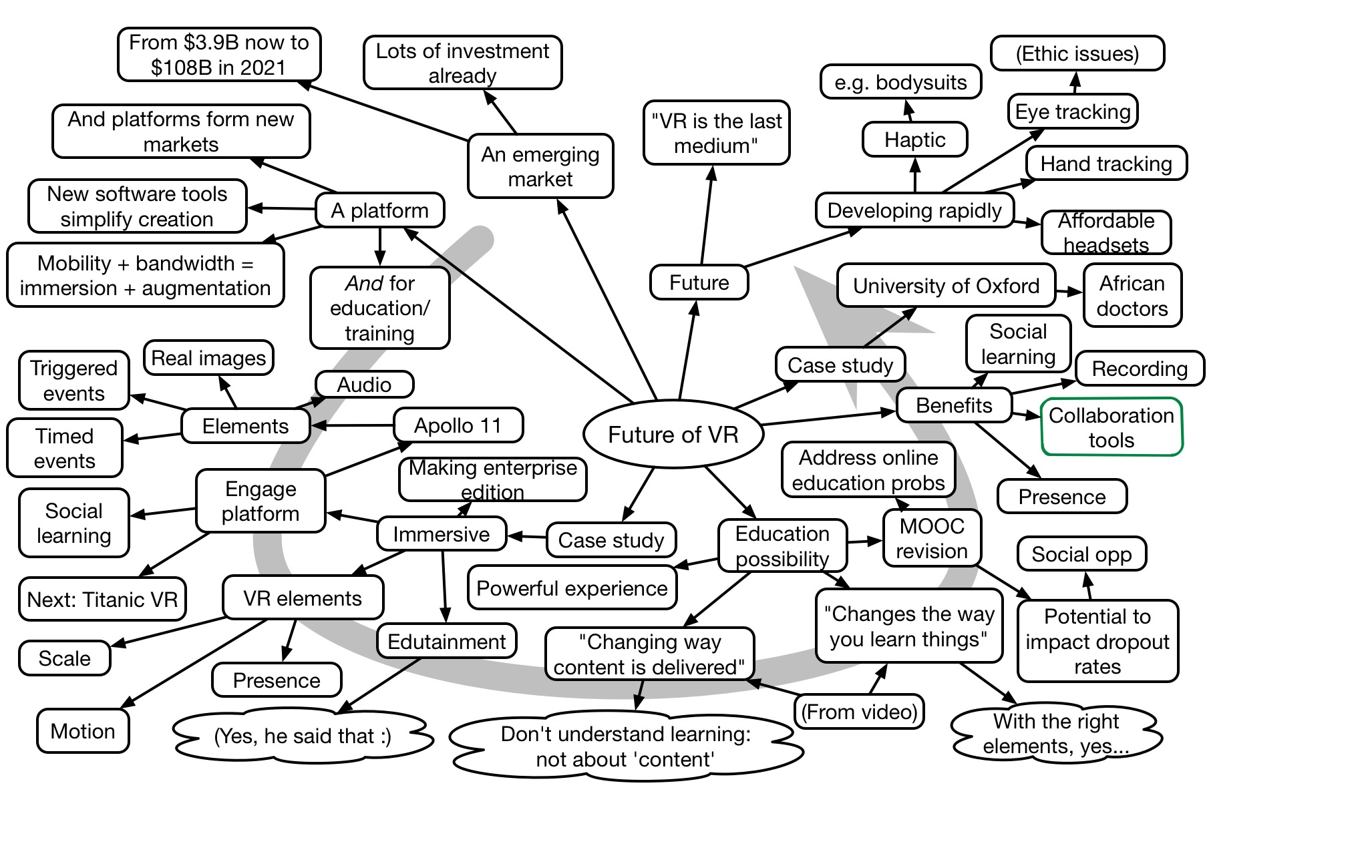


Barry Downes #Realities360 Keynote Mindmap

27 July 2017 by Clark Leave a Comment

Barry Downes talked about the future of the VR market with an interesting exploration of the Immersive platform. Taking us through the Apollo 11 product, he showed what went into it and the emotional impact. He showed a video that talked (somewhat simplistically) about how VR environments could be used for learning. (There is great potential, but it’s not about content.). He finished with an interesting quote about how VR would be able to incorporate any further media. A second part of the quote said:  “Kids will think it’s funny [we] used to stare at glowing rectangles hoping to suspend disbelief.”

VR Keynote

Maxwell Planck #Realities360 Keynote Mindmap

26 July 2017 by Clark 2 Comments

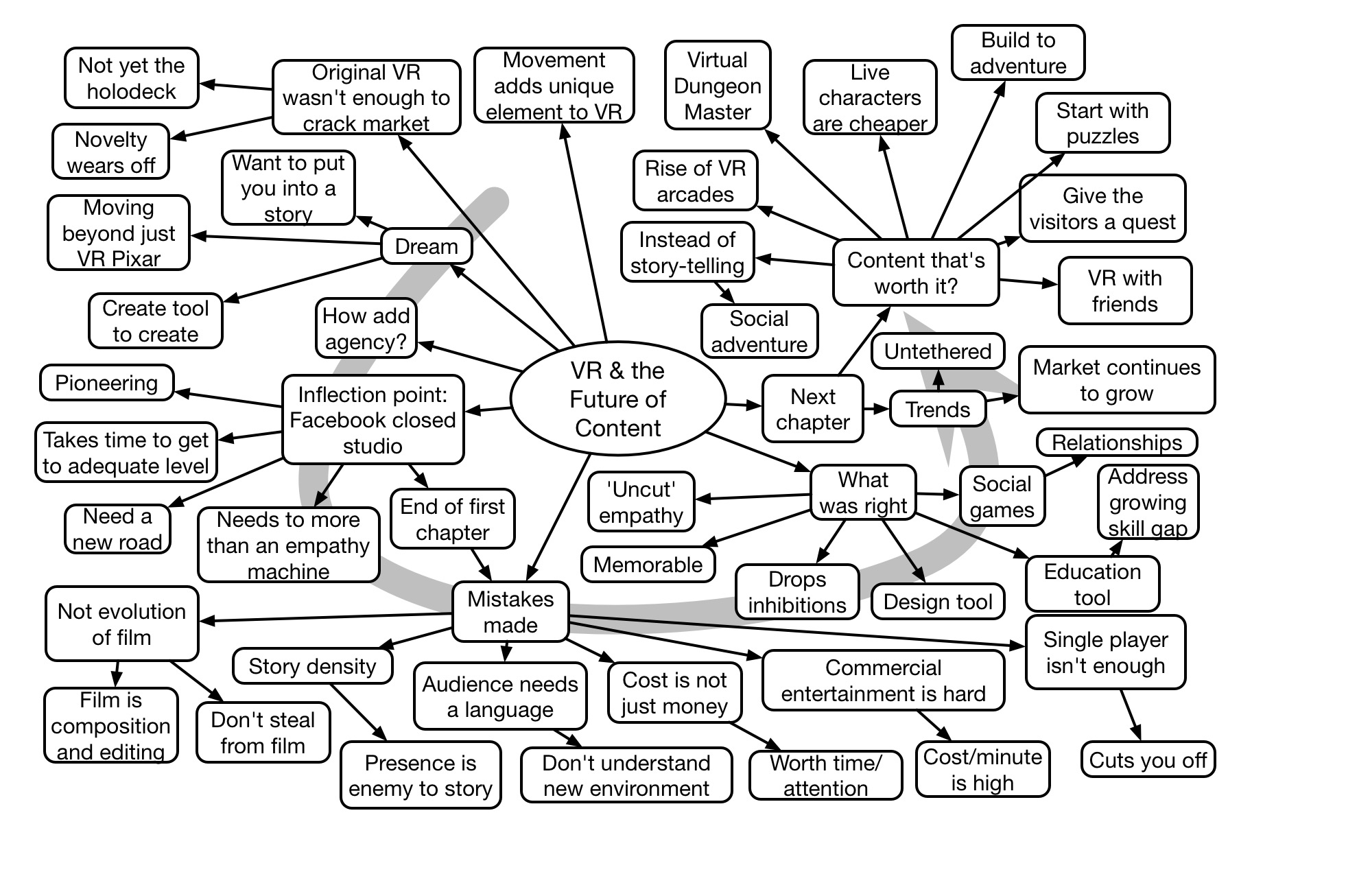
Maxwell Planck opened the eLearning Guild’s Realities 360 conference with a thoughtful and thought-provoking talk on VR. Reflecting on his experience in the industry, he described the transition from story telling to where he thinks we should go: social adventure. (I want to call it “adventure together”. :). A nice start to the event.

Maxwell Planck Keynote Mindmap

What is the Future of Work?

25 July 2017 by Clark Leave a Comment

which is it?Just what is the Future of Work  about? Is it about new technology, or is it about how we work with people?  We’re seeing  amazing new technologies: collaboration platforms, analytics, and deep learning. We’re also hearing about new work practices such as teams, working (or reflecting) out loud, and more.  Which is it? And/or how do they relate?

It’s very clear technology is changing the way we work. We now work digitally, communicating and collaborating.  But there’re more fundamental transitions happening. We’re integrating data across silos, and mining that data for new insights. We can consolidate platforms into single digital environments, facilitating the work.  And we’re getting smart systems that do things our brains quite literally can’t, whether it’s complex calculations or reliable rote execution at scale. Plus we have technology-augmented design and prototyping tools that are shortening the time to develop and test ideas. It’s a whole new world.

Similarly, we’re seeing a growing understanding of work practices that lead to new outcomes. We’re finding out that people work better when we create environments that are psychologically safe, when we tap into diversity, when we are open to new ideas, and when we have time for reflection. We find that working in teams, sharing and annotating our work, and developing learning and personal knowledge mastery skills all contribute. And we even have new  practices such as agile and design thinking that bring us closer to the actual problem.  In short, we’re aligning practices more closely with how we think, work, and learn.

Thus, either could be seen as ‘the Future of Work’.  Which is it?  Is there a reconciliation?  There’s a useful way to think about it that answers the question.  What if we do either without the other?

If we use the new technologies in old ways, we’ll get incremental improvements.  Command and control, silos, and transaction-based management can be supported, and even improved, but will still limit the possibilities. We can track closer.  But we’re not going to be fundamentally transformative.

On the other hand, if we change the work practices, creating an environment where trust allows both safety  and accountability, we can get improvements whether we use technology or not. People have the capability to work together using old technology.  You won’t get the benefits of some of the improvements, but you’ll get a fundamentally different level of engagement and outcomes than with an old approach.

Together, of course, is where we really want to be. Technology can have a transformative amplification to those practices. Together, as they say, the whole is greater than the some of the parts.

I’ve argued that using new technologies like virtual reality and adaptive learning only make sense  after you first implement good design (otherwise you’re putting lipstick on a pig, as the saying goes).  The same is true here. Implementing radical new technologies on top of old practices that don’t reflect what we know about people, is a recipe for stagnation.  Thus, to me, the Future of Work starts with practices that align with how we think, work, and learn, and are augmented with technology, not the other way around.  Does that make sense to you?

Augmented Reality Lives!

20 July 2017 by Clark Leave a Comment

Visually Augmented RealityAugmented Reality (AR) is on the upswing, and I think this is a good thing. I think AR makes sense, and it’s nice to see both solid tool support and real use cases emerging.  Here’s the news, but first, a brief overview of why I like AR.

As I’ve noted before, our brains are powerful, but flawed.  As with any architecture, any one choice will end up with tradeoffs. And we’ve traded off detail for pattern-matching.  And, technology is the opposite: it’s hard to get technology to do pattern matching, but it’s really good at rote. Together, they’re even more powerful. The goal is to most appropriately augment our intellect with technology to create a symbiosis where the whole is greater than the sum of the parts.

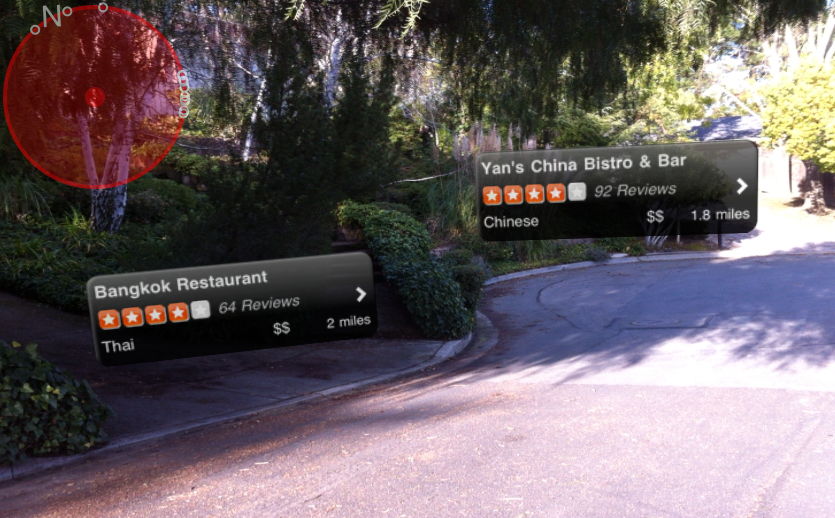
Which is why I like AR: it’s about annotating the world with information, which augments it to our benefit.  It’s contextual, that is, doing things  because  of when and where we are.  AR augments sensorily, either auditory or visual (or kinesthetic, e.g. vibration).  Auditory and kinesthetic annotation is relatively easy; devices generate sounds or vibrations (think GPS: “turn left here”).  Non-coordinated visual information, information that’s not overlaid visually, is presented as either graphics or text (think Yelp: maps and distances to nearby options).  Tools already exist to do this, e.g. ARIS.  However, arguably the most compelling and interesting is the aligned visuals.

Google Glass was a really interesting experiment, and it’s back.  The devices – glasses with camera and projector that can present information on the glass – were available, but didn’t do much because of where you were looking. There were generic heads-up displays and camera, but little alignment between what was seen and what was consequently presented to the user with additional information.  That’s changed. Google Glass has a new Enterprise Edition, and it’s being used to meet real needs and generate real outcomes. Glasses are supporting accurate placement in manufacturing situations requiring careful placement.  The necessary components and steps are being highlighted on screen, and reducing errors and speeding up outcomes.

And Apple has released it’s Augmented Reality software toolkit, ARKit, with features to make AR easy.  One interesting aspect is built-in machine learning, which could make aligning with objects in the world easy!  Incompatible platforms and standards impede progress, but with Google and Apple creating tools for each of their platforms, development can be accelerated. (I hope to find out more at the eLearning Guild’s Realities 360 conference.)

While I think Virtual Reality (VR) has an important role to play for deep learning, I think contextual support can be a great support for extending learning (particularly personalization), as well as performance support.  That’s why I’m excited about AR. My vision has been that we’ll have a personal coaching system that will know where and when we are and what our goals are, and be able to facilitate our learning and success. Tools like these will make it easier than ever.

Accountability and Safety

18 July 2017 by Clark 4 Comments

In much of the discussion about tapping into the power of people via networks and communities, we hear about the learning culture we need. Items like psychological safety, valuing diversity, openness, and time for reflection are up front. And I’m as guilty of this as anyone! However, one other element that appears in the more rigorous discussions (including Edmondson’s Teaming and Sutton & Rao’s  Scaling Up Excellence) is accountability. (Which isn’t to say that it doesn’t appear in other pictures, but it’s certainly not foreground.) And it’s time to address this.

So, the model for becoming agile is creating an environment where people learn, alone  and together.  But it’s informal learning. When you research, problem-solve, design, etc, you don’t know the answer when you start! Yet it’s not like anyone else has the answer, either.  And we know that the output is better when we search more broadly through the possible solution space. (Which is what we’re doing, really.) This means we need diverse inputs to keep us from prematurely converging.  Or searching too narrow a space. We also need also those different voices to contribute, or we won’t get there. And we have to be open to new ideas, or we could inadvertently cut off part of the solution space. We also need time and tools for reflection (hence reflecting out loud).

Typically, the process is iterative (real innovations percolate/ferment/incubate; they aren’t ‘driven’): going away, doing tasks, and returning.  Here,  we need to ensure people  are  contributing, doing the work.  We don’t want to micromanage it, but we do want to assist people because we shouldn’t assume that they’re effective self and social learners.  In short, we can’t squelch the feeling of autonomy to accompany purpose (ala Dan Pink’s Drive), yet the job must get done!

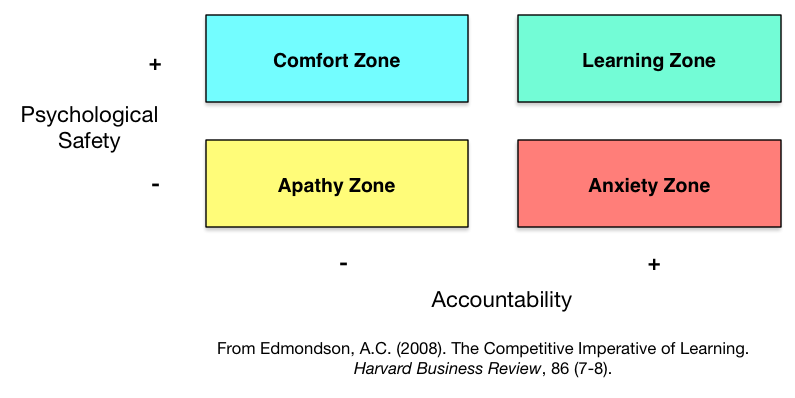
Accountability and SafetyWhen there’s purpose, and community, accountability is natural. When we comprehend how what we’re doing contributes, when we have reciprocal trust with our colleagues that we’ll each do our part, and when there’s transparency about what’s happening, it’s a natural. A transactional model, when it’s a network and not a community, doesn’t feel safe, and doesn’t work as well.  As Edmondson documents it, you want to be in the learning zone where you have both accountability  and safety. And that’s not an easy balance.

So one of the steps to get there is to ensure accountability is part of the picture. And it’s not just calling someone on the carpet. Done right, it’s a tracking and regular support to succeed, so accountability is an ongoing relationship that suggests we  want you to succeed, and we’ll help you do that. Accountability shouldn’t be a surprise! (Transparency helps.)

When we talk about the high-minded principles of making it safe and helping people feel welcome, some can view this as all touchy-feely and worry that it won’t get things  done.  Which isn’t true, but I think it helps if we keep accountability in the picture to assuage those concerns.  Ultimately, we want outcomes, but new and improved ones, not just the same old things. The status quo isn’t really acceptable today. In this increasingly dynamic environment, the ability to adapt is key. And that’s the Learning Zone. Are you ready to go there?

Jay Cross Memorial Award 2017: Marcia Conner

5 July 2017 by Clark 2 Comments

The Internet Time Alliance Jay Cross Memorial Award is presented to a workplace learning professional who has contributed in positive ways to the field of Real Learning and is reflective of Jay‘s lifetime of work. Recipients champion workplace and social learning practices inside their organization and/or on the wider stage. They share their work in public and often challenge conventional wisdom. The Jay Cross Memorial Award is given to professionals who continuously welcome challenges at the cutting edge of their expertise and are convincing and effective advocates of a humanistic approach to workplace learning and performance.

We announce the award on 5 July, Jay‘s birthday. Following his death in November 2015, the partners of the Internet Time Alliance (Jane Hart, Harold Jarche, Charles Jennings, and myself) resolved to continue Jay‘s work. Jay Cross was a deep thinker and a man of many talents, never resting on his past accomplishments, and this award is one way to keep pushing our professional fields and industries to find new and better ways to learn and work.

Marcia Conner, recipient of the Jay Cross Memorial Award

The Internet Time Alliance Jay Cross Memorial Award for 2017 is presented to Marcia Conner. Marcia was an early leader in the movement for individual and social learning, and an innovator. As a Senior Manager at Microsoft, she developed new training practices and wrote an accessible white paper on the deeper aspects of learning design. She subsequently was the Information Futurist at PeopleSoft.  She also served as a co-founder and editor at Learnativity, an early online magazine.

Marcia  co-organized and co-hosted the Creating a Learning Culture conference at the Darden School of Business at the University of Virginia, leading to a book of the same title.  As an advocate for the power of learning, alone and together, she wrote Learn More Now and co-wrote The New Social Learning (now in it‘s second edition) with Tony Bingham of the Association for Talent Development. She also was the instigator who organized the team for the twitter chat #lrnchat, which continues to this day.

Marcia‘s a recognized leader, writing for Fast Company, and keynoting conferences around the world. She currently helps organizations go beyond their current approaches, changing their culture.  She‘s also in the process of moving her focus beyond organizations, to society. In her words, “I‘m in pursuit of meaningful progress, with good faith and honesty, girded by what I know we are capable of doing right now. When we assemble all that is going on at the edges of culture, technology, and (dare I say) business, we find a wildly hopeful view of the future. People doing extraordinary things, on a human scale, that has the potential to change everything for the better.”

Marcia was a friend of Jay‘s for many years (including organizing the creation of his Wikipedia page), and we‘re proud to recognize her contributions.

Helen Blunden was the inaugural award winner in 2016.

An objective request

28 June 2017 by Clark 1 Comment

So, I’d like to ask a favor of you.  I would like to improve my thinking about elearning design, and where this starts are objectives.  Or outcomes. Now, they can be easy, or challenging. I’d like to see some of the latter.

When the goal is fairly obvious, it’s simple to address. They need to be better at doing X?  Well then, practice lots of X! But there are more challenging situations.  You know the ones: weak verbs that aren’t about doing, where the performance is vague, where it’s about knowledge.

I’d like to get concrete. So…

I’d greatly appreciate it if you would share your challenging learning objectives (or outcomes you’re supposed to come up with objectives for) with me.  The ones you dread.  If they’re proprietary, feel free to generify them.  I will also keep you anonymous. Feel free to ask for help, and I’ll respond appropriately.

What will I  do with them?  It depends. These may get written up as a post, if I see themes.  They certainly are likely to be included in any workshops about deeper elearning design. I just want to work from real things, not my made up examples (as fabulous as they might be ;).

Feel free to comment here, or if you see this via LinkedIn or some other channel respond in whatever channel makes the most sense.  Let me know if you’d like a reply.

And thanks in advance.

Nathalie Nahai #FocusOnLearn Keynote Mindmap

21 June 2017 by Clark Leave a Comment

Nathalie Nahai opened the second day of the FocuOn Learning conference. In a rapid fire presentation, she covered 7 principles that engage individuals into behaviors. With clear examples from familiar online experiences, she portrayed how these things work. Admirably, she finished with a call to ethical behavior.

Keynote mindmap

Liza Donnelly #FocusOnLearn Keynote Mindmap

20 June 2017 by Clark Leave a Comment

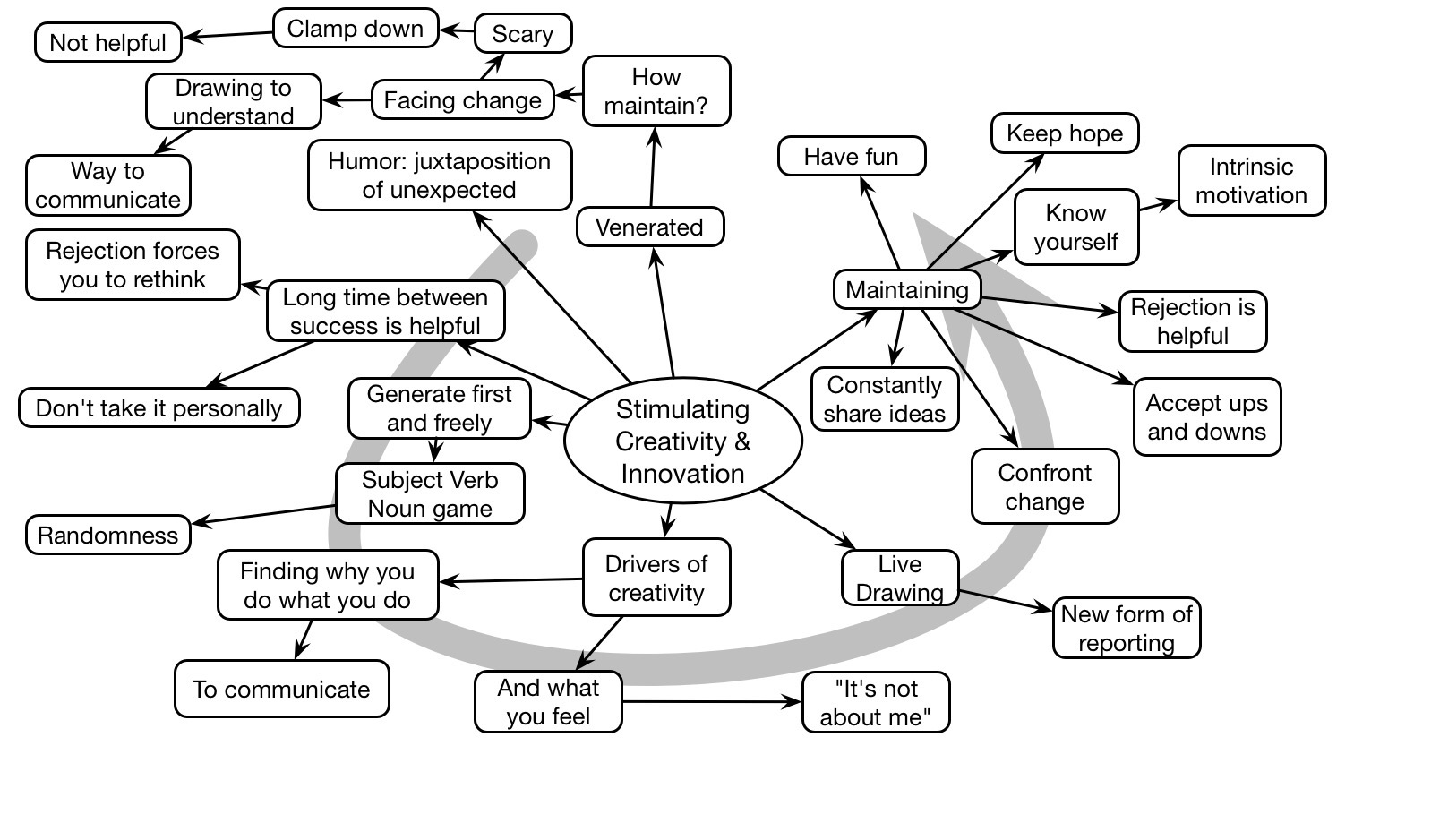
Liza Donnelly opened the FocusOn Learn conference with stories from her career as a cartoonist. With a very personal and compelling story illustrated by her cartoons and some live drawing, she unpacked creativity and innovation. With lessons about commitment and meaning, it was a really nice kickoff to the event.

Keynote Mindmap

« Previous Page
Next Page »

Clark Quinn

The Company

Search

Feedblitz (email) signup

Never miss a post
Your email address:*
Please wait...
Please enter all required fields Click to hide
Correct invalid entries Click to hide

Pages

  • About Learnlets and Quinnovation

The Serious eLearning Manifesto

Manifesto badge

Categories

  • design
  • games
  • meta-learning
  • mindmap
  • mobile
  • social
  • strategy
  • technology
  • Uncategorized
  • virtual worlds

License

Previous Posts

  • March 2026
  • February 2026
  • January 2026
  • December 2025
  • November 2025
  • October 2025
  • September 2025
  • August 2025
  • July 2025
  • June 2025
  • May 2025
  • April 2025
  • March 2025
  • February 2025
  • January 2025
  • December 2024
  • November 2024
  • October 2024
  • September 2024
  • August 2024
  • July 2024
  • June 2024
  • May 2024
  • April 2024
  • March 2024
  • February 2024
  • January 2024
  • December 2023
  • November 2023
  • October 2023
  • September 2023
  • August 2023
  • July 2023
  • June 2023
  • May 2023
  • April 2023
  • March 2023
  • February 2023
  • January 2023
  • December 2022
  • November 2022
  • October 2022
  • September 2022
  • August 2022
  • July 2022
  • June 2022
  • May 2022
  • April 2022
  • March 2022
  • February 2022
  • January 2022
  • December 2021
  • November 2021
  • October 2021
  • September 2021
  • August 2021
  • July 2021
  • June 2021
  • May 2021
  • April 2021
  • March 2021
  • February 2021
  • January 2021
  • December 2020
  • November 2020
  • October 2020
  • September 2020
  • August 2020
  • July 2020
  • June 2020
  • May 2020
  • April 2020
  • March 2020
  • February 2020
  • January 2020
  • December 2019
  • November 2019
  • October 2019
  • September 2019
  • August 2019
  • July 2019
  • June 2019
  • May 2019
  • April 2019
  • March 2019
  • February 2019
  • January 2019
  • December 2018
  • November 2018
  • October 2018
  • September 2018
  • August 2018
  • July 2018
  • June 2018
  • May 2018
  • April 2018
  • March 2018
  • February 2018
  • January 2018
  • December 2017
  • November 2017
  • October 2017
  • September 2017
  • August 2017
  • July 2017
  • June 2017
  • May 2017
  • April 2017
  • March 2017
  • February 2017
  • January 2017
  • December 2016
  • November 2016
  • October 2016
  • September 2016
  • August 2016
  • July 2016
  • June 2016
  • May 2016
  • April 2016
  • March 2016
  • February 2016
  • January 2016
  • December 2015
  • November 2015
  • October 2015
  • September 2015
  • August 2015
  • July 2015
  • June 2015
  • May 2015
  • April 2015
  • March 2015
  • February 2015
  • January 2015
  • December 2014
  • November 2014
  • October 2014
  • September 2014
  • August 2014
  • July 2014
  • June 2014
  • May 2014
  • April 2014
  • March 2014
  • February 2014
  • January 2014
  • December 2013
  • November 2013
  • October 2013
  • September 2013
  • August 2013
  • July 2013
  • June 2013
  • May 2013
  • April 2013
  • March 2013
  • February 2013
  • January 2013
  • December 2012
  • November 2012
  • October 2012
  • September 2012
  • August 2012
  • July 2012
  • June 2012
  • May 2012
  • April 2012
  • March 2012
  • February 2012
  • January 2012
  • December 2011
  • November 2011
  • October 2011
  • September 2011
  • August 2011
  • July 2011
  • June 2011
  • May 2011
  • April 2011
  • March 2011
  • February 2011
  • January 2011
  • December 2010
  • November 2010
  • October 2010
  • September 2010
  • August 2010
  • July 2010
  • June 2010
  • May 2010
  • April 2010
  • March 2010
  • February 2010
  • January 2010
  • December 2009
  • November 2009
  • October 2009
  • September 2009
  • August 2009
  • July 2009
  • June 2009
  • May 2009
  • April 2009
  • March 2009
  • February 2009
  • January 2009
  • December 2008
  • November 2008
  • October 2008
  • September 2008
  • August 2008
  • July 2008
  • June 2008
  • May 2008
  • April 2008
  • March 2008
  • February 2008
  • January 2008
  • December 2007
  • November 2007
  • October 2007
  • September 2007
  • August 2007
  • July 2007
  • June 2007
  • May 2007
  • April 2007
  • March 2007
  • February 2007
  • January 2007
  • December 2006
  • November 2006
  • October 2006
  • September 2006
  • August 2006
  • July 2006
  • June 2006
  • May 2006
  • April 2006
  • March 2006
  • February 2006
  • January 2006

Amazon Affiliate

Required to announce that, as an Amazon Associate, I earn from qualifying purchases. Mostly book links. Full disclosure.

We use cookies to ensure that we give you the best experience on our website. If you continue to use this site we will assume that you are happy with it.