Learnlets

Secondary

Clark Quinn’s Learnings about Learning

Search Results for: align

xAPI conceptualized

1 March 2016 by Clark 6 Comments

A couple of weeks ago, I had the pleasure of attending the xAPI Base Camp, to present on content strategy. While I was there, I remembered that I have some colleagues who don’t see the connection between xAPI and learning.  And it occurred to me that I hadn’t seen a good diagram that helped explain how this all worked.  So I asked and was confirmed in my suspicion. And, of course, I had to take  a stab at it.
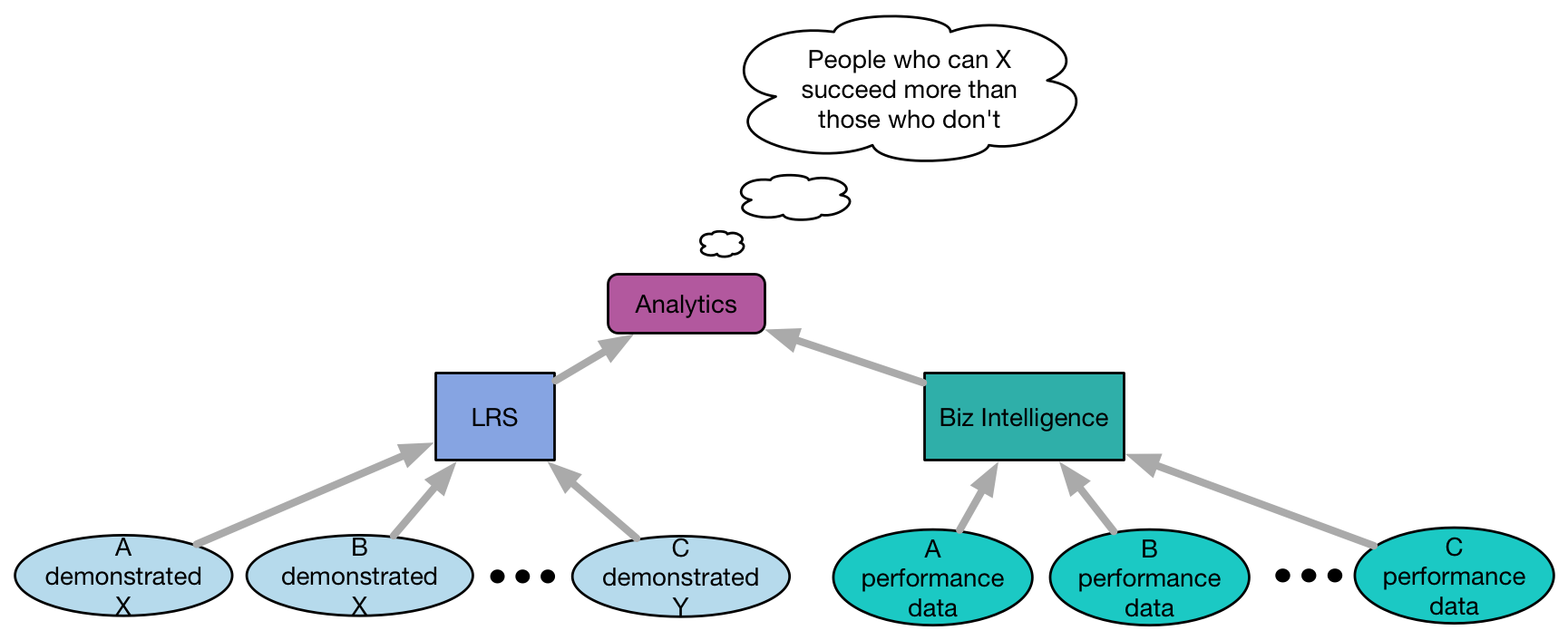
xAPIWhat I was trying to capture was how xAPI tracked activity, and that could then be used for insight. I think one of the problems people have is that they think xAPI is a solution all in itself, but it is just a syntax for reporting.

So when A might demonstrate a capability at a particular level, say at the end of learning, or by affirmation from a coach or mentor, that gets recorded in a Learning Record Store. We can see that A and B demonstrated it, and C demonstrated a different level of capability (it could also be that there’s no record for C, or D, or…).

From there, we can compare that activity with results.  Our business intelligence system can provide   aggregated data of performance for A (whatever A is being measured on: sales data, errors, time to solve customer problems, customer satisfaction, etc). With that, we can see if there are the correlations we expect, e.g. everyone who demonstrated  this level of capability has reliably better performance than those who didn’t.  Or whatever you’re expecting.

Of course, you can mine the data too, seeing what emerges.  But the point is that there are a wide variety of things we might track (who touched this job aid, who liked this article, etc), and a wide variety of impacts we might hope for.  I reckon that you should plan what impacts you expect from your intervention, put in checks to see, and then see if you get what you intended.  But we can look at a lot more interventions than just courses. We can look to see if those more active in the community perform better, or any other question tied to a much richer picture than we get other ways.

Ok, so you can do this with your own data generating mechanisms, but standardization has benefits (how about agreeing that red means stop?).  So, first, does this align with your understanding, or did I miss something?  And, second does this help, at all?
When to gamify?

24 February 2016 by Clark Leave a Comment

I’ve had lurking in my ‘to do’ list a comment about doing a post on  when to gamify. In general, of course, I avoid it, but I have to acknowledge there are times when it makes sense.  And someone challenged me to think about what those circumstances are. So here I’m taking a principled shot at it, but I also welcome your thoughts.

To be clear, let me first define what gamification is  to me.  So, I’m a big fan of serious games, that is when you wrap meaningful decisions into contexts that are intrinsically meaningful.  And I can be convinced that there are times when tarting up memory practice with quiz-show window-dressing makes sense, e.g.  when it has to be ‘in the head’.  What I typically refer to as  gamification, however, is where you use external resources, such as scores, leaderboards, badges, and rewards to support behavior you want to happen.

I happened to hear a gamification expert talk, and he pointed out some rules about what he termed ‘goal science’.  He had five pillars:

  1. that  clear goals makes people feel connected and aligns the organization
  2. that working on goals together (in a competitive sense ;) makes them feel supported
  3. that feedback helps people progress in systematic ways
  4. that the tight loop of feedback is more personalized
  5. that choosing challenging goals engages people

Implicit in this is that you do  good goal setting and rewards. You have to have some good alignment to get these points across.  He made the point that doing it badly could be worse than not doing it at all!

With these ground rules, we can think about when it might make sense.  I’ll argue that one obvious, and probably sad case, would be when you don’t have a coherent organization, and people aren’t aware of their role in the organization.  Making up for effective communication isn’t necessarily a good thing, in my mind.

I think it also might make sense for a fun diversion to achieve a short-term goal. This might be particularly useful for an organizational change, when extra motivation could be of assistance in supporting new behaviors. (Say, for moving to a coherent organization. ;) Or some periodic event, supporting say a  philanthropic commitment related to the organization.

And it can be a reward for a desired behavior, such as my frequent flier points.  I collect them, hoping to spend them. I resent it, a bit, because it’s never as good as is promised, which is a worry.  Which means it’s not being done well.

On the other hand, I can’t see using it on an ongoing basis, as it seems it would undermine the intrinsic motivation of doing meaningful work.  Making up for a lack of meaningful work would be a bad thing, too.

So, I recall talking to a guy many moons ago who was an expert in motivation for the workplace. And I had the opportunity to see the staggering amount of stuff available to orgs to reward behavior (largely sales) at an exhibit happening next to our event. It’s clear I’m not an expert, but while I’ll stick to my guns about preferring intrinsic motivation, I’m quite willing to believe that there are times it works, including on me.

Ok, those are my thoughts, what’ve I missed?

Beyond Consulting

17 February 2016 by Clark 3 Comments

I was at a retreat this weekend, consorting with colleagues. And one of the persistent perceptions of me came up that I was reflecting on, and thought I’d do so ‘out loud’.

So, once consulting became my way of life, I realized I needed to get better at the bits I don’t know.  I’ve got deep theory, and considerable practical experience, but I never was a ‘businessperson’. That is, I didn’t have sales experience, or marketing knowledge, and deal-making. As part of the solution, I found Robert Middleton, who is basically a consultant to help other consultants market themselves.  And I paid attention to his recommendations.

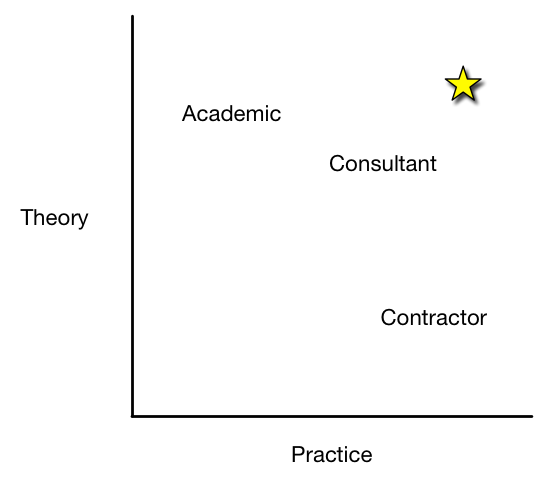
One of the  interesting things was a model he had that pitted your depth of information against your ability to implement.  A high information person was an expert, a high implementation person was a hard worker, (low on both was a salesperson ;), and he suggested your goal was to position yourself as an ‘infoguru’, high on both.

ConsultantI was reminded of it, and realize I see it slightly differently. So I’d put someone high on the theory/information side as an academic or researcher,  whether they’re in an institution or not.  They know the theories behind the outcomes, and may study them, but don’t apply them  . And I’d put someone who can execute against a particular model as a contractor. You know what you want done, and you hire someone to do it.
Then I see consultants in general as those who go beyond contracting to doing analysis up front, and sorting between models to determine which are relevant, and then assist the client to act. And I definitely lump myself in that category, having a very large set of models I draw upon, and lots of experience applying them or developing new ones to help meet real needs.  Creative, yet practical solutions. Reliably.

However…

I was chatting with some colleagues, and their feedback was that while I was perceived highly on the idea side, I didn’t position myself on the expertise side as well.  And it’s true that I talk ideas, models largely, because  they are the frameworks that give you  traction to solve problems. And, of course, more solutions will occur if people have models to use.  I naively believed that showing I knew the models would help assure people that I can assist.  And so, while I develop new and/or useful ones to help frame things so they can be solved,  perhaps I don’t help make clear enough that I also work with people to figure out what models make sense to take them forward.

I don’t talk enough about the projects I’ve worked on, nor the results I’ve had. Sometimes it’s because of confidentiality (you don’t want me talking about your secrets, either). And it can be  hard to talk quantitatively, because too seldom does L&D actually measure what they do, but I’ve helped folks with game  design, mobile strategy, learning process improvement, L&D revolution, and more.  Heck, I had a really good track record while I was  an academic for doing interesting projects developing learning and performance solutions. And so far,  I’ve been feeding the family for 15 years now as a consultant, so I reckon I’m doing something right ;).

Still, I’ll try to do a bit better in linking the two, because I don’t want you to think what I natter on here isn’t directly applicable to improving what you do. I’ve revamped my website a bit, talking about helping at the learning design or strategy level (feedback appreciated).

You’re welcome to attempt improvements  on your own, but if you want assistance in making the move faster with fewer hiccups along the way, I have been assisting  folks for a long time now, and would welcome doing it with you. Whether it’s vendors finally wanting to address better learning design, or organizations looking to go beyond the ordinary, I’m here  to help.  This is what I do!   I find it really rewarding to work with folks and collaboratively generating great outcomes, and I’m looking for more opportunities to assist. So a question for you: am I missing something in helping folks see how I can help them?

Getting pragmatic on what L&D can do

28 January 2016 by Clark 2 Comments

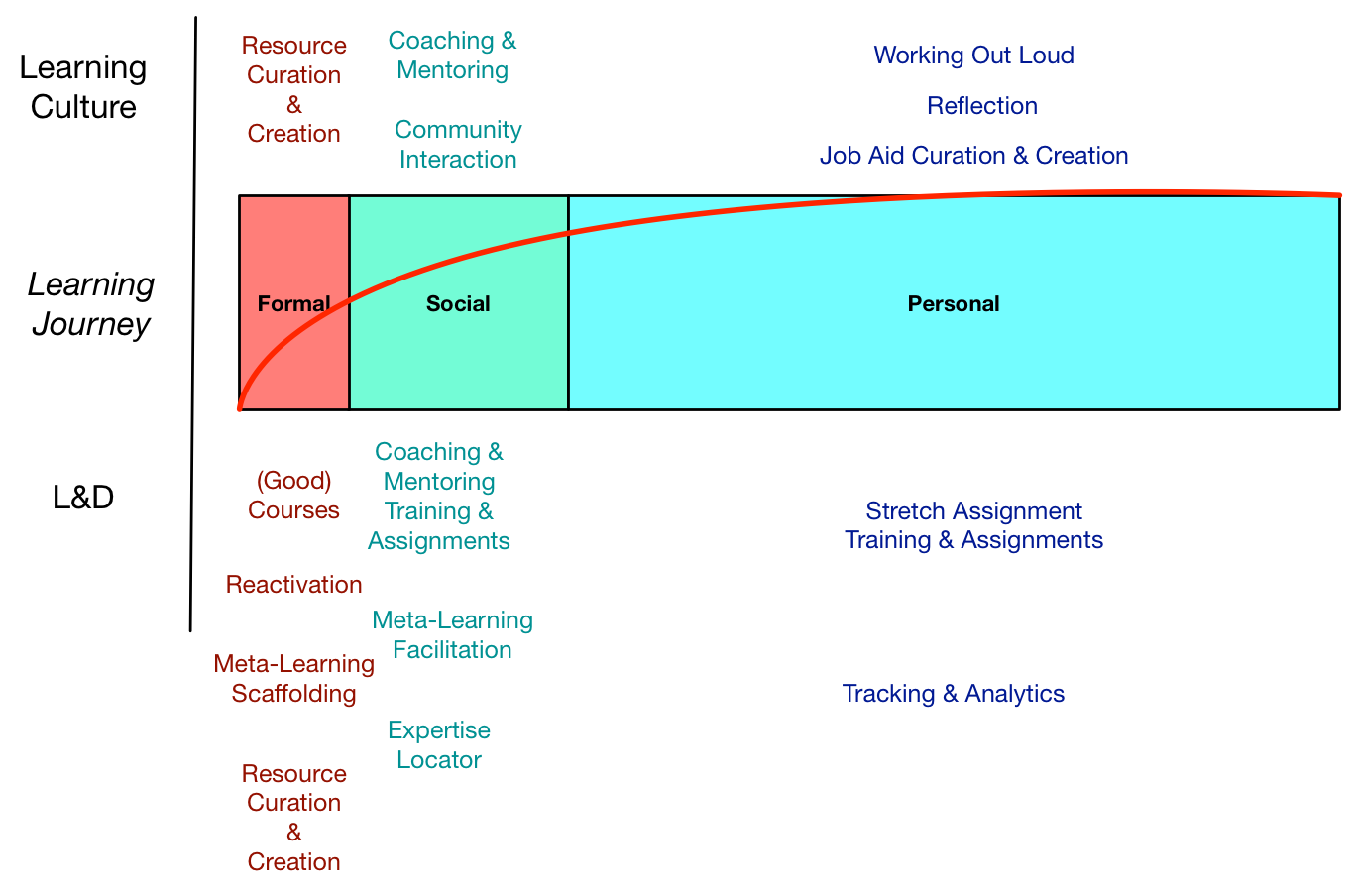
I was inspired by a diagram  that my ITA colleague Harold Jarche included in a post, where he puts some concepts into their 70:20:20 role as either people,  skills, or tools. And I obviously believe the role of L&D should be shifting (as in a full revolution  :), but I realize that putting it together can seem confusing, and so  it led me to think a little bit about what’s the role for L&D versus what’s the role of the community.  As a first cut, as usual.

721Learning Development & CultureMy breakout  starts with the 10 (though you should start your solution thinking with the 70, as my colleague Charles Jennings suggests).  Here I’m seeing what L&D can do, and what should be expected to come from a vibrant learning culture (which is also the role of L&D.

And it’s true that we see the traditional work of courses here (no, we’re not coming for your courses), though of course ones that meet the minimum daily standard of Serious learning, now set by your learning quality evangelists.  And reactivating  the learning, to make it stick.

Another task for L&D  building in meta-learning opportunities and deliberately developing them in addition to whatever domain skills matter. Also, curating (and, occasionally) creating resources for self-study.  If someone wants to learn something, resources before courses  may be a more practical approach, particularly if it’s relatively unique.  And, of course, curation trumps creation.  And on the Culture side, the community should also be curating and creating resources.

Then we segue to the social. Here, the community is taking the role of coaching and mentoring, and the individual is engaging with the community.  However, assuming good coaching and mentoring skills would be a mistake, so there’s a real for L&D to provide explicit development of coaching and mentoring, as well as ensuring that those relationships are established and occur. There’s also a role for facilitating meta-learning, helping folks learn to work out loud and reflect. These are essential components of my colleague Jane Hart’s Modern Workplace Learning. There’s also a role to ensure people can find others with useful expertise to tap into, within or across communities.

Finally, out at the personal end (and don’t think that it really transitions like this, there’s lots of overlap), individual practices are of working out loud and reflecting. The individual  and the community should be building, as well as using, performance support like job aids. L&D can assist by helping ensure that there’s a ‘stretch assignment’ plan, and good rubrics about what constitutes a  good stretch assignment, whether training or job aid.  And, of course, L&D should be looking at what’s happening and looking for opportunities to tune and improve, as well as any emergent phenomena.

Finally, of course, one final role for L&D is to ensure that there  is a learning culture.  This is an important process. Recognize that it’s about a performance ecosystem organized to  facilitate organizational learning at the individual and community level. It’s about having the individual have the tools ‘to hand‘ to continue to develop and perform.  The goal is a coherent organization.

A bit more detail

20 January 2016 by Clark Leave a Comment

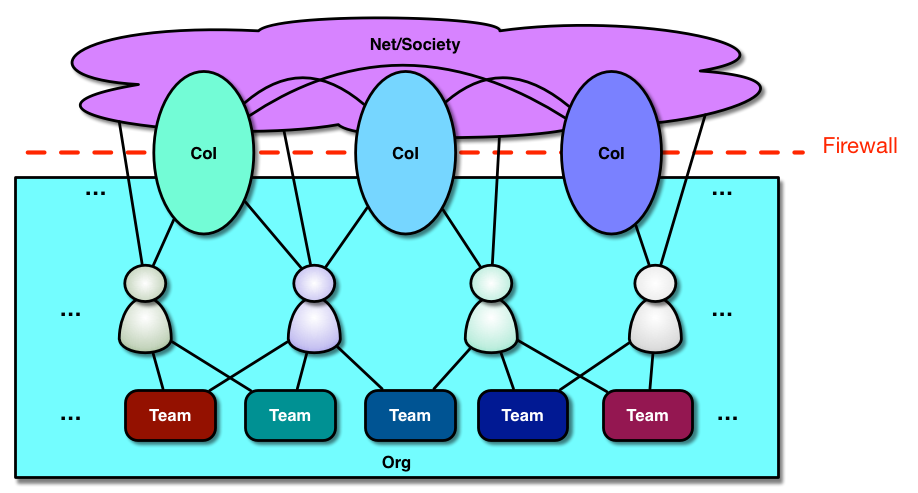
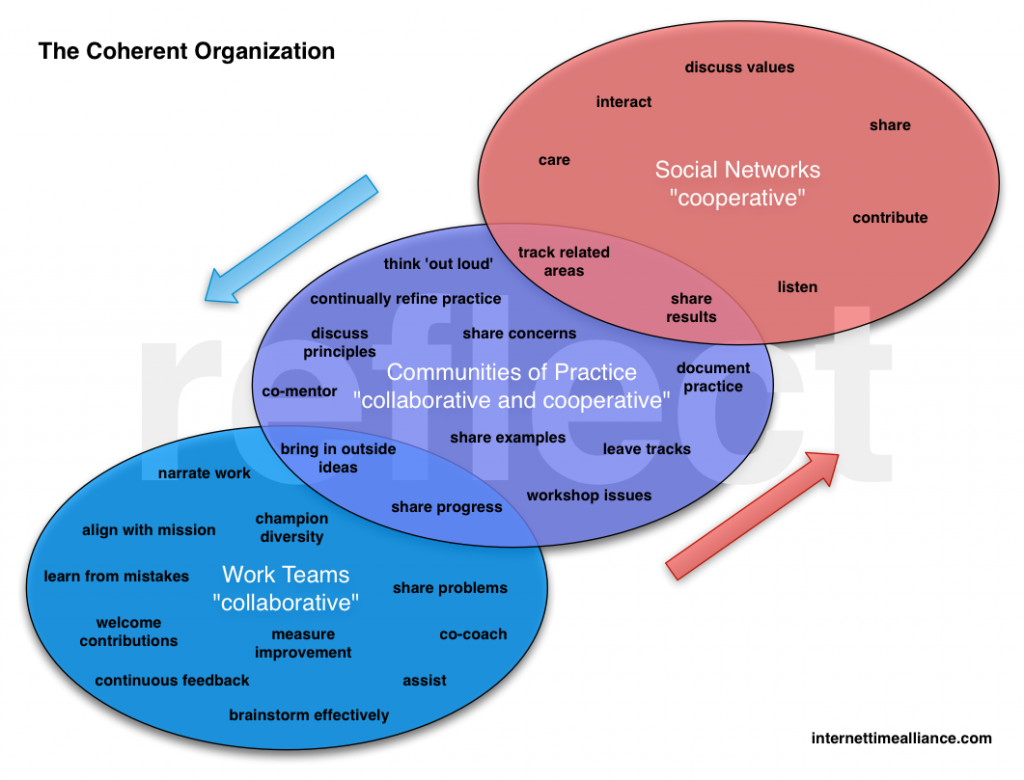
In the Coherent Organization model that we (the ITA) came up with, it talks about how work teams are fed by and feed up to communities as they too feed up to and are fed from social networks.  And while this is all good, it may not be completely clear.  So I tried to take a pass at representing it another way.

OrgStructureSo, at the center are people, the individuals who constitute the organization.  They are the ones who form teams. Ideally, for the most powerful outcomes, they come with different backgrounds, as we know diversity helps.  And they’ll work together in those teams, for short term needs or on an ongoing basis.

Those background are tied into the Communities of Improvement  that they are members of.  A good team member will bring  their community expertise into the team, and likewise feedback their learning from their team work.  Note that most folks are usually members of several communities.

Those communities span both internal to the organization (if it is big enough), but also across the firewall out to other practitioners that are in other organizations.  There are obviously things you can, and can’t, share across the boundaries, but the communities should be continuing to evolve across boundaries.  Proprietary approaches may not, but general learning should be.

And the individuals are, or should be, learning on their own as well, tapping into personal searches inside and outside the organization for immediate needs and ongoing development. Similarly, communities should be looking for ideas and practices from other communities that can be absorbed, and sharing out to other communities as well.

The main change here is showing how people are members of different teams and diverse communities, and how the links are to communities  and to one’s own development.  Not enough, I know (should I show links between people as well), and certainly I’ve got a sparse representation of interconnections here to be indicative, not representative.  Does this help?


Working wiser?

12 January 2016 by Clark Leave a Comment

Noodling:   I’ve been thinking about Working Smarter, a topic I took up over four years ago.  And while I still think there’s too little talk about it, I wondered also about pushing it further.  I also talked in the past about an interest in wisdom, and what that would mean for learning.  So what happens when they come together?

Working smarter, of course, means recognizing how we  really think, work, and learn, and aligning our processes and tools accordingly. That includes recognizing that we  do use external representations, and ensuring that the ones we want in the world are there, and we also support people being able to create their own. It means tapping into the power of people, and creating ways for them to get together and support one another through both communication and collaboration.  And, of course, it means using Serious learning design.

But what, then, does working  ‘wiser’ mean?  I like Sternberg’s model of wisdom, as it’s actionable (other models are not quite specific enough).  It talks about taking into account several levels of  caring about others, several time scales, several levels of action, and all influenced by an awareness of values.  So how do we work that into practices and tools?

Well, pragmatically, we can provide rubrics for evaluation of ideas that include considerations of others inside and outside your circles of your acquaintances, and in short- and long-term timeframes, and the impacts on existing states of affairs, ultimately focusing on the common good. So we can have job aids that provide guidance,  or bake it into our templates.  These, too, can be shown in collaboration tools, so the outputs will reflect these values.  But there’s another approach.

But, at core, it’s really about what you value, and that becomes about culture.  What values does the organization care about?  Do employees know about the organization’s ultimate goal and role?  Is it about short-term shareholder return, or some contribution to society?  I’m reminded about the old statements about whether you’re about selling candles or providing light.  And do employees know how what they do fits in?

It’s pretty clear that the values implicit in  steps to make workplaces more effective are really about making workplaces more humane, that is: respecting our inherent nature.  And movements like this, that provide real meaning, ongoing support, freedom of approach, and time for reflection, are to me about working not just smarter but also wiser.

We can work smarter with tools and practices, but I think we can work better, wiser, with an enlightened approach to who we are working with and how we work to deliver real value to not only customers but to society.  And, moreover, I think that doing so would yield better organizational  outcomes.

Ok, so have I gone off the edge of the hazy cosmic jive?  I am a native Californian, after all, but I’m thinking that this makes real business sense.  I think we can do this, and that the outputs will be better too, in all respects.  No one says it’d be easy, but my suspicion is it’d be worthwhile.

2015 Reflections

31 December 2015 by Clark 3 Comments

It’s the end of the year, and given that I’m an advocate for the benefits of reflection, I suppose I better practice what I preach. So what am I thinking I learned as a consequence of this past year?  Several things come to mind (and I reserve the right for more things to percolate out, but those will be my 2016 posts, right? :):

  1. The Revolution  is real: the evidence mounts that there is a need for change in L&D, and when those steps are taken, good things happen. The latest  Towards Maturity report shows that the steps taken by their top-performing organizations are very much about aligning with business,  focusing on performance, and more.  Similarly, Chief Learning Officer‘s Learning Elite Survey similarly point out to making links across the organization and measuring outcomes.  The data supports the principled observation.
  2. The barriers are real: there is continuing resistance to the most obvious changes. 70:20:10, for instance, continues to get challenged on nonsensical issues like the exactness of the numbers!?!?  The fact that a Learning Management System is not a strategy still doesn’t seem to have penetrated.  And so we’re similarly seeing that other business units are taking on the needs for performance support, social media, and ongoing learning. Which is bad news for L&D, I reckon.
  3. Learning design is  rocket science: (or should be). The perpetration of so much bad elearning continues to be demonstrated at exhibition halls around the globe.  It’s demonstrably true that tarted up information presentation and knowledge test isn’t going to lead to meaningful behavior change, but we still are thrusting people into positions without background and giving them tools that are oriented at content presentation.  Somehow we need to do better. Still pushing the Serious eLearning Manifesto.
  4. Mobile is well on it’s way: we’re seeing mobile becoming mainstream, and this is a good thing. While we still hear the drum beating to put courses on a phone, we’re also seeing that call being ignored. We’re instead seeing real needs being met, and new opportunities being explored.  There’s still a ways to go, but here’s to a continuing awareness of good mobile design.
  5. Gamification is still being confounded: people aren’t really making clear conceptual differences around games. We’re still seeing linear scenarios confounded with branching, we’re seeing gamification confounded with serious games, and more.  Some of these are because the concepts are complex, and some because of vested interests.
  6. Games  seem to be reemerging: while the interest in games became mainstream circa 2010 or so, there hasn’t been a real sea change in their use.  However, it’s quietly feeling like folks are beginning to get their minds around Immersive Learning Simulations, aka Serious Games.   There’s still ways to go in really understanding the critical design elements, but the tools are getting better and making them more accessible in at least some formats.
  7. Design is becoming a ‘thing’: all the hype around Design Thinking is leading to a greater concern about design, and this is a good thing. Unfortunately there will probably be some hype and clarity to be discerned, but at least the overall awareness raising is a good step.
  8. Learning to learn seems to have emerged: years ago the late great Jay Cross and I and some colleagues put together the Meta-Learning Lab, and it was way too early (like so much I touch :p). However, his passing has raised the term again, and there’s much more resonance. I don’t think it’s necessarily a  thing yet, but it’s far greater resonance than we had at the time.
  9. Systems are coming: I’ve been arguing for the underpinnings, e.g. content systems.  And I’m (finally) beginning to see more interest in that, and other components are advancing as well: data  (e.g. the great work Ellen Wagner and team have  been doing on Predictive Analytics), algorithms (all the new adaptive learning systems), etc. I’m keen to think what tags are necessary to support the ability to leverage open educational resources as part of such systems.
  10. Greater inputs into learning: we’ve seen learning folks get interested in behavior change, habits, and more.  I’m thinking we’re going to go further. Areas I’m interested in include myth and ritual, powerful shapers of culture and behavior. And we’re drawing on greater inputs into the processes as well (see 7, above).  I hope this continues, as part of learning to learn is to look to related areas and models.

Obviously, these are things I care about.  I’m fortunate to be able to work in a field that I enjoy and believe has real potential to contribute.  And just fair warning, I’m working on a few areas  in several ways.  You’ll see more about learning design and the future of work sometime in the near future. And rather than generally agitate, I’m putting together two specific programs – one on (e)learning quality and one on L&D strategy – that are intended to be comprehensive approaches.  Stay tuned.

That’s my short list, I’m sure more will emerge.  In the meantime, I hope you had a great 2015, and that your 2016 is your best year yet.

Work with purpose

30 December 2015 by Clark Leave a Comment

As another component of the Future of Work thinking I’ve been doing, one thing that strikes me is the question of what helps people  want to work, which I think pretty clearly will be important.  And I was reminded by my ITA colleague Jane Hart of the work of Dan Pink in his book Drive, where he isolates three components of what makes people engaged: autonomy, mastery, and purpose.  And I think this is a good list.

The idea is fairly straightforward: people want work that actually does something important, they want to be free to pursue that work, and they want to be developed in their ability to accomplish that work.   What work is appropriate for different people is part of the task of deciding who to hire, and who to assign to what.

And while I think autonomy and mastery are part of the picture, for sure, I want to focus on making work  meaningful.  OK, freeing up people from micromanaging is going to be a necessity going forward, but that’s part of the necessary move to agile organizations, and while that’s challenging, it has to happen for organizations to survive. And supporting people by giving them assignments that stretch their abilities, and coaching them through it is absolutely important, but flows out of the 70:20:10 model. Jane, in her valuable book  Modern Workplace Learning, gives very specific  guidance  about managers developing individual potential as part of the larger picture.  But the area that strikes me as something I haven’t developed my thoughts  about before is finding ways to characterize work so that it connects to people.

I think work has to be meaningful (just as I argue learning has to be meaningful). Here I mean something specific, in that people see the connection between what they’re doing and the impact on the world.  And that’s not always done, and certainly not systematically or well.  And yet I think it’s a service to the employees and part of a thriving organization.  Heck, it probably even leads to better employee engagement ;).

Seriously, it first takes an organization that has a clear focus on what it’s doing. There’re the old stories about ice companies losing out when refrigerators came in, and I think that’s part of it: a very clear focus on what purpose they serve. And this is important to align an organization, and make the strategy easier to focus on.  A secondary desirable component, to me, is to understand what contribution the organization is making to the world. I think the ‘b corp‘ notion is a great one here. (I may be an idealist, but that’s the world I  want to live in. ;).

Then, there needs to be a clear alignment between what the employee is doing and the overall organizational goal. I think that if there’s a clear purpose for the work, you have a greater likelihood for employees to be engaged.  No one likes busywork, after all, but even some drudge work that’s part of a bigger picture can be shouldered. And it also means that rote work, work that can be automated,  should be automated, leaving people free to do the important work.   Very much like learning needs to see how the learning connects to their work and the bigger picture, so too should their work connect to the bigger picture, within and outside the org.

Not to say this is easy. It requires clear communication (queue the Coherent Org), and a clear vision, but these are steps organizations need to do.  The recognition that this alignment, coupled with a ‘safe’ culture (i.e. not the Miranda Organization), is the necessity for going beyond survival to ‘thrival’ I think is the catalyst for change in meaningful work. And that’s a good place to go.

#itashare

Working and learning out loud

22 December 2015 by Clark 2 Comments

I’ve been thinking about some of the talk around the Future of Work, and in addition to the free flow of information I recently posted about  from the Coherent Organization, I think working out loud is another component.  Inspired by a post from my colleague ITA Harold Jarche,  this is how I see it, in actionable terms.  (And I expect this is also part of Jane Bozarth’s Show Your Work, but I’ve yet to get my mitts on a copy, mea culpa.)

The point is to make your work visible.  There’re two points: showing the actual goals, progress and status of your work, and showing the thinking that’s going on behind it.  And there are two dimensions: within the organization, and outside the organization.  Pragmatically, this yields some concrete and actionable elements.

First, there have to be mechanisms to share.  Ideally, you don’t have to work and then separately post it, but instead your tools automatically share.  This really means collaborative work tools, because you want people to be able to engage: at least commenting, and of course sometimes (maybe most of the time) you’ll be working in a team. Also tools that track contributions and changes.  And there may have to be permissions: so some people can edit, some can only comment, etc.

And I wouldn’t assume folks know what it means to ‘narrate your work‘ (aka learn out loud).  Here, I mean exposing the underlying elements.  This includes the context, assumptions, considerations, experiments, and reflections.  In User Interface Design, it was called Design Rationale, and it’s showing not only the current state, but how you got there.  Benefits include others’ experiences, not revising early decisions when new team members are added, and more.  The typical techniques of being explicit, modeling, evangelizing, promoting, etc, play a role here.

Then of course it has to be ‘safe’ to share, you can’t be working in a Miranda organization.  If your work will be held against  you in any way, you won’t want to share.  This means culture and policies and more. Basically, you need to be working in a Learning Organization, where the elements are aligned to facilitate optimal engagement.  This includes the practices about how to work out loud and learn out loud.

Another   issue is how far to share.  What can you share outside the organization?  Harold talks about the essential requirement of sharing outside the workplace, and that can be a big concern.  Obviously, proprietary work needs to be protected until it’s not business vulnerable. This means policies about what’s safe to share, and when.  Certainly, ‘sanitized’ work, where critical details are obscured but the thinking is shown should be supported in going out to communities of practice.  And the end result, when the business advantage isn’t threatened, could and should be shared through articles or webinars or conference presentations.

At the end, it’s a risk/reward tradeoff for any project at any time. What’s the benefit of getting feedback to improve versus what’s the downside of information getting out to competitors or exposing regulated data?  At any point, with any particular version of ‘anonymizing’, the balance may tip one way or another.   But the point is to be open to the benefit, and take advantage of it when and where you can.  Getting systematic at making it a regular part of any project is likely to be key.

It’s what I do here, and I encourage you to work out loud as much as you can.  So, any feedback so far?

#itashare

Coherent Implications

17 December 2015 by Clark Leave a Comment

One of the things to do with models is use them as the basis to explain and predict.  And right now I’m working with the Coherent Organization model (which emerged from the work of the ITA) and looking at the implications for decisions.  How does this model map to choices you make in the organization?

Working Collaboratively and cooperativelyThere are three layers: work teams composed of members from different communities of practice, that are connected outward to broader social networks.  An important element is the flow of information within the model; ensuring that there are no barriers to making effective choices.

At the work team level, you want people to be able to communicate with one another effectively, and collaborate to find answers.  While this can occur face to face, you don’t want geography or chronology to be a barrier. So  you want good tools that can represent and support shared understandings. You might also want ways for the team members to find out more about each other, via profiles.  The members of the teams should be bringing in their understandings from their communities, but also be free to ask questions of their community in case their understandings aren’t sufficient. And of course they should share their learnings back with the community.

This latter naturally implies good communication and collaboration tools as well, but here the community is not only within the organization, but outside as well.  There certainly will be internal sites for the community with proprietary information and tools, but there also needs to be participation in the broader discussion. Just as you (should) go to conferences to share with colleagues not in your workplace, so too should you be participating in online communities. The learning should be ongoing.  This also implies that there needs to be an effective way to go beyond the intranet. You get security concerns here, but you need to find a balance, or you’re cutting off half of the organizational brain!  Team members should be asking questions of the internal and external communities (as appropriate, and policies about what’s allowed to be discussed, even if it’s just “don’t be an idiot”are fair enough), and answering them in turn.

And, of course, the community should be observing related communities of practice inside and out, and sharing their own learnings.  For example for learning design there’s a need to track developments in fields like software engineering (e.g. ‘agile methods’), design in general and specific design like game, graphic, interface, etc, sociology, anthropology, psychology, neuroscience, and more.

Decisions, then, are about how to facilitate the most optimal flow of information without compromising organizational integrity.  Realize, of course, that except in extreme cases, these folks will have mobile devices, so in some sense you can’t really block their queries, but you really don’t want to anyway.  Yes, you lock up the data you have to protect, by law or  responsibility, but other than that you try to support communication that can advance the organization.  It’s about policies and technologies  (and of course culture, but that’s another story).

As always, so what am I forgetting?

#itashare

« Previous Page
Next Page »

Clark Quinn

The Company

Search

Feedblitz (email) signup

Never miss a post
Your email address:*
Please wait...
Please enter all required fields Click to hide
Correct invalid entries Click to hide

Pages

  • About Learnlets and Quinnovation

The Serious eLearning Manifesto

Manifesto badge

Categories

  • design
  • games
  • meta-learning
  • mindmap
  • mobile
  • social
  • strategy
  • technology
  • Uncategorized
  • virtual worlds

License

Previous Posts

  • March 2026
  • February 2026
  • January 2026
  • December 2025
  • November 2025
  • October 2025
  • September 2025
  • August 2025
  • July 2025
  • June 2025
  • May 2025
  • April 2025
  • March 2025
  • February 2025
  • January 2025
  • December 2024
  • November 2024
  • October 2024
  • September 2024
  • August 2024
  • July 2024
  • June 2024
  • May 2024
  • April 2024
  • March 2024
  • February 2024
  • January 2024
  • December 2023
  • November 2023
  • October 2023
  • September 2023
  • August 2023
  • July 2023
  • June 2023
  • May 2023
  • April 2023
  • March 2023
  • February 2023
  • January 2023
  • December 2022
  • November 2022
  • October 2022
  • September 2022
  • August 2022
  • July 2022
  • June 2022
  • May 2022
  • April 2022
  • March 2022
  • February 2022
  • January 2022
  • December 2021
  • November 2021
  • October 2021
  • September 2021
  • August 2021
  • July 2021
  • June 2021
  • May 2021
  • April 2021
  • March 2021
  • February 2021
  • January 2021
  • December 2020
  • November 2020
  • October 2020
  • September 2020
  • August 2020
  • July 2020
  • June 2020
  • May 2020
  • April 2020
  • March 2020
  • February 2020
  • January 2020
  • December 2019
  • November 2019
  • October 2019
  • September 2019
  • August 2019
  • July 2019
  • June 2019
  • May 2019
  • April 2019
  • March 2019
  • February 2019
  • January 2019
  • December 2018
  • November 2018
  • October 2018
  • September 2018
  • August 2018
  • July 2018
  • June 2018
  • May 2018
  • April 2018
  • March 2018
  • February 2018
  • January 2018
  • December 2017
  • November 2017
  • October 2017
  • September 2017
  • August 2017
  • July 2017
  • June 2017
  • May 2017
  • April 2017
  • March 2017
  • February 2017
  • January 2017
  • December 2016
  • November 2016
  • October 2016
  • September 2016
  • August 2016
  • July 2016
  • June 2016
  • May 2016
  • April 2016
  • March 2016
  • February 2016
  • January 2016
  • December 2015
  • November 2015
  • October 2015
  • September 2015
  • August 2015
  • July 2015
  • June 2015
  • May 2015
  • April 2015
  • March 2015
  • February 2015
  • January 2015
  • December 2014
  • November 2014
  • October 2014
  • September 2014
  • August 2014
  • July 2014
  • June 2014
  • May 2014
  • April 2014
  • March 2014
  • February 2014
  • January 2014
  • December 2013
  • November 2013
  • October 2013
  • September 2013
  • August 2013
  • July 2013
  • June 2013
  • May 2013
  • April 2013
  • March 2013
  • February 2013
  • January 2013
  • December 2012
  • November 2012
  • October 2012
  • September 2012
  • August 2012
  • July 2012
  • June 2012
  • May 2012
  • April 2012
  • March 2012
  • February 2012
  • January 2012
  • December 2011
  • November 2011
  • October 2011
  • September 2011
  • August 2011
  • July 2011
  • June 2011
  • May 2011
  • April 2011
  • March 2011
  • February 2011
  • January 2011
  • December 2010
  • November 2010
  • October 2010
  • September 2010
  • August 2010
  • July 2010
  • June 2010
  • May 2010
  • April 2010
  • March 2010
  • February 2010
  • January 2010
  • December 2009
  • November 2009
  • October 2009
  • September 2009
  • August 2009
  • July 2009
  • June 2009
  • May 2009
  • April 2009
  • March 2009
  • February 2009
  • January 2009
  • December 2008
  • November 2008
  • October 2008
  • September 2008
  • August 2008
  • July 2008
  • June 2008
  • May 2008
  • April 2008
  • March 2008
  • February 2008
  • January 2008
  • December 2007
  • November 2007
  • October 2007
  • September 2007
  • August 2007
  • July 2007
  • June 2007
  • May 2007
  • April 2007
  • March 2007
  • February 2007
  • January 2007
  • December 2006
  • November 2006
  • October 2006
  • September 2006
  • August 2006
  • July 2006
  • June 2006
  • May 2006
  • April 2006
  • March 2006
  • February 2006
  • January 2006

Amazon Affiliate

Required to announce that, as an Amazon Associate, I earn from qualifying purchases. Mostly book links. Full disclosure.

We use cookies to ensure that we give you the best experience on our website. If you continue to use this site we will assume that you are happy with it.