Learnlets

Secondary

Clark Quinn’s Learnings about Learning

Search Results for: align

Social Cognitive Processing

6 September 2011 by Clark 4 Comments

In an earlier post, I tried to convey the advantages of social activities in formal learning from the cognitive processing perspective, but my diagram apparently didn’t work for everyone.  I took another shot for a presentation I gave on mobile social at the Guild’s mLearnCon, and I thought I’d raise it here as well.
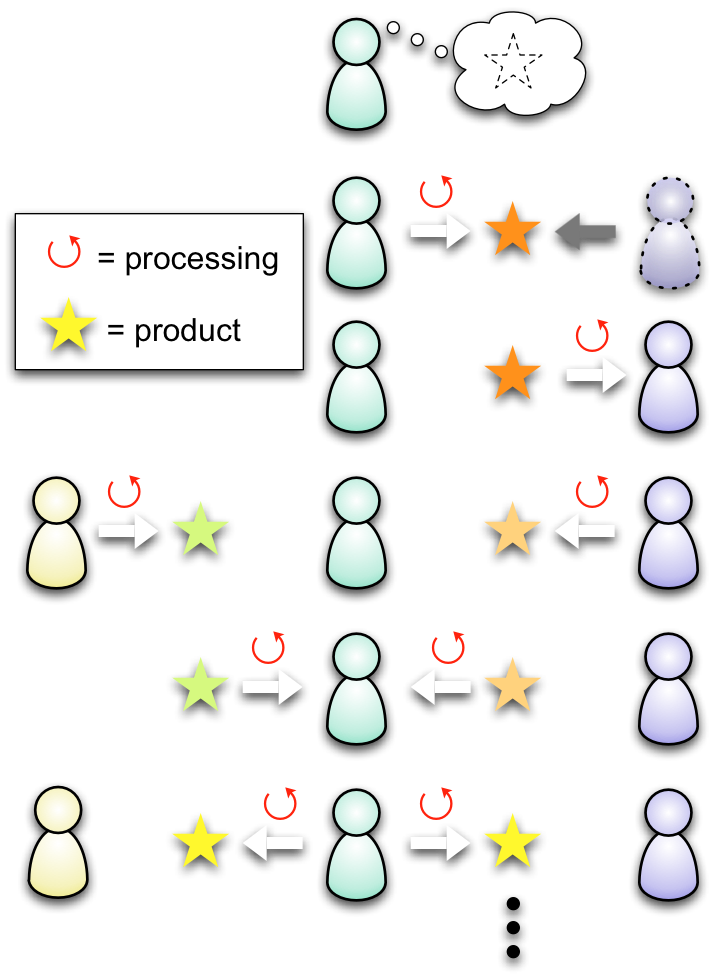
Cognitive reprocessing via social interactionI’m going through this diagram line by line, from the top.

If you go from just having an idea (first line) to trying to capture it as a product (next), whether a diagram or a screed, to communicate to some hypothetical reader, you find out that you might not have thought it out fully (the first benefit to having a personal journal, e.g. blogging).  And you do some processing to generate that product.

Then, if someone actually reads it, they  do some processing.

If they write a response, they do more processing to crystalize their thoughts.

Then, the author, when reading it, also does some more processing.

If someone else reads it, that person does some processing, and if they write  a comment, well, the process continues.

The author could then write a reply to one or both, and that causes even  more  processing. And so on.

And this is good.  Processing is part of learning, and focused processing is part of good learning design.  So, having learners capture and communicate their thoughts is a valuable learning activity.  It can be personal reflections, e.g. “what does this explain in my past” or “what will I do differently in the future”, or responses to a question.

If other learners are asked to read and constructively  comment (not just “great post”), you can get valuable learning outcomes.
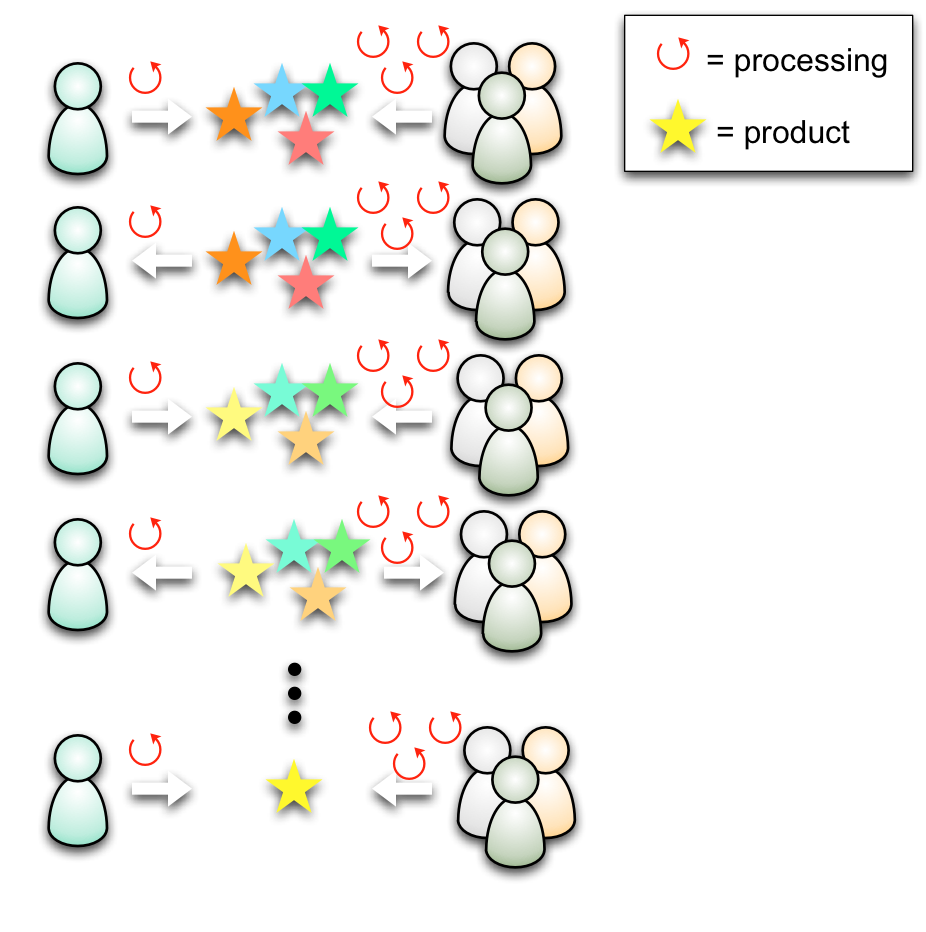
Cognitive processing in group assignmentsThis extends to the social learning situation. Here, you have every learner contribute their initial  thoughts on a group assignment (recommended).

Then, every learner reads the other proposals, and they start to put out their integrated ideas.

As they negotiate a shared understanding as a group response, some great processing is happening.

Ultimately, they create an outcome that’s richer than what they’d create on their own.

If you’ve created the right  amount of ambiguity in the project, you’ll get some great discussions.  The processing benefits here are because the learners will bring somewhat different interpretations and experiences to the project, and that diversity allows a mre robust understanding to emerge.

Consequently, I suggest that social learning adds benefits to the learning experience beyond what individual assignments can achieve. You can mimic some of these effects by staging additional information, but it’s not quite as effective as individual learning (nor near as engaging).

So, does this make sense?  And, hopefully, inspire you to find ways to add social interaction into your learning experiences? It’s not unique to social media, but social media give you a channel to bring these benefits to learning whenever and wherever.


Immersion or collaboration?

25 August 2011 by Clark 2 Comments

In something I’ve just been involved in, I realized I had a question.  I’m a fan of scenarios (read: serious games), to the point that I’ve written a book about how to design them!  I’m also a fan of social learning, and consequently argue for the benefits of collaborative assignments.  They both have the opportunity for powerful outcomes.  The question, naturally, is which makes sense when?

This is an important question, to the point that I’ve recommended it as a critical hiring criteria: that a candidate can not only articulate when you should do which, but also articulate how to do both.  Really, if you’re responsible for learning design, you need to go farther: when would you use scenarios, role-plays, or collaborative assignments?  How would you capitalize on the experience, formatively?  How would you design such a practice?

This gets into not only your pedagogical philosophy, but also your meta-cognitive ability.  Before you read my answer, take a moment and think: what’s my answer?  Seriously: what is your answer?

In short. my take is on the nature of the task the learners will be performing in the real world. Will they be performing individually, or will they be working as a member of a team?    There are processing differences (I do recommend that there is collaborative reflection after an individual learning scenario, to get meaningful processing).  Regardless, the core nature of the real world task should be closely aligned to the practice situation. If they’ll perform alone, make it a scenario. If they’ll work in a group, make it  a collaborative task, or a multi-player scenario/role-play.

Regardless, it’s worth checking: who’s your audience, what are your learning goals, and what is the most appropriate practice.  So: immersion, or collaboration?

Quick mobile thoughts

27 June 2011 by Clark Leave a Comment

SIM card vending machine

It’s obvious that mobile is booming, as you can tell from this shot taken as I deplaned at Heathrow Airport on my way from  mLearnCon conference to an engagement.  It made me reflect on an interesting tension that emerged at the conference.  The resolution will happen, so it’s a question of when, not if, but it’s still a pain.

I was honored to be part of a closing panel with some very clever folks (Bill Rankin, David Metcalf, Carmen Taran, Jim Box, and Richard Culatta, to be specific) responding to crowd-sourced questions.  Paul Clothier served as ringmaster, and the highest rated questions were lobbed at us.

One of the emergent themes was considering what would be really innovative mobile learning applications.  We imagined things from individual coaches to universal teachers.  All this requiring, of course, a pretty robust infrastructure.

And of course, as I sit in an airport (awaiting the 3rd and final leg of which Heathrow was the first), and recognizing that I can’t use the data plan on my phone for fear of penury, I’m still quite frustrated with the situation.  However, there is hope.

advert for a ubiquitous data package

On the wall right next to the vending machine, which I also captured, is one solution.  Here, Vodafone is offering Brits mobile internet when they travel, at a very favorable rate. This is better than the solution I thought was possible: having a service at an airport where you hire a personal wifi device for some reasonable rate of $10 a day or something that you return when you finish your trip.

My traveling companion on the post-US legs (and Internet Time Alliance colleague), Charles Jennings, resides in the UK and said that the competition between providers supports this sort of offer.   £2 is far better than the rate I was hoping for, and way better than a $1 – $20 per MB that is my current option.

Unlike some who worry that we might lose thinking skills, I’m quite happy to devolve certain tasks to my external brain, and only retain the ones I wish to keep for myself.  And once I’ve become so enabled, it’s painful to do without.  I’m glad to see some are getting viable solutions, and hoping I’ll have one soon too.  So we can come up with even more fabulous ways to accessorize our brains. Which is what we want to do!


Amber MacArthur #mLearnCon Keynote Mindmap

22 June 2011 by Clark 1 Comment

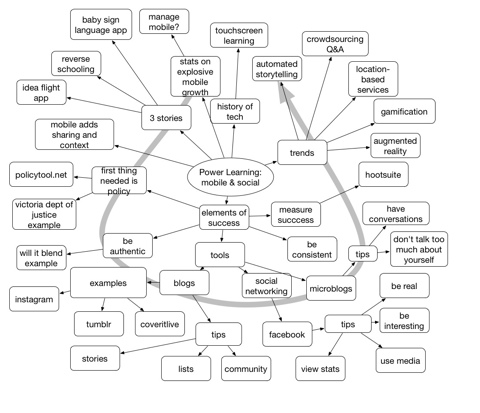
This morning’s mLearnCon keynote was by journalist Amber MacArthur. She talked about the intersection of mobile and social, though mostly talking the social side. Definitely a fun presentation with lots of humorous examples.

20110622-094603.jpg

Jeremiah Owyang mLearnCon keynote mindmap

21 June 2011 by Clark 2 Comments

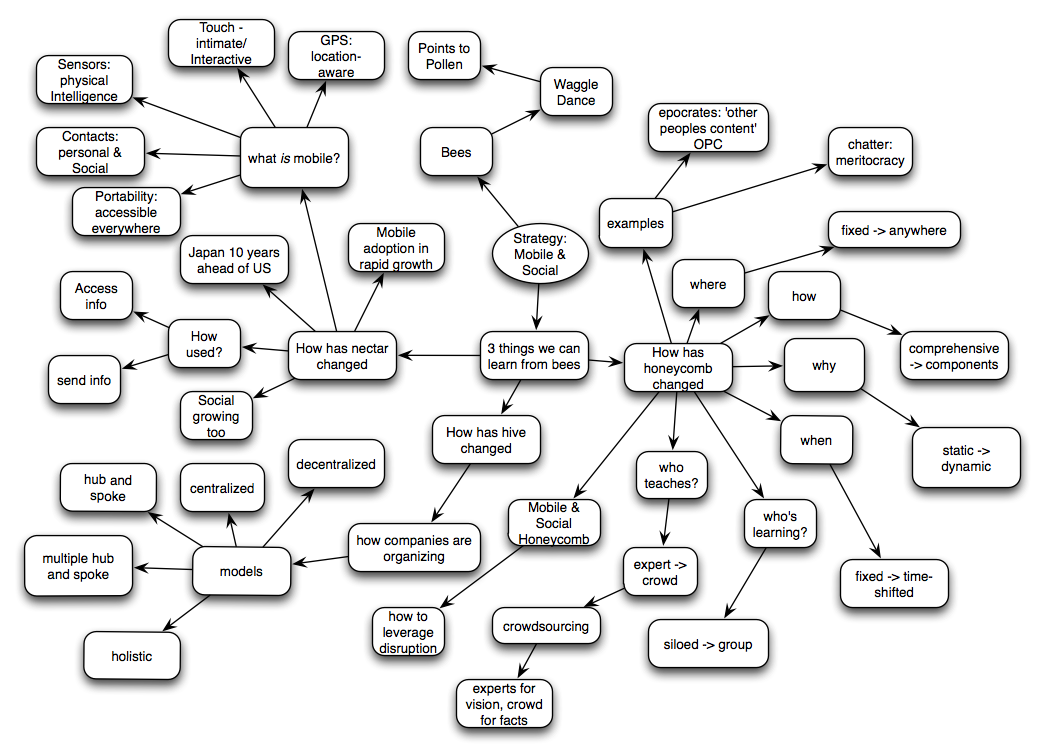
Jeremiah Owyang, analyst at Altimeter, keynoted the opening day of the eLearning Guild’s mLearnCon conference.  He talked about the intersection of mobile and social, talking mobile definitions, organizational structures, and core transitions, using a metaphor of bees.

Integration (or not)

14 June 2011 by Clark 1 Comment

I’ve recently been asked about what industries are leading in the use of (choose one: mobile, games, social).  And, in my experience, while there are some industries (medicine in mobile, for example), it’s more about who’s enlightened enough yet.  Which made me think a little deeper about what I do, and don’t see.

What I do see are pockets of innovation. This company, or this manager, or this individual, will innovate in a particular area.  Chris Hoyt has innovated in social learning for recruitment for PepsiCo, and is now branching out into mobile.  One company will do games, another mobile, another social. And that’s ok as a starting point, but there’s more on the table.  You want to move from tactics to strategy.

Performance EcosystemI want to suggest it’s better if someone higher up sees that tying the elements together into a coherent system is the larger picture.  You don’t just want the individual tactics, but you want to see them as steps towards the larger picture.  At the end of  the day, you want your systems tied together in the back end, providing a unified environment for performance for the individual.  And that takes a view of where you’re going, and the appropriate investment and experimentation.

I recall (but not the link, mea culpa) a recent post or article talking about the lack of R&D investment in the learning space (let me add, the performance space overall).  That is, folks aren’t deliberately setting aside monies to fund some experimentation around learning.  Every learning unit should be spending 3-5% of the budget on R&D.  Is that happening?  If so, it’s not obvious, but I’m happy to be wrong.

I really struggle to find an organization that I think is getting on top of this in a systematic way: that has realized the vision, is aligning tactics to organizational outcomes, and is looking to integrate the technologies in the backend to capitalize on investment in content systems, social media systems, portal technologies, and learning management systems.  This can also be customer-facing as well, so that you’re either meeting customer learning needs around other products or services, or delivering learning experiences as a core business, but still doing so in a coherent, comprehensive, and coordinated approach.

I am working with some folks who are just starting out, but I think the necessity to link optimal execution with continual innovation is going to require much more thorough efforts than I’m yet seeing.  Am I missing someone?  While I love to hear about exemplary individual efforts, I’d really like to hear from those who are pulling it all together as well.

Chris Dede Keynote Mindmap

8 June 2011 by Clark 1 Comment

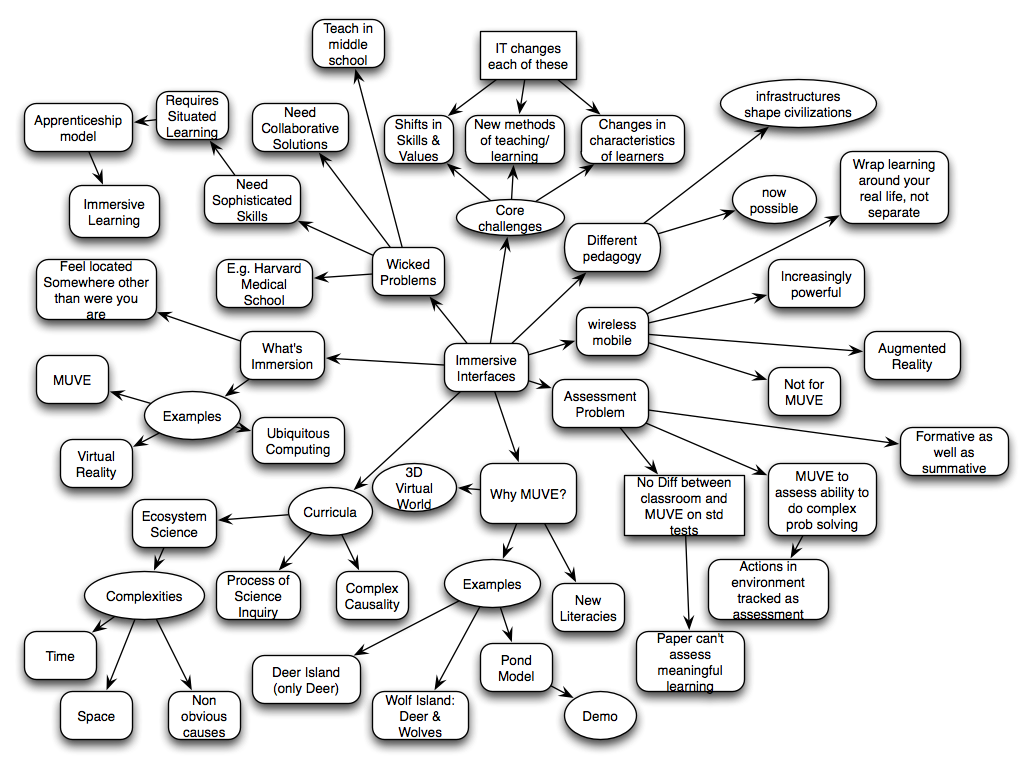
Chris Dede opened the Innovations in eLearning keynote with a speech that very much resonated with me and reflected things I’ve been blogging about here since Learnlets started, but has had the opportunity to build.  His closing comment is intriguing: “infrastructures shape civilization”.

He talked about teaching skills to deal with wicked problems and developing new literacies, using MultiUser Virtual Environments.

Engagification

24 May 2011 by Clark 11 Comments

The latest ‘flavor of the month’ is so-called gamification. Without claiming to be an expert in this area (tho’ with a bit of experience in game design), I have to say that I’ve some thoughts both positive and negative on this.

So what is ‘gamification’? As far as I can tell, it’s the (and I’m greatly resisting the temptation to put the word ‘gratuitous’ in here :) addition of game mechanics to user experiences to increase their participation, loyalty, and more. Now, there are levels of game mechanics, and I can see tapping into some deeper elements, but what I see are relatively simple things like adding scoring, achievements (e.g. badges), etc.   A colleague of mine who released a major learning game admitted that they added score at the end to compensate for the lack of ability to tune further and needing to release to appease investors. I get it; there are times that adding in gamification increases bottom lines in meaningful ways. But I want to suggest that we strive a little bit higher.

In Engaging Learning, I talked about the elements that synergistically lead to both better effectiveness of education practice, and more engaging experiences. These weren’t extrinsic like ‘frame games’ (tarted-up drill-and-kill), but instead focused on aligning with learner interests, intrinsic elements of the task, and more. This means finding out what drives experts to find this intriguing, a role that learners can play that’s compelling, meaningful decisions to make, appropriate level of challenges, and more. That’s what I’m shooting for.

The benefits of intrinsic motivation instead of extrinsic have been studied since the late 70’s in work by Tom Malone and Mark Lepper. In short, you get better outcomes when people are meaningfully engaged rather than trivially engaged. Dan Pink’s book Drive lays out a wealth of related research that suggests we need to avoid rewards for rote performance and instead should be focusing on helping folks do real tasks. I can’t remember where I first heard the term ‘engagification’, but that’s just what I’m thinking of.

To me, it’s the right way take gamification, focus on intrinsic motivation. If we’re gamifying, we’re covering up for some other deficiency, I reckon. Yes, there may be times that intrinsic motivation is hard to find (e.g. to get fit), but that probably means we haven’t tried hard enough yet. I recall recently hearing about gamifying kids math problems; yes, but rote problems are the wrong thing to drill. Can’t we find the intrinsic interest in math, solving real problems (like the ones they’ll see in the real world, not on tests)?  I reckon we could, and should. It would take more effort initially, but the payoff ought to be better.

Perhaps gamify if you have to, but only after you’ve first tried to engagify. Please.

eLearning Guild Mobile Learning Research Report now available

19 May 2011 by Clark Leave a Comment

I’ve had my head down on a couple of projects, but I can now announce one of them: the eLearning Guild’s Mobile Learning Research Report is now available. This is a timely release to help set the context for their upcoming mLearnCon mlearning conference.  (And, yes, I’m speaking, running a pre-conference workshop, all the usual. :)

In it, I review the latest trends in the mobile market, and then synthesize the results of the Guild’s member surveys.  Here’s the marketing blurb:

Mobile learning is not just a fad. It is instead a transformative opportunity both for learning, and the learning organization. Mobile learning means both augmenting formal learning, and moving to performance support, informal, and social learning as well. If you have not yet done so, it is now both possible and desirable to put in place a mobile experiment to create an mLearning strategy articulated with the overall learning, performance, and technology strategy.

The actual implementation of mLearning is growing faster in some capabilities than others. According to eLearning Guild research data collected from thousands of members worldwide, the use of mLearning for social networking and communication is more prevalent than it is for the development of custom applications, with 38.1% of organizations either implementing, designing, or building the business case for social networking and only 25.7% for custom application development.   Of those who have conducted an mLearning implementation, 50% are seeing positive returns.

In this report, author Clark Quinn begins his examination of mobile learning by establishing a foundation with some context and a discussion of devices and major categories of application. Clark then analyzes eLearning Guild research data about how people are currently using mobile, and discusses implementation issues, before taking a look to the future.

The report is free for all paid members of the eLearning Guild, with plenty of other benefits.  Check it out.

Alternate Pedagogies and Experiences

18 May 2011 by Clark 4 Comments

In writing about mobile for higher education, other than meeting learner administrative and information needs, I obviously focused more on the formal learning roles mobile devices could facilitate.  And one of the things that has been of interest to me is looking differently at pedagogies.

Traditional

In the traditional view, we activate the learner’s interest, we present them with the concept, we provide examples, we have them practice (with feedback), and we conclude the learning experience.  I think this makes sense cognitively, but it doesn’t make sense when we start considering the learner’s emotional side.  Unless we open up the learner emotionally, I reckon the rest of the effort won’t stick. We can do this with the intro, but there are other approaches.

Navigable/adaptive

For one, we don’t need to stick to the traditional order.  At least with elearning, we can make the order navigable, allowing the learner to choose what they want to see.  We took that approach when we developed a course on speaking to the media (which had some other innovations too) back around 1997.  It was also seen at UNext.  We provided a ‘follow the bouncing ball’ path for uncertain learners, but anecdotally we found half the audiences, presumably confident self-learners, explored in other approaches than the recommended approach.

This approach also provides the necessary structure to support adaptive systems, which can present different objects at different times. We used this approach when developing the Intellectricityâ„¢ system that adapted the learning experience based upon learner characteristics.

Problem-based

The approach I typically refer to as the problem-based approach (similar approaches are seen in case-based, project-based, and service learning) essentially puts the problem, an overarching practice, first.  By showing the learner the type of problem this learning experience will help you address, you build in the emotional side.  Now they’re understanding why this is important, and are motivated to go explore the concept, examples, and perhaps do trial practices before it matters. This is the pedagogy that drives the interest in serious games, embedding meaningful practice in a compelling context.

The problem-based approach more closely mimics the motivation learners will feel when faced with real performance contexts, and makes the content more meaningful.  Engaging the learner in meaningful practice provides experience for reflection, and shifts the instructor to be a facilitator and guide instead of a content presenter.

The point, of course, is to think more broadly about the learning experience, tapping into intrinsic motivation, whether for learning or for the problem, and start embedding what we know about the emotional side of learning into the learning experience.

« Previous Page
Next Page »

Clark Quinn

The Company

Search

Feedblitz (email) signup

Never miss a post
Your email address:*
Please wait...
Please enter all required fields Click to hide
Correct invalid entries Click to hide

Pages

  • About Learnlets and Quinnovation

The Serious eLearning Manifesto

Manifesto badge

Categories

  • design
  • games
  • meta-learning
  • mindmap
  • mobile
  • social
  • strategy
  • technology
  • Uncategorized
  • virtual worlds

License

Previous Posts

  • March 2026
  • February 2026
  • January 2026
  • December 2025
  • November 2025
  • October 2025
  • September 2025
  • August 2025
  • July 2025
  • June 2025
  • May 2025
  • April 2025
  • March 2025
  • February 2025
  • January 2025
  • December 2024
  • November 2024
  • October 2024
  • September 2024
  • August 2024
  • July 2024
  • June 2024
  • May 2024
  • April 2024
  • March 2024
  • February 2024
  • January 2024
  • December 2023
  • November 2023
  • October 2023
  • September 2023
  • August 2023
  • July 2023
  • June 2023
  • May 2023
  • April 2023
  • March 2023
  • February 2023
  • January 2023
  • December 2022
  • November 2022
  • October 2022
  • September 2022
  • August 2022
  • July 2022
  • June 2022
  • May 2022
  • April 2022
  • March 2022
  • February 2022
  • January 2022
  • December 2021
  • November 2021
  • October 2021
  • September 2021
  • August 2021
  • July 2021
  • June 2021
  • May 2021
  • April 2021
  • March 2021
  • February 2021
  • January 2021
  • December 2020
  • November 2020
  • October 2020
  • September 2020
  • August 2020
  • July 2020
  • June 2020
  • May 2020
  • April 2020
  • March 2020
  • February 2020
  • January 2020
  • December 2019
  • November 2019
  • October 2019
  • September 2019
  • August 2019
  • July 2019
  • June 2019
  • May 2019
  • April 2019
  • March 2019
  • February 2019
  • January 2019
  • December 2018
  • November 2018
  • October 2018
  • September 2018
  • August 2018
  • July 2018
  • June 2018
  • May 2018
  • April 2018
  • March 2018
  • February 2018
  • January 2018
  • December 2017
  • November 2017
  • October 2017
  • September 2017
  • August 2017
  • July 2017
  • June 2017
  • May 2017
  • April 2017
  • March 2017
  • February 2017
  • January 2017
  • December 2016
  • November 2016
  • October 2016
  • September 2016
  • August 2016
  • July 2016
  • June 2016
  • May 2016
  • April 2016
  • March 2016
  • February 2016
  • January 2016
  • December 2015
  • November 2015
  • October 2015
  • September 2015
  • August 2015
  • July 2015
  • June 2015
  • May 2015
  • April 2015
  • March 2015
  • February 2015
  • January 2015
  • December 2014
  • November 2014
  • October 2014
  • September 2014
  • August 2014
  • July 2014
  • June 2014
  • May 2014
  • April 2014
  • March 2014
  • February 2014
  • January 2014
  • December 2013
  • November 2013
  • October 2013
  • September 2013
  • August 2013
  • July 2013
  • June 2013
  • May 2013
  • April 2013
  • March 2013
  • February 2013
  • January 2013
  • December 2012
  • November 2012
  • October 2012
  • September 2012
  • August 2012
  • July 2012
  • June 2012
  • May 2012
  • April 2012
  • March 2012
  • February 2012
  • January 2012
  • December 2011
  • November 2011
  • October 2011
  • September 2011
  • August 2011
  • July 2011
  • June 2011
  • May 2011
  • April 2011
  • March 2011
  • February 2011
  • January 2011
  • December 2010
  • November 2010
  • October 2010
  • September 2010
  • August 2010
  • July 2010
  • June 2010
  • May 2010
  • April 2010
  • March 2010
  • February 2010
  • January 2010
  • December 2009
  • November 2009
  • October 2009
  • September 2009
  • August 2009
  • July 2009
  • June 2009
  • May 2009
  • April 2009
  • March 2009
  • February 2009
  • January 2009
  • December 2008
  • November 2008
  • October 2008
  • September 2008
  • August 2008
  • July 2008
  • June 2008
  • May 2008
  • April 2008
  • March 2008
  • February 2008
  • January 2008
  • December 2007
  • November 2007
  • October 2007
  • September 2007
  • August 2007
  • July 2007
  • June 2007
  • May 2007
  • April 2007
  • March 2007
  • February 2007
  • January 2007
  • December 2006
  • November 2006
  • October 2006
  • September 2006
  • August 2006
  • July 2006
  • June 2006
  • May 2006
  • April 2006
  • March 2006
  • February 2006
  • January 2006

Amazon Affiliate

Required to announce that, as an Amazon Associate, I earn from qualifying purchases. Mostly book links. Full disclosure.

We use cookies to ensure that we give you the best experience on our website. If you continue to use this site we will assume that you are happy with it.