Learnlets

Secondary

Clark Quinn’s Learnings about Learning

Search Results for: align

Think like a publisher

2 May 2011 by Clark Leave a Comment

Way  back when we were building the adaptive learning system tabbed Intellectricityâ„¢, we were counting on a detailed content model that carved up the overall content into discrete elements that could be served up separately to create a unique learning experience.  As I detailed in an article, issues included granularity and tagging vocabulary.  While my principle for the right level of granularity is playing a distinct role in the learning experience, e.g. separating a concept presentation from an example from a practice element, my more simple heuristic is to consider “what would a knowledgeable mentor give to one learner versus another”. The goal, of course, is to support future ability to personalize and customize the learning experience.

Performance Ecosystem

Back then, we were thinking then as a content delivery engine, but our constraints required content produced in a particular format, and we were thinking about how we’d get content produced the way we needed.  Today, I’m still thinking that the advantages of content produced in discrete chunks, under a tight model, is a valuable investment in time and energy.  Increasingly, I’m seeing publishers taking a similar view, and as new content formats get developed and delivered (e.g. ebooks, mobile web), the importance of more careful attention to content makes sense.

The benefits of more careful articulation of content can go further. In the performance ecosystem model (PDF), the greater integration step is specifically around more tightly integrating systems and processes.  While this includes coupling the disparate systems into a coherent workbench for individuals, it also includes developing content into a model that accounts for different input sources, output needs, and governance.  While this is largely for formal content, it could be community-generated content as well.  The important thing is to stop redundant content development.  Typically, marketing generates requirements, and engineering develops specifications, which then are fed separately to documentation, sales training, customer training, and support, which all generate content anew from the original materials.  Developing into and out of a content model reduces errors and redundancy, and increases flexibility and control.  (And this is not incommensurate with devolving responsibility to individuals.)

We’re already seeing the ability to create custom recommendations (e.g. Amazon, Netflix), and companies are already creating custom portals (e.g. IBM).  The ability to begin to customize content delivery will be important for customer service, performance support, and slow learning.  Whether driven by rules or analytics (or hybrids), semantic tagging is going to be necessary, and that’s an concomitant requirement of content models.  But the upside potential is huge, and will eventually be a differentiator.

Learning functions in organizations need to be moving up the strategic ladder in terms of their overall responsibility for more than just formal learning, but also performance support and ecommunity.  Thinking like advanced publishers can and should be about moving beyond the text, and even beyond content, to the experience.  While that could be custom designs (and in some cases it must be, e.g. simulation games), for content curators and providers it also has to be about flexible business models and quality development.  I believe it’s a must for other organizations as well.  I encourage you to start thinking strategically about content development in rich ways that stop with one-off development, and start thinking about putting some up-front effort into not only templates, but also models with tight definitions and labels.
Quinnovation Does Australia

26 April 2011 by Clark Leave a Comment

My itinerary for my upcoming Australian visit has largely converged.  I land on the 22nd of May at around 6:30 AM, but that will give me what will likely be a grueling day of staying awake to get on schedule, and then depart on the 1st of June, no doubt weary but happy.  In between is a lot of really interesting things I’m looking forward to:

I’m excited about the Australasian Talent Conference (discount code: ‘CQ11’), covering the entire talent management space, which looks to be a great event:

24th: I will be running two half-day workshops:

Mobile

Performance Technology Strategy

25th: I will be sharing the stage with Prof. Sara de Freitas of the Serious Games Institute, talking about, not surprisingly, serious games

26th: I will lead a general session talking about social media

Then, on the 27th, I’ve the pleasure of heading down to the University of Wollongong to talk with my friend and colleague Prof. Sandra Wills and audience about her book on  online role playing and mine on mobile learning.

To cap off the visit, the E-learning Network of Australia will be hosting me to offer two different workshops:

30th: a half day on deeper instructional design

31st: a full day on game design

(You can do either or both, but unless you have sufficient background in the former, you probably shouldn’t take the latter alone. The ElNet team includes my friend Anne Forster, and looks like they’re generating an exciting community for elearning folks in Australia.)

Hopefully, I’ll see some of  my Aussie friends from UNSW and elsewhere over the intervening weekend, and maybe even catch a surf if all the necessary elements align.  Looking forward to a visit to my second home, and hope to see you at one of these events!

New Horizon Report: Alan Levine – Mindmap

20 April 2011 by Clark 3 Comments

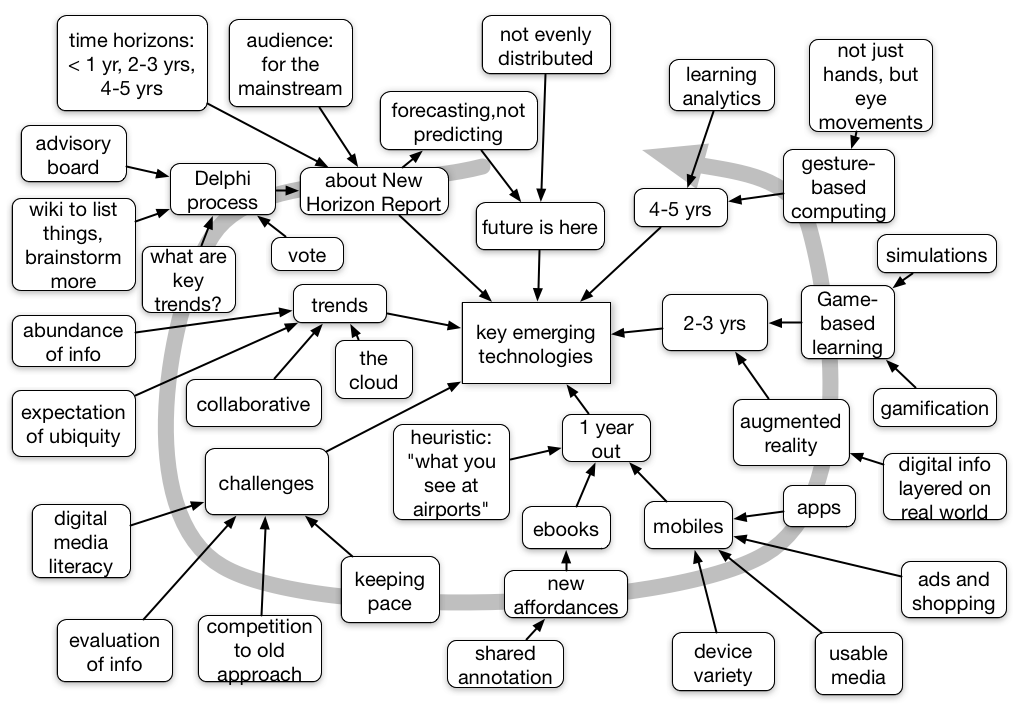
This evening I had the delight to hear Alan Levine present the New Media Consortium’s New Horizon Report for 2011 to the ASTD Mt. Diablo chapter.  As often happens, I mindmapped it.  Their process is interesting, using a Delphi approach to converge on the top topics.

For the near term (< 1 year), he identified the two major technologies as ebooks and mobile devices (with a shoutout for my book: very kind).  For the medium term (2-3 years), he pointed to augmented reality and game-based learning (though only barely touching on deeply immersive simulations, which surprised me).  For the longer term (4-5 years), the two concepts were gesture-based computing and learning analytics.

A very engaging presentation.

mind map of Levine talk

Snake Oil and (April) Fools

4 April 2011 by Clark 4 Comments

For April Fool’s of this year, we (the Internet Time Alliance, with large credit to Jane and Harold) posted a message on our site:

The Internet Time Alliance (ITA) has spent much of the past year on a mission.

We have located and assembled a huge collection of informal learning content.

Today we’re publishing it and offering a free subscription to all individuals as well as corporate rates.

“Without content there is no learning. Repositories of informal learning content
such as this will underpin
much of the social and informal learning over the
next 5 years.”
Lois Kean, CLO, Polar Foil LLC*

Sign up today for the ITA Informal Learning Collection!

Clicking the link took you to another page where we explained:

The Ultimate Content Collection for All Your Informal Learning Needs!*

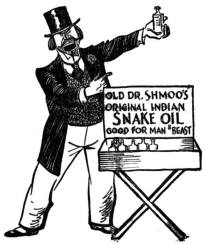
*Nothing but snake oil here, folks.

The Internet Time Alliance can help you navigate the  snake oil and work smarter with Informal and Social Learning. Any time after April Fool‘s Day, that is  ;)

While the ad was a joke, the issue is real: folks can still believe that there’s no learning without formal content. That may be true for novices, but those who know what they’re doing and what they need can very well learn from resources they find on their own, and from each other!

The content may be out there, or it may have to be co-created, but it can’t be in the hands of formal designers and it can’t all be found in the corporate resources.  As things get more complex and faster and more unique, the need for access to others and the rich resources of the internet are a bare minimum.  There’s a role for formal learning and formal content (e.g. performance support), but supporting learners to have access to a much richer suite of resources than an L&D team can design can really empower people. Moreover, having them help each other and create new understandings and knowledge is the key to making progress in this new, faster, world.

We’re seeing companies succeed with these approaches, in small instances and across the organization.  It’s not that there isn’t a role for formal content, it’s just that, as my colleague Charles Jennings talks about, the 70:20:10 rule (individuals tag valuable learning as coming 70% from the workplace, 20% from mentoring/coaching, and only 10% from formal leaning) suggests that our investments in effort and support are not matched to the value of the contribution.

You do want to go beyond just formal learning. It may seem we go over the top, but I’ve found that if you want to get people to Y, you have to talk about 2Y to have any chance. If you just talk about Y, you’ll get them to .5Y.  And we really believe that the benefits – a more positive workplace, a more nimble organization, greater innovation and problem-solving – significantly outweigh the relatively low costs.

So, what’s it going to be, snake oil or social and informal learning?

*Lois Kean is an anagram of SnakeOil and Polar Foil is an anagram of April Fool


Thinking through performing and learning

25 March 2011 by Clark 2 Comments

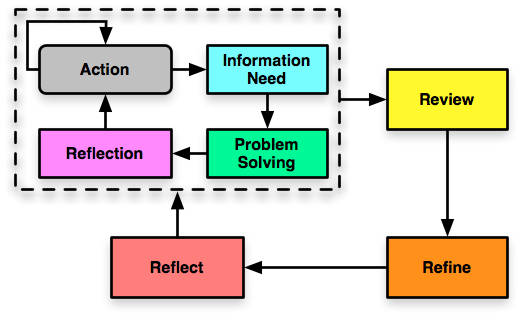
Again as preparation for our upcoming presentation (you can attend!), I was thinking about the skills necessary to cope in this new information age.   That includes not only the performance skills but also meta-learning, and I decided it was also time to take another stab at capturing the concept as a graphical representation.

Performance and meta-laerningHere, I start with the hermeneutic notion of how we act in the world and learn. We start with things well-practiced, but if we have a problem, a breakdown, we look for an answer.   Here we contact people to find an answer, or search for information. There are a suite of associated skills: information lookup, answer validation, filtering, etc.

If we can’t find the answer, we have to go into active problem-solving. Here we might also need people, but note that they’re different folks; there is no one with the answer (or we’d have found them before) and instead they might be collaborators, process facilitators, analysts, etc.   We might need data to look for patterns, or models to help us solve the problem. Again, there are a suite of related skills: leadership, representation and modeling, systematicity, sampling, etc.

If and when we find the answer, we should update the resources for other folks to not have to solve the problem separately.   Here we have additional skills: communication, change management, etc.

Then we get into meta-learning.   Here we are interested in how do we evaluate our own performance, look at what we’re doing and how we can get better at it, and support ourselves through the change.   This is an additional source of skills like self-reflection, working with mentors, etc.

All told, these are the processes that the knowledge or concept worker requires, going forward.   And, of course, capturing the associated skills.   So, in light of my last post on social learning, what do you think about this?   Does it make sense to you?

Thinking through social learning

24 March 2011 by Clark 5 Comments

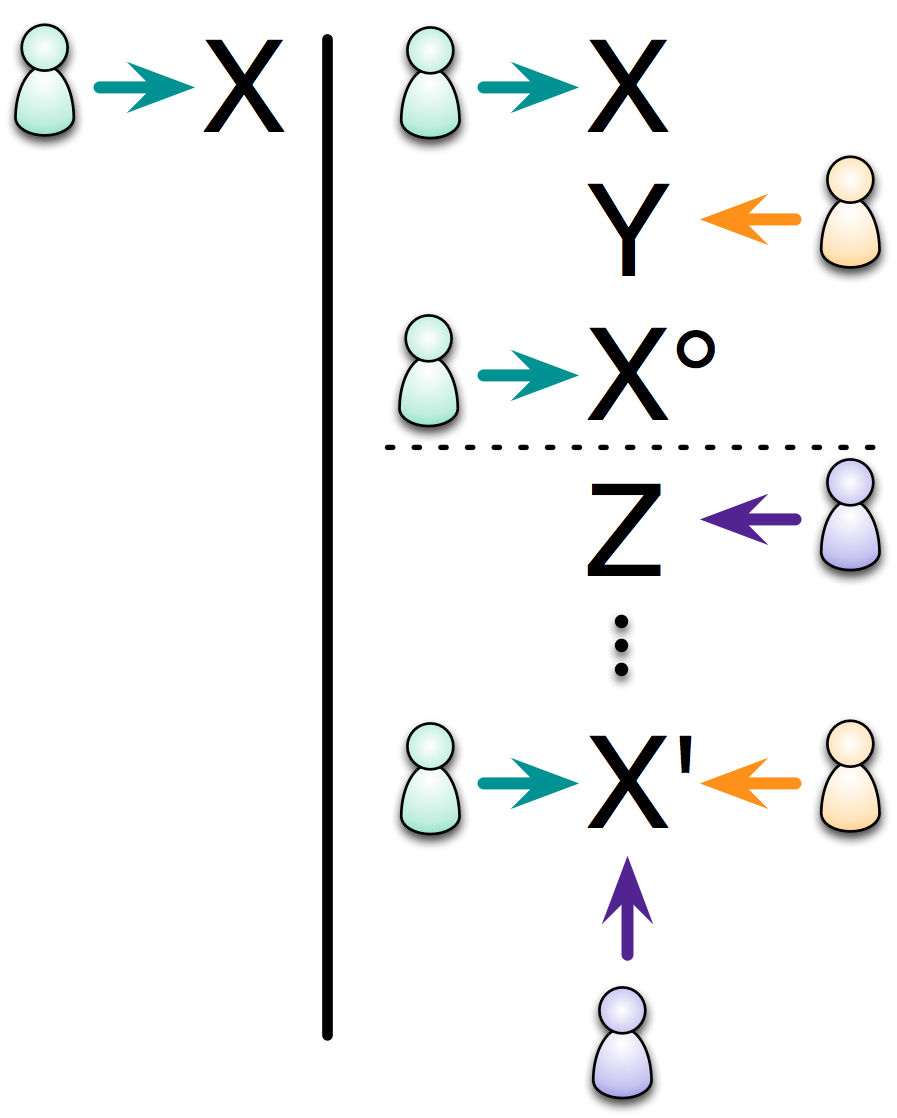
In preparation for our webinar with Citrix and the eLearning Guild, I’ve been thinking through the benefits of learning socially, specifically for formal learning.   I’ve articulated before that I think it’s about processing, but I like to try to capture my thinking in a graphic, and hadn’t done so before. I did so now, and thought I’d share it.

Social Learning re-processingIn this representation, an individual, in creating an output such as a blogpost or a response to a discussion question in a forum, or a response to an assignment, has to do some reasonably robust processing. Typically, by going from thought to an external representation, you find that you’ve got some gaps and have to fix them. Eventually, however, you come up with what you think is right.   And you submit it, say, in formal learning, and eventually may get feedback from an instructor.

But consider where you share that representation, and someone else comments in a way that indicates a different perspective, say in the discussion forum or to your post; then you may have to rethink what you said in light of that alternate viewpoint. You have to do some additional processing.

Then go further: suppose that a team has to come with a convergent answer.   Then you might get a number of cycles of expressed viewpoints, additional processing (by all members of the team), sufficient to come to an agreed-upon view. Then you have lots of alternate ideas, and re-processing going on.   That, to me, is the power of social learning. In that process of negotiation, you are thinking again and again about a topic, let alone with additional input and viewpoints.

Now, there are lots of nuances that have to go into this, such as designing an assignment that has enough ambiguity or challenge to have sufficient variety in viewpoint, but not so much as to lead to an inability to eventually agree.

This, of course, also is what happens in informal learning, if we end up discussing a problem to solve, or even just blog our thoughts and get comments.   As Jay Cross says, the most powerful learning technology is conversation.   It’s even better, however, if there’s a resulting artifact, a representation that captures the understanding, as the externality reduces the opportunity for misinterpretation.

So, does this representation make sense to you?

Pseudoteaching

17 March 2011 by Clark 4 Comments

As a nice complement to my last post on Understanding by Design, comes this piece on Pseudoteaching that Donald Taylor (who runs the excellent UK Learning Technologies conference) pointed out.   The premise is that much teaching that appears good to both the instructor and observers is really ineffective.   And this is instructive in a couple of ways.

First, it’s easy to believe that if you’re preparing, and presenting eloquently, you are communicating.   And that isn’t necessarily so.   For learning to stick, there are several necessary components, the most important being that the learner needs to be engaged in meaningful activity.   That’s not likely the case in the classroom where learners are in your control.   Now, if you’re giving meaningful assignments before the lecture, and then extending the learning afterward, you have a chance.   Otherwise, the content is likely to fall on deaf ears.

And, to fend off the hoary old canard about why do we attend conferences then (and I give a lot of talks): if people are doing meaningful activity, like their jobs, then a presentation related to their work can serve as a valuable reflection opportunity. So, speaking to practitioners makes sense: it can provide new insights, inspiration, and more.   But not for learners who don’t have meaningful activity and aligned content resources.

Which brings me to the second point, you need to start with thinking about what you want learners to be able to do after the learning experience, and then align assessment and learning materials accordingly. Like the post author, I too probably was “doin’ a Lewin” when I first started lecturing, but I coupled it with meaningful and challenging assignments.   And not as well as I now would do, but I improved over time and if I ever get a chance to be an instructor again, I will continue to improve (I’ve got some courses or a program I’d love to run).

It’s real easy to delude ourselves that good production equals good learning, but the evidence is to the contrary.   Similarly, it’s easy to convince ourselves that we’ve given the learners the necessary information.   That doesn’t work either.   You’ve got to understand learning, formally or intuitively (and the latter is not the way to bet), and align the elements to succeed.

That’s if a significant skill-shift is what’s needed, and there are lots of times a course isn’t the answer. But when it is, get it right.   Please.   We really can’t afford to waste money and time like it is all too easy to do.

Understanding by Design

16 March 2011 by Clark 1 Comment

I have long advocated, in consonance with sound learning   principles, that in a good design process works backwards:

  • start with the desired outcomes as capabilities,
  • align assessment to the outcomes,
  • and then design the learning experience to achieve those outcomes.

This shouldn’t be new.   Recently, I was pointed towards Wiggins & McTighe’s Understanding by Design, which turns out to be a curricular approach predicated on just such lines.   I am of mixed feelings.

First, I am thrilled to see someone in formal education talking about looking at more meaningful outcomes, particularly aimed at “clarify learning goals, devise revealing assessments of student understanding, and craft effective and engaging learning activities”.   This is something I’ve been trying to argue for in my work with formal education, e.g. with publishers, schools, and more.   It’s a more enlightened approach to design.

On the other hand, it’s sort of like my reaction when we investigated what should be covered in continuing medical education and were told that we should proselytize evidence-based medicine: “what have they been doing ’til now?!?!”   I continue to be amazed at how folks go about things in ways that do not reflect what we understand about doing things well.   And what I’ve seen of their 6 Facets of Understanding seem a bit vague (and mea culpa, I have not read their thorough exposition, but it seems like YAT, Yet Another Taxonomy), though I’m perfectly willing to be wrong about that.

Interestingly, they apparently do not recommend applying this approach to individual lesson plans, and instead constrain it to curriculum level goals. I can see how the focus should be on the goal, not the time-frame, and I personally believe in spreading out learning over a longer period of time.

It’s nice to have another label to attach to good design, so I laud the initiative, and hope we can get more good design, and more understanding, in our schools and everywhere else.

Let’s talk ‘working smarter’

13 March 2011 by Clark 1 Comment

Join us online on 30 March 2011

We will discuss whatever interests you in the realm of  Working Smarter.

Do you have burning questions about social learning, web 2.0, or working smarter? Want to find out how other organizations are grappling with the culture, politics, and governance of implementing informal learning?

Ask us a question or suggest a topic.   You can use the comments capability, below. The more controversial or challenging the better.

We’ll be giving free  copies of the  Working Smarter Fieldbook to six people who provide us with questions.

REGISTER

Social Media Strategy thoughts

8 February 2011 by Clark 2 Comments

What is a social media strategy for outreach?   Really, it‘s about demonstrating your thinking, your values, and background. It‘s about interacting with appropriate people in ways that reflect who you are.

Here is some thoughts about how that maps out in two areas: Facebook, and Twitter.   I‘m mentioning these as two of the most viable and visible tools for social media engagement.

Twitter

Having a twitter account is a necessary start, maybe several. One might be just a daily thing people can follow, but it has to provide value.   So, for example, you might stream out an interesting bit of the day. That, alone, however, is not enough.

A second important role is to engage people.   More important than the first idea is to ‘be‘ an entity.   If an organization is on social media, and increasingly they should be,   it needs to be interactive. This is accomplished in several ways:

  • point to what the organization is doing
  • point to interesting things outside of the organization
  • re-tweet relevant stuff that others post (which requires following interesting people)
  • respond to people replying to that account.

These require resources, essentially a person or persons who handle these duties.   Done well, these activities demonstrate that there is an interesting mind and a sincere heart behind the account.

Facebook

The same is true of a FaceBook page.   Not only should people be friending it, they should be coming back to be engaged   the organization, but now also with their colleagues also interested in the organization.

There are different ways to be on Facebook: as a static page, or as a ‘presence‘ with dialogs, groups, etc.  A static page might get a few ‘likes‘, but you really want to build a site as a place to come for folks interested in the organization and it’s work.   There need to be discussions supported (and interacted with).   There need to be updates.   There needs to be a way for people to have a dialog with you.   You need information: photos, events.   Use apps to create polls. In short, it’s about interaction around the organization and it’s work.

Again, the message is that you‘re active, engaged, you really care about what you do.   And, again, it takes resources.

Twitter/Facebook Integration

These two elements do not live independently.   Your Twitter strategy should be aligned with your Facebook strategy, so your tweets point to new information on Facebook, your Facebook account reflects your tweets, etc.   Your tweets should drive traffic to the Facebook site, but not exclusively.

There‘s more that can be incorporated: blogs (I use twitter and my blog more than my facebook page, but I‘m an individual not an organization).   However, your elements shouldn‘t be too fragmented.   E.g. only have separate Twitter handles and Facebook pages if your separate initiatives have to maintain unique identities. However, that‘s a branding issue, and not a place I‘m qualified to talk about.   Once you‘ve got the identity, then you need to align your Facebook and Twitter strategies.

So, you should be doing this, and you need to be doing it well.   If you don’t do it right, you may as well not do it at all.

« Previous Page
Next Page »

Clark Quinn

The Company

Search

Feedblitz (email) signup

Never miss a post
Your email address:*
Please wait...
Please enter all required fields Click to hide
Correct invalid entries Click to hide

Pages

  • About Learnlets and Quinnovation

The Serious eLearning Manifesto

Manifesto badge

Categories

  • design
  • games
  • meta-learning
  • mindmap
  • mobile
  • social
  • strategy
  • technology
  • Uncategorized
  • virtual worlds

License

Previous Posts

  • March 2026
  • February 2026
  • January 2026
  • December 2025
  • November 2025
  • October 2025
  • September 2025
  • August 2025
  • July 2025
  • June 2025
  • May 2025
  • April 2025
  • March 2025
  • February 2025
  • January 2025
  • December 2024
  • November 2024
  • October 2024
  • September 2024
  • August 2024
  • July 2024
  • June 2024
  • May 2024
  • April 2024
  • March 2024
  • February 2024
  • January 2024
  • December 2023
  • November 2023
  • October 2023
  • September 2023
  • August 2023
  • July 2023
  • June 2023
  • May 2023
  • April 2023
  • March 2023
  • February 2023
  • January 2023
  • December 2022
  • November 2022
  • October 2022
  • September 2022
  • August 2022
  • July 2022
  • June 2022
  • May 2022
  • April 2022
  • March 2022
  • February 2022
  • January 2022
  • December 2021
  • November 2021
  • October 2021
  • September 2021
  • August 2021
  • July 2021
  • June 2021
  • May 2021
  • April 2021
  • March 2021
  • February 2021
  • January 2021
  • December 2020
  • November 2020
  • October 2020
  • September 2020
  • August 2020
  • July 2020
  • June 2020
  • May 2020
  • April 2020
  • March 2020
  • February 2020
  • January 2020
  • December 2019
  • November 2019
  • October 2019
  • September 2019
  • August 2019
  • July 2019
  • June 2019
  • May 2019
  • April 2019
  • March 2019
  • February 2019
  • January 2019
  • December 2018
  • November 2018
  • October 2018
  • September 2018
  • August 2018
  • July 2018
  • June 2018
  • May 2018
  • April 2018
  • March 2018
  • February 2018
  • January 2018
  • December 2017
  • November 2017
  • October 2017
  • September 2017
  • August 2017
  • July 2017
  • June 2017
  • May 2017
  • April 2017
  • March 2017
  • February 2017
  • January 2017
  • December 2016
  • November 2016
  • October 2016
  • September 2016
  • August 2016
  • July 2016
  • June 2016
  • May 2016
  • April 2016
  • March 2016
  • February 2016
  • January 2016
  • December 2015
  • November 2015
  • October 2015
  • September 2015
  • August 2015
  • July 2015
  • June 2015
  • May 2015
  • April 2015
  • March 2015
  • February 2015
  • January 2015
  • December 2014
  • November 2014
  • October 2014
  • September 2014
  • August 2014
  • July 2014
  • June 2014
  • May 2014
  • April 2014
  • March 2014
  • February 2014
  • January 2014
  • December 2013
  • November 2013
  • October 2013
  • September 2013
  • August 2013
  • July 2013
  • June 2013
  • May 2013
  • April 2013
  • March 2013
  • February 2013
  • January 2013
  • December 2012
  • November 2012
  • October 2012
  • September 2012
  • August 2012
  • July 2012
  • June 2012
  • May 2012
  • April 2012
  • March 2012
  • February 2012
  • January 2012
  • December 2011
  • November 2011
  • October 2011
  • September 2011
  • August 2011
  • July 2011
  • June 2011
  • May 2011
  • April 2011
  • March 2011
  • February 2011
  • January 2011
  • December 2010
  • November 2010
  • October 2010
  • September 2010
  • August 2010
  • July 2010
  • June 2010
  • May 2010
  • April 2010
  • March 2010
  • February 2010
  • January 2010
  • December 2009
  • November 2009
  • October 2009
  • September 2009
  • August 2009
  • July 2009
  • June 2009
  • May 2009
  • April 2009
  • March 2009
  • February 2009
  • January 2009
  • December 2008
  • November 2008
  • October 2008
  • September 2008
  • August 2008
  • July 2008
  • June 2008
  • May 2008
  • April 2008
  • March 2008
  • February 2008
  • January 2008
  • December 2007
  • November 2007
  • October 2007
  • September 2007
  • August 2007
  • July 2007
  • June 2007
  • May 2007
  • April 2007
  • March 2007
  • February 2007
  • January 2007
  • December 2006
  • November 2006
  • October 2006
  • September 2006
  • August 2006
  • July 2006
  • June 2006
  • May 2006
  • April 2006
  • March 2006
  • February 2006
  • January 2006

Amazon Affiliate

Required to announce that, as an Amazon Associate, I earn from qualifying purchases. Mostly book links. Full disclosure.

We use cookies to ensure that we give you the best experience on our website. If you continue to use this site we will assume that you are happy with it.