Learnlets

Secondary

Clark Quinn’s Learnings about Learning

Search Results for: align

Who authorizes the authority?

28 November 2009 by Clark 2 Comments

As a reaction to my eLearnMag editorial on the changing nature of the educational publishing market, Publish or Perish, a colleague said: “There is a tremendous opportunity in the higher ed publishing market for a company that understands what it means to design and deliver engaging, valuable, and authentic customer experiences–from content to services to customer service and training.”

I agree, but it triggered a further thought. When we go beyond delivering content as a component of a learning experience, and start delivering learning experiences, are we moving from publisher to education provider?   And if so, what are the certification processes?

Currently, institutions are accredited by accrediting bodies.   Different bodies accredit different things.   There are special accrediting bodies (a.g. AACSB or ACBSP for business[2?], ABET for applied science).   In some cases, there are just regional accreditation bodies (e.g. WASC).     There’s overlap, in that a computer science school might want to align with ABET, and yet the institution has to be accredited by, say, WASC.

And I think this is good, in that having groups working to oversee specific domains can be responsive to changing demands, and general accreditation to oversee ongoing process.   I recall in the past, this latter was largely about ensuring that there were regular reviews and specific improvement processes, almost an ISO 9001 approach. However, are they really able to keep up?   Are they in touch with new directions?   The recent scandals around business school curricula seem to indicate some flaws.

On the other hand, who needs accreditation?   We still have corporate universities, they don’t seem to need to be accredited except by their organization, though sometimes they partner with institutions to deliver accredited programs. And many people provide coaching services, and workshops.   There are even certificates for workshops which presumably depend on the quality of the presenter, and sometimes some rigor around the process to ensure that there’s feedback going on so that continuing education credits can be earned.

My point is, the standards vary considerably, but when do you cross the line? Presumably, you can’t claim outcomes that aren’t legitimate (“we’ll raise your IQ 30 points” or somesuch), but otherwise, you can sell whatever the market will bear.   And you can arrange to be vetted by an independent body, but that’s problematic from a cost and scale perspective.

Several issues arise from this for me.   Say you wanted to develop some content (e.g. deeper instructional design, if you’re concerned like me about the lack of quality in elearning).   You could just put it out there, and make it available for free, if you’ve the resources.   Otherwise, you could try to attach a pricetag, and see if anyone would pay.   However, what if you really felt it was a definitive suite of content, the equivalent of a Master’s course in Instructional Technology?   You could sell it, but you couldn’t award a degree even if you had the background and expertise to make a strong claim that it’s a more rigorous degree than some of those offered by accredited institutions, and more worthwhile.

The broader question, to me, is what is the ongoing role of accreditation?   I’ve argued that the role of universities, going forward, will likely be to develop learning to learn skills. So, post your higher ed experience (which really should be accomplished K12, but that’s another rant), you should be capable of developing your own skills.   If you’ve developed your own learning abilities, and believe you’ve mastered an area, I guess you really only need to satisfy your current or prospective employer.

On the other hand, an external validation certainly makes it easier to evaluate someone rather than the time-intensive process of evaluation by yourself.   Maybe there’s a market for much more focused evaluations, and associated content?

So, will we see broader diversity of acceptable evaluations, more evaluation of the authorial voice of any particular learning experience, a lifting of the game by educational institutions, or a growing   market of diverse accreditation (“get credit for your life experience” from the Fly By Night School of Chicanery)?
Promoting social media

13 November 2009 by Clark 1 Comment

The Big Question of the Month is “How do I communicate the value of social media as a learning tool to my organization?”.   Now, this is late, but it’s because I’ve been getting ready for and then attending DevLearn (as always, was a great event), but Jay Cross and I spent a day talking about this issue in the larger picture of social learning in the media.

Then, in last night’s #lrnchat, the question was asked again as part of the usual 3 question format.   So, I decided to pull out my tweeted contributions and elaborate on them a bit as my response.   These are the unique answers, not including my responses to others, re-tweets of poignant statements, and snarky comments.

don‘t talk about social learning, talk about innovation, problem-solving, creativity, research, experimentation…

As Andrew McAfee told us in his keynote, the term ‘social learning’ isn’t going to carry a lot of weight where it matters.   You need to talk about benefits.   My message is that learning should be considered as a very   broad umbrella, as it should include all those activities where we don’t have an answer and have to ‘learn’ one.   Therefore, I feel quite comfortable talking about the outcomes of informal learning: innovation, problem-solving, creativity, research, experimentation, design, insights, new products, new services, and so on.

focus on: biz case; need to go beyond execution to continual innovation; collective intelligence.

Organizations don’t want concepts, they want results.   In this case, talk about the concrete outcomes of collective intelligence.   Greater rates of new product and service generation.   More problems solved, and more c0mplex problems solved.   More valuable ideas generated.   Hearing from more members of the organization.   Talk about impacting those things that will make a difference to organizational success.

I point others to @dwilkinsnh excellent list of success stories: http://bit.ly/K16NU

One of the things that helps is having good case studies. Dave Wilkins has collected quite a few in his blog, and more are popping up everywhere.   In particular, showing that the competition is doing it (as one of our workshop attendees intended to do) is a good incentive, and having relevant ones for the particular initiative you choose is important.

standard org change: start small, focus on a good success story, leverage the er, heck out of it

Speaking of initiatives, really the same strategy that goes for most organizational changes holds true, in general.   Start small where the cultural tendencies are supportive and there’s a fairly obvious positive outcome to be had, and get a win.   Then use that to argue for more initiatives.

It’s not easy, there are lots of factors to gaining success, but in the long term it’s really adapt or die.   The most agile will win, and agility comes from aligned inspiration.   Good luck!

Zimmerman Keynote Mindmap DevLearn 09

12 November 2009 by Clark Leave a Comment

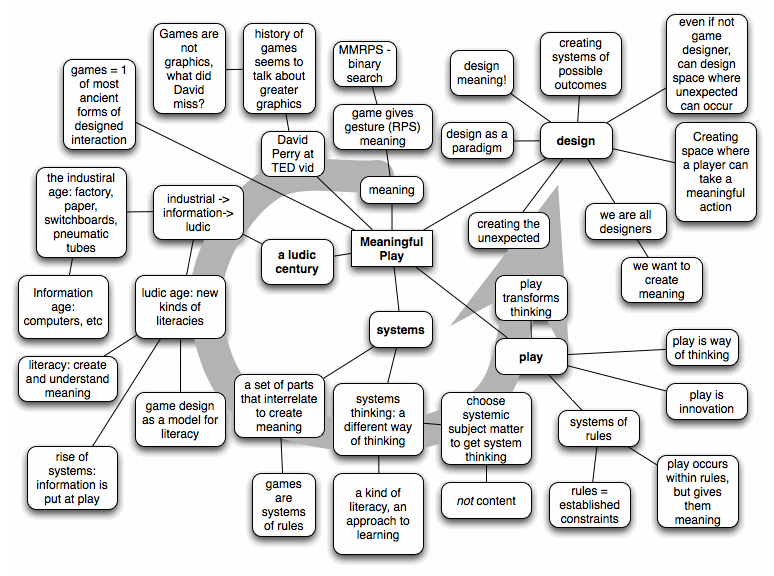
Eric Zimmerman spoke eloquently on games as the second day keynote at DevLearn.   In it, he talked about how systems thinking was important, how games are systems of rules and consequently develop systems thinking.   He talked about how our play brings meaning to the rules, and that creating spaces of possible outcomes allow us to explore.

He ended up advocating that we design for possibilities of unexpected outcomes to create meaning for our learners.   Cammy Bean has blogged the presentation too.

ZimmermanDevLearnMindMap

McAfee Keynote at DevLearn 2009

11 November 2009 by Clark 5 Comments

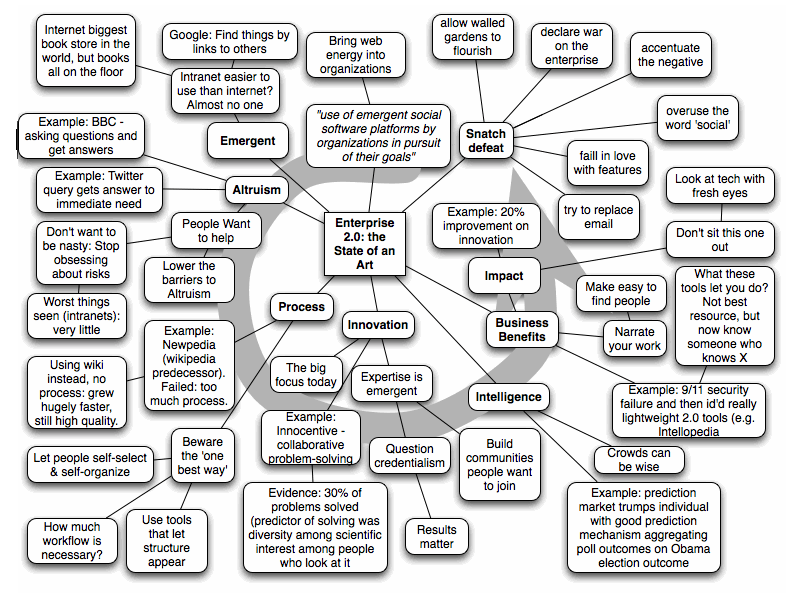
Andy McAfee gave us a lively and informative presentation on his view of Enterprise 2.0.   Punctuated by insightful examples, he defined Enterprise 2.0 as “”use of emergent social software platforms by organizations in pursuit of their goals”, and characterized it more simply as ‘bringing web energy into organizations’.

Along the way, he emphasized points about emergent behavior, inherent altruism, emergent process, developing innovation, the intelligence of crowds, and real business benefits.   A 20% improvement in innovation was one concrete result.   He also warned us of the ways to snatch victory from the jaws of defeat.

BTW, Cammy Bean’s has posted a prose recitation of the talk.   With no further ado:

McAfeeKeynoteMindmap

Engaging Learning

9 November 2009 by Clark 1 Comment

How do you systematically design learning experiences that effectively engage the learner?

This was the question I set out to address more than 5 years ago.   Based upon years of deep investigation into learning & instruction theories and design processes, and practical experience in designing games, I wrote Engaging Learning: Designing e-Learning Simulation Games.

The book was based upon work I’d published as an academic, but was focused very pragmatically.   There were already a few books out about the value of computer games to support learning, notably Marc Prensky’s prescient Digital Game-Based Learning, and Clark Aldrich’s Games and the Future of Learning was also already out.   Subsequently, books by Gee, Shaffer, and others have highlighted the opportunities.

However, I thought and think that my book had a unique contribution, being quite specific around:

  • the principles that underpin why games are the best learning
  • how to modify your design processes to successfully design games

Having looked at the books out there, I still feel it does the best job of making the case.

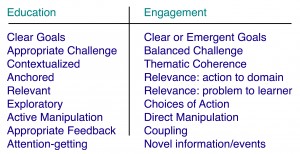
ElementsAt core was an alignment between what makes effective learning practice, and what makes engaging experiences.   Looking across educational theories, repeated elements emerge. Similarly with experience design.   It turns that they perfectly align.   If you recognize that, and can execute against it, your learning will be greater than the sum of the parts, and will both seriously engage and truly educate.   Learning can, and should, be hard fun!
The workshops I’ve run based upon the book have been very well received, reinforcing the value of the book.   Similarly, the content has been solicited as a component of both Silberman’s Handbook of Experiential Learning, and the Guild’s Immersive Learning Simulation report.   I’ve now heard Tony O’Driscoll talk about the design principles for learning experiences in Virtual Worlds (in his and Karl Kapp’s coming book on the topic), and they’re the same principles!

So why hasn’t the book penetrated corporate learning more than it has?   There are several contributing factors.   First, the work I published as an academic didn’t hit the mainstream.   I was part of the international society on computers, and a member of the group specifically about learning through computers (IFIP WG 3.3). They’d just started their own journal, and I wanted to support it (and get a publication). In retrospect, it would’ve been better to publish in one of the more recognized journals on the topic.   As I was overseas, the work never hit the US academic awareness.

Second, I didn’t really understand book marketing then, and trusted that the publisher did.   At the time, they weren’t very pro-active in developing a joint understanding of responsibility (that’s changed), and my book fell through their cracks (and I’m not a marketing person).   (Still, I’m going to be a bit more proactive on the mobile learning book, and they have promised likewise.)

I still firmly believe that the book is the best guide to designing meaningful learning experiences that are centered on deep practice, and a guide for everything from better multiple choice questions to full on simulation-driven serious games.   I’ve tracked the rest of the books out there, and they do a good job of arguing why games are a powerful learning environment, why they make business sense, and more.   However, Engaging Learning is still the best book out there that tells designers how to go about making them.   Sure, I recommend having the workshop to actually get a chance to practice the skills (you know, get your whole team to lift their game), but many who have read it have told me they found value in the book on it’s own.

I don’t say this to generate sales; I get so little it’s not going to make a difference.   I say this because I really worked hard to ensure there is a lot of value in it for you.   I’m just trying to make sure there’s better learning out there, and there’s a lot more need than I can service individually.   There are other good books, Michael Allen’s Guide to eLearning being one, but my book focuses specifically on helping you make more meaningful practice, and that’s a big area of needed improvement, and a major opportunity in making your learning more meaningful.

Please, wherever you draw inspiration, however you figure it out, make more engaging learning. Align the elements of effective practice and the elements of engaging experiences, and make your learning rock. For your learners’ sake, please!

Convenience vs Context

7 November 2009 by Clark 2 Comments

What are the real opportunities in mobile learning?

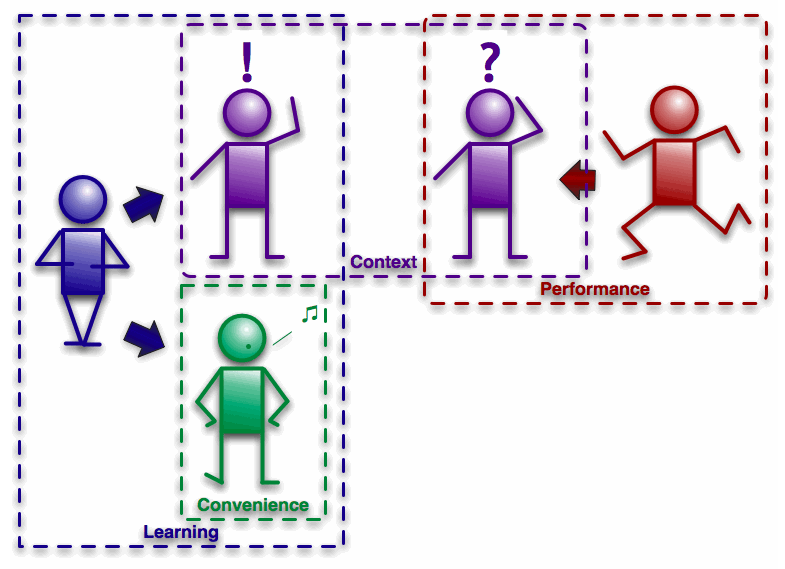
One of the several sessions I’m doing at DevLearn next week (in addition to a pre-conference workshop with Jay Cross, a mobile development session with Richard Clark, and another session on the future of orgnanizational learning) is a mobile learning design introduction.   In thinking through it, I reflected on a distinction I make between convenience and contextualization, and as usual I got into diagramming as a way to get a handle on it.

ContextConvenienceI’ve argued before that mobile is not really about learning, but about performance support.   That said, there are roles for mobile in courses, either as a learning augment or even microcourses (but not putting a whole elearning course on a mobile device).   In talking about mobile, I distinguish between convenience and context.

Convenience is when you access content at a time that’s not at work but you have free.   So, listening to a podcast while commuting, or viewing a video while waiting in the queue at the grocery store, both would qualify. So would doing a little quiz while waiting for your flight, or reading a document on that flight.

Contextualization, on the other hand, is much more specific.   Here, you’re doing something relevant to where you are. In performance support, this is a huge opportunity: providing location specific information (about this device, or this client), or event-based support (providing a quick reference sheet for a negotiation, having a reflection session afterward).

Even for learning, however, there could be specific location information (“this is where X happened”, or “an application of Y is seen here, where…”).   That can be enacted by the device sensing location (GPS, RFID, etc), or by actively reading a location marker (cf QR code).   Similarly, event information could be provided (“for your review meeting, remember to focus on the behavior, not the individual”).

The point is that while convenience is a win, contextualized information is the big win.   It takes a bit more design, but by doing it systemically, the opportunities for really relevant learning are definitely worth considering.

Extremophiles & Organizational Agility

30 October 2009 by Clark Leave a Comment

CreatingLearningCultureWebA number of years ago, I co-wrote a chapter with Eileen Clegg called The Agility Factor, that appeared in Marcia Conner & James Clawson’s excellent collection of organizational culture articles in the book Creating a Learning Culture. The focus of the book was on empowering organizations to be nimble in a context of increasing change.

Eileen’s husband is a marine scientist studying deep sea vents and the creatures that live there.   In biology, organisms that can live in such extreme heat, or in bitter cold, or extreme salinity, etc., are known as extremophiles.   They have a number of mechanisms that allow them to succeed, including stronger ionic bonds, sensing and reacting to changes in the environment, special proteins for extreme circumstances, inoculation mechanisms to cope with toxins, and special partnerships.

In the chapter, we talked about organizational equivalents to these extremophile mechanisms, including tolerating diversity, monitoring the environment, extreme mentoring, and more.   We’re talking about it tonite at a special event, and I reread the article to see what we said then and to reflect on it in light of the subsequent years of experience.   I saw several ways in which to augment the thinking we had then.

In thinking about ionic bonds, it’s not only about the diversity (polarity) adding strength, but it strikes me that it’s also about alignment.   Diversity is particularly valuable when the different abilities and experiences are pulling in the same direction.   It’s important to share and inspire a belief in what the vision is.

On the topic of sensing the environment, I’m reminded of the result from the CLO survey Jay Cross and I did to accompany our Chief Meta-Learning Officer article, where 60% of those who responded thought that their people weren’t talking about  the outside trends that shape their business.   If people aren’t aware, they can’t adapt!   There must be support for individuals to not only self-improve, but to be connected the broader trends in their fields and the organization’s area of endeavor.

Starting from the heat-shock proteins that kick in when things are extreme, I’m mindful of how we need a shift from information presentation or skill-creation to learning facilitation and mentoring.   Organizations can’t provide everything employees need anymore, but they can provide support for developing skills for learning, and coping. I’m reminded of how Outward Bound got started, where older mariners were surviving situations that younger, presumably healthier ones weren’t.   Which reinforces the call for more ubiquitous mentoring that we argued for back then.

The inoculation approach to toxins sparks two thoughts.   One, while we need to tolerate diversity in experience and skills, I suspect we can’t tolerate those who do not buy into the vision and the mission.   In my own experience, I’ve seen how the naysayers can undermine organizational effectiveness.   Yet incorporating new approaches can be extraordinarily valuable. As I’ve argued before, the approach to take is not to try to appropriate so-called best practices, but instead to understand and contextualize best principles.

And finally, in thinking about symbiosis, one of the revelations has been to see the benefits organizations have found by increasing their dialog not only internally, but externally with partners and customers.   The advantages of more transparency and communication, if coupled with a sincere desire to truly listen and respond, are considerable.

It’s always a revelation to re-read something written several years ago and reflect on your thinking then.   I’m always amazed (and, mostly, pleased) with what I find.   Organizations need to reinforce their culture and learning mechanisms to make themselves more agile and more resilient, and that adaptation is possible on principled grounds.

The Future of Organizational Learning event

25 October 2009 by Clark Leave a Comment

At the upcoming DevLearn conference, Jay Cross and I are holding a pre-conference workshop titled: Be the Future of Organizational Learning:  Become a Chief Meta-Learning Officer. We already know we’ve got critical mass in terms of signups, so we’re excited about the possibilities, but we really want to do our best to ensure we   deliver a valuable experience.

clark-quinnBased on the principles from our CLO article on the topic, we’re intending to make it a real hands-on, wrestling with the issues, talking about specifics, and bolstering the discussion with data from close to 200 respondents to the survey that was associated with the article.   We want attendees to not only be informed, but empowered to go back to their organizations and make a meaningful impact.

Though we’ve ideas on what we think is important, we’d really like to hear what you’re expecting, are concerned with, would like to see, etc.

There’s a social networking site for DevLearn, and I’ve created a group for this session. I’d welcome you going there and beginning to talk up things like what you’re seeing, what you’re worried about, and what you’d like to get out of the session.   Of course, you’re welcome to comment here, too.

I’ll be speaking also on the topic in a concurrent session as well, on mobile design with David Metcalf in Judy Brown’s Mobile Learning Jam, and with Richard Clark on pragmatic mobile development, but those are topics for another post.

I’ve always found eLearning Guild events to be worthwhile, and given the lineup I think this one will be as good as ever.   Hope to see you in the workshop, or at least at the conference.

Virtual World Affordances, updated

8 October 2009 by Clark Leave a Comment

VWAffordancesCorrie Bergeron (@skydadddy) pointed out that I hadn’t really accounted for the ability to create a persona, a representation of yourself via avatar that reflects how you’d like to be perceived.   Chuck Hamilton did have it in his list, and I thought it was implicit in the alternative to anonymity, but on reflection, I think it does deserve it’s own affordance, and implications for reputation.
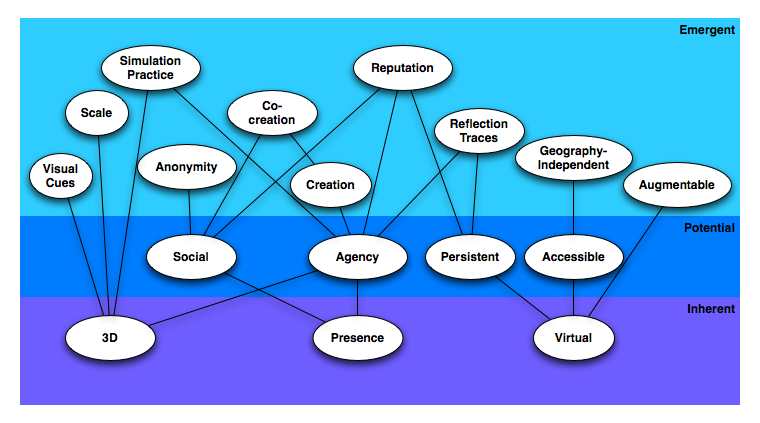
Of course, you’ll have a persona regardless, if you’re present in the world, but the ability to customize one is the unique opportunity.

The question then becomes, how do you use this representation?   Caroline Avey (@aveyca) presented a wide variety of uses of virtual worlds that ACS is exploring, and some are really not things that require long term personas, but are instead ways for folks to come together independent of geography for introductions of new products or other events.   Similarly, other uses of virtual worlds may be better configured with other combinations of affordances.   Different environments have different implementation of the affordances, or the ability to limit the capability of some (ie not have customizable avatars or not support agency) to meet particular event needs.

Understanding your virtual world goals can help determine what affordances are critical, and support your design criteria (and tool choice). That’s my intention, at any rate.   I really appreciate feedback that helps me refine the models I develop, advocate, and use.   Thoughts and comments always welcome.

Extending Virtual World Affordances

6 October 2009 by Clark 3 Comments

I recently attended the 3DTLC conference, as I reported before.   Chuck Hamilton presented on his (IBM’s) take on affordances on virtual worlds. Given that I’ve opined before, I asked for more detail on their take, and he was kind enough to forward to me their definitions.     I like what they’ve done, but it led me to try to refine what I see as some confounding (they actually separate several of their 10 into two separate ones), and try to capture what I think are core, what can be enabled, and what then arise from those capabilities.

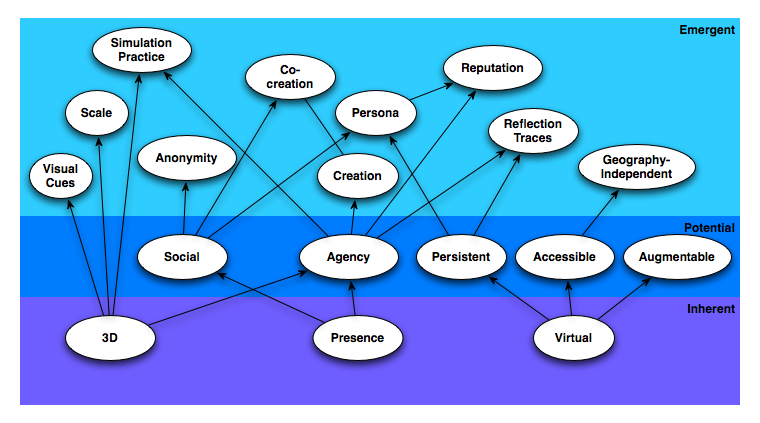
VWAffordancesI start with what I think are the core affordances of virtual worlds, that there’s a 3D world, that you can visit, and that’s digital.   From there, I see that you can enable others to be there (social), you can enable action (agency), the world can be kept around (persistent), and it can be made accessible broadly (e.g. through the internet).

If you choose to enable those (and you should, in most cases), you get some emergent properties.   Chuck talked about a universal visual language, and you certainly can both tap into, and establish, visual cues. The scale does not have to be real, but can indeed scale down to and up to any size you want, in part or all.

You can choose to be anonymous, but if you don’t and choose to have a representation that is active over time, you can establish a reputation.

By being active, you can also enable practice opportunities such as simulations, scenarios, and games.   If agency includes not just interaction, but creation, and you have social, you can have co-creation (one of the most exciting opportunities for informal learning). The persistence of your activity creates the opportunity to capture traces for reflection, e.g. ‘after-action review’.

The fact that it’s digital means it can be augmented with external capability: media, applications, and more.   Also, you can be at least geography-independent, if not chronologically-independent.

This is a preliminary stab at trying to trace the initial, potential, and consequently emergent affordances, by no means do I think it’s the definitive answer.   Feedback solicited!

« Previous Page
Next Page »

Clark Quinn

The Company

Search

Feedblitz (email) signup

Never miss a post
Your email address:*
Please wait...
Please enter all required fields Click to hide
Correct invalid entries Click to hide

Pages

  • About Learnlets and Quinnovation

The Serious eLearning Manifesto

Manifesto badge

Categories

  • design
  • games
  • meta-learning
  • mindmap
  • mobile
  • social
  • strategy
  • technology
  • Uncategorized
  • virtual worlds

License

Previous Posts

  • March 2026
  • February 2026
  • January 2026
  • December 2025
  • November 2025
  • October 2025
  • September 2025
  • August 2025
  • July 2025
  • June 2025
  • May 2025
  • April 2025
  • March 2025
  • February 2025
  • January 2025
  • December 2024
  • November 2024
  • October 2024
  • September 2024
  • August 2024
  • July 2024
  • June 2024
  • May 2024
  • April 2024
  • March 2024
  • February 2024
  • January 2024
  • December 2023
  • November 2023
  • October 2023
  • September 2023
  • August 2023
  • July 2023
  • June 2023
  • May 2023
  • April 2023
  • March 2023
  • February 2023
  • January 2023
  • December 2022
  • November 2022
  • October 2022
  • September 2022
  • August 2022
  • July 2022
  • June 2022
  • May 2022
  • April 2022
  • March 2022
  • February 2022
  • January 2022
  • December 2021
  • November 2021
  • October 2021
  • September 2021
  • August 2021
  • July 2021
  • June 2021
  • May 2021
  • April 2021
  • March 2021
  • February 2021
  • January 2021
  • December 2020
  • November 2020
  • October 2020
  • September 2020
  • August 2020
  • July 2020
  • June 2020
  • May 2020
  • April 2020
  • March 2020
  • February 2020
  • January 2020
  • December 2019
  • November 2019
  • October 2019
  • September 2019
  • August 2019
  • July 2019
  • June 2019
  • May 2019
  • April 2019
  • March 2019
  • February 2019
  • January 2019
  • December 2018
  • November 2018
  • October 2018
  • September 2018
  • August 2018
  • July 2018
  • June 2018
  • May 2018
  • April 2018
  • March 2018
  • February 2018
  • January 2018
  • December 2017
  • November 2017
  • October 2017
  • September 2017
  • August 2017
  • July 2017
  • June 2017
  • May 2017
  • April 2017
  • March 2017
  • February 2017
  • January 2017
  • December 2016
  • November 2016
  • October 2016
  • September 2016
  • August 2016
  • July 2016
  • June 2016
  • May 2016
  • April 2016
  • March 2016
  • February 2016
  • January 2016
  • December 2015
  • November 2015
  • October 2015
  • September 2015
  • August 2015
  • July 2015
  • June 2015
  • May 2015
  • April 2015
  • March 2015
  • February 2015
  • January 2015
  • December 2014
  • November 2014
  • October 2014
  • September 2014
  • August 2014
  • July 2014
  • June 2014
  • May 2014
  • April 2014
  • March 2014
  • February 2014
  • January 2014
  • December 2013
  • November 2013
  • October 2013
  • September 2013
  • August 2013
  • July 2013
  • June 2013
  • May 2013
  • April 2013
  • March 2013
  • February 2013
  • January 2013
  • December 2012
  • November 2012
  • October 2012
  • September 2012
  • August 2012
  • July 2012
  • June 2012
  • May 2012
  • April 2012
  • March 2012
  • February 2012
  • January 2012
  • December 2011
  • November 2011
  • October 2011
  • September 2011
  • August 2011
  • July 2011
  • June 2011
  • May 2011
  • April 2011
  • March 2011
  • February 2011
  • January 2011
  • December 2010
  • November 2010
  • October 2010
  • September 2010
  • August 2010
  • July 2010
  • June 2010
  • May 2010
  • April 2010
  • March 2010
  • February 2010
  • January 2010
  • December 2009
  • November 2009
  • October 2009
  • September 2009
  • August 2009
  • July 2009
  • June 2009
  • May 2009
  • April 2009
  • March 2009
  • February 2009
  • January 2009
  • December 2008
  • November 2008
  • October 2008
  • September 2008
  • August 2008
  • July 2008
  • June 2008
  • May 2008
  • April 2008
  • March 2008
  • February 2008
  • January 2008
  • December 2007
  • November 2007
  • October 2007
  • September 2007
  • August 2007
  • July 2007
  • June 2007
  • May 2007
  • April 2007
  • March 2007
  • February 2007
  • January 2007
  • December 2006
  • November 2006
  • October 2006
  • September 2006
  • August 2006
  • July 2006
  • June 2006
  • May 2006
  • April 2006
  • March 2006
  • February 2006
  • January 2006

Amazon Affiliate

Required to announce that, as an Amazon Associate, I earn from qualifying purchases. Mostly book links. Full disclosure.

We use cookies to ensure that we give you the best experience on our website. If you continue to use this site we will assume that you are happy with it.