Learnlets

Secondary

Clark Quinn’s Learnings about Learning

Search Results for: align

Content, context, and experience

8 August 2007 by Clark Leave a Comment

In my (next to) last post, I talked about print versus screen reading, and at the end made a comment about publishers. I want to extend that comment here, and to do so I need to go to Pine & Gilmore’s Experience Economy.

I’ve talked about it before, but the premise briefly is that we’ve moved from selling services to selling total customer experiences (the pre-sales, the sale, the product or service, the support). Hence the success of Apple, which creates amazing experiences, generating great customer loyalty and satisfaction. So how does this bear on publishers?

The hoary old cliche’ is that publishers need to realize that they’re not about books, they’re about content (the analogy being to the railroad companies who suffered when they didn’t realize they were in the transportation business). On the other hand, the current discussion in industry is that now context is king. The point is that content can be customized to the immediate need. What the experience economy tells us is that the differentiator will be the overall experience. So, is experience or context king?

I want to suggest that the answer is ‘yes’. Contextualized content creates a positive experience. However, I want to argue two facets to this. Publishers do need to move to where content is semantically tagged for when there are smart systems that can contextualize it. However, I want to suggest that they also need quality information design to create a good experience even when it’s unable to be customized.

That’s come into play with educational publishers. Pine & Gilmore have argued that the subsequent economy will be the ‘transformation economy’, with experiences that transform us. I want to suggest that quality learning design will be the differentiator, and it definitely means going beyond traditional instructional design and incorporating cognitive science research and emotional engagement. I immodestly suggest that Engaging Learning is part of the solution, but the point is much bigger. It’s about reorganizing content to focus on meaningful outcomes, and then aligning the experience to achieve those. While incorporating the semantic hooks as well.

So, I’m arguing that the content business needs to look to both quality in design, and elegance in implementation, to support either or both scenarios: customized and quality experiences.

Strategic trial

21 June 2007 by Clark Leave a Comment

I just finished a report for a client, and I’m psyched. They were really great folks to visit, and I feel like I really gave them some valuable thinking. I’m doubly psyched since the eLearning Strategy framework I’ve been working on (and presented at the eLearning Guild‘s last always-great conference) proved useful in helping to analyze their situation and generate recommendations.

elearningvaluenet.jpg

It’s not a ‘pull off the shelf and use’ framework, it requires customization to a particular context, but it’s proved useful in helping to support analysis and guide recommendations.   And it’s in flux, as it’s already improved since it first appeared on the model page (only slightly).

The point is that the steps have entailments, and while there are several entry points eventually you want to fill in the lower parts to provide a solid foundation as you move up. I hope to have a chance to talk about this more at an upcoming conference. Or perhaps with you?

Surfacing

30 May 2007 by Clark Leave a Comment

MS Surface Map CollaborationMicrosoft’s just released Surface, a new product based upon a coffee-table size (and form factor) touchscreen which supports multiple finger gestures and will include placing devices on them (e.g. smartphones, music players) and having them become ‘available’ to share music, photos, and whatever you might imagine. At first I thought it looked cool but limited, but they showed some intriguing scenarios such as having the table be a menu and placing your cards down to pay at the end, dividing up the things ordered between the cards. It’s fairly high resolution and quite interactive.

While I’m a wee bit worried about bending over the table (with my back aching from a weekend which included carrying large landscaping bricks), I can see some interesting opportunities. They showed one person drawing, and it strikes me as a great surface for co-construction of representations. You know I like models, and having a multi-touch interface on top of an application like OmniGraffle would be great to sit over and talk with colleagues about. They talk about sharing files, but I wonder if you could bring in your own applications.

I can really easily see kids all ganging up around one, too, like they already do with the whiteboard, lego, whatever. With that device connectivity, they could take their devices out into the world, bring stuff back, share, and create projects in a more natural way. Or even share their creations (drawings, Spore creatures, genetically created pets, what have you). Then, of course, finding a way to have different surfaces in different places and have them linked, so that they could collaborate at a distance (with VoIP, and maybe their photo or something on the side for ‘telepresence’.

And board games could take on a whole new dimension. Wizard’s Chess, anyone?

Ok, I’m game to play.

Tagging video and platform neutrality

7 May 2007 by Clark 1 Comment

I’m not much of a video person (though I do watch TV, professional obligation ;).
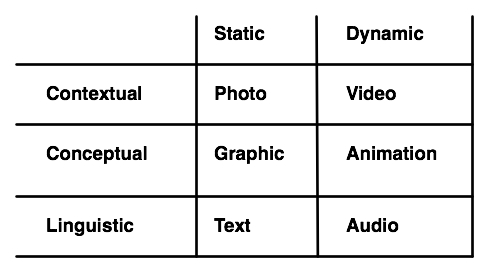
I seldom have the time when I’m online, and would rather have a ‘readers digest condensed ™’ version to read when I’m on the go. However, I do recognize that capturing a presentation can be appropriate for the right audience. Say, for example, when the audience is above the novice level, and when contextualization is important (this is a model that shows my beliefs about when/how to use media).Media Properties

Before the eLearning Guild conference, I was pinged by Veotag, a video tagging company. They were kind enough to buy me a beer when I stopped by and asked some questions (the things I’ll do for beer…). Basically, it’s a web service where you can upload and manually tag videos so that they can be hosted and you can index in to any particular place. I know Avaltus Learning does this as well, though I believe they do it for you, and charge accordingly.

I tried viewing a sample video, in this case of Guy Kawasaki interviewing Steve Wozniak, and it worked just fine, being able to jump around wasn’t a problem, and I could see that this could be a learning solution.

However, when I went to their site, I was dismayed to see that it requires Windows to do the tagging (not for viewing, I could see Woz just fine on my Mac with Firefox). In this day and age I find it hard to justify having a solution that depends on a particular platform. Yes, the corporate world is still largely tied to Microsoft, so this likely isn’t a deal breaker for most folks. But for me, while I think there’s definitely a role for capturing video and making it navigable, I don’t think this is a solution I’m rapt over.

Imagineering

7 May 2007 by Clark Leave a Comment

Last week we went down to LA to visit my Mother for her birthday, and to take the kids to Disneyland for a day (after the other trips we’ve taken for family reasons, including my Dad‘s rememberance). It was a great trip for all reasons, but the Disney experience had a lesson for me.

We had almost no lines the whole day even for top rides like the Matterhorn, Pirates of the Caribbean, Indiana Jones, etc. We caught Mr. Toad’s Wild Ride early, but late in the day went back to Fantasyland to hit Pinocchio, Snow White, & Peter Pan (none of which I’d been on in more years than I care to admit). We went on the first two, since the line for Peter Pan was substantially longer.   Finally we bit the bullet and got in line for Pan, and then I understood why people were waiting for it. Peter Pan was a substantially better ride, for important reasons.

Now, each of these rides has a ‘license’ (in the game industry, companies with ‘properties’ such as Lord of the Rings will license them to companies to make accompanying games, and no one else can make a competing game) they have to align with. The trick, then, is to make the ride a compelling experience in and of itself, as well as use the story associated with the license. With games, sometimes the experience *is* the story, that is you play James Bond in GoldenEye, and other times it’s another story with the same character (e.g. Indiana Jones and the Fate of Atlantis).

In a ride, the experience should be good on it’s own, whether or not you know the story. So, for example, our kids never got into the Pinocchio movie and consequently don’t know the story. Nor had they seen the Disney version of Peter Pan. Yet the Peter Pan ride was just very cool: you float out over the city in a sailing ship and into the stars, before coming down and flying around Neverland. While in Pinocchio, you basically just see the events in the story (with the one caveat of being eaten by the whale, which is scary). And Snow White didn’t even have a real ending, suddenly you’re just out!

Disney’s Imagineering has done amazing things, and those rides are old, but there’s a lesson here about getting the experience right, so that not only is the story referenced, but the rider actually has an interesting experience. That holds for learning game (er, Immersive Learning Simulation) design, too, where you don’t just want cognitive practice of important decisions, but you’d like the learner to be emotionally engaged. As I tell my workshop attendees, it’s not about designing content, it’s about creating an experience! So, think wholistically and create an environment that hooks you from the beginning, creates interesting emotional trajectories, and provides a feeling of closure at the end.

See you in the funny papers

24 April 2007 by Clark 1 Comment

I decided to elaborate a bit more on my comment that I think comics/cartoons are underused in learning, as I truly believe this. I’ve used them in elearning to serve as a motivating example, humorously exaggerating the negative consequences of not learning the material. I’ve also used them as story examples, where the character models the behavior of transforming an ill-formed statement into a well-formed statement. Why?

There are some powerful reasons to consider using cartoons and comic strips (graphic novels, manga, what have you). First, we understand the world in terms of stories, in many instances, and comic strips are a great way to communicate stories. They’re concise, and can minimize the amount of literacy required. And they’re visually appealing.

Then they elegantly simplify the context. You can include the necessary components, and allow the learner’s brain to fill in the rest. That’s true too for the transition between panels (see Scott McCloud’s Understanding Comics for more). This may also facilitate the learner taking ‘ownership’ of the story, as they have to do some of the processing.

They also have one facility I really like. As Alan Shoenfeld’s work says, as I know it through Collins & Brown’s Cognitive Apprenticeship, experts need to make the underlying thought processes visible, not just the resulting steps (say, in working a problem). Thought bubbles are a great way to do this! You can do this with the ‘voiceover’ in audio and video (typically echoing slightly when it’s thoughts), but it’s easier to produce.

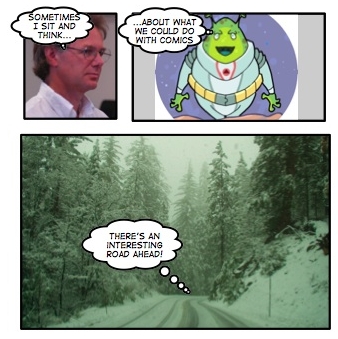
Comic ComicPragmatically, they can be relatively low-cost to produce, and they’re certainly low bandwidth (well, if you do it right ;). Brent Schenkler’s been talking about using ComicLife (a Mac app that lets you put speech and thought bubbles on photos) which would work as well, and then he points to tools that let you make comics! Here’s an elementary one I created with ComicLife. Not definitive, but illustrative (and doable with my limited skills).

Finally, they travel well. While humor might not (though certain types of humor should), the story will, as most if not all cultures have a form of comic strip and they’re easily comprehended. Practically, the internationalization and localization should be easy as well, as long as you leave enough room in the thought bubbles for languages like German translation (and keep all lettering in a separate layer).

I know, you have enough trouble talking about games in corporate settings, and comics may not be any easier, but think of the excitement of your audience, particularly young ones, talk about the lower cost to hit the global market and for lower-literacy employees. I even think they could be used to tell the corporate story (as has been done with novelizations).

Upcoming Talk: eLearning Strategy

5 April 2007 by Clark Leave a Comment

I’ve talked a bit before about eLearning Strategy, and have refined the thoughts into what I hope is a pretty systematic picture about what the different tactics are and how they can be aligned into a coherent approach. It includes ways of thinking about the different needs, the different tools, and systematic steps to get from content on a screen with a quiz, or virtual classroom, to a performance ecosystem (Jay Cross’ learnscape).

I’ll be presenting the thoughts at the eLearning Guild’s Annual Gathering, and as this is embryonic, ‘m really hoping to get feedback and hear things I’ve missed or ways to improve it (of course, I’m hoping it’s already valuable).

If you’re responsible for eLearning Strategy, or thinking about it, I’d love to see you there and in particular hear your feedback!

LCBlog’s big question of the month: Supporting New Managers

10 March 2007 by Clark 2 Comments

This month’s Learning Circuits big question is What Would You Do to Support New Managers? I’ve noticed that some create long answers to these questions, but I try to be brief. Of course, I risk people missing the nuances of my reply, but there’s only so much time in a day ;).

I remember a project we did with a client who had just this problem. They’d developed a set of exercises to assist the ‘promoted from the frontline’ managers in switching to the new role of manager. They did a good job of breaking down the tasks into small chunks, and our task was making an online version. NOT, of course, just putting them online, but revising them to achieve the objectives in the new media. Now if only I could remember what those chunks were…

This is a great example, by the way, where there’s an attitude change and major skill set development as well. The attitude change has to be one of moving from being a colleague and perhaps friend to being a respected manager. There’re a whole bunch of associated skills including comprehending business drivers, aligning and measuring performance, inspiring (versus just motivating), coaching, etc.

So what would I do to support them? Let them listen to some folks who were in the situation and learned lessons, have them explore their own views of management and compare to other views, provide them with principles and safe practice, and then scaffold that practice over time while providing them with a community for support. And I’d practice what I preach, inspiring them, coaching their performance, basically modelling the behavior I would want them to adopt.

It’s really the case of how I’d like to be developed as a manager!

Value Nets

10 March 2007 by Clark Leave a Comment

Well, it was a busy time to begin with, but the time for my Dad‘s remembrance was an unexpected (although necessary and fulfilling) addition to the load. As a consequence, I’ve had my head down with little time for reflection. However, there’s been an interesting synergy between a project I’ve been doing and a framework I’ve been developing.

I’ve had the pleasure of working with Verna Allee (who I mentioned earlier) on a project, and getting to know her stuff better. I’ve also been abstracting from some work with a business partner across several organizations, assisting their elearning strategy. One of the things I saw was that there was a reasonable sequence of steps to take in moving from ‘content on a screen with a quiz’ and ‘virtual classroom’ to a technology-empowered performance environment.

eLearning ValueNet
I decided to justify the steps by mapping the organizational and individual benefits from each step, and they reliably include broader reach and more organizational value as you move up the chain. I also believe (but have yet to map, and not sure I can or will) that the steps have to proceed in this order. Or, rather, if you adopt one of the tactics, you’ll have to retrofit the others to move up a level.

I’m willing to be wrong about that last, of course :). I’ll be talking about this at the eLearning Guild’s always excellent Annual Gathering, so maybe we’ll have a chance to talk about it further.

Filling the informal gap

28 February 2007 by Clark Leave a Comment

The day before yesterday I listened to Jay Cross give his spiel on informal learning. I’m already a fan, but apparently some people were having trouble mapping it into concrete action plans the last time he gave it, and I suspect he wasn‘t putting enough initial framing around it. It got me to thinking…

Informal Learning GapsJay was using O‘Driscoll‘s model on the relative role of formal versus informal learning, and it occurred to me that one of the ways to think about the role of informal learning is filling in the middle. For the novice, you need courses to get the learner up over some initial knowledge/skill hurdles. At the top end, you need to provide a way for experts to converse and negotiate understanding. But what are you doing for the middle?

What do I mean? Jay got Cisco to talk about how they were making videos of presentations available. I‘ve heard of a case where engineers asked a firm to record the white papers as podcasts for listening to in the car. And all that rapid elearning (read: narrated powerpoints and captured webinars) similarly qualifies.

The point being that informal learning is about putting resources out there for the folks who are beyond courses, but are not yet ready to be creating their own resources. Making these resources and making them available, and allowing ways for these learners to tap into the expert conversations (and the experts) as well as begin communicating with peers, is what you need to do.

So, are you neglecting the middle majority, or not?

« Previous Page
Next Page »

Clark Quinn

The Company

Search

Feedblitz (email) signup

Never miss a post
Your email address:*
Please wait...
Please enter all required fields Click to hide
Correct invalid entries Click to hide

Pages

  • About Learnlets and Quinnovation

The Serious eLearning Manifesto

Manifesto badge

Categories

  • design
  • games
  • meta-learning
  • mindmap
  • mobile
  • social
  • strategy
  • technology
  • Uncategorized
  • virtual worlds

License

Previous Posts

  • March 2026
  • February 2026
  • January 2026
  • December 2025
  • November 2025
  • October 2025
  • September 2025
  • August 2025
  • July 2025
  • June 2025
  • May 2025
  • April 2025
  • March 2025
  • February 2025
  • January 2025
  • December 2024
  • November 2024
  • October 2024
  • September 2024
  • August 2024
  • July 2024
  • June 2024
  • May 2024
  • April 2024
  • March 2024
  • February 2024
  • January 2024
  • December 2023
  • November 2023
  • October 2023
  • September 2023
  • August 2023
  • July 2023
  • June 2023
  • May 2023
  • April 2023
  • March 2023
  • February 2023
  • January 2023
  • December 2022
  • November 2022
  • October 2022
  • September 2022
  • August 2022
  • July 2022
  • June 2022
  • May 2022
  • April 2022
  • March 2022
  • February 2022
  • January 2022
  • December 2021
  • November 2021
  • October 2021
  • September 2021
  • August 2021
  • July 2021
  • June 2021
  • May 2021
  • April 2021
  • March 2021
  • February 2021
  • January 2021
  • December 2020
  • November 2020
  • October 2020
  • September 2020
  • August 2020
  • July 2020
  • June 2020
  • May 2020
  • April 2020
  • March 2020
  • February 2020
  • January 2020
  • December 2019
  • November 2019
  • October 2019
  • September 2019
  • August 2019
  • July 2019
  • June 2019
  • May 2019
  • April 2019
  • March 2019
  • February 2019
  • January 2019
  • December 2018
  • November 2018
  • October 2018
  • September 2018
  • August 2018
  • July 2018
  • June 2018
  • May 2018
  • April 2018
  • March 2018
  • February 2018
  • January 2018
  • December 2017
  • November 2017
  • October 2017
  • September 2017
  • August 2017
  • July 2017
  • June 2017
  • May 2017
  • April 2017
  • March 2017
  • February 2017
  • January 2017
  • December 2016
  • November 2016
  • October 2016
  • September 2016
  • August 2016
  • July 2016
  • June 2016
  • May 2016
  • April 2016
  • March 2016
  • February 2016
  • January 2016
  • December 2015
  • November 2015
  • October 2015
  • September 2015
  • August 2015
  • July 2015
  • June 2015
  • May 2015
  • April 2015
  • March 2015
  • February 2015
  • January 2015
  • December 2014
  • November 2014
  • October 2014
  • September 2014
  • August 2014
  • July 2014
  • June 2014
  • May 2014
  • April 2014
  • March 2014
  • February 2014
  • January 2014
  • December 2013
  • November 2013
  • October 2013
  • September 2013
  • August 2013
  • July 2013
  • June 2013
  • May 2013
  • April 2013
  • March 2013
  • February 2013
  • January 2013
  • December 2012
  • November 2012
  • October 2012
  • September 2012
  • August 2012
  • July 2012
  • June 2012
  • May 2012
  • April 2012
  • March 2012
  • February 2012
  • January 2012
  • December 2011
  • November 2011
  • October 2011
  • September 2011
  • August 2011
  • July 2011
  • June 2011
  • May 2011
  • April 2011
  • March 2011
  • February 2011
  • January 2011
  • December 2010
  • November 2010
  • October 2010
  • September 2010
  • August 2010
  • July 2010
  • June 2010
  • May 2010
  • April 2010
  • March 2010
  • February 2010
  • January 2010
  • December 2009
  • November 2009
  • October 2009
  • September 2009
  • August 2009
  • July 2009
  • June 2009
  • May 2009
  • April 2009
  • March 2009
  • February 2009
  • January 2009
  • December 2008
  • November 2008
  • October 2008
  • September 2008
  • August 2008
  • July 2008
  • June 2008
  • May 2008
  • April 2008
  • March 2008
  • February 2008
  • January 2008
  • December 2007
  • November 2007
  • October 2007
  • September 2007
  • August 2007
  • July 2007
  • June 2007
  • May 2007
  • April 2007
  • March 2007
  • February 2007
  • January 2007
  • December 2006
  • November 2006
  • October 2006
  • September 2006
  • August 2006
  • July 2006
  • June 2006
  • May 2006
  • April 2006
  • March 2006
  • February 2006
  • January 2006

Amazon Affiliate

Required to announce that, as an Amazon Associate, I earn from qualifying purchases. Mostly book links. Full disclosure.

We use cookies to ensure that we give you the best experience on our website. If you continue to use this site we will assume that you are happy with it.