Learnlets

Secondary

Clark Quinn’s Learnings about Learning

Search Results for: engagement

Measuring Culture Change

1 November 2016 by Clark Leave a Comment

Someone recently asked how you would go about measuring culture change, and I thought it’s an interesting question.  I’ll  think ‘out loud’ about what might be the possibilities.  A  learning culture is optimal for organizational innovation and agility, and it’s likely that not all elements are already in place.  So it’s plausible that you’d want to change, and if you do, you’d like to know how it’s going.

I think there are two major categories of measures: direct and indirect. Direct measures are ones that are impacting the outcomes you’re looking for, and indirect ones are steps along the way. Say, for instance, one desirable outcome of a learning culture would be, well, learning!  In this case, I mean the broad sense of learning: problems solved, new designs generated, research answering questions.  And indirect would be activity likely to yield that outcome. It could be engagement, or social interaction, or…  If we think of it in a Kirkpatrickian sense, we want to generate the indirect activity, and then measure the actual business impact.

What direct measures might there be?  I can see time to solve customer problems or problems solved per time.  And/or I might look at the rate of research questions answered.  Or the rate of new product generation.  Of course, if you were expecting other outcomes from your culture initiative, you’d naturally want aligned methods.   You could just be concerned with employee engagement, but I’m somewhat inclined (and willing to be wrong) to think about what the outcome of increased engagement would be.  It could also be retention or recruitment, if those are your goals.

These latter – engagement, recruitment, retention – are also possible indirect measures.  They indicate that things are better. Another indirect but more targeted measure might be the amount of collaboration happening (e.g. the use of collaboration tools) or even activity in social networks.  Those have been touted as the benefits of building community in social media, and those are worthwhile as well.

As a process, I think about what I might do  before, during, and after any culture change initiative.  I’d probably want a baseline to begin with, and then regular (if not continual) assessments as we go.  I’d take small steps, perhaps in one unit to begin, and monitor the impact, tuning as I go along.  Culture change is a journey, not an event, after all ;).


So ok, that’s off the top of my head, what say you?

Pick my brain?

26 October 2016 by Clark 1 Comment

It’s a continual bane of a consultant’s existence that there are people who want to ‘pick your brain’.  It’s really asking for free consulting, and as such, it’s insulting. If you google the phrase, you’ll see how many people have indicated their problems with this! However, there are quite legitimate ways to  pick  my brain  and I thought I’d mention a couple.  In both cases,  I think were great engagements on both sides, high value for a reasonable investment.

Both in this case were for folks who develop content. In one case a not-for-profit, the other in the higher-ed space.  One  had heard me speak about learning design, and one had heard about a workshop I’d given, but both contacted me. It is clear they realized that there’s value to them for having a scrutable learning design.

Content Review

So for the first one, they wanted some feedback on their design, and we arranged that I’d investigate a representative sample and provide feedback.  I went through systematically, taking notes, and compiled my observations into a report I sent them.  This didn’t take any investment in travel, but of course this feedback  only points out what’s wrong, and doesn’t really provide mechanisms to improve.

I think they were surprised at the outcome, as the feedback was fairly robust.  They had a good design, largely, under the constraints, but there were some systematic design problems.  There were also  some places where they’d managed to have some errors that had passed editorial (and this was only a small sample of a replicated model across a broad curriculum). To be fair, some of my complaints came from situations that were appropriate given some aspect of their  context that I hadn’t known, but there were still a set of specific improvements I could recommend:

“We found his comments insightful, and  we look forward to implementing his expert suggestions to further improve of our product…“

Learning Design Workshop

In this case, they’d heard about a workshop that I’d run on behalf of a client, and were interested in getting a similar experience. They had been designing content and had a great ability to track the results of their design and tweak, but really wanted a grounding in the underlying learning science.  I did review some sample content, but I also traveled to their site for a day and presented learning science details and workshopped the implications to their design process.

I went through details such as:

  • the importance and format for  objectives,
  • SME limitations and tips how to work with  them,
  • what makes effective practice,
  • the role and characteristics of concepts,
  • the details behind examples,
  • introduction and the role of emotions in the learning experience,
  • and more.

We went through examples of their content, and workshopped how they could adjust their design processes in pragmatic ways to instill the important details into their approach.  We also talked about ways to followup to not lose the momentum, but it was clear that this first visit was viewed favorable:

“…a walking encyclopedia of learning science… was able to respond to our inquiries with one well-researched perspective after another”.

consulttaleslogoSo, there are ways to pick my brain  that provide high value with mutual benefit on each side.  Sure, you can read my blog or books, but sometimes you may want assistance in contextualizing it to your situation.  I encourage you to think of making an investment in quality.  These are about learning design, but I have some examples in strategy that I intend to share soon.  And more.  Stay tuned for more    ‘adventures in  consulting’ tales that talk about ways in which a variety of needs are met.  Maybe one will resonate with you.  Of course, they’ll be mixed in with the regular reflections you’ve come to expect.

Meaningful and meta

17 August 2016 by Clark Leave a Comment

Over the weekend, one of my colleagues posted a rant about MOOCs and critical thinking. And, largely, I think he was right.  There’re several things we need, and MOOCs as they typically are constituted, aren’t going to deliver.  As I talked about yesterday, I think we need a more refined pedagogy.

So the things we need, to me, are two things:

  1. meaningful learning, whereby we have individuals learning skills that are applicable in their lives, and
  2. meta-learning, or learning to learn, so that people can continue to develop their skills in the face of increasing change.

And I don’t think the typical ‘text on screen with a quiz’ that he was ranting about is going to do it. Even with hand-shot videos.  (Though I disagree when he  doesn’t like the word ‘engage’, as I obviously believe that we need engagement, but of both heart  and mind, not just tarted up quizzes.)  He wanted critical thinking skills, and I agree.

Hence the activity framework. Yes, it depends on your design skills, but when done right, focusing on having learners create products that resemble the outputs that they’ll need to generate in their lives (and this is strongly influenced by the story-centered curriculum/goal-based scenario work of Roger Schank) is fundamentally invoking the skills they need. And having them show the thinking behind it developing their ‘work out loud’ (“show your work”) skills that ideally will carry over.

Ideally, of course, they’re engaging with other learners, commenting on their thinking (so they internalize critiquing as part of their own self-improvement skill set) and even collaborating (as they’ll have to).  And of course there are instructors involved to evaluate those critical skills.

As an aside, that’s why I have problems with AI. It’s not yet advanced enough yet, as far as I know, to practically be able to evaluate the underlying thinking and determine the best intervention.  It may be great when we are there, but for now in this environment, people are better.

The other component  is, of course, gradually handing off control of the learning design responsibility to the learners. They should start choosing what product, what reflection, what content, and ultimately what activity.  This is part of developing their ability to take control of their learning as they go forward.  And this means that we’ll have to be scrutable in our learning design, so they can look back, see how we’re choosing to design learning, so they can internalize that meta-level as well.

And we can largely use MOOC technologies (though we need to have sufficient mentors around, which has been a challenge with the ‘Massive’ part).  The point though, is that we need curriculum design that focuses on meaningful skills, and then a pedagogical design that develops them  and the associated learning skills.  That’s what I think we should be trying to achieve.  What am I missing?

Learning Through the Wild

10 August 2016 by Clark 1 Comment

So last week I was in the wilderness for some more time, this time with family.  And there were several learnings as an outcome that are worth sharing.

VogelsangLakeAs context, Yosemite National Park is one of the world’s truly beautiful places, with the valley as an accessible way to see the glacier-carved rock. Beyond the valley, however, there is backcountry (mountains, rivers, lakes) that is only accessible by backpack, and I’ve done plenty of that. And then there’s one other option: the High Sierra Camps. There you can stay in tent cabins, eating prepared meals, but you can only get to them by horse or by hiking. (You can also get just meals, and carry in your tents and bags and all, which is what we did.) What this does is get you to a subset (a spectacular subset) of the high country, a chance to experience real wilderness without having to be able to carry a backpack.

Also as context, I am a fervent believer in the value of wildness.  As I expressed before, there’s the creativity aspect that comes from spending time in the wilderness. You can reflect on your regular world when you’re no longer tied to it.  As you hike or ride along the trails, your mind can wander and process in the background. There are also mental health benefits to be found in escaping from the everyday clatter. (This is very  necessary  for  me! :) And,  importantly, the processes in nature provide a counter-balance to the artificial processes we put in place to breed plants and animals. The variation generated in the wild is a complement to our own approaches, just as computers are a complement to our brains. Consequently, I believe we need to preserve some of our natural spaces.

So, one of the learning outcomes is being able to experience the wilderness without having to be physically capable of carrying everything you need on your back.  I reckon that if you can experience the wildness, you can appreciate it, and then can become a supporter.  Thus, just the existence of these alternate paths (between cars and backpacking) means to me a higher likelihood of preserving the environment.

Similarly, there are rangers who visit these camps, and provide after-dinner campfire talks.  They talk  at  dinner, talking about what they will be covering, but also advocating for the value of the programs and the wilderness. Similarly, the staff at the camps also do a good job of advocating for the wilderness (as they would), and there are guidebooks available for perusal to learn more, as well as information around the dining rooms (and  great food!).

One of the larger learning lessons is that, once you’re in context, the interest is naturally sparked, and then you’re ripe for a  message. Your curiosity gets stoked about  why coyotes howl, once you hear them. Or you wonder about the geology, or the lifecycle of plants, or…you get the idea.  Creating artificial contexts is one of the tricks of learning (please, don’t keep it abstract, it doesn’t work), but layering it on in context is increasingly doable and more valuable.

Meaningful engagement in context is a valuable prerequisite for learning. The reason we can go to conferences and get value (contrary to the old “you can’t learn from a lecture”) is because we’re engaged in activity and conferences serve as reflection opportunities.  Sometimes you need to get away from the context to reflect, if the contextual pressures are too much, and sometimes the context naturally sparks reflection.  Making time for reflection is a component of a learning organization, and getting support in context or having time away from context both are parts. So my recommendation is to support wilderness, and get out in it!

The probability of wasting money

3 August 2016 by Clark Leave a Comment

Designing learning is a probability game.  To paraphrase Dorothy Parker, you can lead a learner to learning, but you can’t make them think.  What I mean is that the likelihood that the learning actually sticks is a result of a myriad of design decisions, and many elements contribute to that likelihood.  It will vary by learner, despite your endeavors, but you increase the probability that the desired outcome is achieved by following what’s know about how people learn.

This is the point of learning engineering, applying learning science to the design of learning experiences.  You need to align elements like:

  • determining  learning objectives that will impact the desired outcome
  • designing  sufficient contextualized practice
  • appropriately presenting a conceptual model that guides performance
  • providing a sufficient and elaborated suite of examples to   illustrate the concept in context
  • developing emotional engagement

and so on.

And to the extent that you’re not fully delivering on the nuances of these elements, you’re decreasing the likelihood of having any meaningful impact. It’s pretty simple:

If you don’t have the right objectives (e.g. if you just take an order for a course), what’s the likelihood that your learning will achieve anything?

If you don’t have sufficient practice, what’s the likelihood that the learning will still be there when needed?

If you have abstract practice, what’s the likelihood that your learners will transfer that practice to appropriate situations?

If you don’t guide performance with a model, what’s the likelihood that learners will be able to adapt their performance to different situations?

If you don’t provide examples, what’s the likelihood that learners will understand the full range of situations and appropriate adaptations for each?

And if you don’t emotionally engage them, what’s the likelihood that any of this will be appropriately processed?

Now, let’s tie that back to the dollars it costs you to develop this learning.  There’s the SME time, and the designer time, and development time, and the time of the learners away from their revenue-generating activity. At the end of the day, it’s a fair chunk of change.  And if you’re slipping in the details of any of this (and I’m just skating the surface, there’re nuances around all of these), you’re diminishing the value of your investment, potentially all the way to zero. In short, you could be throwing your money away!

This isn’t to make you throw up your hands and say “we can’t do all that”.  Most design processes have the potential to do the necessary job, but you have to comprehend the nuances, and ensure that the i’s are dotted and t’s crossed on development.  Just because  you have an authoring tool doesn’t mean what comes out is actually achieving anything.

However, it’s possible to tune up the design process to acknowledge the necessary details. When you  provide support at just the right places, and put in place the subtle tweaks on  things like working with SMEs, you can develop and deliver learning that has a high likelihood of having the desired impact, and therefore have a process that’s justifiable for the investment.

And that’s really the goal, isn’t it?  Being able to allocate resources to impact the business in meaningful ways is what we’re  supposed to be doing. Too frequently we see the gaps continue (hence the call for Serious eLearning), and  we can only do it if we’re acting like the professionals we need to be.    It’s time for a tuneup in organizational learning.  It’s not too onerous, and it’s needed.  So, are you ready?

eLearning Process Survey results!

21 June 2016 by Clark Leave a Comment

So, a few weeks ago I ran a survey asking about elearning processes*, and it’s time to look at the results (I’ve closed it).  eLearning process is  something I’m suggesting is ripe for change, and I thought it appropriate to see what people thoughts.  Some caveats: it’s self-selected, it’s limited (23 respondents), and it’s arguably readers of this blog or the other folks who pointed to it, so it’s a select group.  With those caveats, what did we see?

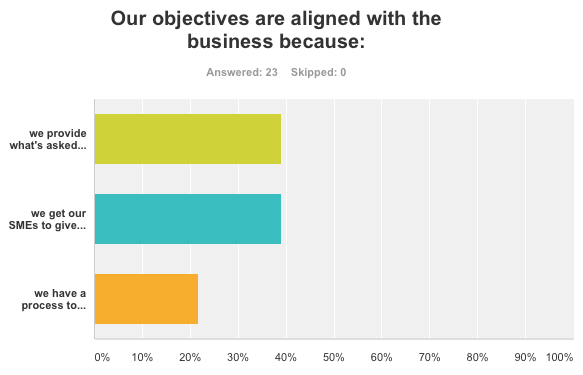
SQ1The first question was looking at how we align our efforts with business needs. The alternatives were ‘providing what’s asked for’ (e.g. taking orders), ‘getting from  SMEs’, and ‘using a process’.  These are clearly in ascending order of appropriateness. Order taking doesn’t allow for seeing if a course is needed and SMEs can’t tell you what they actually do. Creating a process to ensure a course is the best solution (as opposed to a job aid or going to the network), and then getting the real performance needs (by triangulating), is optimal.  What we see, however, is that only a bit more than 20% are actually getting this right from the get-go, and almost 80% are failing at one of the two points along the way.

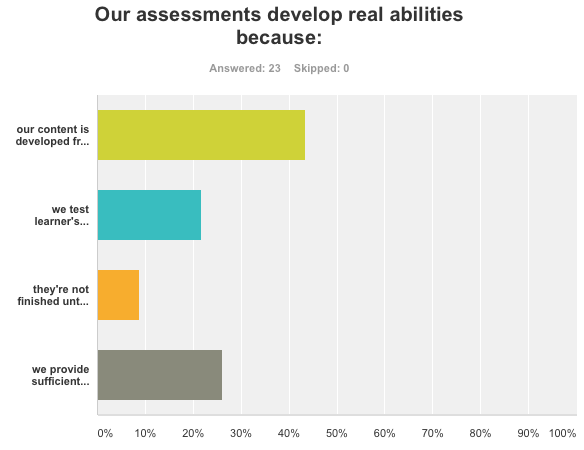
SQ2The second question was asking about how the assessments were aligned with the need. The options ranged from ‘developing from good sources’, thru ‘we test knowledge’ and ‘they have to get it right’ to ‘sufficient spaced contextualized practice’, e.g. ’til they can’t get it wrong.  The clear need, if we’re bothering to develop learning, is to ensure that they can do it at the end.  Doing it ‘until they get it right’ isn’t sufficient to develop a new ability to do.  And, we see more than 40% are focusing on using the existing content! Now, the alternatives were not totally orthogonal (e.g. you could have the first response and any of the others), so interpreting this is somewhat problematic.  I assumed  people would know to choose the lowest option in the list if they could, and I don’t know that (flaw in the survey design).  Still it’s pleasing to see that almost 30% are doing sufficient practice, but that’s only a wee bit ahead of those who say they’re just testing knowledge!  So it’s still a concern.

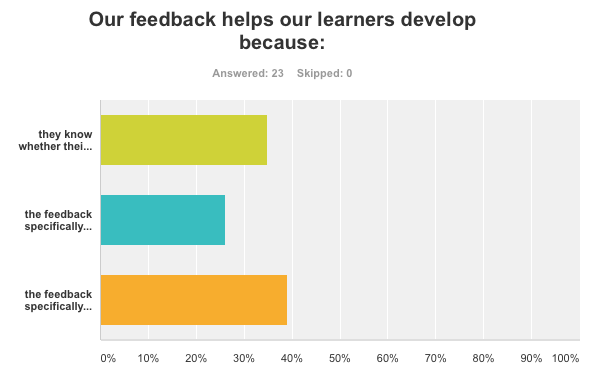
SQ3The third question was looking at the feedback provided. The options included ‘right or wrong’, ‘provides the right answer’, and ‘indication for each wrong answer’.  I’ve been railing against one piece of feedback for all the wrong answers for years now, and it’s important. The alternatives to the wrong answer shouldn’t be random, but instead should represent the ways learners typically get it wrong (based upon misconceptions).  It’s nice (and I admit somewhat surprising) that almost 40% are actually providing feedback that addresses each wrong answer. That’s a very positive outcome.  However, that it’s not even half is still kind of concerning.

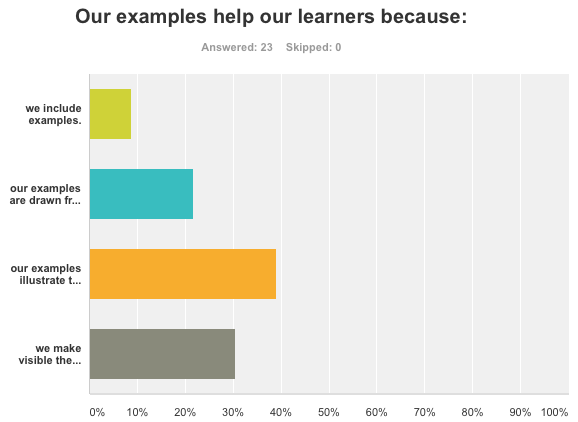
SQ4The fourth question digs into the issue of examples.  There are nuances of details about examples, and here I was picking up on a few of these. The options  ranged from ‘having’, thru ‘coming from SMEs’ and ‘illustrate the concept and context’, to ‘showing the underlying thinking’.  Again, obviously the latter is the best.  It turns out that experts don’t typically show the underlying cognition, and yet it’s really valuable for the learning. We see that we are getting the link of concept to context clear, and together with showing thinking we’re nabbing roughly 70% of the examples, so that’s a positive sign.

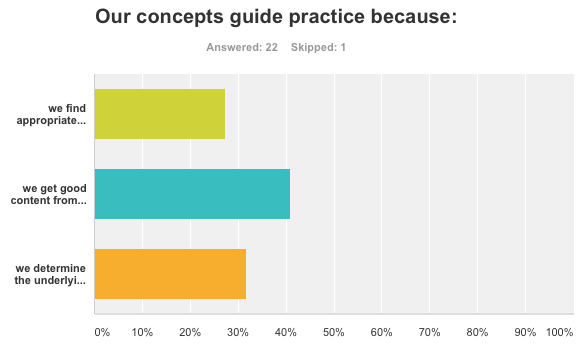
SQ5The fifth question asks about concepts.  Concepts are (or should be) the models that guide performance in the contexts seen across examples and practice (and the basis for the aforementioned feedback). The alternatives ranged from ‘using good content’ and ‘working with SMEs’ to ‘determining the underlying model’.  It’s the latter that is indicated as the basis for making better decisions, going forward.  (I suggest that what will helps orgs is not the ability to receive knowledge, but to make better decisions.)  And we see over 30% going to those models, but still a high percentage still taking the presentations from the SMEs. Which isn’t totally inappropriate, as they  do have access to what they learned. I’m somewhat concerned overall that much of ID seems to talk about practice and ‘content’, lumping intros and concepts and examples and closing all together into the latter (without suitable differentiation), so this was better than expected.

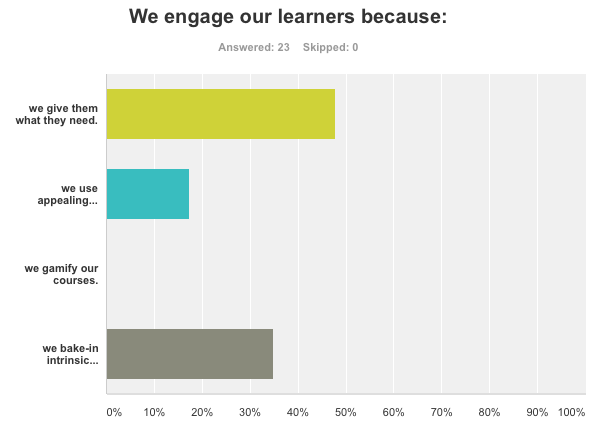
SQ6The sixth question tapped into the emotional side of learning, engagement. The options were ‘giving learners what they need’, ‘a good look’, ‘gamification’, and ‘tapping into intrinsic motivation’.  I’ve been a big proponent of intrinsic motivation (heck, I effectively wrote a book on it ;), and not gamification. I think an appealing visual design, but just ‘giving them what they need’ isn’t sufficient for novices: they need the emotional component too. For practitioners, of course, not so much.  I’m pleased that no one talked about gamification (yet the success of companies that sell ‘tart up’ templates suggests that this isn’t the norm). Still, more than a third are going to the intrinsic motivation, which is heartening. There’s a ways to go, but some folks are hearing the message.

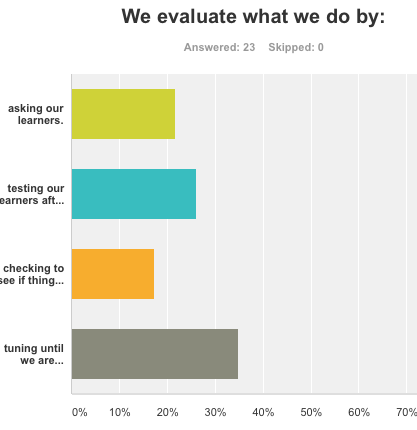
SQ7The last question gets into measurement.  We should be evaluating what we do. Ideally, we start from a business metric we need to address and work backward. That’s typically not seen. The questions basically covered the Kirkpatrick model, working from ‘smile sheets’, through’ testing after the learning experience’ and ‘checking changes in workplace behavior’ to ‘tuning until impacting org  metrics’.  I was pleasantly surprised to see over a third doing the latter, and my results don’t parallel what I’ve seen elsewhere. I’m dismayed, of course, that over 20% are still just asking learners, which we know in general isn’t of particular use.

This was a set of questions deliberately digging into areas where I think elearning falls down, and (at least with this group of respondents), it’s not good as I’d hope, but not as bad as I feared.  Still, I’d suggest there’s room for improvement, given the constraints above about who the likely respondents are.  It’s not a representative sample, I’d suspect.

Clearly, there are ways to do well, but it’s not trivial. I’m arguing that we can do good elearning without breaking the bank, but it requires an understanding of the inflection points of the design process where small changes can yield important results. And it requires an understanding of the deeper elements to develop the necessary tools and support. I have been working with several organizations to make these improvements, but it’s well past time to get serious about learning, and start having a real impact.

So over to you: do you see this as a realistic assessment of where we are? And do you take the overall results as indicating a healthy industry, or an industry that needs to go beyond haphazard approaches and start practicing Learning Engineering?

*And, let me say, thanks  very much to those respondents who bothered to take the time to respond.  It was quick, but still, the effort was completely appreciated.


Moving forward

11 May 2016 by Clark Leave a Comment

I’ve argued before that there’s a pretty clear path forward for organizations.  The necessity to become agile means that the old ‘command and control’ approach won’t cut it any longer. What’s required is tapping into the ability of people to work together.  The new structure is focused on teams (stayed tuned for my review of Amy Edmondson’s Teaming) that  are given the tasks to solve problems, trouble shoot, design new products and services, and generally continue to adapt.  In short, to learn. And I want to talk about the L&D role here, at least the potential one.

Certain elements are required.  The teams need  a number of things to be effective.  They have  to be given  meaningful tasks, to have the freedom to pursue them, to have the ability to experiment (and fail) as necessary, and to be accountable.  To collaborate successfully to accomplish their goals, they need certain features internally:  they need to have diverse representation, be open to new ideas, have time for reflection, and it has to  be safe to contribute.

This takes a new approach from the organization. It takes leadership to make such a culture, and the culture itself has to make it possible for these to occur and to get people to be motivated to contribute.  Two  elements really contribute: contribution,  and transparency.  People need to know what each other is doing, and be willing to chip in and assist.  This happens both within teams and beyond.

So what is L&D’s role?  First, to model the desired behavior. L&D should be practicing what it preaches in experimenting and continually improving. There should be teams assigned to tasks, and the practitioners should be acting as members of their communities.   They should be evangelizing, piloting, and sharing their successes with this approach, while continually learning more.

Then, L&D should be working with others as teams to meet their client needs.  They should be working to innovate around the solutions.  They should be promoting and executing on pilots that get fleshed out.  And they should be gradually raising awareness about the processes and the culture.

Done well, this movement reduces turnover, increases engagement, and produces better outcomes.  It’s not trivial; there are nuances and challenges that will have to be addresses.  On the other hand, evidence is converging that this  is the future of business. So are you preparing for it, or waiting to be blind-sided?  If you’re looking for guidance in getting going, I’m easy to find.


Work with purpose

30 December 2015 by Clark Leave a Comment

As another component of the Future of Work thinking I’ve been doing, one thing that strikes me is the question of what helps people  want to work, which I think pretty clearly will be important.  And I was reminded by my ITA colleague Jane Hart of the work of Dan Pink in his book Drive, where he isolates three components of what makes people engaged: autonomy, mastery, and purpose.  And I think this is a good list.

The idea is fairly straightforward: people want work that actually does something important, they want to be free to pursue that work, and they want to be developed in their ability to accomplish that work.   What work is appropriate for different people is part of the task of deciding who to hire, and who to assign to what.

And while I think autonomy and mastery are part of the picture, for sure, I want to focus on making work  meaningful.  OK, freeing up people from micromanaging is going to be a necessity going forward, but that’s part of the necessary move to agile organizations, and while that’s challenging, it has to happen for organizations to survive. And supporting people by giving them assignments that stretch their abilities, and coaching them through it is absolutely important, but flows out of the 70:20:10 model. Jane, in her valuable book  Modern Workplace Learning, gives very specific  guidance  about managers developing individual potential as part of the larger picture.  But the area that strikes me as something I haven’t developed my thoughts  about before is finding ways to characterize work so that it connects to people.

I think work has to be meaningful (just as I argue learning has to be meaningful). Here I mean something specific, in that people see the connection between what they’re doing and the impact on the world.  And that’s not always done, and certainly not systematically or well.  And yet I think it’s a service to the employees and part of a thriving organization.  Heck, it probably even leads to better employee engagement ;).

Seriously, it first takes an organization that has a clear focus on what it’s doing. There’re the old stories about ice companies losing out when refrigerators came in, and I think that’s part of it: a very clear focus on what purpose they serve. And this is important to align an organization, and make the strategy easier to focus on.  A secondary desirable component, to me, is to understand what contribution the organization is making to the world. I think the ‘b corp‘ notion is a great one here. (I may be an idealist, but that’s the world I  want to live in. ;).

Then, there needs to be a clear alignment between what the employee is doing and the overall organizational goal. I think that if there’s a clear purpose for the work, you have a greater likelihood for employees to be engaged.  No one likes busywork, after all, but even some drudge work that’s part of a bigger picture can be shouldered. And it also means that rote work, work that can be automated,  should be automated, leaving people free to do the important work.   Very much like learning needs to see how the learning connects to their work and the bigger picture, so too should their work connect to the bigger picture, within and outside the org.

Not to say this is easy. It requires clear communication (queue the Coherent Org), and a clear vision, but these are steps organizations need to do.  The recognition that this alignment, coupled with a ‘safe’ culture (i.e. not the Miranda Organization), is the necessity for going beyond survival to ‘thrival’ I think is the catalyst for change in meaningful work. And that’s a good place to go.

#itashare

Starting a revolution?

29 December 2015 by Clark Leave a Comment

In thinking a bit about the Future of Work, one of the issues is where to start.  If we take the implications of the Coherent Organization to heart, we realize that the components include the work teams, the communities of practice (increasingly I think of it as a community of improvement), and the broader network.  But where to begin?

A couple of principles fall into place for me.  The first is the notion of  ‘trojan mice’, e.g. small steps rather than a epic change. That, coupled with the notion of scaling up from the small, leads me to believe that the best place to start is to start small. This follows on the advice about change in general  that changes should be strategic and leveraged.

So, a natural place to start small is the team itself.  The goal would be to draw upon a diverse team meeting a real need, but facilitating their tool use. I remember an engagement with a Scandinavian oil company that I was brought in on, where they started out establishing teams for new projects that crossed geographies (and, implicitly, cultures), scaffolded them using collaboration and communication tools, and then released them back to other projects. The goal was to skill up teams and have the team members become viral influences.

Another approach, as there are already likely communities in existence, would be to migrate and facilitate communities online. I recall that the Defense Acquisition University took this approach.  However, I might like to get some project teams going with tools and then migrate out to the communities, where those team members that had participated were familiar with the tools and could be drawn upon by the community.

In fact, after the initial team work, I might facilitate a team not only working together, but working out  loud back to their respective communities.  And while it makes practical sense to be sequential, at some point it might make sense to go parallel, and be having the working out loud from the teams being worked on at the same time as the community development. But for resource reasons, I might make it sequential.  Ultimately, you want to be facilitating the communities participating in  and outside  the organizations, and looking to other communities both inside and outside for inspiration.

The point is to be finding a small way to begin, and maybe take several tries until you work out how to do it well, then start scaling up and out.  You want to build need, awareness, and ability steadily.  It can effect a change in culture too, if the principles that make this work in teams and communities begins to be made aware as well.

And this is not independent of work on going to more performance consulting and performance support in the organization, but instead is a complement.  In previous exercises, different organizations have prioritized different elements, where you begin will be dependent on your context.

So, in the social space,  this is my instinct and experience, but welcome hearing alternate viewpoints.

#itashare

Working and learning out loud

22 December 2015 by Clark 2 Comments

I’ve been thinking about some of the talk around the Future of Work, and in addition to the free flow of information I recently posted about  from the Coherent Organization, I think working out loud is another component.  Inspired by a post from my colleague ITA Harold Jarche,  this is how I see it, in actionable terms.  (And I expect this is also part of Jane Bozarth’s Show Your Work, but I’ve yet to get my mitts on a copy, mea culpa.)

The point is to make your work visible.  There’re two points: showing the actual goals, progress and status of your work, and showing the thinking that’s going on behind it.  And there are two dimensions: within the organization, and outside the organization.  Pragmatically, this yields some concrete and actionable elements.

First, there have to be mechanisms to share.  Ideally, you don’t have to work and then separately post it, but instead your tools automatically share.  This really means collaborative work tools, because you want people to be able to engage: at least commenting, and of course sometimes (maybe most of the time) you’ll be working in a team. Also tools that track contributions and changes.  And there may have to be permissions: so some people can edit, some can only comment, etc.

And I wouldn’t assume folks know what it means to ‘narrate your work‘ (aka learn out loud).  Here, I mean exposing the underlying elements.  This includes the context, assumptions, considerations, experiments, and reflections.  In User Interface Design, it was called Design Rationale, and it’s showing not only the current state, but how you got there.  Benefits include others’ experiences, not revising early decisions when new team members are added, and more.  The typical techniques of being explicit, modeling, evangelizing, promoting, etc, play a role here.

Then of course it has to be ‘safe’ to share, you can’t be working in a Miranda organization.  If your work will be held against  you in any way, you won’t want to share.  This means culture and policies and more. Basically, you need to be working in a Learning Organization, where the elements are aligned to facilitate optimal engagement.  This includes the practices about how to work out loud and learn out loud.

Another   issue is how far to share.  What can you share outside the organization?  Harold talks about the essential requirement of sharing outside the workplace, and that can be a big concern.  Obviously, proprietary work needs to be protected until it’s not business vulnerable. This means policies about what’s safe to share, and when.  Certainly, ‘sanitized’ work, where critical details are obscured but the thinking is shown should be supported in going out to communities of practice.  And the end result, when the business advantage isn’t threatened, could and should be shared through articles or webinars or conference presentations.

At the end, it’s a risk/reward tradeoff for any project at any time. What’s the benefit of getting feedback to improve versus what’s the downside of information getting out to competitors or exposing regulated data?  At any point, with any particular version of ‘anonymizing’, the balance may tip one way or another.   But the point is to be open to the benefit, and take advantage of it when and where you can.  Getting systematic at making it a regular part of any project is likely to be key.

It’s what I do here, and I encourage you to work out loud as much as you can.  So, any feedback so far?

#itashare

« Previous Page
Next Page »

Clark Quinn

The Company

Search

Feedblitz (email) signup

Never miss a post
Your email address:*
Please wait...
Please enter all required fields Click to hide
Correct invalid entries Click to hide

Pages

  • About Learnlets and Quinnovation

The Serious eLearning Manifesto

Manifesto badge

Categories

  • design
  • games
  • meta-learning
  • mindmap
  • mobile
  • social
  • strategy
  • technology
  • Uncategorized
  • virtual worlds

License

Previous Posts

  • March 2026
  • February 2026
  • January 2026
  • December 2025
  • November 2025
  • October 2025
  • September 2025
  • August 2025
  • July 2025
  • June 2025
  • May 2025
  • April 2025
  • March 2025
  • February 2025
  • January 2025
  • December 2024
  • November 2024
  • October 2024
  • September 2024
  • August 2024
  • July 2024
  • June 2024
  • May 2024
  • April 2024
  • March 2024
  • February 2024
  • January 2024
  • December 2023
  • November 2023
  • October 2023
  • September 2023
  • August 2023
  • July 2023
  • June 2023
  • May 2023
  • April 2023
  • March 2023
  • February 2023
  • January 2023
  • December 2022
  • November 2022
  • October 2022
  • September 2022
  • August 2022
  • July 2022
  • June 2022
  • May 2022
  • April 2022
  • March 2022
  • February 2022
  • January 2022
  • December 2021
  • November 2021
  • October 2021
  • September 2021
  • August 2021
  • July 2021
  • June 2021
  • May 2021
  • April 2021
  • March 2021
  • February 2021
  • January 2021
  • December 2020
  • November 2020
  • October 2020
  • September 2020
  • August 2020
  • July 2020
  • June 2020
  • May 2020
  • April 2020
  • March 2020
  • February 2020
  • January 2020
  • December 2019
  • November 2019
  • October 2019
  • September 2019
  • August 2019
  • July 2019
  • June 2019
  • May 2019
  • April 2019
  • March 2019
  • February 2019
  • January 2019
  • December 2018
  • November 2018
  • October 2018
  • September 2018
  • August 2018
  • July 2018
  • June 2018
  • May 2018
  • April 2018
  • March 2018
  • February 2018
  • January 2018
  • December 2017
  • November 2017
  • October 2017
  • September 2017
  • August 2017
  • July 2017
  • June 2017
  • May 2017
  • April 2017
  • March 2017
  • February 2017
  • January 2017
  • December 2016
  • November 2016
  • October 2016
  • September 2016
  • August 2016
  • July 2016
  • June 2016
  • May 2016
  • April 2016
  • March 2016
  • February 2016
  • January 2016
  • December 2015
  • November 2015
  • October 2015
  • September 2015
  • August 2015
  • July 2015
  • June 2015
  • May 2015
  • April 2015
  • March 2015
  • February 2015
  • January 2015
  • December 2014
  • November 2014
  • October 2014
  • September 2014
  • August 2014
  • July 2014
  • June 2014
  • May 2014
  • April 2014
  • March 2014
  • February 2014
  • January 2014
  • December 2013
  • November 2013
  • October 2013
  • September 2013
  • August 2013
  • July 2013
  • June 2013
  • May 2013
  • April 2013
  • March 2013
  • February 2013
  • January 2013
  • December 2012
  • November 2012
  • October 2012
  • September 2012
  • August 2012
  • July 2012
  • June 2012
  • May 2012
  • April 2012
  • March 2012
  • February 2012
  • January 2012
  • December 2011
  • November 2011
  • October 2011
  • September 2011
  • August 2011
  • July 2011
  • June 2011
  • May 2011
  • April 2011
  • March 2011
  • February 2011
  • January 2011
  • December 2010
  • November 2010
  • October 2010
  • September 2010
  • August 2010
  • July 2010
  • June 2010
  • May 2010
  • April 2010
  • March 2010
  • February 2010
  • January 2010
  • December 2009
  • November 2009
  • October 2009
  • September 2009
  • August 2009
  • July 2009
  • June 2009
  • May 2009
  • April 2009
  • March 2009
  • February 2009
  • January 2009
  • December 2008
  • November 2008
  • October 2008
  • September 2008
  • August 2008
  • July 2008
  • June 2008
  • May 2008
  • April 2008
  • March 2008
  • February 2008
  • January 2008
  • December 2007
  • November 2007
  • October 2007
  • September 2007
  • August 2007
  • July 2007
  • June 2007
  • May 2007
  • April 2007
  • March 2007
  • February 2007
  • January 2007
  • December 2006
  • November 2006
  • October 2006
  • September 2006
  • August 2006
  • July 2006
  • June 2006
  • May 2006
  • April 2006
  • March 2006
  • February 2006
  • January 2006

Amazon Affiliate

Required to announce that, as an Amazon Associate, I earn from qualifying purchases. Mostly book links. Full disclosure.

We use cookies to ensure that we give you the best experience on our website. If you continue to use this site we will assume that you are happy with it.