Learnlets

Secondary

Clark Quinn’s Learnings about Learning

Search Results for: engagement

Reimagining Learning

8 March 2012 by Clark 20 Comments

On the way to the recent Up To All Of Us unconference  (#utaou), I hadn’t planned a personal agenda.  However, I was going through the diagrams that I’d created on my iPad, and discovered one that I’d frankly forgotten. Which was nice, because it allowed me to review it with fresh eyes, and it resonated.  And I decided to put it out at the event to get feedback.  Let me talk you through it, because I welcome your feedback too.

Up front, let me state at least part of the motivation.  I’m trying to capture rethinking about education or formal learning. I’m tired of anything that allows folks to think knowledge dump and test is going to lead to meaningful change.  I’m also trying to ‘think out loud’ for myself.   And start getting more concrete about learning experience design.

Let me start with the second row from the top.  I want to start thinking about a learning experience as a series of activities, not a progression of content.  These can be a rich suite of things: engagement with a simulation, a group project, a museum visit, an interview, anything you might choose for an individual to engage in to further their learning. And, yes, it can  include traditional things: e.g. read this chapter.

This, by the way, has a direct relation to Project Tin Can, a proposal to supersede SCORM, allowing a greater variety of activities: Actor – Verb – Object, or I – did – this.  (For all I can recall, the origin of the diagram may have been an attempt to place Tin Can in a broad context!)

Around these activities, there are a couple of things. For one, content is accessed on the basis of the activities, not the other way around. Also, the activities produce products, and also reflections.

For the activities to be maximally valuable, they should produce output.  A sim use could produce a track of the learner’s exploration. A group project could provide a documented solution, or a concept-expression video or performance. An interview could produce an audio recording.  These products are portfolio items, going forward, and assessable items.  The assessment could be self, peer, or mentor.

However, in the context of ‘make your thinking visible’ (aka ‘show your  work’), there should also be reflections or cognitive annotations.  The underlying thinking needs to be visible for inspection. This is also part of your portfolio, and assessable. This is where, however, the opportunity to really recognize where the learner is, or is not, getting the content, and detect opportunities for assistance.

The learner is driven to content resources (audios, videos, documents, etc) by meaningful activity.  This in opposition to the notion that content dump happens before meaningful action. However, prior activities can ensure that learners are prepared to engage in the new activities.

The content could be pre-chosen, or the learners could be scaffolded in choosing appropriate materials. The latter is an opportunity for meta-learning.  Similarly, the choice of product could be determined, or up to learner/group choice, and again an opportunity for learning cross-project skills.  Helping learners create useful reflections is valuable (I recall guiding honours students to take credit for  the work they’d done; they were blind to much of the own hard work they had put in!).

When I presented this to the groups, there were several questions asked via post-its on the picture I hand-drew. Let me address them here:

What scale are you thinking about?

This unpacks. What goes into activity design is a whole separate area. And learning experience design may well play a role beneath this level.  However, the granularity of the activities is at issue.  I think about this at several scales, from an individual lesson plan to a full curriculum.    The choice of evaluation should be competency-based, assessed by rubrics, even jointly designed ones.  There is a lot of depth that is linked to this.

How does this differ from a traditional performance-based learning model?

I hadn’t heard of performance-based learning. Looking it up, there seems considerable overlap.  Also with outcome-based learning,  problem-based learning, or service learning, and similarly Understanding By Design.  It may not be more, I haven’t yet done the side-by-side. It’s scaling it up , and arguably a different lens, and maybe more, or not.  Still, I’m trying to carry it to more places, and help provide ways to think anew about instruction and formal education.

An interesting aside, for me, is that this does  segue to informal learning. That is, you, as an adult, choose certain activities to continue to develop your ability in certain areas.  Taking this framework provides a reference for learners to take control of their own learning, and develop their ability to be better learners.  Or so I would think, if done right.  Imagine the right side of the diagram moving from mentor to learner control.

How much is algorithmic?

That really depends.  Let me answer that in conjunction with this other comment:

Make a convert of this type of process out of a non-tech traditional process and tell that story…  

I can’t do that now, but one of the attendees suggested this sounded a lot like what she did in traditional design education. The point is that this framework is independent of technology.  You could be assigning studio and classroom and community projects, and getting back write-ups, performances, and more.  No digital tech involved.

There are definite ways in which technology can assist: providing tools for content search, and product and reflection generation, but this is not  about technology. You could be algorithmic in choosing from a suite of activities by a set of rules governing recommendations based upon learner performance, content available, etc.  You could also be algorithmic in programming some feedback around tech-traversal.  But that’s definitely not where I’m going right now.

Similarly, I’m going to answer two other questions together:

 How can I look at the path others take? and How can I see how I am doing?

The portfolio is really the answer.  You should be getting feedback on your products, and seeing others’ feedback (within limits).  This is definitely not intended to be individual, but instead hopefully it could be in a group, or at least some of the activities would be (e.g. communing on blog posts, participating in a discussion forum, etc).  In a tech-mediated environment, you could see others’ (anonymized) paths, access your feedback, and see traces of other’s trajectories.

The real question is: is this formulation useful? Does it give you a new and useful way of thinking about designing learning, and supporting learning?

Making it visible and viral

22 February 2012 by Clark 2 Comments

On a recent client engagement, the issue was spreading an important initiative through the organization.  The challenges were numerous: getting consistent uptake across management and leadership, aligning across organizational units, and making the initiative seem important and yet also doable in a concrete way.  Pockets of success were seen, and these are of interest.

For one, the particular unit had focused on making the initiative viral, and consequently had selected and trained appropriate representatives dispersed through their organization. These individuals were supported and empowered to incite change wherever appropriate.  And they were seeing initial signs of success. The lesson here is that top down is not always sufficient, and that benevolent infiltration is a valuable addition.

The other involvement was also social, in that the approach was to make the outcomes of the initiative visible. In addition to mantras, graphs depicting status were placed in prominent places, showing current status.  Further, suggestions for improvement were not only solicited, but made visible and their status tracked.  Again, indicators were positive on these moves.

The point is that change is hard, and a variety of mechanisms may  be appropriate.  You need to understand not just what formal mechanisms you have, but also how people actually work.  I think that too often, planning fails to anticipate the effects of inertia, ambivalence, and apathy.  More emotional emphasis is needed, more direct connection to individual outcomes, and more digestion into manageable chunks. This is true for elearning, learning, and  change.

In looking at attitude change, and from experience, I recognize that even if folks are committed to change, it can be easy to fall back into old habits without ongoing support.  Confusion in message, lack of emotional appeal, and idiosyncratic leadership only reduce the likelihood.  If it’s important, get alignment and sweat the details. If it’s not, why bother?

Slow Learning – #change11

3 December 2011 by Clark 18 Comments

This is a longer post launching my week in the #change11 MOOC (Massively Open Online Course).  

Our formal learning approaches too often don‘t follow how our brains really work.   We have magic now; we can summon up powerful programs to do our bidding, gaze through webcams across distances, and bring anyone and anything to pretty much anywhere. Our limitations are no longer the technology, but our imaginations. The question is, what are we, and should be, doing with this technology?

I like to look at this a couple of ways. For one, I like to ask myself “what would my ideal learning situation be”

Stop and ask yourself that.   Go ahead, I‘ll wait.   And feel free to share!

For me, that would be having a personal mentor traveling with me, looking at my tasks, providing both support in the moment, and developing me slowly over time.   I talked about how we might systematize that in a post titled Sage at the Side.   I also talked about this model as Layered Learning.   That is, layering on learning across our life.

It‘s part of what my colleague Harold Jarche talks about when saying “work is learning and learning is work”, the notion that as organizations start empowering workers to adapt to the increasing complexity, there will be no difference between work and learning, and we‘ll have to move away from the ‘event‘ model of learning and start integrating learning more closely into our activities.   We‘ll need to have a closer coupling between our activities and the resources, creating what Jay Cross calls a workscape and I‘ve termed the performance ecosystem.   That is, having the tools to hand, including job aids, people, and skill development, but in a more systemic way.

Think about that: how would you construct an optimal performance environment for yourself?   What would it look like?   Again, feel free to share.

Would it look like an LMS over here, training away over there, job aids scattered across portals, and social networks hierarchically structured or completely banned?   Would you have spray-and-pray (aka show up and throw up) training?   Online courses that are clicky-clicky bling-bling? Resources accessible by the way the organization is siloed?   Even the simple and well-documented matter of spaced learning is largely violated in most of the learning interventions we propagate.   In short, all of this is in conflict with how the human brain works!

Look at how how we learn naturally, before schooling (what I call the 7 C‘s of natural learning). We see that we learn by being engaged in meaningful activity, and working with others.   It‘s not about knowledge dump and test, but instead about coupling engaged activity with reflection.   I like Collins, Brown, & Holum‘s Cognitive Apprenticeship as a model for thinking more richly about learning.   Other learning models are not static (c.f. Merrill‘s trajectory through CDT to ID2 to Ripples), and I believe they‘ll converge where Cognitive Apprenticeship is (albeit perhaps my slightly adulterated version thereof).   It talks about modeling, scaffolding and release, naturally incorporating social and meaningful activity into the learning process.

Taking a broader look, too many of our systems have a limited suite of solutions to choose from, and ignore a number of features that we need.   The ADDIE process assumes a course, and still doesn‘t have any real support for the emotional engagement aspect. A step above is the HPT approach, which does look at the learning need and checks to see whether the solution might be a course, a job aid, realigning incentives, or some other things. However, it still doesn‘t consider, really, engagement, nor does an adequate job of considering when connecting to a person is a more valuable solution than designing content.

And while Gloria Gery‘s seminal work on Electronic Performance Support Systems suggested that these systems could not only provide support in the moment but also develop the learners‘ understanding, I still don‘t see this in any systems in practice. Even GPSs don‘t help you understand the area, they just get you where you‘re trying to go. So we are still missing something.

I‘m really arguing for the need to come up with a broader perspective on learning.   I‘ve been calling it learning experience design, but really it‘s more.   It‘s a combination of performance support and learning (and it‘s badly in need of some branding help). The notion is a sort-of personal GPS for your knowledge work. It‘s knows where you want to go (since you told it), and it knows where you are geographically and semantically (via GPS and your calendar), and as it recognizes the context it can provide not only support in the moment, but layers on learning along the way.   And I think that we don‘t know really how to look at things this way yet; we don‘t have design models (to think about the experience conceptually), we don‘t have design processes (to go from goal to solution), and we don‘t have tools (to deliver this integrated experience).   Yet the limits are not technological; we have the ability to build the systems if we can conceptualize the needed framework.

I think this framework will need to start with considering the experience design, what is the flow of information and activity that will help develop the learner (e.g. “If you get the design right, there are lots of ways to implement it”).   Then we can get into the mechanics of how to distribute the experience across devices, information, people, etc.   But this is embryonic yet, I welcome your thoughts!

Really, I‘m looking to start matching our technology more closely to our brains.   Taking a   page from the slow movement (e.g. slow X, where X = food, sex, travel, …), I‘m talking about slow learning, where we start distributing our learning in ways that match the ways in which our brains work: meaningfulness, activation and reactivation, not separate but wrapped around our lives, etc.

There‘s lots more: addressing the epistemology of learners, mobile technologies, meta-learning & 21st C skills, and deep analytics and semantic systems, to name a few, but I think we need to start with the right conceptions.   Some of my notions of design may be too didactic, after all, and we‘ll need to couple information augmentation with meaning-making to make real progress, but I think this notion of stepping back and reflecting on what we might want to achieve and where we‘re currently inadequate is an initial step.

And now the initiative is over to you. I look forward to your thoughts.

Readings

Collins, A., Brown, J.S., and Holum, A. (1991).   .   Cognitive Apprenticeship: Making Thinking Visible. American Educator, Winter.

Quinn, C. (2004).   Learning at Large.   Educational Technology, 44, 4, 45-49.

Quinn, C. (2009). Populating the LearnScape: e-Learning as Strategy. In M. Allen (Ed.) Michael Allen‘s eLearning Annual 2009. Pfeiffer, San Francisco.

Quinn, C. (2010). Rethinking eLearning.   Learning Solutions Magazine. April.

Quinn, C. (2010). Designing for an uncertain world. Learnlets. April.

Thalheimer, W. (2006).  Spacing Learning Over Time.  Work Learning Research.

Evil Design

1 December 2011 by Clark 4 Comments

In the mobile ideation session I ran today for some folks, the question came up about good and bad examples of design, and subsequent events reminded me of the topic of not just bad, but evil design. What I mean is design that is crafted to return maximal outcome to the designer, not just at the expense of the user, but even to the discomfort of the user or contrary to their intentions.  Let me cite a few examples.

First, while this has been improved somewhat, the kiosks that <my usual airline> uses to check in had a big yellow ‘continue’ button that you used to indicate you were ready to move on to the next screen. And the first couple of times in an instance it was innocuous, so you got used to using the button comfortably and automatically.  But then, you’d get the opportunity to spend some extra money – nicer seats, extra miles – and the default action, signaled by the big yellow button,was to spend the money.  This could be several hundred dollars! I fortunately didn’t get trapped (I try to get to the airport early), but I wonder how many rushing travelers inadvertently *did* manage to overspend.  I think such a design takes advantage of our cognitive architecture, falling into a pattern, in unconscionable ways.

Then, today, I was driving back to O’Hare airport from the aforementioned engagement. Following my GPS instructions and the signs, I followed the route to the airport.  Now, on the way out there was a required toll, and I drove through and paid the guy (since naturally I didn’t have a pass). The signs on the way back announcing tolls didn’t look noticeably different, and so I didn’t pay too much attention. Imagine my surprise, then, to find a toll payment arrangement requiring either a pass (which of course I didn’t have) or payment by coins.  Which I also didn’t have.  And  the amount was more than the outbound fee, so even if I tried to use change, I likely wouldn’t have enough (who keeps lots of change around these days?).

The cameras no doubt caught me sitting there looking around, then calling for help, then furiously driving on after giving the camera a frustrated glare. Of course there’s a fine if you don’t pay, but there’s no way to pay except through a long URL that’d be hard to get exactly right.  You have seven days, which in one sense is nice, but might cause you to put it off and forget.  Worse, when you do go online, you’d have to known to record the license plate state and number to be able to pay!  And, of course, it’s highly likely in the rush of travel that you’d forget to do this.  This seems designed for the sheer purpose to get more fees.  For example, paying online is more expensive than paying the original fee.  Why can they have a person outbound, and not inbound?  It’s capitalizing on expectations and putting you in circumstances that are likely to maximize your inability to pay in the initial instance.  What’s with that?

It gets worse, by the way. If you didn’t remember (and our brains aren’t good at rote memory) that the site is singular (Xtollway.com) and instead type  Xtollways.com  (a reasonable and even likely mistake), you end up at a site that looks like it can help, but instead seems to have sponsored ads and looks for clicks. If you weren’t paying attention, you could end up giving your credit card to the wrong site, and still not have paid the fine!  I’m surprised such a site can exist and not be shut down!

Our cognitive architecture has some flaws, and these can be exploited by the unscrupulous (c.f. commercial gambling).  It helps to be cognizant of it. It ranges from the designing interface, to ad campaigns, and the whole way companies conduct  business (see the Cluetrain Manifesto).

This is, BTW, at least part of the reason I don’t like gamification, as many game mechanics like adding points tap into human reactions in a way to get them to do things they might not otherwise do.  This *can* be good if it gets them to do things like lose excess weight or quit smoking, but I’d rather tap into intrinsic motivation instead.

While I’m a fan of good design, and there’s a continuum to bad design, I still prefer that to evil design.  How about you?

WIIFL

24 August 2011 by Clark Leave a Comment

What’s In It For Learners?

In organizations, we talk about addressing WIIFM (What’s In It For Me).  As a key component of motivation, we want to connect to individuals viscerally.  With my focus on engagement in learning, I’ve felt it’s important to address the conative (anxiety, motivation, etc) of learners as well.

What I’ve meant by this has included having introductions that viscerally capture the consequences of the knowledge (positive or negative, dramatically or comically; I’ve a predilection for comically negative), help them connect the learning to the broader context of the world, help them understand why it’s important for them, remove anxiety, etc.  I believe we need to open up learners emotionally as well as the well-known benefits of activating relevant knowledge cognitively.

I was just writing up a list of what would need to change for schools to be effective, and as I was riffing on epistemology (having learners understand and take responsibility for learners), it occurred to me that we needed to address the WIIFM, and I realized it’s about WIIFL.  We need to explicitly address what makes the learning experience valuable to learners.  I’m sure we’ve all heard learners say something like “I’ll never use this”.  If it’s true, bin it.  If it’s not, then help them see it.

On a set of content I was lead on the design of (math), I created the spec for our introductions to show how the content would get used in real life, and then we worked through meaningful examples and practice items. In another set of content I created the engagement for, we used a professional cartoonist to create a comic that introduced every section.

We don’t emphasize enough helping learners understand why they should care, so is it any wonder why they question the WIIFM?  And it’s not  presenting the learning objectives that we use to design, it’s a more coherent story that uses, essentially, marketing to get them to get it.

Ask yourself, if and when you’re creating a learning experience: WIIFL.  If you do, you can either eliminate unneeded content, or help learners connect in a motivating way. If you don’t, you risk learners tuning out and staying away.  Which isn’t a worthwhile investment of time and money.

Quick mobile thoughts

27 June 2011 by Clark Leave a Comment

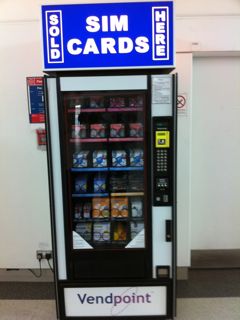
SIM card vending machine

It’s obvious that mobile is booming, as you can tell from this shot taken as I deplaned at Heathrow Airport on my way from  mLearnCon conference to an engagement.  It made me reflect on an interesting tension that emerged at the conference.  The resolution will happen, so it’s a question of when, not if, but it’s still a pain.

I was honored to be part of a closing panel with some very clever folks (Bill Rankin, David Metcalf, Carmen Taran, Jim Box, and Richard Culatta, to be specific) responding to crowd-sourced questions.  Paul Clothier served as ringmaster, and the highest rated questions were lobbed at us.

One of the emergent themes was considering what would be really innovative mobile learning applications.  We imagined things from individual coaches to universal teachers.  All this requiring, of course, a pretty robust infrastructure.

And of course, as I sit in an airport (awaiting the 3rd and final leg of which Heathrow was the first), and recognizing that I can’t use the data plan on my phone for fear of penury, I’m still quite frustrated with the situation.  However, there is hope.

advert for a ubiquitous data package

On the wall right next to the vending machine, which I also captured, is one solution.  Here, Vodafone is offering Brits mobile internet when they travel, at a very favorable rate. This is better than the solution I thought was possible: having a service at an airport where you hire a personal wifi device for some reasonable rate of $10 a day or something that you return when you finish your trip.

My traveling companion on the post-US legs (and Internet Time Alliance colleague), Charles Jennings, resides in the UK and said that the competition between providers supports this sort of offer.   £2 is far better than the rate I was hoping for, and way better than a $1 – $20 per MB that is my current option.

Unlike some who worry that we might lose thinking skills, I’m quite happy to devolve certain tasks to my external brain, and only retain the ones I wish to keep for myself.  And once I’ve become so enabled, it’s painful to do without.  I’m glad to see some are getting viable solutions, and hoping I’ll have one soon too.  So we can come up with even more fabulous ways to accessorize our brains. Which is what we want to do!


The Pad and the Pod

22 April 2011 by Clark 5 Comments

I had a conversation today where I was asked about the difference with a tablet versus a smartphone (or pad versus pod :).  This is something I’ve been thinking about, and some thoughts coalesced as I answered. I don’t think this is my definitive answer, but it’s worth wrestling with (learning out loud and all that).

The must-read for mobile designers, The Zen of Palm, shows data collected from years ago on the early Palm devices (Figure 1.3) which showed the difference between usage of desktops versus handhelds. The general pattern is that folks access desktops a few times a day for long periods, while handheld devices were accessed many times a day for very short periods.

I believe this is still largely true: we tend to use our smartphones and similar devices as learning/performance support as quick access to information.  While we might listen to music, that’s a different thing.   Yes, there will be times we access a video or read a document or even listen to a podcast, but the usual use is as quick access.

And I think we use tablets more like desktops.  We settle down with them for longer periods of time, and engage more deeply. They’re often about content consumption, and they may also be for content creation, in both cases more so than the smaller devices.  And I think it’s more than a quantitative difference, I really do feel it’s qualitative.  Yes, this blurs when we’re talking about 7.1″ tablets instead of 10″, but overall I think it holds.

Which naturally leads to the question of what’s the difference between a tablet and a desktop?  And here I’m on stranger ground.  I think one of the interesting phenomena of the tablet experience is the ‘intimacy’ of the experience. You’re holding the device and touching it.  It’s in your arms, instead of at arms-length.  And I believe, without having come up with empirical ways to document, that’ it’s a more personal engagement. It helps that the first successful instance, the iPad, has an overall aesthetic that’s elegant, so media look good and the user experience feels natural.  I hate the over-used phrase ‘intuitive’, but many inferences about how to use the device play out.

So, in a sense is the tablet a mobile device?  When it’s acting like a desktop: being used to take notes, for instance, I don’t really consider it a truly mobile device, but when it can be with you to meet needs that you’re unlikely to consider meeting with a laptop, and it can deliver some meaningful interaction that’s more immediate than you’d accomplish with even a netbook, a tablet definitely is a mobile device.  And there are plenty of those times.

Fundamentally, though they can share apps, I think a pad serves a different need than a pod.  I think the pod is more performance support and learning augmentation, while the pad is more full learning.  There is overlap, and each can act as the other, but if you’ve got both, I reckon you’ll find this to be the case.

Naturally, I’m still thinking that a real learning opportunity for the pad will be when they can be more than content consumption, and actually do meaningful interaction. Not just quizzes, which can be done now via mobile web, but immersive simulations and serious games.  And you can do that now, but  not in a cross-platform way. We need a standard, like ePub for ebooks, but one that supports simulation-driven interaction.  Flash could’ve been it, but the performance problems have been a barrier.  It’s not clear whether HTML5 will meet my desires, but otherwise we need something else.  When we’ve got that capability, we have a market to provide more meaningful experiences to learners.

The implications for design are to not be exclusive to either, but if you’re designing performance support, you might be thinking more pod, and if you are thinking more full task and full learning, you might be thinking more pad.  That’s what I think, what do you think?

Thinking Social

7 March 2011 by Clark 1 Comment

In talking about the 4C’s of Mobile, the last one I usually mention is ‘communicate’.   Communicate isn’t last because it’s least, but instead because it leads us furthest afield, into the areas of social learning, which has many ramifications in many ways: organizationally, cognitively, culturally, and more.   However, it is of importance for mobile in terms of thinking about how and when to take advantage of it.   It is also something that the Internet Time Alliance is wrestling with.

We strongly believe in performance consulting, that is getting to the root cause of the organizational problem, and determining whether the problem is skill set, information, motivation, or whatever.   This is a necessary step before you decide your intervention. However, the current models of performance consulting seem to be   missing a couple of things.   For one, they are not particularly good at engagement, at least in the formal learning setting, and trying to understand the audience’s interest.   More importantly here, they also seem to lack consideration of when a social media solution might make sense.

As a preliminary step, I went back to some material I have from my workshop on mobile learning design.   One of the activities is thinking about when you might want to consider a social solution, to connect to someone to communicate, rather than have a prepared solution.   My initial thoughts were that you might want to connect when:

  • the content is highly volatile
  • the situation is likely unique
  • the cost of access is low
  • the need for personal touch or mentoring is high

These make sense to me, but I’ve no reason to believe the list is comprehensive.   However, it is a starting point for thinking about when you might want to provide access to a social resource, whether a directory of appropriate people, or consider providing communication tools.

I might extend the list with:

  • when the situation is likely new
  • when there is an expert
  • when the situation is likely to be complex.

Here’s a tougher one: when would you think the situation would likely need a collaborator, instead of an expert?   What’s the trigger?

As I said, I’m just starting to wrestle with this.   What ideas do you have?

Social Media Strategy thoughts

8 February 2011 by Clark 2 Comments

What is a social media strategy for outreach?   Really, it‘s about demonstrating your thinking, your values, and background. It‘s about interacting with appropriate people in ways that reflect who you are.

Here is some thoughts about how that maps out in two areas: Facebook, and Twitter.   I‘m mentioning these as two of the most viable and visible tools for social media engagement.

Twitter

Having a twitter account is a necessary start, maybe several. One might be just a daily thing people can follow, but it has to provide value.   So, for example, you might stream out an interesting bit of the day. That, alone, however, is not enough.

A second important role is to engage people.   More important than the first idea is to ‘be‘ an entity.   If an organization is on social media, and increasingly they should be,   it needs to be interactive. This is accomplished in several ways:

  • point to what the organization is doing
  • point to interesting things outside of the organization
  • re-tweet relevant stuff that others post (which requires following interesting people)
  • respond to people replying to that account.

These require resources, essentially a person or persons who handle these duties.   Done well, these activities demonstrate that there is an interesting mind and a sincere heart behind the account.

Facebook

The same is true of a FaceBook page.   Not only should people be friending it, they should be coming back to be engaged   the organization, but now also with their colleagues also interested in the organization.

There are different ways to be on Facebook: as a static page, or as a ‘presence‘ with dialogs, groups, etc.  A static page might get a few ‘likes‘, but you really want to build a site as a place to come for folks interested in the organization and it’s work.   There need to be discussions supported (and interacted with).   There need to be updates.   There needs to be a way for people to have a dialog with you.   You need information: photos, events.   Use apps to create polls. In short, it’s about interaction around the organization and it’s work.

Again, the message is that you‘re active, engaged, you really care about what you do.   And, again, it takes resources.

Twitter/Facebook Integration

These two elements do not live independently.   Your Twitter strategy should be aligned with your Facebook strategy, so your tweets point to new information on Facebook, your Facebook account reflects your tweets, etc.   Your tweets should drive traffic to the Facebook site, but not exclusively.

There‘s more that can be incorporated: blogs (I use twitter and my blog more than my facebook page, but I‘m an individual not an organization).   However, your elements shouldn‘t be too fragmented.   E.g. only have separate Twitter handles and Facebook pages if your separate initiatives have to maintain unique identities. However, that‘s a branding issue, and not a place I‘m qualified to talk about.   Once you‘ve got the identity, then you need to align your Facebook and Twitter strategies.

So, you should be doing this, and you need to be doing it well.   If you don’t do it right, you may as well not do it at all.

Working Smarter Cracker Barrel

12 December 2010 by Clark Leave a Comment

My Internet Time Alliance colleague Harold Jarche is a clever guy. In preparation for an event, he makes a blog post to organize his thoughts. I like his thinking, so I’ll let him introduce my post:

Next week, at our Working Smarter event hosted by Tulser in Maastricht, NL, we will have a series of short sessions on selected topics. Each Principal of the Internet Time Alliance has three topics of 20 minutes to be discussed in small groups. My topics are listed below and include links to relevant posts as well as a short description of the core ideas behind each topic.

These are mine:

Mobile

Mobile ‘accessorizes‘ your brain.   It is about complementing what your brain does well by providing the capabilities that it does not do well (rote computation, distance communication, and exact detail), but wherever and whenever you are.   Given that our performers are increasingly mobile, it makes sense to deliver the capabilities where needed, not just at their desk.   The 4 C’s of mobile give us a guide to the capabilities we have on tap.

Working smarter is not just mobile capabilities, however, but also combining them to do even more interesting things.   The real win is when we capture the current situation, via GPS and clock/calendar, so we know where you are and what you are doing, to do things that are relevant in the context.

Even without that, however, there are big offerings on the table for informal learning, via access to resources and networks.

Social Formal Learning

Social learning is one of the big opportunities we are talking about in ‘working smarter’.   Most people tend to think of social learning in terms of the informal opportunities, which are potentially huge.   However, there are a couple of reasons to also think about the benefits of social learning from the formal learning perspective.

The first is the processing.   When you are asked to engage with others on a topic, and you have designed the topic well, you get tight cycles of negotiating understand, which elaborates the associations to make them persist better and longer.   You can have learners reflect and share those reflections, which is one meaningful form of processing, and then you can ask them to extend the relevant concepts by reviewing them in another situation together, asking them to come to a shared response. The best, of course, is when learners work together to discern how the concepts get applied in a particular context, by asking them to solve a problem together.

The additional benefit is the connection between formal and informal. You must use social learning tools, and by doing so you are developing the facility with the environment your performers should use in the workplace. You also have the opportunity to use the formal social learning as a way to introduce the learners into the communities of practice you can and should be building.

Performance Ecosystem (Workscape) Strategy

Looking at the individual components – performance support, formal learning, and informal learning – is valuable, but looking at them together is important as well, to consider the best path from where you are to where you want or need to go.   Across a number of engagements, a pattern emerged that I’ve found helpful in thinking about what we term workscapes (what I’ve also called performance ecosystems, PDF) in a systemic way.

You want to end up where you have a seamless performance environment oriented around the tasks that need to be accomplished, and having the necessary layers and components.   You don’t want to approach the steps individually, but with the bigger picture in mind, so everything you do is part of the path towards the end game.   Realizing, of course, that it will be dynamic, and you’ll want to find ways to empower your performers to take ownership.

« Previous Page
Next Page »

Clark Quinn

The Company

Search

Feedblitz (email) signup

Never miss a post
Your email address:*
Please wait...
Please enter all required fields Click to hide
Correct invalid entries Click to hide

Pages

  • About Learnlets and Quinnovation

The Serious eLearning Manifesto

Manifesto badge

Categories

  • design
  • games
  • meta-learning
  • mindmap
  • mobile
  • social
  • strategy
  • technology
  • Uncategorized
  • virtual worlds

License

Previous Posts

  • March 2026
  • February 2026
  • January 2026
  • December 2025
  • November 2025
  • October 2025
  • September 2025
  • August 2025
  • July 2025
  • June 2025
  • May 2025
  • April 2025
  • March 2025
  • February 2025
  • January 2025
  • December 2024
  • November 2024
  • October 2024
  • September 2024
  • August 2024
  • July 2024
  • June 2024
  • May 2024
  • April 2024
  • March 2024
  • February 2024
  • January 2024
  • December 2023
  • November 2023
  • October 2023
  • September 2023
  • August 2023
  • July 2023
  • June 2023
  • May 2023
  • April 2023
  • March 2023
  • February 2023
  • January 2023
  • December 2022
  • November 2022
  • October 2022
  • September 2022
  • August 2022
  • July 2022
  • June 2022
  • May 2022
  • April 2022
  • March 2022
  • February 2022
  • January 2022
  • December 2021
  • November 2021
  • October 2021
  • September 2021
  • August 2021
  • July 2021
  • June 2021
  • May 2021
  • April 2021
  • March 2021
  • February 2021
  • January 2021
  • December 2020
  • November 2020
  • October 2020
  • September 2020
  • August 2020
  • July 2020
  • June 2020
  • May 2020
  • April 2020
  • March 2020
  • February 2020
  • January 2020
  • December 2019
  • November 2019
  • October 2019
  • September 2019
  • August 2019
  • July 2019
  • June 2019
  • May 2019
  • April 2019
  • March 2019
  • February 2019
  • January 2019
  • December 2018
  • November 2018
  • October 2018
  • September 2018
  • August 2018
  • July 2018
  • June 2018
  • May 2018
  • April 2018
  • March 2018
  • February 2018
  • January 2018
  • December 2017
  • November 2017
  • October 2017
  • September 2017
  • August 2017
  • July 2017
  • June 2017
  • May 2017
  • April 2017
  • March 2017
  • February 2017
  • January 2017
  • December 2016
  • November 2016
  • October 2016
  • September 2016
  • August 2016
  • July 2016
  • June 2016
  • May 2016
  • April 2016
  • March 2016
  • February 2016
  • January 2016
  • December 2015
  • November 2015
  • October 2015
  • September 2015
  • August 2015
  • July 2015
  • June 2015
  • May 2015
  • April 2015
  • March 2015
  • February 2015
  • January 2015
  • December 2014
  • November 2014
  • October 2014
  • September 2014
  • August 2014
  • July 2014
  • June 2014
  • May 2014
  • April 2014
  • March 2014
  • February 2014
  • January 2014
  • December 2013
  • November 2013
  • October 2013
  • September 2013
  • August 2013
  • July 2013
  • June 2013
  • May 2013
  • April 2013
  • March 2013
  • February 2013
  • January 2013
  • December 2012
  • November 2012
  • October 2012
  • September 2012
  • August 2012
  • July 2012
  • June 2012
  • May 2012
  • April 2012
  • March 2012
  • February 2012
  • January 2012
  • December 2011
  • November 2011
  • October 2011
  • September 2011
  • August 2011
  • July 2011
  • June 2011
  • May 2011
  • April 2011
  • March 2011
  • February 2011
  • January 2011
  • December 2010
  • November 2010
  • October 2010
  • September 2010
  • August 2010
  • July 2010
  • June 2010
  • May 2010
  • April 2010
  • March 2010
  • February 2010
  • January 2010
  • December 2009
  • November 2009
  • October 2009
  • September 2009
  • August 2009
  • July 2009
  • June 2009
  • May 2009
  • April 2009
  • March 2009
  • February 2009
  • January 2009
  • December 2008
  • November 2008
  • October 2008
  • September 2008
  • August 2008
  • July 2008
  • June 2008
  • May 2008
  • April 2008
  • March 2008
  • February 2008
  • January 2008
  • December 2007
  • November 2007
  • October 2007
  • September 2007
  • August 2007
  • July 2007
  • June 2007
  • May 2007
  • April 2007
  • March 2007
  • February 2007
  • January 2007
  • December 2006
  • November 2006
  • October 2006
  • September 2006
  • August 2006
  • July 2006
  • June 2006
  • May 2006
  • April 2006
  • March 2006
  • February 2006
  • January 2006

Amazon Affiliate

Required to announce that, as an Amazon Associate, I earn from qualifying purchases. Mostly book links. Full disclosure.

We use cookies to ensure that we give you the best experience on our website. If you continue to use this site we will assume that you are happy with it.