David McCandless gave a graphically and conceptually insightful talk on the power of visualization at the Callidus Cloud Connections. He demonstrated the power of insight by tapping into the power of our pattern matching cognitive architecture. 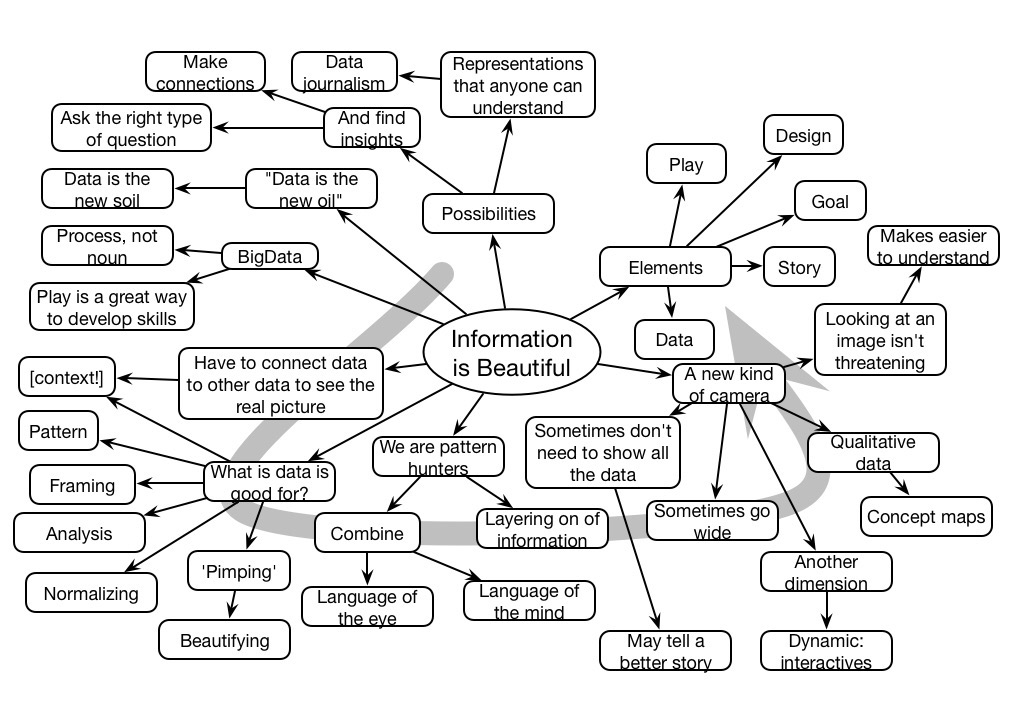
Pushing back
In a recent debate with my colleague on the Kirkpatrick model, our host/referee asked me whether I’d push back on a request for a course. Being cheeky, I said yes, but of course I know it’s harder than that. And I’ve been mulling the question, and trying to think of a perhaps more pragmatic (and diplomatic ;) approach. So here’s a cut at it.
The goal is not to stay with just ‘yes’, but to followup. The technique is to drill in for more information under the guise of ensuring you’re making the right course. Of course, really you’re trying to determine whether there really is a need for a course at all, or maybe a job aid or checklist instead will do, and if so what’s critical to success. To do this, you need to ask some pointed questions with the demeanor of being professional and helpful.
You might, then, ask something like “what’s the problem you’re trying to solve” or “what will the folks taking this course be able to do that they’re not doing now”. The point is to start focusing on the real performance gap that you’re addressing (and unmasking if they don’t really know). You want to keep away from the information that they think needs to be in the head, and focus in on what decisions people can make that they can’t make now.
Experts can’t tell you what they actually do, or at least about 70% of it, so you need to drill in more about behaviors, but at this point you’re really trying to find out what’s not happening that should be. You can use the excuse that “I just want to make sure we do the right course” if there’s some push back on your inquiries, and you may also have to stand up for your requirements on the basis that you have expertise in your area and they have to respect that just as you respect their expertise in their area (c.f. Jon Aleckson’s MindMeld).
If what you discover does end up being about information, you might ask about “how fast will this information be changing”, and “how much of this will be critical to making better decisions”. It’s hard to get information into the head, and it’s a futile effort if it’ll be out of date soon and it’s an expensive one if it’s large amounts and arbitrary. It’s also easy to think that information will be helpful (and the nice-to-know as well as the must), but really you should be looking to put information in the world if you can. There are times when it has to be in the head, but not as often as your stakeholders and SMEs think. Focus on what people will do differently.
You also want to ask “how will we know the course is working”. You can ask about what change would be observed, and should talk about how you will measure it. Again, there could be pushback, but you need to be prepared to stick to your guns. If it isn’t going to lead to some measurable delta, they haven’t really thought it through. You can help them here, doing some business consulting on ROI for them. And here’s it’s not a guise, you really are being helpful.
So I think the answer can be ‘yes’, but that’s not the end of the conversation. And this is the path to start demonstrating that you are about business. This may be the path that starts getting your contribution to the organization to start being strategic. You’ll have to start being about more than efficiency metrics (cost/seat/hour; “may as well weigh ’em”) and about how you’re actually impacting the business. And that’s a good thing. Viva la Revolucion!
Activities for Integrating Learning
I’ve been working on a learning design that integrates developing social media skills with developing specific competencies, aligned with real work. It’s an interesting integration, and I drafted a pedagogy that I believe accomplishes the task. It draws heavily on the notion of activity-based learning. For your consideration.
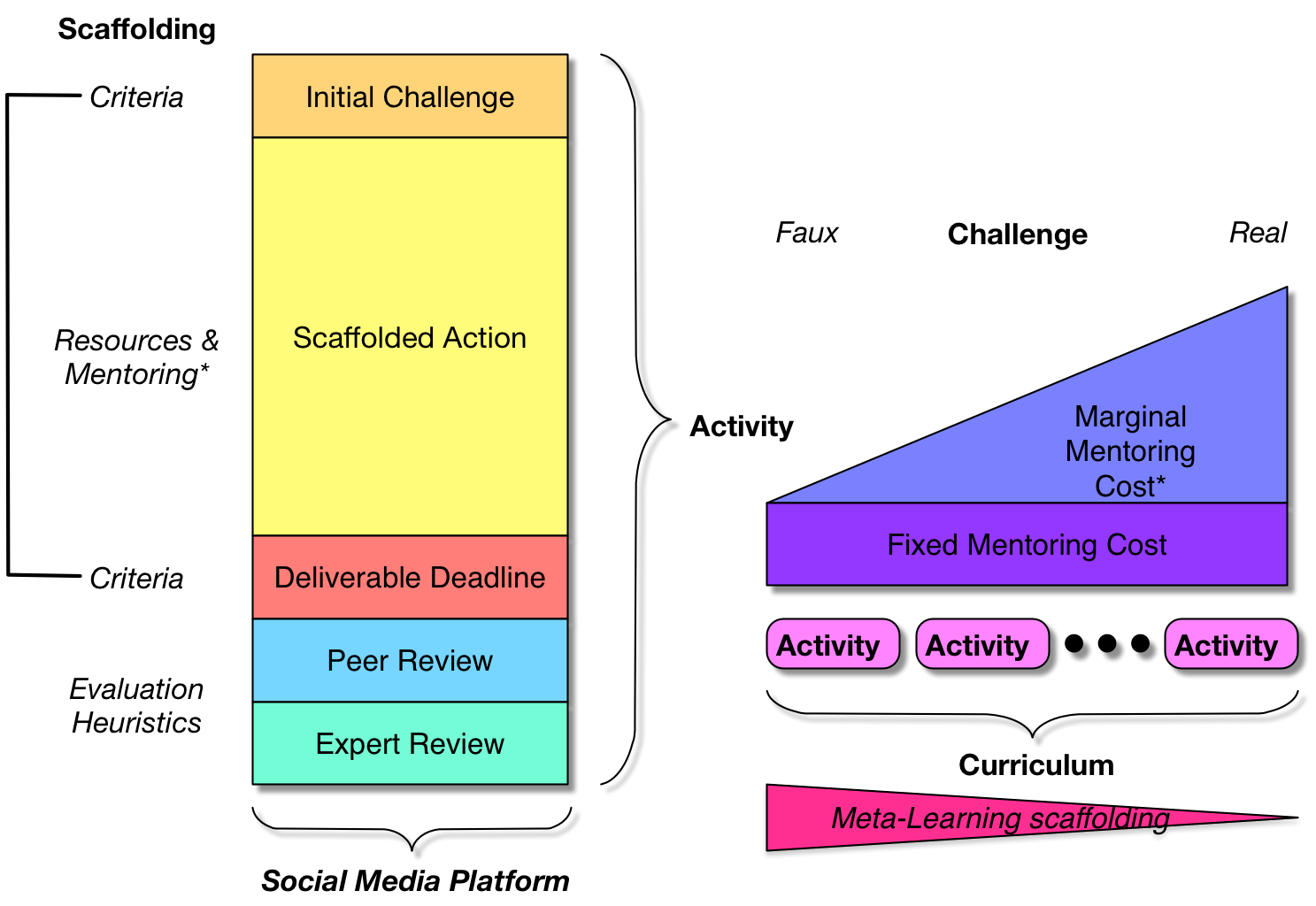 The learning process is broken up into a series of activities. Each activity starts with giving the learning teams a deliverable they have to create, with a deadline an appropriate distance out. There are criteria they have to meet, and the challenge is chosen such that it’s within their reach, but out of their grasp. That is, they’ll have to learn some things to accomplish it.
As they work on the deliverable, they’re supported. They may have resources available to review, ideally curated (and, across the curricula, their responsibility for curating their own resources is developed as part of handing off the responsibility for learning to learn). There may be people available for questions, and they’re also being actively watched and coached (less as they go on).
Now, ideally the goal would be a real deliverable that would achieve an impact on the organization. That, however, takes a fair bit of support to make it a worthwhile investment. Depending on the ability of the learners, you may start with challenges that are like but not necessarily real challenges, such as evaluating a case study or working on a simulation. The costs of mentoring go up as the consequences of the action, but so do the benefits, so it’s likely that the curriculum will similarly get closer to live tasks as it progresses.
At the deadline, the deliverables are shared for peer review, presumably with other teams. In this instance, there is a deliberate intention to have more than one team, as part of the development of the social capabilities. Reviewing others’ work, initially with evaluation heuristics, is part of internalizing the monitoring criteria, on the path to becoming a self-monitoring and self-improving learner. Similarly, the freedom to share work for evaluation is a valuable move on the path to a learning culture. Expert review will follow, to finalize the learning outcomes.
The intent is also that the conversations and collaborations be happening in a social media platform. This is part of helping the teams (and the organization) acquire social media competencies. Sharing, working together, accessing resources, etc. are being used in the platform just as they are used for work. At the end, at least, they are being used for work!
This has emerged as a design that develops both specific work competencies and social competencies in an integrated way. Of course, the proof is when there’s a chance to run it, but in the spirit of working out loud…your thoughts welcome.
Got Game?
Why should you, as a learning designer, take a game design workshop? What is the relationship between games and learning? I want to suggest that there are very important reasons why you should.
Just so you don’t think I’m the only one saying it, in the decade since I wrote the book Engaging Learning: Designing e-Learning Simulation Games, there have been a large variety of books on the topic. Clark Aldrich has written three, at least count. James Paul Gee has pointed out how the semantic features of games match to the way our brains learn, as has David Williamson Shaeffer. People like Kurt Squire, Constance Steinkuhler, Henry Jenkins, and Sasha Barab have been strong advocates of games for learning. And of course Karl Kapp has a recent book on the topic. You could also argue that Raph Koster’s A Theory of Fun is another vote given that his premise is that fun is learning. So I’m not alone in this.
But more specifically, why get steeped in it? And I want to give you three reasons: understanding engagement, understanding practice, and understanding design. Not to say you don’t know these, but I’ll suggest that there are depths which you’re not yet incorporating into your learning, and you could and should. After all, learning should be ‘hard fun’.
The difference between a simulation and a game is pretty straightforward. A simulation is just a model of the world, and it can be in any legal state and be taken to any other. A self-motivated and effective self-learner can use that to discover what they need to know. But for specific learning purposes, we put that simulation into an initial state, and ask the learner to take it to a goal state, and we’ve chosen those so that they can’t do it until they understand the relationships we want them to understand. That’s what I call a scenario, and we typically wrap a story around it to motivate the goal. We can tune that into a game. Yes, we turn it into a game, but by tuning.
And that’s the important point about engagement. We can’t call it game; only our players can tell us whether it’s a game or not. To achieve that goal, we have to understand what motivates our learners, what they care about, and figure out how to integrate that into the learning. It’s about not designing a learning event, but designing a learning experience. And, by studying how games achieve that, we can learn how to take our learning from mundane to meaningful. Whether or not we have the resources and desire to build actual games, we can learn valuable lesssons to apply to any of our learning design. It’s the emotional element most ID leaves behind.
I also maintain that, next to mentored live practice, games are the best thing going (and individual mentoring doesn’t scale well, and live practice can be expensive both to develop but particularly when mistakes are made). Games build upon that by providing deep practice; embedding important decisions in a context that makes the experience as meaningful as when it really counts. We use game techniques to heighten and deep the experience, which makes it closer to live practice, reducing transfer distance. And we can provide repeated practice. Again, even if we’re not able to implement full game engines, there are many important lessons to take to designing other learning experiences: how to design better multiple choice questions, the value of branching scenarios, and more. Practical improvements that will increase engagement and increase outcomes.
Finally, game designers use design processes that have a lot to offer to formal learning design. Their practices in terms of information collection (analysis), prototyping and refinement, and evaluation are advanced by the simple requirement that their output is such that people will actually pay for the experience. There are valuable elements that can be transferred to learning design even if you aren’t expecting to have an outcome so valuable you can charge for it.
As professionals, it behooves us to look to other fields with implications that could influence and improve our outcomes. Interface design, graphic design, software engineering, and more are all relevant areas to explore. So is game design, and arguably the most relevant one we can.
So, if you’re interested in tapping into this, I encourage you to consider the game design workshop I’ll be running for the ATD Atlanta chapter on the 3rd of June. Their price is fair even if you’re not a chapter member, and it’s great deal if you are. Further, it’s a tried and tested format that’s been well received since I first started offering it. The night before, I’ll be busting myths at the chapter meeting. I hope I’ll see you there!
Why models matter
In the industrial age, you really didn’t need to understand why you were doing what you were doing, you were just supposed to do it. At the management level, you supervised behavior, but you didn’t really set strategy. It was only at the top level where you used the basic principles of business to run your organization. That was then, this is now.
Things are moving faster, competitors are able to counter your advances in months, there’s more information, and this isn’t decreasing. You really need to be more agile to deal with uncertainty, and you need to continually innovate. And I want to suggest that this advantage comes from having a conceptual understanding, a model of what’s happening.
There are responses we can train, specific ways of acting in context. These aren’t what are most valuable any more. Experts, with vast experience responding in different situations, abstract models that guide what they do, consciously or unconsciously (this latter is a problem, as it makes it harder to get at; experts can’t tell you 70% of what they actually do!). Most people, however, are in the novice to practitioner range, and they’re not necessarily ready to adapt to changes, unless we prepare them.
What gives us the ability to react are having models that explain the underlying causal relations as we best understand them, and then support in applying those models in different contexts. If we have models, and see how those models guide performance in context A, then B, and then we practice applying it in context C and D (with model-based feedback), we gradually develop a more flexible ability to respond. It’s not subconscious, like experts, but we can figure it out.
So, for instance, if we have the rationale behind a sales process, how it connects to the customer’s mental needs and the current status, we can adapt it to different customers. If we understand the mechanisms of medical contamination, we can adapt to new vectors. If we understand the structure of a cyber system, we can anticipate security threats. The point is that making inferences on models is a more powerful basis than trying to adapt a rote procedure without knowing the basis.
I recognize that I talk a lot in concepts, e.g. these blog posts and diagrams, but there’s a principled reason: I’m trying to give you a flexible basis, models, to apply to your own situation. That’s what I do in my own thinking, and it’s what I apply in my consulting. I am a collector of models, so that I have more tools to apply to solving my own or other’s problems. (BTW, I use concept and model relatively interchangeably, if that helps clarify anything.)
It’s also a sound basis for innovation. Two related models (ahem) of creativity say that new ideas are either the combination of two different models or an evolution of an existing one. Our brains are pattern matchers, and the more we observe a pattern, the more likely it will remind us of something, a model. The more models we have to match, the more likely we are to find one that maps. Or one that activates another.
Consequently, it’s also one of the things I push as a key improvement to learning design. In addition to meaningful practice, give the concept behind it, the why, in the form of a model. I encourage you to look for the models behind what you do, the models in what your presented, and the models in what your learners are asked to do.
It’s a good basis for design, for problem-solving, and for learning. That, to me, is a big opportunity.
Cyborg Thinking: Cognition, Context, and Complementation
I’m writing a chapter about mobile trends, and one of the things I’m concluding with are the different ways we need to think to take advantage of mobile. The first one emerged as I wrote and kind of surprised me, but I think there’s merit.
The notion is one I’ve talked about before, about how what our brains do well, and what mobile devices do well, are complementary. That is, our brains are powerful pattern matchers, but have a hard time remembering rote information, particularly arbitrary or complicated details. Digital technology is the exact opposite. So, that complementation whenever or wherever we are is quite valuable.
Consider chess. When first computers played against humans, they didn’t do well. As computers became more powerful, however, they finally beat the world champion. However, they didn’t do it like humans do, they did it by very different means; they couldn’t evaluate well, but they could calculate much deeper in the amount of turns played and use simple heuristics to determine whether those were good plays. The sheer computational ability eventually trumped the familiar pattern approach. Now, however, they have a new type of competition, where a person and a computer will team and play against another similar team. The interesting result is not the best chess player, nor the best computer program, but a player who knows best how to leverage a chess companion.
Now map this to mobile: we want to design the best complement for our cognition. We want to end up having the best cyborg synergy, where our solution does the best job of leaving to the system what it does well, and leaving to the person the things we do well. It’s maybe only a slight shift in perspective, but it is a different view than designing to be, say, easy to use. The point is to have the best partnership available.
This isn’t just true for mobile, of course, it should be the goal of all digital design. The specific capability of mobile, using sensors to do things because of when and where we are, though, adds unique opportunities, and that has to figure into thinking as well. As does, of course, a focus on minimalism, and thinking about content in a new way: not as a medium for presentation, but as a medium for augmentation: to complement the world, not subsume it.
It’s my thinking that this focus on augmenting our cognition and our context with content that’s complementary is the way to optimize the uses of mobile. What’s your thinking?
Defining Microlearning?
Last week on the #chat2lrn twitter chat, the topic was microlearning. It was apparently prompted by this post by Tom Spiglanin which does a pretty good job of defining it, but some conceptual confusion showed up in the chat that makes it clear there’s some work to be done. I reckon there may be a role for the label and even the concept, but I wanted to take a stab at what it is and isn’t, at least on principle.
So the big point to me is the word ‘learning’. A number of people opined about accessing a how-to video, and let’s be clear: learning doesn’t have to come from that. You could follow the steps and get the job done and yet need to access it again if you ever needed it. Just like I can look up the specs on the resolution of my computer screen, use that information, but have to look it up again next time. So it could be just performance support, and that’s a good thing, but it’s not learning. It suits the notion of micro content, but again, it’s about getting the job done, not developing new skills.
Another interpretation was little bits of components of learning (examples, practice) delivered over time. That is learning, but it’s not microlearning. It’s distributed learning, but the overall learning experience is macro (and much more effective than the massed, event, model). Again, a good thing, but not (to me) microlearning. This is what Will Thalheimer calls subscription learning.
So, then, if these aren’t microlearning, what is? To me, microlearning has to be a small but complete learning experience, and this is non-trivial. To be a full learning experience, this requires a model, examples, and practice. This could work with very small learnings (I use an example of media roles in my mobile design workshops). I think there’s a better model, however.
To explain, let me digress. When we create formal learning, we typically take learners away from their workplace (physically or virtually), and then create contextualized practice. That is, we may present concepts and examples (pre- via blended, ideally, or less effectively in the learning event), and then we create practice scenarios. This is hard work. Another alternative is more efficient.
Here, we layer the learning on top of the work learners are already doing. Now, why isn’t this performance support? Because we’re not just helping them get the job done, we’re explicitly turning this into a learning event by not only scaffolding the performance, but layering on a minimal amount of conceptual material that links what they’re doing to a model. We (should) do this in examples and feedback on practice, now we can do it around real work. We can because (via mobile or instrumented systems) we know where they are and what they’re doing, and we can build content to do this. It’s always been a promise of performance support systems that they could do learning on top of helping the outcome, but it’s as yet seldom seen.
And the focus on minimalism is good, too. We overwrite and overproduce, adding in lots that’s not essential. C.f. Carroll’s Nurnberg Funnel or Moore’s Action Mapping. And even for non-mobile, minimalism makes sense (as I tout under the banner of the Least Assistance Principle). That is, it’s really not rude to ask people (or yourself as a designer) “what’s the least I can do for you?” Because that’s what people generally really prefer: give me the answer and let me get back to work!
Microlearning as a phrase has probably become current (he says, cynically) because elearning providers are touting it to sell the ability of their tools to now deliver to mobile. But it can also be a watch word to emphasize thinking about performance support, learning ‘in context’, and minimalism. So I think we may want to continue to use it, but I suggest it’s worthwhile to be very clear what we mean by it. It’s not courses on a phone (mobile elearning), and it’s not spaced out learning, it’s small but useful full learning experiences that can fit by size of objective or context ‘in the moment’. At least, that’s my take; what’s yours?
Tom Wujec #LSCon Keynote Mindmap
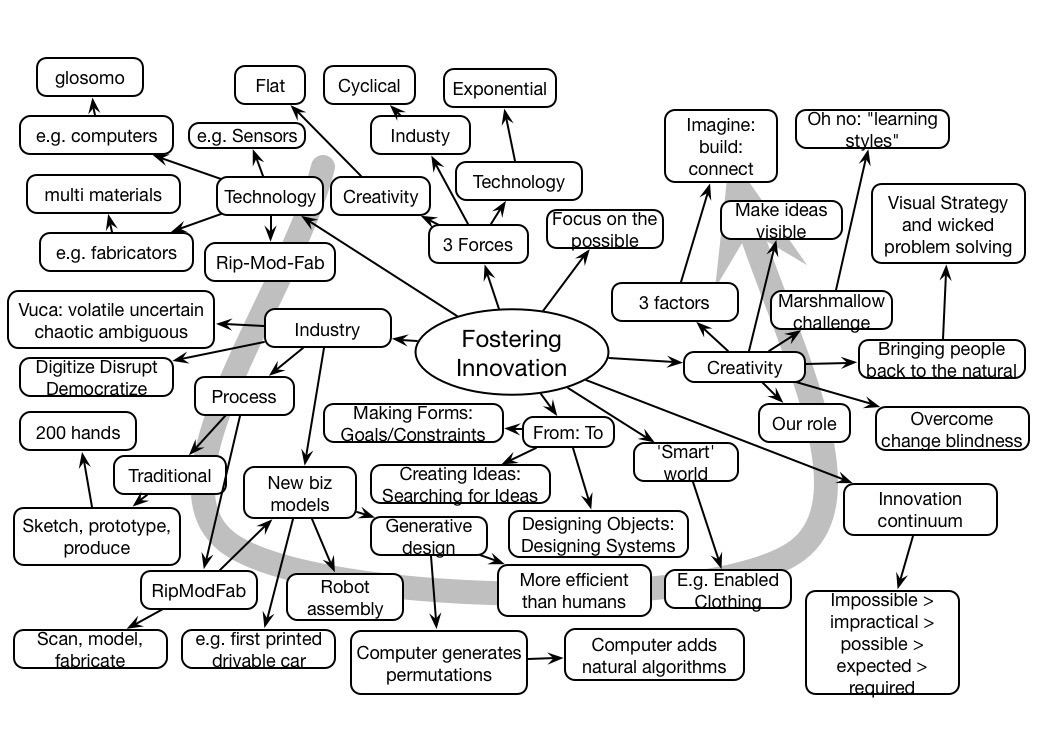
Tom Wujec gave a discursive and well illustrated talk about how changes in technology were changing industry, ultimately homing in on creativity. Despite a misstep mentioning Kolb’s invalid learning styles instrument, it was entertaining and intriguing.
Design Thinking?
There’s been quite a bit of flurry about Design Thinking of late (including the most recent #lrnchat), and I’m trying to get my around what’s unique about it. The wikipedia entry linked above helps clarify the intent, but is there any there there?
It helps to understand that I’ve been steeped in design approaches since at least the 80’s. Herb Simon’s Sciences of the Artificial argued, essentially, that design is the quintessential human activity. And my grad school experience was in a research lab focused on interface design. Process was critical, and when I was subsequently teaching interface design, I was tracking new initiatives like situated design and participatory design, anthropological efforts designed to get closer to the ‘customer’.
In addition to being somewhat obsessive about learning how people learn, and as a confirmed geek continually exploring new technology, I also got interested in design processes beyond interface design. As my passion was designing learning technology solutions to meet real needs, I explored other design approaches to look for universals. Along the way I looked at industrial, graphic, architectural, software, and other design disciplines. I also read the psychological research on our cognitive limitations and design approaches. (I made a small bit of my career on bringing the advances in HCI, which was more advanced in process, to ed tech.)
The reason I mention this is that the elements of Design Thinking: being open minded, diverging before converging, using teams, empathy for the customer, etc, all strike me as just good design. It’s not obvious to me whether it gets into the nuances (e.g. the steps in the Wikipedia article don’t allow me to see whether they do things like ensure that everyone takes time to brainstorm on their own before coming together; an important step to prevent groupthink), but at the granularity I’ve seen, it seems to be quite good. You mean everyone isn’t already both aware of and using this? Apparently not.
So in that respect, Design Thinking is a win. If adding a label to a systematized compendium of good practices will raise awareness, I’m all for it. And I’m willing to have my consciousness raised that there’s more to it, because as a proponent of design, I’m glad to see that folks are taking steps to help design get better and will be thrilled if it adds something new.
Engage, yea or nay?
In a recent chat, a colleague I respect said the word ‘engagement’ was anathema. This surprised me, as I’ve been quite outspoken about the need for engagement (for one small example, writing a book about it!). It may be that the conflict is definitional, for it appeared that my colleague and another respondent viewed engagement as bloating the content, and that’s not what I mean at all. So I thought I lay out what I mean when I say engaging, and why I think it’s crucial.
Let’s be clear what I don’t mean. If you think by engagement it’s adding in extra stuff, we’re using a very different definition of engagement. It’s not about tarting up uninteresting stuff with ‘fun’ (e.g. racing themed window dressing on knowledge test). It’s not about putting in unnecessary unrelated imagery, sounds, or anything else. Heck, the research of Dick Mayer at UCSB shows this actually hinders learning!
So what do I mean? For one thing, stripping away any ‘nice to have’ or unnecessary info. Lean is engaging! You have to focus on what really will help the learners, and in ways that they get. And they do. And then help them in the ‘in the ways they get’ bit.
You need contextualized practice. Engaging is making the context meaningful to the learners. You need contextualization (e.g research by John Bransford on anchored cognition), but arbitrary contextualization isn’t as good as intrinsically interesting contexts. This isn’t window dressing, since you need to be doing it anyway, but do it. And in a minimal style (as de Saint-Exupery said: “Perfection is finally attained not when there is no longer anything to add but when there is no longer anything to take away…”).
You want compelling examples. We know that examples lead to better learning (ala, for instance John Sweller’s work on cognitive load), but again, making them meaningful to the learners is critical. This isn’t window dressing, as we need them, but they’re better if they’re well told as intrinsically interesting stories.
Finally, we need to introduce the learning. Too often we do this in ways that the learner doesn’t get the WIIFM (What’s In It For Me). Learners learn better when they’re emotionally open to the content instead of uninterested. This may be a wee bit more, but we can account for this by getting rid of the usual introductory stuff. And it’s worth it.
Now, let’s be clear, this is for when we’ve deemed formal learning as necessary. When the audience is practitioners who know what they need and why it’s important, then giving them ‘just the facts’, performance support, is sufficient. But if it’s new skills they need, when you need a learning experience, then you want to make it engaging. Not extrinsically, but intrinsically. And that’s not more in quantity, it’s not bloated, it’s more in quality, in minimalism for content and maximal for immersion.
Engaging learning is a good thing, a better thing than not, the right thing. I’m hoping it’s just definitional, because I can’t see the contrary argument unless there’s confusion over what I mean. Anyone?