Learnlets

Secondary

Clark Quinn’s Learnings about Learning

Continual Exploration

4 April 2017 by Clark Leave a Comment

CompassI was reading about Digital Business Platforms, which is  a move away from   siloed IT systems  to create a unified environment. Which, naturally, seems like a sensible thing to do. The benefits are  about continual innovation, but I wonder if a more apt phrase is  instead  continual exploration.

The premise is that  it’s now possible to migrate from separate business systems and databases, and converge that data into a unified platform. The immediate benefits are that you can easily link information that was previously siloed, and track real time changes. The upside is the ability to try out new business models easily.  And while that’s a good thing, I think it’s not going to get fully utilized out of the box.

The concomitant component, it seems to me, is the classic ‘culture’ of learning. As I pointed out in last week’s post, I think that there are significant  benefits to leveraging the power of social media to unleash organizational outcomes. Here, the opportunity is to facilitate easier experimentation. But that takes more than sophisticated tools.

These tools, by integrating the data, allow new combinations of data and formulas to be tried and tested easily. This sort of experimentation is critical to innovation, where small trials  can be conducted, evaluated, and reviewed to refine or shift direction.   This sort of willingness to make trials, however, isn’t necessarily going to be successful in all situations.  If it’s not safe to experiment, learn from it, and share those learnings, it’s unlikely to happen.

Thus, the willingness to continually experiment is valuable. But I wonder if a better mindset is exploration. You don’t want to just experiment, you want to map out the space of possibilities, and track the outcomes that result from different ‘geographies’.  To innovate, you need to try new things. To do that, you need to know what the things are you  could try, e.g .the places you haven’t been and perhaps look promising.

It has to be safe to be trying out different things. There is trust and communication required as well as resources and permission. So here’s to systematic experimentation to yield continual exploration!

Leveraging Technology

29 March 2017 by Clark Leave a Comment

I was listening to a tale  recounting a time  when an organization was going through a change, and had solicited help.  And the story surprised me.  The short story is that the initial approach  being taken weren’t leveraging  technology effectively.  And it led me to wonder how many organizations are still doing things the old way.

So the story was of a critical organizational change.  The hired guns (the typical consulting agency) came into to do their usual schtick, interviewing some people and making recommendations. The problem was, there was no way to interview an appropriately representative sample, and consequently the outcome was going to be less than optimal.  The resulting plan was large. dd

In this situation, a colleague stepped in and managed to arrange to use a social platform to do a better job of sharing the intentions and soliciting feedback.  You might not be surprised to hear that the subsequent process also yielded greater buy-in.  The process resulted in a fine-grained analysis of the plan, with some elements continuing to be executed by the initial partner, others taken on internally, and others discarded.  The ultimate cost was reduced  far more than the cost to implement this extra step.

The missed opportunity, it turns out, was that the process used didn’t get scaled and implemented for further changes. Some outside factors removed the instigator responsible for the change and it had been done as a ‘stealth’ operation, so awareness wasn’t spread. The hired guns, already entrenched, went back to business as usual.

The eye-opener for me was the fact that the approach initially taken  wasn’t  leveraging technology.  In this day and age, that strikes me as completely unjustifiable! They were better able to support transparency and communication, and as typically happens that yielded both better outcomes and  better engagement.  Of course,  that’s the point of the revolution, getting smarter about aligning technology with how our brains think, work, and learn. It’s just that I forget how far we still need to go.

Just thinking through changes, at every stage of initiatives there’s a benefit:

  • collecting data and determining the issue, via surveys and discussion
  • developing ideas and approaches in collaboration (transparently, showing your work)
  • sharing visions about the resulting approach
  • providing support for expected problems
  • collaborating to address the unexpected problems
  • maintaining focus through the change
  • celebrating successes

All these can be facilitated through technology in powerful ways that can’t be done across geographies and timezones without tech.

So here’s my question to you. Is your organization leveraging technology appropriately?  And this is both at the level of L&D, and then also organization wide.  Is your L&D group working transparently, leveraging social media to both support effective performance and continue to develop? And then are you using that experience to spread the possibilities throughout the organization?  That’s the opportunity on tap, and I would really like to see L&D leading the way. Heck, we’re  supposed to be the ones who understand how people learn, and when it comes to change, that’s learning too. Let’s  own this!

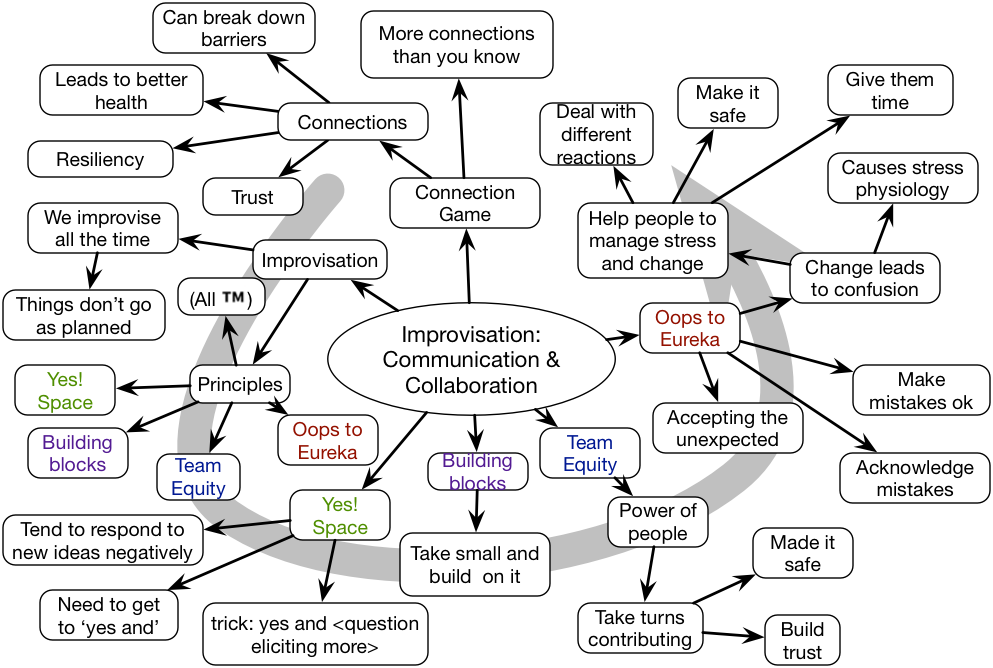
Karen Hough #ATDCore4 Keynote Mindmap

23 March 2017 by Clark 1 Comment

Karen Hough kicked off ATD’s Core 4 event with a lively keynote talking about how improvisation reflects many core factors involved in successful organizational agility.  Going through her trademarked elements, she had the audience up and participating and reflecting on interpersonal interactions. She covered important components  of a learning organization like openness to new ideas, diversity, and safety and demonstrated ways to help break down the barriers.

A ‘Field of Dreams’ Industry

8 March 2017 by Clark 3 Comments

Corn fieldIn the movie, Field of Dreams, the character played by Kevin Costner is told “If you build it, they will come.” And I use an  image from this movie to talk about learning culture, in that you can put all the elements of the performance ecosystem together, but if you work in  a Miranda organization (where anything you say can and will be held against you), you won’t be able to tap into the power of the ecosystem because people won’t share. But it’s clear that the problem is worse; the evidence suggests that L&D overall is in a ‘Field of Dreams’ mentality.

A  new  report (in addition to the two I cited last week) documents the problems in L&D.  LinkedIn has released their Workplace Learning report, and one aspect stood out: Only 8% of CEOS see biz impact of L&D, only 4% see ROI.  And if you ask the top ways they evaluate their programs, the top five methods are subjective or anecdotal.  Which concurs with data a few years ago from ATD that the implementation of measurement according to the Kirkpatrick model dropped off drastically: while 96% were doing level 1, only 34% were doing level 2, and it went dramatically down from there. In short, L&D isn’t measuring.

Which means that there’s a very strong belief that: if we build it, it is good.  And that, to me, is a Field of Dreams mentality. It feels like the L&D industry is living in a world where they take orders and produce courses and trust that it all works.  I was pleased to hear that there’s testing, but there’s far too little measurement.

And, interestingly,  one other statistic struck me:”less than 1⁄4 are willing to recommend their program to peers”.   To put it another way, the majority of L&D are embarrassed by their outputs. This isn’t any better situation than the statistics I reported in my book calling for an L&D Revolution!

So, the complaints are predictable: too little money, too few people, and getting people to pay attention. Um, that comes when you’re demonstrably contributing to the organization. And that’s the promise I think we offer. L&D could and should be a big contributor to organizational success. If we were adequately addressing the optimizing performance side of the story, and ensuring   the continual innovation part as well, our value should and would be high.

It’s past time L&D moves beyond the ‘Field of Dreams’ status, and becomes a viable, and measurable contributor to organizational success. It’s doable, under real world constraints. It needs a plan, and some knowledge, but there’s a path forward.  So, are you ready to move out of the corn, and onto the road?

Other writings

1 February 2017 by Clark Leave a Comment

It occurs to me to mention some of the other places you can find my writings besides here (and how they differ ;).  My blog posts are pretty regular (my aim is 2/week), but tend to have ideas that are embryonic or a bit ‘evangelical’. First, I’ve written four books; you can check them out and get sample chapters at their respective sites:

Engaging Learning: Designing e-Learning Simulation Games

Designing mLearning: Tapping Into the Mobile  Revolution for Organizational Performance

The Mobile Academy: mLearning For Higher Education

Revolutionize Learning &  Development: Performance and Information Strategy for the Information Age

They’re designed to be the definitive word on the topic, at least at the moment.

I’ve also written or co-written a number of chapters in a variety of books.  The books  include The Really Useful eLearning Instruction Manual,  Creating a Learning Culture, Michael Allen’s eLearning Annual 2009,   and a bunch of academic handbooks (Mobile Learning, Experiential Learning, Wiley Learning Technology ;).  These tend to be longer than an article, with a pretty thorough coverage of whatever topic is on tap.

Then  there are articles in a variety of magazines.  These tend to be aggregated thoughts that are longer than a blog post, but not as through as a chapter. In particular, they are things I think need to be heard (or read).  So, my writing has shown up in:

eLearnMag

Learning Solutions

CLO

The topics  vary. (For the eLearnMag ones, you’ll have to search for my name owing to their interface, and they tend to be more like editorials.)

And then there are blog posts for others that are a bit longer than my usual blog post, and close to an article in focus:

The  Deeper eLearning  series for  Learnnovators

A monthly article for Litmos.

These, too, are more like articles in that they’re focused, and deeper than my usual blog post.  For the latter I cover a lot of different topics, so you’re likely to find something relevant there in many different areas.

I’m proud of it all, but for a quick update on a topic, you might be best seeing if there’s a Litmos post on it first.  That’s likely to be relatively short and focused if there is one. And, of course, if it’s a topic you’re interested in advancing in and I can help, do let me know.

Silo APIs?

26 January 2017 by Clark 3 Comments

I was in a conversation with my colleague Charles Jennings  about organizational innovation, and one of the topics that arose was that of barriers to successful organizational function. In particular, we were talking about how the division of responsibility between organizational development (OD), leadership development, and learning & development is a problem. And I think the problem is bigger. Separating out functions into silos makes sense in a deterministic world, but that doesn’t characterize our current environment.

Now, separation of functions can be useful. Certainly in software engineering, having application program interfaces (APIs) have led to the ability to connect powerful capabilities.  A program can call a function and get data returned via an API, and  the software doesn’t have to care how the function’s carried out.

In the org equivalent we could have a business unit request a course, for example, and L&D responds with said course. In fact, that’s not atypical.  Yet it’s problematic in human terms. The business unit may not have done the due diligence, the performance analysis, that ensures a course is the right solution.

Ok, we could change it: the business unit could indicate the performance problem and L&D could respond. However, again there’s a problem. Without understanding how things are done, L&D’s solution won’t be contextually accurate.  Any intervention won’t reflect how things are done unless interactions occur.

And that’s the point. Any meaningful work – problem-solving, trouble-shooting, improvement, innovation, research, design etc – any  learning,  is complex. And, done right, they inherently require engagement and interaction.  Moreover, we also know that the best solutions come from  creative  friction, people interacting.  Communication and collaboration is key!

Engagement between silos works best when you mix members from each.  Or, to put it another way, breaking down the silos is the only way to get the best outputs for the important work, the work that will advance the organization whether removing errors, creating new products or processes, etc.

People are complex (the human brain is arguably the most complex thing in the known universe).  Solutions that tap into that complexity, instead of trying to avoid  it, are bound to yield the best insights. We’ve now got a lot of insight into processes that facilitate getting the best outcomes. It’s time to engage with it, to the benefit of the organization.

Culture or Cultures?

25 January 2017 by Clark Leave a Comment

A twitter pointer led me to an HBR article arguing that We’re Thinking about Organizational Culture all Wrong.  In it, the author argues that it’s fallacious to think that there’s just one organizational culture, , and that all people buy into it.  I agree, and yet where the author leads us is, I think, misleading, or at least not as helpful as it could be.

The argument includes two major thrusts. The first is that the cultural values may be interpreted differently.  What you mean by ‘free’ and what I mean may differ.  Take, for instance, the  difference between ‘free beer’ and ‘free speech’ (a classic example).  And this certainly can be the case.  The second is that people may comply with the culture even if they don’t agree with it. There are multiple reasons, such as job security, that could support this.

The result, according to the article, is that corporate ‘culture’ isn’t a set of shared values, it’s a “web of power relationships”.  That’s quite a leap, but the point is apt: these relationships can facilitate,  or hinder, individual goals.  However, one statement near the end rings wrong for me:

“Reliance on culture as a way to create unity can mislead those in positions of power into thinking that the core values expressed by the organization are actually uncritically accepted by employees.”.

I agree, but I think it’s simplistic.  No one in power should  be naive enough to believe that anyone uncritically accepts any values.  Instead, the view should be to recognize what core values facilitate the most effective outcomes for the organization, and then  follow some well-tested rules about change:

  • sell the vision
  • make it a choice
  • support
  • know how to address the expected problems
  • be prepared to address the unexpected
  • evangelize
  • reward
  • test and tweak
  • persist

It may make sense to start small and spread virally rather than make it an overall change initiative.  Still, I think it’s a worthwhile goal.

There is a clear value proposition about having a culture that supports innovation, and identifiable components.  Abandoning the effort because culture is complex seems a missed opportunity.  The benefits are big. Cultures are developed and do change. Doing so systematically, and systemically, seem to me to be the path to competitive success.  What am I missing?

Rahaf Harfoush #ATDTK Keynote Mindmap

12 January 2017 by Clark Leave a Comment

Rahaf Haroush opened the second day of the 2017 ATD TechKnowledge conference. She made clear some important points about the potential for technology.  For instance she made the case for context-sensitive performance support, social network analysis, and a learning culture. An interesting point was that existing business practices were developed in times of data scarcity. She closed by advocating experimentation, evolution, and alignment with values.  A very nice support for the revolution ;).

Harfoush Keynote Mindmap

Mick Ebeling #ATDTK Keynote Mindmap

11 January 2017 by Clark Leave a Comment

Mick Ebeling, of Not Impossible Labs, opened the TechKnowledge conference with an inspiring keynote. He told engaging stories about achieving the impossible because it just took commitment. He evangelized contributing, and getting contributions by emphasizing the brand benefits of doing good.

Ebeling Keynote Mindmap

A Cognitive Audit?

11 January 2017 by Clark 2 Comments

image of brainIn the recent Chief Learning Officer magazine, I wrote an article on the basics of the cognitive science of learning. Given the evidence that “L&D isn’t doing near what it could and should, and what it is doing it is doing badly, other than that it’s fine” (as I say), at least one of the potential barriers is that L&D isn’t truly aware of what science says about their profession.

And I truly believe that if you’re a professional, you should be aware of the fundamental scientific basis of your profession. Pilots need to know aeronautics, physicians need to know physiology, etc. And therefore, I reckon L&D needs to know the cognitive background. But there’s more.

Knowing a suitable level of cognitive science is one thing, using that to assess your practices is another. Too often, we have what we call ‘inert knowledge’: we know it, but we don’t apply it. That’s not helpful. What has to happen is that processes need to be evaluated, improvements identified, interventions prioritized, enablement enacted, and progress reviewed. It’s just part of being a professional!

There are other sorts of audits possible (I know folks who do performance audits, and knowledge audits, etc), but I’m increasingly thinking that the one that matters is the one that aligns with how our brains work. Not at the neural level (there’s little of impact there), but at the cognitive level. Note that cognitive science includes social, conative and affective components (e.g. the culture and motivation), and neural, for that matter ;).

This isn’t an academic exercise. The increasing competition enabled by technology already suggests  that optimal execution is only the cost of entry, and continual innovation will be the only sustainable differentiator. Both are cognitive functions, and the best outcomes will only be achieved when organizations are acting in accordance with how we think, work, and learn. This is about equipping your organization to kick some proverbial tail.

I’m drafting an initial such instrument, with associated recommendations. I welcome your thoughts, and any interest in engaging around this.

« Previous Page
Next Page »

Clark Quinn

The Company

Search

Feedblitz (email) signup

Never miss a post
Your email address:*
Please wait...
Please enter all required fields Click to hide
Correct invalid entries Click to hide

Pages

  • About Learnlets and Quinnovation

The Serious eLearning Manifesto

Manifesto badge

Categories

  • design
  • games
  • meta-learning
  • mindmap
  • mobile
  • social
  • strategy
  • technology
  • Uncategorized
  • virtual worlds

License

Previous Posts

  • April 2026
  • March 2026
  • February 2026
  • January 2026
  • December 2025
  • November 2025
  • October 2025
  • September 2025
  • August 2025
  • July 2025
  • June 2025
  • May 2025
  • April 2025
  • March 2025
  • February 2025
  • January 2025
  • December 2024
  • November 2024
  • October 2024
  • September 2024
  • August 2024
  • July 2024
  • June 2024
  • May 2024
  • April 2024
  • March 2024
  • February 2024
  • January 2024
  • December 2023
  • November 2023
  • October 2023
  • September 2023
  • August 2023
  • July 2023
  • June 2023
  • May 2023
  • April 2023
  • March 2023
  • February 2023
  • January 2023
  • December 2022
  • November 2022
  • October 2022
  • September 2022
  • August 2022
  • July 2022
  • June 2022
  • May 2022
  • April 2022
  • March 2022
  • February 2022
  • January 2022
  • December 2021
  • November 2021
  • October 2021
  • September 2021
  • August 2021
  • July 2021
  • June 2021
  • May 2021
  • April 2021
  • March 2021
  • February 2021
  • January 2021
  • December 2020
  • November 2020
  • October 2020
  • September 2020
  • August 2020
  • July 2020
  • June 2020
  • May 2020
  • April 2020
  • March 2020
  • February 2020
  • January 2020
  • December 2019
  • November 2019
  • October 2019
  • September 2019
  • August 2019
  • July 2019
  • June 2019
  • May 2019
  • April 2019
  • March 2019
  • February 2019
  • January 2019
  • December 2018
  • November 2018
  • October 2018
  • September 2018
  • August 2018
  • July 2018
  • June 2018
  • May 2018
  • April 2018
  • March 2018
  • February 2018
  • January 2018
  • December 2017
  • November 2017
  • October 2017
  • September 2017
  • August 2017
  • July 2017
  • June 2017
  • May 2017
  • April 2017
  • March 2017
  • February 2017
  • January 2017
  • December 2016
  • November 2016
  • October 2016
  • September 2016
  • August 2016
  • July 2016
  • June 2016
  • May 2016
  • April 2016
  • March 2016
  • February 2016
  • January 2016
  • December 2015
  • November 2015
  • October 2015
  • September 2015
  • August 2015
  • July 2015
  • June 2015
  • May 2015
  • April 2015
  • March 2015
  • February 2015
  • January 2015
  • December 2014
  • November 2014
  • October 2014
  • September 2014
  • August 2014
  • July 2014
  • June 2014
  • May 2014
  • April 2014
  • March 2014
  • February 2014
  • January 2014
  • December 2013
  • November 2013
  • October 2013
  • September 2013
  • August 2013
  • July 2013
  • June 2013
  • May 2013
  • April 2013
  • March 2013
  • February 2013
  • January 2013
  • December 2012
  • November 2012
  • October 2012
  • September 2012
  • August 2012
  • July 2012
  • June 2012
  • May 2012
  • April 2012
  • March 2012
  • February 2012
  • January 2012
  • December 2011
  • November 2011
  • October 2011
  • September 2011
  • August 2011
  • July 2011
  • June 2011
  • May 2011
  • April 2011
  • March 2011
  • February 2011
  • January 2011
  • December 2010
  • November 2010
  • October 2010
  • September 2010
  • August 2010
  • July 2010
  • June 2010
  • May 2010
  • April 2010
  • March 2010
  • February 2010
  • January 2010
  • December 2009
  • November 2009
  • October 2009
  • September 2009
  • August 2009
  • July 2009
  • June 2009
  • May 2009
  • April 2009
  • March 2009
  • February 2009
  • January 2009
  • December 2008
  • November 2008
  • October 2008
  • September 2008
  • August 2008
  • July 2008
  • June 2008
  • May 2008
  • April 2008
  • March 2008
  • February 2008
  • January 2008
  • December 2007
  • November 2007
  • October 2007
  • September 2007
  • August 2007
  • July 2007
  • June 2007
  • May 2007
  • April 2007
  • March 2007
  • February 2007
  • January 2007
  • December 2006
  • November 2006
  • October 2006
  • September 2006
  • August 2006
  • July 2006
  • June 2006
  • May 2006
  • April 2006
  • March 2006
  • February 2006
  • January 2006

Amazon Affiliate

Required to announce that, as an Amazon Associate, I earn from qualifying purchases. Mostly book links. Full disclosure.

We use cookies to ensure that we give you the best experience on our website. If you continue to use this site we will assume that you are happy with it.