Learnlets

Secondary

Clark Quinn’s Learnings about Learning

Appropriate friction

22 April 2014 by Clark Leave a Comment

In a conversation, a colleague mentioned using social tools to minimize friction, and the thought struck me wrong. In thinking further, I realized that there were different notions of friction that needed to be teased out.  So here’s where my thinking went.

I argue that what organizations need is creative friction.  I have previously suggested that conversations are the engine of business.  These are the discussions where ideas are sparked, and decisions are made.  These are also the tools used to negotiate a new and shared understanding that is richer and better than it was before.

There are also unproductive conversations, e.g. meetings where we have status updates that are more effectively done offline, and jockeying for various sorts of recognition.  These are reflections of bad processes and worse culture.  There’s a mistaken view that brainstorming doesn’t work; it works well if you know the important elements that make it work, but if you follow misunderstood processes, it can not produce the optimal outcome. Similarly, if the culture is  misaligned, it might be unsafe to share, or folks might be too busy competing.

However, it is when people are constructively interacting – not just pointing to useful resources  or  answering questions, but  working together on a joint project – is when you are getting the important creative friction.  Not that it’s bad when people point to useful resources or answer questions, that makes things more efficient.  When folks come with different ideas, though, and jointly create a new insight, a new idea, a new product or process, that is  when you’re providing the sparks necessary to help organizations succeed. Not all of them will be good, but if they’re new, some subset will likely be good.

If people aren’t sharing what they learn and discover, you might miss the new, or it might not really be new but have been previously discovered and not leveraged. That’s why you should work, and learn, out loud.

The issue then in friction is removing unproductive friction. If people have to be co-located to have these conversations, or don’t have tools to express their understandings and share their thoughts around each other’s work is when you unproductive barriers.  I’m a fan of collaborative documents that support annotation and track contributions. Here we can share our ideas, and quickly converge on the elements of disagreement and resolve them.  It may need to have periods of synchronous conversation as well as asynchronous work (we did this when creating the Manifesto).

So it seems to me that having the right culture, tools, and skills is the key to optimizing the innovative outcomes that will drive sustainability for organizations.  Now how about some creative inputs to refine and improve this?

(And, at a meta-level, it was a conversation that triggered this deeper thought, just the type of outcome we want to facilitate!)

#itashare

Egoless design

3 April 2014 by Clark Leave a Comment

A number of years ago I wrote a series on design heuristics that emerged by looking at our cognitive limitations and practices from other field. One of the practices I covered briefly in one of the posts was egoless design, and a recent conversation reminded me of it.

The context for this is talking about how to improve our designs.  One of the things from Watts Humphrey’s work on software design was that if we don’t scrutinize our own work, we’ll have blindspots that we’re unaware of.  With regular peer review, he substantially improved code quality outcomes.  Egoless programming was all about getting our ego out of the way while we worked.

This applies to instructional design as well.  Too often we have to crank it out, and we don’t test it to see if it’s working.  Instead, if it’s finished, it is good.  How do we know?  It’s very clear that there are a lot of beliefs and practices about design that are wrong. Otherwise, we shouldn’t have this problem with elearning avoidance.  There’s too much bad elearning out there. What can we do?

One of the things we could, and should do, is design reviews. Just like code reviews, we should get other eyes looking at our work.  We should share our work at things like DemoFest, we should measure ourselves against quality criteria, and we should get expert reviews.  And, we should set performance metrics and measure against them!

Of course, that alone isn’t good enough. We have to redesign our processes once we’ve identified the flaws, to structure things so that it’s hard to do bad design, and doing good design flows naturally.  And then iterate.

If you don’t think your work is good enough to share, you’re not doing good enough work. And that needs to change.  Get started: get feedback and assistance in moving forward.  Just hearing talks about good design isn’t a bad start, but it’s not enough. You’ve got to look at what  you are doing, get specifically relevant feedback, and then get assistance in redesigning your design processes.  Or you won’t know your own limitations.  It’s time to get serious about your elearning; do it as if it matters. If not, why do it at all?

It’s (almost) out!

2 April 2014 by Clark 4 Comments

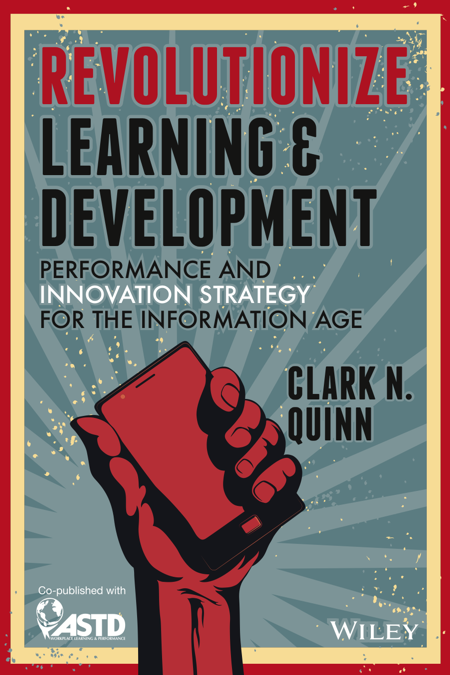
My latest tome, Revolutionize Learning & Development: Performance and Innovation Strategy for the Information Age is out.  Well, sort of.  What I mean is that it’s now available on Amazon for pre-order.  Actually, it’s been for a while, but I wanted to wait until there was some  there there, and now there’s the ‘look inside’ stuff so you can see the cover, back cover (with endorsements!), table of contents, sample pages, and more.  Ok, so I’m excited!

RLnDCoverSmallWhat I’ve tried to do is make the case for dragging L&D into the 21st Century, and then provide an onramp.  As I’ve been saying, my short take is that L&D isn’t doing what it could and should be doing, and what it  is doing, it is doing badly.  But I don’t believe complaining alone is particularly helpful, so I’m trying to put in place what I think will help as well.  The major components are:

  • what’s wrong (you can’t change until you admit the problem :)
  • what we know about how we think, work, and learn that we aren’t accounting for
  • what it would look like if we were doing it right
  • ways forward

By itself, it’s not the whole answer, for several reasons. First, it can’t be. I can’t know all the different situations you face, so I can’t have a roadmap forward for everyone. Instead, what I supposed you could think of is that it’s a guidebook  (stretching metaphors), showing suggestions that you’ll have to sequence into your own path.  Second, we don’t know all yet. We’re still exploring many of these areas.  For example, culture change is not a recipe, it’s a process.  Third, I’m not sure any one person can know all the answers in such a big field. So, fourth, to practice what I’m preaching, there should be a community pushing this, creating the answers together.

A couple of things on that last part, the first one is a request.  The community will need to be in place by the time the book is shipping.  The question is where to host it.  I don’t intend to build a separate community for it on the book site, as there are plenty of places to do this.  Google groups, Yahoo groups, LinkedIn…the list goes on. It can’t be proprietary (e.g. you have to be a paid member to play).  Ideally it’d have collaborative tools to create resources, but I reckon that can be accommodated via links.  What do you folks think would be a good choice?

The second part of the community bit is that I’m very grateful to many people who’ve helped or contributed.  Practitioner friends and colleagues provided the five case studies I’ve the pleasure to host.  Two pioneers shared their thoughts.  The folks at ASTD have been great collaborators in both helping me with resources, and in helping me get the message out.  A number of other friends and colleagues took the time to read an early version and write endorsements.  And I’ve learned together with so many of you by attending events together, hearing you speak, reading your writings, and having you provide feedback on my thoughts via talking or writing to me after hearing me speak or commenting on my scribblings here.

The book isn’t perfect, because I have thought of a number of ways it could be improved since I provided the manuscript, but I have stuck to the mantra that at some point it’s better out than still being polished. This book came from frustration that we can be doing so much better, and we’re not. I didn’t grow up thinking “I’m going to be a revolutionary”, but I can’t not see what I see and not say  something.  We can be doing so much better than we are. And so I had to be willing to just get the word out, imperfect.  It wasn’t (isn’t) clear that I’m the best person to call this out, but someone needs to!

That said, I have worked really hard to have the right pieces in place.  I’ve collected and integrated what I think are the necessary frameworks, provided case studies and a workplace scenario, and some tools to work forward.   I have done my best to provide a short and cogent kickstart to moving forward.  

Just to let you know that I’m starting my push.  I’ll be presenting on the book at ASTD’s ICE conference, and doing some webinars. Bryan Austin of GameOn Learning interviewed me on my thoughts in this direction.  I do believe in the message, and that it at least needs to be heard.  I think it’s really the necessary message for L&D (in it, you’ll find out why I’m suggesting we need to shift to P&D!).  Forewarned!  I look forward to your feedback.

Aligning with us

12 March 2014 by Clark Leave a Comment

The main complaint I think I have about the things L&D does isn’t so much that it’s still mired in the industrial age of plan, prepare, and execute, but that it’s just not aligned with how we think, learn, and perform, certainly not for information age organizations.  There are very interesting rethinks in all these areas, and our practices are not aligned.

So, for example, the evidence is that our thinking is not the formal logical thinking that underpins our assumptions of support.  Recent work paints a very different picture of how we think.  We abstract meaning but don’t handle concrete details well, have trouble doing complex thinking and focusing attention, and our thinking is very much influenced by context and the tools we use.

This suggests that we should be looking much more at contextual performance support and providing models, saving formal learning for cases when we really need a significant shift in our understanding and how that plays out in practice.

Similarly, we learn better when we’re emotionally engaged, when we’re equipped with explanatory and predictive models, and when we practice in rich contexts.    We learn better when our misunderstandings are understood, when our practice adjusts for how we are performing, and feedback is individual and richly tied to conceptual models.  We also learn better  together, and when our learning to learn skills are also well honed.

Consequently, our learning similarly needs support in attention, rich models, emotional engagement, and deeply contextualized practice with specific feedback.  Our learning isn’t a result of a knowledge dump and a test, and yet that’s most of what see.

And not only do we learn better together, we work better together.  The creative side of our work is enhanced significantly when we are paired with diverse others in a culture of support, and we can make experiments.  And it helps if we understand how our work contributes, and we’re empowered to pursue our goals.

This isn’t a hierarchical management model, it’s about leadership, and culture, and infrastructure.  We need bottom-up contributions and support, not top-down imposition of policies and rigid definitions.

Overall, the way organizations need to work requires aligning all the elements to work with us the way our minds operate.  If we want to optimize outcomes, we need to align both performance  and  innovation.  Shall we?

Conference advice

3 March 2014 by Clark Leave a Comment

David Kelly of the eLearning Guild has a series of interviews going on about attending conferences.  The point is to help attendees get some good strategies about how to prepare beforehand and take advantage after the fact, as well as what to bring and how to get the most out of it.

Today’s interview is me, and you’re welcome to have a look at my thoughts on conferences.   Feedback welcome!

Explain versus describe?

19 February 2014 by Clark 1 Comment

I’ve been watching the Olympics, at least select bits (tho’ I’m an Olympics widower; the full panoply  is  being watched in the house). And I enjoy seeing some of the things that I can relate to, but I realize that the commentators make a big difference.

The distinction seems to come down to a fundamental difference (aside from the ones that drill into uncomfortable zones with a zeal that seems to be a wee bit inhuman): the ones who describe what’s happening versus those who  explain.  Let me explain.

Description isn’t a bad thing, so when I watch (American) football, a guilty pleasure, the play-by-play commentator tends to describe the action, helping to ascertain what’s happened in case it’s confounded by intervening people, bad camera angles, interruptions, what have you.  Similarly, I’ve been listening to Olympic commentators describe the action in case I have missed it. And that’s helpful.

But in football, the color commentator (often a player or coach), interprets or explains what happened, and interprets it.  Similarly, the good commentary on Olympics has someone explain not just what happened (X just made a spectacular run), but why (Y was absorbing the forces better, minimizing the elements that would detract from speed). And this is really important.

I have a former mentor, colleague, and friend who is now part of an organization that enhances sports broadcasts with additional information; it’s a form of augmented reality showing things that started with first down lines in football but now includes things like wind and tracking information in the America’s cup.  Similarly, I have loved the overlays of one person’s performance against another.  The point is providing insight into the context, and more importantly the thinking behind the performance.

The relevance I’m seeing is that showing the underlying concepts help inform the exceptional performance, help educate about the nuances, and help support comprehension. This relates so much to what we need to be doing in business.  Working and learning out loud is so important to transfer skills across the organization. Showing the thinking helps spread the understanding. Whether it’s breaking from the pack in snow cross, or closing deals, having the thinking annotated is essential for spreading learning.

Whether it’s a retrospective by the performer or expert commentary, explaining, not just describing, is important. Does my explanation make sense? :)

Flip the office?

18 February 2014 by Clark 3 Comments

In talking with my ITA colleagues yesterday, we were discussing the necessity of  going into the office, or not.  And it seemed that there were times it made sense, and times it didn’t.

What doesn’t make sense is trying to do work in an office.  If you need to think, having random conversations and interruptions happen gets in the way.  Yes,  you need colleagues and resources ‘to hand’, but that’s available digitally and distally.

Being together makes sense, it seemed to us, when you either are meeting for the first time (e.g. with clients), or want creative friction.  You can interact virtually for planned work, but it helps to interact F2F when getting to know one another, and when you’re looking for serendipitous interactions.  Jay Cross, in his landmark  Informal Learning book, talked about how offices were being designed to have the mail room and coffee in the same place, to facilitate those interactions.  If conversations are the engine of business, having the opportunity for their occurrence is useful.

This seems the opposite of most visions of work: work away from the office, interact in the office, instead of the reverse.  So, is this the flipped office?


Jill Bolte Taylor Training 14 #trg14 Keynote Mindmap

4 February 2014 by Clark Leave a Comment

Jill Bolte Taylor gave a rapid fire overview of our cognitive anatomy and insights about how we act and why. Most importantly, she gave us a powerful message about how we can choose who and how we can be.

20140204-151755.jpg

Shawn Achor Training 14 #Trg14 Keynote Mindmap

3 February 2014 by Clark Leave a Comment

Shawn Achor gave a rapidfire, amusing, and engaging presentation about the benefits of happiness and ways to cultivate it.

20140203-103501.jpg

Starting trouble

28 January 2014 by Clark Leave a Comment

This seems to be my year of making trouble, and one of the ways is talking about what L&D is and isn’t doing. As a consequence of the forthcoming book (no cover comps yet nor ability to preorder), I’ve had to put my thoughts together, and I’m giving the preliminary version next Thurs, February 6, at 11AM PT, 2PM ET as a webinar for ASTD.

The gist is that there are a number of changes L&D is not accommodating: changes in how business should be run, changes in understanding how we think and perform, and even our understanding of learning has advanced (at least beyond the point that most of our corporate approaches seem to recognize).  Most L&D really seems stuck in the industrial age, and yet we’re in the information age.

And this just doesn’t make sense!  We should be the most eager adopters of technology, staying on top of new developments and looking for their potential to support our organizations.  We should be leading the charge in being learning organizations: following the business precepts of experimenting regularly, failing fast, and reflecting on the outcomes.  Yet that doesn’t reflect what the we’re seeing.

To move forward, we need to do more. To address business needs, we need to consider performance support and social networks. In fact, I argue that these should be our first line of defense, and courses should only be used when a significant skill shift is required.  We should be leveraging technology more effectively, looking at semantics and content architectures as well as mobile and contextual opportunities.  And we need to be getting strategic about how we’re helping the organization and evaluating not just efficiency but our effectiveness and impact.

This is just the start of a rolling series of activities trying to inject a sense of urgency into L&D (change management step 1).  While this will be covered in print, in sessions starting with last week’s TK14, and continuing through Learning Solutions and ICE, here’s a chance to get a headstart.  Look for a followup somewhere around April.  Hope you’ll join us!

« Previous Page
Next Page »

Clark Quinn

The Company

Search

Feedblitz (email) signup

Never miss a post
Your email address:*
Please wait...
Please enter all required fields Click to hide
Correct invalid entries Click to hide

Pages

  • About Learnlets and Quinnovation

The Serious eLearning Manifesto

Manifesto badge

Categories

  • design
  • games
  • meta-learning
  • mindmap
  • mobile
  • social
  • strategy
  • technology
  • Uncategorized
  • virtual worlds

License

Previous Posts

  • April 2026
  • March 2026
  • February 2026
  • January 2026
  • December 2025
  • November 2025
  • October 2025
  • September 2025
  • August 2025
  • July 2025
  • June 2025
  • May 2025
  • April 2025
  • March 2025
  • February 2025
  • January 2025
  • December 2024
  • November 2024
  • October 2024
  • September 2024
  • August 2024
  • July 2024
  • June 2024
  • May 2024
  • April 2024
  • March 2024
  • February 2024
  • January 2024
  • December 2023
  • November 2023
  • October 2023
  • September 2023
  • August 2023
  • July 2023
  • June 2023
  • May 2023
  • April 2023
  • March 2023
  • February 2023
  • January 2023
  • December 2022
  • November 2022
  • October 2022
  • September 2022
  • August 2022
  • July 2022
  • June 2022
  • May 2022
  • April 2022
  • March 2022
  • February 2022
  • January 2022
  • December 2021
  • November 2021
  • October 2021
  • September 2021
  • August 2021
  • July 2021
  • June 2021
  • May 2021
  • April 2021
  • March 2021
  • February 2021
  • January 2021
  • December 2020
  • November 2020
  • October 2020
  • September 2020
  • August 2020
  • July 2020
  • June 2020
  • May 2020
  • April 2020
  • March 2020
  • February 2020
  • January 2020
  • December 2019
  • November 2019
  • October 2019
  • September 2019
  • August 2019
  • July 2019
  • June 2019
  • May 2019
  • April 2019
  • March 2019
  • February 2019
  • January 2019
  • December 2018
  • November 2018
  • October 2018
  • September 2018
  • August 2018
  • July 2018
  • June 2018
  • May 2018
  • April 2018
  • March 2018
  • February 2018
  • January 2018
  • December 2017
  • November 2017
  • October 2017
  • September 2017
  • August 2017
  • July 2017
  • June 2017
  • May 2017
  • April 2017
  • March 2017
  • February 2017
  • January 2017
  • December 2016
  • November 2016
  • October 2016
  • September 2016
  • August 2016
  • July 2016
  • June 2016
  • May 2016
  • April 2016
  • March 2016
  • February 2016
  • January 2016
  • December 2015
  • November 2015
  • October 2015
  • September 2015
  • August 2015
  • July 2015
  • June 2015
  • May 2015
  • April 2015
  • March 2015
  • February 2015
  • January 2015
  • December 2014
  • November 2014
  • October 2014
  • September 2014
  • August 2014
  • July 2014
  • June 2014
  • May 2014
  • April 2014
  • March 2014
  • February 2014
  • January 2014
  • December 2013
  • November 2013
  • October 2013
  • September 2013
  • August 2013
  • July 2013
  • June 2013
  • May 2013
  • April 2013
  • March 2013
  • February 2013
  • January 2013
  • December 2012
  • November 2012
  • October 2012
  • September 2012
  • August 2012
  • July 2012
  • June 2012
  • May 2012
  • April 2012
  • March 2012
  • February 2012
  • January 2012
  • December 2011
  • November 2011
  • October 2011
  • September 2011
  • August 2011
  • July 2011
  • June 2011
  • May 2011
  • April 2011
  • March 2011
  • February 2011
  • January 2011
  • December 2010
  • November 2010
  • October 2010
  • September 2010
  • August 2010
  • July 2010
  • June 2010
  • May 2010
  • April 2010
  • March 2010
  • February 2010
  • January 2010
  • December 2009
  • November 2009
  • October 2009
  • September 2009
  • August 2009
  • July 2009
  • June 2009
  • May 2009
  • April 2009
  • March 2009
  • February 2009
  • January 2009
  • December 2008
  • November 2008
  • October 2008
  • September 2008
  • August 2008
  • July 2008
  • June 2008
  • May 2008
  • April 2008
  • March 2008
  • February 2008
  • January 2008
  • December 2007
  • November 2007
  • October 2007
  • September 2007
  • August 2007
  • July 2007
  • June 2007
  • May 2007
  • April 2007
  • March 2007
  • February 2007
  • January 2007
  • December 2006
  • November 2006
  • October 2006
  • September 2006
  • August 2006
  • July 2006
  • June 2006
  • May 2006
  • April 2006
  • March 2006
  • February 2006
  • January 2006

Amazon Affiliate

Required to announce that, as an Amazon Associate, I earn from qualifying purchases. Mostly book links. Full disclosure.

We use cookies to ensure that we give you the best experience on our website. If you continue to use this site we will assume that you are happy with it.