Last night I went to hear Ross Dawson speak on the Future of the Enterprise. His points resonated with a lot of what I and my TogetherLearn colleagues have been saying about the changes we’re seeing. I really do think that some changes are in the air.
 Ross reiterated the notion that the current context is a state of increasing change. Things are moving faster, and the chaotic reality underpinning our existence is being brought into highlight more and more. He talked about how commoditization is a driving economic factor, the fact that others can reproduce what you create quickly, so there’s incredible pressure to have to build more on top. I afterward asked him and he supported my contention that optimal execution is only the price of entry, and that continual innovation and delivering a seamless customer experience will be the differentiator.
He asked a series of five questions at the end, and one was how we got people to participate. Verna Allee suggested leadership would be even more critical. Another attendee thought that companies would have to offer compelling experiences for employees as well. I do think that helping individuals comprehend the vision, letting them figure out how to achieve the necessary goal, and creating an empowering environment are critical.
Another question had to do with how organizations would be structured going forward. Ross made a clever reference to how the word ‘corporation’ comes from corpus, or body, and that organizations now were much more a distributed enterprise: networks of employees, suppliers, clients, partners, contractors, etc. “The organization is just a persistent network.”
A point made was that all that matters are relationships and knowledge, particularly when manufacturing can be ‘on demand’, and that mass participation creates value. If the organization is a network, and all these participants generate the value, organizations have to support networking for knowledge work, getting contributions from empowered learners. To cope in this age of increasing disruptive influences, it’s critical.
It’s time for organizations to get serious about providing infrastructure that supports workers networking, communicating, collaborating, problem-solving, innovating, learning. Coupled with a supportive culture and clear vision, it’s the wave of the future. Ross thought that in five years time, the new organizational imperatives would be clear. That doesn’t give you a lot of time to get moving, and you really ought to begin last week if you want to be a leader, not a late adopter.
Get moving, or get help!
 So I’ve been playing with rethinking my Performance Ecosystem conceptualization and visualization. The original had very discrete components, and an almost linear path, and that doesn’t quite convey the reality of how things are tied together. I believe it’s useful to help people see the components, but it doesn’t capture the goal of an integrated system.
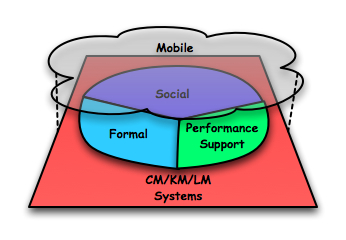 So here’s my current conception. It took me a long time to create the circle with different components! First I had to discover that there were tools to create freeform shapes, and then work to get them to articulate, but I like the kind of ‘rough’ feel of it (appropriate for it’s stage).