Learnlets

Secondary

Clark Quinn’s Learnings about Learning

Search Results for: align

Align, deepen, and space

8 July 2014 by Clark 1 Comment

I was asked about, in regards to the Serious eLearning Manifesto, about how people could begin to realize the potential of eLearning.  I riffed about this once before, but I want to spin it a different way.  The key is making meaningful practice.  And there are three components: align it, deepen it, and space it.

First, align it. What do I mean here?  I mean make sure that your learning objective, what they’re learning, is aligned to a real change in the business. Something you know that, if they improve, it will have an impact on a measurable business outcome.  This means two things, underneath. First, it has to be something that, if people do differently and better, it will solve a problem in what the organization is trying to do.  Second, it has to be something learning benefits from.  If it’s not a case where it’s a cognitive skill shift, it should be about using a tool, or replaced with using a tool. Only use a course when a course makes sense, and make sure that course is addressing a real need.

Second, deepen it.  Abstract practice, and knowledge test are both less effective than practice that puts the learner in a context like they’ll be facing in the workplace, and having them make the same decisions they’ll need to be making after the learning experience.  Contextualize it, and exaggerate the context (in appropriate ways) to raise the level of interest and importance to be closer to the level of engagement that will be involved in live performance.  Make sure that the challenge is sufficient, too, by having alternatives that are seductive unless you really understand. Reliable misconceptions are great distractors, by the way.  And have sufficient practice that leads from their beginning ability to the final ability they need to have, and so that they can’t get it wrong (not just until they get it right; that’s amateur hour).

Here’s where the third, space it, can come in.  Will Thalheimer has written a superb document (PDF) explaining the need for spacing. You can space out the complexity of development, and sufficient practice, but we need to practice, rest (read: sleep), and then practice some more. Any meaningful learning really can’t be done in one go, but has to be spread.  How much? As Will explains, that depends on how complex the task is, and how often the task will be performed and the gaps in between, but it’s a fair bit. Which is why I say learning  should be expensive.

After these three steps, you’ll want to only include the resources that will lead to success, provide models and examples that will support success, etc, but I believe that, regardless,  learners with good practice are likely to get more out of the learning experience than any other action you can take. So start with good practice, please!
Aligning with us

12 March 2014 by Clark Leave a Comment

The main complaint I think I have about the things L&D does isn’t so much that it’s still mired in the industrial age of plan, prepare, and execute, but that it’s just not aligned with how we think, learn, and perform, certainly not for information age organizations.  There are very interesting rethinks in all these areas, and our practices are not aligned.

So, for example, the evidence is that our thinking is not the formal logical thinking that underpins our assumptions of support.  Recent work paints a very different picture of how we think.  We abstract meaning but don’t handle concrete details well, have trouble doing complex thinking and focusing attention, and our thinking is very much influenced by context and the tools we use.

This suggests that we should be looking much more at contextual performance support and providing models, saving formal learning for cases when we really need a significant shift in our understanding and how that plays out in practice.

Similarly, we learn better when we’re emotionally engaged, when we’re equipped with explanatory and predictive models, and when we practice in rich contexts.    We learn better when our misunderstandings are understood, when our practice adjusts for how we are performing, and feedback is individual and richly tied to conceptual models.  We also learn better  together, and when our learning to learn skills are also well honed.

Consequently, our learning similarly needs support in attention, rich models, emotional engagement, and deeply contextualized practice with specific feedback.  Our learning isn’t a result of a knowledge dump and a test, and yet that’s most of what see.

And not only do we learn better together, we work better together.  The creative side of our work is enhanced significantly when we are paired with diverse others in a culture of support, and we can make experiments.  And it helps if we understand how our work contributes, and we’re empowered to pursue our goals.

This isn’t a hierarchical management model, it’s about leadership, and culture, and infrastructure.  We need bottom-up contributions and support, not top-down imposition of policies and rigid definitions.

Overall, the way organizations need to work requires aligning all the elements to work with us the way our minds operate.  If we want to optimize outcomes, we need to align both performance  and  innovation.  Shall we?

Exaggeration and Alignment

4 February 2014 by Clark Leave a Comment

In addition to my keynote and session at last week’s Immersive Learning University event, I was on a panel with Eric Bernstein, Andy Peterson, & Will Thalheimer. As we riffed about Immersive Learning, I chimed in with my usual claim about the value of exaggeration, and Will challenged me, which led to an interesting discussion and (in my mind) this resolution.

So, I talk about exaggeration as a great tool in learning design. That is, we too often are reigned in to the mundane, and I think whether it’s taking it a little bit more extreme or jumping off into a fantasy setting (which are similar, really), we bring the learning experience closer to the emotion of the performance environment (when it matters).

Will challenged me about the need for transfer, and that the closer the learning experience is to the performance environment, the better the transfer. Which has been demonstrated empirically. Eric (if memory serves) also raised the issue of alignment to the learning goals, and that you can’t overproduce if you lose sight of the original cognitive skills (we also talked about when such experiences matter, and I believe it’s when you need to develop cognitive skills).

And they’re both right, although I subsequently pointed out that when the transfer goal is farther, e.g. the specific context can vary substantially, exaggeration of the situation may facilitate transfer. Ideally, you would have practice across contexts spanning the application space, but that might not be feasible if we’re high up on the line going from training to education.

And of course, keeping the key decisions at the forefront is critical. The story setting can be altered around those decisions, but the key triggers for making those decisions and the consequences must map to reality, and the exaggeration has to be constrained to elements that aren’t core to the learning. Which should be minimized.

Which gets back to my point about the emotional side. We want to create a plausible setting, but one that’s also motivating. That happens by embedding the decisions in a setting that’s somewhat ‘larger than life’, where we’re emotionally engaged in ways consonant with the ones we will be when we’re performing.

Knowing what rules to break, and when, here comes down to knowing what is key to the learning and what is key to the engagement, and where they differ. Make sense?

Aligning coherency

2 April 2013 by Clark Leave a Comment

CoherentOrgLayers

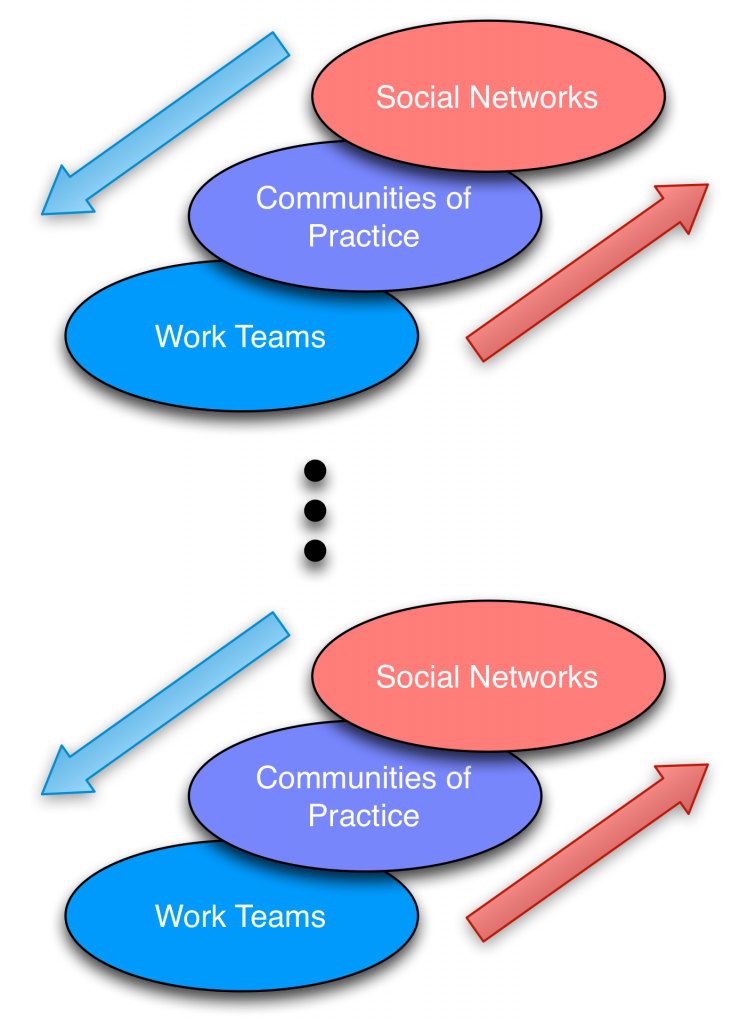
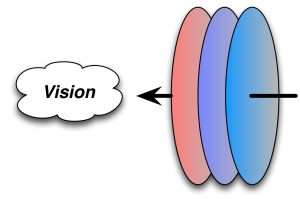
In thinking about the coherent organization, a couple of realizations occurred to me.  One is about how those layers actually are replicated at different levels. The other is how those levels need to be aligned in the organization to the overall vision.

For one, those work teams can be at any level. There will be work teams at the level that the work gets done, but there’ll also be work teams at the management and even executive levels.  Similarly, there are communities of practice at all these levels as well.  Even the top level executives can be members of several communities, including as executives of their org, but also with their peers at other orgs.

Moreover, at each of these levels they need to be tapping into what’s happening outside the organization, and tracking the implications for what they do.  They need to feed back out as well (of course, not their proprietary information).

The two way flow of information has to be in and out as well as up and down.  Communication, for both collaboration and cooperation, is key.

CoherentOrgAlignmentA second necessary component is alignment.  Those groups, at every level, need to be working in alignment with the broader organization’s goals, and vision.  When Dan Pink talks about the elements of motivation in Drive, the 3rd element, purpose, is about knowing what you’re doing and why it’s important.  So organizations have to be clear about what they’re about, and make sure everyone knows how they fit. Then you can provide autonomy and the paths to mastery (the other two elements) and get people working from intrinsic motivation.

The integrated focus on communication and alignment are two keys to developing the ability to continually innovate, and cope in the increasing complexity which will make or break an organization.  That’s how it seems to me.

#itashare

Reflections on reflection

17 March 2026 by Clark Leave a Comment

Reflection of fall trees in a lakeHaving come up a couple of times now, it’s probably time to think ‘out loud’ about reflection. Yes, very meta and all, but I’ve come to think that there are two or more different types of reflection. That, of course, would be confusing and thus problematic. So, here are some reflections on reflection.

So, first, I typically talk about reflection as the complement to action: learning is action and reflection. Then, I extend that to say that instruction should be designed action and guided reflection. When I say ‘reflection’ in that sense, it’s everything but the practice: models, examples, and feedback. Which is a simplification, but still not completely wrong.

However, we probably need a tighter definition. Because, for instance, we can ask people to reflect on the content, e.g. an elaborative or generative activity. We can ask them to reflect on their actions in practice. For that matter, we can ask them to reflect on the overall experience. Sure, each is valuable, but they’re different.

So, when we ask people to reflect on models and examples, we’re asking them to make connections between the content and their previous knowledge. That’s whether personal experience or prior learning (or both, of course, intermixed). Which is a necessary part of building their understanding, their schema. We want to enrich those connections, to increase the likelihood of activation in relevant settings.

Then, we ask them to reflect on their performance in retrieval. We can give them feedback, but as they progress that should fade. Indeed, ‘after action’ reviews are just this sort of activity. Learners need to internalize the self-monitoring, to become self-improving learners. So here we could ask them what they did right or wrong before we give them feedback. This, too, is valuable.

We can also ask them to reflect on the overall experience: what worked, what didn’t, what they’d like that they want more of or didn’t see, and what they’d like less of. Here we’re asking them to reflect on the pedagogy: what improvements can we provide? This is valuable more for us, of course, to refine the learning experience, but it’s still useful.

The problem is, we often use the term of ‘reflection’ for all of these. Reflection is great, but we need to deal with the specifics of each. Yes, we can term the elaborative one a ‘generative’ activity, so arguably that’s taken care of. But the other two are still both confounded. We could use the term ‘review’ for the case of overall experience evaluation, if we wanted to remove confusion. However, my main point is not to solve, at least not yet, but instead to point out the issue (this blog is for preliminary thoughts, at least ;). Those are my reflections, what are yours?

Standing up…

3 February 2026 by Clark 5 Comments

…and I won’t back down. Ok, so this is a little off my usual thread, but it does have some learning in it. What I’m talking about is using your attention and your money as a way to express your values. It’s what I’m increasingly doing, and there’re lessons in it. So let’s talk about standing up for what you believe in.

It may be that I’ve stood too much on principle in the past, and paid the price. I left a (probably) secure position at a university to come back to the US to be closer to our aging parents. A job at what was positioned as a secure startup appeared to be a good choice..but I didn’t properly account for ego and greed. I even was a bit cheeky about a possible position, to my long-term shame. Consulting then, I joke, went from a euphemism for ‘unemployed’ to a way of life. I’m fortunate, that despite my lack of business nous, my curiosity and inclination to share learnings has proven to be moderately valuable. Somehow, this hasn’t been enough to dissuade me.

As I theoretically get wiser, I’m being more forthright. I’m relinquishing my accounts on platforms that have demonstrated a lack of accountability, for instance. I’ve left a few places in the past few years. I stay on LinkedIn, because it’s not awful (though getting worse), and it’s the place where folks connect for business. I’m on a few other social networks, one that is built to be able to stay independent, and one that, so far, is seeming to have good principles. That latter one I’m willing to abandon if that changes.

I’m also avoiding technologies with misrepresentation, and calling out such claims. Not always, of course, I want to educate, not punish. Still, I strive to let what science tells us to serve as a guide, not what folks want you to believe. Their intentions may be simply misguided, or worse, they may not care. It’s important to be careful, which is why we (Matt Richter and I, e.g. the LDA) wrote the research checklist, for instance. (May require membership, but it’s free!) I even avoiding indulging in an opportunity to watch an activity I enjoy, because it was part of a trend I think is harmful overall (e.g. supporting increasing compartmentalization).

I’m also shifting my purchasing. I’m trying to shop more local, and use sources that aren’t aligned with the most problematic providers. This isn’t always easy, as the ‘long tail’ means certain things are hard to come by. There are consequences, including paying more, and doing with less. Tradeoffs.

Similarly, I try to do business only with those who have approaches I favor. For instance, I’ve avoid positions where I receive compensation for promoting a product, because that would bias my recommendations. I (perhaps wrongly) believe that having that unbiased opinion (and stating when I have conflicts) is of value. I am now am working with Elevator 9, but that’s because they have demonstrated that they care about learning science.

None of this is perfect. For one, there are barriers to completely shifting. Some services you just can’t get without aligning with one platform or another. Certain products are basically just impossible to source any other way. Not everyone you know and care about will go along. You do what you can, and live with the results.

There’s learning from this. It’s harder than not. I’ve learned that trusting what people say, particularly those with vested interests, isn’t a good bet unless they’ve earned your trust in other ways first. Acquisitions, for one, rarely go the way that the acquirers promise! Also, it’s pretty obvious that this stance is an effort that not everyone can, or is willing to, make. There’s risk, for instance. On the other hand, it’s rewarding. You do feel better that you’re doing things to support what you believe.

Note that I’m being relatively opaque about my intentions. I think they’re pretty obvious, but still, the principles hold regardless; vote with your attention and your dollars. Align your actions with your values. Standing up for what you believe in is a way to show what you believe so others can see what others think. It’s a way of learning ‘out loud’ I suppose. Or maybe ‘living out loud’. Still, I won’t back down. What think you?

(And now, back to your regularly scheduled posts. BTW, my intent is to keep Tuesdays for my thoughts; if I’m touting something I think you should know about, I’ll try to keep to Thursdays. And rare. ;)

Looking into 2026

6 January 2026 by Clark Leave a Comment

First, of course, happy new year! Relatively arbitrary deadline, but signification matters, and marking a new year is also a new chance. So, what’s happening? Here are some of the things I’m thinking about, looking into 2026!

So, first, a brief look back to set the stage. This was a year without any sustained engagements for Quinnovation, so that meant being a bit more agile. Not a problem, I was on lots of podcasts about a variety of things, and of course engaged with clients. I did spend considerable time and effort, however, in my side gigs.

For one, the Learning Development Accelerator (LDA) had a variety of things going on: conferences, books, webinars, podcasts, and more. Plus, they’re great people to work with! I think it’s a worthwhile investment of my time, focusing on helping people get more exposed to evidence-informed design.There are signs that we’re moving more that way (though it is a small case of two steps forward, one step back; learning styles and other myths still haunt our industry; there’s a continuing need!). I’ve also done some ‘free’ consulting to our platinum members, and that seems to be valuable for them, and I find it really rewarding!

I also continued to spend time with the Elevator 9 (E9) folks. They’re now ready for prime time (check ’em out!), but there’s been lots of work along the way. That includes developing a real platform, and I’m continuing to learn heaps about what goes into a startup. And why I haven’t been the one to do it! It’s been great, however, to be in association with folks who really do want to care about learning science; all too rare in the learning technology space (sadly).

Of course, my association with both continues.

With LDA, we’re already planning this coming year. We’re deep into thinking about what to do with the spring conference, and potential series for blog posts, and more. We already have our first Meet the Author on the schedule, and more are in the works.  There are some changes afoot, so stay tuned!

With E9, I will be using them again for my next mini-scenario workshop (with LDA) as a followon. Did it last year, as a trial, and it worked. Always room to improve, of course. Still, if you’re running a live event, and not following it up to extend the learning, why? There are other solutions – e.g. coaching – but please be doing something! There are worse solutions than E9, including nothing.

Of course, I’ll be doing more. I’ve been working on a couple of short books, likely eBooks (too short for print). I don’t want to go live yet about them, as they’re still in process. Of course they’d be with LDA Press. Besides online, I may be running a workshop or two live, too. As to conferences, well, I never say ‘never’, but right now there’s nothing I’m particularly excited about. We’ll see. And, of course, I’m always keen to help organizations, so do reach out if there are any ways I can be of assistance.

As you might expect, ideas continue to percolate. I’m always exploring more about technology, design, engagement, and more, and of course about learning. As always, you’ll probably hear about them here first, as this is where I learn ‘out loud’. There’re breadcrumbs from the past pointing forward, so it’s time to be looking into 2026. What are you seeing? In the meantime, stay curious my friends.

Analyzing analysis

9 December 2025 by Clark 1 Comment

Another reflection, triggered by my visit to DevLearn. One of the things that matters, and we don’t discuss enough, is analysis. That is, starting up front to determine what we need! There are nuances here, and I’m not a total expert (paging Dawn Snyder), but certain things are obvious, So let’s take some time analyzing analysis.

Analysis is the first part of the process. Yes, there’re the organizing and managing bits, but the process starts with analysis, whether ADDIE, SAM, LLAMA, or any other acronym. You need to determine what’s going on, what’s the need, and what’s the appropriate remedy.

One of the first things to note is that not everything L&D does fits. As is widely noted (e.g. here), there are lots of reasons courses aren’t the only answer. The real trigger should be a need. That is, there’s a new skillset required to do this thing we’ve identified as wrong or necessary. Or, there’s something we’re doing, but badly. At core, there are two situations: the one where we need to be, and the one where we are. The gap between is what we want to remedy.

Then, it’s matter of determining why we’re not where we want to be. The reason is, there are different interventions for different problems, as Guy Wallace talks about in his tome. It might be a lack of resources, or people get rewards for doing X, even though it’s Y they’re to be doing. These, by the way, aren’t things we deal with! That’s why you do this, so you don’t build a solution where said solution actually isn’t.

When it is a situation where knowledge in the world, or in the head, will help, then we can jump into action. Of course, we need a clear definition of what it is people need to be able to do, under what conditions, etc. BTW, what we need are performance objectives, not ‘learning’ objectives. That is, it’s about doing. Which is why, if the circumstances support, we should be providing job aids, not courses! You’ll usually find that job aids are cheaper to do than courses. If it’s not being performed very frequently, or too frequently, memory will play a role, and external memory is valuable in many such circumstances.

When you’ve determined that a course is needed, you can develop that. HOWEVER, you need certain things from the analysis phase here too. In short, you need to understand the actual performance. That includes what the performance should be, and how you can tell. Essentially, you need to know the decisions people must make to deliver the required outcomes. Which involves knowing the models that describe how the world works in this particular area, what ways people go wrong and why, and why people should care. This is where you need your subject matter experts (SMEs).  Then you can build your practices that align, and the models and examples, and then the hook and closing, and…

Whatever it is, ideally there’s a metric, that says this is what’s needed. You design to that metric, and then test until you achieve it. If you’re not achieving it faster than you’re losing resources, you can consciously evaluate. Is the lower level ok? Can we get more resources? Should we abandon ship? But doing so consciously is better than just going ’til you run out of time and/or money.

Analysis is a necessary first step. What is not is responding with acquiescence to a ‘we need a course on X’ request. Do you trust them to know that a course on X solves their problem? (Not the way to bet.) You can, and should, say, “yes, and…let’s dig in and make sure we’re solving the right problem”. Analysis is, properly, the way to start looking at problems. You understand what the gap is, then the root cause, and then align an intervention, or interventions, to address it. By analyzing analysis, we can figure out what we have to do, and why.

And, yes, I just gave a talk on designing in the real world, and you may have to do inference on resources to determine all the above, but at least you know what you need to come away with.

Thinking about motivation

18 November 2025 by Clark Leave a Comment

So, I haven’t been a big Self-Determination Theory (SDT) person, simply because I hadn’t really known about it. I learned about it enough to mention in my most recent tome (highlighting the importance of motivation in learning), but that’s about it. However, it’s been popping up more and more (not least with the Motivation Summit the LDA’s putting on; the live sessions will be past, but you can still register to watch the presentations and recordings thereof). And, I am increasingly thinking that there’s some real ‘there’ there, so here’s some thinking about motivation.

SDT posits, quite simply, that there are three consistent elements that contribute to motivation. They are:

  • Competence: the ability to do something, maybe with support, but also development to get better
  • Relatedness: other people who are there believing similarly and supporting you
  • Autonomy: the ability to be who you are

(These are my definitions, by the way, not the official ones, which are no doubt better.) Importantly, they’ve been verified by research across cultures, age ranges, and every other demographic difference. It’s pretty much a human universal. Also importantly, they have practical implications for how you do things.

Quite simply, motivation plays a role in pretty much everything we do! Our motivations include exercising, eating, and sleep; work tasks and job environment; and for us, intent to learn. It’s that latter I was tapping into for designing games, lo those many decades ago. I didn’t at the time know about the SDT framework (in fact, it hadn’t really emerged yet ;), but I was tapping into the elements when I was talking about goals, appropriate challenge, relevance, and more. So when I write about the education/engagement alignment, SDT is a higher-level framework. Simple alignment would have challenge = competence, goals = autonomy, relevance = relatedness. Social learning, too.

Increasingly, as ‘leadership’ becomes a topic, it plays a role as well. I’ve been interested in culture and social for many years as a function for L&D. Leadership is how you create a culture, by how you are socially. How well do you support those elements? I’m not a leadership expert, but I’m increasingly seeing those factors, crossed by types of situations being faced. For instance, in a crisis you have to make a decision, which reduces autonomy for others, but then you should rebuild it. Importantly, I’m finding out that efforts are yielding valuable outcomes, which alone is a reason to pay attention!

So, I’m looking more into it, as an aspect of making a good environment, organizationally and societally. If we’re thinking about motivation, we can start being wise about it. That is, not just for me, and you, but for others. Not just short term, but also long-term. And, explicitly considering our values. Which may be the most important part of it! I think the values that empirically lead to the best for all is a good basis. What say you?

Making the case

4 November 2025 by Clark Leave a Comment

I was asked, recently, about how to get execs to look more favorably on L&D initiatives. And, I discover, I’ve talked about this before, more than 15 years ago. And we’re still having the conversation. So, it appears we’re still struggling with making the case. Maybe there’s another way?

So, there were two messages. Briefly, I heard this:

the difficulty lies in shifting behaviours and mindsets around how people perceive the L&D role and its function(s); particularly when advocating for a transition towards evidence-based approaches and best practices.

Then this response:

[we] are just considered a bunch of lowly content creators who are given SMEs to create courses with no real access to end learners and with no scope of reaching out to anyone else. We are supposed to create all singing and dancing content which will hopefully change behaviour and make some impact.

Both are absolutely tragic situations! We should not be having to fight to be using evidence-informed approaches, and we shouldn’t be expected to create courses without having an opportunity to do research (conversations and more). Why would you want to do things in a vacuum according to outdated beliefs? It’s maniacal.

Now, my earlier screed posited making sure that the executives were aware of the tradeoffs. In general, the model I believe has been validated is one that says people need to see the alternatives, before choosing one. In this case, they really aren’t aware of the costs, largely for one reason. Folks don’t measure impact of learning interventions! That’s not true everywhere, of course, but just asking if people liked it is worthless, and even asking if they thought it had an impact is pretty much a zero correlation with actual value. You have to do more. Our colleague Will Thalheimer has been one of the foremost proponents of this. In his recent tome, talking to org execs, he argues why you should. But that’s still the theoretical argument.

Sadly, if you don’t measure, you don’t have evidence. And, I’ll argue, you can’t look elsewhere, because I’ve tried. I have regularly looked for articles that cite research about whether training investments pay off. Beer and colleagues mentioned a meta-analysis that showed only 10% of investment showed a return, but…they didn’t cite the study and haven’t responded to a request for more data. So, I’ve been trying to think of another way.

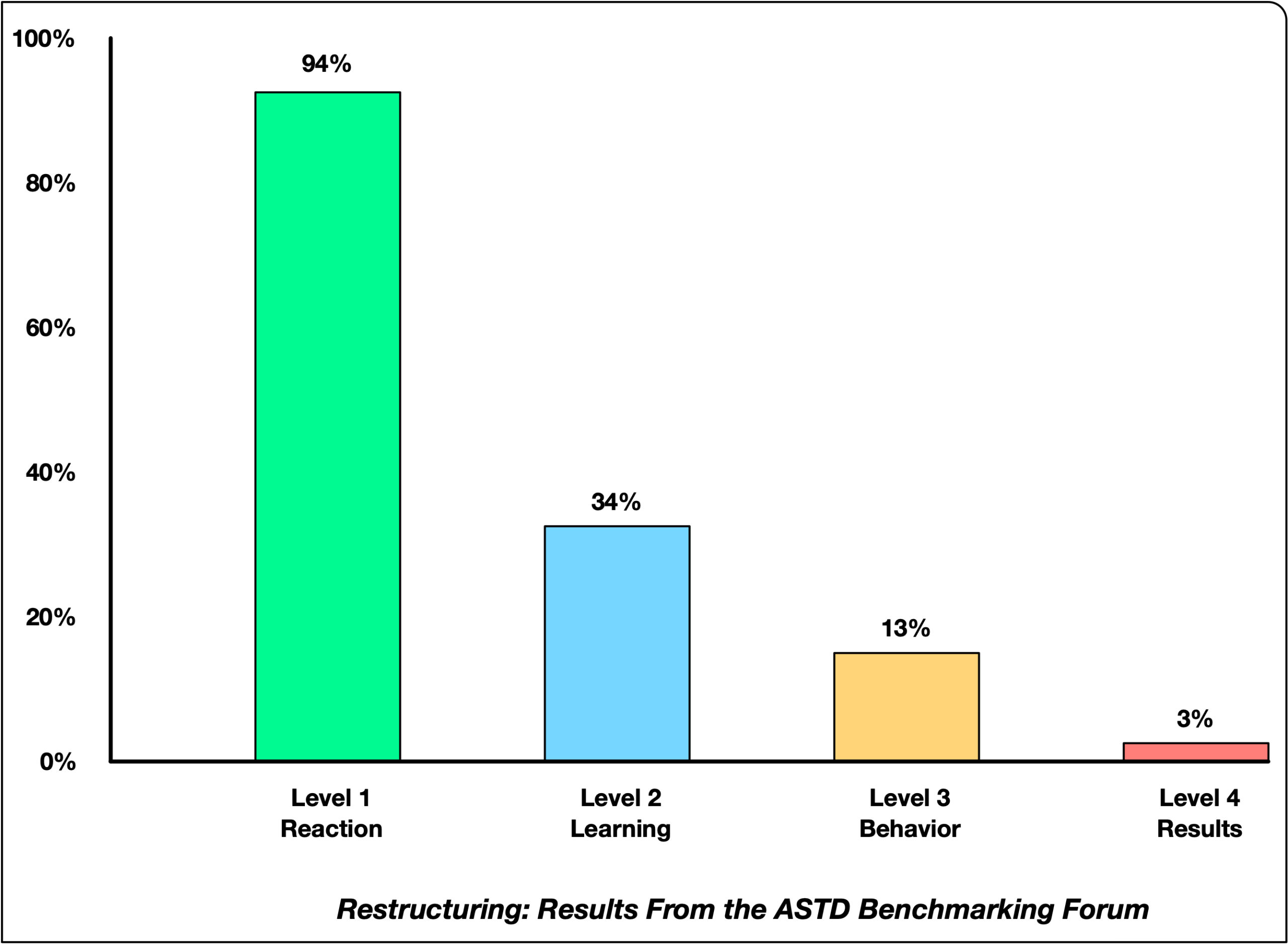
Recently, it occurred to me that the measurement itself might be a mechanism. So, ATD had data on the use of evaluation, and most everybody was saying they did Kirkpatrick Level 1 (did they like it), but as mentioned, that’s not useful. A third did Kirkpatrick level 2, which checks whether learners can perform after the course. Too often, however, that can be knowledge checks, not actual performance. Only an eighth actually looked for change in the workplace behavior, and almost no one checked whether there was an org impact. One problem is that this totals more than 100%, so clearly some folks were doing more.

However, if we take the final two and add them, 13% and 3%, we get 16%, which means at best, 84% of folks aren’t measuring. Which means they’re likely not getting any results. So, a cynical view would say that 84% of efforts aren’t returning value! Now, to caveats. For one, the data is old; I don’t have an exact date but it precedes my book on strategy, so it’s at least before 2014. And, of course, we could be doing better (though the above quotes might argue otherwise). Also, maybe some of those unmeasured approaches actually are working. Who knows?

Still, I take this as a strong case that we’re still wasting money on L&D. Now, I’ve argued that you should have a collection of arguments: data, theory, examples, your personal experience, their personal experience, and perhaps what the competition is doing. Then, you present what works for them at the moment. Or you can (and should) do stealth evaluation. Find performance data, work with eager adopters, whatever it takes. But worst case, you might use the above argument to show that it’s not being measured, and, as the saying goes, “what’s measured matters”. I’ll suggest that this may be one way of making the case. I welcome hearing others, or better yet, actual real research! But we have to find some traction to get better, for ourselves and our colleagues.

« Previous Page
Next Page »

Clark Quinn

The Company

Search

Feedblitz (email) signup

Never miss a post
Your email address:*
Please wait...
Please enter all required fields Click to hide
Correct invalid entries Click to hide

Pages

  • About Learnlets and Quinnovation

The Serious eLearning Manifesto

Manifesto badge

Categories

  • design
  • games
  • meta-learning
  • mindmap
  • mobile
  • social
  • strategy
  • technology
  • Uncategorized
  • virtual worlds

License

Previous Posts

  • March 2026
  • February 2026
  • January 2026
  • December 2025
  • November 2025
  • October 2025
  • September 2025
  • August 2025
  • July 2025
  • June 2025
  • May 2025
  • April 2025
  • March 2025
  • February 2025
  • January 2025
  • December 2024
  • November 2024
  • October 2024
  • September 2024
  • August 2024
  • July 2024
  • June 2024
  • May 2024
  • April 2024
  • March 2024
  • February 2024
  • January 2024
  • December 2023
  • November 2023
  • October 2023
  • September 2023
  • August 2023
  • July 2023
  • June 2023
  • May 2023
  • April 2023
  • March 2023
  • February 2023
  • January 2023
  • December 2022
  • November 2022
  • October 2022
  • September 2022
  • August 2022
  • July 2022
  • June 2022
  • May 2022
  • April 2022
  • March 2022
  • February 2022
  • January 2022
  • December 2021
  • November 2021
  • October 2021
  • September 2021
  • August 2021
  • July 2021
  • June 2021
  • May 2021
  • April 2021
  • March 2021
  • February 2021
  • January 2021
  • December 2020
  • November 2020
  • October 2020
  • September 2020
  • August 2020
  • July 2020
  • June 2020
  • May 2020
  • April 2020
  • March 2020
  • February 2020
  • January 2020
  • December 2019
  • November 2019
  • October 2019
  • September 2019
  • August 2019
  • July 2019
  • June 2019
  • May 2019
  • April 2019
  • March 2019
  • February 2019
  • January 2019
  • December 2018
  • November 2018
  • October 2018
  • September 2018
  • August 2018
  • July 2018
  • June 2018
  • May 2018
  • April 2018
  • March 2018
  • February 2018
  • January 2018
  • December 2017
  • November 2017
  • October 2017
  • September 2017
  • August 2017
  • July 2017
  • June 2017
  • May 2017
  • April 2017
  • March 2017
  • February 2017
  • January 2017
  • December 2016
  • November 2016
  • October 2016
  • September 2016
  • August 2016
  • July 2016
  • June 2016
  • May 2016
  • April 2016
  • March 2016
  • February 2016
  • January 2016
  • December 2015
  • November 2015
  • October 2015
  • September 2015
  • August 2015
  • July 2015
  • June 2015
  • May 2015
  • April 2015
  • March 2015
  • February 2015
  • January 2015
  • December 2014
  • November 2014
  • October 2014
  • September 2014
  • August 2014
  • July 2014
  • June 2014
  • May 2014
  • April 2014
  • March 2014
  • February 2014
  • January 2014
  • December 2013
  • November 2013
  • October 2013
  • September 2013
  • August 2013
  • July 2013
  • June 2013
  • May 2013
  • April 2013
  • March 2013
  • February 2013
  • January 2013
  • December 2012
  • November 2012
  • October 2012
  • September 2012
  • August 2012
  • July 2012
  • June 2012
  • May 2012
  • April 2012
  • March 2012
  • February 2012
  • January 2012
  • December 2011
  • November 2011
  • October 2011
  • September 2011
  • August 2011
  • July 2011
  • June 2011
  • May 2011
  • April 2011
  • March 2011
  • February 2011
  • January 2011
  • December 2010
  • November 2010
  • October 2010
  • September 2010
  • August 2010
  • July 2010
  • June 2010
  • May 2010
  • April 2010
  • March 2010
  • February 2010
  • January 2010
  • December 2009
  • November 2009
  • October 2009
  • September 2009
  • August 2009
  • July 2009
  • June 2009
  • May 2009
  • April 2009
  • March 2009
  • February 2009
  • January 2009
  • December 2008
  • November 2008
  • October 2008
  • September 2008
  • August 2008
  • July 2008
  • June 2008
  • May 2008
  • April 2008
  • March 2008
  • February 2008
  • January 2008
  • December 2007
  • November 2007
  • October 2007
  • September 2007
  • August 2007
  • July 2007
  • June 2007
  • May 2007
  • April 2007
  • March 2007
  • February 2007
  • January 2007
  • December 2006
  • November 2006
  • October 2006
  • September 2006
  • August 2006
  • July 2006
  • June 2006
  • May 2006
  • April 2006
  • March 2006
  • February 2006
  • January 2006

Amazon Affiliate

Required to announce that, as an Amazon Associate, I earn from qualifying purchases. Mostly book links. Full disclosure.

We use cookies to ensure that we give you the best experience on our website. If you continue to use this site we will assume that you are happy with it.