Learnlets

Secondary

Clark Quinn’s Learnings about Learning

Search Results for: align

Solutions for Tight Cycles of Assessment

22 November 2017 by Clark 5 Comments

In general, in a learning experience stretching out over days (as spaced learning would suggest), learners want to regularly get feedback about how they’re doing. As a consequence, you want regular cycles of assessment. However, there’s a conflict.  In workplace performance we produce complex outputs (RFPs, product specs, sales proposals, strategies, etc). These still typically require human oversight to evaluate.  Yet resource limitations are likely in most such situations, so we prefer auto-marked solutions (read: multiple choice, fill-in-the-blank), etc.  How do we reconcile meaningful assessment with realistic constraints?  This is one of the questions I’ve been thinking about, and I thought I’d share my reflections with you.

In workplace learning, at times we can get by with auto-assessment, particularly if we use coaching beyond the learning event.  Yet if it matters, we’d rather them practice things that matter  before they actually are used for real work.  And for formal education, we want learners to have at least weekly cycles of performance and assessment.  Yet we also don’t want just rote knowledge checks, as they don’t lead to meaningful performance.  We need some intermediate steps, and that’s what I’ve been thinking on.
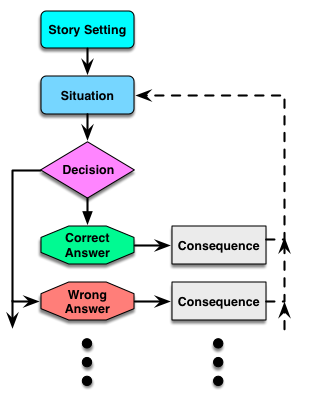
Multiple choice mini-scenario structureSo first, in  Engaging Learning, I wrote about what I called ‘mini-scenarios’. These are really just better-written multiple-choice questions.  However, such questions don’t ask learners to identify definitions or the like (simple recognition), but instead put learners in contextual situations.  Here, the learner chooses between different  decisions. Which means retrieving the information, mapping it to the context,  and then choosing the best answer.  Such a question has a story context, a precipitating situation, and then alternative decisions. (And the alternatives are ways learners go wrong, not silly or obviously incorrect choices).  I suggest that your questions should be like this, but are there more?

Branching scenarios are another, rich form of practice. Here it’s about tying together the decisions (they  do tend to travel in packs) and consequences. When you do so, you can provide an immersive experience.  (When designed well, of course.)  They’re a pragmatic approximation of a full game experience.  Full games are  really good when you need lots of practice (or can amortize over a large audience), but they’re an additional level of complexity to develop.

Another one that Tom Reeves presented in an article was intriguing. You not only have to make the right choice, but then you also choose the reason  why you made that choice. It’s only an additional step, but it gets at the choice  and the thinking.  And this is important. It would minimize the likelihood of guessing, and provide a richer basis for diagnosis and feedback.  Of course, no one is producing a ‘question type’ like this that I know of, but it’d be a good one.

An approach we used in the past was to have learners create a complex answer, but have the learner evaluate it! In this case it was a verbal response to a question (we were working on speaking to the media), but then the learner could hear their own answer and a model one.  Of course, you’d want to pair this with an evaluation guide as well. The learner creates a response, and then is presented with their response,  a good response, and a rubric about what makes a good answer. Then we ask the learner to self evaluate against the rubric.  This has the additional benefit that learners are evaluating work with guidance, and can internalize the behavior to become a self-improving learner. (This is the basis of ‘reciprocal teaching’, one of the component approaches in Cognitive Apprenticeship.)

Each of these is auto-(or self-) marked, yet provides valuable feedback to the learner and valuable practice of skills. Which shouldn’t be at the expense of also having instructor-marked complex work products or performances, but can supplement them. The goal is to provide the learner with guidance about how their understanding is progressing while keeping marking loads to a minimum. It’s not ideal, but it’s practical.  And it’s not exclusive of knowledge test as well, but it’s more applied and therefore is likely to be more valuable to the learner and the learning. I’m percolating on this, but I welcome hearing what approaches (and reflections) you have.
My Professional Learner’s Toolkit

21 November 2017 by Clark 7 Comments

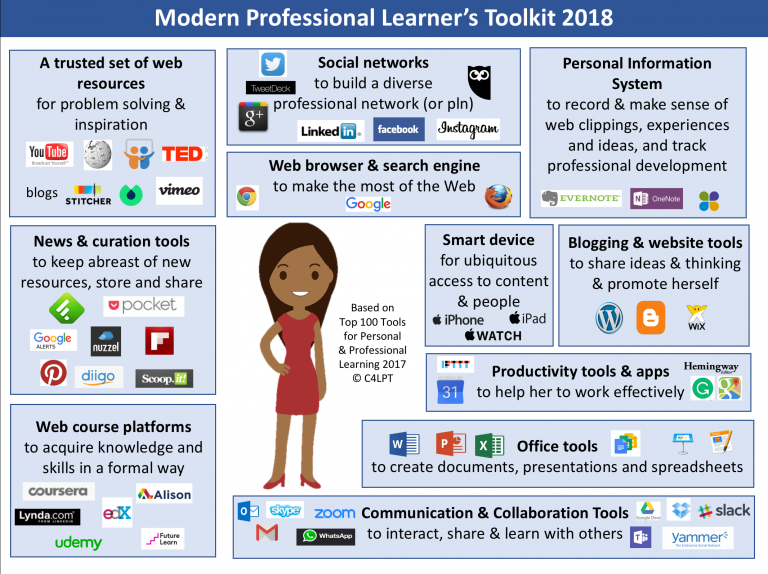
My colleague, Harold Jarche, recently posted about his professional learning toolkit, reflecting our colleague Jane Hart’s post about a Modern Learner’s Toolkit. It’s a different cut through the top 10 tools.  So I thought I’d share mine, and my reflections.

Favorite browser and search engine: I use Safari and Google, by default. Of course, I keep Chrome and Firefox around for when something doesn’t work (e.g. Qualtrics).  I would prefer another search engine, probably DuckDuckGo, but I’m not facile with it, for instance finding images.

A set of trusted web resources: That’d be Wikipedia, pretty much. And online magazines, such as eLearnMag and Learning Solutions, and ones for my personal interests. I use Pixabay many times to find images.

A number of news and curation tools: I use Google News and the ABC (Oz, not US) in my browser, and the BBC and News apps on my iDevices. I also use Feedblitz to bring blogposts into my email.  I keep my own bookmarks using my browser.

Favorite web course platforms: I haven’t really taken online courses. I’ve used Zoom to share.

A range of social networks: I use LinkedIn professionally, as well as Slack. And Twitter, of course.  I stay in touch with my ITA colleagues via Skype.  Facebook is largely personal.

A personal information system: I use both Notability and Notes to take notes.  Notes more for personal stuff, Notability for work-related. I use Omnigraffle for diagrams and mindmaps.  And OmniOutliner also helps when I want to think hierarchically.

A blogging or website tool: I use WordPress for Learnlets (i.e. here), and I use Rapidweaver for my sites: Quinnovation and my book sites.

A variety of productivity apps and tools: Calendar is crucial, and Pagico keeps me on track for projects. I use Google Maps for navigation. I use SplashID for passwords and other private data. I often read and markup documents on my iPad with GoodReader. CloudClip lets me share a multi-item clipboard across my devices.    Reflection: this overlaps with the personal information system.

A preferred office suite: I don’t have a preferred suite, though I’d like to use the Apple Suite. I use Word to write (Pages hasn’t had industrial-strength outlining), Keynote to create presentations (e.g. one from each suite). I don’t create sheets often.

A range of  communication and collaboration tools: I use Google Drive to collaborate on representations.  I have used Dropbox to share documents as well. And of course Mail for email.   Reflection: this overlaps with social networks.

1 or more smart devices: I’d be lost without my iPhone and iPad (neither of which is the latest model). I use the phone for ‘in the moment’ things, the iPad for when I have longer time frames.

So, that’s my toolkit, what’s yours?

Jane's toolkit diagram

Tom Reeves AECT Keynote Mindmap

10 November 2017 by Clark 1 Comment

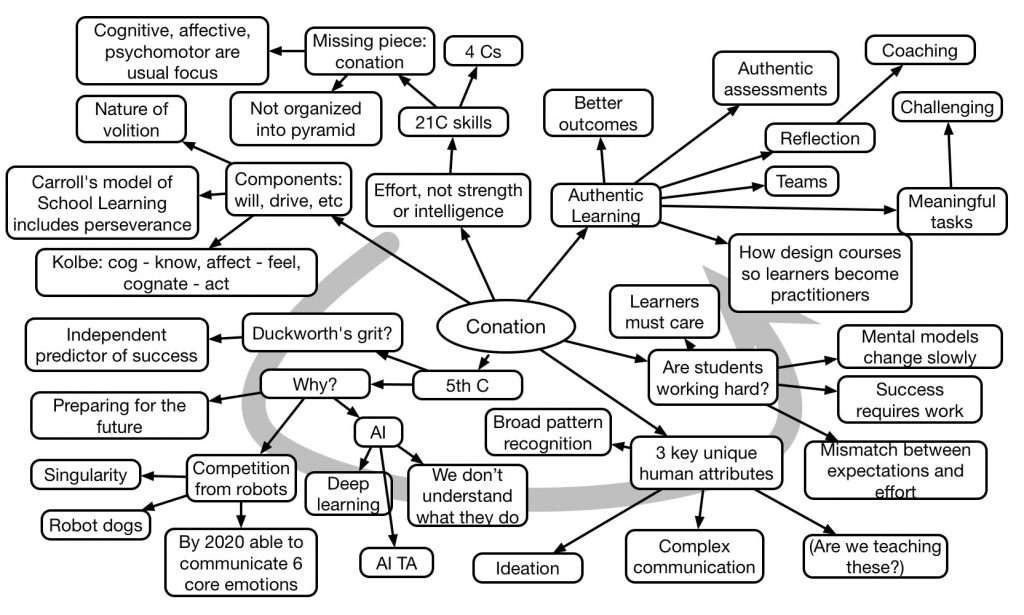
Thomas Reeves opened the third day of the AECT conference with an engaging keynote that used the value of conation to drive the argument for Authentic Learning. Conation is the component of cognition that consists of your intent to learn, and is under-considered. Authentic learning is very much collaborative problem-solving. He used the challenges from robots/AI to motivate the argument.

Mindmap

Derek Cabrera AECT Keynote Mindmap

9 November 2017 by Clark 1 Comment

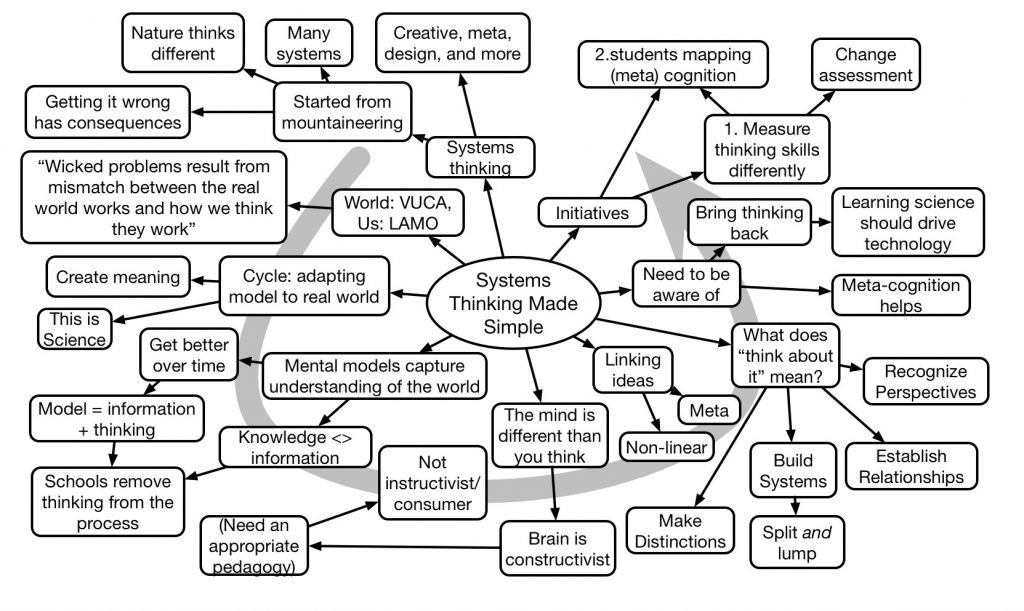
Derek Cabrera opened the second day of the AECT conference with an insightful talk about systems thinking and the implications for education. With humorous examples he covered the elements of systems thinking and why it means we need to switch pedagogies to a constructivist approach.

Mindmap

Marcy Driscoll AECT Keynote Mindmap

8 November 2017 by Clark Leave a Comment

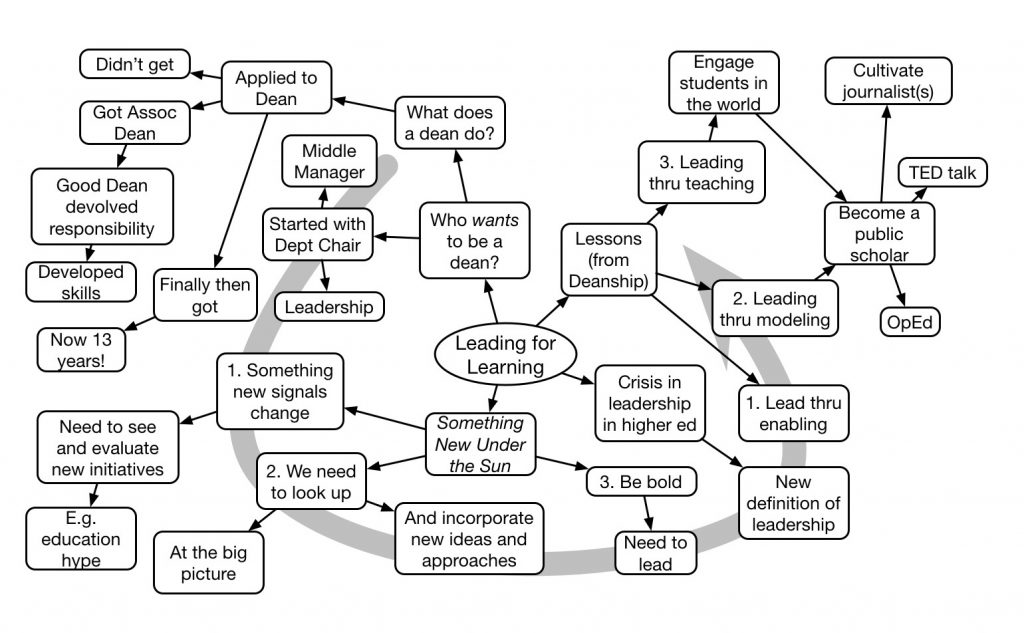
Marcy Driscoll kicked off the Association for Educational Communications and Technology’s annual conference with a thoughtful keynote on leadership. She used her experience as a Dean to explore possibilities and suggestions for what this could and should mean.

Mindmap

Revisiting 70:20:10

7 November 2017 by Clark 14 Comments

Last week, the Debunker Club (led by Will Thalheimer) held a twitter debate on 70:20:10 (the tweet stream can be downloaded if you’re curious).  In ‘attendance’ were two of the major proponents of 70:20:10, Charles Jennings and Jos Arets.  I joined Will as a moderator, but he did the heavy lifting of organizing the event and queueing up questions.  And there were some insights from the conversations and my own reflections.

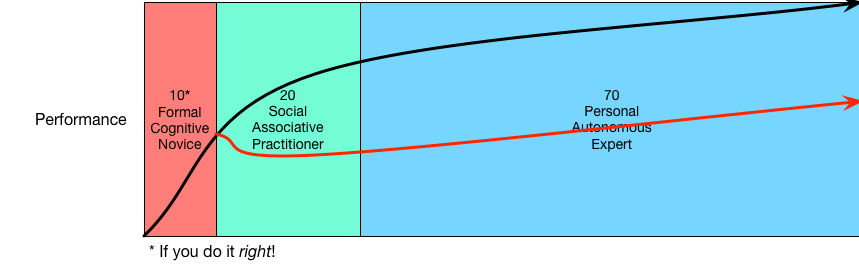
Learning curveTo start, 70:20:10 is a framework, it’s not a specific ratio but a guide to thinking about the whole picture of developing organizational solutions to performance problems. In the book by Jos & Charles, along with their colleague Vivian Heijnen,  on the topic, there’s a whole methodology that encompasses 5 roles and 28 steps. The approach goes from a problem to a solution that incorporates tools, formal learning, coaching, and more.

The numbers come from a study on leaders, who felt that 10% of what they learned to do their jobs came from formal learning, 20% came from working with others and coaching, and 70% they learned from trying and reflecting on the outcomes. The framework’s role is to help people recognize this, and not leave the 70 and 20 to chance. The goal is to help people along the learning curve, not just leave them to chance after the ‘event’.

First, my impression was that a lot of people  like that the 70:20:10 framework provides a push beyond the event model of ‘the course’. Also, a number struggle with the numbers as a brand, because they feel that the numbers are misleading. And some folks clearly believe that good instructional design  should include the social and the activity, so the framework is a distraction. A colleague felt that there were also some who feel that formal learning is a waste of time, but I don’t think that many truly ignore the 10, they just want it in the proper perspective (and I could be wrong).

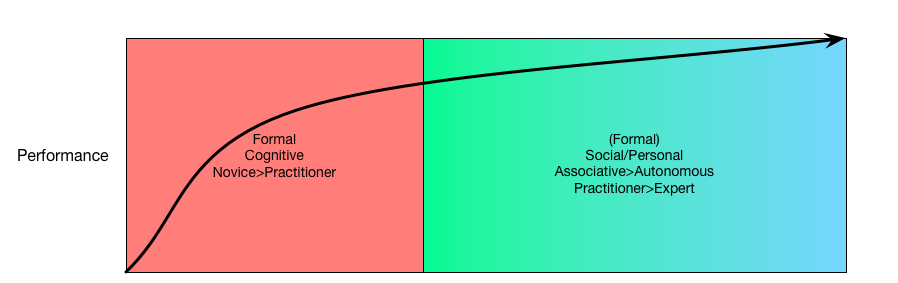
MoreFormalNow, there are times when the ratio changes. In roles where the consequences of failure are drastic (read: aerospace, medical, military), you tend to have a lot  more formal.  It can go quite a ways up the learning curve. Ideally, we’d do this for every situation, but in real life we have to strike a balance.  If we can do the job right in the 10, and then similarly ensure good practices around the 20 and the 70, we’ll get people up the curve.

Another issue, for me, is that 70:20:10 not only provides a push towards thinking of the whole picture, but like Kirkpatrick (and perhaps better) it serves as a design tool. You should start from what the situation looks like at the end and figure out what can be in the world and what has to be in the head, and then go backwards. You then design your tools, and then your training, and 70:20:10 suggests including coaching, etc.  But starting with the 70 is one of the messages.

So, I like the realization of 70:20:10 (except typing all those redundant zeros and colons, I often refer to it as 721 ;): the focus on designing the full solution, including tools and coaching and more.  I don’t see 70:20:10 being the full solution, as the element of continual innovation and a learning culture are separate, but it’s a good solution for the performance part of the picture, and the specific  parts of the development.

Addressing Changes

25 October 2017 by Clark Leave a Comment

Yesterday, I listed some of the major changes that L&D needs to acknowledge. What we need now is to look at the top steps that need to be taken.  As serious practitioners in a potentially valuable field, we need to adapt to the changing environment as much as we need to assist our charges to do so. So what’s involved?

We need to get a grasp on technology  affordances. We don’t need to that the latest technology exists, whether AI, AR, or VR.  Instead, we have to understand what they mean  in the context of our brains.  What key capabilities are brought?  Can VR go beyond entertainment to help us learn better? How can AI partner with us?  If we can make practical use of AR, what would we do with it?

In conjunction, we need to  understand the realities about us.  We need to take ownership and have a suitable background in how people  really think, work, and learn. Further, we need to recognize that they’re all tied together, not separate things. So, for instance, we learn as we work, we think as we learn, etc.

For example, we need to understand situated and distributed cognition. That is, we need to grasp that we’re not formal logical thinkers, but instead very context dependent, and that our thinking is across our tools. As a consequence, we need to design solutions that recognize our individual situations, and leverage technology as an augment. So we want to design human/computer system solutions to problems, not just human or system solutions.

We also need to understand cultural elements. We work better when we are given meaningful work, freedom to pursue those goals, and get the necessary support to succeed. This is  not micromanagement, but instead, is leadership and coaching. We also need an environment where it’s safe, expected even, to experiment and even to make mistakes.

We also need to understand that we work better (read: produce better results), when we work together in particular ways. Where we understand that we should allow individual thought first, but then pool those ideas. And we need to show our work and the underlying thinking. Moreover, again, it has to be safe to do so!

And, these are all tied together into a systemic approach!  It can’t be piecemeal, because working together and out loud can’t be divorced from the technology used to enable these capabilities. And giving people meaningful work and not letting them work together, or vice-versa, just won’t achieve the necessary critical mass.

Finally, we also need to do this in alignment with the business. And, lets be clear, in ways that can be measured!  We need to be understanding what are the critical performance needs of the organization, and demonstrate that we’re impacting them in the ways above.

This can be done, and it will be the hallmark of successful organization. We’re already seeing a wide variety of converging evidence that these changes lead to success. The question is, are you going to lead your organization forward into the future, or keep your head down and do what you’ve always done?

Stay Curious

18 October 2017 by Clark Leave a Comment

One of my ongoing recommendations to people grew out of a toss-off line, playing off an advertisement. Someone asked about a strategy for continuing to learn (if memory serves), and I quipped “stay curious, my friends”.  However, as I ponder it, I think more and more that such an approach is key.

I was thinking of this trend the other day as “intellectual restlessness”. What I’m talking about is being intrigued by things you don’t understand that have persisted or recently crossed your awareness, and pursuing it.  It’s not just saying “how interesting”, but recognizing connections, and pondering how it could change what you do. Even to the point of actually changing!

It also would include pointing interesting things to other people who would benefit.  This doesn’t always have to happen, but in the spirit of cooperation (in the Jarche sense), we could and should contribute, curate, when we can.  And, ideally, leaving trails of your explorations that others can benefit from. Writings, diagrams, videos, what have you, helps yourself as well as others.

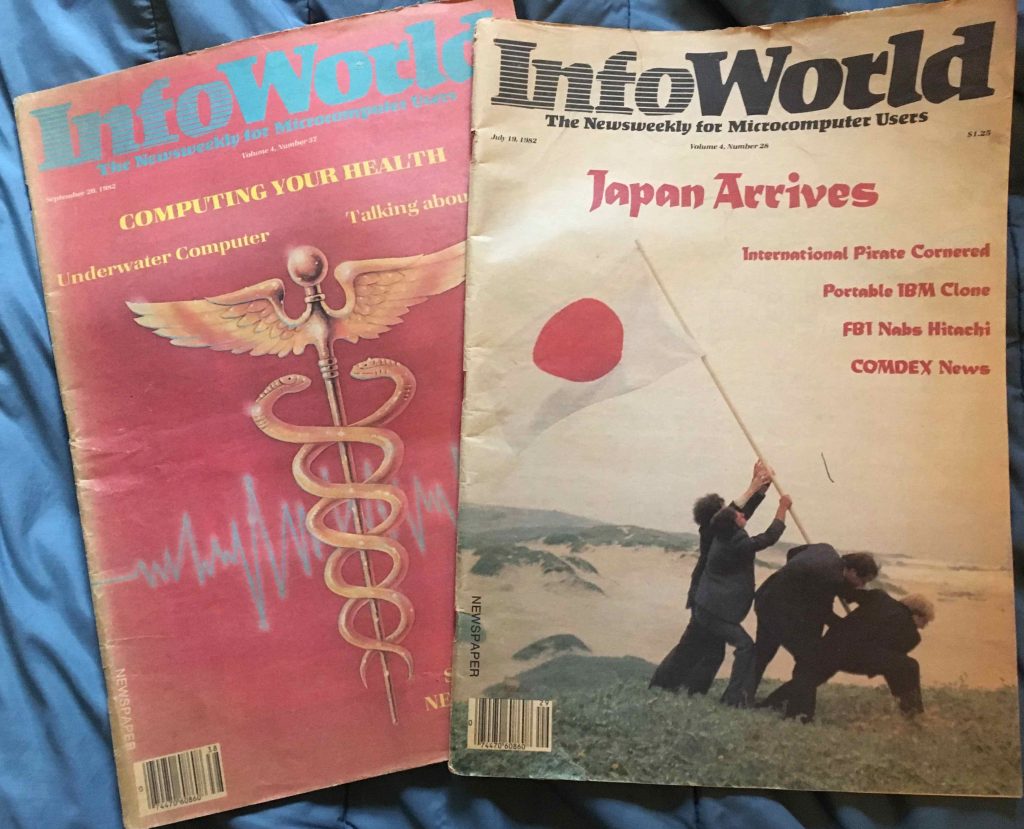
Old Infoworld magazinesI was reminiscing that more than 30 years ago, on top of my job designing educational computer games, I was already curious. I still have copies of the magazines containing reviews I did (one hardware, one software), as well as a journal article based upon undergraduate research I was fortunate to participate in.

And that persistence in curiosity has led to a trail of artefacts. You may have come across the books, book chapters, articles, presentations, etc. And, of course, this blog for the past decade and more. (May it continue!) However, I’m not here to tout my wares, but instead to point to the benefit of being curious.

As things change faster, a continuing interest is what provides an ongoing ability to adapt. All the news about the ongoing changes in jobs and work isn’t likely to lessen.  Staying curious benefits you, your colleagues and friends, and I reckon society in general.  You want to look at many sources of information, track tangential fields, and be open to new ideas.

This isn’t just your choice, of course, ideally your organization is supportive. These lateral inputs are a component of innovation, as is time to allow for serendipity and incubation. Orgs that want to be able to be agile will need this capabilities as well. I suppose organizations need to stay curious as well!


Radical Coherency

11 October 2017 by Clark Leave a Comment

Tied to my last post about insufficient approaches, I was thinking again about the Coherent Organization  . Coherency is powerful, but it could be a limiting metaphor.   So I want to explore it a bit further.

First, coherency is powerful.   Lasers, for example, are just light, the same as comes from your lightbulbs. Except that the wavelengths are aligned and focused. When they‘re at the same frequency, in the same direction, suddenly you can cut steel!

However, an easy interpretation is that you get this right, and it‘s then sufficient. But that‘s no longer sufficient in organizations. As things change, you need coherency and agility. How do you get both?

I‘m suggesting that coherency has to be on many dimensions.   So you have coherency with the organization‘s purpose, but people are coherent with each other, and with the customers, and with best principles.   And that latter is important, as best practices won‘t transfer unless they‘re abstracted and recontextualized.

So what I‘m arguing for is a more radical coherency, a coherency that‘s in synchrony in an ecosystem perspective. Where people are communicating and collaborating in ways that apply best principles in an way that integrates them into an aligned whole that‘s greater than the sum of the parts.

This is a learning organization, but one that‘s integrating many disparate elements. That, I think, is a desirable and achievable goal, but it’s more than one program. It’s a campaign that needs an initial focus, and a plan to successfully integrate it into practice first, and then to scale it to both shift practice and culture. It’s non-trivial, but I think it’s more than worthwhile: it’s necessary. What do you think?

Mundanities

29 September 2017 by Clark Leave a Comment

This post is late, as my life has been a little less reflective, and a little more filled with some mundane issues.  There’re some changes here around the Quinnstitute, and they take bandwidth.  For a small update on these mundanities with some lessons:

standing deskFirst, I moved office from the side of the house back to the front. My son had occupied it, but he’s settled into an apartment for college, and I prefer the view out to the street (to keep an eye on the neighborhood). Of course, this entailed some changes:

My ergonomic chair stopped working, and it took several days to a) find out someone who’d repair it, b) get it there, wait for it to get fixed, and get it back.  It’s worth it (a lot less than replacing) and ergonomics is important.

Speaking of which, I also now could get a standup desk, or in my case one of those convertible desks that lets you raise and lower your workspace. I’ve been wanting one since the research has come out on the problems with sitting.  We’d previously constructed a custom desktop (with legs from Ikea!), for the odd shaped room, so it was desirable to just put it on top. So far, so good. Strongly recommended.

Also bought a used bookshelf (rather than move the one from the old office).  Real wood, real heavy.  Used those ‘forearm forklift’ straps to get it in. They work!  And, this being earthquake country, had to strap it to the wall. Still to come: filling with books.

At the same time, fed up with  all  the companies that provide internet and cable television, we decided to change. (We changed mobile providers back in January.)  As I noted previously, companies use policies to their advantage. One of the approaches is that they sell you a two year package, but then there’s no notification that the time’s up and the rate jumps up. And you can’t find just a low rate provider (I don’t even mind if it’s higher than the bonus deal). Everyone uses this practice. Sigh.

As I said, I can’t find anyone better, but just decided to change. That involved conversations, and research, and installation time, and turning off the old systems.  At least we’re getting a) a lower rate, b) nicer DVR, and c) faster internet.  For the time being. While the new provider promised to ping me before the plan runs out, the old provider says they can’t. See what I mean?  Regardless, I’ve got a trigger before it expires to sign up anew. Or change again.  That’s the lesson on this one.

And of course there are some conversations about some upcoming presentations. I was away last week presenting, and have one coming up next month (ATD China Summit, if you’re near Shanghai say hello) and several in November at AECT  in Jacksonville.  You’ve seen some of the AI reflections, more likely to come on the new topics.

And there’s been some background work. Reading a couple of books, and working on two projects. Stay tuned for a couple of new things early next year.

The lesson, of course, is trying to find time to reflect while you’re executing on mundanities is more challenging, but still a valuable investment.  I fight to make time, I hope you do too!

« Previous Page
Next Page »

Clark Quinn

The Company

Search

Feedblitz (email) signup

Never miss a post
Your email address:*
Please wait...
Please enter all required fields Click to hide
Correct invalid entries Click to hide

Pages

  • About Learnlets and Quinnovation

The Serious eLearning Manifesto

Manifesto badge

Categories

  • design
  • games
  • meta-learning
  • mindmap
  • mobile
  • social
  • strategy
  • technology
  • Uncategorized
  • virtual worlds

License

Previous Posts

  • March 2026
  • February 2026
  • January 2026
  • December 2025
  • November 2025
  • October 2025
  • September 2025
  • August 2025
  • July 2025
  • June 2025
  • May 2025
  • April 2025
  • March 2025
  • February 2025
  • January 2025
  • December 2024
  • November 2024
  • October 2024
  • September 2024
  • August 2024
  • July 2024
  • June 2024
  • May 2024
  • April 2024
  • March 2024
  • February 2024
  • January 2024
  • December 2023
  • November 2023
  • October 2023
  • September 2023
  • August 2023
  • July 2023
  • June 2023
  • May 2023
  • April 2023
  • March 2023
  • February 2023
  • January 2023
  • December 2022
  • November 2022
  • October 2022
  • September 2022
  • August 2022
  • July 2022
  • June 2022
  • May 2022
  • April 2022
  • March 2022
  • February 2022
  • January 2022
  • December 2021
  • November 2021
  • October 2021
  • September 2021
  • August 2021
  • July 2021
  • June 2021
  • May 2021
  • April 2021
  • March 2021
  • February 2021
  • January 2021
  • December 2020
  • November 2020
  • October 2020
  • September 2020
  • August 2020
  • July 2020
  • June 2020
  • May 2020
  • April 2020
  • March 2020
  • February 2020
  • January 2020
  • December 2019
  • November 2019
  • October 2019
  • September 2019
  • August 2019
  • July 2019
  • June 2019
  • May 2019
  • April 2019
  • March 2019
  • February 2019
  • January 2019
  • December 2018
  • November 2018
  • October 2018
  • September 2018
  • August 2018
  • July 2018
  • June 2018
  • May 2018
  • April 2018
  • March 2018
  • February 2018
  • January 2018
  • December 2017
  • November 2017
  • October 2017
  • September 2017
  • August 2017
  • July 2017
  • June 2017
  • May 2017
  • April 2017
  • March 2017
  • February 2017
  • January 2017
  • December 2016
  • November 2016
  • October 2016
  • September 2016
  • August 2016
  • July 2016
  • June 2016
  • May 2016
  • April 2016
  • March 2016
  • February 2016
  • January 2016
  • December 2015
  • November 2015
  • October 2015
  • September 2015
  • August 2015
  • July 2015
  • June 2015
  • May 2015
  • April 2015
  • March 2015
  • February 2015
  • January 2015
  • December 2014
  • November 2014
  • October 2014
  • September 2014
  • August 2014
  • July 2014
  • June 2014
  • May 2014
  • April 2014
  • March 2014
  • February 2014
  • January 2014
  • December 2013
  • November 2013
  • October 2013
  • September 2013
  • August 2013
  • July 2013
  • June 2013
  • May 2013
  • April 2013
  • March 2013
  • February 2013
  • January 2013
  • December 2012
  • November 2012
  • October 2012
  • September 2012
  • August 2012
  • July 2012
  • June 2012
  • May 2012
  • April 2012
  • March 2012
  • February 2012
  • January 2012
  • December 2011
  • November 2011
  • October 2011
  • September 2011
  • August 2011
  • July 2011
  • June 2011
  • May 2011
  • April 2011
  • March 2011
  • February 2011
  • January 2011
  • December 2010
  • November 2010
  • October 2010
  • September 2010
  • August 2010
  • July 2010
  • June 2010
  • May 2010
  • April 2010
  • March 2010
  • February 2010
  • January 2010
  • December 2009
  • November 2009
  • October 2009
  • September 2009
  • August 2009
  • July 2009
  • June 2009
  • May 2009
  • April 2009
  • March 2009
  • February 2009
  • January 2009
  • December 2008
  • November 2008
  • October 2008
  • September 2008
  • August 2008
  • July 2008
  • June 2008
  • May 2008
  • April 2008
  • March 2008
  • February 2008
  • January 2008
  • December 2007
  • November 2007
  • October 2007
  • September 2007
  • August 2007
  • July 2007
  • June 2007
  • May 2007
  • April 2007
  • March 2007
  • February 2007
  • January 2007
  • December 2006
  • November 2006
  • October 2006
  • September 2006
  • August 2006
  • July 2006
  • June 2006
  • May 2006
  • April 2006
  • March 2006
  • February 2006
  • January 2006

Amazon Affiliate

Required to announce that, as an Amazon Associate, I earn from qualifying purchases. Mostly book links. Full disclosure.

We use cookies to ensure that we give you the best experience on our website. If you continue to use this site we will assume that you are happy with it.