Learnlets

Secondary

Clark Quinn’s Learnings about Learning

Search Results for: align

The Human-Centered Organization

18 May 2016 by Clark 1 Comment

As I talk about aligning work with how we  brains think, work, and learn, I realize I’m talking about something bigger.  While I want L&D to lead the way (as those are the folks I know), it’s really about leading the way to an organization that’s aligned with  us, with people.  And I think that’s something bigger, and definitely better.

The point being, as we reorganize work to tap into the best of us, we’re creating organizations that are humane in a very specific, and hopefully deep, sense.  Humane for all employees, and further.

The industrial era organization, quite simply, wasn’t. The mechanization of human work, the drive for more efficiency at whatever cost, the top-down imposition of rules, and more, are all contrary to what brings out the best in people. It’s demeaning and unhealthy, but even from a business perspective  it’s rigid and inflexible.

Instead, when we talk about having work with purpose, and socially aware organizations, with tighter coupling to the market, and greater empowerment of employees, we’re talking about our finer human elements.  And, the evidence seems to be that such organizations are more successful.

Interestingly, I searched the term “Human Centered Organization”, and came across this proposal. (And, in fact, it’s now an ISO standard, 27500:2016, not that I’ve made it past the paywall to view the whole thing.) I found the  principles from the summary  to be a a good starting point:

  • capitalize on individual differences as an organizational strength
  • make usability and accessibility strategic business objectives
  • adopt a total system approach
  • ensure health, safety, and well-being are business priorities
  • value employees and create a meaningful work environment
  • be open and trustworthy
  • act in socially responsible ways

All of these reflect different areas I’ve either touted or am aware of specific work (and workers) in the area. I’d add that this should not be just internally-facing; this should reflect work with partners and customers as well.

Frankly, many companies I interact with seem driven to confuse me to the point that I make decisions that favor them. I don’t like that, and try to avoid them. A few organizations, instead, offer simple services with clear benefits.  Interestingly, when I engage with the people in the straightforward organizations, they  seem to like their employment circumstances.  When I can engage one of the others to speak to me honestly, or I know them through other channels than a business relationship, they admit they don’t like what they have to do.

OK, so I can be an idealist (and am a native Californian :), but it seems to me that organizations that move to a more humane approach are going to be the ones that will last.  There are known concrete steps to get there, but the path will vary by organization. I suggest that you start thinking about your strategy. Are you ready to get human?
Two separate systems?

10 May 2016 by Clark Leave a Comment

I frequently say that L&D needs to move from just ensuring optimal execution to also supporting continual innovation.  Can these co-exist, or are they fundamentally different?  I really don’t know, but it’s worth pondering.

Kotter (the change management guru), has begun to advocate for a dual-operating system approach, where companies jointly support an operational hierarchy and an innovation network that are coupled.  I haven’t read his book on the topic, but it seems to be a bit  extrinsic, a way of bolting on innovation instead of making it intrinsic to the operation.

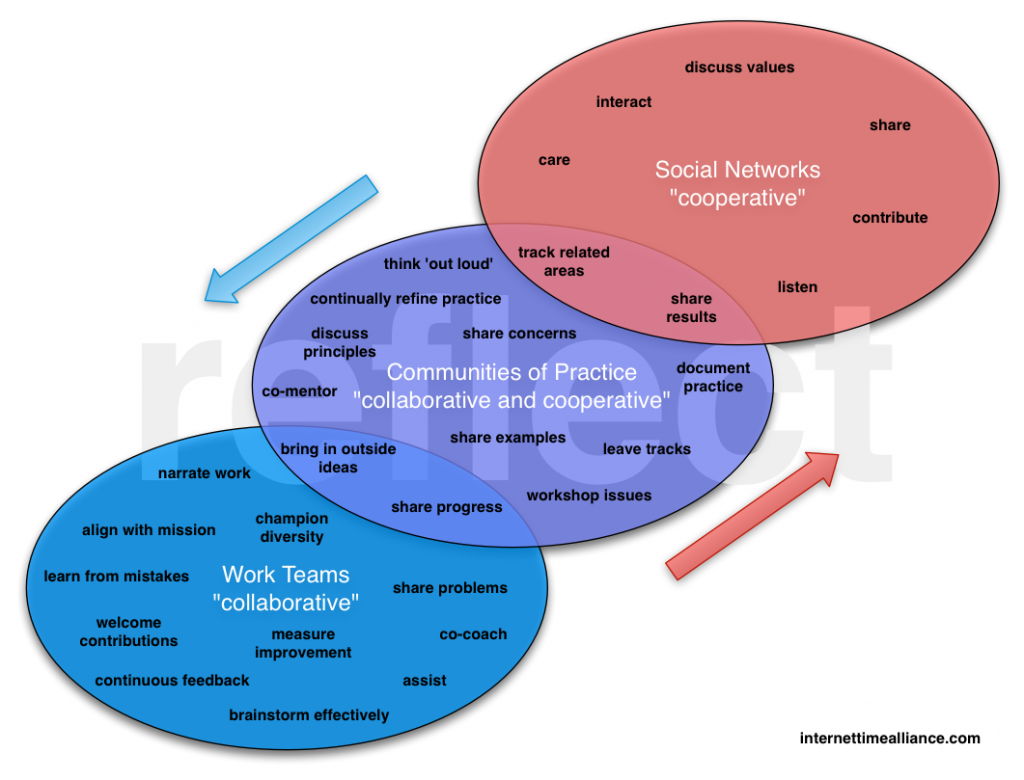
On the other hand, there is quite a bit of expression for more flexible systems, a more podular approach. Teaming or small nodes are increasingly appearing as not just for innovation, but ongoing operation. However, it’s not clear how the various different areas are coordinated, so how marketing across pods maintains coherent.

CoherentOrgExpandedThis is what led to our Coherent Organization model.  The notion is that the teams are coming in from, and reporting back up through, their communities. And their communities are communicating both within, and outside of, the organization.

It’s not clear to me whether the team  approach can scale to a global organization, or whether you need the hybrid model.  I can see that the hybrid model would appeal to existing business folks who would be concerned about optimization in execution.  I can see that the new model would at least require fundamental changes in mechanisms, and perhaps a willingness to tradeoff absolute perfection in execution to maintain continuing innovation and customer-responsiveness.

While  intuitively the more biologically inspired approach sounds like the longer-term solution, it’s non-trivial in terms of creating cultures that are appropriately conducive.  I think that organizational operations may be at an inflection point, and there does seem to be data that supports more radical flexibility.   I think a performance ecosystem coupled with a learning organization environment is likely going to be the way to move.  How you get there is part of the revolution that’s needed. Start small, scale out, etc. And I hope L&D can help lead the way.

Moving forward

27 April 2016 by Clark Leave a Comment

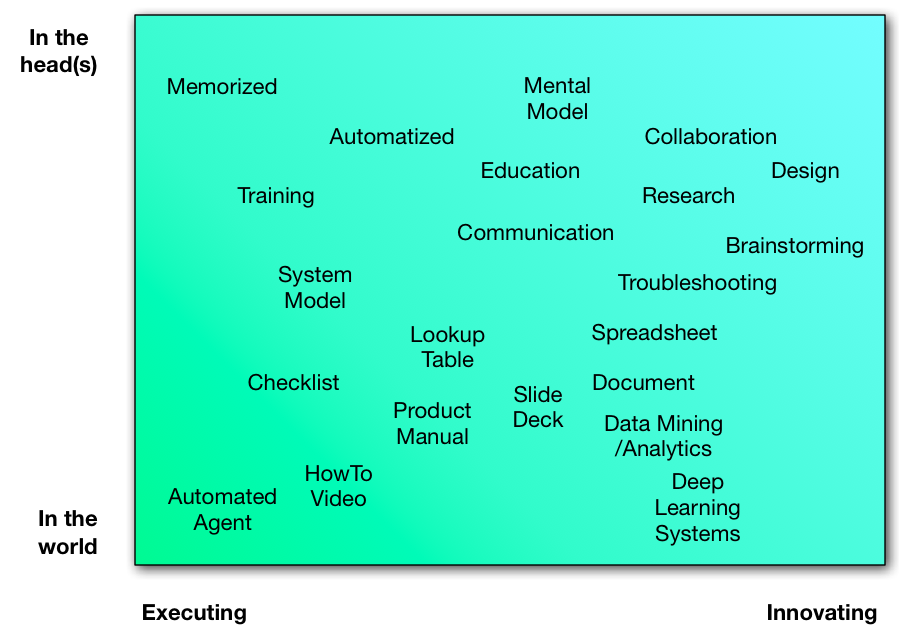
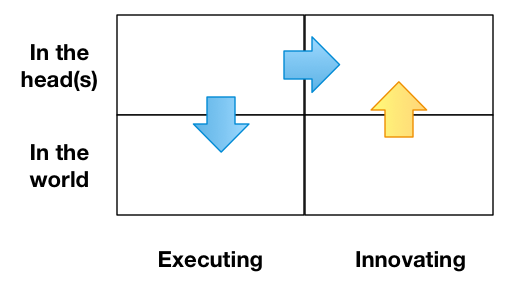
A few weeks ago, I posted about laying out activities in a  space dividing the execution side from the innovation side, and in the head from in the world.  None of you took the bait about talking what it meant (I’m  so disappointed), but it continued to ponder it myself. And at least one idea came to mind.

LearningSpaceImplicationsSo what I’m thinking is that the point is to  not be using our heads to be doing simple execution. Machines (read: robots or computation agents) are very good at doing what they’re told. Reliably, and repeatably.  They may need oversight, but in many ways we’re seeing this play out.

What we should be doing is trying to automate execution. We aren’t good at doing rote things, and having us do them is silly.  Ideally you automate them, or outsource them in some way.  Let’s save our minds for doing important work.

Of course, many times the situations we’re increasingly seeing are not matters of simply executing. As things get more ambiguous, more novel, more  chaotic, we’re really discovering we need to have people handle those situations in innovative ways. So they’re really being moved over regardless.

And, of course, we want that innovation to be fueled by data, information in the world being made available to support making these decisions. Big analytics, or even little analytics are good basis, as are models and support tools to facilitate the processes.  And, of course, this doesn’t have to be all in one head, but drawing upon teams, communities, and networks to get solution.

The real point is to let machines do what they can do well, and leave to us what we do well. And, what we  want to be responsible for.  As I see it, the role of technology is to augment us, not replace us.  It’s up to us to make the choices, but we have the opportunity to work in ways that align with how our brains really think, work, and learn.  I reckon that choice is a no-brainer ;).

Learning in context

26 April 2016 by Clark 3 Comments

In preparation for the upcoming FocusOn Learning Conference, where I’ll be running a workshop  about cognitive science for L&D, not just for learning but also for mobile and performance support, I was thinking about how  context can be leveraged to provide more optimal learning  and performance.  Naturally, I had to diagram it, so let me talk through it, and you let me know what you think.

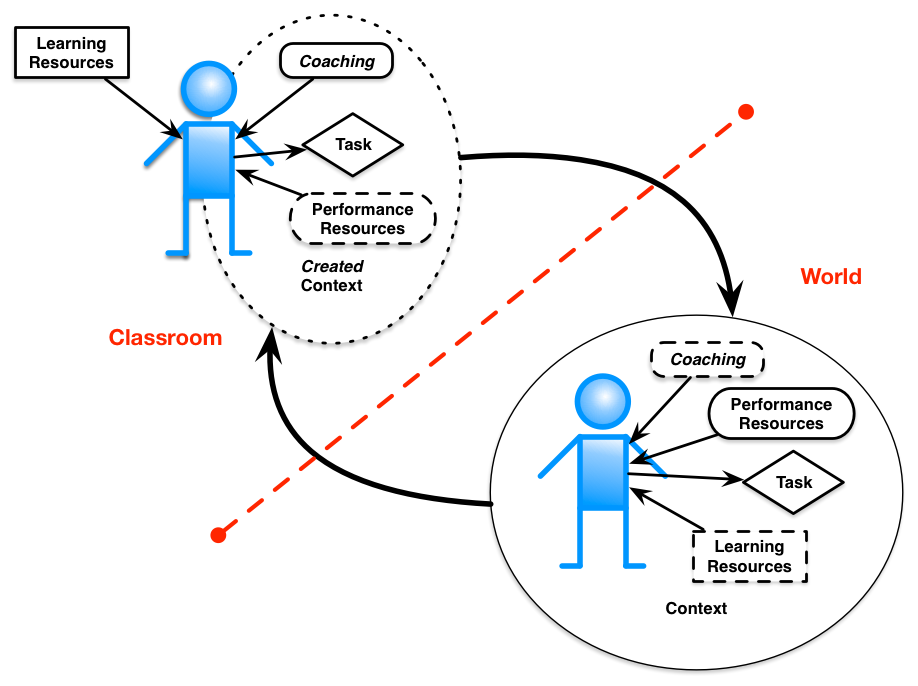
ApartLearningWhat we tend to do, as a default, is to take people away from work, provide the learning resources away from the context, then create a context to practice in. There are coaching resources, but not necessarily the performance resources.  (And I’m not even mentioning the typical lack of sufficient practice.) And this makes sense  when the consequences of making a mistake on the task are irreversible and costly.  E.g. medicine, transportation.  But that’s not as often as we think. And there’s an alternative.

We can wrap the learning around the context.  Our individual is  in the world, and performing the  task. There can  be coaching (particularly at the start, and then gradually removed as the individual  moves to acceptable competence). There are also performance resources – job aids, checklists, etc – in the environment. There also  can be learning resources, so the individual can continue to self-develop, particularly in the increasingly likely situation that the task has some ambiguity or novelty in it. Of course, that only works if we have a learner  capable of self learning (hint hint).

The problems with always taking people away from their jobs are multiple:

  • it is costly to interrupt their performance
  • it can be costly to create the artificial context
  • the learning has a lower likelihood to make it back to the workplace

Our brains don’t learn in an event model, they learn in little bits over time. It’s more natural,  more  effective, to dribble the learning out at the moment of need, the learnable moment.  We have the capability, now, to  be more aware of the learner, to deliver support in the moment, and develop learners over time. The way their brains actually learn.  And we should be doing this.  It’s more effective as well as more efficient.  It requires moving out of our comfort zone; we know the classroom, we know training.  However, we now also know that the effectiveness of classroom training can be very limited.

We have the ability to start making learning effective as well as efficient. Shouldn’t we do so?

Work Experiment

13 April 2016 by Clark Leave a Comment

At a  point some days ago, I got the idea to map out different activities by their role as executing versus innovating, and whether it’s in the head or in the world. And I’ve been playing with it since.  I’m mapping some  ways of getting work done, at least the mental aspects, across those dimensions.

LearningSpace

I’m not sure I’ve got things in the right places.  I’m not even sure what it really means. I’ve some ideas, but I think I’m going to try something new, and ask you what  you think it means.  So, what’s interesting and/or important here?

A complex look at task assignments

6 April 2016 by Clark Leave a Comment

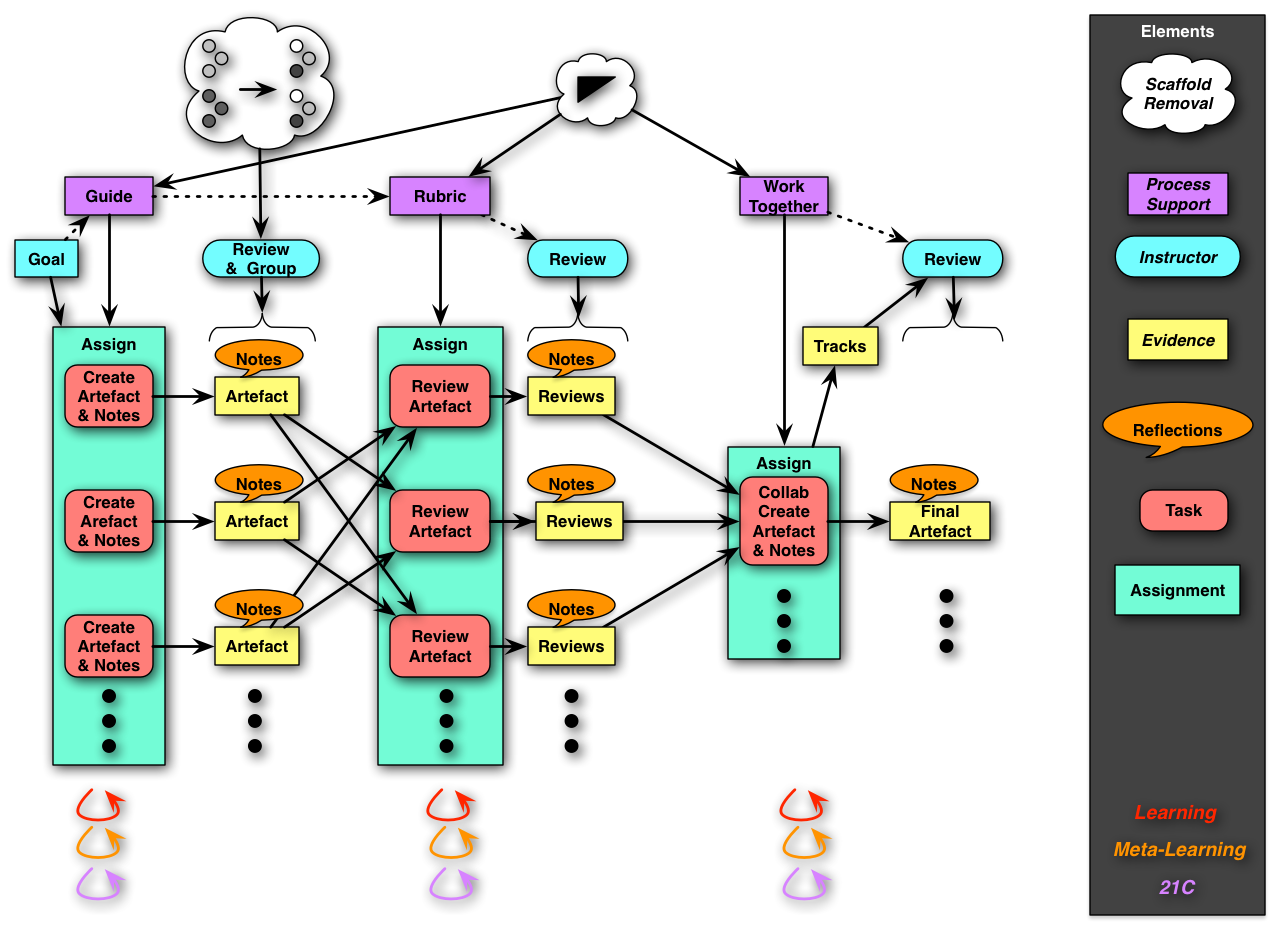
I was thinking (one morning at 4AM, when I was wishing I was asleep) about designing assignment structures that matched my activity-based learning model.  And a model emerged that I managed to recall when I finally did get up.  I’ve been workshopping it a bit since, tuning some details. No claim that it’s there yet, by the way.

ModelAssignmentAnd I’ll be the first to acknowledge that it’s complex, as the diagram represents, but let me tease it apart for you and see if it makes sense. I’m trying to integrate meaningful tasks, meta-learning, and collaboration.  And there are remaining issues, but let’s get to the model first.

So, it starts by assigning the learners a task to create an artefact. (Spelling intended to convey that it’s not a typical artifact, but instead a created object for learning purposes.) It could be a presentation, a video, a document, or what have you.  The learner is also supposed to annotate their rationale for the resulting design as well.  And, at least initially, there’s a guide to principles for creating an artefact of this type.   There could even be a model presentation.

The instructor then reviews these outputs, and assigns the student several others to review.  Here it’s represented as 2 others, but it could be 4. The point is that the group size is the constraining factor.

And, again at least initially, there’s a rubric for evaluating the artefacts to support the learner. There could even be a video of a model evaluation. The learner writes reviews of the two artefacts, and annotates the underlying thinking that accompanies and emerges.  And the instructor reviews the reviews, and provides feedback.

Then, the learner joins with other learners to create a joint output, intended to be better than each individual submission.  Initially, at least, the learners will likely be grouped with others that are similar.  This step might seem counter intuitive, but while ultimately the assignments will be to widely different artefacts, initially the assignment is lighter to allow time to come to grips with the actual process of collaborating (again with a guide, at least initially). Finally, the final artefacts are evaluated, perhaps even shared with all.

Several points to make about this.  As indicated, the support is gradually faded. While another task might use another artefact, so the guides and rubrics will change, the working together guide can gradually first get to higher and higher levels (e.g. starting with “everyone contributes to the plan”, and ultimately getting to “look to ensure that all are being heard”) and gradually being removed. And the assignment to different groups goes from alike to as widely disparate as possible. And the tasks should eventually get back to the same type of artefact, developing those 21 C skills about different representations and ways of working.  The model is designed more for a long-term learning experience than a one-off event model (which we should be avoiding anyways).

The artefacts and the notes are evidence for the instructor to look at the learner’s understanding and find a basis to understand not only their domain knowledge (and gaps), but also their understanding of the 21st Century Skills  (e.g. the artefact-creation process, and working and researching and…), and their learning-to-learn skills. Moreover, if collaborative tools are used for the co-generation of the final artefact, there are traces of the contribution of each learner to serve as further evidence.

Of course, this could continue. If it’s a complex artefact (such as a product design, not just a presentation), there could be several revisions.  This is just a core structure.  And note that this is  not for every assignment. This is a major project around or in conjunction with other, smaller, things like formative assessment of component skills and presentation of models may occur.

What emerges is that the learners are learning about the meta-cognitive aspects of artefact design, through the guides. They are also meta-learning in their reflections (which may also be scaffolded). And, of course, the overall approach is designed to get the valuable cognitive processing necessary to learning.

There are some unresolved issues here.  For one, it could appear to be heavy load on the instructor. It’s essentially impossible to auto-mark the artefacts, though the peer review could remove some of the load, requiring only oversight. For another, it’s hard to fit into a particular time-frame. So, for instance, this could take more than a week if you give a few days for each section.  Finally, there’s the issue of assessing individual understanding.

I think this represents an integration of a wide spread of desirable features in a learning experience. It’s a model to shoot for, though it’s likely that not all elements will initially be integrated. And, as yet, there’s no LMS that’s going to track the artefact creation across courses and support all aspects of this.  It’s a first draft, and I welcome feedback!


Activity-Based Learning

23 March 2016 by Clark 2 Comments

On a recent conversation with some Up to All of Us colleagues, I was reminded about my ‘reimagining learning‘ model. The conversation was about fractals and learning, and how most tools  (e.g. the LMS)  don’t reflect the conversational nature of learning.  And I was thinking again about how we need to shift our thinking, and how we can reframe it.

I’d pointed one colleague to Diana Laurillard’s model of  conversational  learning, as it does reflect a more iterative model of learning with ongoing cycle of action and reflection. And it occurred to me that I hadn’t conveyed what the learner’s experience with the activity curriculum would look like. It’s implicit, but not explicit.

New Learning CycleOf course, it’s a series of activities (as opposed to a series of content), but it’s about the product of those activities.  The learner (alone or together) creates a response to a challenge, perhaps accessing relevant content as part of the process, and additionally annotates the thinking behind it.

This is then viewed by peers and/or a mentor, who provide feedback to the learner. As a nuance, there should be guidance for that feedback, so that it explicitly represent the concept(s) that should guide the performance. The subsequent activity could be to revise the product, or move along to something else.

The point being that the learner is engaged in a meaningful assignment (the activity should be contextualized), and actively reflecting. The subsequent activity, as the Laurillard model suggests, should reflect what the learner’s actions have demonstrated.

It’s very much the social cognition benefits I’ve talked about before, in creating and then getting feedback on that representation.  The learner’s creating and reflecting, and that provides a rich basis for understanding where they are at.

Again, my purpose here is to help make it clear that a curriculum properly should be  about  doing, not knowing.  And this is why I believe that there must   be people in the loop. And while much of that burden might be placed on the other learners (if you have a synchronous cohort model), or even the learner with guidance on generating their own feedback, with rubrics for evaluation, but you still benefit from  oversight in case the understanding  gets off track.

We can do a lot to improve asynchronous learning, but we should not neglect social when we can take advantage of it. So, are you wanting to improve your learning?

Metacognitive Activity?

8 March 2016 by Clark Leave a Comment

So, as another outcome of the xAPI base camp a few weeks back, I was wondering about tracking not only learning, but meta-learning. That is, not only what activity might mean ‘learning’, but what might mean ‘meta-learning’ is happening?  I started wondering about a vocabulary, but realized that you’d have to have activity that you could actually detect that was evidence of meta-learning.  And I didn’t know what that was. Naturally, I started diagramming.

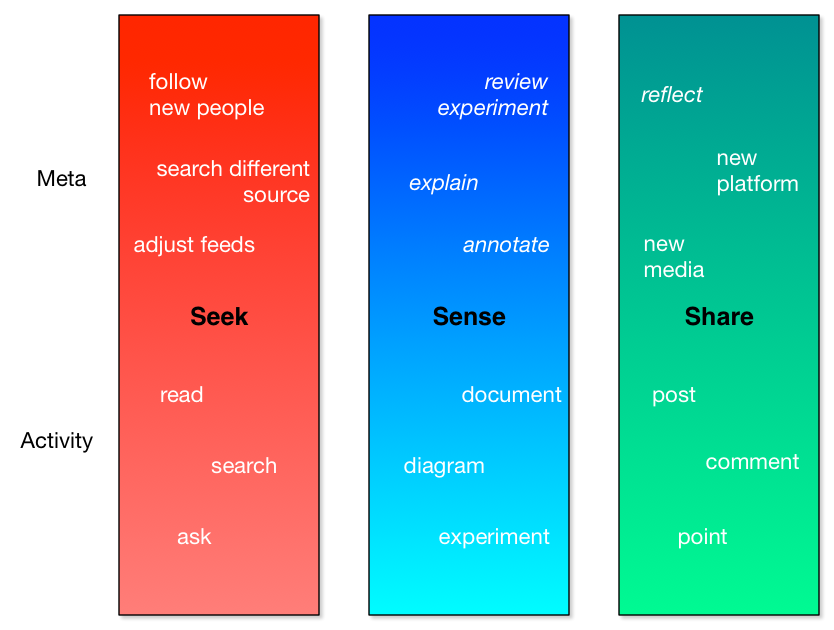
I started with Harold Jarche’s Personal Knowledge Mastery  model  of Seek-Sense-Share.  This is about how you continue to learn in manageable ways, and it served as an organizing framework.  To each of the elements, I attributed activities that would constitute learning in that model, and then above it I was thinking what would constitute meta-learning.

MetaCogSo, for seek, we start with reading what comes into your feeds, searching about particular topics, and asking questions of your network. Sensing is about reconciling what’s found with your own knowledge. So you could write or present, diagram (see what I  did there?), or experiment. And then to share you can post, or comment, or send a pointer to something.

So what are actions that reflect on those actions?  For seeking, you can adjust your feeds of what you follow, you can try a different search mechanism, or you can follow new people.  These are all detectable, I reckon.

For sensing, I see it as a little harder.  How do we know when you’re annotating a document  with the underlying thinking, not just documenting your progress?  How do we know when you’re explaining the thinking behind a diagram (here it’d be about my choice of vertical dimension, and spreading things below and above)?  How do we know when you’re actually reviewing your experimental approach or the results?

For sharing, it’s a mixed bag. If you choose to use a different media (perhaps it’s relative, like when I created an  animation  after blogging for > 10 years ;), we might know. If you try out a new social media platform/channel, we can probably note that.  If you’re reflecting on your comments from others, how would we know?

And this is just one way of carving it up.  The point being, meta is good, but detecting and tracking it is hard.  We might ask people to annotate it with tags, but that’s problematic too.  I have no obvious answers, but it’s a question I had, and I’m thinking out loud about it.  I welcome your thoughts, too.

Mindmapping

3 March 2016 by Clark 11 Comments

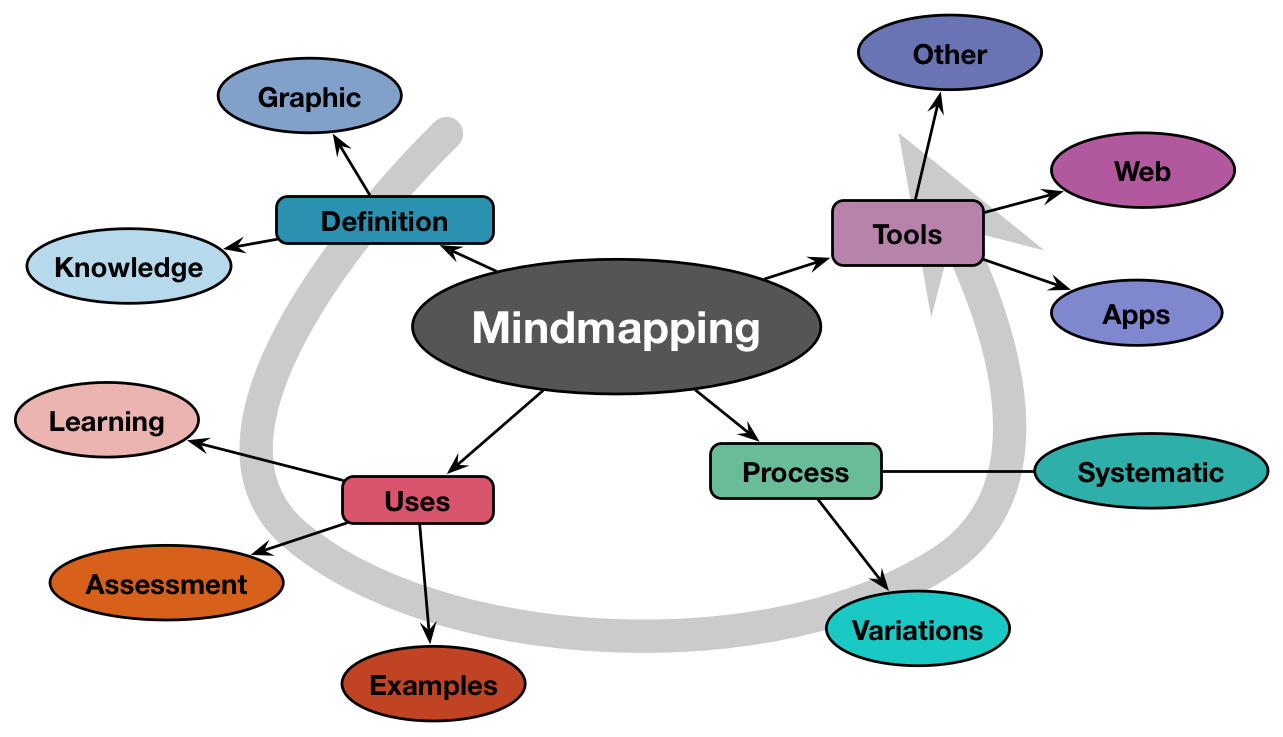
So, if you haven’t figured it out yet, I do mindmaps.  As I’ve recited before, I started doing it as a way to occupy my brain enough so I could listen to keynotes, but occasionally I use it to other purposes, such as representing structure or even planning. And thru  my esteemed colleague Jane Hart  (who’s Modern Workplace Learning book I’m going through and thoroughly impressed), I’m giving a mindmapping webinar today for a group of several universities in Ireland.  I thought I’d share what I’m presenting.

MindmappingMindmaps are a visual way of representing knowledge.  You use links to show connections between concepts (represented as nodes), developing a structural relationship.  A true semantic network would have those links labeled, as there are many different types of relationships (causal, precedence, hierarchical), but mindmaps typically have unlabeled links.  Still, mindmaps capture structural information in a visual way, that supports tapping into our powerful visual processing system. (This is the one I created for them to advertise the talk, it’s neither the order I ended up for them or am using here. ;)

You can add information to them; as a visual tool, you can add extra graphical information, like tables or charts, to augment the map.  You can similarly add color as a way to layer additional semantic information such as similarity. And the links can be plain or directional.  Importantly, while a mindmap can be essentially equivalent to an outline  if you maintain a strict tree structure, you can create a graph by having more complex links that generate loops.

The process of mindmapping is fairly straightforward: you have a central node, and then generate additional nodes and link them. I tend to go counter-clockwise, and include an arrow indicating that, because I’m capturing a linear presentation, but generating a static representation of information doesn’t have any directional requirement. I find that I have to frequently rearrange to fit the mindmap appropriately to the image, but that’s part of the benefit.

The evidence appears to show that mindmapping is superior to note-taking. I don’t do it all the time, but there are reasons to think you should.  The reasons, I believe, that it  is better is that you’re not just transcribing a presentation, but you’re actively parsing it to represent the structure. If you do take notes, you should be paraphrasing what you hear in your own words, to have active processing of the information. The additional effort to extract the structure as well is a form of valuable cognitive processing that elaborates the information.  Doing both, paraphrasing and extracting structure, would be a great way to really comprehend what you’re hearing.

As suggested, it’s helpful to mindmap talks, but it can also be a thinking tool, to analyze situations and sort out your thoughts or plan activities and add elements as you think of them. No real advantage over an outline, potentially (though the ability to add other graphics and to make non-strict maps may counter that), though I suspect some find the drawing and rearranging to be a nice physical overhead to facilitate reflecting.  And, of course, it can be an evaluation tool, asking someone to create their maps to see their understanding.

While there are dedicated tools for mindmapping, both applications and in the cloud, which will make creating and rearranging easier (I presume), you can use almost any drawing package (I use OmniGraffle). You could use Powerpoint or Keynote, and even pencil and paper (if it’s just for the processing) though it can be harder to revise.

So, that’s my riff on mind mapping.  I welcome your thoughts.

Content isn’t a silo

2 March 2016 by Clark 2 Comments

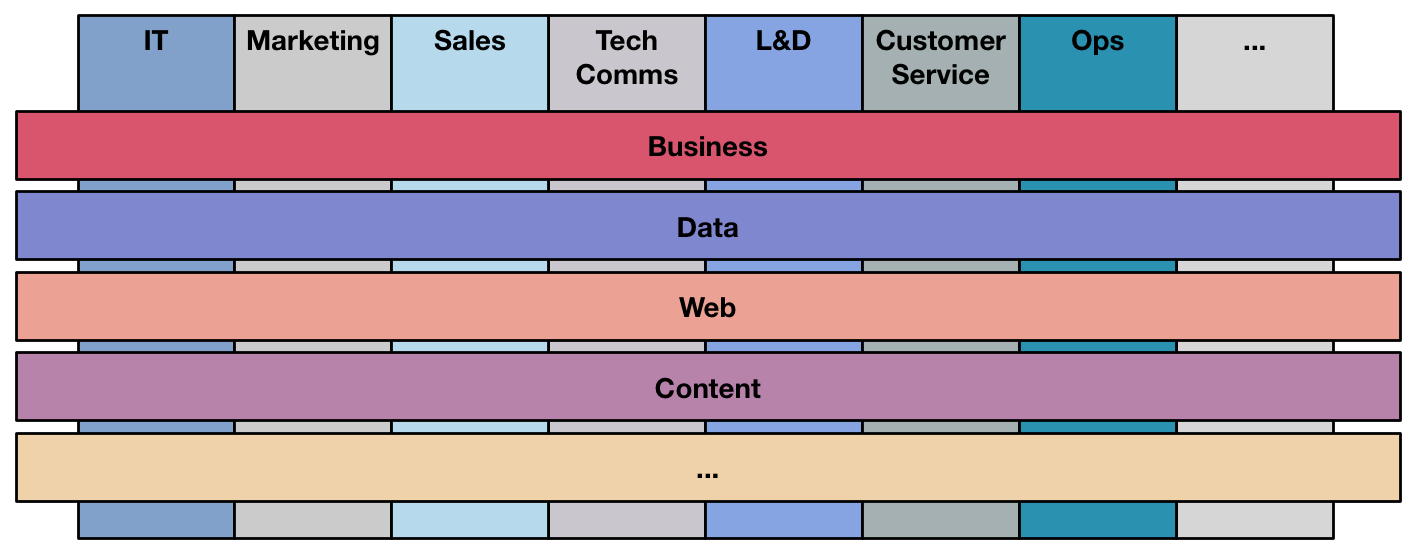
I mentioned in my previous post that I was talking at the xAPI camp about content strategy, and on the way in I created a new diagram to convey a concept I wanted to discuss.  Of course one of the things I agitate about for the revolution is that L&D can’t hide away but has to start engaging across the business.  And, let me add, that’s only increasing.  Our silos are breaking down. To wit:

ContentStrategyHere I was trying to think of activities that cross silos.  So, of course, the overall role of the business aligns and integrates the separate actions of sales, marketing, IT, etc.  And, to suit my campaign, I looked for others.

Obviously, data is coming out across the organization.  As I mentioned in that last post, we can only look at the impact of L&D on performance if we can start working with data from the business units, but data from customer service influences marketing, and so on.

The web, too, is a channel for many activities. Units that reach customers, for instance,  include customer service, customer education, sales & marketing, and more.  Heck, the supply chain is increasingly connected by the web, and data.

Consequently, so too is content.  Content is used in many ways, whether via  apps, through the web, or print.  And for many purposes: sales, marketing, tech support, and of course learning.  And there’s a point to all this.

L&D, with it’s hard-wired content, needs to pull on the big kids pants, and start getting with content systems: content engineering, governance, and strategy. Truly, if you want to be part of the strategic picture going forward, you have to work with information tools. Industrial age methods won’t cut it. So, are you thinking about how to move  to a content strategy?

« Previous Page
Next Page »

Clark Quinn

The Company

Search

Feedblitz (email) signup

Never miss a post
Your email address:*
Please wait...
Please enter all required fields Click to hide
Correct invalid entries Click to hide

Pages

  • About Learnlets and Quinnovation

The Serious eLearning Manifesto

Manifesto badge

Categories

  • design
  • games
  • meta-learning
  • mindmap
  • mobile
  • social
  • strategy
  • technology
  • Uncategorized
  • virtual worlds

License

Previous Posts

  • March 2026
  • February 2026
  • January 2026
  • December 2025
  • November 2025
  • October 2025
  • September 2025
  • August 2025
  • July 2025
  • June 2025
  • May 2025
  • April 2025
  • March 2025
  • February 2025
  • January 2025
  • December 2024
  • November 2024
  • October 2024
  • September 2024
  • August 2024
  • July 2024
  • June 2024
  • May 2024
  • April 2024
  • March 2024
  • February 2024
  • January 2024
  • December 2023
  • November 2023
  • October 2023
  • September 2023
  • August 2023
  • July 2023
  • June 2023
  • May 2023
  • April 2023
  • March 2023
  • February 2023
  • January 2023
  • December 2022
  • November 2022
  • October 2022
  • September 2022
  • August 2022
  • July 2022
  • June 2022
  • May 2022
  • April 2022
  • March 2022
  • February 2022
  • January 2022
  • December 2021
  • November 2021
  • October 2021
  • September 2021
  • August 2021
  • July 2021
  • June 2021
  • May 2021
  • April 2021
  • March 2021
  • February 2021
  • January 2021
  • December 2020
  • November 2020
  • October 2020
  • September 2020
  • August 2020
  • July 2020
  • June 2020
  • May 2020
  • April 2020
  • March 2020
  • February 2020
  • January 2020
  • December 2019
  • November 2019
  • October 2019
  • September 2019
  • August 2019
  • July 2019
  • June 2019
  • May 2019
  • April 2019
  • March 2019
  • February 2019
  • January 2019
  • December 2018
  • November 2018
  • October 2018
  • September 2018
  • August 2018
  • July 2018
  • June 2018
  • May 2018
  • April 2018
  • March 2018
  • February 2018
  • January 2018
  • December 2017
  • November 2017
  • October 2017
  • September 2017
  • August 2017
  • July 2017
  • June 2017
  • May 2017
  • April 2017
  • March 2017
  • February 2017
  • January 2017
  • December 2016
  • November 2016
  • October 2016
  • September 2016
  • August 2016
  • July 2016
  • June 2016
  • May 2016
  • April 2016
  • March 2016
  • February 2016
  • January 2016
  • December 2015
  • November 2015
  • October 2015
  • September 2015
  • August 2015
  • July 2015
  • June 2015
  • May 2015
  • April 2015
  • March 2015
  • February 2015
  • January 2015
  • December 2014
  • November 2014
  • October 2014
  • September 2014
  • August 2014
  • July 2014
  • June 2014
  • May 2014
  • April 2014
  • March 2014
  • February 2014
  • January 2014
  • December 2013
  • November 2013
  • October 2013
  • September 2013
  • August 2013
  • July 2013
  • June 2013
  • May 2013
  • April 2013
  • March 2013
  • February 2013
  • January 2013
  • December 2012
  • November 2012
  • October 2012
  • September 2012
  • August 2012
  • July 2012
  • June 2012
  • May 2012
  • April 2012
  • March 2012
  • February 2012
  • January 2012
  • December 2011
  • November 2011
  • October 2011
  • September 2011
  • August 2011
  • July 2011
  • June 2011
  • May 2011
  • April 2011
  • March 2011
  • February 2011
  • January 2011
  • December 2010
  • November 2010
  • October 2010
  • September 2010
  • August 2010
  • July 2010
  • June 2010
  • May 2010
  • April 2010
  • March 2010
  • February 2010
  • January 2010
  • December 2009
  • November 2009
  • October 2009
  • September 2009
  • August 2009
  • July 2009
  • June 2009
  • May 2009
  • April 2009
  • March 2009
  • February 2009
  • January 2009
  • December 2008
  • November 2008
  • October 2008
  • September 2008
  • August 2008
  • July 2008
  • June 2008
  • May 2008
  • April 2008
  • March 2008
  • February 2008
  • January 2008
  • December 2007
  • November 2007
  • October 2007
  • September 2007
  • August 2007
  • July 2007
  • June 2007
  • May 2007
  • April 2007
  • March 2007
  • February 2007
  • January 2007
  • December 2006
  • November 2006
  • October 2006
  • September 2006
  • August 2006
  • July 2006
  • June 2006
  • May 2006
  • April 2006
  • March 2006
  • February 2006
  • January 2006

Amazon Affiliate

Required to announce that, as an Amazon Associate, I earn from qualifying purchases. Mostly book links. Full disclosure.

We use cookies to ensure that we give you the best experience on our website. If you continue to use this site we will assume that you are happy with it.