Learnlets

Secondary

Clark Quinn’s Learnings about Learning

Search Results for: align

Changing Culture: Changing the Game

13 June 2014 by Clark Leave a Comment

I previously wrote about Sutton & Rao’s Scaling up Excellence, and have now finished a quick read of Connors & Smith’s  Change the Culture, Change the Game.  Both books cover roughly the same area, but in very different ways.  Sutton & Rao’s was very descriptive of the changes they observed and the emergent lessons.  Connors & Smith, on the other hand, are very prescriptive.  Yet both are telling similar stories with considerable overlap.

Let’s be clear, Connors & Smith have a model they want to sell you.  You get the model up front, and then implementation tools in the second half. Of course, you  aren’t supposed to actually try this without having their help.  As long as you’re clear on this aspect of the book, you can take the lessons learned and decide whether you’d apply them yourself or use their support.

They have a relatively clear model, that talks about the results you want, the actions people will have to take to get to the results,  the beliefs that are needed to guide those actions, and the experiences that will support those beliefs. They aptly point out that many change initiatives stop at the second step, and don’t get the necessity of the subsequent two steps. It’s a plausible story and model, where  the actions, beliefs, and experiences are the elements that create the culture that achieves the results.

Like Kirkpatrick’s levels, the notion is that you start with the results you need, and work backward.  Further, everything has to be aligned: you have to determine what actions will achieve the new results, and then what new beliefs can   guide those new actions, and ultimately what  experiences are needed  to foster those new beliefs.  You work rigorously to only focus on the ones that will make a difference, recognizing that too much will impact the outcome.

The second half talks about tools to foster these steps. There are management tools,  leadership  skills, and  integration steps.  There’s necessary training associated with these, and then coaching (this is the sales bit).   It’s very formulaic, and makes it sound like close adherence to these approaches will lead to success.  That said, there is a clear recognition that you need to continually check on how it’s going, and be active in making things happen.

And this is where there’s overlap with Sutton & Rao: it’s about ongoing effort, it requires accountability (being willing to take ownership of outcomes),  people must be  engaged and involved, etc.  Both are different approaches to dealing with the same issue: working systematically to make necessary changes in an organization. And in both cases, the arguments are pretty compelling that it takes transparency and commitment by the leadership to walk the talk.  It’s up to the executives to choose the needed change, but the empowerment to find ways to make that happens is diffused downward.

Whether you like the more organic approach of Sutton & Rao or the more formulaic model of Connors & Smith, you will find insight into the elements that facilitate change.  For me, the synergy was nice to see.  Now we’ll see if these are still old-school by comparison to Laloux’s  Reinventing Organizations,  that has received strong support  from some  colleagues I have learned to trust.

#itashare
 

From Content to Experience

3 June 2014 by Clark 1 Comment

A number of years ago, I said that the problem for publishers was not going from text to content (as the saying goes), but from content to experience.  I think elearning designers have the same problem: they are given a knowledge dump, and have to somehow transform that into an effective experience.  They may even have read the Serious eLearning Manifesto, and want to follow it, but struggle with the transition or transformation.  What’s a designer to do?

The problem is, designers will be told, “we need a course on this”, and given a dump of Powerpoints (PPTs), documents (PDFs), and maybe access to a subject matter expert (SME).  This is all about knowledge.  Even the SME, unless prompted carefully otherwise, will resort to telling you the knowledge they’ve learned, because they just don’t have access to what they know.  And this, by itself, isn’t a foundation for a course.  Processing the knowledge, comprehending it, presenting it, and then testing on acquisition (e.g. what rapid elearning tools make easy), isn’t going to lead to a meaningful outcome. Sorry, knowledge isn’t the same as ability to perform.

And this ignores, of course, whether this course is actually needed.  Has anyone checked to see that if the skills associated with this knowledge have a connection with a real workplace performance issue?  Is the performance need a result of a lack of skills?  And is this content aligned to that skill?  Too often folks will ask  for a course on X when the barrier is something else.  For instance, if the content is a bunch of knowledge that somehow you’re to magically put in someone’s head, such as product information or arbitrary rules, you’re far better off putting that information in the world than trying to put it in the head.  It’s really hard to get arbitrary information in the head.  But let’s assume that there is a core skill and workplace need for the sake of this discussion.

The key is determining what this knowledge actually supports  doing differently.  The designer needs to go through that content and figure out what individuals will be able to  do that they can’t do now (that’s important), and then develop practice doing that. This is so important that, if what they’ll be able to do differently, isn’t there, there should be push back.  While you can talk to the SME (trying to get them to talk in terms of decisions they can make instead of knowledge), you may be better off inferring the decisions and then verifying and refining with the SME.  If you have access to several SMEs, better yet get them in a room together and just facilitate until they come up with the core decisions, but there are many situations where that’s not feasible.

Once you have that key decision, the application of the skill in context, you need to create situations where learners can practice using it.  You need to create scenarios  where these decisions will play out. Even just better written multiple choice questions that have: story setting, situation precipitating decision, decision alternatives that are ways in which learners might go wrong,  consequences of the decisions, and feedback.  These practice attempts are the core of a meaningful learning experience. And there’s even evidence that putting problems up front or at core is a valuable practice.  You also want to have sufficient practice not just ’til they get it right, but until they have a high likelihood of not getting it wrong.

One thing that might not be in the PDFs and PPTs are examples.  It’s helpful to get colorful examples of someone using  information to successfully solve a problem, and also cases where they misapplied it and failed.  Your SME should be able to help you here, telling you engaging stories of wins and losses.  They may be somewhat resistant to the latter; worst case have them tell them about someone else.

The content in the PDFs and PPTs then gets winnowed down into just the resource material that helps the learner actually able to do the task, to successfully make the decision.  Consider having the practice set in a story, and the content is available through the story environment (e.g. casebooks on the shelves for examples, a ‘library’ for concepts).  But even if you present the (minimized) content and then have practice, you’ve shifted from knowledge dump/test to more of a flow of experience.  The suite  of  meaningful practice, contextualized well and made meaningful with a wee bit of exaggeration and careful alignment with learner’s awareness, is the essence of experience.

Yes, there’s a bit more to it than that, but this is the core: focus on  do, not dump.  And, once you get in the habit, it shouldn’t  take longer, it just takes a change in thinking.  And even if it does, the dump approach isn’t liable to  lead to any meaningful learning, so it’s a waste of time anyway.  So, create experiences, not content.


Vale Don Kirkpatrick

28 May 2014 by Clark 2 Comments

Last week, Don Kirkpatrick passed away.  Known for his four ‘levels‘ of measuring learning, he’s been hailed and excoriated.  And it’s instructive to see why on both sides.

He derived his model as an approach to determine the impact of an intervention on organizational performance.  He felt that you worked backward from the change you needed, to determine whether the workplace performance was changing, as then to see if that could be attributed to the training, and ultimately to the learner.  He numbered his steps so that step 1 was seeing what learners thought, 2 was that learners  could demonstrate a change, 3 was that the change was showing up in the workplace post intervention, and 4 was it impacting business measures.

This actually made a lot of sense. Rather than measuring the cost of hour of seat time or some other measure of efficiency, or, worse, not measuring at all, here was a plan that was designed to focus on meaningful change that the business needed.  It was obvious, and yet also obviously needed.    So his success in bringing awareness to the topic of business impact is to be lauded.

There were two major  problems, however.  For one, having numbered it the way that it was, people seemed that they could take a partial attempt.  Research shows that the number of people would only do step 1 or 2, and these are useless without ultimately including 4.  He even later wondered if he should have numbered the approach in the reverse.  The numbers have been documented (from a presentation with results from the ASTD Benchmarking Forum) as dropping in implementation from 94% doing level 1, 34% doing level 2, 13% doing level 3, and 3% doing level 4.  That’s  not  the idea!

The second problem was that whether or not he intended it (and there are reasons to believe he didn’t), it become associated only with training interventions.  Performance support interventions or social network outcomes  could similarly be measured (at least on levels 3 and 4), yet the language was all about training, which made it easy for folks to wrongly conclude that training was your only tool.  And we still see folks using courses as the only tool in their repertoire, which just isn’t aligned with how we think, work, and learn (hence the revolution).

Kirkpatrick rode this tool for the rest of his career,  created a family business in it, and he wasn’t shy about suggesting that you buy a book to learn about it.  I certainly can’t fault him for it either, as he did have a sensible model and it could be put into effective use.  There are worse ways to earn a living.

Others have played upon his model.  The Phillips have made a similar career with their fifth level, ROI, measuring the cost of impacting level 4 against the value of the impact.  Which isn’t a bad move to make  after you focus on making an impact.  Similarly, a client opined that there was also level 0, are the learners even showing up for the training!

In assessing the impact, part of me is mindful that tools can be used for good or ill.  Powerpoint doesn’t kill people, people do, as the saying goes.  Still, Kirkpatrick could’ve renumbered the steps, or been more outspoken about the problems with just step 1.

So, I laud his insight, and bemoan the ultimate lack of impact.  However, I reckon it’s better to argue about it than be ignorant.  Rest in peace.

Setting Story

27 May 2014 by Clark Leave a Comment

I’ve been thinking about the deep challenge of motivating uninterested learners.  To me, at least part of that is making the learning of intrinsic interest.  And one of those elements is practice, and this is arguably the most important element to making learning work.  So how to do we make practice intrinsically interesting?

One of the challenging but important components of designing meaningful practice is choosing a context in which that practice is situated.  It’s really about finding a story line that makes the action meaningful to both the learner and the learning. It’s creative (and consequently fun), but it’s also not intrinsically obvious (which I’ve learned after trying to teach it in both game design and advanced ID workshops). There are heuristics to be followed (there’s no guaranteed formula except brainstorm, winnow, trial, and refine), however, that can be useful.

While Subject Matter Experts (SMEs) can be the bane of your existence while setting learning goals (they have conscious access to no more than 30% of what they do, so they tend to end up reciting what they know, which they do have access to),  they can be very useful when creating stories. There’s a reason why they’ve spent the requisite time to  become experts in the field, and that’s an aspect we can tap into. Find out  why it’s of interest to them.  In one instance, when asking experts about computer auditing, a colleague found that auditors found it like playing detective, tracking back to find the error.  It’s that sort of insight upon which a good game or practice exercise can hinge.

One of the tricks to work with SMEs is to talk about decisions.  I argue that what is most likely to make a difference to organizations is that people make better decisions, and I also believe that using the language of decisions helps SMEs focus on what they  do, not what they know.  Between your performance gap analysis of the situation, and expert insight into what decisions are key, you’re likely to find the key performances you want learners to practice.

You also want to find out all the ways learners go wrong.  Here you may well hear instructors and/or SMEs say “no matter what we do, they always…”. And that’s the things you want to know, because novices don’t tend to make random errors.  Yes, there’s some, owing to our cognitive architecture (it’s adaptive), which is why it’s bad to expect people to do rote things, but it’s a small fraction of mistakes.  Instead, learners make patterned mistakes based upon mistakes in their conceptualizations of the performance, aka misconceptions.  And  you want to trap those because you’ll have a chance to remediate them in the learning context. And they make the challenge more appropriately tuned.

You also need the consequences of both the right choice and the misconceptions. Even if it’s just a multiple choice question, you should show what the real world consequence is before providing the feedback about why it’s wrong. It’s also the key element in scenarios, and building models for serious games.

Then the  trick is to ask SMEs about all the different settings in which these decisions embed. Such decisions tend to travel in packs, which is why scenarios are better practice than simple multiple choice, just as scenario-based multiple choice trumps knowledge test.  Regardless, you want to contextualize those decisions, and knowing the different settings that  can be used gives you a greater palette to choose from.

Finally, you’ll want to decide how close you want the context to be to the real context.  For certain high-stakes and well-defined tasks, like flying planes or surgery, you’ll want them quite close to the real situation.  In other situations, where there’s more broad applicability and less intrinsic interest (perhaps accounting or project management), you may want a more fantastic setting that facilitates broader transfer.

Exaggeration is a key element. Knowing what to exaggerate and when is not yet a science, but the rule of thumb is leave the core decisions to be based upon the important variables, but the context can be raised to increase the importance.  For example, accounting might not be riveting but your job depends on it.  Raising the importance of the accounting decision in the learning experience will mimic the importance, so you might be accounting for a mob boss who’ll terminate your existence if you don’t terminate the discrepancy in his accounts!  Sometimes exaggeration can serve a pedagogical purpose as well, such as highlighting certain decisions that are rare in real life but really important when they occur. In one instance, we had asthma show up with a 50% frequency instead of the usual ~15%, as the respiratory complications that could occur required specific approaches to address.

Ultimately, you want to choose a setting in which to embed the decisions. Just making it abstract decreases the impact of the learning, and making it about knowledge, not decisions, will render it almost useless, except for those rare bits of knowledge that have to absolutely be in the head.  You want to be making decisions using models, not recalling specific facts. Facts are better off put in the world for reference, except where time is too critical. And that’s more rare than you’d expect.

This may seem like a lot of work, but it’s not that hard, with practice.  And the above is for critical decisions. In many cases, a good designer should be able to look at some content and infer what the  decisions involved  should be.  It’s a different design approach then transforming knowledge into tests, but it’s critical for learning.  Start working on your practice items first, aligned with meaningful objects, and the rest will flow. That’s my claim, what say you?

Getting contextual

21 May 2014 by Clark Leave a Comment

For the current ADL webinar series on mobile, I gave a presentation on contextualizing mobile in the larger picture of L&D (a natural extension of my most recent books).  And a question came up about whether I thought wearables constituted mobile.  Naturally my answer was yes, but I realized there’s a larger issue, one that gets meta as well as mobile.

So, I’ve argued that we should be looking at models for guiding our behavior.  That we should be creating them by abstracting from successful practices, we should be conceptualizing them, or adopting them from other areas.  A good model, with rich conceptual relationships, provides a basis for explaining what has happened, and predicting what will happen, giving us a basis for making decisions.  Which means they need to be as context-independent as possible.

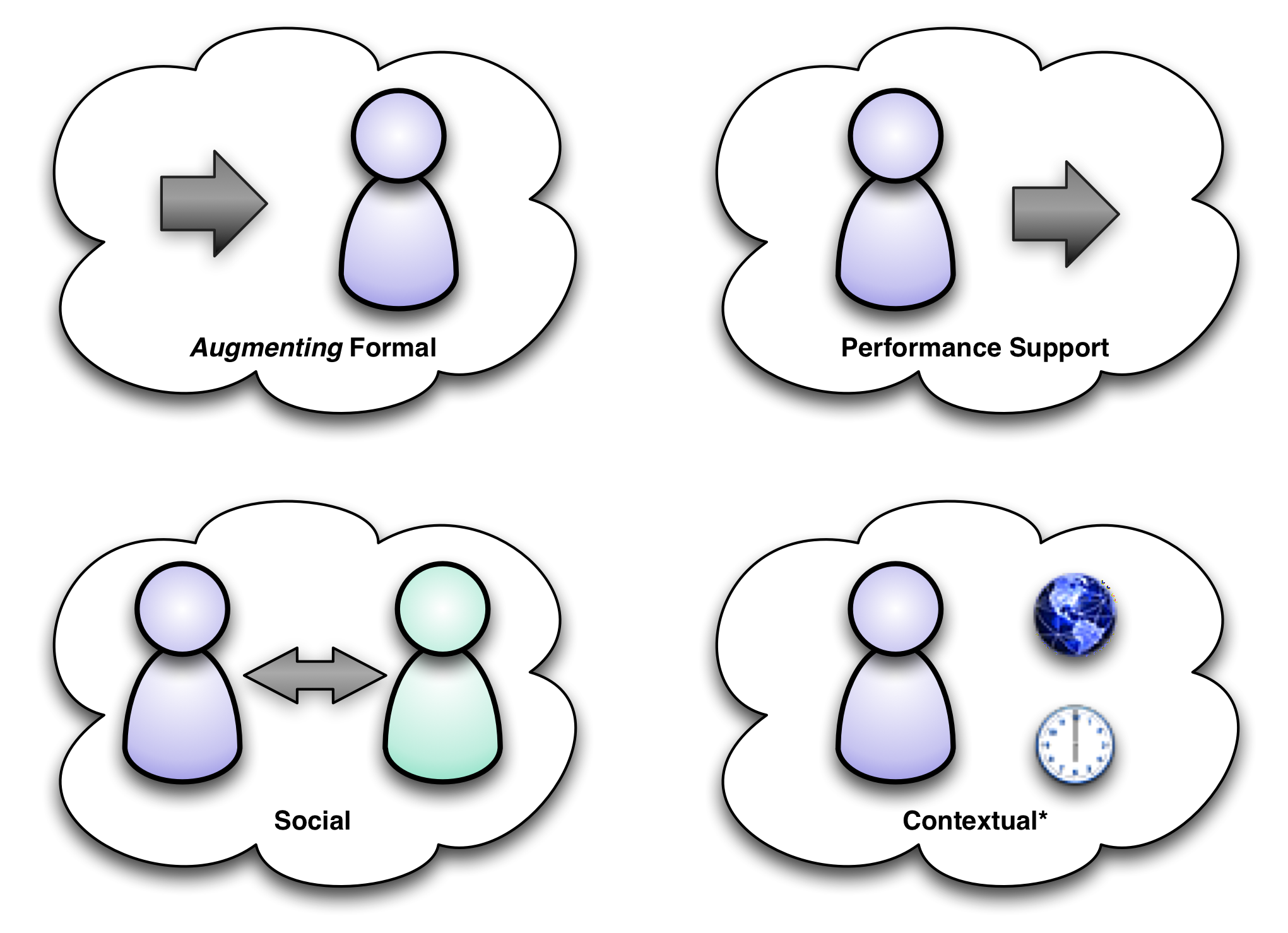
WorkOppsSo, for instance, when I developed the mobile models I use, e.g. the 4C‘s and the applications of learning (see figure), I deliberately tried to create an understanding that would transcend the rapid changes that are characterizing mobile, and make them appropriately recontextualizable.

In the case of mobile, one of the unique opportunities is contextualization.  That means using information about where you are, when you are, which way you’re looking, temperature or barometric pressure, or even your own state: blood pressure, blood sugar, galvanic skin response, or whatever else skin sensors can detect.

To put that into context (see what I did there): with desktop learning, augmenting formal could be emails that provide new examples or practice that spread out over time. With a smartphone  you can do the same, but you could also have a localized information so that because of where you were you might get information related to a learning goal. With a wearable, you might get some information because of what you’re looking at (e.g. a translation or a connection to something else you know), or due to your state (too anxious, stop and wait ’til you calm down).

Similarly for performance support: with a smartphone you could take what comes through the camera and add it onto what shows on the screen; with glasses you could lay it on the visual field.  With a watch or a ring, you might have an audio narration.  And we’ve already seen how the accelerometers in fit bracelets can track your activity and put it in context for you.

Social can not only connect you to who you need to know, regardless of device or channel, but also signal you that someone’s near, detecting their face or voice, and clue you in that you’ve met this person before.  Or find someone that you should meet because you’re nearby.

All of the above are using contextual information to augment the other tasks you’re doing.  The point is that you map the technology to the need, and infer the possibilities.  Models are a better basis for elearning, too so that you teach transferable understandings (made concrete in practice) rather than specifics that can get outdated.  This is one of the elements we placed in the Serious eLearning Manifesto, of course.  They’re also useful for coaching & mentoring as well, as for problem-solving, innovating, and more.

Models are powerful tools for thinking, and good ones will support the broadest possible uses.  And that’s why I collect them, think in terms of them, create them, and most importantly, use them in my work.   I encourage you to ensure that you’re using models appropriately to guide you to new opportunities, solutions, and success.

Stan McChrystal #ASTD2014 Keynote Mindmap

6 May 2014 by Clark Leave a Comment

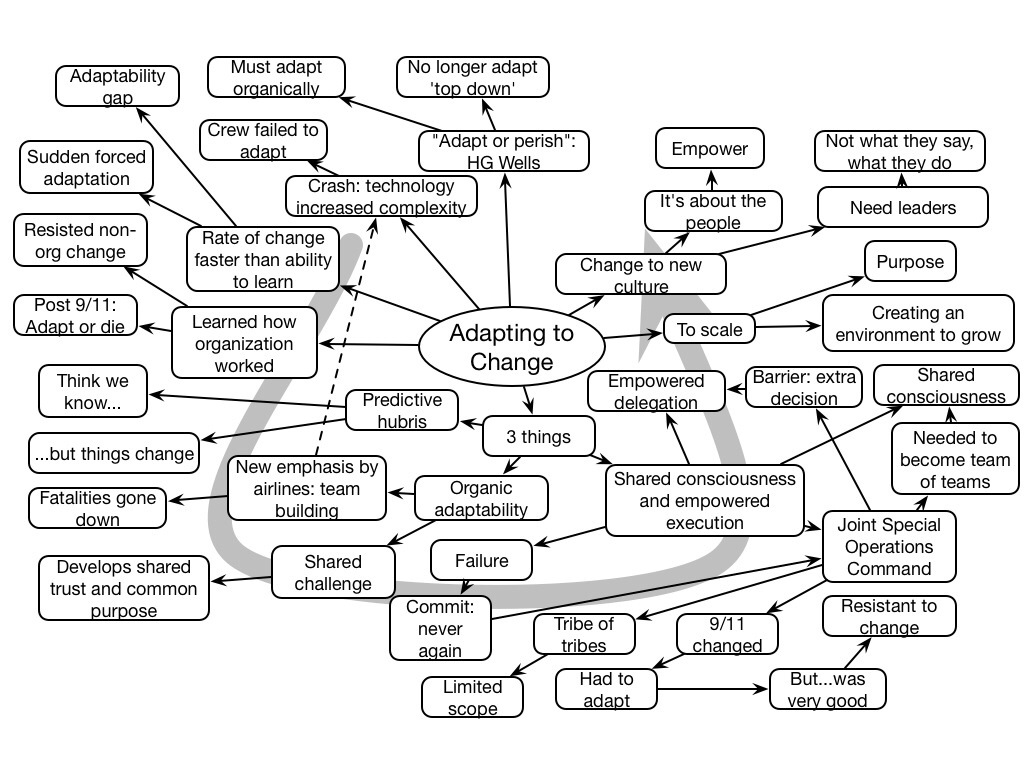
General Stan McChrystal gave an inspiring and insightful talk about adapting to change, based upon his experience.

20140506-092810.jpg


Ariana Huffington #ASTD2014 Keynote Mindmap

5 May 2014 by Clark 3 Comments

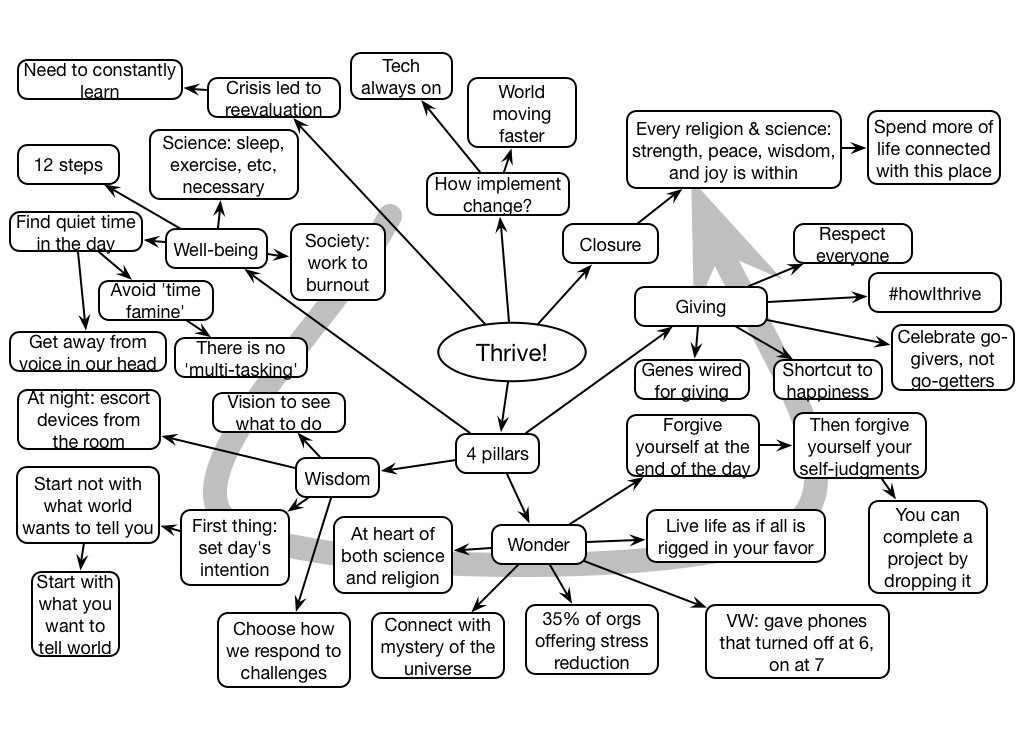
Arianna Huffington kicked off ASTD’s international conference with a very engaging presentation covering the four pillars to thrive. Alternately funny and wise, it was a great start.

20140505-092318.jpg

Neil Jacobstein #ChurchillClub Keynote Mindmap

22 April 2014 by Clark 1 Comment

Neil Jacobstein gave the keynote for the special Future of Talent event sponsored by SAP and hosted by the Churchill Club. In a wide ranging and inspiring talk, Neil covered how new technologies, models, and methods provide opportunities to transcend our problems and create a world worth living in.

20140422-195914.jpg

Appropriate friction

22 April 2014 by Clark Leave a Comment

In a conversation, a colleague mentioned using social tools to minimize friction, and the thought struck me wrong. In thinking further, I realized that there were different notions of friction that needed to be teased out.  So here’s where my thinking went.

I argue that what organizations need is creative friction.  I have previously suggested that conversations are the engine of business.  These are the discussions where ideas are sparked, and decisions are made.  These are also the tools used to negotiate a new and shared understanding that is richer and better than it was before.

There are also unproductive conversations, e.g. meetings where we have status updates that are more effectively done offline, and jockeying for various sorts of recognition.  These are reflections of bad processes and worse culture.  There’s a mistaken view that brainstorming doesn’t work; it works well if you know the important elements that make it work, but if you follow misunderstood processes, it can not produce the optimal outcome. Similarly, if the culture is  misaligned, it might be unsafe to share, or folks might be too busy competing.

However, it is when people are constructively interacting – not just pointing to useful resources  or  answering questions, but  working together on a joint project – is when you are getting the important creative friction.  Not that it’s bad when people point to useful resources or answer questions, that makes things more efficient.  When folks come with different ideas, though, and jointly create a new insight, a new idea, a new product or process, that is  when you’re providing the sparks necessary to help organizations succeed. Not all of them will be good, but if they’re new, some subset will likely be good.

If people aren’t sharing what they learn and discover, you might miss the new, or it might not really be new but have been previously discovered and not leveraged. That’s why you should work, and learn, out loud.

The issue then in friction is removing unproductive friction. If people have to be co-located to have these conversations, or don’t have tools to express their understandings and share their thoughts around each other’s work is when you unproductive barriers.  I’m a fan of collaborative documents that support annotation and track contributions. Here we can share our ideas, and quickly converge on the elements of disagreement and resolve them.  It may need to have periods of synchronous conversation as well as asynchronous work (we did this when creating the Manifesto).

So it seems to me that having the right culture, tools, and skills is the key to optimizing the innovative outcomes that will drive sustainability for organizations.  Now how about some creative inputs to refine and improve this?

(And, at a meta-level, it was a conversation that triggered this deeper thought, just the type of outcome we want to facilitate!)

#itashare

It’s (almost) out!

2 April 2014 by Clark 4 Comments

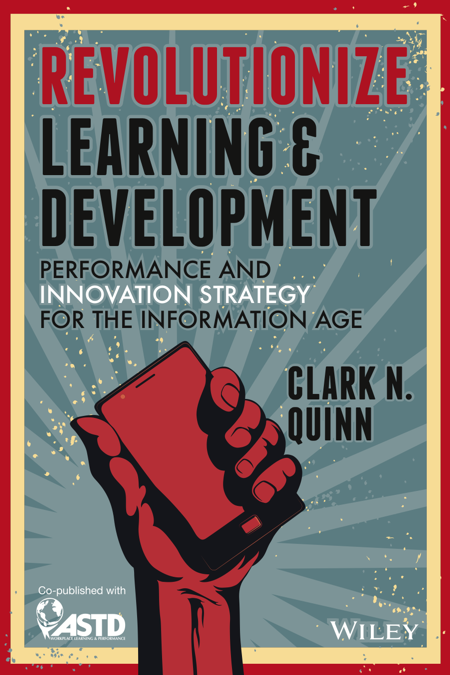
My latest tome, Revolutionize Learning & Development: Performance and Innovation Strategy for the Information Age is out.  Well, sort of.  What I mean is that it’s now available on Amazon for pre-order.  Actually, it’s been for a while, but I wanted to wait until there was some  there there, and now there’s the ‘look inside’ stuff so you can see the cover, back cover (with endorsements!), table of contents, sample pages, and more.  Ok, so I’m excited!

RLnDCoverSmallWhat I’ve tried to do is make the case for dragging L&D into the 21st Century, and then provide an onramp.  As I’ve been saying, my short take is that L&D isn’t doing what it could and should be doing, and what it  is doing, it is doing badly.  But I don’t believe complaining alone is particularly helpful, so I’m trying to put in place what I think will help as well.  The major components are:

  • what’s wrong (you can’t change until you admit the problem :)
  • what we know about how we think, work, and learn that we aren’t accounting for
  • what it would look like if we were doing it right
  • ways forward

By itself, it’s not the whole answer, for several reasons. First, it can’t be. I can’t know all the different situations you face, so I can’t have a roadmap forward for everyone. Instead, what I supposed you could think of is that it’s a guidebook  (stretching metaphors), showing suggestions that you’ll have to sequence into your own path.  Second, we don’t know all yet. We’re still exploring many of these areas.  For example, culture change is not a recipe, it’s a process.  Third, I’m not sure any one person can know all the answers in such a big field. So, fourth, to practice what I’m preaching, there should be a community pushing this, creating the answers together.

A couple of things on that last part, the first one is a request.  The community will need to be in place by the time the book is shipping.  The question is where to host it.  I don’t intend to build a separate community for it on the book site, as there are plenty of places to do this.  Google groups, Yahoo groups, LinkedIn…the list goes on. It can’t be proprietary (e.g. you have to be a paid member to play).  Ideally it’d have collaborative tools to create resources, but I reckon that can be accommodated via links.  What do you folks think would be a good choice?

The second part of the community bit is that I’m very grateful to many people who’ve helped or contributed.  Practitioner friends and colleagues provided the five case studies I’ve the pleasure to host.  Two pioneers shared their thoughts.  The folks at ASTD have been great collaborators in both helping me with resources, and in helping me get the message out.  A number of other friends and colleagues took the time to read an early version and write endorsements.  And I’ve learned together with so many of you by attending events together, hearing you speak, reading your writings, and having you provide feedback on my thoughts via talking or writing to me after hearing me speak or commenting on my scribblings here.

The book isn’t perfect, because I have thought of a number of ways it could be improved since I provided the manuscript, but I have stuck to the mantra that at some point it’s better out than still being polished. This book came from frustration that we can be doing so much better, and we’re not. I didn’t grow up thinking “I’m going to be a revolutionary”, but I can’t not see what I see and not say  something.  We can be doing so much better than we are. And so I had to be willing to just get the word out, imperfect.  It wasn’t (isn’t) clear that I’m the best person to call this out, but someone needs to!

That said, I have worked really hard to have the right pieces in place.  I’ve collected and integrated what I think are the necessary frameworks, provided case studies and a workplace scenario, and some tools to work forward.   I have done my best to provide a short and cogent kickstart to moving forward.  

Just to let you know that I’m starting my push.  I’ll be presenting on the book at ASTD’s ICE conference, and doing some webinars. Bryan Austin of GameOn Learning interviewed me on my thoughts in this direction.  I do believe in the message, and that it at least needs to be heard.  I think it’s really the necessary message for L&D (in it, you’ll find out why I’m suggesting we need to shift to P&D!).  Forewarned!  I look forward to your feedback.

« Previous Page
Next Page »

Clark Quinn

The Company

Search

Feedblitz (email) signup

Never miss a post
Your email address:*
Please wait...
Please enter all required fields Click to hide
Correct invalid entries Click to hide

Pages

  • About Learnlets and Quinnovation

The Serious eLearning Manifesto

Manifesto badge

Categories

  • design
  • games
  • meta-learning
  • mindmap
  • mobile
  • social
  • strategy
  • technology
  • Uncategorized
  • virtual worlds

License

Previous Posts

  • March 2026
  • February 2026
  • January 2026
  • December 2025
  • November 2025
  • October 2025
  • September 2025
  • August 2025
  • July 2025
  • June 2025
  • May 2025
  • April 2025
  • March 2025
  • February 2025
  • January 2025
  • December 2024
  • November 2024
  • October 2024
  • September 2024
  • August 2024
  • July 2024
  • June 2024
  • May 2024
  • April 2024
  • March 2024
  • February 2024
  • January 2024
  • December 2023
  • November 2023
  • October 2023
  • September 2023
  • August 2023
  • July 2023
  • June 2023
  • May 2023
  • April 2023
  • March 2023
  • February 2023
  • January 2023
  • December 2022
  • November 2022
  • October 2022
  • September 2022
  • August 2022
  • July 2022
  • June 2022
  • May 2022
  • April 2022
  • March 2022
  • February 2022
  • January 2022
  • December 2021
  • November 2021
  • October 2021
  • September 2021
  • August 2021
  • July 2021
  • June 2021
  • May 2021
  • April 2021
  • March 2021
  • February 2021
  • January 2021
  • December 2020
  • November 2020
  • October 2020
  • September 2020
  • August 2020
  • July 2020
  • June 2020
  • May 2020
  • April 2020
  • March 2020
  • February 2020
  • January 2020
  • December 2019
  • November 2019
  • October 2019
  • September 2019
  • August 2019
  • July 2019
  • June 2019
  • May 2019
  • April 2019
  • March 2019
  • February 2019
  • January 2019
  • December 2018
  • November 2018
  • October 2018
  • September 2018
  • August 2018
  • July 2018
  • June 2018
  • May 2018
  • April 2018
  • March 2018
  • February 2018
  • January 2018
  • December 2017
  • November 2017
  • October 2017
  • September 2017
  • August 2017
  • July 2017
  • June 2017
  • May 2017
  • April 2017
  • March 2017
  • February 2017
  • January 2017
  • December 2016
  • November 2016
  • October 2016
  • September 2016
  • August 2016
  • July 2016
  • June 2016
  • May 2016
  • April 2016
  • March 2016
  • February 2016
  • January 2016
  • December 2015
  • November 2015
  • October 2015
  • September 2015
  • August 2015
  • July 2015
  • June 2015
  • May 2015
  • April 2015
  • March 2015
  • February 2015
  • January 2015
  • December 2014
  • November 2014
  • October 2014
  • September 2014
  • August 2014
  • July 2014
  • June 2014
  • May 2014
  • April 2014
  • March 2014
  • February 2014
  • January 2014
  • December 2013
  • November 2013
  • October 2013
  • September 2013
  • August 2013
  • July 2013
  • June 2013
  • May 2013
  • April 2013
  • March 2013
  • February 2013
  • January 2013
  • December 2012
  • November 2012
  • October 2012
  • September 2012
  • August 2012
  • July 2012
  • June 2012
  • May 2012
  • April 2012
  • March 2012
  • February 2012
  • January 2012
  • December 2011
  • November 2011
  • October 2011
  • September 2011
  • August 2011
  • July 2011
  • June 2011
  • May 2011
  • April 2011
  • March 2011
  • February 2011
  • January 2011
  • December 2010
  • November 2010
  • October 2010
  • September 2010
  • August 2010
  • July 2010
  • June 2010
  • May 2010
  • April 2010
  • March 2010
  • February 2010
  • January 2010
  • December 2009
  • November 2009
  • October 2009
  • September 2009
  • August 2009
  • July 2009
  • June 2009
  • May 2009
  • April 2009
  • March 2009
  • February 2009
  • January 2009
  • December 2008
  • November 2008
  • October 2008
  • September 2008
  • August 2008
  • July 2008
  • June 2008
  • May 2008
  • April 2008
  • March 2008
  • February 2008
  • January 2008
  • December 2007
  • November 2007
  • October 2007
  • September 2007
  • August 2007
  • July 2007
  • June 2007
  • May 2007
  • April 2007
  • March 2007
  • February 2007
  • January 2007
  • December 2006
  • November 2006
  • October 2006
  • September 2006
  • August 2006
  • July 2006
  • June 2006
  • May 2006
  • April 2006
  • March 2006
  • February 2006
  • January 2006

Amazon Affiliate

Required to announce that, as an Amazon Associate, I earn from qualifying purchases. Mostly book links. Full disclosure.

We use cookies to ensure that we give you the best experience on our website. If you continue to use this site we will assume that you are happy with it.