Gary Woodill gave a broad reaching keynote covering the past, present, and future of mobile learning. Peppered with great examples and good thinking, it was an illuminating kickoff to the MobiLearnAsia conference.
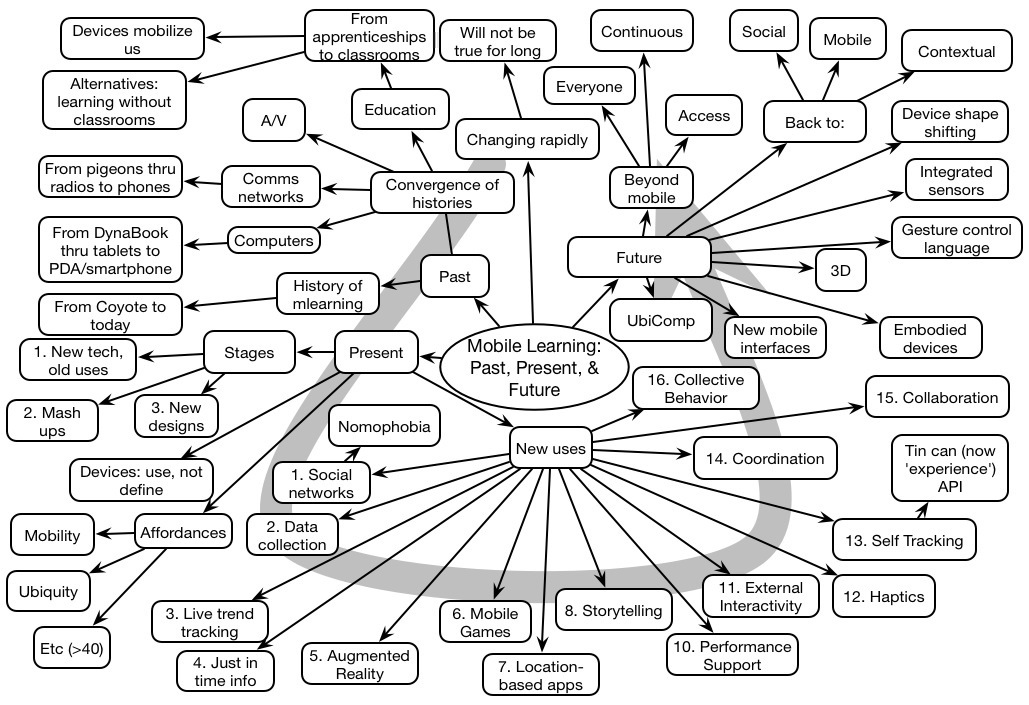
Gary Woodill gave a broad reaching keynote covering the past, present, and future of mobile learning. Peppered with great examples and good thinking, it was an illuminating kickoff to the MobiLearnAsia conference.
A respected colleague recently suggested Andy Clark’s Being There as a read to characterize the new views of cognition, so I checked it out. The book covers the new emerging views of cognition, grounded in the connectionist revolution and incorporating a wide variety of neural and robotic studies. The interesting thing to me are the implications for learning and instruction.
The book makes the case that the way we think is not only heavily tied to our contexts, but that we co-construct the world in ways that affect our thinking in profound ways. Studies across economic behavior, animal cognition, simulation studies, and more are integrated to make the point that they way we think is very different than the models of conscious minds sitting in meat vehicles. Instead, we’re very driven from below and outside, and our conscious thinking is rare, hard, and language based. Moreover, the constructs we create to think affect our thinking, making it easier. We automate much not only through learning, but we externalize. And, our representations and understanding are very much constructed ‘on the fly’ in each new situations, as opposed to existing abstract and robust.
This isn’t easy reading. Clark is a philosopher of mind, and covers much complex research and deep neuroscience. The emergent picture, however, is of a mind very different than the cognitivist model. I’m grateful that while I pursued my PhD in Cog Psych, the research going on in our co-shared lab by Rumelhart and McClelland on connectionist networks sensitized me to this viewpoint, and Hutchins work on Cognition in the Wild was similarly taking place at the same time. Despite the challenge, there are important reasons to get our minds around this way of thinking.
The notion that providing abstract knowledge will lead to any meaningful outcome has already pretty much been debunked both empirically and theoretically. What these models seem to suggest is that what can and will work is deep scaffolded practice and guided reflection, based upon a situated cognition. For other reasons, this is the model that Collins and Brown had in Cognitive Apprenticeship, and now we’ve a more solid philosophical basis for it. (I also think that there are rejoinders to Kirschner, Sweller, & Clark, and Anderson, Reder, & Simon; discussing how language, including writing, is social, and that iterations between abstract models and meaningful practice is guided reflection.)
This model suggests that language is our differentiator, and that much of our higher level cognition is mediated through language. There’s a reason consciousness feels like a dialog. Much of our processing is beneath consciousness, and things we monitor and develop through language become compiled away inaccessible to language.
The point, to me, is that the activity-based learning model I’ve proposed has both bottom up grounding in new cognitive models, theoretical framing from anchored instruction and social constructivism, as well as empirical validity from apprenticeships and work-place learning. We need to start aligning our learning design to the cognitive realities.
I was having a discussion the other day with my ITA colleague Jay Cross, and the topic wandered over to how to use the social approaches we foster under the umbrella of the Coherent Organization to help organizations become one. And I went feral.
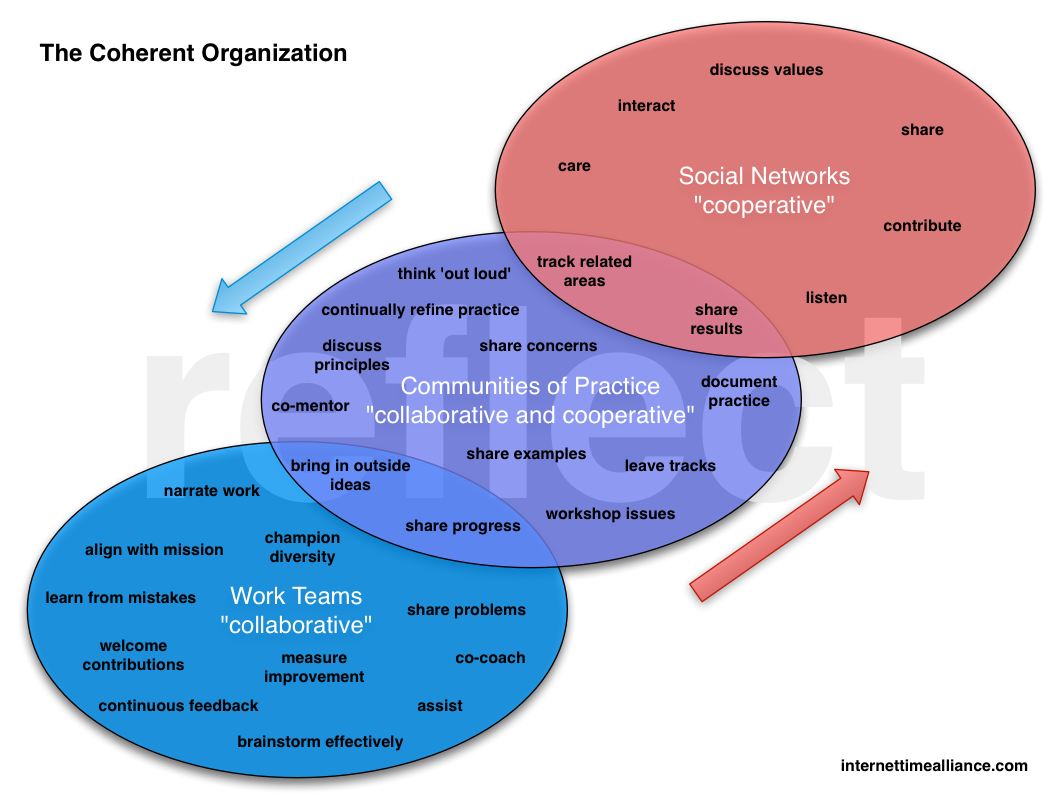 Do we work top down, or bottom up? In the course of the conversation it occurred to me that given the model we propose, that you can’t just have the broader social network create it, and you can’t even really build a community of practice (CoP). The smallest unit is the working group; how could we use that?
The thought that struck me was creating a working group who’s goal was to create a CoP around being a Coherent Organization. That is, they’d have to understand the principles, start defining and discussing it, document the opportunities, and start disseminating the ideas through the organization. Inherently, it has to be viral, and the most effective way to introduce a virus is by inoculation.
The idea then is that the mission of the working group is to develop a community of practice around understanding and implementing developing communities of practice. It’s a bit recursive or self-referential, but it’s the seed that needs to sprout. Seeding it is the action that’s needed to get it going, and then some feeding needs to happen. While it’s possible that a self-supported initiative could survive, having some external support may make sense in making this happen.
Yes, I’m assuming that the end result is desirable and possible. The former is, I think, reasonably well accepted (short form: working effectively is a necessary survival tactic, going forward), even if the path to get there isn’t. I’m suggesting that this is a path to get there. It’s not easy; it takes persistence, support, all those things that make organizational initiatives succeed, with an understanding of the strategies, policies, and cultural adjustments needed. Yet I’ll suggest that it is doable. Now, it’s time to do it!
#itashare
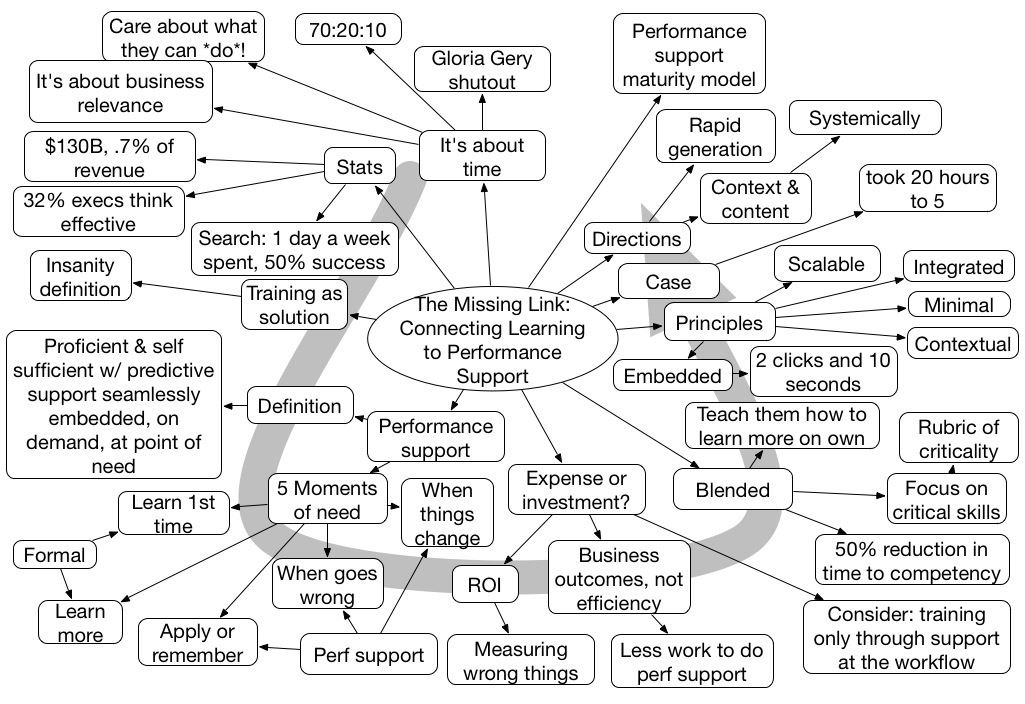
Bob Mosher opened the Performance Support Symposium with a passionate keynote about Performance Support. It strongly made the case for a blended approach, which I support. As with mobile, the time is definitely now.
A mobile solution is not about the right answer, it’s about the right answer for you. You need to understand the tradeoffs involved in deciding how you’re going to go about creating a mobile solution. Case in point: what’s your development platform?
 It’s easy to say “we need to develop an app” (aka ‘there’s an app for that’). And there are reasons to develop an app, such as speed and elegance.
You could also say: “we’ll do mobile web”. Again, there are reasons to go this way, too: it’ll work on more devices.
But there are tradeoffs. Apps can be expensive. Mobile web may be slow and clunky on any particular device. You can’t just choose one without determining your needs: who’s the audience, what are they trying to do, what do you control, and what’s a given.
You should also be aware of a middle ground, so called hybrid apps. They minimize some of the extremes of both, though they’re no panacea either. You have to know the space, and your own context, to make an informed decision.
Triggered by an apparent knee-jerk reaction.
A few days ago, my colleague Jay Cross wrote a post on plagiarism, dealing with the fact that some of his work (even an example of some of our collaborative work) was being used without attribution. He preceded me in the use of Creative Commons licensing, but from his example (and Harold Jarche), I placed a BY – NC – SA license in the side bar. Fast forward to today, and I get alerted by a colleague (thanks, Martin!) that my stuff is appearing without attribution.
 At their site (see screenshot), 4 of the first 6 posts listed are mine. Full grab of the text, graphics, and all. Not all of mine are there, but many. The posts may no longer be there by the time you read this, but they were when I was notified, as the screenshot shows. And, apparently, for a while in the past. Look at my list of blog posts, and you’ll see that these were my four most recent posts.
Now, the license I mentioned means three things I ask for. First, you say who it’s BY (i.e. attribution). That it’s NC No Charge, i.e. you’re not making money off of it (if you are, let’s work out a deal). And that it’s SA Share Alike. Others can take your content too. So, you’re welcome to use any or all of a post if you a) attribute it to me, b) don’t charge, and c) you are willing for any work created from mine to similarly be shared. I see that this group has only violated one, but I’m inclined to think it’s an important one. It’s my thinking, after all.
As you might imagine, this upsets me. I work hard to put worthwhile information out. I expect to at least get credit for it, given that it provides no direct revenue (yep, still ad-free). To have someone take my intellectual property and redistribute under their banner, without at least providing a pointer back strikes me as less than appropriate. I note Jeff Cobb is getting credit. Why not me?
Sure I’m grateful that they find it worth quoting, but not if they’re implying it’s theirs. They’re getting value from my thinking, and I’m not getting anything in return. Other have redistributed my posts, and they can, as long as they credit me (and aren’t charging for it). That’s of value to me. Unattributed, not so much.
By the way, when I pointed this out, several others indicated that this site has or has had unattributed content from themselves or others in the past. You have to wonder…
Am I too touchy about this?
I’ve been revisiting performance support in preparation for the Guild’s Performance Support Symposium next month, and I’m seeing a connection between two models that really excite me. It’s about how social and performance support are a natural connection.
 So, let’s start with a performance model. This model came from a look at how people act in the world and I was reminded of it during a conversation on informal learning. Most of the time, we’re acting in well-understood ways (e.g. driving), and we can keep our minds free for other things. However, there may be times when we can’t rely on that well-practiced approach (say, for instance, if our usual route home is blocked for some reason). Then we have a breakdown, and need to consciously problem-solve. Ideally, if we find the solution, we reflect on it and make it part of our well-practiced repertoire.
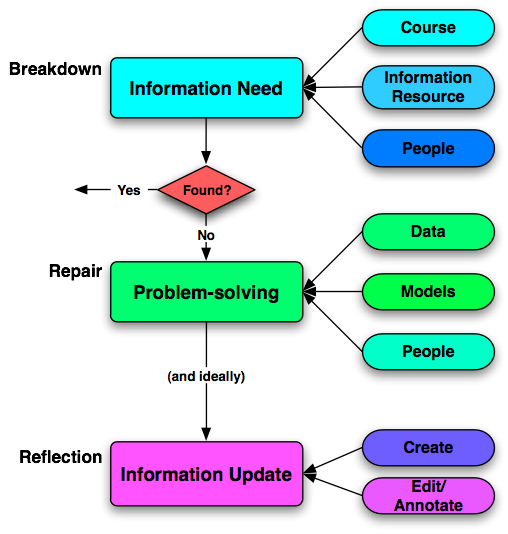 So what I wanted to do was use this understanding to think about how we might support performance. What support do we need at these different stages? I propose that when we have a breakdown, ideally we find the answer, either as an information resource, or from a person with the answer. Some of the time, we might identify a real skill shift we need, and then we might actually take a course, but it’s a small part of the picture.
If we find the answer, we can go back into action, but if we can’t find the answer, we have to go into problem-solving mode. Here, the support we need differs. We may need data to look for patterns that can explain what’s going on, or models to help find a solution, or even people. Note, however, that the people here are different than the people we would access for the answer. If there were a person with the answer, we would’ve found them in the first step. Here it’s likely to be good collaborators, people with complementary skills and a willingness to help.
If and when we find the answer, then we should share that so that others don’t have to do the same problem-solving, but can access the resource (or you) in the first step. This step is often skipped, because it’s not safe to share, or there’s just not a focus on such contributions and it’s too easy to just get back to work without recognizing the bigger picture. This is one of the components of what Harold Jarche means by ‘narrating your work‘, and I mean in ‘learning out loud’. If it’s habitual, it’s beneficial.
The connection that I see, however, is that there’s a very strong relationship between this model, and the coherent organization model. At the first step, finding the answer, likely comes from your community of practice or even the broader network (internal or external). This is cooperation, where they’re willing to share the answer.
At the second step, if you get to problem-solving, this is collaboration. It may not just be in a work group (though, implicitly, it is a work group), but could be folks from anywhere. The bigger the problem, the more it’s a formal work group.
The point is that while the L&D group can be providing some of the support, in terms of courses and fixed resources, at other times the solution is going to require ‘the network’. That is, folks are going to play a part in meeting the increasing needs for working. The resources themselves are increasingly likely to be collaboratively developed, the answer is more likely ‘out there’ than necessarily codified in house.
There’s going to of necessity be a greater shift to more flexible solutions across resources and people, to support organizational performance. The performance support model will increasingly require an infrastructure to support the coherent organization. Are you ready?
It’s coming up to the 25th anniversary of HyperCard, and I’m reminded of how much that application played a role in my thinking and working at the time. Developed by Bill Atkinson, it was really ‘programming for the masses’, a tool for the Macintosh that allowed folks to easily build simple, and even complex, applications. I’d programmed in other environments : Algol, Pascal, Basic, Forth, and even a little Lisp, but this was a major step forward in simplicity and power.
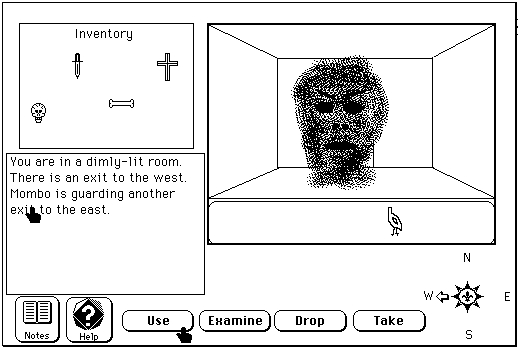 A colleague of mine who was working at Claris suggested how cool this new tool was going to be, and I taught myself HyperCard while doing a postdoc at the University of Pittsburgh’s Learning Research and Development Center. I used it to prototype my ideas of a learning tool we could use for our research on children’s mental models of science. I then used it to program a game based upon my PhD research, embedding analogical reasoning puzzles into a game (Voodoo Adventure; see screenshot). I wrote it up and got it published as an investigation how games could be used as cognitive research tools. To little attention, back in ’91 :).
While teaching HCI, I had my students use HyperCard to develop their interface solutions to my assignments. The intention was to allow them to focus more on design and less on syntax. I also reflected on how the interface encapsulated to some degree on what Andi diSessa called ‘incremental advantage’, a property of an environment that rewarded greater investments in understanding with greater power to control the system. HyperCard’s buttons, fields, and backgrounds provided this, up until the next step to HyperTalk (which also had that capability once you got into the programming notion). I also proposed that such an environment could support ‘discoverability’ (a concept I learned from Jean Marc Robert), where an environment could support experimentation to learn to use it in steady ways. Another paper resulted.
I also used HyperCard to develop applications in my research. We used it to develop Quest for Independence, a game that helped kids who grew up without parents (e.g. foster care) learn to survive on their own. Similarly, we developed a HCI performance support tool. Both of these later got ported to the web as soon as CGI’s came out that let the web retain state (you can still play Quest; as far as I know it was the first serious game you could play on the web).
The other ways HyperCard were used are well known (e.g. Myst), but it was a powerful tool for me personally, and I still miss having an easy environment for prototyping. I don’t program anymore (I add value other ways), but I still remember it fondly, and would love to have it running on my iPad as well! Kudos to Bill and Apple for creating and releasing it; a shame it was eventually killed through neglect.
In looking across several instances of training in official procedures, I regularly see that, despite bunches of regulations and guidelines, that things are not black and white, but that there are myriad shades of grey. And I think that there is probably a very reasonable way to deal with it. (Surely you didn’t think I was talking about a book!)
In these situations, there are typically cases that are very white, others that are very black, but most end up somewhere in the middle, with a fair degree of ambiguity. And the concerns of the governing body are various. In one instance, the body was more concerned that you’d done due diligence and could show a trail of the thinking that led to the decision. If you did that, you were ok, even if you ended up making the wrong decision. In another case, the concern was more about consistency and repeatability. You didn’t want to show bias.
However, the training doesn’t really reflect that. In many cases, they point out the law (in the official verbiage), you work through some examples, and you’re quizzed on the knowledge. You might even workshop a few examples. Typically, you are to get the ‘right answer’.
I’d suggest that a better approach would be to give the learners a series of examples that are first workshopped by small groups, with their work brought back to the class. The important things are the ways the discussion is facilitated, supported, and the choice of problems. First, I think they’re given the problems and the associated requirements, guidelines, or regulations. Period. No presentation beforehand, nothing except reactivating the relevance of this material to their real work.
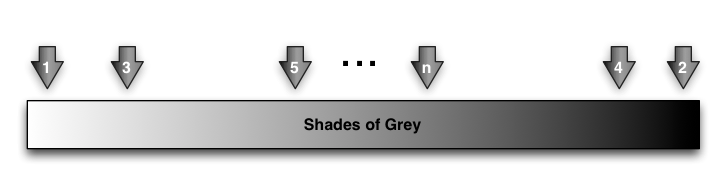 I’m suggesting that the first problem they face be, essentially, ‘white’, and the second is ‘black’ (or vice versa). The point is for them to see what the situation looks like when it’s very clear, and for them to get used to using the materials to make a determination. (This is likely what they’re going to be doing in real practice anyway!) At this point, the discussion facilitation is focused on helping them understand how the rules play out in the clear cases.
Then they start getting grayer cases, ones where there’s more ambiguity. Here, the focus of discussion facilitation is to start emphasizing the subtext: either ‘document your work’, or ‘be consistent’, or whatever. The amount of these will depend on how much practice they need. If the decisions are complex, they’re relatively infrequent, or the decisions are really important, they’ll need more practice.
This way, the learners are a) getting comfortable with the decisions, b) getting used to using the materials to make the decisions, and c) recognizing what’s really important.
I’m relatively certain that this may be problematic for some of the SMEs, who may prefer to argue for right/wrong answers, but I think it reflects the reality when you unpack the thinking behind the way it plays out in practice. And I think that’s more important for the learners, and the training organization, to recognize.
Of course, as they work in groups, the most valuable way to support them may be for them to have the coordinates of other members of their group to call on when they face really tough decisions. That sort of collaboration may trump formal instruction anyway ;).
Of late, I’ve been both reviewing eLearning, and designing processes & templates. As I’ve said before, the nuances between well-designed and well produced eLearning are subtle, but important. Reading a forthcoming book that outlines the future but recounts the past, it occurs to me that it may be worthwhile to look at a continuum of possibilities.
For the sake of argument, let’s assume that the work is well-produced, and explore some levels of differentiation in quality of the learning design. So let’s talk about a lack of worthwhile objectives, lack of models, insufficient examples, insufficient practice, and lack of emotional connection. These combine into several levels of quality.
The first level is where there aren’t any, or aren’t good learning objectives. Here we’re talking about waffly objectives like ‘understand’, ‘know’, etc. Look, I’m not a behaviorist, but I think *when* you have formal learning goals (and that’s not as often as we deliver), you bloody well ought to have some pretty meaningful description around it. Instead what we see is the all-to-frequently observed knowledge dump and knowledge test.
Which, by the way, is a colossal waste of time and money. Seriously, you are, er, throwing away money if that’s your learning solution. Rote knowledge dump and test reliably lead to no meaningful behavior change. We even have a label for it in cognitive science: “inert knowledge”.
So let’s go beyond meaningless objectives, and say we are focused on outcomes that will make a difference. We’re ok from here, right? Er, no. Turns out there are several different ways we can go wrong. The first is to focus on rote procedures. You may want execution, but increasingly the situation is such that the decisions are too complex to trust a completely prescribed response. If it’s totally predictable, you automate it!
Otherwise, you have two options; you provide sufficient practice, as they do with airline plots and heart surgeons. If lives aren’t on the line and failure isn’t as expensive as training, you should focus on providing model-based instruction where you develop the performer’s understanding of what’s underlying the decisions of how to respond. That latter gives you a basis for reconstructing an appropriate response even if you forget the rote approach. I recommend this in general, of course.
Which brings up another way learning designs go wrong. Sufficient practice as mentioned above would suggest repeating until you can’t get it wrong. What we tend to see, however, is practice until you get it right. And that isn’t sufficient. Of course, I’m talking real practice, not knowledge test ala multiple choice questions. Learners need to perform!
We don’t see sufficient examples, either. While we don’t want to overwhelm our learners, we do need sufficient contexts to abstract across. And it does not have to occur in just one day, indeed, it shouldn’t! We need to space the learning out for anything more than the most trivial of learning. Yet the ‘event’ model of learning crammed into one session is much of what we see.
The final way many designs fails is to ignore the emotional side of the equation. This manifests itself in several ways, including introductions, examples, and practice. Too often, introductions let you know what you’re about to endure, without considering why you should care. If you’re not communicating the value to the learner, why should they care? I reckon that if you don’t convey the WIIFM, you better not expect any meaningful outcomes. There are more nuances here (e.g. activating relevant knowledge, etc), but this is the most egregious.
In examples and practice, too, the learner should see the relevance of what is being covered to what they know is important and they care about. These are two important and separate things. What they see should be real situations where the knowledge being addressed plays a real role. Then they should also care about the examples personally.
It’s hard to be able to address all the elements, but aligning them is critical to achieving well-designed, not just well-produced learning. Are you really making the necessary distinctions?