Learnlets

Secondary

Clark Quinn’s Learnings about Learning

Search Results for: align

Virtual Worlds: Affordances and Learning

25 September 2009 by Clark Leave a Comment

Two days ago I attended the 3D Teaching, Learning, & Collaboration conference, organized by Tony O’Driscoll.   I’ve previously posted my thoughts on virtual worlds, but I had a wee bit of a revelation that I want to get clear in my head, and it ties into several things that went on at the conference.

First, let me say that the day of the conference I got to attend was great, with lots of the really involved folks there, and every evidence (including the tweet stream) that the second day was every bit as good.   Tony talked about his new book with Karl Kapp, Chuck Hamilton spoke on lessons learned through IBM’s invovlement in Virtual Worlds, Koreen Olbrish chaired a panel with a number of great case studies, to name just a few of the great opportunities.

Chuck listed 10 ‘affordances‘ of virtual worlds, expanding a list Tony had previously started.   There was some debate about whether affordance is a good term, since not everyone knows it, but I maintain that for people who need it, it’s the right term and that we can use some term like ‘inherent capability’ for those who don’t.   I had some quibbles with Chuck’s list, as it seemed that several confounded some issues, and I hope to talk with him more about it.

Tony also presented, in particular, some principles about designing learning for virtual worlds (see slide 17 here).   Interestingly, they aren’t specific to virtual worlds, and mirror the principles for designing engaging learning experiences that come from the alignment of educational practice and engaging experiences I talk about in my book.   Glad to see folks honing in on principles for creating meaningful virtual world experiences!

The revelation for me, however, was linking the social informal learning with virtual worlds.   Virtual worlds can be used for both formal and informal learning, they’re platforms for social action.   I’ve had the formal and informal separated in my mind, but needn’t.   I’ve been quite active in social learning to meet informal learning needs with   my togetherLearn colleagues, but have always written off virtual worlds as still having too much technical and learning overhead to be worth it unless you have a long-term intention where those overheads get amortized.

What’s clear is that, increasingly, organizations are creating and leveraging those long term relationships.   ProtonMedia even announced integration of both Sharepoint and their own social media system with their virtual world platform, so either can be accessed in world or from the desktop. There were a suite of examples across both formal and informal learning where organizations were seeing real, measurable, value.

The underlying opportunities of virtual presence are clear, it’s just not been clear that it’s significantly better than a non-immersive social networking system.   Certainly if what your people need to formally learn, or informally network on is inherently 3D, but the contextualization is having some benefits.

Some issues remain. At lunch I was talking to some gents who have a system that streams your face via webcam onto your avatar, so your real expressions are represented.   That’s counter to some of the possibilities I see to represent yourself in virtual worlds as you prefer to be seen, not as how nature commands, but there are some trust issues (and parental safety concerns as well).

Still, as technical barriers are surpassed, and audiences become more familiar with and comfortable in virtual worlds, the segue between formal and social networking can be accomplished in world making a virtual business office increasingly viable.   It may be time to dust off my avatar and get traveling.
The 7 c’s of natural learning

18 September 2009 by Clark 7 Comments

Yesterday I talked about the seeding, feeding, and weeding necessary to develop a self-sustaining network. I referred to supporting the activities that we find in natural learning, for both formal and informal learning.   The goal is to align our organized support with our learners to optimize the outcome.   In thinking about it (and borrowing heavily from some slides by Jay Cross), I discerned (read: worked hard to fit :) 7 C’s of learning that characterize how we learn before schooling extinguishes the love of learning:

Choose: we are self-service learners.   We follow what interests us, what is meaningful to us, what we know is important.

Commit: we take ownership for the outcomes.   We work until we’ve gotten out of it what we need.

Crash: our commitment means we make mistakes, and learn from them.

Create: we design, we build, we are active in our learning.

Copy: we mimic others, looking to their performances for guidance.

Converse: we talk with others. We ask questions, offer opinions, debate positions.

Collaborate: we work together. We build together, evaluate what we’re doing, and take turns adding value.

With this list of things we do, we need to find ways to support them, across both formal and informal learning.   In formal learning, we should be presenting meaningful and authentic tasks, and asking learners to solve them, ideally collaboratively.   While individual is better than none, collaborative allows opportunity for meaning negotiation.   We need to allow failure, and support learning from it. We need to be able to ask questions, and make decisions and see the consequences.

Similarly in informal learning, we need to create ways for people to develop their understandings, work together, to put out opinions and get feedback, ask for help, and find people to use as models.   By using tools like blogs for recording and sharing personal learning and information updates, wikis to collaborate, discussion forums to converse, and blogs and microblogs to track what others think are important, we provide ways to naturally learn together.

Recognize that I’m taking the larger definition of learning here.   I do not mean just courses, though they’re part of it.   However, real learning involves research, design, problem-solving, creativity, innovation, experimentation, etc.  We absolutely have to get our and the organization’s mind around this if we’re going to be effective.   So, look to natural learning to guide your role in facilitating organizational learning.

Seed, feed, & weed

17 September 2009 by Clark 12 Comments

In my presentation yesterday, I was talking about how to get informal learning going.   As many have noted, it’s about moving from a notion of being a builder, handcrafting (or mass-producing) solutions, to being a facilitator, nurturing the community to develop it’s own capabilities.   Jay Cross talks about the learnscape, while I term it the performance ecosystem. The point, however, is from the point of the view of the learner, all the resources needed are ‘to hand’   through every stage of knowledge work. Courses, information resources, people, representational tools, the ability to tap into the 4 C’s (create, contextualize, connect, co-create).

Overall, it taps into our natural learning, where we experiment, reflect, converse, mimic, collaborate, and more.   Our approach to formal learning needs to more naturally mimic this approach, having us attempting to do something, and resourcing around it with information and facilitation.   Our approach to informal learning similarly needs to reflect our natural learning.

Networks grow from separate nodes, to a hierarchical organization where one node manages the connections, but the true power of a network is unleashed when every node knows what the goal is and the nodes coordinate to achieve it.   It is this unleashing of the power of the network that we want to facilitate.   But if you build it, they may not come.

Networks take nurturing.   Using the gardener or landscaper metaphor,   yesterday I said that networks need seeding, feeding, and weeding.   What do I mean?   If you want to grow a network, you will have to:

Seed: you need to put in place the network tool, where individuals can register, and then create the types of connections they need.   They may self-organize around roles, or tasks, or projects, or all of the above.   They may need discussion forums, blogs, wikis, and IM.   They may need to load, tag, and search on resources.   You likely will need to preload it with resources, to ensure there’s value to be found.   And you’ll have to ensure that there are rewards for participating and contributing.   The environment needs to be there, and they have to be aware.

Feed: you can’t just put in place, you have to nurture the network.   People have to know what the goals are and their role.   Don’t tell them what to do, tell them what needs done.   You may need to quietly ‘encourage’ the opinion makers to participate.   And the top of the food chain needs to not only anoint the process, but model the behavior as well.   The top level of the group (ie not the CEO, but the leader of whatever group you’ve chosen to facilitate) needs to be active in the network.   You may need to highlight what other people have said, elicit questions and answers, and take a role both within and outside the network to get it going.     You may have to go in and reorganize the resources, take what’s heard and make it concrete and usable. You’ll undoubtedly have to facilitate the skills to take advantage of the environment.   And you have to ensure there’s value there for them.

Weed: you may have to help people learn how to participate.   You may well find some inappropriate behavior, and help those learn what’s acceptable. You’ll likely have to develop, and modify, policies and procedures.   You may have to take out some submitted resources and revise them for better usability.   You may well have to address cultural issues that arise, when you find that participation is stunted by a lack of tolerance of diversity, no openness to new ideas, no safety for putting ideas out, and other factors that facilitate a learning organization.

However, if you recognize that it will take time and tuning, and diligently work to nurture the network, you should be able to reap the benefits of an aligned group of empowered people.   And those benefits are real: innovation, problem-solving, and more, and those are the key to organizational competitiveness going forward. Ready to get grubby?

What’s an ‘A’ for?

12 September 2009 by Clark 2 Comments

I was recently thinking about grades, and was wondering what an ‘A’ means these days.   Then, at my lad’s Back to School night, I was confronted with evidence of the two competing theories that I see. One teacher had a scale on the wall, with (I don’t remember exactly, but something like): 96-100 = A+, 91-95 = A, 86-90 = A-, and so on, down to below 50 = Fail. Now, you get full points on homework just for trying, but it’s clearly a competency model, with absolute standards.   A different teacher recounted how she tells students that if they just do the required work, that it’s only worth a C, and A’s are for above and beyond. That’s a different model. There aren’t strict criteria for that latter.   And I’m very sympathetic to that latter stance, despite that it seems subjective.

The second approach resonates with my experience back in high school, where A’s were handed out for work that really was above and beyond the ordinary.   A deeper understanding.   We seem to have shifted to a model where if you do what’s asked, you get an ‘A’.   And I see benefits of both sides.   Defining performance, and having everyone able to achieve them is ideal.   Yet, intuitively, you recognize that there’s the ability to apply concepts, and then another level where people can flexibly use them to solve novel problems, combine them with other concepts, infer new concepts, etc.

I was pointed to some work by Daniel Schwartz (thanks @mrch0mp3rs) that grounds this intuition in an innovative framework based upon some good research. In a paper with John Bransford and David Sears, they made a intriguing case for two different forms of transfer: efficient and innovative, and argued convincingly that most of our models address the former and not the latter, yet addressing the latter yielded better outcomes on both.   I think the work David Jonassen is doing on teaching problem-solving is developing just this sort of understanding, but it’s on problems that are like real world ones (and yet improves performance on standard measures).   And I like David’s lament that the problems kids solve in schools have no relation to the problems they see in the world (and, implicitly, no worth).

Right now, our competencies aren’t defined well enough to support assessing this extra level.   In an ideal world, we’d have them all mapped out, and you could get A’s in every one you could master.   We don’t live in that world, unfortunately.   So we have two paths.   We live with our lower measures, and everyone gets A’s meeting them (if they try, but that’s a separate issue), and then sort it out after graduation, in the real world, or we allow some interpretation by the teacher and measure not only effort, but a deeper form of understanding.   We’ve steered away from the second approach, probably because of the consequent arguments about favoritism, social stigma, etc.   Yet the former is increasingly meaningless, I fear.

We should bite the bullet and admit that we’re waving our hands. Then we could own up that not all teachers are ready to do the type of teaching David’s doing and Daniel’s advocating, and look to using technology to make available a higher quality of content (like the UC College Prep program has been doing) to provide support.   I’d rather see a man-in-the-moon program around getting a really meaningful curriculum up online than going to Mars at this point, and I’m a big fan of NASA and the pragmatic benefits of space exploration. Just think such a project would have a bigger impact on the world, all told.

In the meantime, we have to live with some grade inflation (gee, I got into a UC with a high school average below 4.0!), bad alignment between what schools do and what kids need as preparation for life in this century, and a very long road towards any meaningful change.   Sigh.

Design, processes, and ADDIE

9 September 2009 by Clark 1 Comment

I come to check briefly on what’s happening, late on an evening, and find a flurry of discussion that prompts reflection. It’s been an ongoing debate, with notables like Ellen Wagner and Brent Schlenker weighing in.   In reading another post pointed to by Cammy Bean, I see a cogent discussion of how processes can be stifling or supportive.

I was reminded of a story told many years ago on a listserve, where both new and experienced (10 years) graduates of several ID programs were asked to design projects.   The projects by the new graduates were categorizable by school.   The projects by the experienced graduates were not, until the accompanying rationales were read.   This was never published, unfortunately, but even as an apocryphal story, it’s instructive.

The point being, that the processes we learn are scaffolds for performance.   ADDIE is a guide to help ensure hitting all the important points.   It’s no guarantee of a good design.   It takes understanding the nuances (see Broken ID), and some creativity.

Used appropriately, ADDIE reminds us to dot our i’s and cross our t’s.   We ensure an adequate analysis of need (cf HPT), appropriate attention to design and development, care about the implementation, and ensure evaluation.   Used inappropriately, we pay lip service to the stages, doing the same cookie-cutter process we butcher when we do bad ID.

So, to my point: ADDIE’s not broken, but the way it’s used is. It’s supposed to be used as a guide, which is fine.   However, it’s being used as a crutch, and that’s wrong.     The question is, do we impugn the approach because of it’s implementation, as a way to draw attention to the misuse, or only malign the misuse?   I’m not sure the latter’s sufficient, nor the former is fair.

So, I say let the debate rage. We need a resolution, but I fear that there aren’t sufficient resources concerted to a) bring together the necessary conceptual inputs, b) to support the debate, and c) to advocate any outcomes.   There are broader issues to be talking about, such as how a design process plays out when we consider not just novices, but practitioners and experts, including performance support and social/informal.   We’ve some breakdowns conceptually, and then pragmatically in implementation.

I’ll echo Brent’s call to bring the issue to DevLearn, and see where we get. At least, a lot of us will be there!

Learning Experience Creation Systems

2 September 2009 by Clark 2 Comments

Where do the problems lie in getting good learning experiences? We need them, as it’s becoming increasingly important to get the important skills really nailed, not just ‘addressed’.   It’s not about dumping knowledge on someone, or the other myriad ways learning can be badly designed.   It’s about making learning experiences that really deliver.   So, where does the process of creating a learning experience go wrong?

There’s been a intriguing debate over at Aaron (@mrch0mp3rs) Silver’s blog about where the responsibility lies between clients and vendors for knowledge to ensure a productive relationship.   One of the issues raised (who, me?) is understanding design, but it’s clearly more than that, and the debate has raged.

Then, a post in ITFORUM asked about how to redo instructor training for a group where the instructors are SMEs, not trainers, and identified barriers around curriculum, time, etc.   What crystallized for me is that it’s not a particular flaw or issue, but it’s a system that can have multiple flaws or multiple points of breakdown.

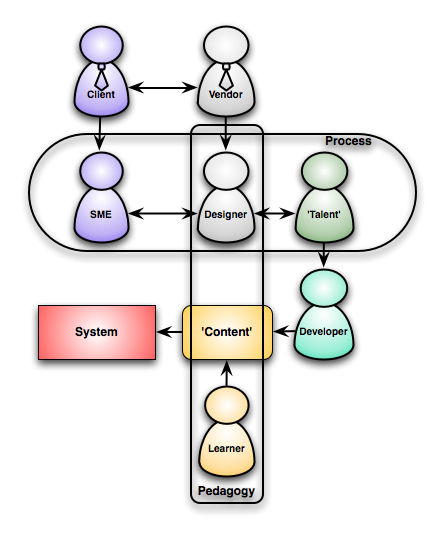
LearningExperienceDesignSystemThe point is, we have to quit looking at it as design, development, etc; and view it not just as a process, but as a system. A system with lots of inputs, processes, and places to go wrong.   I tried to capture a stereotypical system in this picture, with lots of caveats: clients or vendors may be internal or external, there may be more than one talent, etc, it really is a simplified stereotype, with all the negative connotations that entails.

Note that there are many places for the system to break even in this simplified representation.   How do you get alignment between all the elements?   I think you need a meta-level, learning experience creation system design. That is, you need to look at the system with a view towards optimizing it as a system, not as a process.

I realize that’s one of the things I do (working with organizations to improve their templates, processes, content models, learning systems, etc), trying to tie these together into a working coherent whole. And while I’m talking formal learning here, by and large, I believe it holds true for performance support and informal learning environments as well, the whole performance ecosystem.   And that’s the way you’ve got to look at it, systemically, to see what needs to be augmented to be producing not content, not dry and dull learning, not well-produced but ineffective experiences, but the real deal: efficient, effective, and engaging learning experiences. Learning, done right, isn’t a ‘spray and pray’ situation, but a carefully designed intervention that facilitates learning.   And to get that design, you need to address the overall system that creates that experience.

The client has to ‘get’ that they need good learning outcomes, the vendor has to know what that means.   The designer/SME relationship has to ensure that the real outcomes emerge.   The designer has to understand what will achieve these outcomes.   The ‘talent’ (read graphic design, audio, video, etc) needs to align with the learning outcomes, and appropriate practices, the developer(s) need to use the right tools, and so on.   There are lots of ways it can go wrong, in lack of understanding, in mis-communication, in the wrong tools, etc.   Only by looking at it all holistically can you look at the flows, the inputs, the processes, and optimize forward while backtracking from flaws.

So, look at your system.   Diagnose it, remedy it, tune it, and turn it into a real learning experience creation system.   Face it, if you’re not creating a real solution, you’re really wasting your time (and money!).

On the road again

21 August 2009 by Clark Leave a Comment

I like going to conferences: exchanging ideas, meeting new people, and just variety.   However, I haven’t been on the road since early June for any conferences, after running a workshop at ASTD’s international conference and then presenting at DAU/GMU’s Innovations in eLearning Conference.   But it’s that time again.

First, Jay Cross and I will be presenting on the Chief Meta-Learning Officer article we wrote at the Fall CLO Symposium Sept 28-30.   We’ll be riffing on the results of the survey we made available as part of the article, looking at what folks are saying about how their organization is learning.   There are big opportunities for organizations to improve how the facilitate and leverage their employee ideas, and we’re hoping to help that vision come forth.

At DevLearn (Nov 10-13), Jay and I will be running a 1 day workshop on how to be a Chief Meta-Learning Officer, and I expect we’ll capture some of the process and outcomes that led my attendees at the elearning strategy workshop to say things like “powerful and overwhelming – in a good way!”,   “Very current for today‘s priorities”, “extremely useful … I learned so much”, and “Really makes the shift from just
learning and takes it to performance.”   While it’ll focus more on the social and informal, that’s where a lot of opportunity is, and it’s really a whole shift about thinking of the learning organization’s role.

I’ll also be presenting the performance ecosystem in an abbreviated form as a concurrent session. I will also partner with Richard Clark to talk about pragmatic mobile development.   I’m looking forward to it.

I was also reflecting about what makes a good conference.   I don’t know about CLO (my first), but I love the Guild events, and I was trying to figure out why.   I think it’s because they do as good a job as anyone at making the event a good experience for all: attendees, exhibitors/sponsors, and speakers.   Others come close, but they really strike the best balance.

From an attendee perspective, you want speakers that cover the breadth and depth you want, for different levels of experience, and access to vendors without being hammered with pitches.   As a speaker, you want to maximize your exposure if you get to speak, and be treated like a valuable contribution. I can’t speak what it’s like from a vendor perspective, but I reckon it’s fair access to attendees without onerous costs or restrictions.   Somehow, the Guild events strike this balance the best, from my perspective as a speaker and attendee.

The ongoing success suggests others feel the same. I was just reviewing the speaker list, and see that in the very first timeslot, you’ve got Allison Rossett going up against Ruth Clark and Ray Jimenez, among others!   That’s a pretty heady lineup.   The topics are similarly spread to be as interesting as the speakers, with user-generated content, rapid elearning, mobile, games/simulations, and more.   And again, that’s only the first timeslot!

I’ll be online presenting in October and again in January, but for someone who’s in elearning, I still value the face to face time when I can get it.   Hope to meet you at one of these, please do introduce yourself or say hi!

The Performance Environment

17 August 2009 by Clark 12 Comments

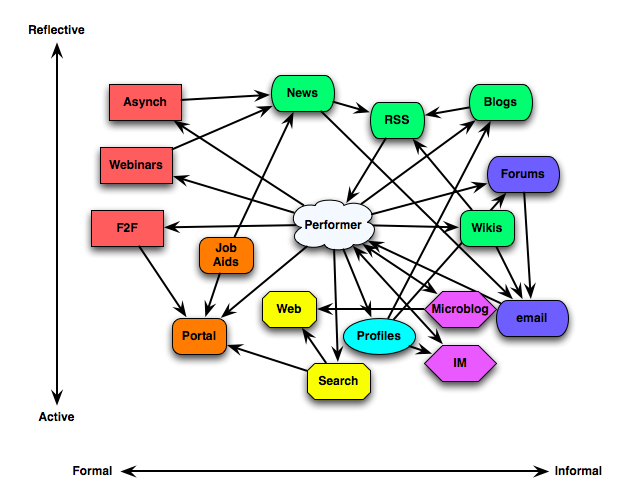
I’ve represented the performance ecosystem in several ways in the past, and that process continues to occur.   In the process of writing up a proposal to do some social learning strategizing for an organization, I started thinking about it from the performer perspective.PLE

Now, personal learning environments (PLE) is not a completely new concept, and quite a number of folks contributed their PLEs here.   However, I wasn’t creating mine so much as a conceptual framework, yet it shares characteristics with many.

I realized there were some relevant dimensions, so I added those in, including whether they tend to be more reflective or active, and whether they’re formal or informal.   Note that I played a little fast and loose in the positioning to hopefully not make the connections too obscured, so it’s not quantitatively accurate so much as conceptually indicative.   Also, I’m trying to catch categories of tools, not specifics.   Still, I (apparently :) thought it was interesting enough to try to get feedback on.

So, what do you think? Am I missing a channel?   A connection?   Feedback solicited.

Implementing Learning Redesign

14 July 2009 by Clark Leave a Comment

In my Broken ID series, I talked about the mistakes people made and how the elements of elearning should be redesigned.   I didn’t talk about how you’d revamp your design processes to achieve the results.   And I should, because it’s easy to ‘get’ the concepts, harder to turn around and revise your organizational design processes so that they systematically are providing improved design. I’ve been involved in improving organizational design processes in several different instances, and it took several different steps to lead to persistent change.

Naturally, it starts with a good vision; you’ve got to have a sound basis for good design on tap.   The Broken ID series is a good start (and there others), but it takes more than that.

The next step naturally is working through the implications for the design process, mapping out the principles and how they play out in practice makes the design guidance concrete.   It helps if everyone’s on the same page, and a shared understanding has been negotiated, so developing this as a team is valuable.   Having this facilitated by someone who can help interpret the principles through concrete examples and then applying it to inhouse work product is ideal, but even internal workshopping would likely provide some improvement.

Of course, this works better if the frameworks and design tools are aligned with this new vision.   That is, any design templates need to be reviewed and updated, or design support needs to be created.   The point is to provide scaffolding because old approaches are hard to shift. Think of it as performance support for design.

When I’ve been part of making this work in the past, a real benefit has come from having the first outputs from the design process be reviewed.   External review has advantages, but even peer review (those who have not been part of the generating design team) can be advantageous.   Document the mistakes made (anonymously may be desirable), or at least the remedies, and share them, so others learn from the process.

Finally, putting in place processes around the design process, e.g. ensuring that the solutions are designed to meet strategic initiatives, is a level of extra care to help ensure that the learning solution is of benefit.   Not just ROI, but aligned to the business.

It’s surprisingly hard to make design changes persistent, and it’s been my experience that token efforts don’t lead to lasting results.   It takes a systematic effort so that it’s hard to go back, as opposed to being hard to continue.   That’s when you’ll find the change sticking.

There’s clearly still a deep need for better learning design, and the solution, while not trivial, is also not rocket science.   There is a straightforward set of steps that will yield better designs, by design, and it’s reasonable in resources and time.   Let’s practice what we preach, and design our design processes to be optimal, not just expedient. So,   no more excuses for bad design, please!

Beyond Web 2.0

7 July 2009 by Clark 3 Comments

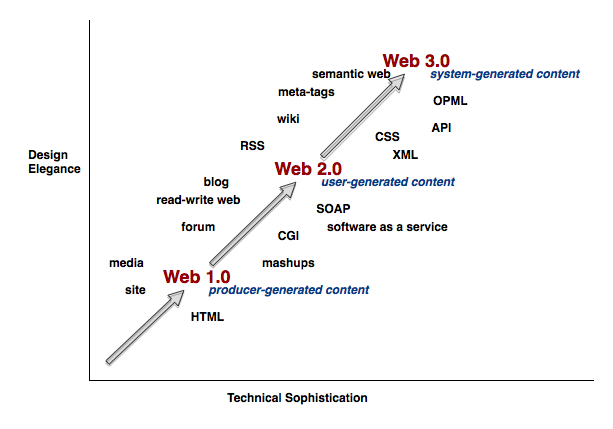
In preparing for a talk I’m going to give, I was thinking about how to represent the trends from web 1.0 through 2.0 to 3.0.   As I’ve mentioned before, in my mind 3.0 is the semantic web. I think of web 2.0 as really two things, the social read-write user-generated content web, and the web-services mashup web.   In elearning, we tend to focus on the former, but the latter is equally important.

Web2.0However, if we think about web 2.0 as user-generated content, we can think about 1.0 as producer-generated content.   The original web was what people savvy enough (whether tech or biz) could get up on the web.   The new web is where it’s easy for anyone to get content up, through blogs, photo-, video-, and slide-sharing sites, and more.

Extending that, what’s web 3.0 going to be?   If we take the semantic web concept, the reason we add these tags is for systems to start being able to use search and rules to find and custom-deliver content.   An extension, however, is to have the system generate the necessary content (cf Wolfram|Alpha).   In a sense, by knowing some things about you and your interests, needs, and activities, a system could proactively choose what and when to deliver information.

And that, to me, is really system-generated content, and a real opportunity.   It’s not ahead of what we can do (though I recognize it’s ahead of where most are ready to be; why do you think it’s called Quinnovation? :), but it’s certainly something to keep on your radar.   And when you’re ready, so am I!

« Previous Page
Next Page »

Clark Quinn

The Company

Search

Feedblitz (email) signup

Never miss a post
Your email address:*
Please wait...
Please enter all required fields Click to hide
Correct invalid entries Click to hide

Pages

  • About Learnlets and Quinnovation

The Serious eLearning Manifesto

Manifesto badge

Categories

  • design
  • games
  • meta-learning
  • mindmap
  • mobile
  • social
  • strategy
  • technology
  • Uncategorized
  • virtual worlds

License

Previous Posts

  • March 2026
  • February 2026
  • January 2026
  • December 2025
  • November 2025
  • October 2025
  • September 2025
  • August 2025
  • July 2025
  • June 2025
  • May 2025
  • April 2025
  • March 2025
  • February 2025
  • January 2025
  • December 2024
  • November 2024
  • October 2024
  • September 2024
  • August 2024
  • July 2024
  • June 2024
  • May 2024
  • April 2024
  • March 2024
  • February 2024
  • January 2024
  • December 2023
  • November 2023
  • October 2023
  • September 2023
  • August 2023
  • July 2023
  • June 2023
  • May 2023
  • April 2023
  • March 2023
  • February 2023
  • January 2023
  • December 2022
  • November 2022
  • October 2022
  • September 2022
  • August 2022
  • July 2022
  • June 2022
  • May 2022
  • April 2022
  • March 2022
  • February 2022
  • January 2022
  • December 2021
  • November 2021
  • October 2021
  • September 2021
  • August 2021
  • July 2021
  • June 2021
  • May 2021
  • April 2021
  • March 2021
  • February 2021
  • January 2021
  • December 2020
  • November 2020
  • October 2020
  • September 2020
  • August 2020
  • July 2020
  • June 2020
  • May 2020
  • April 2020
  • March 2020
  • February 2020
  • January 2020
  • December 2019
  • November 2019
  • October 2019
  • September 2019
  • August 2019
  • July 2019
  • June 2019
  • May 2019
  • April 2019
  • March 2019
  • February 2019
  • January 2019
  • December 2018
  • November 2018
  • October 2018
  • September 2018
  • August 2018
  • July 2018
  • June 2018
  • May 2018
  • April 2018
  • March 2018
  • February 2018
  • January 2018
  • December 2017
  • November 2017
  • October 2017
  • September 2017
  • August 2017
  • July 2017
  • June 2017
  • May 2017
  • April 2017
  • March 2017
  • February 2017
  • January 2017
  • December 2016
  • November 2016
  • October 2016
  • September 2016
  • August 2016
  • July 2016
  • June 2016
  • May 2016
  • April 2016
  • March 2016
  • February 2016
  • January 2016
  • December 2015
  • November 2015
  • October 2015
  • September 2015
  • August 2015
  • July 2015
  • June 2015
  • May 2015
  • April 2015
  • March 2015
  • February 2015
  • January 2015
  • December 2014
  • November 2014
  • October 2014
  • September 2014
  • August 2014
  • July 2014
  • June 2014
  • May 2014
  • April 2014
  • March 2014
  • February 2014
  • January 2014
  • December 2013
  • November 2013
  • October 2013
  • September 2013
  • August 2013
  • July 2013
  • June 2013
  • May 2013
  • April 2013
  • March 2013
  • February 2013
  • January 2013
  • December 2012
  • November 2012
  • October 2012
  • September 2012
  • August 2012
  • July 2012
  • June 2012
  • May 2012
  • April 2012
  • March 2012
  • February 2012
  • January 2012
  • December 2011
  • November 2011
  • October 2011
  • September 2011
  • August 2011
  • July 2011
  • June 2011
  • May 2011
  • April 2011
  • March 2011
  • February 2011
  • January 2011
  • December 2010
  • November 2010
  • October 2010
  • September 2010
  • August 2010
  • July 2010
  • June 2010
  • May 2010
  • April 2010
  • March 2010
  • February 2010
  • January 2010
  • December 2009
  • November 2009
  • October 2009
  • September 2009
  • August 2009
  • July 2009
  • June 2009
  • May 2009
  • April 2009
  • March 2009
  • February 2009
  • January 2009
  • December 2008
  • November 2008
  • October 2008
  • September 2008
  • August 2008
  • July 2008
  • June 2008
  • May 2008
  • April 2008
  • March 2008
  • February 2008
  • January 2008
  • December 2007
  • November 2007
  • October 2007
  • September 2007
  • August 2007
  • July 2007
  • June 2007
  • May 2007
  • April 2007
  • March 2007
  • February 2007
  • January 2007
  • December 2006
  • November 2006
  • October 2006
  • September 2006
  • August 2006
  • July 2006
  • June 2006
  • May 2006
  • April 2006
  • March 2006
  • February 2006
  • January 2006

Amazon Affiliate

Required to announce that, as an Amazon Associate, I earn from qualifying purchases. Mostly book links. Full disclosure.

We use cookies to ensure that we give you the best experience on our website. If you continue to use this site we will assume that you are happy with it.