Learnlets

Secondary

Clark Quinn’s Learnings about Learning

Search Results for: align

eLearning Guild Keynote: Keith Sawyer

15 April 2008 by Clark 4 Comments

Today I’m at the eLearning Guild’s Annual Gathering. Yesterday I was part of two different pre-conference symposiums, one on Immersive Learning Simulations (read: serious games) and Mobile Learning, and today we started off with a keynote. I mind-mapped it, which I sometimes do, and here’s the result:
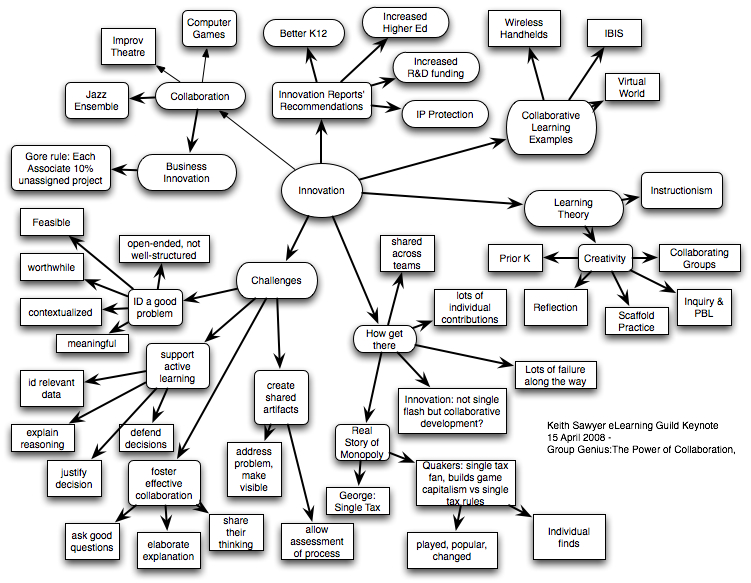
Keith Sawyer Keynote Mindmap

Overall, I confess I was a wee bit underwhelmed, as some of the talk was that a constructivist approach fostered more innovative folks. Well, yeah. However, there were some good points, and he told a great story about the real history of Monopoly.

The main good point was debunking the myth that innovation is individual insight, and his research on creativity shows how teams iterate over time to create new ideas. He also pointed out a couple of ways to facilitate creativity, which included building layouts (pointing to his book, ahem), and re-assigning staff as a systematic organizational policy.

There were also some good details about making effective learning (see the subtrees from the ‘challenges’ node in the mind map, above), including identifying a relevant problem, supporting active learning, fostering effective collaboration, and creating shared artifacts.   Most specifically, the details underneath these were more depth than you often get.

Of course, the question is whether the talk was relevant for the general audience, not me (after all, I too have studied creativity, and the learning sciences). My informal poll seemed to support my view, but the eLearning Guild is making some good efforts at linking in social tools, so there should be lots of reactions being tracked. Did you see his presentation? If so, what did you think?

Scope of Responsibility

6 March 2008 by Clark 1 Comment

The Learning Circuit’s Blog Big Question of the Month for March is “what is the scope of our responsibility as learning professionals”. It’s an interesting question, and what prompted it is an interesting read in itself. I’ve been on the stump in a variety of ways suggesting our responsibility is quite broad, if we want to matter to the organization, and we should.

First, I believe it is the learning professional’s scope of responsibility to go beyond courses to resources and job aids, portals, knowledge management, eCommunity, etc, populating the ‘performance ecosystem‘ to support individuals throughout their development and meeting their performance needs. This is the foundation of my elearning strategy, though of course it goes beyond elearning and eventually covers all learning, including coaching & mentoring, instructor-led, organization of workspaces, informal learning, etc.

That’s pretty good, but it’s not enough. I think there’s a broader issue of Creating a Learning Culture (disclaimer: I co-wrote a chapter), which involves ensuring that the climate is supportive for learning, where individuals believe it’s ok to reflect, share ideas (even mistakes), and more. I think that this shouldn’t be taken for granted, but is the result of deliberate effort, and that the learning professional should be working to develop and promote this.

How much would you pay for this now? But wait, there’s more! I think the biggest gap, and the biggest opportunity, is in developing learners as learners, scaffolding them into a learning culture where they are confident and competent self-learners, understanding their role in the learning process, taking command and actively engaging in learning. And this, too, is a role that learning professionals should be supporting. It’s a layer across the previous activities, but should have the largest organizational payoff.

I suppose this seems like quite a lot, but it’s really at core about creating the learning environment in an organization, which includes lots of elements including the culture, goals, as well as resources. As I captured it in a diagram for thinking about the learning environment:

Learning Environment

our responsibility, to me, means watching out over all of these, and ensuring that the area within the organization is as optimized as possible, and in alignment with the elements outside the box. So, do you buy into this?

Questions from the audience

29 February 2008 by Clark 4 Comments

Today we held the Emerging Trends panel session at the TechKnowledge conference. We‘d intended to use an audience response system (aka ‘clickers‘), but of course the technology didn‘t work at that moment, so my colleagues (Frank Nguyen, Ann Kwinn, and Jim Javenkoski) and I winged it with questions from the audience.

Second Life came up a couple times. Joe Miller was the keynote on Wednesday, and in his far ranging and thoughtful presentation he reinforced my previous thoughts on what the fundamental learning affordances are, and helped illuminate a point that hadn‘t really gelled for me.

Using Tony O‘Driscoll‘s diagram, he elaborated on the topic of the current state of virtual worlds. In 1995, when you first looked at HTML, did you have any idea that the web would grow to where it is today? The argument is similar for Second Life, in that the first generation of the web was “Democratization of Access”, where now anyone could find information. Web 2.0 is “Democratization of Collaboration”, where you can create, share, and comment. He called virtual worlds the “3D internet”, and here it‘s the “Democratization of co-creation”.

Besides that, the panel still felt that it‘s about socialization and spatial capabilities, and, as Frank said, that if your objectives didn‘t match those, a virtual world wouldn‘t need to be your solution. I also recited the barriers that Joe had mentioned – usability, download, and processing load -as a way to reinforce the point that there‘s considerable initial investment, and I believe that such worlds make sense when you are intending to have a long-term in-world involvement.

Several questions danced around the relevance of instructional design and the teaching thereof. I pointed to the ongoing dialogs, and we generally agreed that the teaching wasn‘t as aligned to real world practice as it could be, but, as Ann pointed out, ISD principles still apply (our brains haven‘t changed).

Another question came out about the real world validity of Web 2.0. I cited an audiocast of a cutting edge project leader who used BaseCamp, Twitter, Deli.cio.us, IM, and more to keep his team aligned, and my own use of technologies to accomplish various business goals. Jim raised the point that Web 2.0 is a way to have the communication be two way, not just from the designers to the victims, er, learners.   These tools may initially take up extra time, but once ‘assimilated’, they are proving to be time-savers in productivity as well.

One individual pointed out how there seemed to be two camps of instructional technology: traditional eLearning which was instructivist and a second that was social. I agreed and pointed out how we really need to wrap instruction with collaboration from the get-go to help learners immediately recognize that dialog is part of the process and enculturate them into the community.

We also talked about the pragmatics of introductions of technology. To a question about moving the government along, I suggested that there‘s a ‘late adopter‘ advantage of avoiding mistakes (though I‘m not so certain it‘s strategy rather than inertia :), and that solid examples with ROI were the best leverage.

Another question on how to get people to use wikis seemed to suggest that in the particular instance, wikis were the wrong tool (the goal was capturing ‘stories‘). As it pushed one of my hot buttons, I suggested that we should not forget to do a proper match between need and tool, nor forget older tools in the flush of new technologies; in this case a discussion list would probably be a better tool. However, my real answer is that when the need is a resource, a wiki can be a collaboratively improved resource and the way to get participation is to make sure the resource is valuable. I would add, now, that a session I heard indicated success in using incentives to get initial participation, and that may be pragmatic, if not principled ;).

Many thanks to the participants, I thought it was a nice way to cap off the conference.

The US (lack of) class system…

15 December 2007 by Clark 3 Comments

Ok, this is a gripe and somewhat political; fair warning.

My son has a VSD, a ventricular septal defect. It’s a tiny hole in his heart wall, not growing, so the doctors say “don’t operate”, and he’s perfectly (almost obnoxiously :) healthy. Our insurance provider, however, says that unless we cut into his healthy body, they won’t cover him. They have to, actually, because of HIPAA (thankfully). BUT, they won’t cover him under our family plan (which has gone up 400% in the past 4 years), and we have to have a second, separate, and much less coverage policy for him.

This makes him, effectively, a second class citizen.

As an independent consultant, I can’t get small business insurance where a plan would have to cover the whole family (and can’t just employ my wife to qualify). So let me be clear that I’m for the US to move to a one not-for-profit medical insurance system, nationally. Don’t tell me it doesn’t work, because I lived in Australia for seven years where they have it and it works. It’s not perfect, but it’s bloody well better than our system here in terms of coverage for everyone. And of course you should’ve seen the results that show the US system is worst and most expensive of the major countries. Scandalous.

I’m a bit dismayed that the major candidates’ plans aren’t willing to go this far. And, by and large, their plans won’t help my health care costs. Given that the forecasts are for more independent workers, this should be of more concern.

The alternative would be a regular job, but so far no one’s come through with an offer that affords me the level of contribution I can and want to make. So, anyone want an ‘on call’ elearning expert for the cost of health, disability, and retirement benefits for me and my family?

willworkforbenefits.jpg

Readability

17 November 2007 by Clark 1 Comment

I’ve seen that my colleagues have been running their blogs through a ‘readability‘ test. I’m not sure how reasonable it is, but I took a punt and:

My High School Readability

I’m pleased that it’s readable (I wouldn’t want otherwise), but I admit I’ve always thought that I’m too conceptual, so I’m a little put out! ;).

On the other hand, the code they ‘recommend’ has as an alternate a ‘cash advance’ site(?!?). Given that Cammy Bean’s is ‘genius’ level, and Jay Cross’ is ‘jr. high school’, maybe it’s random? I respect both, but I don’t find that big a difference between their outputs. Caveat emptor.

Labeling Games

17 October 2007 by Clark 3 Comments

I’ve mentioned before how I got into this field, and back then what we were doing was creating educational computer games. Playing the original Colossal Cave adventure, I realized how we could put meaningful skills into these environments (not really what we were doing at DesignWare). Still, I thought of them as games.

Later, when I built a game requiring analogical reasoning (based upon my PhD thesis) and then with Quest, and more, I continued to think of them as games. When I finally wrote about how to design them, I used the phrase Simulation Games in the title, partly at the prodding of my publisher. So it’s been interesting to see the recent struggles with naming that are going on.

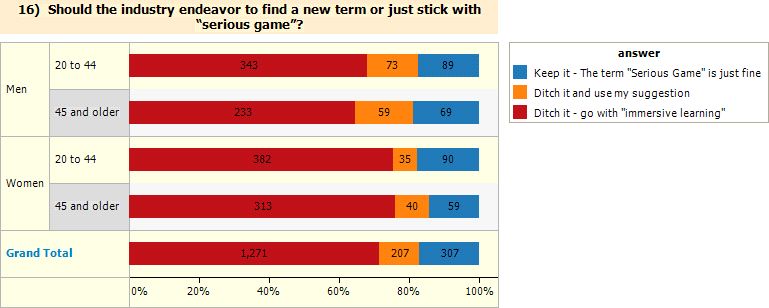
Ben Sawyer, moderator of the Serious Games discussion list, recently had a post discussing the various nuances of the term ‘serious games’. He differentiated his interpretation from what the eLearning Guild has called Immersive Learning Simulations (ILS). Interesting, the Guild chose that name when they received serious feedback (1784 respondents represented here) from their great research tool that the phrase ‘game’ was seriously problematic:

eLearning Guild ILS research report findings on naming fieldAs you can see, there was a strong feeling that the name had to change. On the other hand, there was speculation that the reason the ILS symposium at the upcoming DevLearn conference was cancelled due to low signups may well be because of the label. So, what’s going on?

It is true that some of us are focused on the corporate space with these, while others are almost definitely not interested in that space, instead being in, for the lack of a better term, the political/social action space. I like to think that my design principles work for either, but Ben’s message made clear that using games to ease kids pain, to exercise, etc, don’t qualify in his mind. I don’t quite agree, as my approach starts with an objective and provides systematic steps to achieve that objective, but there are things that wouldn’t qualify.

The issue for labeling in corporate learning is that some companies are concerned enough (concerned being a diplomatic euphemism) to actually block the term ‘game’ from any search through their firewall (!). As I’ve said before, a simulation is just a model, when you put the simulation in a particular state and ask the learner to take it to a goal state it’s a scenario, and when you tune that experience until engagement is achieved it’s a game. Clark Aldrich says it slightly differently, putting ILS at the intersection (think ‘Venn Diagram’, I can’t find a copy on his site) of Simulation, Games, and Pedagogy (I agree if you essentially equate the word ‘games’ with ‘engagement’ :).

Regardless, if you’re not at least considering deeply immersive practice through scenarios (though the one connotation that scenarios mean branching is too limited), you’re missing a powerful learning experience. More, there are very good reasons to think that tuning the experience, at least to some degree, makes the learning even more powerful. Finally, as I’ve said before, they’re not as expensive as you might fear.

So, regardless of name, consider the outcome, and make your learning practice as powerful as possible!

Performance

21 September 2007 by Clark 7 Comments

Yesterday I was delighted to have lunch with Jay Cross, elearning guru, author, bon vivant, mentor, friend, (and now drummer). We’re almost neighbors (15 mi) and share passions for learning (and the meta-version), the capabilities technology can provide (not the technology itself), good food and drink. We’ve shared many adventures. I was helping him pick a new computer (a Mac), and of course having good conversation. Jay in WC

One of the things to talk about was performance support, as he’s writing an elegant update on the history and importance of this approach. It triggered many thoughts, not the least because performance support is the real focus of my mobile design piece I did for the recent eLearning Guild mobile research report.

It occurred to me that the new technologies make performance support even more effective. Semantic tagging, combined with user models, for instance, gives us opportunities to customize our support. As I’ve said before, mobile’s been a tale of convenience, making information available when needed, even if it’s a small screen, or over a small speaker, but the real opportunity still awaits: context sensitivity. We can track more than location, we can take a meeting, wrap support around it, and turn it into a learning event. Wrapping performance support around our lives, improving us as it improves our performance, is a true quantum shift in developing human capability.

Of course, we can also take performance support and meta- it, too! Our devices can not only support our performance on task, but support our performance on learning from the performance. It sounds a bit recursive, but I think that helping people become effective self-learners is a second great opportunity.

In Jay’s excellent book Informal Learning, he makes the point that “Dialogue is the most powerful learning technology on earth”, and it’s certainly true that when I get together with great thinkers, my own thinking gets sparked. I’m not a ‘big group’ person, but I love small conversations, and try to get together with folks and share conversation and comestibles. Let’s do lunch!

VideoConferencing and Mobile

19 September 2007 by Clark Leave a Comment

“Father, it’s been too many days since my last blog”, but it’s been a bit hectic. I’ve been dealing with some presentations, and more to come. Yesterday, one of them was a video conference for the Graduate School of Education (if I understand correctly!) at ITESM (Institute Technologica).
VideoConference

Here you can see the setup, I was in a video conference center, and I could control whether they saw me or my slides, and I could see them. Well, actually, some of them, as others were at satellite centers. I’m not an experienced video presenter (I do a lot of webinars, like tomorrow’s eLearning Guild Online Forum introducing eLearning, but it’s my first videoconference), but tried to balance some of me talking to them directly (they had a translator, I don’t speak Spanish unfortunately) with my usual diagrams and voice over (their system wouldn’t allow them to see both me and my slides at the same time). They’re quite advanced technologically, even telling me before we began that they’re making mobile a part of their learning solutions, with vidcasts and audcasts as well as quizzes.

Which was relevant, as they’d asked me to speak on mobile learning. I spoke to mobile design, my pet passion, and emphasized as I have in the eLearning Guild’s mobile research report that you have to ‘think different’, not about courses, but about performance support. They asked some very good questions afterwards, including what competencies learners should have (to be effective self-directed learners, and not to take that for granted but scaffold it), how mobile could be incorporated into universities (separate content from display, while using more open tools), and what content makes sense for mobile (interactive, reactivating, not content dump).

In one sense, I missed that I didn’t get a trip to Monterrey, Mexico (love to see new places, particularly ones with good food!), but it was a learning experience both in the new medium for me, and of course in thinking anew about the topic. Every time I present, there’re always new thoughts, even if it’s the same topic, though I try to get to speak on new things to challenge myself (one of my learning strategies). Of course, I also offer to host one of my well-reviewed workshops on game or mobile design, as well.   For instance, I’m talking about emotional elearning and mapping tools to learning needs at the eLearning Guild’s DevLearn (in San Jose CA), about eLearning Strategy for SENA (in Columbia, this time I do get a trip), and on learning technology futures in Copenhagen for the Danish Research Network (another trip!). What would you like to hear about?

Where to work?

13 September 2007 by Clark Leave a Comment

The Learning Circuits Blog big question of the month for September is “Where to work?” (PS I don’t know why I can’t get a straight URL just to the question.) It’s kind of a tough question, really. For whom? When?

When I look at the broad categories of who works in eLearning, first there’s a breakdown between ‘education’ and ‘the real world’, the latter of which roughly breaks down into corporate, government, and not-for-profit. The reason I separate out education is that there elearning is much more about education, not training. The others reverse. My definition of the distinction is a continuum from performance in very specific contexts (training) to broad applicability (education). Increasingly, we’re seeing pushes down on education, and up on training, however.

And we need to recognize that in many instances, we’re talking about a broader picture, where the a second dimension is performance support versus full instruction.

To be honest, though, it doesn’t so much matter where you work as what you do, who you work with, etc. The main thing is to align your job description with what you want to do: if you want to tinker with code and systems, be a develop, not a designer. If you want to figure out who should learn what, do curriculum development, if you want to create content, be a designer, etc. If you want to do a bit of each, work in a small organization.

Then choose based upon manager, company culture, location, and all the rest. Realize that you’ll never get the perfect fit, it’s all about tradeoffs. So know what’s important to you, and maximize your priorities. But that’s basic job counseling.

Of course, you have to be realistic with your strengths and styles too. Interestingly, a friend who has been doing counseling was interested in something new that involved teamwork and computers but not really software engineering. I thought elearning was a viable suggestion (though I did caveat with my ‘bias’). I do believe that understanding people, technology, and business (whether from interface design, learning design, or business intelligence perspective) is a valuable skill set going forward!

Mobile Devices, Generically

10 September 2007 by Clark Leave a Comment

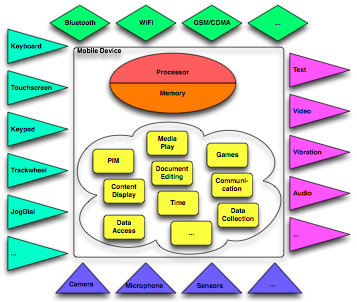
In addition to working on the mobile learning report, I’m speaking on mobile to Mexico’s Tecnológico de Monterrey via videoconference next week on mobile. As an part of my ongoing efforts to capture my thinking as graphics (for lots of reasons including my visual conceptualization approach, making my powerpoints more worthwhile, communicating, etc), I took a stab at graphically representing my generic model of a mobile device:

Mobile Device ModelIn this model, I’m trying to show that a mobile device is, at core, a processor and memory unit with a variety of possible means of connection (personal, local, and wide-area ways to network), input to the device (e.g. keys, touchscreen), output from the device (e.g. screen, speakers), and sensors that can do things like take pictures, capture audio, and sense position both in the larger context (e.g. GPS), and relative (like whether it’s tilted sideways or upright). Also, we have certain types of prototypical software that can be included: Personal Information Management, data viewing, capture, editing, communication, etc.

The point is that there are lots of form factors, but at heart we have this digital communication device with certain affordances (there’s that word again :) that we can map to our learning needs and goals.   I think it’s valuable to try to abstract away from particular devices as they are continually changing (well, increasingly multi-capable), and consider more fundamentally what capabilities are available and how they might be used. What do you think?

« Previous Page
Next Page »

Clark Quinn

The Company

Search

Feedblitz (email) signup

Never miss a post
Your email address:*
Please wait...
Please enter all required fields Click to hide
Correct invalid entries Click to hide

Pages

  • About Learnlets and Quinnovation

The Serious eLearning Manifesto

Manifesto badge

Categories

  • design
  • games
  • meta-learning
  • mindmap
  • mobile
  • social
  • strategy
  • technology
  • Uncategorized
  • virtual worlds

License

Previous Posts

  • March 2026
  • February 2026
  • January 2026
  • December 2025
  • November 2025
  • October 2025
  • September 2025
  • August 2025
  • July 2025
  • June 2025
  • May 2025
  • April 2025
  • March 2025
  • February 2025
  • January 2025
  • December 2024
  • November 2024
  • October 2024
  • September 2024
  • August 2024
  • July 2024
  • June 2024
  • May 2024
  • April 2024
  • March 2024
  • February 2024
  • January 2024
  • December 2023
  • November 2023
  • October 2023
  • September 2023
  • August 2023
  • July 2023
  • June 2023
  • May 2023
  • April 2023
  • March 2023
  • February 2023
  • January 2023
  • December 2022
  • November 2022
  • October 2022
  • September 2022
  • August 2022
  • July 2022
  • June 2022
  • May 2022
  • April 2022
  • March 2022
  • February 2022
  • January 2022
  • December 2021
  • November 2021
  • October 2021
  • September 2021
  • August 2021
  • July 2021
  • June 2021
  • May 2021
  • April 2021
  • March 2021
  • February 2021
  • January 2021
  • December 2020
  • November 2020
  • October 2020
  • September 2020
  • August 2020
  • July 2020
  • June 2020
  • May 2020
  • April 2020
  • March 2020
  • February 2020
  • January 2020
  • December 2019
  • November 2019
  • October 2019
  • September 2019
  • August 2019
  • July 2019
  • June 2019
  • May 2019
  • April 2019
  • March 2019
  • February 2019
  • January 2019
  • December 2018
  • November 2018
  • October 2018
  • September 2018
  • August 2018
  • July 2018
  • June 2018
  • May 2018
  • April 2018
  • March 2018
  • February 2018
  • January 2018
  • December 2017
  • November 2017
  • October 2017
  • September 2017
  • August 2017
  • July 2017
  • June 2017
  • May 2017
  • April 2017
  • March 2017
  • February 2017
  • January 2017
  • December 2016
  • November 2016
  • October 2016
  • September 2016
  • August 2016
  • July 2016
  • June 2016
  • May 2016
  • April 2016
  • March 2016
  • February 2016
  • January 2016
  • December 2015
  • November 2015
  • October 2015
  • September 2015
  • August 2015
  • July 2015
  • June 2015
  • May 2015
  • April 2015
  • March 2015
  • February 2015
  • January 2015
  • December 2014
  • November 2014
  • October 2014
  • September 2014
  • August 2014
  • July 2014
  • June 2014
  • May 2014
  • April 2014
  • March 2014
  • February 2014
  • January 2014
  • December 2013
  • November 2013
  • October 2013
  • September 2013
  • August 2013
  • July 2013
  • June 2013
  • May 2013
  • April 2013
  • March 2013
  • February 2013
  • January 2013
  • December 2012
  • November 2012
  • October 2012
  • September 2012
  • August 2012
  • July 2012
  • June 2012
  • May 2012
  • April 2012
  • March 2012
  • February 2012
  • January 2012
  • December 2011
  • November 2011
  • October 2011
  • September 2011
  • August 2011
  • July 2011
  • June 2011
  • May 2011
  • April 2011
  • March 2011
  • February 2011
  • January 2011
  • December 2010
  • November 2010
  • October 2010
  • September 2010
  • August 2010
  • July 2010
  • June 2010
  • May 2010
  • April 2010
  • March 2010
  • February 2010
  • January 2010
  • December 2009
  • November 2009
  • October 2009
  • September 2009
  • August 2009
  • July 2009
  • June 2009
  • May 2009
  • April 2009
  • March 2009
  • February 2009
  • January 2009
  • December 2008
  • November 2008
  • October 2008
  • September 2008
  • August 2008
  • July 2008
  • June 2008
  • May 2008
  • April 2008
  • March 2008
  • February 2008
  • January 2008
  • December 2007
  • November 2007
  • October 2007
  • September 2007
  • August 2007
  • July 2007
  • June 2007
  • May 2007
  • April 2007
  • March 2007
  • February 2007
  • January 2007
  • December 2006
  • November 2006
  • October 2006
  • September 2006
  • August 2006
  • July 2006
  • June 2006
  • May 2006
  • April 2006
  • March 2006
  • February 2006
  • January 2006

Amazon Affiliate

Required to announce that, as an Amazon Associate, I earn from qualifying purchases. Mostly book links. Full disclosure.

We use cookies to ensure that we give you the best experience on our website. If you continue to use this site we will assume that you are happy with it.