 Tony O’Driscoll, who works for IBM around learning, technology, and organizations, has finally started his own blog. I’ve subscribed, as I’ve liked his thinking in the past (I use his diagram on in/formal learning). I have to admit I’m hoping his posts will get briefer from a purely pragramatic perspective (hey, it’s not the only one I read in a day!); in keeping with my site title, I try to keep my posts small, but I know others can be more thoughtful. So, check it out!
Search Results for: align
J. Nives Quinn, Jr. (1917-2007) RIP
 Today my father died. It wasn’t unexpected, he’d been ready for years, and we’re fortunate that his final demise was relatively quick and painless. He was an interesting guy: born in east Colorado at the edge of the prairie, he grew up with wide open spaces, even spending time as a cowboy (“stupidest job in the world” he used to say, “hard work, low pay, and no girls”).
His dad had a bank that was wiped out by the Depression. My grandfather continued to work until he paid back every single person who’s money he’d lost before he again started settling his own financial future, and this had a great impression on my dad.
Named for his dad, he shared his Dad’s preference for being called by his middle name, Nives (pronounced Neeves). It’s become a family tradition for middle names, shared by me and my first-born son. May it continue.
He had an amazing talent for building and fixing things. He used to build radios and trade them for things like cars. He was a good story-teller, and from what I heard it’s amazing he managed to survive to an age where his youthful temper mellowed and he was able to settle down and have a family. When I knew him he had remarkable patience, certainly with machinery.
He never finished college, but spent time in the war in the Navy (the picture is from his days serving as a tail-gunner in a dive-bomber, the duty he was required to have to balance his time in then-secret radar). After the war he visited his sister in Southern California, and ended up working for Northrop Aircraft for 32 years until he retired.
He migrated to facilities because he knew every sort of engineering: electrical, hydraulic, civil, you name it he knew how it worked and how to plan it, build it, maintain it, and dismantle it. He would stand up to contractors, employees, even management when he was right, and convince them to do it his way.
He avoided management as long as he could; they finally promoted him while he was on vacation, and he ended up with responsibility for the entire mile-long plant in Hawthorne. I hadn’t known him as a leader, but while he had no patience with fools, he was blind to color and background and his employees from Hungarians to Burmese were fiercely loyal. I learned from the notes from his retirement party that he was relentless in ensuring there was justification for requests for facilities services. I got a chuckle from this note: “people learned to disagree with him one way, with respect” (the “one way” was underlined by hand).
After retirement (he left early, when the job wasn’t fun anymore), he traveled the world with my mom. They were quite humble and frugal throughout their lives, and rode in local buses and stayed in the cheapest accommodations in the most interesting places, with new stocks of stories to tell such as camping in tents with lions padding around outside(!).
They greatly valued education; really the only reason to be excused from the dinner table in the middle of the meal was to go look up something in the encyclopedia or the dictionary. We knew we had to try our hardest, but they were happy with whatever the outcome of that was.
When they weren’t traveling he volunteered time doing what he’d always done for almost anyone, fixing things, particularly as a handyman for a local shelter. Tragically, a late diagnosis and botched surgery for Dupuytren’s cost him the use of his hands, and brought to a close his one real passion in life. Subsequent persistent pain and loss of hearing also contributed to his lack of enthusiasm in his last years. Yet he still welcomed a drink, a laugh, and beamed at the sight of his grandkids.
I was always impressed that he maintained his idealism throughout his life, caring about doing the right thing rather than the expedient thing. He was security-oriented, and passed up many chances to do better financially to ensure we were never without food and shelter. He had his flaws, but he was a very good man overall, and I was proud to call him “Dad”. Rest in Peace.
Content Models
Sorry, it’s been a whirl of activity, this past week and more. Most of it, interestingly, circling around something I was working on several years ago, content models. The notion is being more granular in content specification, separating out, both in content development and in representation through tagging,the different components of learning:

This gives us flexibility in packaging them up in different ways to serve different needs.
I once defined the right size of a learning object as the smallest unit you’d give to one learner versus another (implying if you were serving as a wise and knowledgeable tutor). However, we’re not there yet with the ability to sufficiently tag domain/topic role down to the level of a table or a graphic across all domains, which is what you’d need to build a really intelligent but mass-market tutoring system, but we certainly can make approximations.
Yes, I do have complaints from authors who feel it’s constraining, but when we pay closer attention to the elements (and good principles along with, see the Seven Steps to Improved Instructional Design white paper, warning: PDF; soon to come out in a ‘readers digest condensed’ version via Lisa Neal’s eLearningMag) we get more flexibility and better learning outcomes. And it’s not that hard to shift, it’s some initial extra overhead, not a whole new writing process.
As you move from publishing monolithic works to delivering Wayne Hodgin’s “right stuff” (the right information, to the right person, at the right time, in the right place…etc), and increasingly want authors who don’t have instructional design expertise but important knowledge to develop learning, you’ll need this structure. I’m finally seeing some real market movements in these directions, and I look forward to more innovations.
School Daze and Teachers & Teaching
A few thoughts on the first day of school…
My daughter, 6, told me on Saturday that she didn’t want to start school. Having to get up and get dressed on time, and back to homework, etc. Yesterday, she told me she was excited about starting school again. The difference? She found out that she has the same teacher her brother had two years ago, a young, enthusiastic, nice teacher. Here’s to all those who teach with passion and skill!
I was talking with my students, and one opined that there were a lot of “junk teachers”. I don’t really believe that; while there probably are a few who are just looking for a sinecure (I’ve known some :), I think that there are a number of other explanations why all our teachers aren’t passionate and skilled. It’s not a highly valued profession, despite the fact that I can think of few others who have a greater influence on our future. The government puts them under ridiculous pressure to have students pass tests, despite the evidence that that doesn’t lead to useful skills. There aren’t enough of them with skills (I’ve met so many ex-teachers), their administrative support is idiosyncratic at best, they’re under-resourced, the list goes on.
And there’s a societal component as well. Sayings like “those who can, do, those who can’t, teach”, and our unfortunate tendency to belittle smarts (and lionize those who succeed financially, despite potentially suspect methods), both are at odds with teachers being successful. I’d like to suggest that any society that values lawyers more than teachers has it’s priorities wrong. Not that I have anything against lawyers (despite jokes to the contrary), but I think the eastern veneration of scholars and teachers has much to be commended. The reason I’m in learning is I think it’s the most likely way to address societal ills.
I remember a post-doc who’s wife was doing a sociology PhD. It turns out that doctors re-engineered their status in society around the 1920s, creating their medical school process (still used, with many negatives in terms of learning outcomes) and changing their public perception from ‘sawbones’ and ‘quacks’ to their almost un-questioned authority through most of the subsequent years. Her thesis was that teachers should do something similar. I’m all for it, frankly, or any other way we can get societal support back behind effective teaching and learning, not as advanced baby-sitting and rote learning. Ideas?
Emotion in Game Experience
Today I was working with a team (coordinated by my long-time mentor/colleague/friend Jim Schuyler, who knows the most interesting people) to design an experience for an upcoming event. Dialed in for a big part of the planning session was Nicole Lazzaro, a real revelation!
Nicole gave us a rundown on her insightful take on the four “fun keys” that serve as emotional signposts in the gaming experience. They’re a different cut through the elements I draw upon, and are insightful and well-based in her research on game playing. Moreover, she taps into an element I have largely ignored (owing to my own ‘non-social’ learning style; I’m not asocial, I’m just shy and kind of independent), the social aspect.
Her elements were:
- Fiero: an Italian word capturing individual triumph over adversity (requiring frustration beforehand). This is something that movies don’t do well, she asserts (and certainly vicarious triumph isn’t quite the same). I was pleased to hear her use ‘hard fun’, which those who know me is a concept I tout, though her take was more specific than mine. I align this with a perfectly-pitched ‘challenge’.
- Curiosity: this is an ‘easy fun’ which is interleaved with the hard fun, providing choice and opportunity to explore. I have choice and novelty which are combined to some extent here. Her take is that this leads to wonder, surprise, and/or awe. Delightful!
- Relaxation/Excitement: I didn’t quite get the nuances here, obviously, because this seemed like a twist on the shift between fiero and Curiosity. It’s a continuum, but the bits that did ‘stick’ included playing to learn and achieving goals, and also the importance of meta-cognition. These are concepts near and dear to my heart, so I’ll have to pursue these further.
- People fun: Here she included the joy of working with others, and also Shadenfreude “pleasure taken from someone else’s misfortune”. I tend to focus on individual learning experiences, and so she’s providing valuable new perspective to me here. This incorporates all the social emotions from envy and jealousy to camaraderie, gratitude, and generosity.
I have written about emotion in elearning(a PDF), but this is an elegant analysis of emotion in the gaming experience, and valuable for learning game design as well. There’s a brief introduction in a Gamasutra article summarizing a session on emotion that Nicole participated in (free registration may be required). Have at it!
Attitudinal Change
Sorry for the slowdown, but I’ve been travelling, workshopping, presenting, etc at one of the as-always excellent eLearning Guild conferences. It’s given me great opporunitities for learnings, which will dribble out in spare moments in my upcoming schedule (I’m back for one day then on a plane to Taiwan).
One of the comments I found myself saying to folks here at the conference is “more and more, I’m coming to believe that much of our learning goals aren’t about knowledge or skills, but about attitude change”. People actually have a lot of knowledge they can draw upon in the world, but they have to believe it’s important to act in that way. Their lack of performance in a particular way is not an inability, but an unwillingness.
Because I’ve been interested in looking at all the ways in which people understand the world I’ve looked at things as far afield as machine learning and ritual, and also what’s known about attitude change. AECT’s research handbook entry is my best guide, and it’s become clear that attitude change is not easy (as if we didn’t know that…:).
So how do we do it? I’m inclined to think that a suite of effective steps goes like this:
- First, we have to make people aware of their own beliefs. Many times we aren’t even aware of our own attitudes towards things. So we need to create an activity that ‘unpacks’ these attitudes.
- Then we have to present alternative attitudes. These need to be plausible alternatives, and I suspect we need more than just one other (but I’m willing to be wrong about this).
- We have to support learners comparing the tradeoffs embodied in the different attitudes. They need to be free to explore what the different attitudes or beliefs will provide, both upside and down.
- We have to support learners in choosing an attitude. They need to commit to the suite of attitudes that characterize what they want to believe.
- And then, assuming that they’ve chosen a new approach, we need to support their realignment of behavior. Recognize that even a change in belief may not realize a sustained change in behavior if there’s no support around that process (it’s hard to break habits).
So, for illicit use of software copying, this might look like:
Making them acknowledge their own behavior, in this case using illegal software. Then we might talk about different attitudes that could be tolerated: nonchalance, the ‘rationalizing’ approach, an honest approach, and their tradeoffs: potential risk of prosecution, ripping off or supporting endeavor, etc. Then allow the learner to choose, and support them through a change (assuming they choose to move to an honest approach), for instance by giving them some situations where they might be tempted to backslide and give them chances to practice ways to deal with it in ethical but non-confrontational methods.
It may not have to be this exhaustive, but the underpinning structure probably includes this.
I’d welcome feedback on the claim that it’s more prevalent or the approach.
Learning Wisdom
The old canard about data->information->knowledge->intelligence->wisdom resonates with me. Don Norman wrote a book called ‘Things That Make Us Smart’, and it was great at taking a richly informed look at how we can enhance how we think with tools. But I think we’re being way too smart and not being wise, the missing element being values.
It was Lance Secretan, talking about inspiring, not just motivating, that got me on this path. I’ve had trouble articulating what it is I do, but the closest I had come was ‘making people smarter’. I like what I do, but it’s not a vision, a mission, so I took it the next step, ‘making people wiser’. This is actually the culmination of a number of converging interests.
My interest in helping people learn led me beyond cognitive to the emotional side of learning, which impacts my interest in games, including myth and ritual as effective tools to align behavior with a set of values. I’ve also started exploring attitudinal change, and how that can be accomplished. Which is why I liked a quote Jay took from Malcolm Gladwell about how values give us criteria to make decisions. When I heard Dennis Meadows talk about systems-thinking, it’s clear our vision is not far enough ahead.
All these elements, but it’s hard to nail down how they pull together, what exactly wisdom is, except for manifesting itself as decisions that are, well, wise. It seems like pornography, “you know it when you see it”. Which of course isn’t good enough for me. So I looked further…
Robert Sternberg has a model of wisdom that talks about evaluating the consequences for the individual, for the community, and the broader society (for which I read: world). It also includes both short- and long-term effects, and in the context of a set of values. Which isn’t bad, if a wee bit obvious. He actually has an article recommending teaching wisdom in schools, and it’s not the worst proposal I’ve heard.
At core, I think a greater focus on value-driven decisions, wise decisions, is a missing element for business success, but since my personal mission is to use technology, I’m convincing myself that we might actually be able to help people make wiser decisions through technology. For instance, LifeBalance is one piece of software that helps you maintain your long-term priorities day-to-day, and I’ve a model for technology mentoring over time that could be developed.
The larger picture is relevant, however. In a talk I gave in Abu Dhabi, I talked about the need for new curricula (e.g. systems-thinking, design problem-solving, meta-learning, communication, values), new pedagogies (e.g. service learning, simulations), and new technology applications. I think that the need for wisdom grows, and currently our grasp exceeds our reach. The problems are organizational and social, not theory or technical. Any ideas how to step up to the challenge?
Hurrah for Active Learning
Yesterday I attended the board meeting of the Center for Civic Education. I’m pleased to support this activity for a number of reasons, not least because they’re focused on developing an understanding of the principles of government and an associated set of values around the importance of civic engagement, goals I think are important. I’m pleased to see that they’re succeeding both nationally but also internationally.
However, what is great is how they do it. Two major initiatives are Project Citizen, and The Citizen & The Constitution. Both have rich approaches and stellar outcomes.
In The Citizen & The Constitution, the students create a team and learn about the Constitution and Bill of Rights, as preparation for simulated congressional hearings. Our first board meeting of the year is held in Sacramento, where the California State regional competitions are held (preliminaries at the hotel, finals at the Capitol building; the national finals are held in DC and have been held in actual congressional hearing rooms). And these kids are awesome: knowledgeable, poised, and articulate. Research shows they have much improved attitudes and civic participation (92% of graduates voted in the last election). Yes, it’s US centric, but the model is easily adoptable (some 30-40% of the Center’s activities are now international, and it’s not knee-jerk American flag-waving, but meaningful discussion on the principles of government and ways to accommodate it within current contexts).
In Project Citizen, a class investigates problems in their neighborhood, figures out where a legislative solution will help, and then works to get that legislative solution enacted. It’s a real service learning approach and nicely integrates awareness of how government operates with an understanding of how citizen activity is a crucial component. And they’ve created significant changes! Again, research supports great outcomes.
While I think this is a great organization and encourage your investigation, the point here is the great pedagogy, aligned with my thoughts on making learning meaningful (read: engaging). Using an authentic activity, in particular the latter case where it also contributes to society, as a way to connect learning to the broader context, integrates the elements that really cement learning. Sometimes we’ll have to simulate it (and exaggerate the story to hook in the emotions we lose with the lack of authenticity, making it a game), but it’s the right way to practice.
Emotional Trajectory…
I was talking about learning games a year or so ago, and mentioned a concept that’s slowly been percolating since. The idea was based upon the notion that we don’t design content, we design experiences, and therefore it could be useful to think of a learner’s emotional trajectory through the experience.
In words I described it as “wry recognition (of the necessity), followed by some slightly apprehensive anticipation, which would segue to growing confidence and finally a feeling of growth and then closure.
I’ve take my first stab at capturing it:
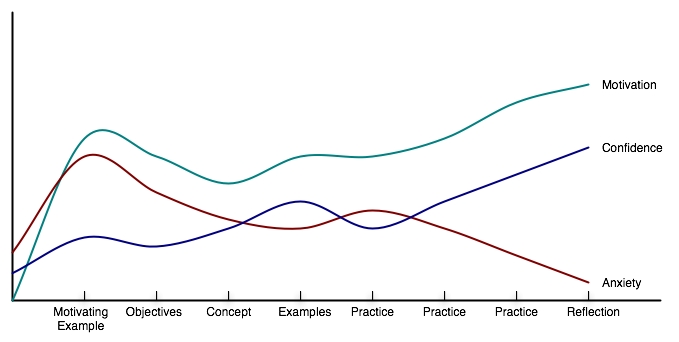
The notion is that, as you progress, your confidence should increase and your anxiety decrease, while motivation develops for the learning from the beginning, and then is maintained until the end. Your feedback solicited.