Learnlets

Secondary

Clark Quinn’s Learnings about Learning

Search Results for: engagement

Design: design as search

18 September 2008 by Clark Leave a Comment

A four-part series on design, barriers, and some heuristics to improve outcomes:

I found my passion in learning technology.   I took most of a computer science degree (after flirting with biology, and…) before designing my own major combining CS with education.   I went back to grad school to learn a lot about cognition and learning.   I took a rather eclectic approach, going beyond cognitive approaches to include behavioral approaches, instructional design, social learning theories, constructivist learning theories, even machine learning.   (I continue that today.)

As I took very much an ‘applied‘ approach (not doing pure research, but interpreting research to meet real problems, now known as “design-based research” in the edtech field, but close to the more general ‘action research‘), and was teaching interaction design, I started looking at design processes in that same eclectic way. (NB: I‘ve also tracked ‘engagement‘, as those who‘ve read the book or heard me speak on games know).   I looked at interface design processes, and instructional design processes, heck, I looked at architectural, industrial, engineering, and graphic design processes. And I realized some things that I‘ve talked about in various places but haven‘t written about for over 10 years, and yet I think are still relevant.   I‘m going to talk here about design, our cognitive (and other) barriers to design, and my plan is to subsequently post about a suite of heuristics I‘ve come up with to minimize the consequences of those barriers.

Design can be characterized as a search of a ‘solution‘ space. Think of all the possible solutions as this n-dimensional space or cloud, and outside the cloud are designs that wouldn‘t solve the problem, like the old approach we were using; inside the cloud are possible solutions).   Sometimes we can evolve an existing design incrementally to solve the problem, and sometimes we combine previous solutions to create a new one (or so some theories say).   Another way to think about it is we have this infinite solution space, and then we start putting in constraints that limit the space (must cost less than $50K, must be doable in six weeks, must work in our technical environment, etc).   Constraints are actually good, as they limit the space we have to search.   However, too often when we consider all the constraints, we‘ve just made the space the null set; we‘ve excluded any solution. Then we have to relax constraints: reduce scope, increase budget, etc.

One of the problems is prematurely limiting our search. It turns out that our cognitive architecture has biases that may limit our search long before we consciously look at our options.   We may only search a limited space nearby our prior experience, and only achieve what‘s know in search as a ‘local maximum‘, as a good solution for part of the space but not the best solution overall (a ‘global maximum‘). We need to know the barriers, and then propose solutions around those barriers.   Coming up: Functional Fixedness, Set-Effects, Premature Evaluation, and the ever-dreaded Social issues.   Stay tuned!

Second: https://blog.learnlets.com/2008/09/design-our-barriers/

Third: https://blog.learnlets.com/2008/09/design-the-first-heuristics/

Fourth: https://blog.learnlets.com/2008/09/design-final-heuristics/  

Motivation by Behavior Change

11 August 2008 by Clark Leave a Comment

Clive Shepherd blogs this idea from Richard Middleton, about two possible dimensions that might affect your learning goals: how motivated your learners are, and how ‘big’ the behavior change is:

The quick notion is that if you’ve a small change and high motivation, it can be very lean.   Lower motivation requires more engaging presentation, and once you start having big changes you’ll need lots of practice, and when the learner isn’t interested or is resistant, you’ll really have to ramp up the engagement (tuning it into a game).

There are lots of other dimensions (e.g. maybe it doesn’t even require rapid elearning, but just an information update), but this is certainly a good way to look more richly at the design task and how it might be addressed.   And looking richly at your learning task is where you get more creative learning solutions (read: learning experience designs).

Am I deluded?

10 July 2008 by Clark 2 Comments

As you should know, my book Engaging Learning: Designing e-Learning Simulation Games was published back in 2005.   I was just talking to them about some other possible projects, and the question arose about why it hadn’t been more successful.   I had my story, but I’d welcome your feedback.

I’m quite proud of the book, I have to say; I believe it accomplished what I intended it to, which was to lay out a principled framework about why games are effective for learning, and then give you a systematic process to go about designing them, along with some hints and tips.   It came out at a time when interest was peaking about using games to meet learning needs.   So, why didn’t it fly off the shelves?   My answer is severalfold:

  • It wasn’t marketed well.   My publisher basically sent a few copies to reviewers, and then did little.   I may have not been proactive enough in letting them know my speaking engagements, but I did do a lot of speaking and writing.   That may not have been leveraged sufficiently.
  • The unique contribution, that this book is about how to design learning games, wasn’t really communicated.   That is, while some books tell you about why it’s important, this was the only one that really gives you a design process.   (And still is, as far as I can tell.)
  • At the same time, lots of other books came out that were about games for learning, authors including Johnson, Gee, Shaffer, Aldrich, Koster, and more. They had a different proposition, but some were higher profile for a variety of reasons, and the sheer quantity created confusion.

Now, there are other possible reasons, including most obviously that the book isn’t any good.   I’ve received very nice comments from people who’ve read it, but one of the few Amazon reviews isn’t very nice (I noticed only recently).   So, I could be self-deluded.   Also, I’m not a great self-promoter (that is, while I’m convinced that I’m quite good at what I do, I’m not very active in going out and selling that idea to people).     I probably should’ve been more forward in getting those who told me they liked it to write Amazon reviews (please, feel free!).

I’d really welcome feedback on this, as I did try to make a unique and valuable contribution, and still expect that the book could have ‘legs’ if I can figure out where I might refocus some of my or my publisher’s efforts.   They did mention that they’ve reorganized their marketing department ;).   Comments?   Honest and constructive encouraged as well as supportive.

Expert vs designer: who wins?

3 July 2008 by Clark 4 Comments

We had quite the heated discussion today on a project I’m working on, and one of the emergent issues was whether ‘the expert’ dictates the objectives, or whether the developer could change them. I recognized that this is not only an issue in our process going forward (read: scalability), but it’s also a larger issue.

In this case, the design that was presented by the developer to the expert (this is a simplification, our team process is more complicated than this :) ) didn’t match the expert’s expectation. (This was an artifact of a bad choice of language at the beginning that confounded the issue.) However, the expert expected to present the objectives, and the game would be designed to achieve that objective. Which I would agree with, but with one caveat.

My caveat is two-fold. First, experts aren’t necessarily masters of learning. Second, they may not actually have access to the necessary objectives: expertise is ‘compiled’ and experts don’t necessarily know how they do what they do! (An outcome of cognitive science research, it’s something I talk about in my ‘deeper elearning’ talk and also my white paper on the topic, .pdf) In this case the experts will be instructors on the topic, so presumably they’re both aware of content and learning design, but we all know courses can be too much knowledge, not enough skill.

Now, as Sid Meier said, “a good game is a series of interesting decisions”, and my extension is that good learning practice is a series of important decisions. I claim that you can’t give me a learning objective I can’t make a game for, but I reserve the right to move the objective high enough (in a learning taxonomy sense). Similarly, I can see that an expert might bring in an objective that’s not appropriate for any number of reasons: too low a level, not something individuals would really have difficulty with, or not important in the coming years, and the developer might not recognize it as wrong from the point of view of domain expertise, but when mapping a game mechanic onto it would realize it’s wrong because it’s an uninteresting task (or they’re more closely tied to the audience, often being younger, more tech-savvy, etc).

So, I believe (and it’s been my experience) that there’s of necessity a dialog between the source of the domain knowledge, be it expert, professor, whatever, and the designer/developer/whatever. When it comes to objectives, once the expert understands the developer’s point, they do get the final say on the necessary task & skills, but they need to be open to the developer’s feedback and willing to work with them to produce a design that’s both effective and engaging. My book is all about why that’s a doable goal and how to, but in short the elements that make learning practice effective align perfectly with the elements that make an engaging interactive experience (and so say many authors, including Gee, Prensky, Aldrich, Johnson, Shaffer, the list goes on).

Similarly, the developer has to design the game experience around the objective, and while the expert may provide feedback about aesthetic preferences or information helping to establish the audience, at the end the developer has final say on the engagement. With good intentions all around, this will work (with bad intentions, it won’t work regardless :).

Which is, of course, where the team ended up, after an hour of raised voices and frustration. All’s well that ends well, I reckon. Are your experiences or expectations different?

Evaluating Serious Games (er, ILS)

7 May 2008 by Clark 2 Comments

I’ve been working with a group creating the rubrics for evaluating submissions in a 2nd Life serious game competition. It’s an interesting issue, as there’re broad variances in what folks are thinking. As a reaction to a draft consensus of opinion, I rewrote the criteria to be evaluated as:

Learning
Comprehensiveness of alternatives to right answer
Match of game decisions to learning objectives
Appropriateness of feedback

Usability
Appropriate interface match to action
Interface navigation

Game
Naturalness of feedback mechanism
Continuity of experience
Seamlessness in embedding decisions into game world
Appropriateness of world to audience
Relevant to irrelevant action ratio
Appropriate challenge balancing
Level of replay (linear, branching, engine-driven)

I know this can be done better.     Your thoughts?

It’s an effort to combine my aligned elements from both education and engagement (the theoretical basis for my book on learning game design): clear goals, balanced challenge, thematic context, meaningfulness of action to story, meaningfulness of story to player, active choice, direct manipulation, integrated feedback, and novelty (see below), with the more standard elements necessary to make a successful online experience.

Alignment of Engagement and Game Elements

I find it useful to revisit principles from another angle, as it gives me a fresh chance to put a reality-check on my thinking. I think my older model holds up (and has continued to over the years), and the extras are not unique to learning games. Some elements cross boundaries, such as feedback having to components: one being the relation to the learning, and the other to the action.

The principles state that, done properly, the best practice (next to mentored real performance) ought to be games. Or, as I like to say: “Learning can, and should, be hard fun!”

Fantastic Gaming (long)

27 April 2008 by Clark Leave a Comment

In the Serious Games discussion list, Richard Wainess posted a thoughtful and eloquent reply to my request for research on the value (or not) of fantastic settings, in which he argued about the necessary learning design depth required in game design. I‘m primed for the discussion since I‘ve just been in the process of designing a learning game with a team. I thoroughly agree with him, and I’d highly recommend you find and read his response except for the fact that it appears there’s no archive. However, I had assumed the issues he‘s suggested, and penned this (slightly modified) response:

I think you’re missing the value of fantastic settings in effectively adding on top of what you say. We could set a task (e.g. negotiation) in several real-life environments, including with a car dealer, with the boss for a raise, with the kids about bed time (bad idea), etc. Or we could set it in space, for example, negotiating with suppliers for equipment, with civilizations for territory, with buyers for products, etc. Once we ensure we’ve put the necessary skills into the game, across differing contexts, and added the post-game reflection, is there a potential benefit for having a more compelling storyline? That trades off positively against the less direct transfer?

Yes, it takes different contexts to abstract and generalize, but let’s not neglect the value of motivation. So I agree it absolutely *has* to encompass the essential skills across contexts (broad enough to generalize to all relevant situations, and to no irrelevant ones). But there’s more than just that. My hypothesis is that embedding them into an exaggerated storyline may enhance the outcomes more than a real-world setting (and the more so the more general the skill).

If it’s not a storyline that the learner cares about, they’re not going to engage like they will when it really matters to them (e.g. the car *they* want to purchase). So we need that motivation, that emotional engagement as well. And that’s when we’re going to want to align the cognitive and game engagement. When people really have to perform, they have external motivation. Don’t we want to embed that in the experience as well?

I suggest that once we get the educational process down and vary the settings in context, that increasing the motivation through a compelling storyline that both is a meaningful application of the skill and is a storyline that the learners care about, will increase the outcome measure more than an more realistic, and dull, exercise. It’s testable, and I want the answer rather than just relying on my intuition (which will suffice for now; I too am trying to meet real needs, not just satisfy academic interests, but I’d feel far better knowing the answer one way or another).

My feeling is, rightly or wrongly, that not enough people get the depths he talks about, and on the other side, the argument I make above. I‘d like the answer, but in lieu of that, I‘m going to stick with my belief. (And later, Richard responded about how my response made him smile, as he’s starting just this research.)

A further claim from another respondent said that we just need to make the next Oregon Trail, which spurred this rejoinder:

If you don’t have the academic underpinning that Richard argues so eloquently for, all the cool window-dressing won’t lead to a thing. If you’ve infinite resources, you can iterate ’til you get the outcomes you suggest, but I’d prefer to draw upon principled bases and shorten the development process by systematically combining deep learning design with creative engagement design.

It almost appears that the few good edutainment titles were more a case of “even a blind pig finds a truffle once in a while” (a botched metaphor, to be sure, but personally relevant as how my friend described me finding my wife) than the result of a real understanding; there are too many bad titles out there. I don’t want to trust to chance that NASA’s MMO will be effective, nor burn through too much $$ to ensure it. I’d like to use what we know to help do it reliably, and repeatably. We owe it to ourselves and to society to demonstrate that serious games are a viable learning vehicle, not a hit or miss (or money sink) proposition.

Ok, so I‘m opinionated. What did you expect? I didn‘t spend, off and on, 25+ years doing learning game design to just throw up my hands. So, am I off my rocker?

DevLearn thoughts

10 November 2007 by Clark Leave a Comment

It’s been a mad week (not going to change for a couple of weeks, yikes), what with presentations and breakfast bytes and events and…   It was a great conference (people are even raving about the food)!   Some quick thoughts while I spend time with family before my upcoming 1.5 weeks away:

There was a consistent theme in the keynotes, ones I naturally resonate with: creativity, change, and innovation.   Sir Ken Robinson opened with a witty conversation on creativity and how we all need to cultivate it.   It’s one of the elements in my notion of what a future curriculum needs to include. Paul Saffo talked about the changes that are occurring (and really suggested elearning is poised to be a real factor).   Finally,   Frans Johannsen talked about generating innovation from diversity.

Mobile is where games were 2 years ago, just at the top of the hill and gaining momentum for that downhill roll.   The pre-conference symposium was great fun, listening to David Metcalf, Judy Brown, and Ellen Wagner showing great examples, talking about great principles, etc (and Steve Wexler and Brent Schenkler in there for the research).   The audience really pitched in asking tough questions, coming up with great ideas, and really getting into it.   While I underestimated the timing on my mobile design exercise, it’s one I think I can refine and have great fun with in the future.

Games are really steaming along.   People are getting that learning has to have engagement, contextualization, be focused on meaningful change, etc.   My session on the emotional side of elearning went well, the Immersive Learning Simulation challenge organized by Mark Oehlert was a hoot, with great stuff by Brent Smith and Anne Derryberry.   The goal was to design a game to help convicts survive on the streets and not return to prison.   It was really interesting to see how what we presented all mutually reinforced.   It’d be a great team!   More will be happening on this, such as Clive Shepherd taking a shot at it on Monday supposedly.   When I get a moment, I’ll post my thoughts and approach.   We’re hoping others will take a shot and start a discussion. Not necessarily on the particular topic, but using that as a way to catalyze discussion about how to design and implement serious games, er, ILS.

My session on elearning tools went really well, I thought, generating discussion about what purposes the tools serve.   This despite the fact that the handouts were missing some graphics (grr), which I didn’t know about ’til afterward.   People were so into it that they asked if there were a way to continue.   I”ll be talking to the Guild about doing that.

There was a blogger’s bash Wed night, and Jay Cross invited some Knowledge Management bloggers from the KM World conference going on down the block.   Had a very interesting conversation with Dave Snowden who has some rather revolutionary ideas that resonate, but I’ve got to digest them a bit more.   Short version: all our categorization is useless, live in the moment ad hoc.

There may be more, but I’ve off to kid’s soccer tournaments, etc.

Labeling Games

17 October 2007 by Clark 3 Comments

I’ve mentioned before how I got into this field, and back then what we were doing was creating educational computer games. Playing the original Colossal Cave adventure, I realized how we could put meaningful skills into these environments (not really what we were doing at DesignWare). Still, I thought of them as games.

Later, when I built a game requiring analogical reasoning (based upon my PhD thesis) and then with Quest, and more, I continued to think of them as games. When I finally wrote about how to design them, I used the phrase Simulation Games in the title, partly at the prodding of my publisher. So it’s been interesting to see the recent struggles with naming that are going on.

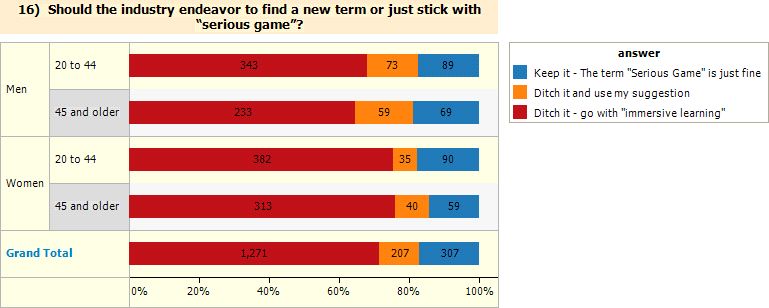
Ben Sawyer, moderator of the Serious Games discussion list, recently had a post discussing the various nuances of the term ‘serious games’. He differentiated his interpretation from what the eLearning Guild has called Immersive Learning Simulations (ILS). Interesting, the Guild chose that name when they received serious feedback (1784 respondents represented here) from their great research tool that the phrase ‘game’ was seriously problematic:

eLearning Guild ILS research report findings on naming fieldAs you can see, there was a strong feeling that the name had to change. On the other hand, there was speculation that the reason the ILS symposium at the upcoming DevLearn conference was cancelled due to low signups may well be because of the label. So, what’s going on?

It is true that some of us are focused on the corporate space with these, while others are almost definitely not interested in that space, instead being in, for the lack of a better term, the political/social action space. I like to think that my design principles work for either, but Ben’s message made clear that using games to ease kids pain, to exercise, etc, don’t qualify in his mind. I don’t quite agree, as my approach starts with an objective and provides systematic steps to achieve that objective, but there are things that wouldn’t qualify.

The issue for labeling in corporate learning is that some companies are concerned enough (concerned being a diplomatic euphemism) to actually block the term ‘game’ from any search through their firewall (!). As I’ve said before, a simulation is just a model, when you put the simulation in a particular state and ask the learner to take it to a goal state it’s a scenario, and when you tune that experience until engagement is achieved it’s a game. Clark Aldrich says it slightly differently, putting ILS at the intersection (think ‘Venn Diagram’, I can’t find a copy on his site) of Simulation, Games, and Pedagogy (I agree if you essentially equate the word ‘games’ with ‘engagement’ :).

Regardless, if you’re not at least considering deeply immersive practice through scenarios (though the one connotation that scenarios mean branching is too limited), you’re missing a powerful learning experience. More, there are very good reasons to think that tuning the experience, at least to some degree, makes the learning even more powerful. Finally, as I’ve said before, they’re not as expensive as you might fear.

So, regardless of name, consider the outcome, and make your learning practice as powerful as possible!

Clive’s 30 minute Master’s

27 September 2007 by Clark Leave a Comment

A post by Clive Shepherd reminded me of his 30 minute Master’s project to, as it states on the site “develop a curriculum to train subject-matter experts in the design of rapid e-learning materials”. So I went over to check it out, and the script is pretty complete and very good.

I of course am thrilled to see the emotional engagement upfront in the design phase (not least because I suggested it ;), but overall the design does a very good job of having misconceptions to the suggested approaches, and addressing them, using a storyline to keep the ‘flow’ moving, etc. Very practical, focused, and informed.

It sounds like he’s planning on producing it, which is great, but even reading the script and imagining the actual experience is worthwhile to understand the content, and viewing it in script phase is valuable to think about interim representations in developing elearning. So, two learning experiences for the price of none!

He’ll be presenting it at DevLearn, the eLearning Guild conference in San Jose in November. I’ll be there, as the Guild’s events are always good, and I’m presenting twice and participating in two of the pre-conference management symposiums (any practical solutions for cloning one’s self?).

I’m actually working on a similar project, but it’s still hush-hush for now. Hopefully before the end of the year we’ll be able to talk about or even show it.   In the meantime, you can read my 7 steps to better ID paper (warning, PDF).

Content, context, and experience

8 August 2007 by Clark Leave a Comment

In my (next to) last post, I talked about print versus screen reading, and at the end made a comment about publishers. I want to extend that comment here, and to do so I need to go to Pine & Gilmore’s Experience Economy.

I’ve talked about it before, but the premise briefly is that we’ve moved from selling services to selling total customer experiences (the pre-sales, the sale, the product or service, the support). Hence the success of Apple, which creates amazing experiences, generating great customer loyalty and satisfaction. So how does this bear on publishers?

The hoary old cliche’ is that publishers need to realize that they’re not about books, they’re about content (the analogy being to the railroad companies who suffered when they didn’t realize they were in the transportation business). On the other hand, the current discussion in industry is that now context is king. The point is that content can be customized to the immediate need. What the experience economy tells us is that the differentiator will be the overall experience. So, is experience or context king?

I want to suggest that the answer is ‘yes’. Contextualized content creates a positive experience. However, I want to argue two facets to this. Publishers do need to move to where content is semantically tagged for when there are smart systems that can contextualize it. However, I want to suggest that they also need quality information design to create a good experience even when it’s unable to be customized.

That’s come into play with educational publishers. Pine & Gilmore have argued that the subsequent economy will be the ‘transformation economy’, with experiences that transform us. I want to suggest that quality learning design will be the differentiator, and it definitely means going beyond traditional instructional design and incorporating cognitive science research and emotional engagement. I immodestly suggest that Engaging Learning is part of the solution, but the point is much bigger. It’s about reorganizing content to focus on meaningful outcomes, and then aligning the experience to achieve those. While incorporating the semantic hooks as well.

So, I’m arguing that the content business needs to look to both quality in design, and elegance in implementation, to support either or both scenarios: customized and quality experiences.

« Previous Page
Next Page »

Clark Quinn

The Company

Search

Feedblitz (email) signup

Never miss a post
Your email address:*
Please wait...
Please enter all required fields Click to hide
Correct invalid entries Click to hide

Pages

  • About Learnlets and Quinnovation

The Serious eLearning Manifesto

Manifesto badge

Categories

  • design
  • games
  • meta-learning
  • mindmap
  • mobile
  • social
  • strategy
  • technology
  • Uncategorized
  • virtual worlds

License

Previous Posts

  • March 2026
  • February 2026
  • January 2026
  • December 2025
  • November 2025
  • October 2025
  • September 2025
  • August 2025
  • July 2025
  • June 2025
  • May 2025
  • April 2025
  • March 2025
  • February 2025
  • January 2025
  • December 2024
  • November 2024
  • October 2024
  • September 2024
  • August 2024
  • July 2024
  • June 2024
  • May 2024
  • April 2024
  • March 2024
  • February 2024
  • January 2024
  • December 2023
  • November 2023
  • October 2023
  • September 2023
  • August 2023
  • July 2023
  • June 2023
  • May 2023
  • April 2023
  • March 2023
  • February 2023
  • January 2023
  • December 2022
  • November 2022
  • October 2022
  • September 2022
  • August 2022
  • July 2022
  • June 2022
  • May 2022
  • April 2022
  • March 2022
  • February 2022
  • January 2022
  • December 2021
  • November 2021
  • October 2021
  • September 2021
  • August 2021
  • July 2021
  • June 2021
  • May 2021
  • April 2021
  • March 2021
  • February 2021
  • January 2021
  • December 2020
  • November 2020
  • October 2020
  • September 2020
  • August 2020
  • July 2020
  • June 2020
  • May 2020
  • April 2020
  • March 2020
  • February 2020
  • January 2020
  • December 2019
  • November 2019
  • October 2019
  • September 2019
  • August 2019
  • July 2019
  • June 2019
  • May 2019
  • April 2019
  • March 2019
  • February 2019
  • January 2019
  • December 2018
  • November 2018
  • October 2018
  • September 2018
  • August 2018
  • July 2018
  • June 2018
  • May 2018
  • April 2018
  • March 2018
  • February 2018
  • January 2018
  • December 2017
  • November 2017
  • October 2017
  • September 2017
  • August 2017
  • July 2017
  • June 2017
  • May 2017
  • April 2017
  • March 2017
  • February 2017
  • January 2017
  • December 2016
  • November 2016
  • October 2016
  • September 2016
  • August 2016
  • July 2016
  • June 2016
  • May 2016
  • April 2016
  • March 2016
  • February 2016
  • January 2016
  • December 2015
  • November 2015
  • October 2015
  • September 2015
  • August 2015
  • July 2015
  • June 2015
  • May 2015
  • April 2015
  • March 2015
  • February 2015
  • January 2015
  • December 2014
  • November 2014
  • October 2014
  • September 2014
  • August 2014
  • July 2014
  • June 2014
  • May 2014
  • April 2014
  • March 2014
  • February 2014
  • January 2014
  • December 2013
  • November 2013
  • October 2013
  • September 2013
  • August 2013
  • July 2013
  • June 2013
  • May 2013
  • April 2013
  • March 2013
  • February 2013
  • January 2013
  • December 2012
  • November 2012
  • October 2012
  • September 2012
  • August 2012
  • July 2012
  • June 2012
  • May 2012
  • April 2012
  • March 2012
  • February 2012
  • January 2012
  • December 2011
  • November 2011
  • October 2011
  • September 2011
  • August 2011
  • July 2011
  • June 2011
  • May 2011
  • April 2011
  • March 2011
  • February 2011
  • January 2011
  • December 2010
  • November 2010
  • October 2010
  • September 2010
  • August 2010
  • July 2010
  • June 2010
  • May 2010
  • April 2010
  • March 2010
  • February 2010
  • January 2010
  • December 2009
  • November 2009
  • October 2009
  • September 2009
  • August 2009
  • July 2009
  • June 2009
  • May 2009
  • April 2009
  • March 2009
  • February 2009
  • January 2009
  • December 2008
  • November 2008
  • October 2008
  • September 2008
  • August 2008
  • July 2008
  • June 2008
  • May 2008
  • April 2008
  • March 2008
  • February 2008
  • January 2008
  • December 2007
  • November 2007
  • October 2007
  • September 2007
  • August 2007
  • July 2007
  • June 2007
  • May 2007
  • April 2007
  • March 2007
  • February 2007
  • January 2007
  • December 2006
  • November 2006
  • October 2006
  • September 2006
  • August 2006
  • July 2006
  • June 2006
  • May 2006
  • April 2006
  • March 2006
  • February 2006
  • January 2006

Amazon Affiliate

Required to announce that, as an Amazon Associate, I earn from qualifying purchases. Mostly book links. Full disclosure.

We use cookies to ensure that we give you the best experience on our website. If you continue to use this site we will assume that you are happy with it.