Learnlets

Secondary

Clark Quinn’s Learnings about Learning

Extending Mobile Models

21 October 2014 by Clark Leave a Comment

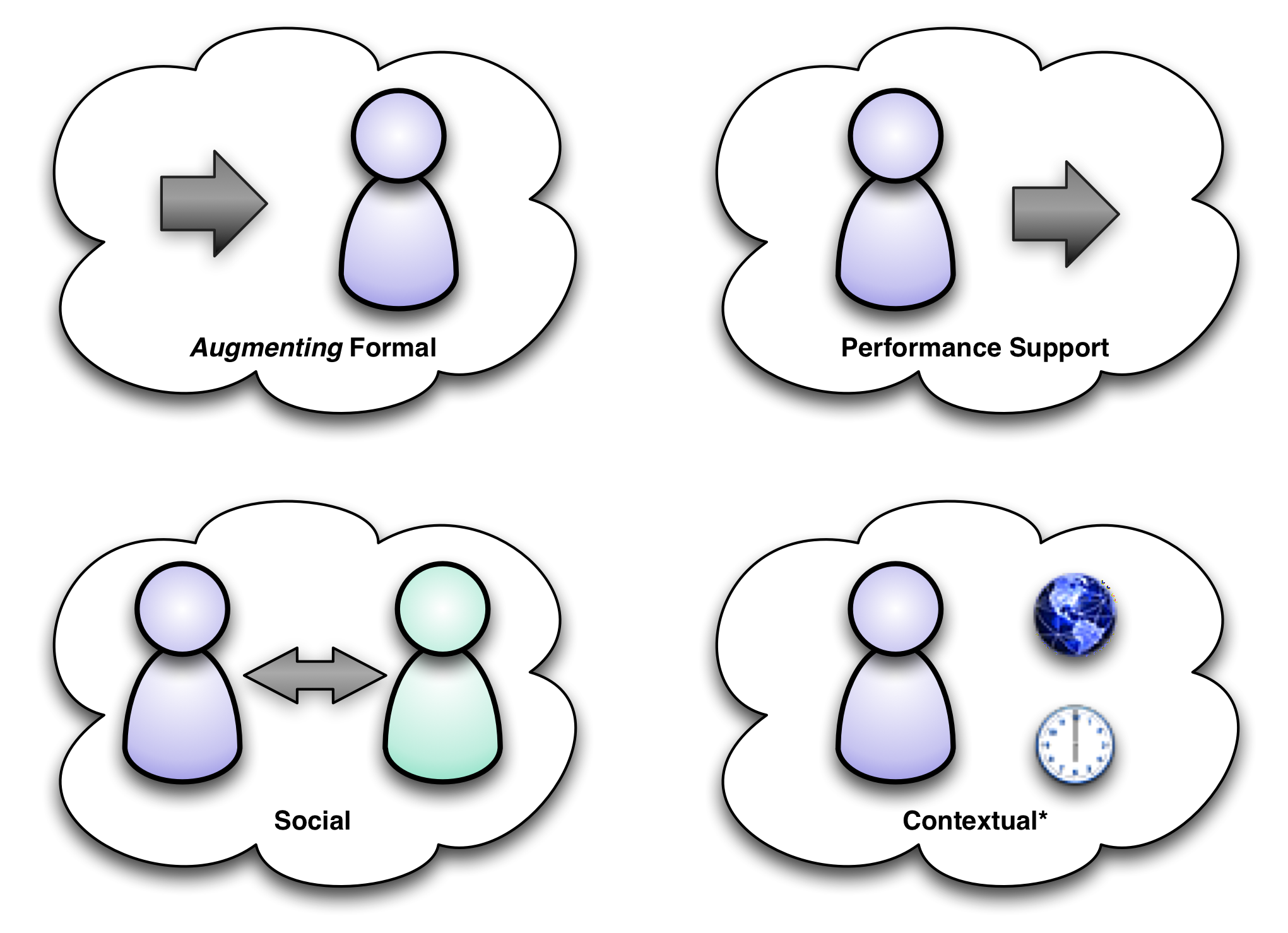
In preparation for a presentation, I was reviewing my mobile models. You may recall I started with my 4C‘s model (Content, Compute, Communicate, & Capture), and have mapped that further onto Augmenting Formal, Performance Support, Social, & Contextual.  I’ve refined it as well, separating out contextual and social as different ways of looking at formal and performance support.  And, of course, I’ve elaborated  it again, and wonder whether you think this more detailed conceptualization makes sense.
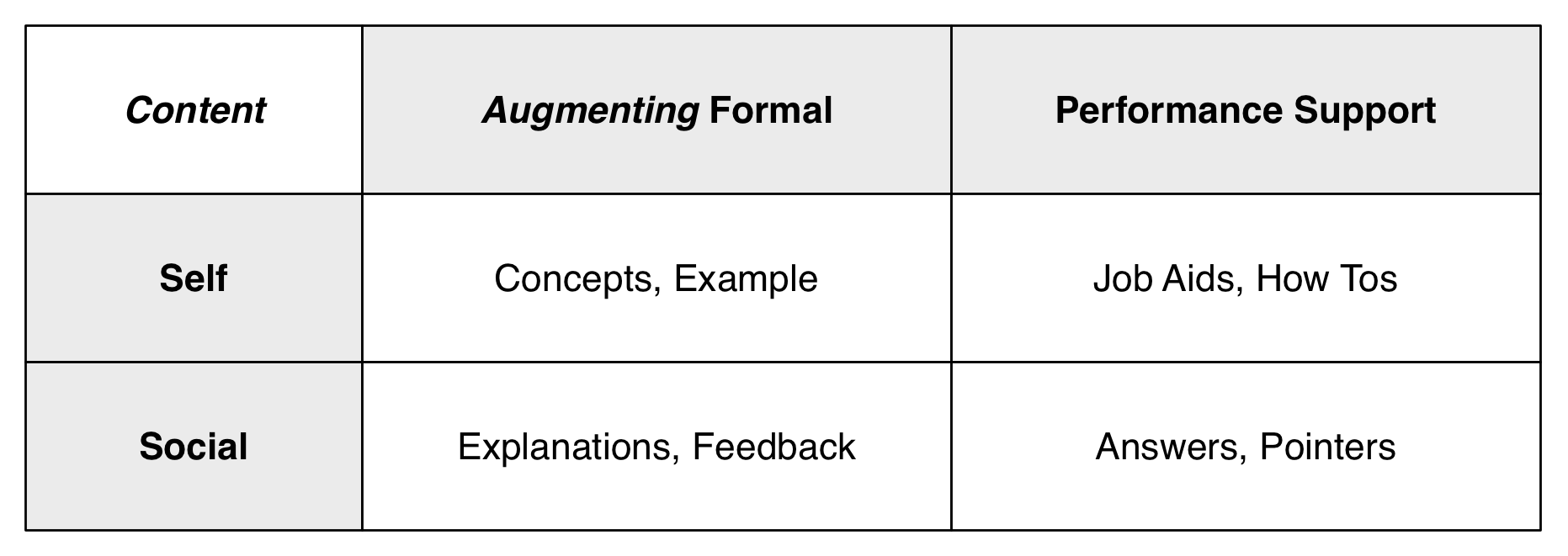
self and social mlearning contentSo, my starting point was realizing that it wasn’t just  content.  That is, there’s a difference between compute and content where the interactivity was an important part of the 4C’s, so that the characteristics in the content box weren’t discriminated enough.  So the new two initial sections are mlearning content and mlearning compute, by self or social.  So, we can be getting things for an individual, or it can be something that’s socially generated or socially enabled.
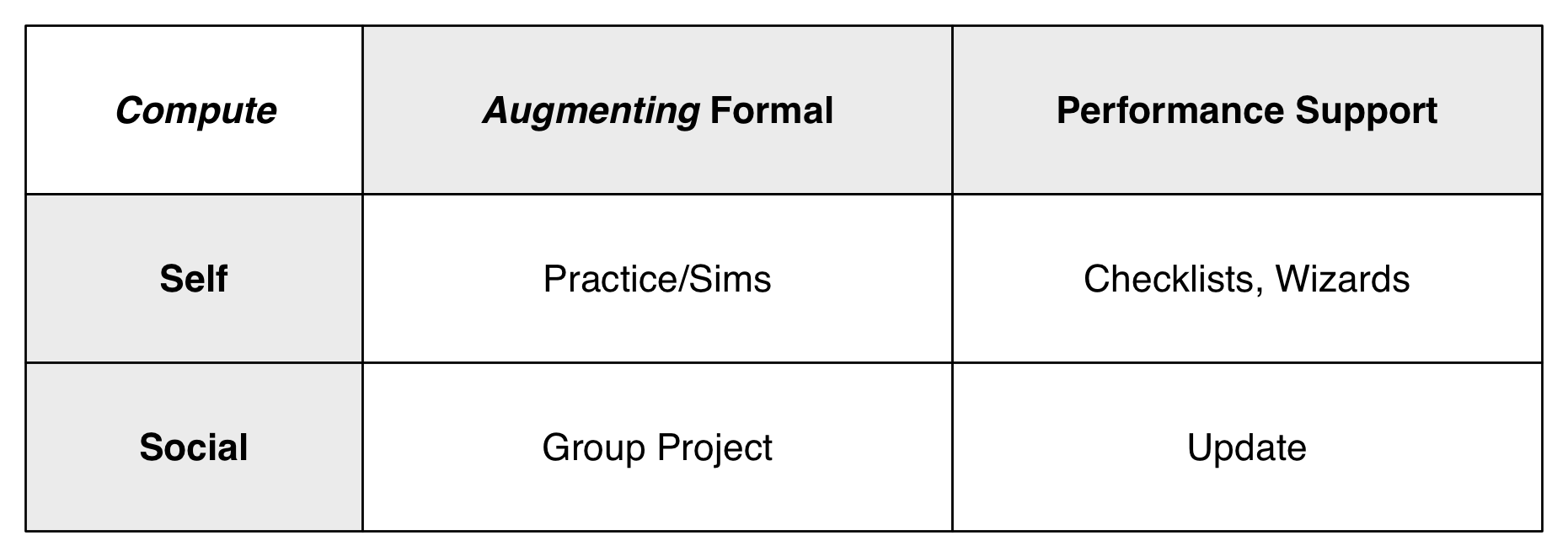
mLearningComputeThe point is that content is prepared media, whether text, audio, or video.  It can be delivered or accessed as needed. Compute, interactive capability, is harder, but potentially more valuable. Here, an individual might actively practice, have mixed initiative dialogs, or even work with others or tools to develop an outcome or update some existing shared resources.
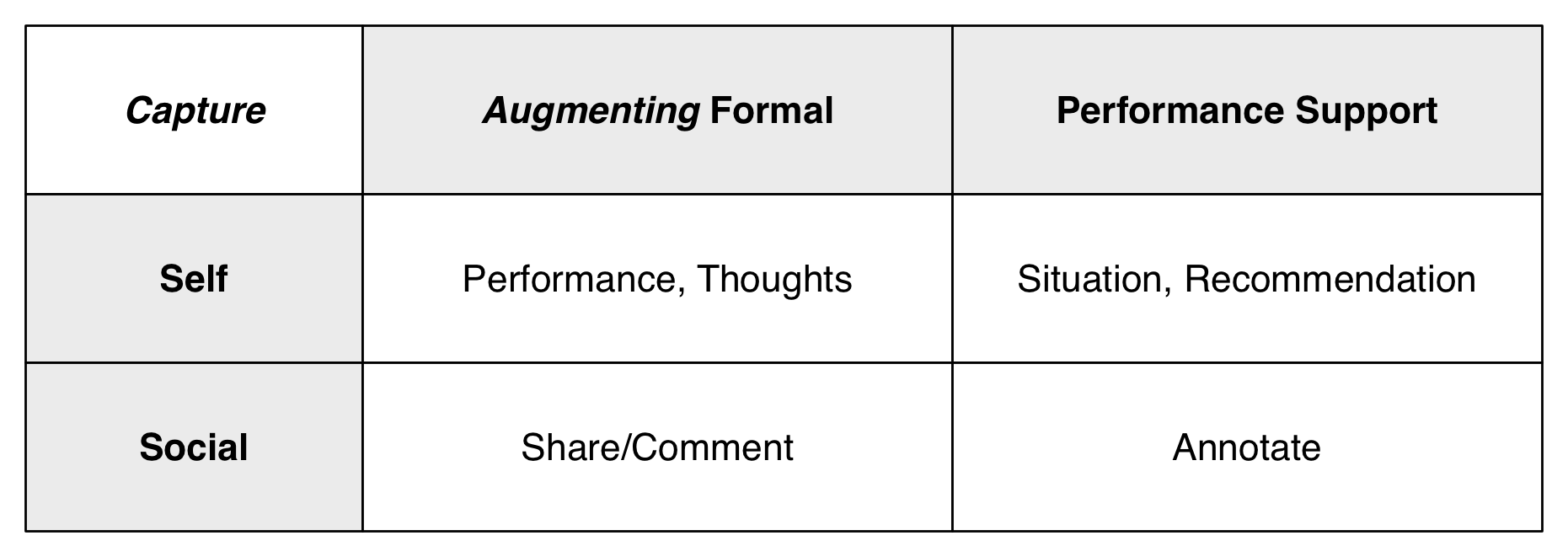
mLearningCaptureThings get more complex when we go beyond these elements.  So I had capture as one thing, and I’m beginning to think it’s two: one is the capture of current context and keeping sharing that for various purposes, and the other is the system using that context  to do something unique.

To be clear here, capture is where you use the text insertion, microphone, or camera to catch unique contextual data (or user input).  It could also be other such data, such as a location, time, barometric pressure, temperature, or more. This data, then, is available to review, reflect on, or more.  It can be combinations, of course, e.g. a picture at this time and this location.
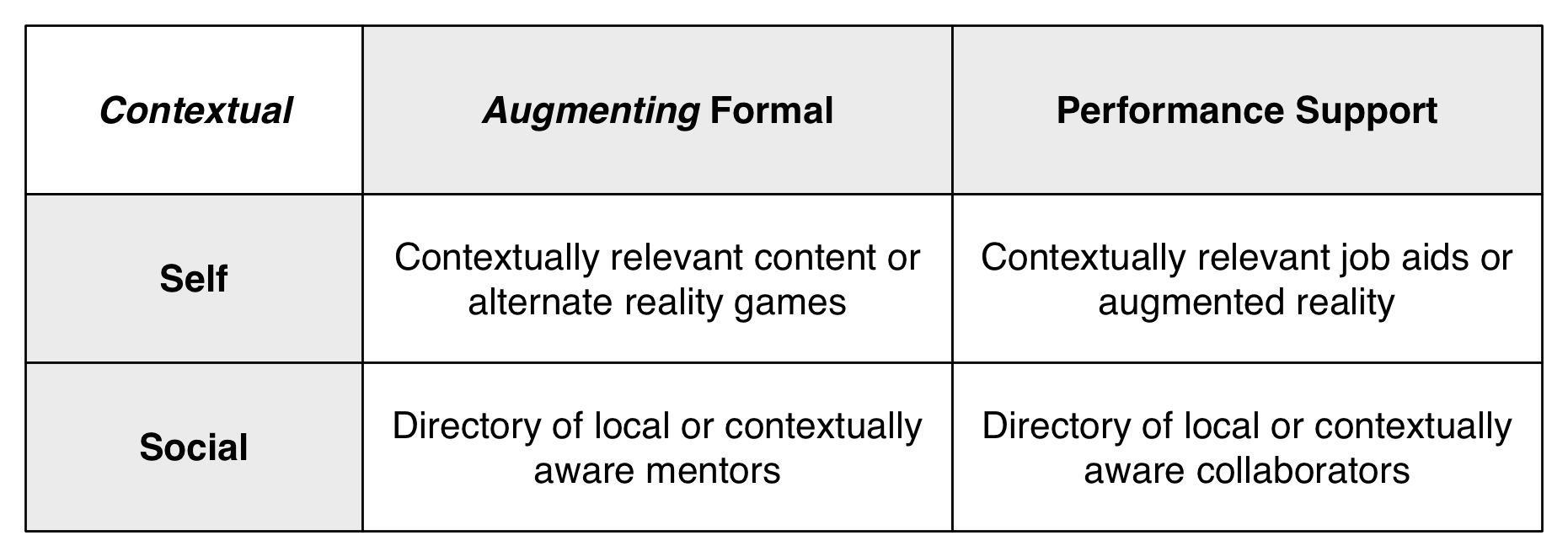
mLearningContextualNow, if the system  uses this information to do something different than under other circumstances, we’re contextualizing what we do. Whether it’s because of when you are, providing specific information, or where you are, using location characteristics, this is likely to be the most valuable opportunity.   Here I’m thinking alternate reality games or augmented reality (whether it’s voiceover, visual overlays, what have you).

And I  think  this is device independent, e.g. it could apply to watches or glasses or..as well as phones and tablets.  It means my 4 C’s become: content, compute, capture, and contextualize.  To ponder.

So, this is a more nuanced look at the mobile opportunities, and certainly more complex as well. Does the greater detail provide greater benefit?


Learning in 2024 #LRN2024

17 September 2014 by Clark 1 Comment

The eLearning Guild is celebrating it’s 10th year, and is using the opportunity to reflect on what learning will look like 10 years from now.  While I couldn’t participate in the twitter chat they held, I optimistically weighed in: “learning in 2024 will look like individualized personal mentoring via augmented reality, AI, and the network”.  However, I thought I would elaborate in line with a series of followup posts leveraging the #lrn2024 hashtag.  The twitter chat had a series of questions, so I’ll address them here (with a caveat that our learning really hasn’t changed, our wetware hasn’t evolved in the past decade and won’t again in the next; our support of learning is what I’m referring to here):

1. How has learning changed in the last 10 years (from the perspective of the learner)?

I reckon the learner has seen a significant move to more elearning instead of an almost complete dependence on face-to-face events.  And I reckon most learners have begun to use technology in their own ways to get answers, whether via the Google, or social networks like FaceBook and LinkedIn.  And I expect they’re seeing more media such as videos and animations, and may even be creating their own. I also expect that the elearning they’re seeing is not particularly good, nor improving, if not actually decreasing in quality.  I expect they’re seeing more info dump/knowledge test, more and more ‘click to learn more‘, more tarted-up drill-and-kill.  For which we should apologize!

2.  What is the most significant change technology has made to organizational learning in the past decade?

I reckon there are two significant changes that have happened. One is rather subtle as yet, but will be profound, and that is the ability to track more activity, mine more data, and gain more insights. The ExperienceAPI coupled  with analytics is a huge opportunity.  The other is the rise of social networks.  The ability to stay more tightly coupled with colleagues, sharing information and collaborating, has really become mainstream in our lives, and is going to have a big impact on our organizations.  Working ‘out loud’, showing our work, and working together is a critical inflection point in bringing learning back into the workflow in a natural way and away from the ‘event’ model.

3.  What are the most significant challenges facing organizational learning today?

The most significant change is the status quo: the belief that an information oriented event model has any relationship to meaningful outcomes.  This plays out in so many ways: order-taking for courses, equating information with skills, being concerned with speed and quantity instead of quality of outcomes, not measuring the impact, the list goes on.   We’ve become self-deluded that an LMS and a rapid elearning tool means you’re doing something worthwhile, when it’s profoundly wrong.  L&D needs a revolution.

4.  What technologies will have the greatest impact on learning in the next decade? Why?

The short answer is mobile.  Mobile is the catalyst for change. So many other technologies go through the hype cycle: initial over-excitement, crash, and then a gradual resurgence (c.f. virtual worlds), but mobile has been resistant for the simple reason that there’s so much value proposition.  The cognitive augmentation that digital technology provides, available whenever and wherever you are clearly has benefits, and it’s not courses!  It will naturally incorporate augmented reality with the variety of new devices we’re seeing, and be contextualized as well.  We’re seeing a richer picture of how technology can support us in being effective, and L&D can facilitate these other activities as a way to move to a more strategic and valuable role in the organization.  As above, also new tracking and analysis tools, and social networks.  I’ll add that simulations/serious games are an opportunity that is yet to really be capitalized on.  (There are reasons I wrote those books :)

5.  What new skills will professionals need to develop to support learning in the future?

As I wrote  (PDF), the new skills that are necessary fall into two major categories: performance consulting and interaction facilitation.  We need to not design courses until we’ve ascertained that no other approach will work, so we need to get down to the real problems. We should hope that the answer comes from the network when it can, and we should want to design performance support solutions  if it can’t, and reserve courses for only when it absolutely has to be in the head. To get good outcomes from the network, it takes facilitation, and I think facilitation is a good model for promoting innovation, supporting coaching and mentoring, and helping individuals develop self-learning skills.  So the ability to get those root causes of problems, choose between solutions, and measure the impact are key for the first part, and understanding what skills are needed by the individuals (whether performers or mentors/coaches/leaders) and how to develop them are the key new additions.

6.  What will learning look like in the year 2024?

Ideally, it would look like an ‘always on’ mentoring solution, so the experience is that of someone always with you to watch your performance and provide just the right guidance to help you perform in the moment and develop you over time. Learning will be layered on to your activities, and only occasionally will require some special events but mostly will be wrapped around your life in a supportive way.  Some of this will be system-delivered, and some will come from the network, but it should feel like you’re being cared for  in the most efficacious way.

In closing,  I note that, unfortunately,my Revolution book and the Manifesto were both driven by a sense of frustration around the lack of meaningful change in L&D. Hopefully, they’re riding or catalyzing the needed change, but in a cynical mood I might believe that things won’t change near as much as I’d hope. I also remember a talk (cleverly titled:  Predict Anything but the Future  :) that said that the future does tend  to come as an informed basis would predict  with an unexpected twist,  so it’ll be interesting to discover what that twist will be.

On the Road Fall 2014

16 September 2014 by Clark Leave a Comment

Fall always seems to be a busy time, and I reckon it’s worthwhile to let you know where I’ll be in case you might be there too! Coming up are a couple of different  events that you might be interested in:

September 28-30 I’ll be at the Future of Talent retreat   at the Marconi Center up the coast from San Francisco. It’s a lovely spot with a limited number of participants who will go deep on what’s coming in the Talent world. I’ll be talking up the Revolution, of course.

October 28-31 I’ll be at the eLearning Guild’s  DevLearn in Las Vegas (always a  great event; if you’re into elearning you  should be there).  I’ll be running a Revolution workshop  (I believe there are still a few spots), part of  a mobile panel, and talking  about how we are going about addressing the challenges of learning design at the Wadhwani Foundation.

November 12-13 I’ll be part of the mLearnNow event in New Orleans (well, that’s what  I call it, they call it LearnNow mobile blah blah blah ;).  Again, there are some slots still available.    I’m honored to be co-presenting with  Sarah Gilbert and Nick Floro  (with Justin Brusino pulling strings in the background), and we’re working hard to make sure it should be a really great deep dive into mlearning.  (And,  New Orleans!)

There may be one more opportunity, so if anyone in Sydney wants to talk, consider Nov 21.

Hope to cross paths with you at one or more of these places!

Wearable affordances

1 July 2014 by Clark 1 Comment

At the mLearnCon conference, it became clear it was time to write about wearables.  At the same time, David Kelly (program director for t he Guild) asked for conference reflections for the Guild Blog. Long story short, my reflections are a guest post there.

Karen McGrane #mLearnCon Keynote Mindmap

25 June 2014 by Clark Leave a Comment

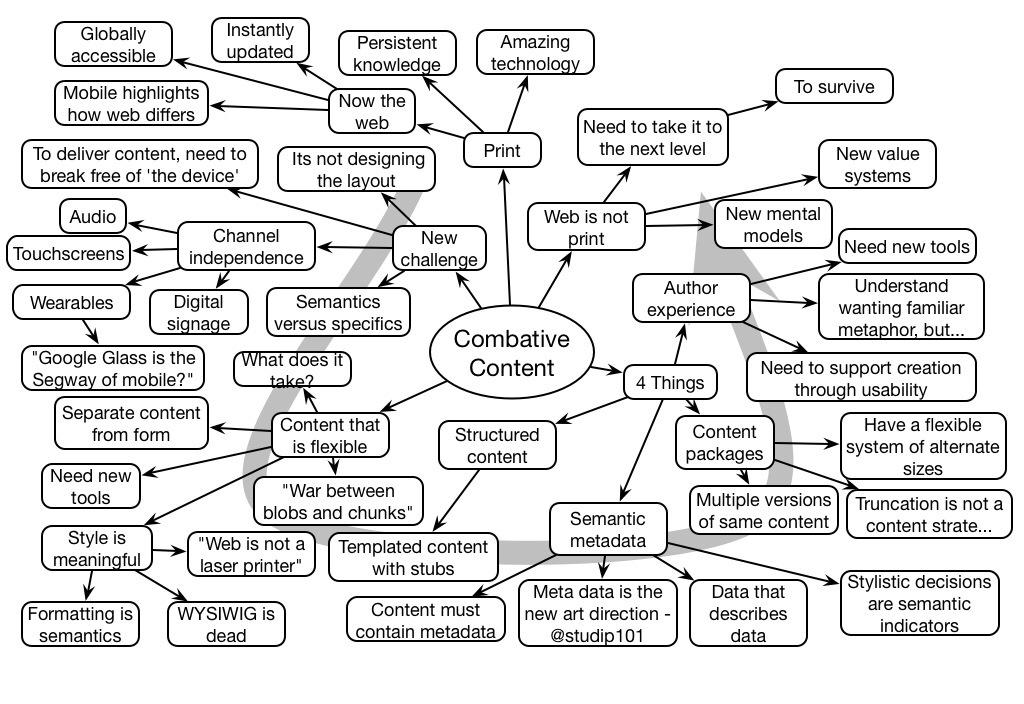
Karen McGrane evangelized good content architecture (a topic near to my heart), in a witty and clear keynote. With amusing examples and quotes, she brought out just how key it is to move beyond hard wired, designed content and start working on rule-driven combinations from structured chunks. Great stuff!

20140625-095410-35650831.jpg

Getting contextual

21 May 2014 by Clark Leave a Comment

For the current ADL webinar series on mobile, I gave a presentation on contextualizing mobile in the larger picture of L&D (a natural extension of my most recent books).  And a question came up about whether I thought wearables constituted mobile.  Naturally my answer was yes, but I realized there’s a larger issue, one that gets meta as well as mobile.

So, I’ve argued that we should be looking at models for guiding our behavior.  That we should be creating them by abstracting from successful practices, we should be conceptualizing them, or adopting them from other areas.  A good model, with rich conceptual relationships, provides a basis for explaining what has happened, and predicting what will happen, giving us a basis for making decisions.  Which means they need to be as context-independent as possible.

WorkOppsSo, for instance, when I developed the mobile models I use, e.g. the 4C‘s and the applications of learning (see figure), I deliberately tried to create an understanding that would transcend the rapid changes that are characterizing mobile, and make them appropriately recontextualizable.

In the case of mobile, one of the unique opportunities is contextualization.  That means using information about where you are, when you are, which way you’re looking, temperature or barometric pressure, or even your own state: blood pressure, blood sugar, galvanic skin response, or whatever else skin sensors can detect.

To put that into context (see what I did there): with desktop learning, augmenting formal could be emails that provide new examples or practice that spread out over time. With a smartphone  you can do the same, but you could also have a localized information so that because of where you were you might get information related to a learning goal. With a wearable, you might get some information because of what you’re looking at (e.g. a translation or a connection to something else you know), or due to your state (too anxious, stop and wait ’til you calm down).

Similarly for performance support: with a smartphone you could take what comes through the camera and add it onto what shows on the screen; with glasses you could lay it on the visual field.  With a watch or a ring, you might have an audio narration.  And we’ve already seen how the accelerometers in fit bracelets can track your activity and put it in context for you.

Social can not only connect you to who you need to know, regardless of device or channel, but also signal you that someone’s near, detecting their face or voice, and clue you in that you’ve met this person before.  Or find someone that you should meet because you’re nearby.

All of the above are using contextual information to augment the other tasks you’re doing.  The point is that you map the technology to the need, and infer the possibilities.  Models are a better basis for elearning, too so that you teach transferable understandings (made concrete in practice) rather than specifics that can get outdated.  This is one of the elements we placed in the Serious eLearning Manifesto, of course.  They’re also useful for coaching & mentoring as well, as for problem-solving, innovating, and more.

Models are powerful tools for thinking, and good ones will support the broadest possible uses.  And that’s why I collect them, think in terms of them, create them, and most importantly, use them in my work.   I encourage you to ensure that you’re using models appropriately to guide you to new opportunities, solutions, and success.

How do we mLearn?

14 April 2014 by Clark Leave a Comment

As preface, I used to teach interface design.  My passion was still learning technology (and has been since I saw the connection as an undergraduate and designed my own major), but there’re strong links between the two fields in terms of design for humans.  My PhD advisor was a guru of interface design and the thought was “any student of his should be able to teach interface design”.  And so it turned out.  So interface design continues to be an interest of mine, and I recognize the importance. More so on mobile, where there are limitations on interface real estate, so more cleverness may be required.

Stephen Hoober, who I had the pleasure of sharing a stage with at an eLearning Guild conference, is a notable UI design expert with a speciality in mobile.  He had previously conducted a research project examining how people  actually hold their phones, as opposed to anecdotes.  The Guild’s Research Director, Patti Schank, obviously thought this interesting enough to extend, because they’ve jointly published the results of the initial report and subsequent research into tablets as well. And the results are important.

The biggest result, for me, is that people tend to use phones while standing and walking, and tablets while sitting.  While you can hold a tablet with two hands and type, it’s hard.  The point is to design for supported use with a tablet,  but for handheld use with a phone. Which actually does imply different design principles.

I note that I still  believe  tablets to be mobile, as they can be used naturally while standing and walking, as opposed to laptops. Though you can support them, you don’t  have  to.  (I’m not going to let the fact that there are special harnesses you can buy to hold tablets while you stand, for applications like medical facilities dissuade me, my mind’s made up so don’t confuse me :)

The report goes into more details, about just  how people hold it in their hands (one handed w/ thumb, one hand holding, one hand touching, two hands with two thumbs, etc), and the proportion of each.  This has impact on where on the screen you put information and interaction elements.

Another point is the importance of the center for information and the periphery for interaction, yet users are more accurate at the center, so you need to make your periphery targets larger and easier to hit. Seemingly obvious, but somehow obviousness doesn’t seem to hold in too much of design!

There is a wealth of other recommendations scattered throughout the report, with specifics for phones, small and large tablets, etc, as well as major takeaways.  For example the implication from the fact that tablets are often supported means that more consideration of font size is needed than you’d expect!

The report is freely available on the Guild site in the Research Library (under the Content>Research menu).  Just in time for mLearnCon!  

The death of the PDA greatly exaggerated?

8 April 2014 by Clark 1 Comment

A colleague wondered if the image on the cover of the new book was a PDA, and my initial response was that the convergence of capabilities suggested the demise of the PDA. But then I had a rethink…

For what is a PDA?  It’s a digital platform sans the capability of a cellular voice channel.  My daughter got an iPod touch, but within a year we needed to get her a new phone, and it’s an iPhone.   Which suggests that a device without phone capability is increasingly less feasible.

But wait a minute, there are plenty of digital devices sans voice. In fact,  I  have one.  It’s a tablet!  It  may  have cellular data, but it certainly doesn’t have voice.  And while people are suggesting that the tablet is done, I’m not interested in a phablet, as I already have a problem with a phone in my pocket (putting me in the fashion faux pas category of liking a holster), and I think others want something smaller that they can have all the time.

So, I’ve argued elsewhere that mobile devices have to be handheld, and that tablets have usage patterns different than pocketables.  But I think in many instances tablets do function as personal digital assistants, when you’re not constrained by space.  There are advantages to the larger screen. So, while I think the pocketable version of the PDA is gone (since having a phone  and a PDA seems redundant), the non-phone digital assistant is going to persist for the larger form factor.  What am I missing?

It’s (almost) out!

2 April 2014 by Clark 4 Comments

My latest tome, Revolutionize Learning & Development: Performance and Innovation Strategy for the Information Age is out.  Well, sort of.  What I mean is that it’s now available on Amazon for pre-order.  Actually, it’s been for a while, but I wanted to wait until there was some  there there, and now there’s the ‘look inside’ stuff so you can see the cover, back cover (with endorsements!), table of contents, sample pages, and more.  Ok, so I’m excited!

RLnDCoverSmallWhat I’ve tried to do is make the case for dragging L&D into the 21st Century, and then provide an onramp.  As I’ve been saying, my short take is that L&D isn’t doing what it could and should be doing, and what it  is doing, it is doing badly.  But I don’t believe complaining alone is particularly helpful, so I’m trying to put in place what I think will help as well.  The major components are:

  • what’s wrong (you can’t change until you admit the problem :)
  • what we know about how we think, work, and learn that we aren’t accounting for
  • what it would look like if we were doing it right
  • ways forward

By itself, it’s not the whole answer, for several reasons. First, it can’t be. I can’t know all the different situations you face, so I can’t have a roadmap forward for everyone. Instead, what I supposed you could think of is that it’s a guidebook  (stretching metaphors), showing suggestions that you’ll have to sequence into your own path.  Second, we don’t know all yet. We’re still exploring many of these areas.  For example, culture change is not a recipe, it’s a process.  Third, I’m not sure any one person can know all the answers in such a big field. So, fourth, to practice what I’m preaching, there should be a community pushing this, creating the answers together.

A couple of things on that last part, the first one is a request.  The community will need to be in place by the time the book is shipping.  The question is where to host it.  I don’t intend to build a separate community for it on the book site, as there are plenty of places to do this.  Google groups, Yahoo groups, LinkedIn…the list goes on. It can’t be proprietary (e.g. you have to be a paid member to play).  Ideally it’d have collaborative tools to create resources, but I reckon that can be accommodated via links.  What do you folks think would be a good choice?

The second part of the community bit is that I’m very grateful to many people who’ve helped or contributed.  Practitioner friends and colleagues provided the five case studies I’ve the pleasure to host.  Two pioneers shared their thoughts.  The folks at ASTD have been great collaborators in both helping me with resources, and in helping me get the message out.  A number of other friends and colleagues took the time to read an early version and write endorsements.  And I’ve learned together with so many of you by attending events together, hearing you speak, reading your writings, and having you provide feedback on my thoughts via talking or writing to me after hearing me speak or commenting on my scribblings here.

The book isn’t perfect, because I have thought of a number of ways it could be improved since I provided the manuscript, but I have stuck to the mantra that at some point it’s better out than still being polished. This book came from frustration that we can be doing so much better, and we’re not. I didn’t grow up thinking “I’m going to be a revolutionary”, but I can’t not see what I see and not say  something.  We can be doing so much better than we are. And so I had to be willing to just get the word out, imperfect.  It wasn’t (isn’t) clear that I’m the best person to call this out, but someone needs to!

That said, I have worked really hard to have the right pieces in place.  I’ve collected and integrated what I think are the necessary frameworks, provided case studies and a workplace scenario, and some tools to work forward.   I have done my best to provide a short and cogent kickstart to moving forward.  

Just to let you know that I’m starting my push.  I’ll be presenting on the book at ASTD’s ICE conference, and doing some webinars. Bryan Austin of GameOn Learning interviewed me on my thoughts in this direction.  I do believe in the message, and that it at least needs to be heard.  I think it’s really the necessary message for L&D (in it, you’ll find out why I’m suggesting we need to shift to P&D!).  Forewarned!  I look forward to your feedback.

Making Mobile Mayhem

8 January 2014 by Clark 3 Comments

As I suggested in my post on directions for the year, I intend to be stirring up a bit of trouble here and there.  On a less formal basis, I want to suggest that another area where we need a little more light and a little less heat (and smoke) is mobile.  There is huge opportunity here, and I am afraid we are squandering it.

We’re doing a lot wrong when it comes to mobile.  As Jason Haag has aptly put it, elearning courses on a phone (or tablet) is mobile elearning, not mobile learning (aka mlearning).  And while there’s an argument for mobile elearning (at least on tablets), and strong case for  augmenting formal learning with mobile (regardless of device), mobile elearning is not mlearning’s natural niche.

mLearning’s natural niche is performance support, whether through content (interactive or not), or social.   Think about how  you use your phone? When I ask this of attendees, they’re using them to get information in the moment, or find their way, or capture information.  They’re not using them to take courses!

So we need to be thinking outside the course.  To help, we need case studies, across business sectors, and across the areas.  Which means we need people to be getting their hands on development tools.

Which is a second problem: the tools that are easiest to use are being used to create courses.  The elearning tools we use are increasingly having mobile output, but it’s too easy to then just output courses.  It turns out one of the phenomena that characterize our brains is ‘functional fixedness’, we use a tool in the way we’ve used it before.  Yet we can use these tools to do other things. And there are tools more oriented towards performance support.  Anything that creates content or interactivity can be used to build performance support, but we have to be  doing  it!

There’s more that we need to be doing in the background –  content, governance, strategy – but we need to get our minds around mobile solutions to contextual needs, and start delivering the resources people need.  Mobile is big; the devices are out there, and they’re a platform for so much; we need to capitalize.

The place where you’re going to be able to see the case studies and explore the tools and start getting your mind around mobile will be this summer’s mLearnCon (in San Diego in June!). And you really should be going. Also, if you are  doing mobile, you really should be submitting to present.  We need more examples, more ideas, more experience!  (If you need help writing a proposal, I’ve already written a guide.)

Really, presenting is a great contribution to yourself and the industry, and we really could use it.  Help us make mobile mayhem by showing the way.  Or, of course, join us at the conference to get ready to mix it up.  Hope to see you there.

« Previous Page
Next Page »

Clark Quinn

The Company

Search

Feedblitz (email) signup

Never miss a post
Your email address:*
Please wait...
Please enter all required fields Click to hide
Correct invalid entries Click to hide

Pages

  • About Learnlets and Quinnovation

The Serious eLearning Manifesto

Manifesto badge

Categories

  • design
  • games
  • meta-learning
  • mindmap
  • mobile
  • social
  • strategy
  • technology
  • Uncategorized
  • virtual worlds

License

Previous Posts

  • February 2026
  • January 2026
  • December 2025
  • November 2025
  • October 2025
  • September 2025
  • August 2025
  • July 2025
  • June 2025
  • May 2025
  • April 2025
  • March 2025
  • February 2025
  • January 2025
  • December 2024
  • November 2024
  • October 2024
  • September 2024
  • August 2024
  • July 2024
  • June 2024
  • May 2024
  • April 2024
  • March 2024
  • February 2024
  • January 2024
  • December 2023
  • November 2023
  • October 2023
  • September 2023
  • August 2023
  • July 2023
  • June 2023
  • May 2023
  • April 2023
  • March 2023
  • February 2023
  • January 2023
  • December 2022
  • November 2022
  • October 2022
  • September 2022
  • August 2022
  • July 2022
  • June 2022
  • May 2022
  • April 2022
  • March 2022
  • February 2022
  • January 2022
  • December 2021
  • November 2021
  • October 2021
  • September 2021
  • August 2021
  • July 2021
  • June 2021
  • May 2021
  • April 2021
  • March 2021
  • February 2021
  • January 2021
  • December 2020
  • November 2020
  • October 2020
  • September 2020
  • August 2020
  • July 2020
  • June 2020
  • May 2020
  • April 2020
  • March 2020
  • February 2020
  • January 2020
  • December 2019
  • November 2019
  • October 2019
  • September 2019
  • August 2019
  • July 2019
  • June 2019
  • May 2019
  • April 2019
  • March 2019
  • February 2019
  • January 2019
  • December 2018
  • November 2018
  • October 2018
  • September 2018
  • August 2018
  • July 2018
  • June 2018
  • May 2018
  • April 2018
  • March 2018
  • February 2018
  • January 2018
  • December 2017
  • November 2017
  • October 2017
  • September 2017
  • August 2017
  • July 2017
  • June 2017
  • May 2017
  • April 2017
  • March 2017
  • February 2017
  • January 2017
  • December 2016
  • November 2016
  • October 2016
  • September 2016
  • August 2016
  • July 2016
  • June 2016
  • May 2016
  • April 2016
  • March 2016
  • February 2016
  • January 2016
  • December 2015
  • November 2015
  • October 2015
  • September 2015
  • August 2015
  • July 2015
  • June 2015
  • May 2015
  • April 2015
  • March 2015
  • February 2015
  • January 2015
  • December 2014
  • November 2014
  • October 2014
  • September 2014
  • August 2014
  • July 2014
  • June 2014
  • May 2014
  • April 2014
  • March 2014
  • February 2014
  • January 2014
  • December 2013
  • November 2013
  • October 2013
  • September 2013
  • August 2013
  • July 2013
  • June 2013
  • May 2013
  • April 2013
  • March 2013
  • February 2013
  • January 2013
  • December 2012
  • November 2012
  • October 2012
  • September 2012
  • August 2012
  • July 2012
  • June 2012
  • May 2012
  • April 2012
  • March 2012
  • February 2012
  • January 2012
  • December 2011
  • November 2011
  • October 2011
  • September 2011
  • August 2011
  • July 2011
  • June 2011
  • May 2011
  • April 2011
  • March 2011
  • February 2011
  • January 2011
  • December 2010
  • November 2010
  • October 2010
  • September 2010
  • August 2010
  • July 2010
  • June 2010
  • May 2010
  • April 2010
  • March 2010
  • February 2010
  • January 2010
  • December 2009
  • November 2009
  • October 2009
  • September 2009
  • August 2009
  • July 2009
  • June 2009
  • May 2009
  • April 2009
  • March 2009
  • February 2009
  • January 2009
  • December 2008
  • November 2008
  • October 2008
  • September 2008
  • August 2008
  • July 2008
  • June 2008
  • May 2008
  • April 2008
  • March 2008
  • February 2008
  • January 2008
  • December 2007
  • November 2007
  • October 2007
  • September 2007
  • August 2007
  • July 2007
  • June 2007
  • May 2007
  • April 2007
  • March 2007
  • February 2007
  • January 2007
  • December 2006
  • November 2006
  • October 2006
  • September 2006
  • August 2006
  • July 2006
  • June 2006
  • May 2006
  • April 2006
  • March 2006
  • February 2006
  • January 2006

Amazon Affiliate

Required to announce that, as an Amazon Associate, I earn from qualifying purchases. Mostly book links. Full disclosure.

We use cookies to ensure that we give you the best experience on our website. If you continue to use this site we will assume that you are happy with it.