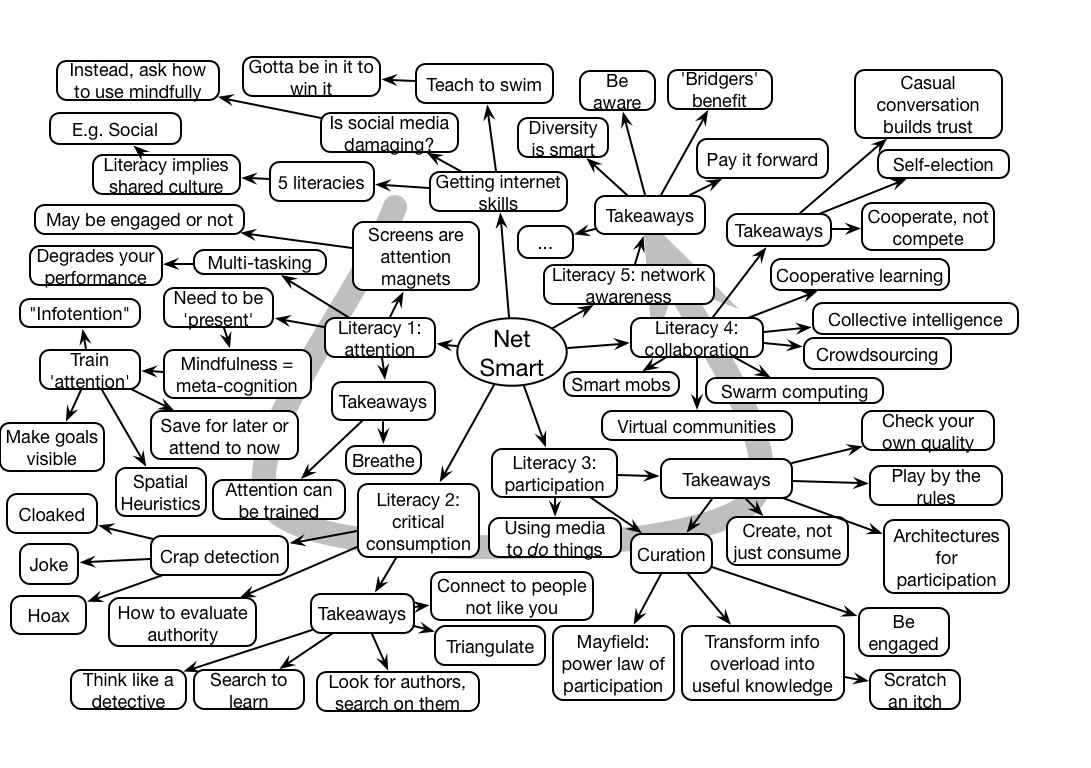
Howard Rheingold gave a fast-paced and inspiring talk on social network skills. With great examples and deep insight, he brought home powerful lessons on the power of people. His takeaways provided valuable lessons for individuals, schools, organizations, and society.
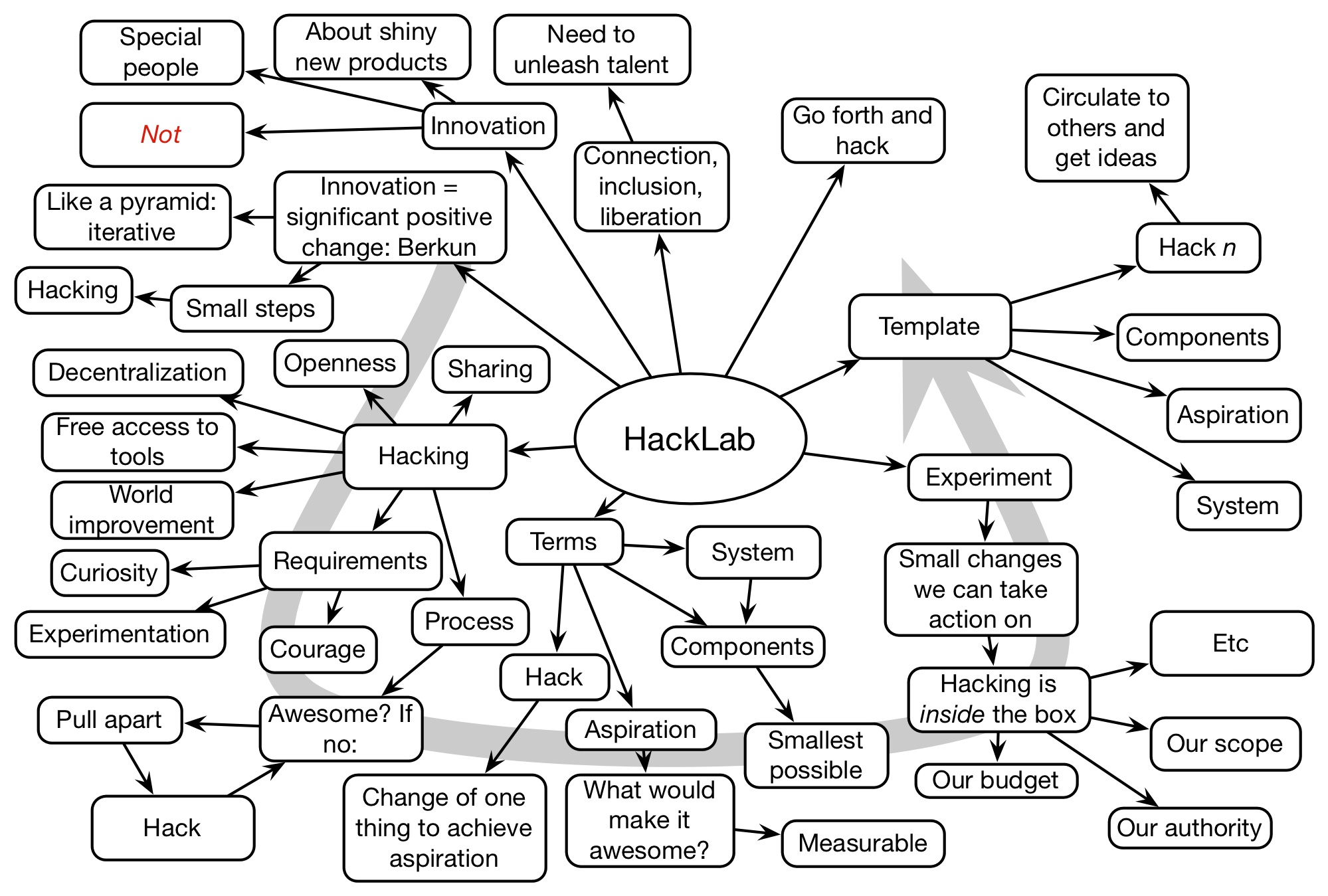
Jason Lauritsen & Joe Gerstandt #DevLearn Keynote Mindmap
Jason and Joe led a lively session inspiring us to innovate through small hacks. Their very pragmatic process is approachable and practical. A great closing to DevLearn.

Moving forward
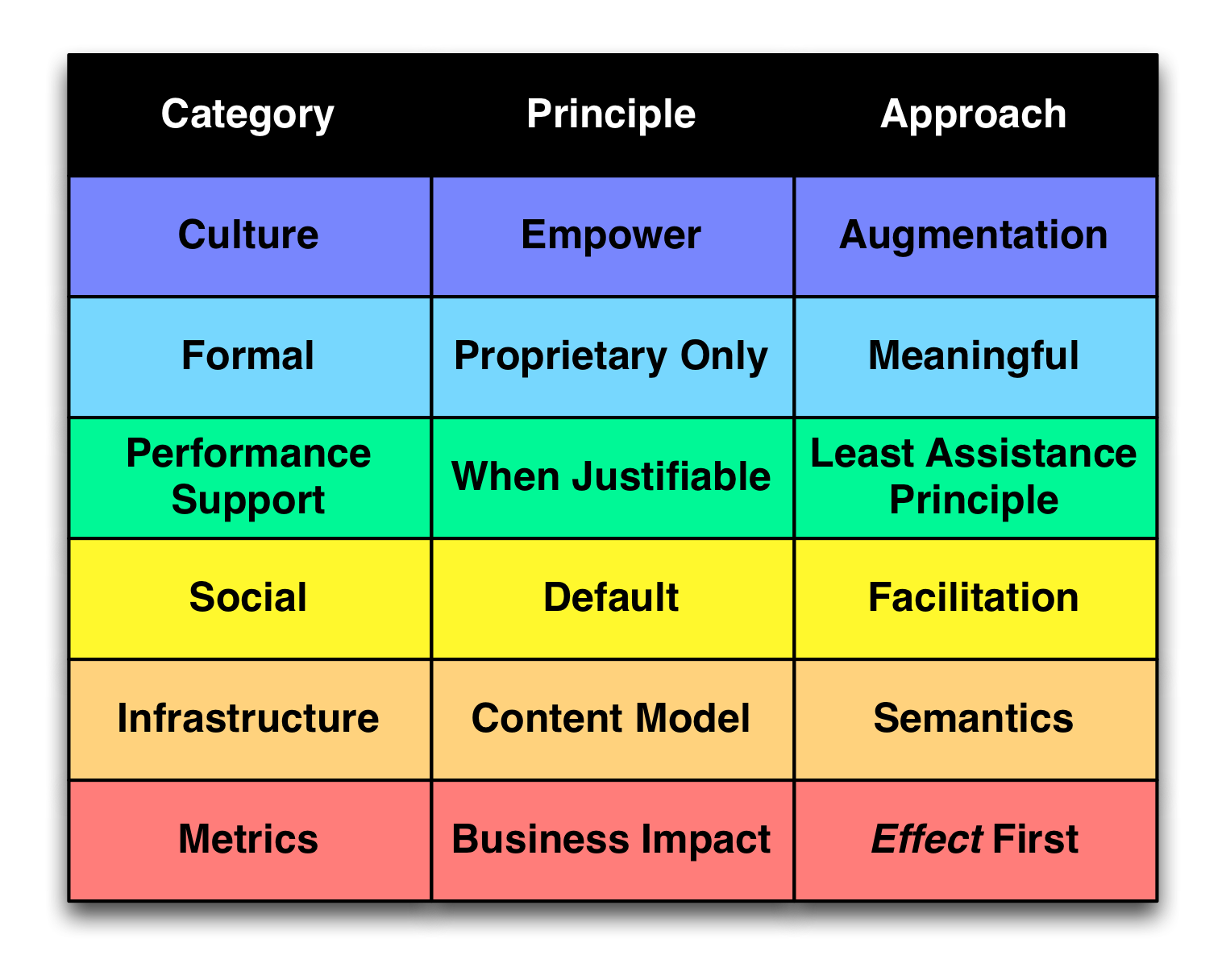
Last week, I talked about what L&D could (and should) look like. In thinking about how to move folks forwards, I’m working on looking at various ways to characterize the different elements, and what various levels of profession should be. One of my first stabs is trying to get at the necessary core principles, and the associated approach to be taken. Here’s the thinking:
We start with the culture of the organization. What the culture should be doing is empowering individuals, providing them with support for learning. And that is not to provide all the answers, but to support people discovering the answer. The goal is to not only address optimal execution, but increasingly to address continual innovation, which comes from cooperation and collaboration. The goal is to augment their existing capabilities with appropriate skills and tools to focus on accomplishing the work to hand. And not reintroducing things that already exist or can be found elsewhere.
That means that formal learning really should be focused on proprietary activities. Don’t design training on commercial tools, that exists. Save the effort to do a real course for those things that are fixed for long enough and specific to your organization. And make it meaningful: contexts that the user gets, skills that the user recognizes are needed, and that will make a real impact on the business. Done properly, with sufficient practice, it will take time and money: formal learning should be expensive, so use those precious resources where and when it really should be applied.
Performance support is more likely to add value in the moment, helping augment our limited memory and working memory capacity. When people need to be focused on the task, designing or curating resources to be used in the moment is a more cost-effective option, though again to be used appropriately. If things are changing too fast, or the situation’s unique, there are better options. And when you are developing or sourcing support, realize that less is more. Look to be minimalist, and your performers (and the bottom line) will thank you.
If things are changing too fast, or the situation’s new and unique (which will be happening more often), the network is likely to be your best resource and likely should be your first. The role here is to make sure that the network is available and vibrant. Facilitation of dialog, and skills, will make this solution the most powerful one in a company that intends to thrive.
The infrastructure, beyond the usual integration of tools, needs to take another level down, and start treating content as an asset that drives outcomes. The steps that matter are to get detailed about the content structures, the model, underneath, and the associated governance. At the end, it requires a focus on semantics, what labels we have and how we define and describe content to move forward into personalization and contextualization.
Finally, we need to measure what we’re doing, and we have to stop doing it on efficiencies. How much it costs us per seat hour doesn’t matter if that time in the seat isn’t achieving anything. We need to be measuring real business effects: are we increasing sales, decreasing costs or errors, solving problems faster, decreasing time to market, increasing customer satisfaction, the list goes on. Then, and only then, should we be worrying about efficiencies. Yes, we should be smart about our investments, but all the efficiency in the world about doing something inane is just kind of silly.
So, does this make sense? Any tuning or clarification needed? Feedback welcome.
What does change(d) look like?
In an post this past spring, I opined that we do have to change. One obvious related question is what that change would look like. What would an effective L&D unit be doing, and what would the employee/manager/exec experience be? This is a longer topic, but here’re some initial thoughts that I really would welcome your thoughts on.
I see employees experiencing less ‘training’. As I’ve said, effective training is expensive when done properly, and should be used only when significant skill shifts are needed. It should only be for proprietary approaches, otherwise you should use others’ materials. And it only is for upskilling new employees (and only when needed), or when a significant change is happening.
I’d expect to see more performance support, easily accessible via user-centric portals and search and delivered when and where needed. Similarly social would play a much more central role, arguably our first recourse. Employees would be tightly coupled to their work teams, and more loosely coupled to their communities of practice. Teams would be diverse and flexible, and group work would be the norm.
Resources would be sometimes created, sometimes crowd-sourced within (or without) the organization, and sometimes curated. Much curation would happen by individual in communities monitoring the larger network, individuals in teams bringing in relevant elements from their communities, and sharing back reflections and outcomes that inform the community while communities would share back to the larger network. This is the vision of the Coherent Organization.
Managers would be playing a leadership and mentoring & coaching role rather than a directive role. They’d be looking to share the vision of goals and rationale, and then supporting performance aligned towards this goal. Executives would be aligning manager visions with organizational goals, monitoring performance, and facilitating infrastructure to support effective communication and cooperation, and well as establishing and maintaining a learning organization culture.
The L&D unit would need to be monitoring the effectiveness of communication and collaboration, management, and leadership, as well as experimenting with new tools to support the work. The L&D unit becomes responsible for the learning to learn skills, the learning and performance tools, and the corporate culture.
If organizations are to successfully couple optimal execution with continual innovation, particularly in times of increasing change and decreasing resources, the mechanisms for success transcend training. Providing support when needed, and leveraging the power of people will be key. Does this make sense? Next step: how do you get there?
#itashare
A personal look at crowd sourcing
The last time I had a beard was right before college graduation. I was off in the wilderness, and when I came back my razor was busted. So, I grew a beard that was largely red, and in terms of being well behaved, well, it made Gabby Hayes look well-groomed. So I’ve been clean shaven since (see to the right).
Well, that’s changed. To make a long story short, I had an extended period of time away from family and razor, and grew it out. When I came back, the reviews went from mixed to positive, not a negative word. Now, of course, you seldom hear from those who don’t like a look (wonder how many people do not like Quinnovation as a company name), but the important people (my immediate family) either initially or grew to prefer the new look. (Maybe the more of my face I cover, the better ;)
Well, this creates a conundrum, because I’ve plenty of promo photos out there for various speaking engagements that now are no longer appropriate. It was time for a new official photo (it was anyways, this is close to a decade old, and I do not want to be the guy who’s photo is decades out of date).
The official way to do this is to hire someone, but I perused the local options, and either they were sidelining portraits on top of weddings, babies, etc, or they used stock backgrounds. The pre-beard shot above was taken by my friend and colleague Jay Cross, chose it out of several candidates, and liked the more natural setting. So I got my wife to take a bunch of shots, and we (with my daughter’s help) went through them. They were all flawed for various reasons (some problems she saw and I didn’t, and there begins the tale; it was a collaborative project and decision). We tried again, and finally found two we liked. How to decide?
So I went out to a small group of colleagues who I could trust would give me straight feedback, and they reliably preferred one. This was a relief. However, there was a problem: my face was kind of dark against the background. And, lo, one of them stepped up and offered to work on the photo.
She kindly took the shadow off my face, and did another lightening up the whole picture. The former was better, but I was concerned that there wasn’t sufficient contrast, so she also created one that had the background muted. Her contribution was so valuable. Now I had two more to choose from: the more natural one or the one with the muted background. How to answer this?
So I went out to four of the groups I have or was going to talk for, and asked them which they would prefer for their brochures or websites. Of the 3 that responded, they all preferred the natural background (my preference). I’d converged on a new headshot.
More importantly, I had avoided my usual blind decisions, and got contributions all along the way that made the outcome better. Throwing out ego and being willing to ask for help isn’t my natural approach, as I hate to impose, but I know I don’t mind helping colleagues and friends, so I stepped out of my comfort zone and I’m so grateful they stepped up.
The take-home lesson for me is the power of communication and collaboration: crowd sourcing works. You may not like the new look, but it’s where I’m at, and it’s a lot better picture than I’d had if I tried to do it alone.
Making Sparks Fly
Last night I did a presentation for the San Diego chapter of ISPI titled ‘making sparks fly’. I used that concept to talk about a couple of my favorite topics: deeper instructional design, and social learning.
In the former, it’s about two things: getting the real cognitive underpinning right, and the emotional content, both integrated in a natural and elegant way. So you start with your objectives (at a high enough level, addressing real business needs). Then you immediately develop deep practice with core decisions embedded in meaningful contexts. You need sufficient practice to not get it wrong, as opposed to just getting it right. Then we elaborate with model-based concepts and story-based examples. All introduced in ways that engage the emotions as well as the mind, and closing that process off similarly addressing the emotional as well as the cognitive. The point being, if you’re going to do formal, do it right.
From there, I segued off to talk about social: the power of the additional processing you get from social learning. This includes sharing ideas, and collaborative work. Then, systematically looking at tools like blogs, wikis, profiles, feeds, and more for both formal and informal learning. The notion is that thinking and working ‘out loud’ are, in the right culture, better than not.
Formal learning (and I didn’t discuss performance support, after all it was ISPI :) addresses the optimal execution that will be just be the cost of entry going forward, while continual innovation requires the creative friction, the interpersonal interaction that generates new ideas. You need to have good learning and good performance support on those processes you can identify, but then you need to create the environment where folks are helping one another solve the new problems that arise, including new ideas. Engaging the learner, and the interaction, are both sparks to take what we do to the next level.
There’s more: culture, mindset, L&D role, and we touched on that, but in the broader picture, you want to start with social and performance support, only doing formal when you absolutely have to (as it’s dear). We need to stop doing formal only, and badly. We need to cover the spread, and do all well. Or else…
World first!
A few weeks ago, I posted that we should think social first. I want to amend my statement (I reserve the right to improve my recommendations :) to say “world first”, and clarify what I mean. Earlier, I posted about working backward and forward, and err on the side of putting information in the world first, and only put things in the head as a last resort (because formal learning is expensive).
What I’d suggested is that you should go to networks first, if the answer is out there. If not, you would try to use performance support (which, though not necessarily cheap, may be less expensive than formal learning in terms of time off task, etc). Formal learning is the recourse of last resort. However, I missed one element, which came up in a conversation.
The conversation had to do with not developing resources at all, except core ones. When someone wanted help with something, the option was to first try to point them to a video or book, or person. The goal is not to reinvent the wheel, reproduce resources, etc. Use the world first, and only pick up a secondary approach if the world doesn’t have it. In some sense that’s the social network, but it might be that the L&D department, in the course of their continual self-learning (hint hint, nudge nudge), would’ve curated a relevant resource, so it could come either from a pointer to a resource, or a question of others.
Then, the core content for an organization would be meta-learning: how to find resources, how to solve problems, etc. Something we were pushing about a decade ago. Ok, so you might also develop the values and mission of the organization as well. And of course proprietary processes, formulas, etc.
The focus, however, is and should be the Least Assistance Principle: what’s the least we can do for someone to get them safely back into their flow. The reality is we can’t meet all the needs in an era of increasing complexity, and we need to be more efficient and effective: giving good support but in the right modality. So, point to it if you can, develop the minimal support to move forward, and only put stuff into people’s heads when it absolutely has to be there. Fair enough?
State of L&D Survey
What is the current state of L&D, and where is it working (and not)? Some are saying that things are largely okay, while others are suggesting that things must improve. Where are we at?
The Learning & Performance Institute research suggests that L&D practitioners don‘t assess themselves as having all the skills they might need. Charles Jennings‘ work with the 70:20:10 Forum is pushing the model that we could be focusing on a wider range of activities beyond courses. Tony Bingham and Marcia Conner have pointed out the new roles we could be taking in their book The New Social Learning. Are we on track?
I have previously written that the industry has to change. Rather than trust my instincts, however, I‘m fortunate in that ASTD itself is looking to have more up to date answers, and is partnering with me to ask some questions about the full suite of activities that are being undertaken. We‘ve collaborated to create a questionnaire to supplement their usual collections of research reports. We do have an endgame on this; stay tuned.
We‘re asking a short suite of questions designed to understand a snapshot of how organizations are addressing learning needs. These include questions about how effort is distributed across different activities, what pedagogical beliefs are being used, where the learning culture is at, and how outcomes are being measured.
We encourage you to both take it and promote it. We hope that through this, we can get a snapshot of where the industry believes itself to be and how we can continue to move it forward.
Please take the survey and encourage others to as well. Thanks!
Supporting Work
A number of years ago, I discussed a useful model that talks about how we solve problems in the world. In the piece, I talked about how when we can’t act, we try to find the answer (and if we do, we go back into action). Then if we can’t find the answer, we have to go into a problem-solving mode: we need to do research, experiment, and generally discover the solution. If we find a solution we should update the resources to help other people find the answer rather than having to rediscover it.
I was thinking about this in terms of the ways in which L&D can support this process, and started noting the ways in which we can help besides courses. I broke it up into two different forms of support: direct, and supporting the associated skills.
When we have an information need, we might need directories to people with various expertise (associated with Communities of Practice, presumably). We might design or curate useful information resources (how-to videos, job aids), and occasionally, when a significant skill shift is needed, we might design courses.
There are associated skills here, so communicating successfully with the experts who have the answer, or information literacy to develop the performer’s ability to find the answers themselves.
If the answer doesn’t already exist, then we might support learner with tools about problem solving, and research and problem-solving skills, as well as communication skills again to deal successfully with collaborators.
Finally, when the answer is found, might have tools to create resources and skills to edit existing resources.
First, this is by no means a complete list, as even in writing this I thought of design to create resources to support problem-solving, and information architecture to go along with information resources, and…you get the idea. The point is two-fold: we need to recognize how people actually act in the world, and we need to then find ways to support all the points of need, not just the ones we can design a course for. There are lots of opportunities!
Reshaping L&D
Jane Hart (one of my ITA colleagues) has laid out a proposal for the new services of the L&D department, and I think it resonates nicely with some thinking I’ve been having. The point is that L&D has to shift, but the question is: “to where?”
So Jane posits 3 services:
- Content production: designing and delivering courses and resources
- Learning Concierge: address ad hoc or ongoing learning or performance problems
- Connected Workplace: supporting continuous learning and performance improvement through knowledge sharing and collaboration
The first is most of what the L&D group does now, and overuses. And the focus really is on courses, though sometimes resources are developed. The latter two, however, are real opportunities.
Increasingly, we can’t anticipate the unique needs our learners will have, and what we have to move towards supporting them ‘at will’. It may be a pointer to a resource such as a book or person or video as opposed to designing a course. We increasingly need to serve as curators.
Similarly, we need to serve as facilitators, helping people learn how to self-help by working ‘out loud’ when we find ways to help them, so they can start self-helping. We can and should be facilitating conversations, helping those who are having trouble being effective in communicating, and more.
As I suggested earlier, social learning may often be our first recourse (not off our radar), and performance support second. If formal learning is (or should be) expensive, it should only be used when we need a significant skill shift. Yes, there are times that it’ll be needed (e.g. unskilled employees, highly regulated performances), but we need to have a much richer suite of support possibilities, and start more accurately targeting the assistance to the need (and measuring the impact).
Our goal should be to have a business impact, and a one-trick pony isn’t going to meet the rich complexity and rate of change we’re increasingly going to face. So, as Jane concludes: “how ready are you to provide these new services?”
#itashare