Learnlets

Secondary

Clark Quinn’s Learnings about Learning

Social First!

9 July 2013 by Clark 5 Comments

I’m convincing myself that as performance consultants assisting our organizations moving forward, we need to start thinking differently.  And as an extreme version of this, let me start by saying we need to start thinking ‘social’ first.  When we’re facing a performance problem in the organization, our first resort should be to ask: “would a social solution solve this”?  Let me explain.

Social solutions basically suggest that we either tap into user-generated solutions, or reach out to people on the fly.  It might be recorded video or user-generated job aids.  It might be asking a SME via an expertise directory. Or it just might be tossing it out to our network.  It may even be asking for some collaboration on a unique situation.

Here’s the thing: social networks are more likely to be up-to-date, and better able to deal with one-off questions and unique situations than our formally designed solutions.  In situations where things are changing rapidly, formally designed solutions are not likely to be up to date with where things are, owing to the time to capture, process, and generate appropriate content. And unusual situations aren’t worth trying to anticipate. They’re likely to be too many to address.  And, as the rate of change accelerates, these situations are more likely.

Of course, this requires infrastructure, an appropriate culture, and facilitation, but that should be already accomplished if not underway.  We know that continual innovation is the only sustainable differentiator, and that this comes from creative friction (the myth of individual innovation is busted). The  important  outcomes are going to come from the social network, not from L&D.

Finally, formal is (or should be) expensive.  If we’re doing it right, the effort to help change someone’s skill set sufficiently is a prolonged effort.  We need to be looking for effective, agile, and efficient.  Formal isn’t the latter two (and too frequently not the former either).  We should hold formal as a last resort!

There  will be times when social isn’t the answer, but for a number of reasons social should be your first solution if possible. It’s effective, it’s agile, and it’s very efficient.  Anticipating quite the  social  reaction to this ;).

#itashare

Formal Learning is (or should be) Expensive!

2 July 2013 by Clark 7 Comments

It’s becoming clear to me that we’re making a big mistake in our thinking. We seem to think that formal learning is relatively cost-effective, and may even think that performance support and social are more costly.   Yet we need to realize that formal learning is likely our most costly approach!

To start with, we should be doing sufficient analysis to ensure that the need is indeed a skill shift. If it’s an information problem, it should be solved with a job aid. Courses are more expensive.  And we need to take the time that the skill shift really is needed; it’s not a motivation problem or some other problem. In other words, we need to take the time to identify what business problem this is solving that a course will affect, and the associated metric.  That takes time.

Then we need to design an intervention that will address that skill shift: we need to determine what the change in the workplace behavior needs to be to impact that metric, and then design an objective that reflects that needed behavior change.  This is not trivial: a poorly formed objective about knowledge, not behavior, isn’t going to have an impact on the business.

Then, to do formal learning well, you need appropriate and sufficient practice.   That takes time to design properly, ideally with scenarios or simulation-driven interactions.  And the practice needs to be aligned with the learner; it has to be meaningful to them.  Enough of them. This takes time.

Then we need to create an appropriate model to guide their behavior, and introduce it appropriately. And find meaningful examples that illustrate the concept being applied in context, across sufficient contexts.  This takes time, though no more time (once you determine a course is the answer) than other learning design once you get experienced in this more advanced way of designing.  And it takes development resources.

And, of course, if you’re not doing the above, why are you bothering? It’s not going to hit the mark.  We don’t, frankly, and to the extent we don’t, we undermine the  likelihood  that our interventions will have the desired impact.  The point being that courses should not be our first line of defense!

Rapid elearning is cheap and fast, but it’s not going to have any impact.  Most of what we do doesn’t have any impact. If we want to have impact, we have to do it right, and that’s not a cheap proposition.  We need to worry about measuring more than cost/bum, and worry about hitting the business goal.  Then we can truly determine whether we should go this route, rather than another.  But, seriously, you shouldn’t be throwing formal learning at a problem unless you’re willing to do it right. There are times it  will be the right answer, but right now we’re throwing too much money away.  Let’s stop, and do it right  when  it’s right.  And that will be both expensive  and worth it.


Chuck Martin #mLearnCon Keynote Mindmap

19 June 2013 by Clark 1 Comment

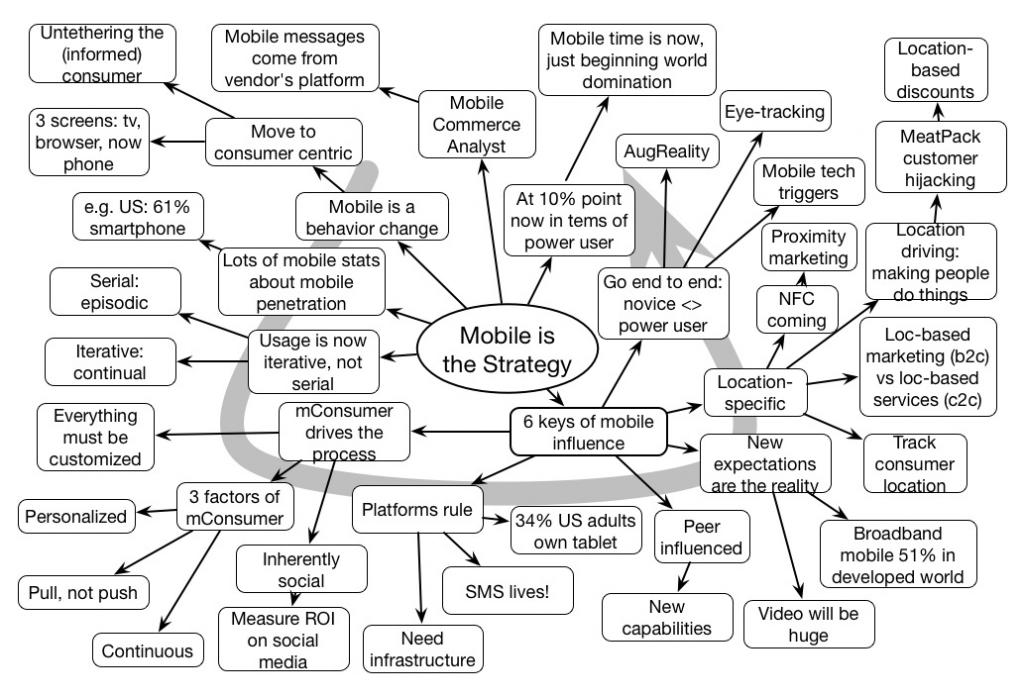
Chuck Martin gave a lively and valuable keynote at #mLearnCon, with stats on mobile growth, and then his key components of what he thinks will be driving mobile.  He illustrated his points with funny and somewhat scary videos of how companies are taking advantage of mobile.

MartinKeynoteMindmap

JSB #astd2013 Keynote Mindmap

21 May 2013 by Clark 4 Comments

John Seely Brown spoke eloquently on extreme learning for coping with extreme change, e.g. now. He talked about how extreme learning resembles play and challenged us to create environments where imagination could flourish.

20130521-092533.jpg

Starting Strategy

15 May 2013 by Clark 4 Comments

If you’re going to move towards the performance ecosystem, a technology-enabled workplace, where do you start?  Partly it depends on where you’re at, as well as where you’re going, but it also likely depends on what type of org you are.  While the longer term customization is very unique, I wondered if there were some meaningful categorizations.

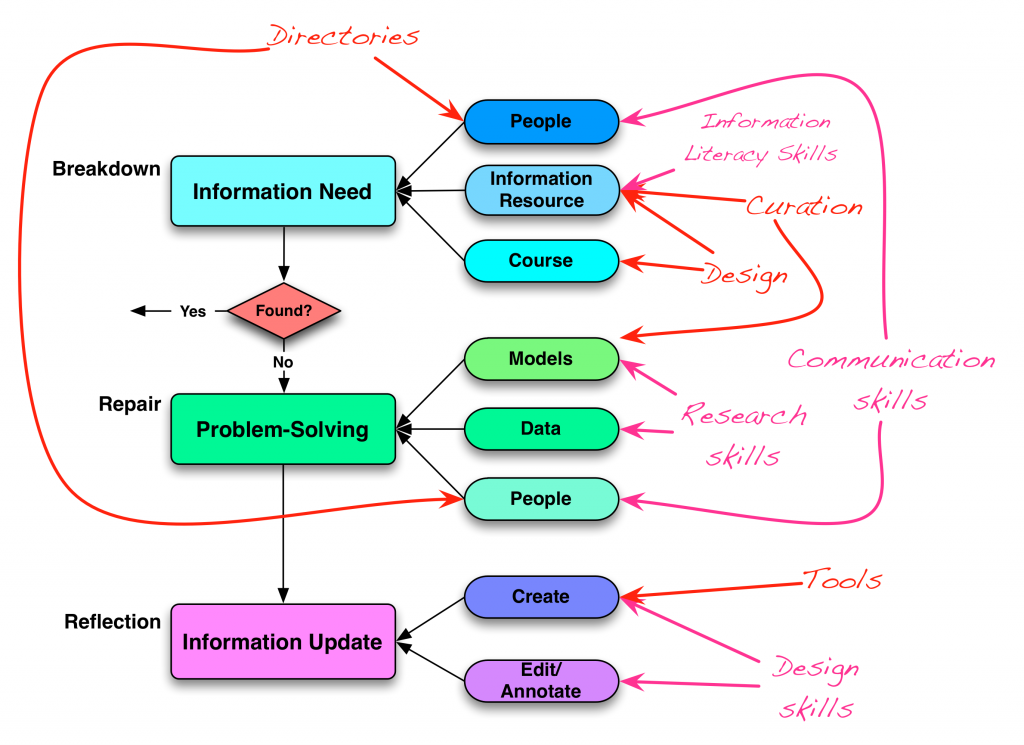
Performance EcosystemWhat would characterize the reasons why you might start with formal learning, versus performance support, versus social?  My initial reaction, after working with my ITA colleagues, would be that you should start with social.  As things are moving faster, you just can’t keep ahead of the game while creating formal resources, and equipping folks to help each other is probably your best bet.  A second step would then likely be performance support, helping people in the moment.  Formal learning would then backstop for those things that are static and defined enough, or meta- enough (more generic approaches) that there’s a reason to consolidate it.

However, it occurred to me that this might change depending on the nature of the organization.  So, for example, if you are in an organization with lots of new members (e.g. the military, fast food franchises), formal learning might well be your best starting point.  Formal learning really serves novices best.

So when might you want to start with performance support? Performance support largely serves practitioners trying to execute optimally. This might be something like manufacturing or something heavily regulated or evidence based, like medicine.  The point here would be to helping folks who know why they’re doing what they’re doing, and have a good background, but need structure to not make human mistakes.

Social really comes to it’s fore for organizations depending on continual innovation: perhaps consumer products, or other organizations focused on customer experience, as well as in highly competitive areas.  Here the creative friction between individuals is the highest value and consequently needs a supportive infrastructure.

Of course, your mileage may vary, and every organization will have places for all of the above, but this strikes me as a potential way to think about where you  might want to place your emphasis.  Other elements, like when to do better back end integration, and when to think about enabling via mobile, will have their own prioritization schemes, such as a highly mobile workforce for the latter.

So, what am I missing?

#itashare

Hire the ‘loud’?

3 April 2013 by Clark 1 Comment

In thinking about how organizations can ‘learn’, it strikes me that everyone needs to be simultaneously learning  and teaching.  How does that happen?  I think it can be scaffolded, but it may also be an inherent trait.

A number of us are talking more about working out loud: Jane Bozarth and Harold Jarche talk about ‘narrating your work’, while I go on about ‘thinking out loud’ and ‘learning out loud’.  The point is capitalizing on the benefits that come from putting your thoughts out: people can give you feedback, helping you learn; and folks can learn from you.

And, as I’ve said before, conversations are the engine of business. You need to be interacting to be advancing.

The recent story of Marissa Mayer, CEO of Yahoo, struck me as an interesting case.  Here she’s bringing in folks who’ve been working remotely, or to put it another way she’s not allowing telecommuting any more. While there are obvious downsides, I can think of two justifications for that step:

  • to get everyone back on the same page in regards to mission and vision
  • to have folks sharing more

Both of these would be good outcomes for Yahoo.  And I can see in both cases that it could be temporary: once you get the mission message shared, and have developed a culture of and infrastructure for sharing, folks could then again work from where they want.  Of course, I have no idea whether that will actually happen.

The interesting thing for me was to contemplate those folks who  don’t share.  What to do?  I know of folks who are happy to sit at home and do their job, and aren’t necessarily interested in the larger picture.  What do you do? Sometimes these folks have useful skills.  And they may have their own methods of keeping up to date.  But if they’re not sharing, not contributing, what’s the overall picture?

And the thought occurred to me that those are folks that you bring in as contractors or consultants, but not as employees.  Particularly in the case of a ‘no fire’ policy, who do you want on board?  It seems to me that the employees you want are the ones who are continually learning and contributing to the organization’s overall knowledge.

Sure, there’s lots more you’d have to get right: safety to speak out loud, tolerating diversity, openness to new ideas, but having folks who are willing to learn together seems to me to be one criteria for an organization that will thrive.

So, is this a plausible component of a hiring policy?  Those who demonstrably narrate their work are the ones to attract, develop, and reward?

#itashare

Aligning coherency

2 April 2013 by Clark Leave a Comment

CoherentOrgLayers

In thinking about the coherent organization, a couple of realizations occurred to me.  One is about how those layers actually are replicated at different levels. The other is how those levels need to be aligned in the organization to the overall vision.

For one, those work teams can be at any level. There will be work teams at the level that the work gets done, but there’ll also be work teams at the management and even executive levels.  Similarly, there are communities of practice at all these levels as well.  Even the top level executives can be members of several communities, including as executives of their org, but also with their peers at other orgs.

Moreover, at each of these levels they need to be tapping into what’s happening outside the organization, and tracking the implications for what they do.  They need to feed back out as well (of course, not their proprietary information).

The two way flow of information has to be in and out as well as up and down.  Communication, for both collaboration and cooperation, is key.

CoherentOrgAlignmentA second necessary component is alignment.  Those groups, at every level, need to be working in alignment with the broader organization’s goals, and vision.  When Dan Pink talks about the elements of motivation in Drive, the 3rd element, purpose, is about knowing what you’re doing and why it’s important.  So organizations have to be clear about what they’re about, and make sure everyone knows how they fit. Then you can provide autonomy and the paths to mastery (the other two elements) and get people working from intrinsic motivation.

The integrated focus on communication and alignment are two keys to developing the ability to continually innovate, and cope in the increasing complexity which will make or break an organization.  That’s how it seems to me.

#itashare

Yvonne Camus #LSCon Keynote Mindmap

15 March 2013 by Clark 1 Comment

Yvonne Camus closed the conference with a stirring talk on success under extreme circumstances as an Eco-challenge winner.

20130315-122054.jpg

Aaron Dignan #LSCon Keynote Mindmap

13 March 2013 by Clark 1 Comment

In a clever talk, Aaron Dignan used game theory to talk about how to improve the workplace.

20130313-170311.jpg

Leadership for Complexity

7 March 2013 by Clark Leave a Comment

The other meme from the retreat event  last weekend was the notion of leadership for complexity.   A few of us decided to workshop a topic around performance, leadership, and technology.   We realized technology was only a means to an end, and the real issue was how to move organizations to optimal performance (e.g. the Coherent Organization).

We talked through how things are moving from complicated to complex (and how important it is to recognize the difference), and that organizations need to receive the wake-up call and start moving forward.   Using the Cynefin model, the value will not come from the simple (which should be automated) nor the complicated (which can be outsourced), but from dealing with the complex (and chaotic).   This won’t come from training and top down management. As I’ve said before, optimal execution will only be the cost of entry, and the differentiator (and hence the value) will be continual evaluation. And that comes from a creative and collaborative workforce.   The issue really is to recognize the need to seize new directions, and then execute the change.

One concern was whether we were talking evolution or revolution.   Rather than taking an either or, I was inclined to think that you needed revolutionary thinking (I like Kathy Sierra’s  take on this), but that you fundamentally can’t revolutionize an organization short of total replacement (“blood on the streets” as one colleague gleefully put it :).   I reckoned a committed change initiative to the place the revolutionary thinking pointed was what was needed.

The issue, then, is the vision and guidance to get there.   What’s needed is leadership that can lead the organization to be able to leverage complexity for success.   This will be about equipping and empowering people to work together on shared goals: sharing, commenting, contributing, collaborating, and more.   It will be inherently experimental in an ongoing way.

What that means practically is an exercise I (and we) are continually working on, but we’ve coalesced on the top-level frameworks to form the basis of tools, and what’s needed are some organizations to co-develop the solutions.   Design-based research] if you will. So who’s up for working on the path to the future?

#itashare

« Previous Page
Next Page »

Clark Quinn

The Company

Search

Feedblitz (email) signup

Never miss a post
Your email address:*
Please wait...
Please enter all required fields Click to hide
Correct invalid entries Click to hide

Pages

  • About Learnlets and Quinnovation

The Serious eLearning Manifesto

Manifesto badge

Categories

  • design
  • games
  • meta-learning
  • mindmap
  • mobile
  • social
  • strategy
  • technology
  • Uncategorized
  • virtual worlds

License

Previous Posts

  • April 2026
  • March 2026
  • February 2026
  • January 2026
  • December 2025
  • November 2025
  • October 2025
  • September 2025
  • August 2025
  • July 2025
  • June 2025
  • May 2025
  • April 2025
  • March 2025
  • February 2025
  • January 2025
  • December 2024
  • November 2024
  • October 2024
  • September 2024
  • August 2024
  • July 2024
  • June 2024
  • May 2024
  • April 2024
  • March 2024
  • February 2024
  • January 2024
  • December 2023
  • November 2023
  • October 2023
  • September 2023
  • August 2023
  • July 2023
  • June 2023
  • May 2023
  • April 2023
  • March 2023
  • February 2023
  • January 2023
  • December 2022
  • November 2022
  • October 2022
  • September 2022
  • August 2022
  • July 2022
  • June 2022
  • May 2022
  • April 2022
  • March 2022
  • February 2022
  • January 2022
  • December 2021
  • November 2021
  • October 2021
  • September 2021
  • August 2021
  • July 2021
  • June 2021
  • May 2021
  • April 2021
  • March 2021
  • February 2021
  • January 2021
  • December 2020
  • November 2020
  • October 2020
  • September 2020
  • August 2020
  • July 2020
  • June 2020
  • May 2020
  • April 2020
  • March 2020
  • February 2020
  • January 2020
  • December 2019
  • November 2019
  • October 2019
  • September 2019
  • August 2019
  • July 2019
  • June 2019
  • May 2019
  • April 2019
  • March 2019
  • February 2019
  • January 2019
  • December 2018
  • November 2018
  • October 2018
  • September 2018
  • August 2018
  • July 2018
  • June 2018
  • May 2018
  • April 2018
  • March 2018
  • February 2018
  • January 2018
  • December 2017
  • November 2017
  • October 2017
  • September 2017
  • August 2017
  • July 2017
  • June 2017
  • May 2017
  • April 2017
  • March 2017
  • February 2017
  • January 2017
  • December 2016
  • November 2016
  • October 2016
  • September 2016
  • August 2016
  • July 2016
  • June 2016
  • May 2016
  • April 2016
  • March 2016
  • February 2016
  • January 2016
  • December 2015
  • November 2015
  • October 2015
  • September 2015
  • August 2015
  • July 2015
  • June 2015
  • May 2015
  • April 2015
  • March 2015
  • February 2015
  • January 2015
  • December 2014
  • November 2014
  • October 2014
  • September 2014
  • August 2014
  • July 2014
  • June 2014
  • May 2014
  • April 2014
  • March 2014
  • February 2014
  • January 2014
  • December 2013
  • November 2013
  • October 2013
  • September 2013
  • August 2013
  • July 2013
  • June 2013
  • May 2013
  • April 2013
  • March 2013
  • February 2013
  • January 2013
  • December 2012
  • November 2012
  • October 2012
  • September 2012
  • August 2012
  • July 2012
  • June 2012
  • May 2012
  • April 2012
  • March 2012
  • February 2012
  • January 2012
  • December 2011
  • November 2011
  • October 2011
  • September 2011
  • August 2011
  • July 2011
  • June 2011
  • May 2011
  • April 2011
  • March 2011
  • February 2011
  • January 2011
  • December 2010
  • November 2010
  • October 2010
  • September 2010
  • August 2010
  • July 2010
  • June 2010
  • May 2010
  • April 2010
  • March 2010
  • February 2010
  • January 2010
  • December 2009
  • November 2009
  • October 2009
  • September 2009
  • August 2009
  • July 2009
  • June 2009
  • May 2009
  • April 2009
  • March 2009
  • February 2009
  • January 2009
  • December 2008
  • November 2008
  • October 2008
  • September 2008
  • August 2008
  • July 2008
  • June 2008
  • May 2008
  • April 2008
  • March 2008
  • February 2008
  • January 2008
  • December 2007
  • November 2007
  • October 2007
  • September 2007
  • August 2007
  • July 2007
  • June 2007
  • May 2007
  • April 2007
  • March 2007
  • February 2007
  • January 2007
  • December 2006
  • November 2006
  • October 2006
  • September 2006
  • August 2006
  • July 2006
  • June 2006
  • May 2006
  • April 2006
  • March 2006
  • February 2006
  • January 2006

Amazon Affiliate

Required to announce that, as an Amazon Associate, I earn from qualifying purchases. Mostly book links. Full disclosure.

We use cookies to ensure that we give you the best experience on our website. If you continue to use this site we will assume that you are happy with it.