Learnlets

Secondary

Clark Quinn’s Learnings about Learning

Search Results for: Reading Research

Context and models

22 July 2025 by Clark Leave a Comment

One of the things I’ve recognized is that we don’t pay enough attention to context. It turns out to be a really important factor in cognition, as our long-term memory interacts with the current context to determine our interpretation. And, as such, makes our interpretations very ’emergent’. Thus, our training needs to ensure that we’re liable to make the right interpretation and so choose the right action. Do we do this well? And can artificial intelligence (AI), specifically generative AI (GenAI), help? Here’re some thoughts on context and models.

So, we’ve gone from symbolic models to sub-symbolic ones as we’ve moved to a ‘post-cognitive’ interpretation of our thinking. What’s been realized is that we’re not the formal logical reasoning beings that we’d like to think. Instead, we’re very much assembling our understanding on the fly as an interaction between context and memory. In fact, our emergent memory can be altered by the context, as Beth Loftus’ research demonstrated. Which means that, if we want specific interpretations and reactions (e.g. making decisions under uncertainty), we should be careful to ensure that we provide training across a suitable suite of contexts.

Now, active inference models of cognition suggest that we’re actively building models of how the world works. Thus, we’re abstracting across experiences to generate ever-more accurate explanations. Research on mental models suggests that they’re incomplete, not completely accurate, and, arguably most importantly, hard to get rid of if they’re wrong. Thus, providing good models beforehand is important, and work by John Sweller further suggests that examples showing models in context benefit learning. You can present the model, but ultimately the learner must ‘own’ it. So, it’s important to know the models and their range of applicability to facilitate that abstraction.

What is important to know, however, is that GenAI doesn’t build models of the world. This was an important (and, sadly, not self-generated) realization for me. The implication, however, is clear. I have maintained that GenAI can’t understand context, and thus can’t generate suitable practice environments. Which, of course, is to the good for designers, since it leaves them a role ;). Importantly, however, this framing also suggests that GenAI also can’t choose an appropriate suite of contexts for practice, since it doesn’t understand models and how they’re applicable (and when not). (Another designer role!)

I am all for using technology to complement our own cognition. However, that entails knowing what the true affordances of the technology are, and also what it can’t do. So, GenAI can help think of great settings for practice. Along with a person (an expert actually) to vet the suggestions, of course. It can think of things we might forget, or ones we haven’t thought of yet. It can, of course, also create ones that aren’t realistic. There’re potentially great opportunities, but we have to know what matters, and what doesn’t. Context and models matter. GenAI can’t understand them. You can take it from there.

Where’s quality?

1 July 2025 by Clark 4 Comments

I get it, when you’ve a hammer, the whole world looks like a nail. Moreover, there’s money on the table, and it’d be a shame not to grab onto it. Still, there’s also integrity. And, frankly, I fear that we’re going down the wrong path. So I’ll rail again, by asking “where’s quality?”

So, a colleague recently provided a link to a report by a well-known analyst. In the report, they call for an AI revolution for L&D. And, yes, I do believe L&D needs a revolution, I wrote a whole book about it. However, I fear that the direction under advisement is focusing on the wrong thing. So here’s what the initial post summarized about the article:

* Despite significant investment, many companies are utilizing outdated learning models that do not deliver substantial business impact.

* Learning needs to be dynamic, personalized, and focused on enablement.

* Chief Learning Officers (CLOs) should re-establish themselves as leaders within the enterprise, focusing not just on learning but on employee enablement.

* Artificial intelligence (AI) offers the potential to speed up content creation, lower costs, and improve operational efficiency, which allows Learning and Development (L&D) to adopt a wider and more strategic role.

Do you see anything wrong with this? I actually agree  with the first point, and probably the third. However, I think we can make a strong case that the second is not the primary issue. And very clearly the fourth point identifies what’s wrong in the second, at least before the last phrase.

So, first, when we invoke learning, we should be very careful to do it right. There are claims that up to 90% of our investment in training is going to waste. However, it’s not because our learning designs aren’t ‘dynamic, personalized, and focused on enablement’, it’s because our learning isn’t designed according to what research says works. Now, our learning needs change as our abilities improve. We start knowing what we need and why. There’re also times when performance support can be more effective than courses. Courses can still be valid, if they’re done well.

That’s the point I continue to make: I maintain that we’ll save more money and have more impact if we focus on good learning design before we invest in fancy technology. That includes AI. We want meaningful practice (which I suggest is still a role for designers, as AI doesn’t understand context), not information dump. Knowledge <> ability to perform. What we need is practice of doing. At least for novices. But beyond that, only effective self-learners will be truly able to leverage information on their own to learn. Even social learning gets better when we understand learning.

So, learning needs to be evidence-informed, first. Then, and only then, can it be dynamic, personalized, etc. Even knowing when and how to use AI as performance support counts (a more valid role, tho’ there needs to be scrutiny of the advice somehow, as AIs can give bad advice). Sure, CLO’s do need to be leaders in the enterprise, but that comes from understanding cognition and learning, and then using those to better enable innovation as well as optimizing performance. Enablement’s fine as a premise, but it’s got to come from understanding. For instance, you can’t get employees contributing just because you put in AI, you need to create a learning culture. (Putting AI into a Miranda organization isn’t going to magically fix the problem.)

Let me be clear: my argument is not Gen AI bad vs Gen AI good. No, it’s learning science involved versus not. I am fine if we start using AI, Gen or otherwise,, but after we’ve made sure we’re doing the right things first. Let me pose a hypothetical: for $30K, would you rather have 3 courses versus 10? What if those 3 courses were designed to actually have an impact, versus 10 that are pretty and full of information, but won’t move a single meaningful needle the organization? Sure, I’ve made up the numbers, but the reality is that we’re talking about achieving real outcomes versus making folks feel good; I’ll suggest “it’s pretty and people like it” is no substitute for improving the outcome.

This makes the last line above more problematic: we don’t need to speed up content creation. Content dump <> learning. Lowering costs and improving efficiency is all good, but after you’ve ensured adequate effectiveness. And no one seems to be talking about that. That’s why I’m asking “where’s quality?” It’s not being discussed, because AI is the next shiny object: “there’s plenty of money to be made”. Anyone else sensing a bubble? And that’s without even considering IP ethics, environmental impact, security, and VC funding. The business model is still up in the air. Hence, my question. Your thoughts?

As an aside, there’s a quote in the paper that illustrates their lack of deep understanding: “As our attention spans shorten”. Ahem. While there’s a credible argument made by Gloria Marks, I still suggest it’s not a change in our cognitive architecture, but instead availability and familiarity. We can still disappear for hours into a novel, movie, or game. It’s a fallacious basis for an argument. 

Truth in advertising: I was tempted to title this “WTAH”, but…I decided that might be too incendiary ;). Hence, “Where’s quality?” Still, you can imagine my mood while reading and then writing this.

Why science?

15 April 2025 by Clark 1 Comment

I’ve written in praise of the cognitive and learning sciences. I, however, need to take a step back. It’s becoming increasingly clear to me, sadly, that there are attacks on science itself.  Yet, I have a strong belief that it matters. So let me briefly address the question of why science.

As background, I have been steeped in science. It was one of my favorite topics in school, and in college. My PhD is in the underpinnings of how we think. Though it’s been a long while since I was an active scientific researcher, I still apply what’s known. Moreover, I continue to track developments, so I can continue to do so. 

As a result, I’ve been a fan of the work of scientists in the cognitive and learning fields. I’ve not only had training in the methods, but I also continue to explore more broadly the methods and the applications. I also love the translators who take that research written in the original academese and turn it into practical advice. Heck, I’m co-director of a society about evidence-based practices. 

There has been some ‘confusion’ about the scientific process. “How can you trust it if it admits it’s been wrong?” Er, that’s what it’s about, continually creating explanations about the world. When we know more, we may need to change our explanations. We went from the sun circling the earth to the other way around, and we no longer (should) think the world is flat. If you don’t believe in the findings, how (and why) are you reading this? Technologies developed from scientific endeavor. 

To be fair, science has been used for ill as well as good. That’s about people’s ethics, not the outcomes. We have to be mindful of how we apply what we learn. That’s up to our values and morals, which science actually has a lot to say as well. For instance, I’ve made the case that research tells us we do better when we’re inclusive. That’s science telling us what values lead to the best outcomes. When we work with what we know about how we think, work, and learn, we improve the outcomes. 

The evidence says that science is better than any alternative. When we apply evidence-based practices, we get the best results. That’s a win. When we turn our backs on it, we lose. Lives can be negatively impacted or lost. That’s not a win. And for our orgs, ignoring science in marketing, operations, sales, etc doesn’t make sense. So, too, for learning and ‘human resources’ in general. And, that’s true for society and government as well. So let’s make sure we’re making decisions in ways that align with science. It may seem more expedient in the short-term to do otherwise, but the long-term results argue for us doing the right thing. When there’re conflicts between beliefs and the evidence, things go better when we adapt beliefs and go with the evidence. “Why science” is because it works better. 

Is “Workflow Learning” a myth?

24 September 2024 by Clark 5 Comments

There’s been a lot of talk, of late, about workflow learning. To be fair, Jay Cross was talking about learning in the flow of work way back in the late 1990s, but the idea has been recently suborned and become current. Yet, the question remains whether it’s real or a mislabeling (something I’m kind of  anal about, see microlearning). So, I think it’s worth unpacking the concept to see what’s there (and what may not be). Is workflow learning a myth?

To start, the notion is that it’s learning at the moment of need. Which sounds good. Yet, do we really need learning? The idea Jay pointed to in his book Informal Learning, was talking about Gloria Gery’s work on helping people in the moment. Which is good! But is it learning? Gloria was really talking about performance support, where we’re looking to overcome our cognitive limitations. In particular, memory, and putting the information into the world instead of in the head. Which isn’t learning! It’s valuable, and we don’t do it enough, but it’s not learning.

Why? Well, because learning requires action and reflection. The latter can just be thinking about the implications, or in Harold Jarche’s Personal Knowledge Mastery model, it’s about experimenting and representing. In formal learning, of course, it’s feedback. I’ve argued we could do that, by providing just a thin layer on top of our performance support. However, I’ve never seen same!  So,  you’re going to do, and then not learn. Okay, if it’s biologically primary (something we’re wired to learn, like speaking), you’re liable to pick it up over time, but if it’s biologically secondary (something we’ve created and aren’t tuned for, e.g. reading) I’d suggest it’s less likely. Again, performance is the goal. Though learning can be useful to support comprehending context and  making complex decisions, what we’re good at.

What is problematic is the notion of workflow and reflection in conjunction. Simply, if you’re reflecting, you’re by definition out of the workflow! You’re not performing, you’re stopping and thinking. Which is valuable, but not ‘flow’. Sure, I may be overly focused on workflow being in the ‘zone’, acting instead of thinking, but that, to me, is really the notion. Learning happens when you stop and contemplate and/or collaborate.

So, if you want to define workflow to include the reflection and thoughtful work, then there is such a thing. But I wonder if it’s more useful to separate out the reflection as things to value, facilitate, and develop. It’s not like we’re born with good reflection practices, or we wouldn’t need to do research on the value of concept mapping and sketch noting and how it’s better than highlighting. So being clear about the phases of work and how to do them best seems to me to be worthwhile.

Look, we should use performance support where we can. It’s typically cheaper and more effective than trying to put information into the head. We should also consider adding some learning content on top of performance support in times where people knowing why we’re doing it as much as what we should do is helpful. Learning should be used when it’s the best solution, of course. But we should be clear about what we’re doing.

I can see arguments why talking about workflow learning is good. It may be a way to get those not in our field to think about performance support. I can also see why it’s bad, leading us into the mistaken belief that we can learn while we do without breaking up our actions. I don’t have a definitive answer to “is workflow learning a myth” (so this would be an addition to the ‘misconceptions’ section of my myths book ;). What I think is important, however, is to unpack the concepts, so at least we’re clear about what learning is, about what workflow is, and when we should do either. Thoughts?

Sleep & Walking

6 August 2024 by Clark 2 Comments

We interrupt our regularly scheduled blog for this public service announcement. We will resume normal broadcasting after this brief message.

My late friend, Jay Cross, once wrote a post that said something to the effect of: “if you want to have better health, lose weight…<and a litany of other health benefits>…start walking.”  My reasons are in addition to that, actually. I also believe strongly in sleep. (Let me be clear, not sleep walking, of which I have no knowledge.) So here’re some thoughts on sleep & walking.

First, let’s talk sleep. I don’t know why (self-justification?), but I’ve regularly tracked the research on sleep. And, I find some robust results:

  • Most of us really are best off with 8 hours of sleep
  • Reading in the same place you sleep means you don’t read nor sleep as well
  • Keeping a regular sleep schedule helps
  • Naps are good

Also, of course, most people don’t do this. Personally, I try. It used to be about optimizing performance, but these days it’s more about maintaining performance! I can nap, though I usually don’t need to because of the first three. Also, I do try to get my eight hours (and am generally successful). I definitely don’t read in bed (tho’ occasionally I’ll get up to write something down so it’s off my brain and I can go back to sleep). And I try to be pretty regular in my sleep. I’m just following what’s recommended, and it seems to work. There’s more I’m not necessarily so good at, of course.

When it comes to walking, I don’t get it every day. That’s ok, because I try to exercise 5 days a week, and 3 of those are to use my torture device, er, exercise machine. Which I now do for 30 minutes 3 times a week, per the doc who asked for that much time at >100 beats per minute. As well as two strength things and some physio things to counteract my sedentary work life. I was doing 20+ minutes, with High Intensity Interval Training (10 of those mins are 30 secs intense, 30 secs not), and that’s still the case. I just extended the cool down.

The other two days a week I walk (sometimes more if we do it on our weekend). I have a set route, so my mind can be free. Annie Murphy Paul, whose book The Extended Mind I cited in my recent ‘post cognitive’ presentation (requires free membership) for the LDA, talks about the benefits of being out in nature. Of course, my walk is through my neighborhood, but it’s a bit wild (no sidewalks; wild animals can be spotted such as turkeys, hawks, quail, the occasional coyote).

My rationale for walking, however, in addition to health, is time to think! I come up with blog post topics, resolve questions, and more. Further, I don’t have headphones on, deliberately, so I’m aware but also allow what comes to mind. I also walk on the left side of the road, to face oncoming traffic, both a good idea and the law. (Too often I see folks walking with earphones, on the wrong side of the road, sometimes even with animals on a leash or a kid in a stroller! Yikes!)

We know that having time to reflect works. Being outside is also a boon. Together, it’s valuable time to think, as well as a healthy activity. I encourage you to follow good sleep practices and get in some walking (or equivalent, if there’re reasons that’s not possible). I’ve heard that walking conversations are also productive, but I work from home, so…

We now return you to your regularly scheduled blog, already in progress.

About my books

21 May 2024 by Clark 2 Comments

My booksSo, I’ve written about writing books, what makes a good book, and updated on mine (now a bit out of date). I thought it was maybe time to lay out their gestation and raison d’être. (I was also interviewed for a podcast, vidcast really, recently on the four newest, which brought back memories.) So here’re some brief thoughts on my books.

My first book, Engaging Learning came from the fact that a) I’d designed and developed a lot of learning games, and b) had been an academic and reflected and written on the principles and process. Thus, it made sense to write it. Plus, a) I was an independent and it seemed like a good idea, and b) the publisher wanted one (the time was right). In it, I laid out some principles for learning, engagement, and the intersection. Then I laid out a systematic process, and closed with some thoughts on the future. Like all my books, I tried to focus on the cognitive principles and not the technology (which was then and continues to change rapidly). It went out of print, but I got the rights back and have rereleased it (with a new cover) for cheap on Amazon.

I wanted to write what became my fourth book as the next screed. However, my publisher wanted a book on mobile (market timing). Basically, they said I could do the next one if I did this first. I had been involved in mlearning courtesy of Judy Brown and David Metcalfe, but I thought they should write it. Judy declined, and David reminded me that he had written one. Still I and my publisher thought there was room for a different perspective, and I wrote Designing mLearning. I recognized that the way we use mobile doesn’t mesh well with ‘courses on a phone’, and instead framed several categories of how we could use them. I reckon those categories are still relevant as ways to think about technology!  Again, republished by me.

Before I could get to the next book, I was asked by one of their other brands if I could write a mobile book for higher education. The original promise was that it’d be just a rewrite of the previous, and we allocated a month. Hah! I did deliver a manuscript, but asked them not to publish it. We agreed to try again, and The Mobile Academy was the result. It looks at different ways mobile can augment university actions, with supporting the classroom as only one facet. This too was out of print but I’ve republished.

Finally, I could write the book I thought the industry needed, Revolutionize Learning & Development. Inspired by Marc Rosenberg’s Beyond eLearning and Jay Cross’s Informal Learning, this book synthesizes a performance and technology-enabled push for an ecosystem perspective. It may have been ahead of its time, but it’s still in print. More importantly, I believe it’s still relevant and even more pressing! Other books have complemented the message, but I still think it’s worth a read. Ok, so I’m biased, but I still hear good feedback ;). My editor suggested ATD as a co-publisher, and I was impressed with their work on marketing (long story).

Based upon the successes of those books (I like to believe), and an obvious need in our field, ATD asked for a book on the myths that plague our industry. Here I thought Will Thalheimer, having started the Debunkers Club, would be a better choice. He, however, declined, thinking it probably wasn’t a good business decision (which is likely true; not much call for keynotes or consulting on myths). So, I researched and wrote Millennials, Goldfish & Other Training Misconceptions. In it, I talked about 16 myths (disproved beliefs), 5 superstitions (things folks won’t admit to but emerge anyways) and 16 misconceptions (love/hate things). For each, I tried to lay out the appeal and the reality. I suggest what to do instead, for the bad practices. For the misconceptions, I try to identify when they make sense.  In all cases I didn’t put down exhaustive references, but instead the most indicative. ATD did a great job with the book design, having an artist take my intro comic ideas for each and illustrating them, and making a memorable cover. (They even submitted it to a design competition, where it came close to winning!)

After the success of that tome, ATD came back and wanted a book on learning science. They’d previously asked me to edit the definitive tome, and while it was appealing, I didn’t want to herd cats. Despite their assurances, I declined. This, however, could be my own simple digest, so I agreed. Thus, Learning Science for Instructional Designers emerged. There are other books with different approaches that are good, but I do think I’ve managed to make salient the critical points from learning science that impact our designs. Frankly, I think it goes beyond instructional designers (really, parents, teachers, relatives, mentors and coaches, even yourself are designing instruction), but they convinced me to stick with the title.

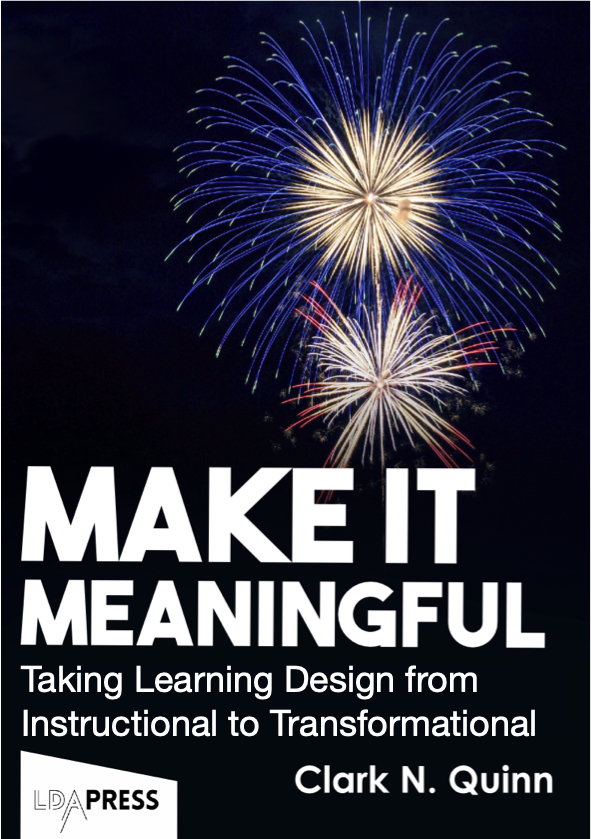
Now, I view Learning Experience Design as the elegant integration of learning science with engagement. My learning science book, along with others, does a good job of laying out the first part. But I felt that, other than game design books (including mine!), there wasn’t enough on the engagement side. So, I wanted a complement to that last book (though it can augment others). I wrote Make It Meaningful as that complement. In it, I resurrected the framework from my first book, but use it to go across learning design. (Really, games are just good practice, but there are other elements). I also updated my thinking since then, talking about both the initial hook and maintaining engagement through to the end. I present both principles and practical tips, and talk about the impact on your standard learning elements. In an addition I think is important, I also talk about how to take your usual design process, and incorporate the necessary steps to create experiences, not just instruction. I do want you to create transformational experiences!

So, that’s where I’m at. You can see my recommended readings here (which likely needs an update.) Some times people ask “what’s your next book”, and my true answer at this point is “I don’t know.”  Suggestions? Something that I’m qualified to write about, that there’s not already enough out about, and it’s a pressing need? I welcome your thoughts!

Lazy thinking?

21 November 2023 by Clark 1 Comment

Now, I’m the last who should throw stones. I can be quite guilty of lazy thinking, particularly when there’re commercial decisions to be made. (Providers have done a fabulous job of making sure you can’t compare apples to apples, and when there’re so many such situations…) Yet, there’s one place where I struggle with the consequences. That’s in our professional field, and it seems like there’re too many opportunities to yield.

A trigger was a recent conversation where an individual was talking about generations. Grouping folks by when they’re born is problematic at best. For one, the boundaries used seem to vary by who’s doing the categorizing. Not a solid basis. Moreover, the research suggests that there really aren’t meaningful differences. What do exist are explainable by age differences (which isn’t the same thing, for one it’s a continuum, not discrete chunks). Really, it’s a mild form of age discrimination, differentiating people by when they’re born, not who they are or how they behave. (Also problematic is the notion that events affect certain segments of the population, but that’s a longer conversation).  It’s one of the myths in my book on same.

Other examples include learning styles, hemispheres, gender differences, and more. First, they’re categorizations on things that people can’t control. Second, they don’t get backing from data. I just read that medical science has been excluding women from research based upon an assumption about temperature variability that was exposed as being irrelevant!

Sure, it’s much easier if we can reliably group people into segments that mean we have a reliable basis to do different things. Marketers do this with psychographics, for instance. Demographics can also matter. The problem here is that we’re using unreliable metrics. First, there are assumptions that turn out to be flawed. They frequently use self-report, also problematic. Some also have a flawed theoretical foundation.

Yes, it’s hard to keep on top of all of this. Ideally, you’d have time to investigate them all. In practice, there are other things to do. We all need ways to simplify our lives. Plus, vendors are telling you that they, at least, are immune to the complaints (with self-interest at stake).  On the other hand, there are good sources of insight from reliable translators of research. There are also practices we can follow to make it manageable. More help is on the way (at the LDA we’re working on it; stay tuned).

While lazy thinking is understandable, it’s not acceptable, at least not in our professional field. While we may not be sued for malpractice, we certainly should be responsible. So let’s avoid taking the easy path, at least when it matters. In our professional capacity, it matters when we’re designing for our learners. Let’s do so on evidence, not assumptions.

Make Meaningful Practice

11 July 2023 by Clark Leave a Comment

Last week, I gave a webinar with the CEO of Upside Learning on microlearning. In the commentary, one of the attendees pointed to the research of Pooja Agarwal. Turns out she’s worked with Roediger (one of the authors of Make It Stick, a book on my list). In a paper I found there, I found justification there for an approach I’ve advocated. My point is that we should make meaningful practice. Which is something I think we don’t focus enough on, so let me elaborate.

So, I argue that even for rote knowledge, you should retrieve in context and apply it. That is, I believe strongly in how Van Merriënboer talks about the knowledge you need and the complex problems you apply it to. That is, the knowledge underpins the ability to determine an appropriate approach and execute.  However, checking to see whether you have the knowledge can be either typical knowledge test or retrieval in some meaningful way. I think the former is boring, but it did seem to align with what learning science would imply.

Fortunately, in that paper (PDF), however, she tested and found that while lower level testing lead to better lower-level recall, it didn’t impact higher-level problem-solving.  Even a combination of low- and high-level questions wasn’t noticeably better than just higher-level question practice. So, if you want the higher-level skills, you practice them and that’s what’s necessary. Such questions require you to know the lower-level material, but don’t seem to need fact-checks.

Which, for experience design, is great news. My book on engagement suggested more meaningful practice. (It’s really on learning experience design, as it’s a complement to my learning science book. The final chapter talks about a design process for integrating learning science with engagement. ) What I proposed was to make practice meaningful by  retrieving information in the context of applying it. This is the case whether it’s mini-scenarios, branching scenarios, or full games.

FYI, if you’re seeking a face-to-face workshop talking about engagement, I’ll point you to my upcoming one at DevLearn in Las Vegas on October 24. The focus is on elegantly integrating engagement, including how to make meaningful practice, It received top ratings across the board when I ran it last year, so I am confident it’s worth it. I’m running a related workshop online right now, but at times most appropriate for the Asia-Pacific region, but if you’re interested, you might check it out.

The details matter

18 April 2023 by Clark 2 Comments

For many reasons, I end up reading relevant books to our field. A recent one underway is Wiggins & McTighe’s Understanding by Design. In it, I found a quote that really resonated. It highlights to me one of the biggest barriers I think we face, that the details matter. Not everyone will see this, however.

So, the quote is from Bransford, Brown, & Cocking’s masterwork, How People Learn, funded by the National Academies of Sciences. It chronicles what was known at the time about the subject of learning, aggregating learning science research. I don’t know if it’s true outside the US, but within you can get a free PDF copy!

Wiggins & McTighe’s book is a primary argument for working backwards. They’re not concerned with the pedagogy, but the planning. Of course, it also matters what your learning goals are. Thus, they also discuss what understanding means. That’s where this quote comes from:

Many approaches to instruction look equivalent when the only measure of learning is memory. …Instructional differences become more apparent when evaluated from the perspective of how well the learning transfers to new problems and settings.

This resonates because it highlights something I think we struggle with. To folks who don’t know any better, as I’ve argued before, well-produced, versus well-designed and well-produced, is hard to distinguish. As a respondent noted, we don’t always even test memory! Yet our goals should be (retention and) transfer.

I think the field has fallen into a superstition that information dump and knowledge test is learning! Which is mistaken, but if you don’t know any better, it’s hard to tell. Reckon we have to continue to focus on outcomes, measuring if  learning transfers to new problems and settings. When we do, we’ll have evidence to help make the case for learning that works. Then we can have the resources to pay attention, reflecting that the details matter. ‘Til then, we’ll continue to fight to do it right.

Pre-order for Make It Meaningful now available

21 April 2022 by Clark 3 Comments

I’m happy to report that the ebook version of my next tome, Make It Meaningful: Taking Learning Design From Instructional to Transformational, is now available for pre-order! Why should you care?  Here’s a pass at explaining, and you can decide whether a pre-order for Make It Meaningful  makes sense for you.

Why this book?

Here’s the marketing blurb:

Learning Experience Design is, as author Clark Quinn puts it, about “the elegant integration of learning science with engagement”. While there are increasing resources available on the learning science side, the other side is somewhat neglected. Having written one of the books on the learning science side, Clark has undertaken to write the other half. The book is grounded in his early experience writing learning games, then researching cognition and engagement, and ongoing exploration and application of learning, technology, and design to creating solutions and strategies. It covers the underlying principles including surprise, story, and emotion and pulls them together to create a coherent approach. The book also covers not just the principles, but the implications for both learning elements and a design process. With concise prose and concrete examples, this book provides the framework to take your learning experience designs from instructional to transformational!

I hope that suggests why I think it’s important. Further, here are the short versions of what some early readers had to say:

“…the right emotional engagement tactics can be effective, desirable difficulties. The book explains why and how, with good examples.”
Patti Shank, PhD Author of Write Better Multiple-Choice Questions to Assess Learning

“… the notion of engagement, and its true meaning, is like the mysterious fifth element waiting to be discovered and summoned through three words in this book: Make. It. Meaningful.”
Zsolt Olah, Senior Learning Technologist, Amazon

“…systematically reveals the secret sauce for creating impactful learning experiences…brings to light the missing emotional design dimension that separates instructional design from LXD. Highly recommended..!”
Les Howles, Co-Author, Designing the Online Learning Experience

“As a fan of Clark Quinn‘s books, I‘m happy to announce this is another winner. Make It Meaningful closes a gaping hole in instructional design models by showing how to address the emotions in learning design.”
Connie Malamed, Publisher of theelearningcoach.com

Going a wee bit further…

What’s included

There are two sections, the first on principles, the second on practice. Initially I cover a bit of basics about learning, how to ‘hook’ people, then how to extend the experience, and some tips and tricks. In the subsequent section I consider the implications for the different elements of learning design: introduction, concepts, examples, practice, and closing, and then the amendments to your design process to incorporate the necessary elements. Thus, I’m trying to be thorough.

Who this is for

This is a book for those who already know the basics of science-grounded design, and are looking to take their learning experience design to the next level. It’s about addressing the emotional side. To be sure, it  also  makes mention of the cognitive essentials, but it is first and foremost focused on the emotional side.

What else should you know?

This is the first offering from the Learning Development Accelerator (LDA)  offshoot, LDA Press. (Note: as Editor-In-Chief, I’m biased.) In my own words:

LDA Press, an imprint of the Learning & Development Accelerator, is a boutique publisher focusing on evidence-informed titles that fill needed gaps in the literature while offering authors the relationship they deserve.

Hopefully, my experience with publishers (as author and consultant), is a good start. Then, the rigor of academic training in writing and reading should provide a reasonable expectation of quality. Additionally, I’m also looking to make the prose comprehensible. Finally, we’ve engaged professional copy-editing. We’ll see how that plays out, but so far it’s seems like we’re on track. Also, we’re actively soliciting additional needed works.

A further point: we’re keeping costs low. Thus, print copies of Meaningful  will be 22.99 (discount for LDA members), and the ebook is only $10.99 (also a discount for LDA members), plus there’s a special discount for pre-orders! The book releases 16 May, both ebook and print, but the latter may take awhile since orders will only be available on that date.

I think this book is needed, and immodestly believe it’s one that I am capable to write. At any rate, now you know you can make a pre-order for Make It Meaningful. Whether that makes sense for you is something only you can determine.  We now return you to your regularly scheduled blog…


« Previous Page
Next Page »

Clark Quinn

The Company

Search

Feedblitz (email) signup

Never miss a post
Your email address:*
Please wait...
Please enter all required fields Click to hide
Correct invalid entries Click to hide

Pages

  • About Learnlets and Quinnovation

The Serious eLearning Manifesto

Manifesto badge

Categories

  • design
  • games
  • meta-learning
  • mindmap
  • mobile
  • social
  • strategy
  • technology
  • Uncategorized
  • virtual worlds

License

Previous Posts

  • August 2026
  • July 2026
  • June 2026
  • May 2026
  • April 2026
  • March 2026
  • February 2026
  • January 2026
  • December 2025
  • November 2025
  • October 2025
  • September 2025
  • August 2025
  • July 2025
  • June 2025
  • May 2025
  • April 2025
  • March 2025
  • February 2025
  • January 2025
  • December 2024
  • November 2024
  • October 2024
  • September 2024
  • August 2024
  • July 2024
  • June 2024
  • May 2024
  • April 2024
  • March 2024
  • February 2024
  • January 2024
  • December 2023
  • November 2023
  • October 2023
  • September 2023
  • August 2023
  • July 2023
  • June 2023
  • May 2023
  • April 2023
  • March 2023
  • February 2023
  • January 2023
  • December 2022
  • November 2022
  • October 2022
  • September 2022
  • August 2022
  • July 2022
  • June 2022
  • May 2022
  • April 2022
  • March 2022
  • February 2022
  • January 2022
  • December 2021
  • November 2021
  • October 2021
  • September 2021
  • August 2021
  • July 2021
  • June 2021
  • May 2021
  • April 2021
  • March 2021
  • February 2021
  • January 2021
  • December 2020
  • November 2020
  • October 2020
  • September 2020
  • August 2020
  • July 2020
  • June 2020
  • May 2020
  • April 2020
  • March 2020
  • February 2020
  • January 2020
  • December 2019
  • November 2019
  • October 2019
  • September 2019
  • August 2019
  • July 2019
  • June 2019
  • May 2019
  • April 2019
  • March 2019
  • February 2019
  • January 2019
  • December 2018
  • November 2018
  • October 2018
  • September 2018
  • August 2018
  • July 2018
  • June 2018
  • May 2018
  • April 2018
  • March 2018
  • February 2018
  • January 2018
  • December 2017
  • November 2017
  • October 2017
  • September 2017
  • August 2017
  • July 2017
  • June 2017
  • May 2017
  • April 2017
  • March 2017
  • February 2017
  • January 2017
  • December 2016
  • November 2016
  • October 2016
  • September 2016
  • August 2016
  • July 2016
  • June 2016
  • May 2016
  • April 2016
  • March 2016
  • February 2016
  • January 2016
  • December 2015
  • November 2015
  • October 2015
  • September 2015
  • August 2015
  • July 2015
  • June 2015
  • May 2015
  • April 2015
  • March 2015
  • February 2015
  • January 2015
  • December 2014
  • November 2014
  • October 2014
  • September 2014
  • August 2014
  • July 2014
  • June 2014
  • May 2014
  • April 2014
  • March 2014
  • February 2014
  • January 2014
  • December 2013
  • November 2013
  • October 2013
  • September 2013
  • August 2013
  • July 2013
  • June 2013
  • May 2013
  • April 2013
  • March 2013
  • February 2013
  • January 2013
  • December 2012
  • November 2012
  • October 2012
  • September 2012
  • August 2012
  • July 2012
  • June 2012
  • May 2012
  • April 2012
  • March 2012
  • February 2012
  • January 2012
  • December 2011
  • November 2011
  • October 2011
  • September 2011
  • August 2011
  • July 2011
  • June 2011
  • May 2011
  • April 2011
  • March 2011
  • February 2011
  • January 2011
  • December 2010
  • November 2010
  • October 2010
  • September 2010
  • August 2010
  • July 2010
  • June 2010
  • May 2010
  • April 2010
  • March 2010
  • February 2010
  • January 2010
  • December 2009
  • November 2009
  • October 2009
  • September 2009
  • August 2009
  • July 2009
  • June 2009
  • May 2009
  • April 2009
  • March 2009
  • February 2009
  • January 2009
  • December 2008
  • November 2008
  • October 2008
  • September 2008
  • August 2008
  • July 2008
  • June 2008
  • May 2008
  • April 2008
  • March 2008
  • February 2008
  • January 2008
  • December 2007
  • November 2007
  • October 2007
  • September 2007
  • August 2007
  • July 2007
  • June 2007
  • May 2007
  • April 2007
  • March 2007
  • February 2007
  • January 2007
  • December 2006
  • November 2006
  • October 2006
  • September 2006
  • August 2006
  • July 2006
  • June 2006
  • May 2006
  • April 2006
  • March 2006
  • February 2006
  • January 2006

Amazon Affiliate

Required to announce that, as an Amazon Associate, I earn from qualifying purchases. Mostly book links. Full disclosure.

We use cookies to ensure that we give you the best experience on our website. If you continue to use this site we will assume that you are happy with it.