Learnlets

Secondary

Clark Quinn’s Learnings about Learning

Search Results for: align

Curious about Curiosity

4 August 2020 by Clark 3 Comments

Looking into motivation, particularly for learning, certain elements appear again and again.   So I’ve heard ‘relevance’, ‘meaningfulness‘, consequences, and more. Friston suggests that we learn to minimize surprise. One I’ve heard, and wrestled with, is curiosity. It’s certainly aligned with surprise. So I’ve been curious about curiosity.

Tom Malone, in his Ph.D. thesis, talked about intrinsically motivating instruction, and had curiosity along with fantasy and challenge. Here he was talking about helping learners see that their understanding is incomplete. This is in line with the Free Energy Principle suggesting that we learn to do better at matching our expectations to real outcomes.

Yet, to me, curiosity doesn’t seem enough. Ok, for education, particularly young kids, I see it. You may want to set up some mismatch of expectations to drive them to want to learn something. But I believe we need more.

Matt Richter, in his well-done L&D conference presentation on motivation, discussed self-determination theory. He had a nice diagram (my revision here) that distinguished various forms of motivation. From amotivated, that is, not, there were levels of external motivation and then internal motivation. The ultimate is what he termed intrinsic motivation, but that’s someone wanting it of their own interest. Short of that, of course, you have incentive-driven behavior (gamification), and then what you’re guilted into (technically termed Introjection), to where you see value in it for yourself (e.g. WIIFM).
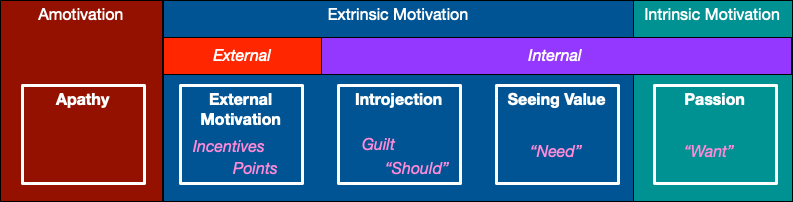
While intrinsic motivation, passion, sounds good, I think having someone be passionate about something is a goal too far. Instead, I see our goal as helping people realize that they need it, even if not ‘want’ it. That, to me, is where consequences kick in. If we can show them the consequence of having, or not, the skills, and do this for the right audience and skills, we can at least ensure that they’re in the ‘value’ dimension.

So, my take is that while we should value curiosity, we may not be able to ensure it. And we can ensure that, with good analysis and design, we can at least get them to see the value. That’s my current take after being curious about curiosity. I’d like to hear yours!
Mythless Learning Design

28 July 2020 by Clark 1 Comment

If I’m going to rail against myths in learning, it makes sense to be clear about what learning design without  myths looks like. Let me lay out a little of what mythless learning design is, or should be.

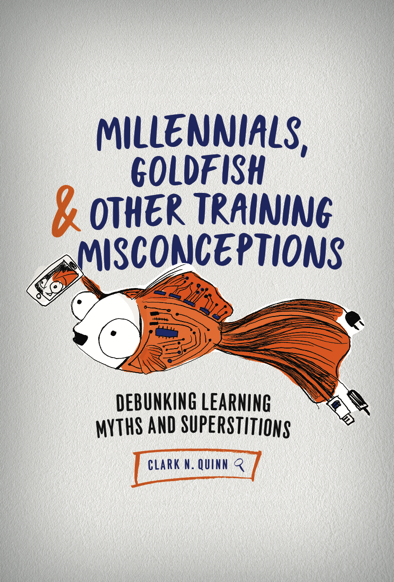
Myths book coverLearning with myths manifests in many ways. Redundant development to accommodate learning styles, or generations. Shortened to be appropriate for millennials or the attention span of a goldfish. Using video and images for everything because we process images 60K faster. Quiz show templates for knowledge test questions because they’re more engaging. And all of these would be wrong.

Instead, mythless design starts with focusing on  performance. That is, there’re clear learning outcomes that will change what people do that will affect the success of the organization. It’s not about knowledge itself, but only in service of achieving better ability to make decisions.

Then, it’s about designing meaningful practice in making those decisions. It’s not about testing knowledge, but ability to apply that knowledge to choose between alternative courses of action. It can be mini-scenarios (better multiple choice), branching, or sims, but it’s about ‘do’, not  know.

We reinforce practice with content that guides performance and provides feedback. It does use multiple media, because we use the right media for the message. Yes, we look to engage multiple senses, but for comprehending and encoding information. And variety. We use visuals to tap into our powerful visual processing system, not because they have any particular metric improvement. We also use audio when appropriate. And while text is visual, we use it as appropriate too. To address learning outcomes, not learner preferences.

Mythless learning design may use small amounts of content, but because minimalism keeps cognitive load in check, not because our attention span has changed. We need appropriate chunking, as our working memory is limited, so we want to make things as small as possible, but no smaller!

We design meaningful active practice not because any generation needs it, but because it’s better aligned with how our brains learn at pretty much any age. There are developmental differences in working memory capacity and experience base, but  everyone benefits from doing things, not passively consuming content.

There are good bases for design. Ones that lead to real outcomes. Starting from a performance focus, and reflecting what’s been demonstrated in learning science research, and tested and refined. Evidence guiding design, not myths.

There are also bad bases for design. Dale’s Cone, shiny object syndrome, the list goes on. Gilded bad design is still bad design. Get the core right. Let’s practice good, mythless learning design. Please.


Practicing the Preach

21 July 2020 by Clark 4 Comments

I’m working on my next plan for global domination. And as I do, I’ve been developing my thinking, and there are some interesting outcomes. Including a realization that I wasn’t doing what I usually recommend. And I also believe that you should ‘show your work‘. So here I’m practicing the preach.

First, I’m developing my understanding, getting concrete about it. I usually use Omnigraffle as a diagramming tool, to represent my conceptual understandings. And I started doing that as part of the ‘developing thinking’ part. But I started with a diagram, and took the elements out and mindmapped them, and threw in other bits. In short, the ‘diagram’ has become a visual place to store bits and pieces of different diagrams, representations, mindmap, prose, or more. As well as outlining elsewhere. But it’s working out for me, so I thought I’d share.

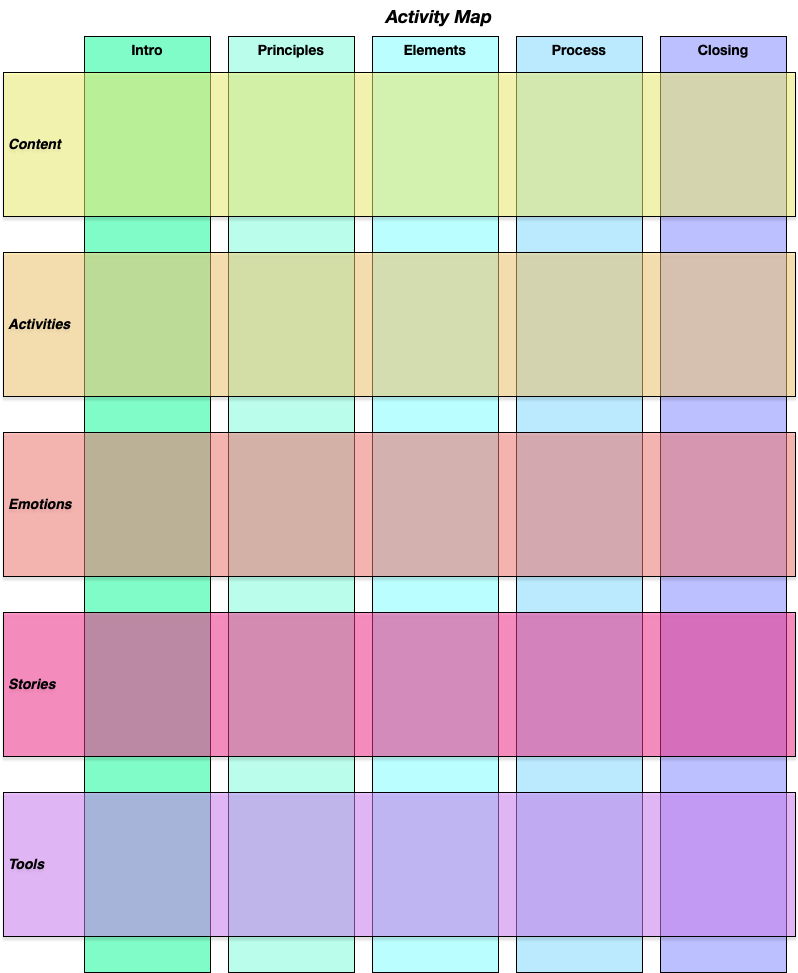
The overall visualization gives me a place, like a business canvas, to drop stuff on and rearrange. It’s a ‘thinking tool’. I’m also copying part of the the activity map and linking things together to capture the actual flow between content and activities. Etc. A virtual whiteboard, I guess.

Second, one of the things to represent was how this would be communicated. Whether a course, or interactive ebook, or whatever, I want to create a flow. And I realized an activity map might make sense. I haven’t done this before (I’ve used storyboards and diagrams), but I find it interesting. Here’s the current status.

Across the top are the various stages (Introduction, the Principles, the resulting learning Elements, the associated Process, and the Closing). Your stages may vary.  Along the side are the different components (the Content topics, the associated practice Activities, the Emotions I to be evoked, the Stories to tell, and the Tools). I think putting in ’emotion’ is an important step! And then I can drop text bits into the intersections.

Finally, as I started developing the associated content, I realized one thing I advocate is backwards design. That is, envision the performance and how it’s distributed across tools and brains. Then, I realized I hadn’t designed the tools first! I’m going back and doing that. So it’s now in the activity map as well ;).

Just thought I’d share this, practicing the preach, and hope that you find it interesting, if not useful. Feedback welcome!


Thinking about reframing

14 July 2020 by Clark 2 Comments

I found something interesting, and wanted to share, but…I realize this is supposed to be about my learnings about  learning. So, I’m framing it as thinking about reframing ;). Seriously, it’s about extant models and opportunities to rethink.

So, to begin with, I’ve been somewhat frustrated with the traditional model of capitalism. No, not as a plea for communism or something, but because it doesn’t align with our brains. When I champion that we should align with how we think, work, and learn, that’s true at the individual, team, organizational, and societal levels.

The problem is, capitalism assumes that we’re optimizing buyers. That is, we will search out and buy the best products, so there’ll be consistent pressure for quality, and this drives improvement. A lovely theory. With only one small flaw…

We’re not optimizing buyers. Herb Simon was part winner of a Nobel prize (kinda before he went on to be a leader in the cognitive science field) on the fact that we’re satisficing buyers, not optimizing. That is, we’ll buy ‘good enough’. I’ve used the fish shop story to document this. We know how to make light, crispy, non-greasy fish’n’chips. So, the capitalist model would posit that every shop should have beautiful fish. Er, no. You’re just as (more?) likely to find greasy sodden fish. Because we’re not likely to drive one borough/neighborhood/town over to get perfect when what’s close is ‘good enough’.

You can get backup from behavioral economics or the work of Daniel Kahneman about how we aren’t logical beings. The point being, we don’t behave in rational ways. For instance, we’re vulnerable to marketing that affects our perceptions. And economics is linked to politics about whether all the real costs are included. Thus, the fundamental foundation of capitalism is flawed.

As an aside, it’s also predicated on unlimited growth. That is, we’ll continually advance in our ability to meet needs. Yet we live on a finite planet…and yes, I know that there are also technological advances. It’s just that I reckon there are limits to growth.

A serious problem is that the alternatives are also flawed. Capitalism proposes that it passes back by the creator of the superior end product purchasing the components and that cascades backwards. However, to change it, e.g. to track based upon the value of a person’s contribution to the greater good, we’d need bookkeeping to track it.

What I hit a wall against was working within the assumptions. And yet, maybe there’s another way, that is thinking about reframing the problem. Just as I previously talked about replacing happiness with contentment, maybe we can rethink economics. If we think about it differently, can we come up with a different model.

Something pointed me to doughnut economics. And it’s not a full solution, but it does have some interesting properties. The reason it’s called the doughnut model is that there’s a hole in the center, then the body, and then the external limits. The hole consists of the basic capabilities humans need: clean water, reliable and healthy food, etc. This, to me, is kind of the ‘aligning with us’. Then the outside are the practical limits: finite planet, limits on water, energy, air, etc. Between these two are where humans can (and should) live.

It’s a different way of looking at things. I’m not an economist by any means (I find it aversive ;), but I do like looking at society in ways that might make it better. And this model, as far as I know, doesn’t have a clear path to replace our current economic system (e.g. prices on goods). But it’s way of rethinking what matters that’s somehow closer to how we really exist.

The take-home for learning, of course, is being willing to step back and reframe what we think we know. Different perspectives enable different insights. It’s part of the creative process to diverge before you converge. So here’s hoping we can find ways to be thinking about reframing. What ways do you use to think afresh?

Losing our collective minds?

7 July 2020 by Clark 3 Comments

microscopeSo, after that mess on Twitter, I next see on LinkedIn a recognized personage who proceeds to claim that learning styles are legit, and promises a post (see tomorrow’s review). And, the basis for this claim is fundamentally wrong. So I’m beginning to fear that we’re losing our collective minds!   Let me be clear about the claim, the problem, and a healthy approach.

The claim started like this:

I know there is a huge camp of folks who say no one has learning styles and they provide all types of links of others who concur. Then there are folks who say they do exist, and change of a period of time (as you age). And you may have more than one.

I admit I am in the latter group, because I have seen it first-hand as a Director of Training, and when I taught at the HS and University levels.

And, this is a problem, because it misrepresents what’s going on. My response was:

Sure, learners differ, no one who’s taught can say otherwise. But, identifying how they differ, reliably? Er, no. And that we should adapt to learning styles? Again, not what research says. And, to be clear about the ‘huge camp’ (why would that be?), we don’t post links to others who concur, we post links to the science that shows that the instruments to measure styles aren’t psychometrically valid and that the evidence shows no benefit to adapting to learning styles. A waste of time and money.

When called out, the response was similar:

You have perspective, I respectfully disagree.

What this response did was suggest that it’s about opinion. Which is not just irritating, but it’s  dangerously wrong. I’ve argued before about why myths matter. And, here, specifically, learning styles can cause you to waste money, but more importantly it may have people prematurely limit themselves. To their detriment.

But it’s also the refusal to acknowledge that it’s science, not opinion. Saying, basically, that the folks against learning styles support each other is very different, and wrong. We don’t point to each other, we point to the research!

It gets worse. The commentary on the post went sideways. Despite some apt questions about the legitimacy, there were counter opinions. One comment brought in neuro-linguistic programming! (Debunked, by the way.) It’d be funny if it weren’t so scary!

And, then, the followup, I have ‘perspective’. Sorry, but it’s not about your opinion versus mine. That may work for fashion, art, cinema. Not what we do in medicine, hazardous material, construction, flight, and the like. Even traffic! We follow what’s been demonstrated to save lives (or we should). When we get into the absurd situation of saying your anecdotal evidence is better than the weight of scientific evidence, we’re on a slippery slope to losing our collective minds.

Look, you can prefer vanilla to chocolate. You can like pineapple on your pizza. Or even put ketchup on your hotdog. (Quelle horreur!) I can differ. No one’s hurt. But if you yell ‘fire’ in a crowded theatre, or advise consuming disinfectant as a virus cure, or using nuclear waste as a skin lotion, you’re violating what’s known. And it’s wrong, if not outright illegal.

Please, be skeptical. Even of what I say! (The scientific method does have its flaws, but it’s better than everything else.) But please value controlled studies over anecdotes. There are lots of ways we can be misled by the latter. We don’t want to be losing our collective minds, we should be leveraging them. Please help!

ITA Jay Cross Award 2020

5 July 2020 by Clark Leave a Comment

The Internet Time Alliance Award, in memory of Jay Cross, is presented to a workplace learning professional who has contributed in positive ways to the field of Informal Learning and is reflective of Jay‘s lifetime of work.
Recipients champion workplace and social learning practices inside their organization and/or on the wider stage. They share their work in public and often challenge conventional wisdom. The Award is given to professionals who continuously welcome challenges at the cutting edge of their expertise and are convincing and effective advocates of a humanistic approach to workplace learning and performance.
We announce the award on 5 July, Jay‘s birthday.
Following his death in November 2015, the partners of the Internet Time Alliance (Jane Hart, Harold Jarche, Charles Jennings, and Clark Quinn) resolved to continue Jay‘s work. Jay Cross was a deep thinker and a man of many talents, never resting on his past accomplishments, and this award is one way to keep pushing our professional fields and industries to find new and better ways to learn and work.
The Internet Time Alliance Jay Cross Memorial Award for 2020 is presented to Andrew Jacobs.
Andrew is determined that learning and development should be an integral part of business activity. He is currently employed in a challenging position inside the UK government. But Andrew continues to blog at ‘Lost & Desperate’ [  https://lostanddesperate.com/  ] In 2013 his blog  was one the 50 most socially-shared learning and development blogs. In spite of his work demands, Andrew continues to share through his blog and on Twitter. He also speaks at industry events and shares what he has learned. In his previous work, Andrew became an expert at improving workplace learning with almost no budget.
Much in the spirit of Jay Cross, Andrew is constantly questioning the status quo. In his own words —
“If LnD help them learn, they won‘t need learning.
 
If they don‘t need learning, LnD aren‘t required.
 
Therefore, to be required, LnD shouldn‘t help them learn.
 
Why do LnD still market a once and done approach to learning?
 
Can‘t sell? Learn this.
 
Can‘t comply? Learn this.
 
Can‘t coach? Learn this.
 
Can‘t manage? Learn this.
 
Can‘t lead? Learn this.”
It is with great pleasure that we present the fifth annual Internet Time Alliance Jay Cross Memorial Award to Andrew Jacobs. Andrew will be presented with the award later this year in the city of London.

Myths, publishers, and confusion

30 June 2020 by Clark 5 Comments

Myths book coverOn twitter the other day, I was asked how I could on one hand rail against myths, and on the other work with orgs who either sell or promote DiSC and MBTI. The problem, it appears, was a perception that I’m deeply involved with orgs that perpetuate the problem. I thought I’d try to clarify all this, and make sense of myths, publishers and confusion.

The dialog started as a reaction to an article I pointed to on twitter. This article made what I thought was a pretty good case against tools like MBTI and DiSC. And that matters. The arguments raised in the article were legitimate, and even didn’t go far enough. For instance, MBTI is based on Jungian archetypes, which Jung just made up!   So, one question raised is why ask practitioners to change, why aren’t we challenging the businesses?

For one response, I don’t call out the practitioners. I sympathize!   In the myths book, I deliberately addressed the appeal before pointing out it’s wrong (and, importantly, point to better alternatives). Instead, I rail against the tools. That, to me, is where the problem lies, and implicitly indicts the vendors. Now, the org that now owns DiSC was my first publisher. However, they bought it after I was locked into a contract with them. And when I heard, I complained about the choice to them. But they didn’t consult me on it ;).   And yes, they published my first 3.5 books. I dissociated from them on other reasons, but I’m no longer engaged.

Was there any relationship between DiSC and what I wrote? I was able to complain about learning styles in my fourth book with them. It’s a huge company, with many different divisions. There’s no provision to not say things that are contrary to their business interests. They publish and sell what they can sell. They can publish what’s right, and sell stuff that’s not. That’s their confusion, I reckon, not mine.

I’m now publishing with another org, who had, in the past, had learning styles in their competency model. When I found out, I asked and was told it was not in the latest version of the model. They also do make money selling exhibit space to folks with these tools. Note that the folks I work with may not agree, but also have to work in their part of the org and have little contact with the other entity (that makes much money). Yet, to their credit, they asked me to write the myths book. In fact, after I gave a myths talk to launch the the book, an anonymous audience member complained that they shouldn’t have speakers that disparage vendor products. And, they’ve continued to have me write and speak. Again, I suggest that’s their issue, not mine. I’m not responsible for that relationship between myths, publishers, and confusion.

And, yes, there are voices that cry out  for the tools. For instance a TD article claimed that such tools are popular. (Under the guise of saying they’re effective.) Which is problematic. Asking folks for their assessments of tools they’ve invested in introduces a clear source of bias. We know that people’s judgments of effectiveness may not match reality. So it’s a problem. But not one I’m in a position to change (though I quietly try).   It does muddy the water. Which, to me, speaks even more to talk about how to review science and what science already says.

I try to be a consistent voice for science in our practice. My publisher gave me a forum to speak that to an audience that needs to hear the message. There are others who echo that voice (see Mythbusters here). I’d welcome having the opportunity to address those who are making the decisions to buy these tools. I don’t have reliable access (I welcome any assistance ;). Instead, now they can give the book to those leaders to bolster the resistance.

So, are my publisher activities part of the business end, or the education end? Do you really concern yourselves with my previous relationship or current publisher? I note that it’s pretty much a hands-off relationship: “if you propose a valuable offering, we’ll publish it.”

I‘m saying “here‘s what Quinnovation has to say” and the orgs are endorsing it. Not the other way around. Is that accurate? Do you see that as a conflict? I’m perfectly willing to be wrong, and if so I welcome ideas how to be more clear about what and how it’s wrong.

I think I’m fighting a good fight, for the right reasons, and pretty much in the right way. But it’s not my perspective that matters. So I ask you, am I off the mark here? Am I helping or hurting the issues in myths, publishers, and confusion?

Wanna talk meaning, learning science, and more…?

22 June 2020 by Clark Leave a Comment

The L&D conference, starting today, has a wide variety of things going on. I’m actually impressed, because in addition to the asynchronous and synchronous sessions I knew about, there are a number of other things going on. Including things I’m in. So, do you wanna talk meaning, learning science, and more…? Here’s when and how.

In addition to the presenters who have prepared asynchronous learning experiences, and the live presentations by the same and others, there are other things going on. There are panels on, for instance, on diversity & inclusion, state of learning, learning technology, women in learning, as just a few. There are also debates on games, evaluation, to e- or not to e-, at least. Lots of interesting topics. But wait, there’s more!

There are also networking sessions, a quiz show, roundtable breakouts, breakfast/cocktail (depending on timezone) networking, … There are also some interviews with prominent folks, both specifically for the conference and some legacy ones courtesy of Guy Wallace (HPT guru). And there’s either or both of more I don’t know about, and more to come.

A special mention for the CrowdThinking project, in collaboration with IBSTPI. My colleague, Fernando Senior, will be leading an event to understand the current and anticipated requirements for L&D roles. And there’s a survey you’re requested to fill out regardless of whether you’re attending the conference. Please help!

As for me, first, my asynchronous session is on Learning Science 101. I’ve created some short videos that talk about, and illustrate, a number of things our cognitive architecture has to account for. And, hint hint, it presages something hopefully to be announced soon.

My synchronous sessions (two different times; they’re making a serious effort to reach out globally) are 3PM ET (noon PT) Wed July 1, and 11AM ET (8AM PT) on July 8. Here, I’ll be talking about what I think is a huge missed opportunity and addressable (tho’ not simple) element of our learning design. I’ll also be part of the panel on learning science (The State of Learning) 8AM PT July 9 and 11 AM PT July 17. And, a reprise of the great debate on evaluating learning or impact (4PM PT 25 June).

And, importantly, I’ll be holding some office hours where we can truly talk about learning science, meaningfulness, and more! So will the other presenters. (They’re still to be set; I’ll update here when I know!)

Of course, there is a host of other really great speakers. Have a look at this lineup! Also, guests for a variety of things will include people like Charles Jennings & Jos Arets, Paul Kirschner, and many many more. Most of the live sessions have two times, so there’s a good chance you can catch them sometime. And there’s no overlap (so far ;), but things going on every day.

If, by the way, you are thinking about attending the  conference, but have some struggles with cost, get in  touch  with me. I may have a way to help out ;).   I hope to see you there, whether you want to be talking meaningful learning, or for any of the other myriad reasons.

As you can probably infer, I’m interested in this. It’s not surprising, but most online events have mimicked face-to-face events. Webinars, basically. Here there’s more going on. I don’t expect all of it to work (though it all sounds good), but I love that they’re experimenting to find ways to go beyond. We’ll all learn from this initiative. Hope to see you there if you wanna talk meaning, learning science, and more…


Making learning meaningful?

2 June 2020 by Clark 5 Comments

So, last week, I asked the musical question: where are we going most wrong? I followed that up asking what most would help.   I also suggested   that I had my own answers.   So I have answers for each. My answer for the first part, where we’re going wrong, is somewhat complex. But for the second, I’m  thinking that the biggest opportunity is making learning meaningful. My thoughts…

So, where we go most wrong is, to me, tied together. I think it’s mostly that we’re starting on the wrong foot. We’re not ensuring that we’re addressing the real problem. We take orders for courses, and then take what the experts tell us needs to be in. This gives us the wrong objective, the wrong content, and the wrong practice!

I’ve suggested that measurement might be the best solution for this. If we measured our impact (not our efficiency), that drives us to focus on things were we can make a difference.   Time for a shout out to Will Thalheimer and LTEM (or whatever it becomes). Or use appropriate techniques instead of throwing a course at everything.

If we had the right objective, there’s still the challenge of making sure we’re talking about ‘do’, not  know.  However, I think it’s less likely.

Most importantly, I think there’s good support for evidence-based learning design. Whether it’s Michael Allen, Julie Dirksen, Cathy Moore, Patty Shank, Mirjam Neelen, or someone else, there’s good guidance for design. Basically, how to create practice that aligns with outcomes, resource with models and examples, etc.

One area, however, I think we reliably get wrong  and there’s not as much guidance for, is making learning meaningful. Not only is Keller the only ID theorist talking about the emotional side, there’s not much other systematic guidance. Rance Green’s new book on instructional story design gives a good stab, but I think there’s more. And while Nick Shackleton-Jones book has some good ideas, his model also has a fundamental flaw.

And I  have addressed this. My book  Engaging Learning was about designing games for learning, but the alignment at the core is applicable to making learning personally relevant. And, of course, my thinking’s continued. I’ve been digging in deeper into the emotional side.

So, my thinking is that this might be an area to really unpack and get concrete about. It’s been part of my approach to LXD, but I’m wondering about not trying to cover all the learning science, and focus on the unique elements of engagement. I’m signed up to speak on it at the Learning and Development Conference, but the question is whether I start doing more. Should I focus on making learning meaningful? And I really, really welcome your thoughts on this!


Where are we going most wrong…

26 May 2020 by Clark 4 Comments

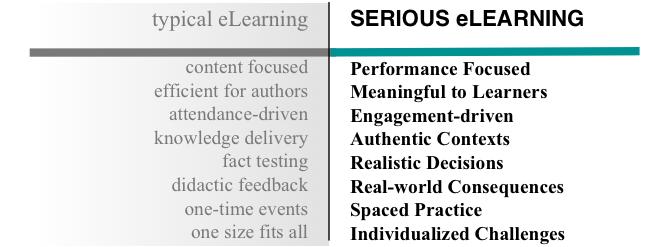
…and what’s most important to fix?   I was a co-conspirator on the Serious eLearning Manifesto, and we identified 8 values that separated typical elearning from serious elearning. However, I suspect that not all are as important, nor hard to fix. And, thinking about what my unique contribution could and should be, I wondered where best to target my efforts to avoid going most wrong. I have some thoughts, but…

First, I’d like to ask you two questions:

  1. What are the best inflection points to improve learning?
  2. Which would you most want to have help in addressing?

Note that they might be two completely different things.

Now, it could be a number of things.   Any one of the eight could be problematic. And it might be another that’s where you most would like help.

Is it getting the right objectives in the first place? We might fail to do the proper performance consulting. Thus, we’d be developing learning solutions that aren’t going to meet the need.

Another possibility is that we’re not providing the right support. We’re not providing useful models and examples instead of a content dump with what’s to hand.

We might not be helping learners understand why they should care. Are we missing out on developing motivation? Making it meaningful?

Another problem might be giving them abstract concepts instead of concrete practice. Are we asking them to do things in situations they recognize?

Also, we could be asking for them to recite knowledge back to us instead of applying it. Are we asking them to make decisions like we need them to make after the learning experience?

And we might be giving them simple feedback like “right” and “wrong” instead of providing them first with the consequences of their actions. And, we could be ensuring that the alternatives represent some real ways people go wrong, and providing feedback that addresses those specific misconceptions.

There’s also the possibility (probability?) that we’re not spacing out the learning. We could still be using the ‘event’ model, not reactivating the knowledge as appropriate.

And, of course, we might not be individualizing the challenges. We could be adapting to demonstrated learner capability. Are we?

Not only might one or more of these be the biggest contributor to a lack of learning impact, but some might be more challenging than others to address. And, of course, which ones should I be focusing on? I do address all in a variety of ways (c.f. the learning science 101 session I’ll be doing for the Learning Development Conference), but I’m thinking of focusing in.

And I have an idea where we may be going  most wrong. But first, I’d like to hear your ideas. I’ll weigh in next week. And, of course, I could be wrong. So let me know!


« Previous Page
Next Page »

Clark Quinn

The Company

Search

Feedblitz (email) signup

Never miss a post
Your email address:*
Please wait...
Please enter all required fields Click to hide
Correct invalid entries Click to hide

Pages

  • About Learnlets and Quinnovation

The Serious eLearning Manifesto

Manifesto badge

Categories

  • design
  • games
  • meta-learning
  • mindmap
  • mobile
  • social
  • strategy
  • technology
  • Uncategorized
  • virtual worlds

License

Previous Posts

  • March 2026
  • February 2026
  • January 2026
  • December 2025
  • November 2025
  • October 2025
  • September 2025
  • August 2025
  • July 2025
  • June 2025
  • May 2025
  • April 2025
  • March 2025
  • February 2025
  • January 2025
  • December 2024
  • November 2024
  • October 2024
  • September 2024
  • August 2024
  • July 2024
  • June 2024
  • May 2024
  • April 2024
  • March 2024
  • February 2024
  • January 2024
  • December 2023
  • November 2023
  • October 2023
  • September 2023
  • August 2023
  • July 2023
  • June 2023
  • May 2023
  • April 2023
  • March 2023
  • February 2023
  • January 2023
  • December 2022
  • November 2022
  • October 2022
  • September 2022
  • August 2022
  • July 2022
  • June 2022
  • May 2022
  • April 2022
  • March 2022
  • February 2022
  • January 2022
  • December 2021
  • November 2021
  • October 2021
  • September 2021
  • August 2021
  • July 2021
  • June 2021
  • May 2021
  • April 2021
  • March 2021
  • February 2021
  • January 2021
  • December 2020
  • November 2020
  • October 2020
  • September 2020
  • August 2020
  • July 2020
  • June 2020
  • May 2020
  • April 2020
  • March 2020
  • February 2020
  • January 2020
  • December 2019
  • November 2019
  • October 2019
  • September 2019
  • August 2019
  • July 2019
  • June 2019
  • May 2019
  • April 2019
  • March 2019
  • February 2019
  • January 2019
  • December 2018
  • November 2018
  • October 2018
  • September 2018
  • August 2018
  • July 2018
  • June 2018
  • May 2018
  • April 2018
  • March 2018
  • February 2018
  • January 2018
  • December 2017
  • November 2017
  • October 2017
  • September 2017
  • August 2017
  • July 2017
  • June 2017
  • May 2017
  • April 2017
  • March 2017
  • February 2017
  • January 2017
  • December 2016
  • November 2016
  • October 2016
  • September 2016
  • August 2016
  • July 2016
  • June 2016
  • May 2016
  • April 2016
  • March 2016
  • February 2016
  • January 2016
  • December 2015
  • November 2015
  • October 2015
  • September 2015
  • August 2015
  • July 2015
  • June 2015
  • May 2015
  • April 2015
  • March 2015
  • February 2015
  • January 2015
  • December 2014
  • November 2014
  • October 2014
  • September 2014
  • August 2014
  • July 2014
  • June 2014
  • May 2014
  • April 2014
  • March 2014
  • February 2014
  • January 2014
  • December 2013
  • November 2013
  • October 2013
  • September 2013
  • August 2013
  • July 2013
  • June 2013
  • May 2013
  • April 2013
  • March 2013
  • February 2013
  • January 2013
  • December 2012
  • November 2012
  • October 2012
  • September 2012
  • August 2012
  • July 2012
  • June 2012
  • May 2012
  • April 2012
  • March 2012
  • February 2012
  • January 2012
  • December 2011
  • November 2011
  • October 2011
  • September 2011
  • August 2011
  • July 2011
  • June 2011
  • May 2011
  • April 2011
  • March 2011
  • February 2011
  • January 2011
  • December 2010
  • November 2010
  • October 2010
  • September 2010
  • August 2010
  • July 2010
  • June 2010
  • May 2010
  • April 2010
  • March 2010
  • February 2010
  • January 2010
  • December 2009
  • November 2009
  • October 2009
  • September 2009
  • August 2009
  • July 2009
  • June 2009
  • May 2009
  • April 2009
  • March 2009
  • February 2009
  • January 2009
  • December 2008
  • November 2008
  • October 2008
  • September 2008
  • August 2008
  • July 2008
  • June 2008
  • May 2008
  • April 2008
  • March 2008
  • February 2008
  • January 2008
  • December 2007
  • November 2007
  • October 2007
  • September 2007
  • August 2007
  • July 2007
  • June 2007
  • May 2007
  • April 2007
  • March 2007
  • February 2007
  • January 2007
  • December 2006
  • November 2006
  • October 2006
  • September 2006
  • August 2006
  • July 2006
  • June 2006
  • May 2006
  • April 2006
  • March 2006
  • February 2006
  • January 2006

Amazon Affiliate

Required to announce that, as an Amazon Associate, I earn from qualifying purchases. Mostly book links. Full disclosure.

We use cookies to ensure that we give you the best experience on our website. If you continue to use this site we will assume that you are happy with it.