Learnlets

Secondary

Clark Quinn’s Learnings about Learning

Search Results for: align

About this change to the site…

7 February 2018 by Clark 3 Comments

So, I’d been unhappy with how hard it was to update my site. It had some problems, but I was afraid to change it because of the repercussions. Well, it turns out that’s not a problem! So what you see is my first stab at a new site. A little background…

My ISP, a good friend, colleague, and mentor, was making some changes to how my sites are implemented.  While my other sites (Quinnovation and the book sites) are all done in a WYSIWIG tool called RapidWeaver, Learnlets is a WordPress site. While I could do a blog  in Rapidweaver, I’m afraid I’d lose my decade+ of posts!  So, I’ve kept it in WordPress.  And that’s handy for updating the site when I’m on the road (e.g. for mindmaps).

However, my ISP, in addition to being a tech guru, is also a security guru.  He does tech for a living, and is kind enough to host me as well. To prevent some of the attacks that were happening to WordPress sites (hey, write a script that hammers WordPress vulnerabilities and point it to all their sites you can find), he instituted some security measures. One was that I couldn’t get into the PHP code for my sidebar!  It made sense, because if anyone could get access to my admin code, they could not only change the look and feel (easy to fix), they could alter the code and put in malicious stuff. Not good. But…

I’d cobbled it together with cut-and-pasted code, but now I couldn’t edit it without downloading the raw source (once I could find the file in the WordPress hierarchies), editing it, and uploading.  I couldn’t even access the sidebar editor!  I had a second login for upgrading the site, but it wouldn’t allow access to things I wanted to customize. And I have a bad habit of tinkering!  As things happen, I might want to add an image, or…what have you.

So, with this upgrade, I mentioned my problems with the site, and he installed some new themes I could play with.  And, I found, it was pretty much click and type to create a new sidebar. Suddenly, it’s  easy to change the site, without coding!  It’s not perfect, but it’s better for mobile (a friend had complained about that).

As evidence, somehow it seized up in the midst of creating the first draft.  I was going to have to  re-create the new site!  First, it would’ve been easy. I’d created most of the graphics and put them in a location.  And, it remembered my previous choices, and restored them so I didn’t have to!

I asked my lad, who has a good digital aesthetic, to give me feedback on two of the options my colleague installed, and he liked this one, with a suggestion on the background (not a stock photo).  I’m using the background image from the  Designing mLearning book cover, but that can be changed.  He didn’t like the idea of the bag of bulbs from the Quinnovation site, as he thought it was ‘stock’. I  think it’s aligned with the notion of Quinnovations (or I wouldn’t have used it), and so too with Learnlets, but in honor of his opinion I’m sticking with this for now.  And I appreciate that he shared his thinking!

Now that I have a draft up, what’s working and what’s not?  I still need to figure out a way to let folks sign up for Learnlets as an email feed (beyond RSS, but through Feedblitz, the service I use), but other than that it’s pretty much the same. And easier to tweak! (E.g., I have subsequently gone to the Feedblitz site, used their tool to create the widget HTML code, and it’s now on the sidebar as well.)

So, the question is, what  should I tweak?  I’ll definitely listen on usability issues, and I’ll consider aesthetic ones ;).  Regardless, thought I’d share the rationale and the process, because that’s what ‘working out loud’ is, and I think it’s part of the moves we need to see. And in return, getting feedback. So, what doesn’t work for you?
At the edge

31 January 2018 by Clark 4 Comments

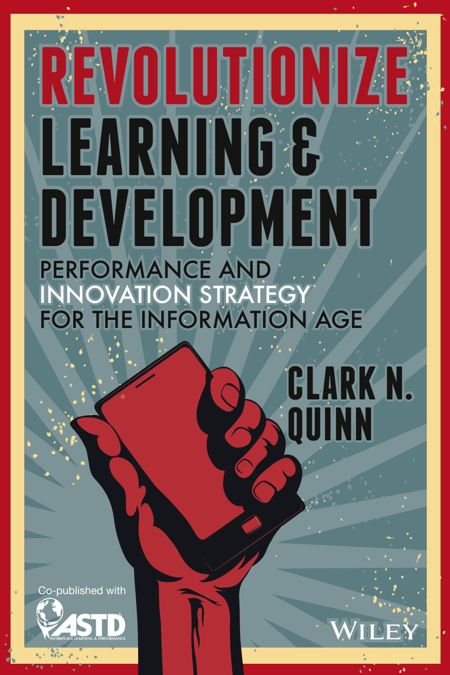
Revolutionize book coverAnother response to my request for topics asked about moving from the classroom to the ‘fringe’.  Here, I have a very simple response: the case studies in Revolutionize Learning & Development. Each was chosen and structured to talk about the context, specific situation, the plan, the results, and advice.  Each also represents a diversity of settings and needs.  These represent some folks working at the edge, away from the ‘event’.

Mark Britz, facing more experts than novices, structured his corporate university as a network, not a series of courses.  Communities of Practice served as a model for this thinking.  This included and Enterprise Social Network and a Knowledge Management system.

Jos Arets and Vivian Heijnin at Tulser talked through a case study working with a medical care organization.  The problem was too much hierarchy. Using a Human Performance Improvement approach, they decentralized the work to more self-directed teams.  The solution includes continuous assessment, mobile performance support, and coaching.

Coaching also played a role in the case study Jane Bozarth provided.  The issue was solving workplace problems. Instead of courses, the solution connected those with demonstrable skills to mentor those who could benefit.  A ‘yellow pages’ to find ‘in the moment’ help was also a part.

For an internal self-help solution, Allison Anderson developed a community of practice with events, portal, and a networking platform. Here, the issues was getting disparate groups performing similar functions (L&D) to share best principles.

I had Charles Jennings recount his actions while serving as CLO in a global organization. With a mantra of ‘from event to process’, he used the 70:20:10 framework to rethink a balance of ‘push’ and ‘pull’ services.

In the book, they tell the stories in their own words. They unpack the thinking behind their choices, ‘showing their work’.  The contributions are very valuable, and I’m very grateful that they agreed to share them.  For that matter, you should find and track these folks!

Each of these were chosen as exemplary of the type of thinking that takes us from the old model to the ‘edge’. We want to be looking holistically at how people think, work, and learn, and aligning our infrastructure (policies, technology, procedures, and culture) accordingly.  This is the L&D part of a larger push to make the workplace more effective by making it more humane (read: more aligned with  us).


Busting Myths!

30 January 2018 by Clark Leave a Comment

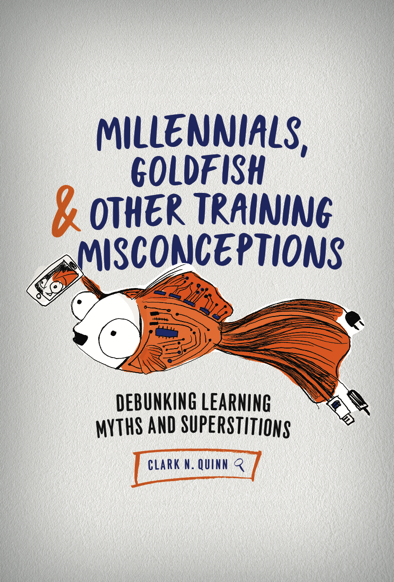
Myths book coverAs I have hinted, I’ve been working on a project that is related to what learning science has to do with learning design.  And I can finally announce the project!  I’ve been writing a book on debunking learning myths & superstitions, and unpacking some misconceptions. I’m happy to say that it’s finally available for pre-order (ATD members here, Amazon here). It’s myth-smashing time!

The focus here is on workplace learning, as the title suggests. There already has been a book oriented toward the education market, but this one is particularly focused on myths that impact learning & development. The title is Millennials, Goldfish & Other Training Misconceptions:  Debunking Learning Myths and Superstitions.   There are 3 major categories of things addressed:

  • Myths: beliefs that are the source of effort and investment that have been proven to be false.  It’s surprising how many there are, but they persist. I have addressed 16 of them.  I talk about the appeal, the possibilities and problems, how research could answer the question, and what the research says.
  • Superstitions: these are practices that aren’t really advocated, but continue to be observed in practice. And they’re not necessarily the subject of specific research, but instead we can make principled arguments against them. I have documented five of these, with the approaches, the plausible case, and why it’s not accurate.
  • Misconceptions: these are topics that are hotly debated, with typically smart people on both sides, but yet contention remains.  After identifying what both sides are arguing, what I try to point out is what is worth taking away. Or when it’s useful.

In each case,  I identify what you  should be doing.  The point is not to just point out the flaws, but have us using good approaches.  And have a wee bit of fun ;).

This book is very much intended as a tool. It’s to pull out when you have a question, and very specifically when someone wants to push you to do something that’s contrary.  It’s a reference tool that you should have on your shelf for when these questions arise.

While the book won’t be available ’til late April, I can now let you know that it’s already available for pre-order.  In conjunction with ATD, the publisher, we’re finalizing all the aspects.  If you’re not an ATD member, you can also get it here.

I’ll be talking on the topic of myths, covering a limited subset, for Training Mag’s Network in a webinar on April 11 at 9 PT, noon ET.  See you there?

And I’ll be addressing the larger issue of being professional about learning science, including myths, for ATD in a webinar on May 24 at 11AM PT, 2PM ET.

Here’s to busting myths!


John Medina #ATDTK Keynote Mindmap

25 January 2018 by Clark Leave a Comment

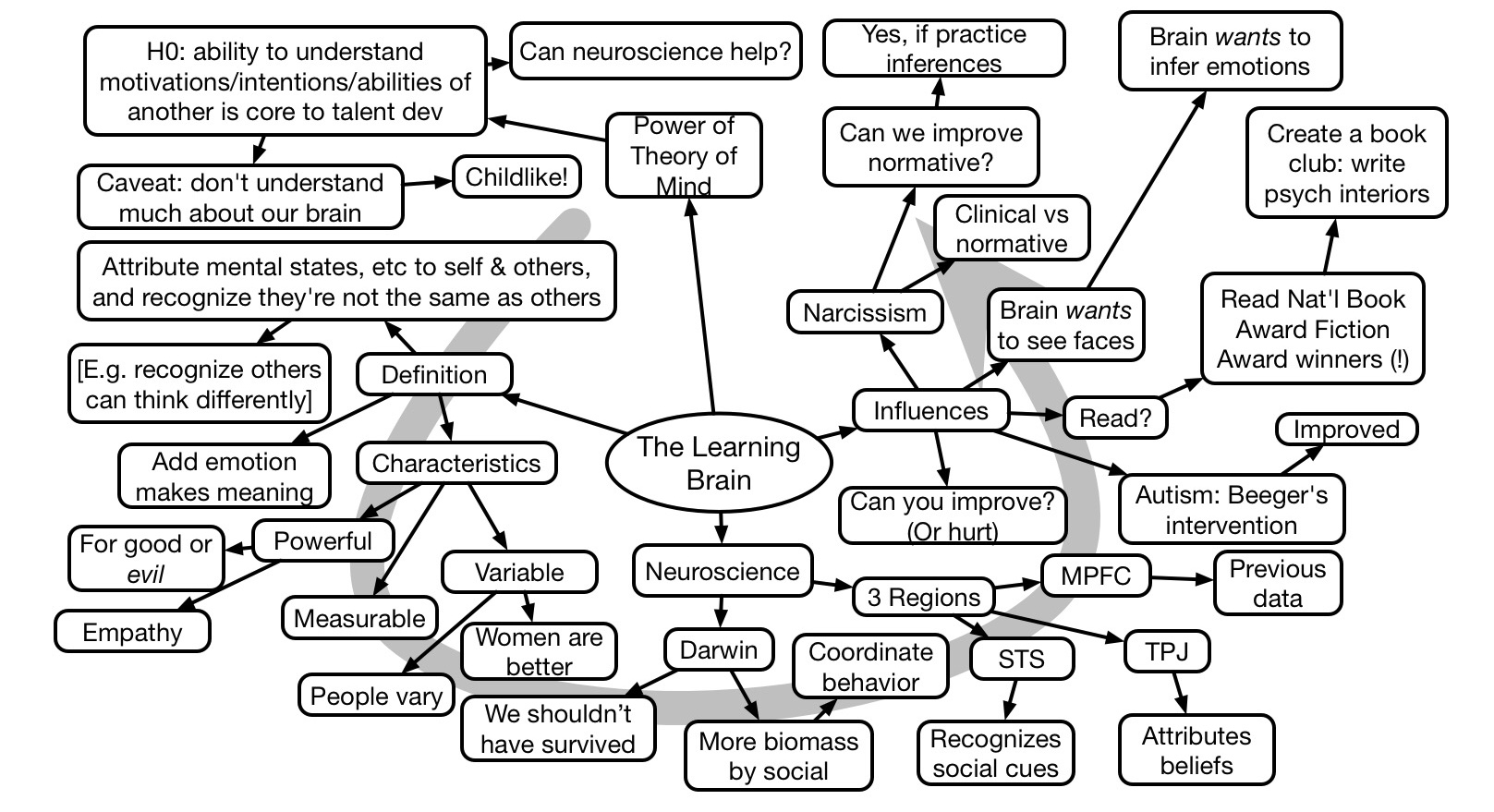
John Medina of Brain Rules  fame opened the second day of ATD’s TechKnowledge conference. In a rapid-paced and amusing presentation, he went through how we understand others, and can get better.  This was, he hypothesized, the core of talent development: understanding others and helping them improve.

Keynote mindmap

Kevin Carroll #ATDTK Keynote Mindmap

24 January 2018 by Clark Leave a Comment

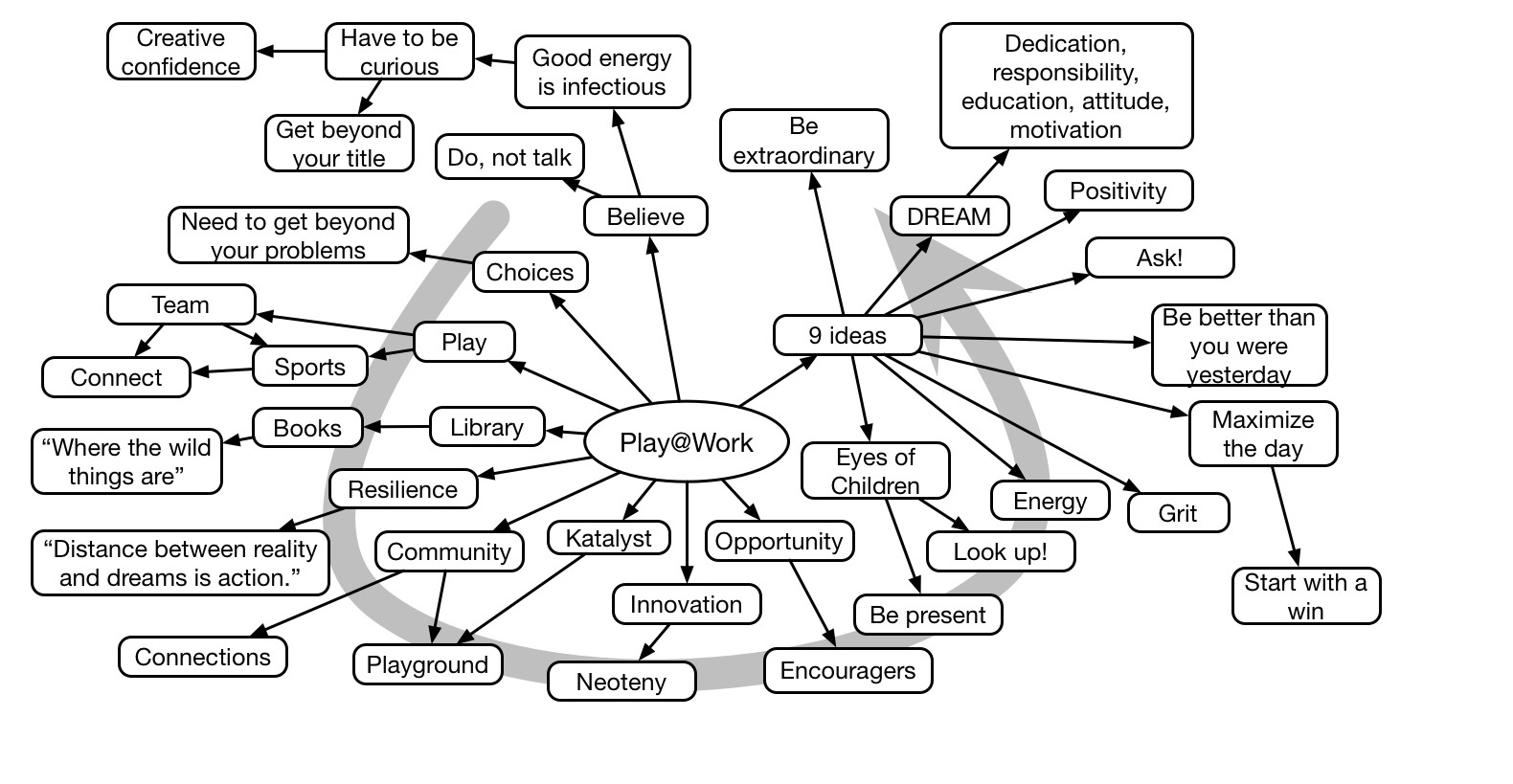
Kevin Carroll opened the TechKnowledge 18 conference with his story of triumphing over a rough beginning and the lessons he’s learned.

Mindmap


Listening

16 January 2018 by Clark 1 Comment

Listening, as I mentioned, in this case to  Guy Wallace.  As one of the premier promoters of evidence-based design, he responded to my question  about what to post on with:

Any “How Tos” using methods, tools and techniques that you‘ve found to work in L&D and Performance Improvement.

Since I am a fan of Guy’s work, I thought I should answer!  Now, obviously I don’t work in a typical L&D environment, so this list is somewhat biased. So I mentally ran through memorable projects from the past and looked for the success factors. Besides the best principles I usually advocate, here are a few tips and tricks that I’ve used over the years:

  • Engage.  Obviously, I wrote a book about this, but some of the quick things I do include:
    • embed the decisions they should be making in contexts where they make sense
    • as Henry Jenkins put it: “put the player in a role they  want to be in”
    • exaggerate the context
    • minimize the distractions
    • hook the learners in emotionally from the start
  • Decisions. I find that working with the objectives for learning projects, it’s critical to focus on the decisions that learners will ultimately be making.  I argue that what will make the difference for organizations, going forward, will be better decisions. And it keeps the discussion from focusing on knowledge. Knowledge is needed, but it’s not central.
  • Brainstorming. When working a strategy session with clients, I seed the discussion before hand with the challenges and background material, and ask that everyone think on their own before we begin collaboration.
  • Better ‘Pair and Share’.  If, in brainstorming, you should think individually before collectively, so should you do so in all forms. So I trialed a ‘pair and share’ where I asked everyone to:
    • think on the questions (asking for 2 things) first,
    • then share with another,
    • and try to reach agreement
    • (I polled the first audience I trialed it on, and they said that the discussion was better, FWIW).
  • Shared language. I have found it valuable, when starting a new project, to run a little ‘presentation’ where I present some of the models that I’m bringing to the table (that’s why I‘m there ;), so we’re starting from a shared understanding. And of course I’ve reviewed materials of theirs beforehand so I can use their terminology.  Educating clients is part of a Quinnovation engagement!
  • Test.  In making the Workplace of the Future project with Learnnovators,  we were barreling along full tilt, working on the second module, and I was getting increasingly worried about the fact that we hadn’t tested the first.  We finally did, relatively informally, but still got valuable feedback that changed our design somewhat. Similarly on other projects, get feedback early and often.
  • Visualize. My diagramming bent had me map out the workflow of a client’s production process, to identify opportunities to tweak the process to bring in better learning science with minimal interruption.  In general, I will often jump up to the whiteboard and try to represent what I’m hearing to see if it’s shared.
  • Prototype.  Similar to the above, I will often mock up what I’m thinking about (in sort of a ‘ape with a crayon’ level of fidelity), to help communicate the idea; e.g. some sort of walkthrough.  I find that only a percentage of the audience can imagine what the experience will be without getting somewhat concrete. (And, yes, they do then complain about the production values, despite the tradeoff of cost versus value.  Sigh.)
  • Get the context.  I generally try to understand the whole ecosystem (ala ‘the revolution‘) before I engage in specifics.  What are the goals, stakeholders, what’s already being done and by whom, etc. It’s important to re-contextualize ‘best principles’, and that requires  knowing the context.
  • Architecture. Thinking through things using a design thinking approach and a systems-thinking perspective, I’ve tried to think of platforms, not just solutions. It might be content architectures, ecosystem elements, but it’s thinking in terms of systems, not just tactics.
  • Pragmatism. One final approach that has been beneficial is thinking about how to approximate the best with a budget.  I used to talk about ‘what would you do if you had magic’, and then see how close you can get with the resources to hand. It’s a heuristic that often has led to an innovative yet viable solution.

Looking at them, I see that they generally reflect my overall focus on aligning what we do with how we think, work, and learn. Your thoughts?

Innovations

19 December 2017 by Clark Leave a Comment

Sparked by a colleague, I’m reading The Digital Transformation Playbook, by David Rogers. In the chapter on innovation, he talks about two types of experimentation: convergent and divergent. And I was reminded that I think of two types of innovations as well.  So what are they?

Experimentation

He talks about how experimentation is the key to innovation (in fact, the chapter title is Innovate by Rapid Experimentation). His point is that you need to be continually experimenting, rapidly.  And throughout the organization, not just in separate labs. Also, it’s ok to fail, as long as the lesson’s learned.  And then he distinguishes between two types of experimentation.

The first is convergent. Not surprisingly, this is when you’re trying to eliminate options and make a decision.  This is your classic A/B testing, for example. Here you might try out two or three different solutions, to see which one works best. You create the options, and have measures you’ll use to determine the answer.  You might ask: should we use a realistic video or a cartoon animation? A situation where there isn’t a principled answer, and you need to make a decision.

Divergent experimentation is, instead, exploratory. Here you give folks some ideas, or a prototype, and see what happens. You don’t know what you’ll get, but you’re eager to learn.  What would a scenario look like here?

Innovation

These roughly correspond to the two types of innovation I think of. One is the ‘we need to solve this’ type. I think of this as short-term innovation. Here we are problem-solving or trouble-shooting.  You bring together a team of relevant capabilities and otherwise as diverse as possible. You facilitate the process. And you’re likely to try convergent experimentation.

At the other end is the serendipitous, long-term innovation that happens because you create an environment where ideas can gestate.  You’ve got access to the adjacent possible, and the opportunities to explore and share. It’s safe to experiment and fail.  People are  supposed to take time to reflect! This is more closely aligned to divergent experimentation.

Note that this is  all learning, as you don’t know the answers when you start!  The success of organizational learning, however, is a product of both. You need to solve the problems you know you have, and allow for ideas to generate solutions to problems you didn’t know you had.  Or, more optimistically, to search through idea spaces for opportunities you didn’t know to look for.

Rogers is right that continual experimentation is key.  It has to become baked into how you do what you do.  Individually, and organizationally.  And you can’t really get it unless you start practicing it yourself.  You need to continually challenge yourself, and try things both to fix the problems, and to explore things that are somewhat tangential. Your own innovations will be key to your ability to foster them elsewhere.

Too many orgs are only focused on the short-term.  And while that may solve shareholder return expectations, it’s not a receipt for longer-term organizational survival.  You need both types of innovations. So, the question is whether you can assist your org in making a shift to the serendipitous environment.  Are you optimizing your innovation?

Video Lessons

15 December 2017 by Clark Leave a Comment

So, I’ve been creating a ‘deeper elearning’ course for one of the video course providers. And I’m not mentioning where it is (yet), since it’s still under development.  But to do this, I had to do some serious learning about creating video.  And there were some realizations in this, of course.

One of the decisions to be made was how to include graphics.. My mentor/colleague/friend showed me (by video chat) his elegant setup.  He has green screens, and lights, and has a full studio in a separate room as well. Of course, he’s been doing video for decades.  I’ve hardly done much besides taking a multimedia course at least 20 years ago. And narrating the occasional Keynote deck.

In the meantime I asked around, and colleagues were pretty unanimous on ScreenFlow being  the tool to use.  So I got a copy. And, indeed, I was able to film myself.  Moreover, I quickly found out I could include diagrams and text right on the screen! That eliminated the need for a green screen.

My video imageI had a couple of lights, and without them my screen reflected on my glasses.  However, that’s not really fixable, since I didn’t get the anti-glare coating when I had them made.  Doh!  Next time, for sure. I positioned a couple of lights off to each side, and they reduced (though not eliminated) the glare.

We were moving my office back to the front of the house (long story), so we moved a bookcase behind me, with my library.  It looks good, but…you don’t see much of it anyway.  I filmed standing up (on my new stand/sit desk converter), and I block most of the background anyway (except for the Albert Einstein poster that sits on the wall).

Having read up,  I knew to have a written script, which, without a prompter, I just positioned to the top of the screen under the camera.  Of course I changed it a bit, and adlibbed a bit, but mostly stuck to what I’d written. It’s not quite as spontaneous (and goofy) as I am in person, but it ensures consistent quality. And I filled in diagrams a few times, and added some text a few times, to help keep pace.

Frankly, it’s not great, but I had a deadline.  It’s too much of me talking, without animation. But this is done by me, alone, under a tight deadline. And that’s my error, too, since I have video anxiety almost as bad as my phone anxiety, and dragged my heels until things were too late.  Dang emotions getting in the way again! (Even when you know this.)

I also created some quizzes, in mini-scenario fashion pretty much. That is, there’s a fair bit of dialog that you either are asked and/or choose to respond with. Because it’s only a multiple choice option, I was somewhat constrained.  I subsequently was prodded for some assignments, and found I could do what I’d talked about.  I used the assignment tool to create questions that asked learners to go out and do things and then provide them with some guidance to self-evaluate.

One thing I learned is that I don’t have a good mental model of how the software works. I ‘get’ the tracks, but there’s another aspect I don’t understand. So, it turns out though I’d filmed myself at 720p, and exported at 720p, it still had an unnecessary border. Fortunately, in stumbling around I found a ‘crop’ setting that forced it to 1280 x 720 (720p), but I don’t understand  why that was necessary!?!?

I still want to add some examples (as documents) before I feel it’s fully ready to go. And I now sympathize much more with those who struggle to do good learning design under real-world constraints.  It’s also certainly been an example of my accepting assignments that are within my reach, but not within my grasp; my learning style ;).   More later, but thought I’d share my struggles and learning. I welcome your feedback.

Before the Course

29 November 2017 by Clark 6 Comments

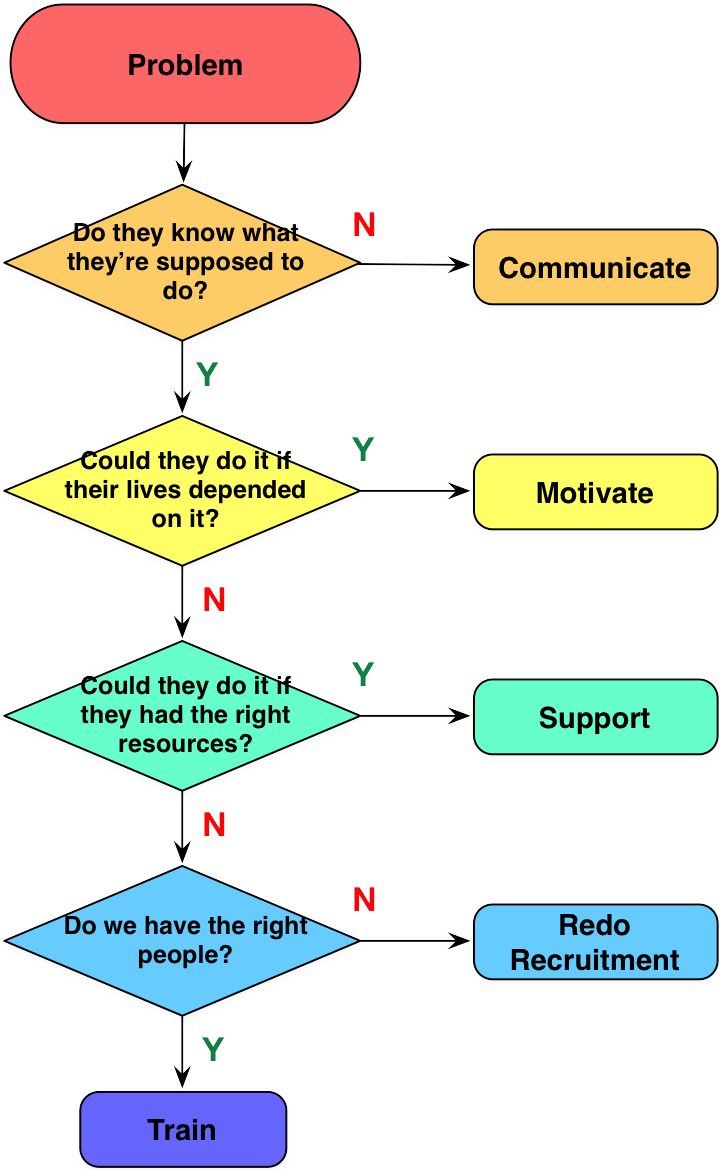
It appears that, too often, people are building courses when they don’t need to (or, more importantly, shouldn’t).  I realize that there are pressures to make a course when one is requested, including expectations and familiarity, but really, you should be doing some initial thinking about what makes sense.  So here’s a rough guide about the thinking you should do  before you course.

FlowchartYou begin with a performance problem.  Something’s not right: calls take too long, sales success rate is too low, there’re too many errors in manufacturing.  So it must need training, right?  Er, no.  There’s this thing that’s called ‘performance consulting‘ that talks about identifying the gaps that could be preventing the desirable outcomes, and they’re not  all about gaps that training meets.  So we need to triage, and see what’s broken and what’s the priority.

To start, people can simply not  know what they’re supposed to do.  That may seem obvious, but it can in fact be the case.  Thus, there’s a need to communicate. Note that this and all of these are more complex than just ‘communicate’. There are the issues about who needs to communicate, and when, and to whom, etc.  But it’s  not (at least initially) a training problem.

If they do know, and could do it but aren’t, the problem isn’t going to be solved by training.  As someone once put it “if they could do it if their life depended on it”, then there’s something else going on. If they’re not following safety procedures because they’re too onerous, a course on it isn’t going to fix it. You need to address their motivation.

Now, if they can’t do it, then could they do it if they had the right tools, or more people, or more time? In other words, is it a resource problem?  And, in one way I like to think about it: can we put the solution in the world, instead of in the head?  Will lookup tables, checklists, step-by-step guides or videos solve the problem? Or even connections to other folks! (There are times when it doesn’t make sense to course or even job-aid; e.g. if it’s changing too fast, or too unique, or…)

And, of course, if you don’t have the right people, training still may not work. If they need to meet certain criteria, but don’t, training won’t solve it.  Training can’t fix color-blindness or lack of height, for instance.

Finally, if the prior solutions won’t solve it, and there’s a serious skill gap, then it’s time for training.  And not just knowledge dump, of course, but models and examples and meaningful (and spaced) practice.

Again, these are all abbreviated, and this is oversimplified.  There’s more depth to be unpacked, so this is just a surface level way to represent that a course isn’t always the solution.  But before you course, consider the other solutions. Please.

eLearning Land

28 November 2017 by Clark 1 Comment

This post is just a bit of elearning silliness, parodying our worst instincts…

Welcome back my friends, to the show that never ends. We’re so glad you could attend. Come inside, come inside! – Emerson, Lake & Palmer: Karn Evil 9,  1st Impression, Part 2.

It’s so good to see you, and I hope you’re ready for fun. Let’s introduce you to the many attractions to be found here.  We’ve got entertainment suitable for all ages, and wallets!  You can find something you like here, and for an attractive cost.

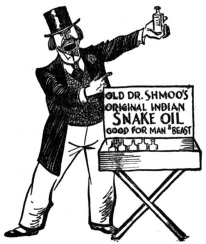
snake oil salesmanTo start, we have the BizBuzz arcade. It’s a mirror maze, where all things look alike. Microlearning, contextual performance support, mobile elearning, chunking, just-in-time, it’s all there.  Shiny objects appear and disappear before your eyes!  Conceptual clarity is boring, it’s all about the  sizzle.

And over here is the Snake Oil Pool.  It’s full of cures for what ails you!  We’ve got potions and lotions and aisles of styles.  It’s slippery, and unctuous; you can’t really get a handle on it, so how can you go wrong?  Apply our special solution, and your pains go away like magic.  Trust us.

Step right up and ride the Hype Balloon!  It’s a quick trip to the heights, held aloft by empty promises based upon the latest trends: neuro/brain-based, millennial/generations, and more.  It doesn’t matter if it holds water, because it’s lighter than air!

Don’t forget the wild Tech Lifecycle ride. You’ll go up, you’ll go down, you’ll take unpredictable twists, followed by a blazing finale. Get in line early!  You’ll leave with a lighter pocketbook, and perhaps a slight touch of nausea, but no worries, it was fun while it lasted.

Come one, come all! We’ll help you feel better, even if when you leave things aren’t any different. You’ll at least have been taken for a ride.  We’ll hope to see you again soon.

This was a jest, this was only a jest. If this were a real emergency, I’d write a book or something. Seriously, we do have to pay attention to the science in what we’re doing, and view things with a healthy skepticism.  We now return you to your regularly scheduled blog, already in progress.  

« Previous Page
Next Page »

Clark Quinn

The Company

Search

Feedblitz (email) signup

Never miss a post
Your email address:*
Please wait...
Please enter all required fields Click to hide
Correct invalid entries Click to hide

Pages

  • About Learnlets and Quinnovation

The Serious eLearning Manifesto

Manifesto badge

Categories

  • design
  • games
  • meta-learning
  • mindmap
  • mobile
  • social
  • strategy
  • technology
  • Uncategorized
  • virtual worlds

License

Previous Posts

  • March 2026
  • February 2026
  • January 2026
  • December 2025
  • November 2025
  • October 2025
  • September 2025
  • August 2025
  • July 2025
  • June 2025
  • May 2025
  • April 2025
  • March 2025
  • February 2025
  • January 2025
  • December 2024
  • November 2024
  • October 2024
  • September 2024
  • August 2024
  • July 2024
  • June 2024
  • May 2024
  • April 2024
  • March 2024
  • February 2024
  • January 2024
  • December 2023
  • November 2023
  • October 2023
  • September 2023
  • August 2023
  • July 2023
  • June 2023
  • May 2023
  • April 2023
  • March 2023
  • February 2023
  • January 2023
  • December 2022
  • November 2022
  • October 2022
  • September 2022
  • August 2022
  • July 2022
  • June 2022
  • May 2022
  • April 2022
  • March 2022
  • February 2022
  • January 2022
  • December 2021
  • November 2021
  • October 2021
  • September 2021
  • August 2021
  • July 2021
  • June 2021
  • May 2021
  • April 2021
  • March 2021
  • February 2021
  • January 2021
  • December 2020
  • November 2020
  • October 2020
  • September 2020
  • August 2020
  • July 2020
  • June 2020
  • May 2020
  • April 2020
  • March 2020
  • February 2020
  • January 2020
  • December 2019
  • November 2019
  • October 2019
  • September 2019
  • August 2019
  • July 2019
  • June 2019
  • May 2019
  • April 2019
  • March 2019
  • February 2019
  • January 2019
  • December 2018
  • November 2018
  • October 2018
  • September 2018
  • August 2018
  • July 2018
  • June 2018
  • May 2018
  • April 2018
  • March 2018
  • February 2018
  • January 2018
  • December 2017
  • November 2017
  • October 2017
  • September 2017
  • August 2017
  • July 2017
  • June 2017
  • May 2017
  • April 2017
  • March 2017
  • February 2017
  • January 2017
  • December 2016
  • November 2016
  • October 2016
  • September 2016
  • August 2016
  • July 2016
  • June 2016
  • May 2016
  • April 2016
  • March 2016
  • February 2016
  • January 2016
  • December 2015
  • November 2015
  • October 2015
  • September 2015
  • August 2015
  • July 2015
  • June 2015
  • May 2015
  • April 2015
  • March 2015
  • February 2015
  • January 2015
  • December 2014
  • November 2014
  • October 2014
  • September 2014
  • August 2014
  • July 2014
  • June 2014
  • May 2014
  • April 2014
  • March 2014
  • February 2014
  • January 2014
  • December 2013
  • November 2013
  • October 2013
  • September 2013
  • August 2013
  • July 2013
  • June 2013
  • May 2013
  • April 2013
  • March 2013
  • February 2013
  • January 2013
  • December 2012
  • November 2012
  • October 2012
  • September 2012
  • August 2012
  • July 2012
  • June 2012
  • May 2012
  • April 2012
  • March 2012
  • February 2012
  • January 2012
  • December 2011
  • November 2011
  • October 2011
  • September 2011
  • August 2011
  • July 2011
  • June 2011
  • May 2011
  • April 2011
  • March 2011
  • February 2011
  • January 2011
  • December 2010
  • November 2010
  • October 2010
  • September 2010
  • August 2010
  • July 2010
  • June 2010
  • May 2010
  • April 2010
  • March 2010
  • February 2010
  • January 2010
  • December 2009
  • November 2009
  • October 2009
  • September 2009
  • August 2009
  • July 2009
  • June 2009
  • May 2009
  • April 2009
  • March 2009
  • February 2009
  • January 2009
  • December 2008
  • November 2008
  • October 2008
  • September 2008
  • August 2008
  • July 2008
  • June 2008
  • May 2008
  • April 2008
  • March 2008
  • February 2008
  • January 2008
  • December 2007
  • November 2007
  • October 2007
  • September 2007
  • August 2007
  • July 2007
  • June 2007
  • May 2007
  • April 2007
  • March 2007
  • February 2007
  • January 2007
  • December 2006
  • November 2006
  • October 2006
  • September 2006
  • August 2006
  • July 2006
  • June 2006
  • May 2006
  • April 2006
  • March 2006
  • February 2006
  • January 2006

Amazon Affiliate

Required to announce that, as an Amazon Associate, I earn from qualifying purchases. Mostly book links. Full disclosure.

We use cookies to ensure that we give you the best experience on our website. If you continue to use this site we will assume that you are happy with it.