Learnlets

Secondary

Clark Quinn’s Learnings about Learning

Search Results for: align

Challenges in engaging learning

16 December 2014 by Clark 2 Comments

I’ve been working on moving a team to deeper learning design.  The goal is to practice what I preach, and make sure that the learning design is competency-aligned, activity-based, and model-driven.  Yet, doing it in a pragmatic way.

And this hasn’t been without it’s challenges.  I  presented to the team my vision, we worked out a process, and started coaching the team during development.  In retrospect, this wasn’t proactive enough.  There were a few other hiccups.

We’re currently engaged in a much tighter cycle of development and revision, and now feel we’re getting close to the level of effectiveness  and  engagement we need.  Whether a) it’s really better, and b) whether we can replicate it yet scale it as well is an open question.

At core are a few elements. For one, a rabid focus on what learners are  doing is key.  What do they need to be able to do, and what contexts do they need to do it in?

The competency-alignment focus is on the key tasks that they have to do in the workplace, and making sure we’re preparing them across pre-class, in-class, and post-class activities to develop that ability.  A key focus is having them make the decision in the learning experience that they’ll have to make afterward.

I’m also pushing very hard on making sure that there are models behind the decisions.  I’m trying hard to avoid arbitrary categorizations, and find the principles that drove those categorizations.

Note that all this is  not easy.  Getting the models is hard when the resources  provided don’t include that information.  Avoiding presenting just knowledge and definitions is hard work.  The tools we use make certain interactions easy, and other ones not so easy.  We have to map meaningful decisions into what the tools support.  We end up making  tradeoffs, as do we all.  It’s good, but not as good as it could be.  We’ll get better, but we do want to run in a practical fashion as well.

There are more elements to weave in: layering on some general biz skills is embryonic.  Our use of examples needs to get more systematic.  As does our alignment of learning goal to practice activity.    And we’re struggling to have a slightly less didactic and earnest tone;  I haven’t worked hard enough on pushing a bit of humor in, tho’ we are ramping up some exaggeration.  There’s only so much you can focus on at one time.

We’ll be running some student tests next week before presenting to the founder.  Feeling mildly confident that we’ve gotten a decent take on quality learning design with suitable production value, but there is the barrier that the nuances of learning design are  subtle. Fingers crossed.

I still believe that, with practice, this becomes habit and easier.  We’ll see.
My thoughts on tech and training

9 December 2014 by Clark Leave a Comment

The eLearning Guild,  in queuing up interest in their Learning Solutions/Performance Ecosystem conference, asked for some thoughts on the role of technology and training.  And, of course, I obliged.  You can see them here.

In short, I said that technology can augment what we already do, serving to fill in gaps between what we desired and what we could deliver, and it also gave us some transformative capabilities.  That is, we can make the face to face time more effective, extend the learning beyond the classroom, and move the classroom beyond the physical space.

The real key, a theme I find myself thumping more and more often, is that we can’t use technology in ineffective ways. We need to use technology in ways that align with how we think, work, and learn.  And that’s all too rare.  We can do amazing things, if: we muster the will and resources, do the due diligence on what would be a principled approach, and then do the cycles of develop and iteration to get us to where the solution is working as it should.

Again, the full thoughts can be found on their blog.


L&D and working out loud #wolweek

18 November 2014 by Clark 1 Comment

This week is Working Out Loud week, and I can’t but come out in support of a principle that I think is going to be key to organizational success. And, I think, L&D has a key role to play.

The benefits from working out loud are many. Personally, documenting what you’re doing serves as a reminder to yourself and awareness for others. The real power comes, however, from taking that next level: documenting not just what you’re doing, but why. This helps you in reflecting on your own work, and being clear in your thinking. Moreover, sharing your thinking gives you a second benefit in getting others’ input which can really improve the outcome.

In addition, it gives others a couple of benefits. They get to know what you’re up to, so it’s easier to align, but if your thinking is any good, it gives them the chance to learn from how you think.

So what is the role of L&D here? I’ll suggest there are two major roles: facilitating the skills and enabling the culture.

First, don’t assume folks know what working out loud means. And even if they do, they may not be good at it in terms of knowing how to indicate the underlying thinking. And they likely will want feedback and encouragement. First, L&D needs to model it, practicing what they preach. They need to make sure the tools are easily available and awareness is shared. Execs need to be shown the benefit and encouraged to model the behavior too. And L&D will have to trumpet the benefits, accomplishments, and encourage the behavior.

None of this is really likely to succeed if you don’t have a supportive culture. In a Miranda organization, no one is going to share. Instead, you need the elements of a learning organization: the environment has to value diversity, be open to new ideas, provide time for reflection, and most of all be safe. And L&D has to understand the benefits and continue to promote them, identify problems, and work to resolve them.

Note that this is not something you manage or control. The attitude here has to be one of nourishing aka (seed, feed, and weed). You may track it, and you want to be looking for things to support or behaviors to improve, but the goal is to develop a vibrant community of sharing, not squelching anything that violates the hierarchy.

Working out loud benefits the individual and the organization in a healthy environment. Getting the environment right, and facilitating the practice, are valuable contributions, and ones that L&D can, and should, contribute to.

#itashare

Belinda Parmar #DevLearn Keynote Mindmap

31 October 2014 by Clark Leave a Comment

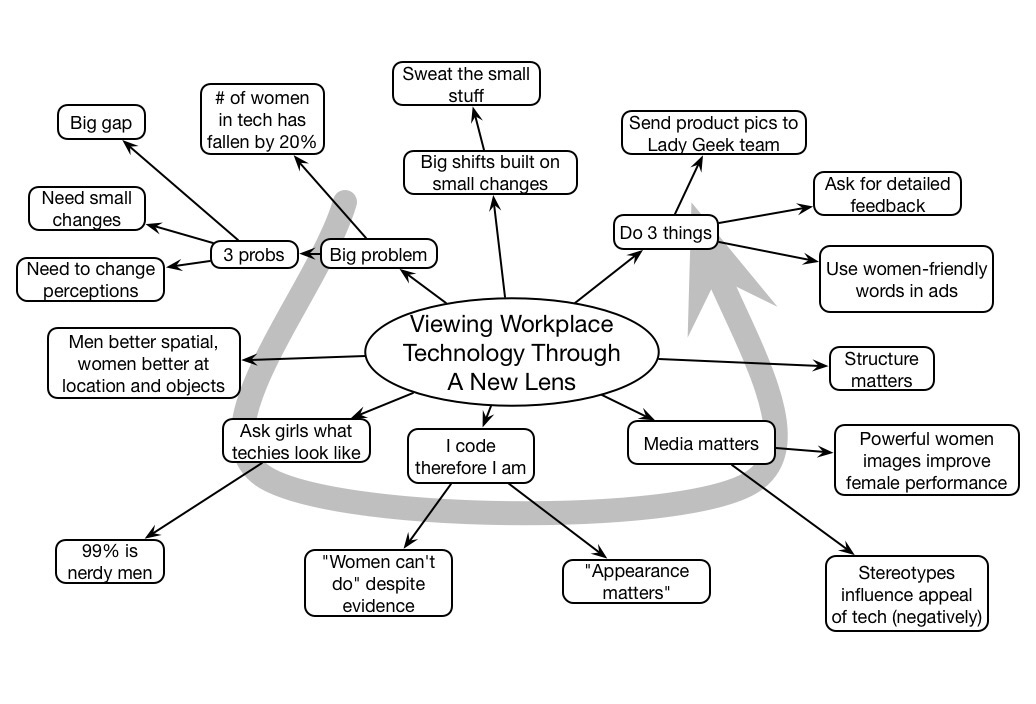
Belinda Parmar addressed the critical question of women in tech in a poignant way, pointing out that the small stuff is important: language, imagery, context. She concluded with small actions including new job description language and better female involvement in product development.

IMG_0156.JPG

Beau Lotto #DevLearn Keynote Mindmap

30 October 2014 by Clark Leave a Comment

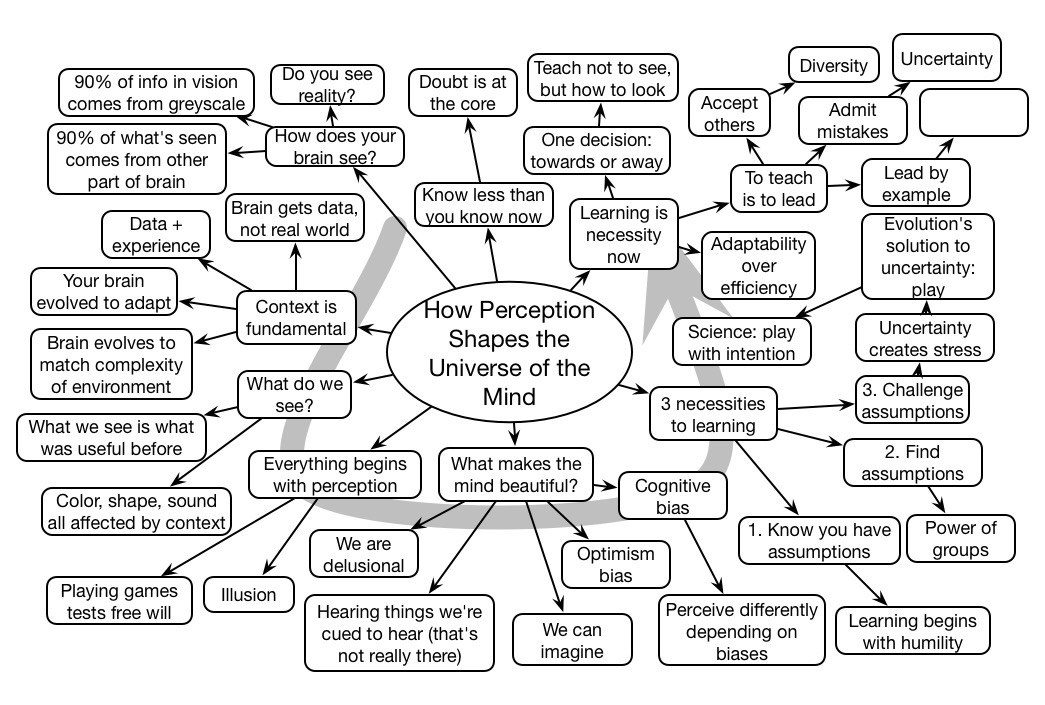
Beau Lotto gave a very interesting keynote that built from perceptual phenomena to a lovely message on learning.

IMG_0154.JPG

Neil deGrasse Tyson #DevLearn Keynote Mindmap

29 October 2014 by Clark 1 Comment

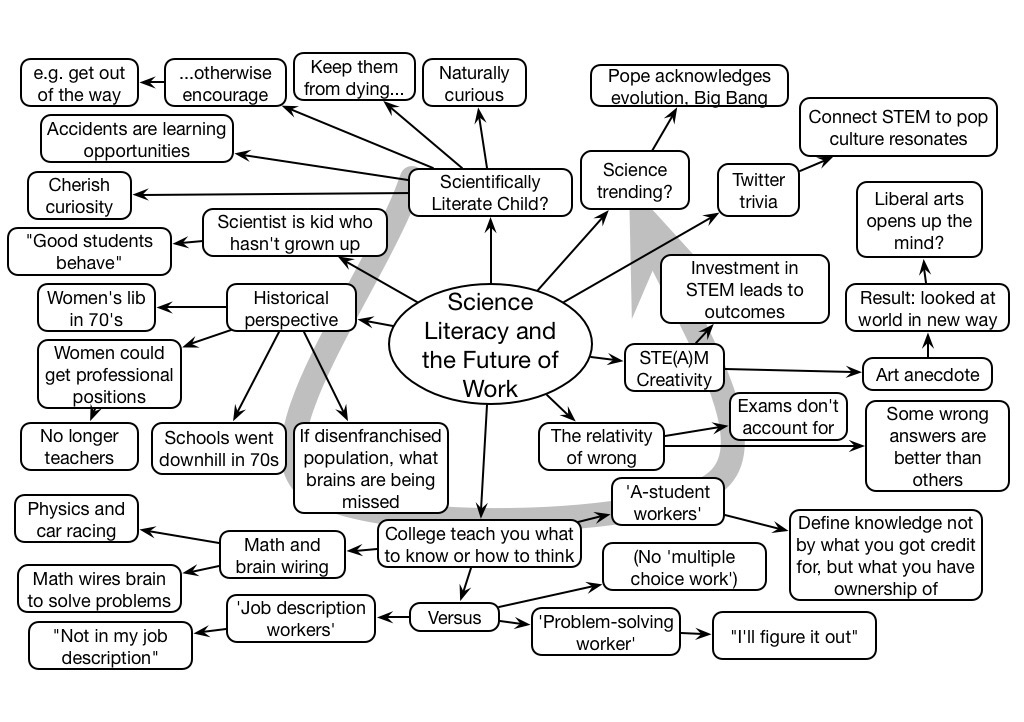
Neil deGrasse Tyson opened this year’s DevLearn conference. A clear crowd favorite, folks lined up to get in (despite the huge room). In a engaging, funny, and poignant talk, he made a great case for science and learning.

IMG_0153.JPG

Cognitive prostheses

28 October 2014 by Clark 2 Comments

While our cognitive architecture has incredible capabilities (how else could we come up with advances such as Mystery Science Theater 3000?), it also has limitations. The same adaptive capabilities that let us cope with information overload in both familiar and new ways also lead to some systematic flaws. And it led me to think about the ways in which we support these limitations, as they have implications for designing solutions for our organizations.

The first limit is at the sensory level. Our mind actually processes pretty much all the visual and auditory sensory data that arrives, but it disappears pretty quickly (within milliseconds) except for what we attend to. Basically, your brain fills in the rest (which leaves open the opportunity to make mistakes). What do we do? We’ve created tools that allow us to capture things accurately: cameras and microphones with audio recording. This allows us to capture the context exactly, not as our memory reconstructs it.

A second limitation is our ‘working’ memory. We can’t hold too much in mind at one time. We ‘chunk’ information together as we learn it, and can then hold more total information at one time. Also, the format of working memory largely is ‘verbal’. Consequently, using tools like diagramming, outlines, or mindmaps add structure to our knowledge and support our ability to work on it.

Another limitation to our working memory is that it doesn’t support complex calculations, with many intermediate steps. Consequently we need ways to deal with this. External representations (as above), such as recording intermediate steps, works, but we can also build tools that offload that process, such as calculators. Wizards, or interactive dialog tools, are another form of a calculator.

Processing information in short term memory can lead to it being retained in long term memory. Here the storage is almost unlimited in time and scope, but it is hard to get in there, and isn’t remembered exactly, but instead by meaning. Consequently, models are a better learning strategy than rote learning. But external sources like the ability to look up or search for information is far better than trying to get it in the head.

Similarly, external support for when we do have to do things by rote is a good idea. So, support for process is useful and the reason why checklists have been a ubiquitous and useful way to get more accurate execution.

In execution, we have a few flaws too. We’re heavily biased to solve new problems in the ways we’ve solved previous problems (even if that’s not the best approach. We’re also likely to use tools in familiar ways and miss new ways to use tools to solve problems. There are ways to prompt lateral thinking at appropriate times, and we can both make access to such support available, and even trigger same if we’ve contextual clues.

We’re also biased to prematurely converge on an answer (intuition) rather than seek to challenge our findings. Access to data and support for capturing and invoking alternative ways of thinking are more likely to prevent such mistakes.

Overall, our use of more formal logical thinking fatigues quickly. Scaffolding help like the above decreases the likelihood of a mistake and increases the likelihood of an optimal outcome.

When you look at performance gaps, you should look to such approaches first, and look to putting information in the head last. This more closely aligns our support efforts with how our brains really think, work, and learn. This isn’t a complete list, I’m sure, but it’s a useful beginning.

Extending Mobile Models

21 October 2014 by Clark Leave a Comment

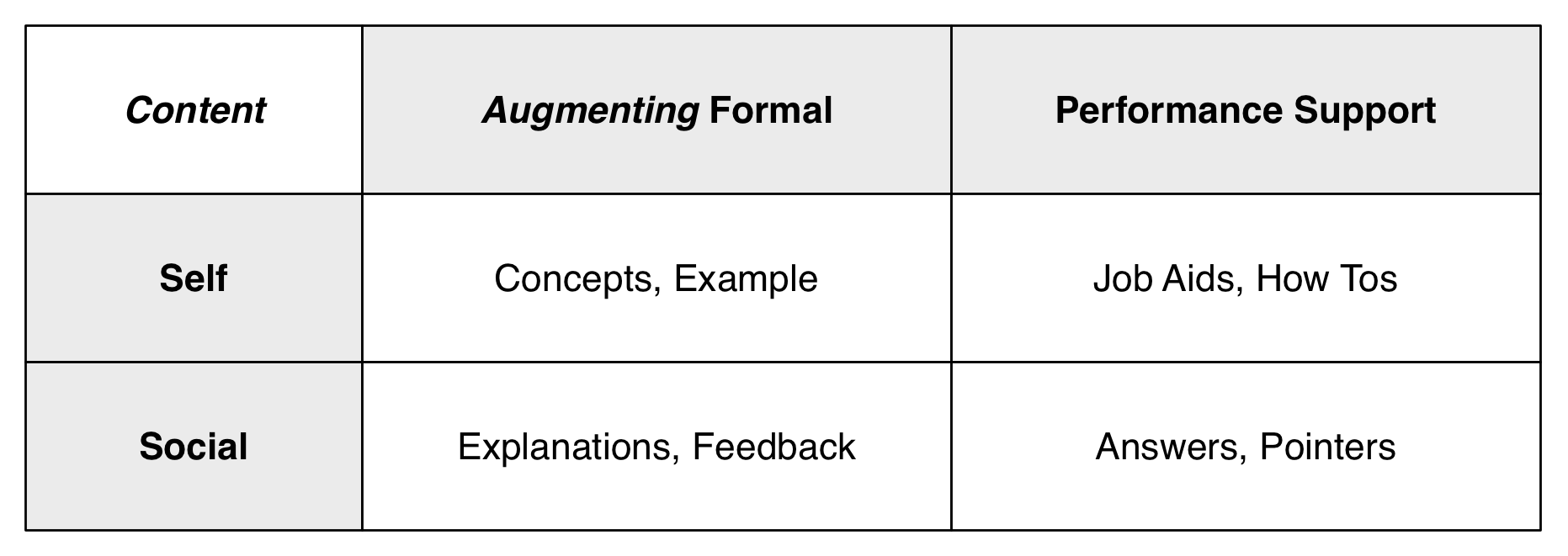
In preparation for a presentation, I was reviewing my mobile models. You may recall I started with my 4C‘s model (Content, Compute, Communicate, & Capture), and have mapped that further onto Augmenting Formal, Performance Support, Social, & Contextual.  I’ve refined it as well, separating out contextual and social as different ways of looking at formal and performance support.  And, of course, I’ve elaborated  it again, and wonder whether you think this more detailed conceptualization makes sense.

self and social mlearning contentSo, my starting point was realizing that it wasn’t just  content.  That is, there’s a difference between compute and content where the interactivity was an important part of the 4C’s, so that the characteristics in the content box weren’t discriminated enough.  So the new two initial sections are mlearning content and mlearning compute, by self or social.  So, we can be getting things for an individual, or it can be something that’s socially generated or socially enabled.
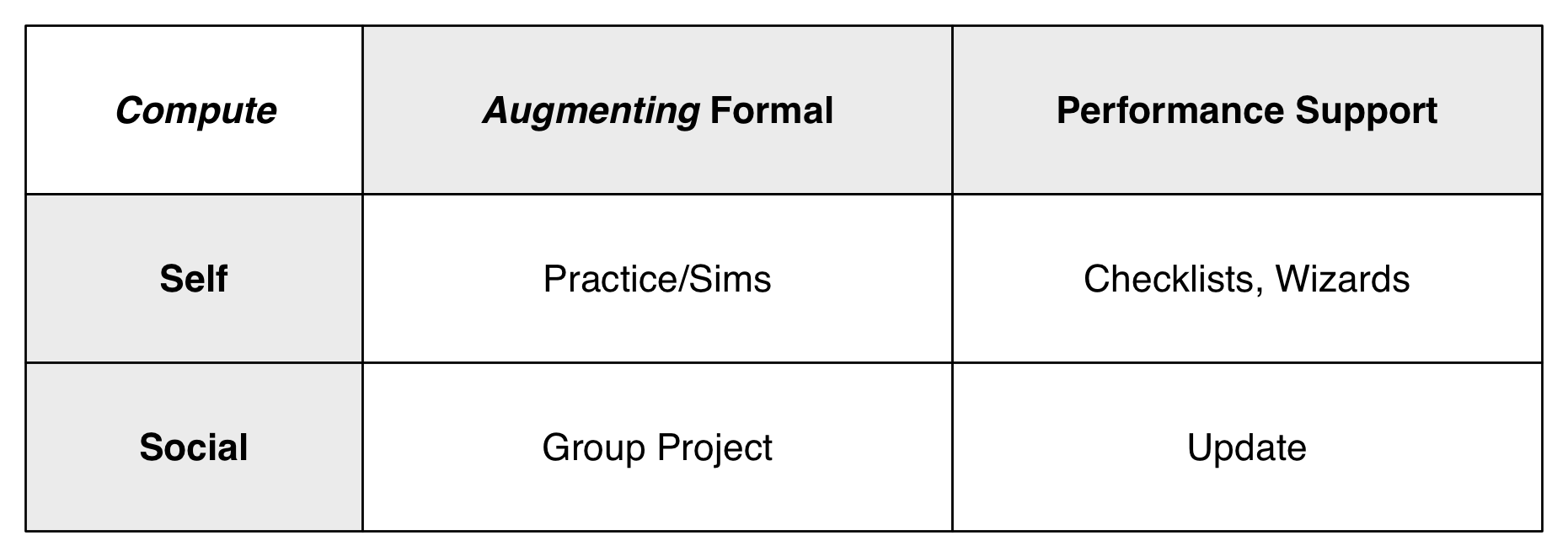
mLearningComputeThe point is that content is prepared media, whether text, audio, or video.  It can be delivered or accessed as needed. Compute, interactive capability, is harder, but potentially more valuable. Here, an individual might actively practice, have mixed initiative dialogs, or even work with others or tools to develop an outcome or update some existing shared resources.
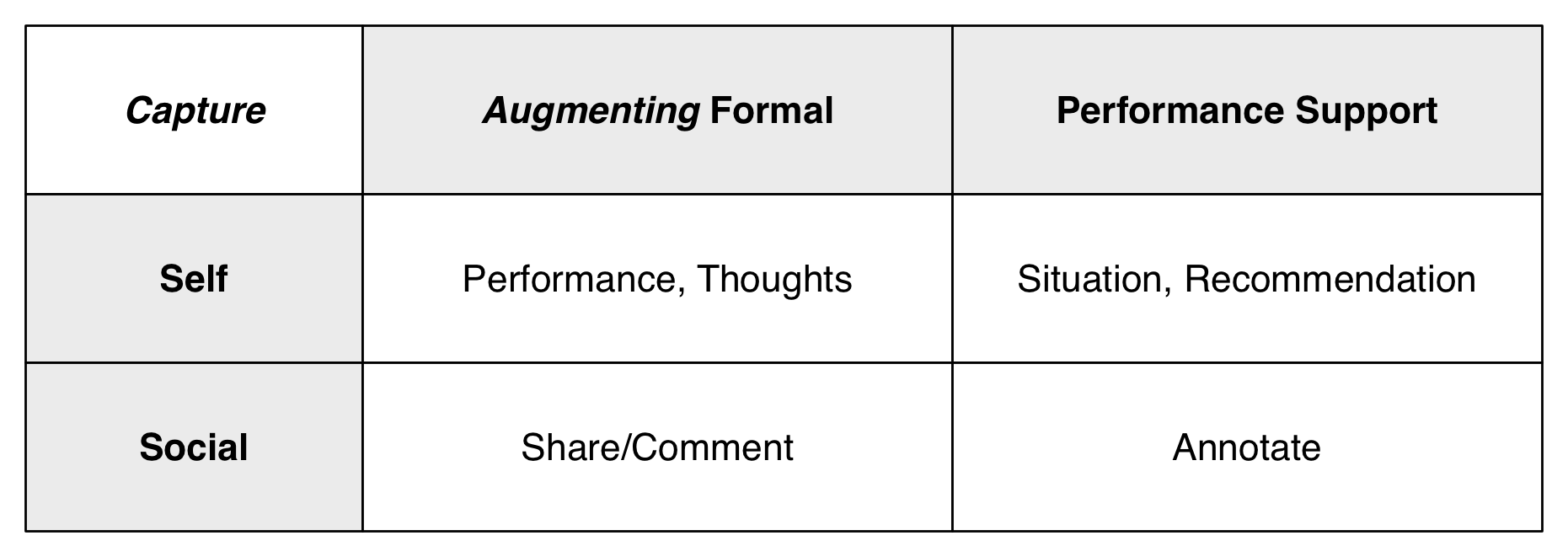
mLearningCaptureThings get more complex when we go beyond these elements.  So I had capture as one thing, and I’m beginning to think it’s two: one is the capture of current context and keeping sharing that for various purposes, and the other is the system using that context  to do something unique.

To be clear here, capture is where you use the text insertion, microphone, or camera to catch unique contextual data (or user input).  It could also be other such data, such as a location, time, barometric pressure, temperature, or more. This data, then, is available to review, reflect on, or more.  It can be combinations, of course, e.g. a picture at this time and this location.

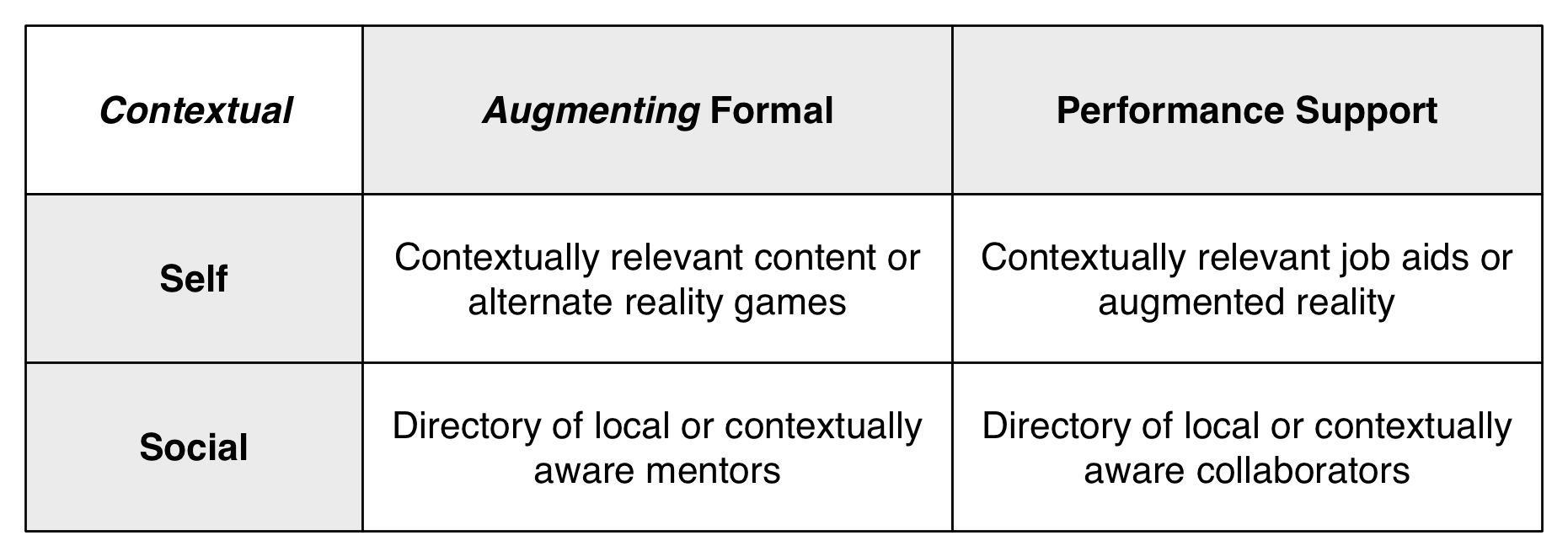
mLearningContextualNow, if the system  uses this information to do something different than under other circumstances, we’re contextualizing what we do. Whether it’s because of when you are, providing specific information, or where you are, using location characteristics, this is likely to be the most valuable opportunity.   Here I’m thinking alternate reality games or augmented reality (whether it’s voiceover, visual overlays, what have you).

And I  think  this is device independent, e.g. it could apply to watches or glasses or..as well as phones and tablets.  It means my 4 C’s become: content, compute, capture, and contextualize.  To ponder.

So, this is a more nuanced look at the mobile opportunities, and certainly more complex as well. Does the greater detail provide greater benefit?


Sharing pointedly or broadly

16 October 2014 by Clark 3 Comments

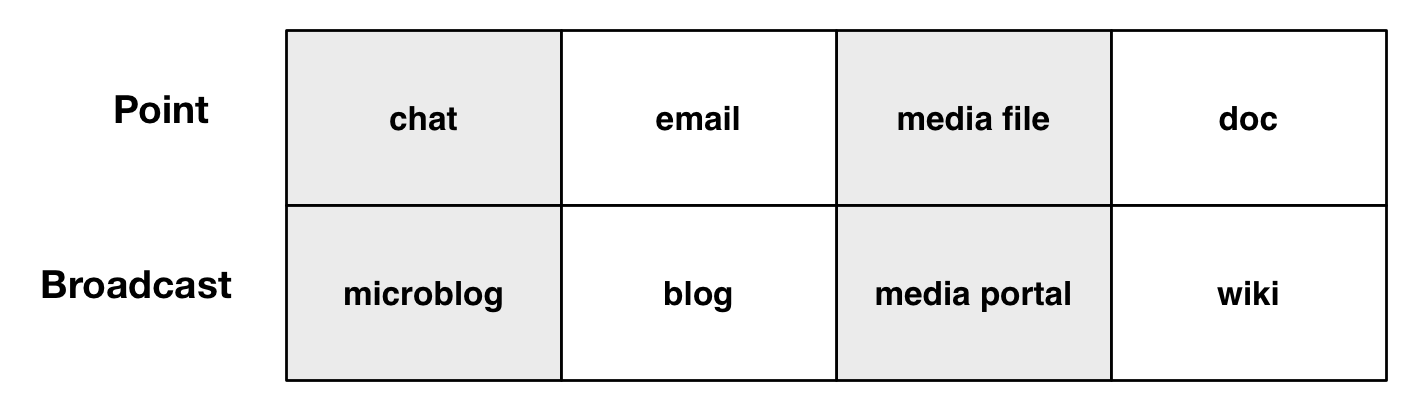
In a (rare) fit of tidying, I was moving from one note-taking app to another, and found a diagram I’d jotted, and it rekindled my thinking. The point was characterizing social media in terms of their particular mechanisms of distribution. I can’t fully recall what prompted the attempt at characterization, but one result of revisiting was thinking about the media in terms of whether they’re part of a natural mechanism of ‘show your work’ (ala Bozarth)/’work out loud’ (ala Jarche).

whether person to person or one to manyThe question revolves around whether the media are point or broadcast, that is whether you specify particular recipients (even in a mailing or group list), or whether it’s ‘out there’ for anyone to access.  Now, there are distinctions, so you can have restricted access on the ‘broadcast’ mode, but in principle there’re two different mechanisms at work.

It should be noted that in the ‘broadcast’ model, not everyone may be aware that there’s a new message, if they’re not ‘following’ the poster of the message, but it should be findable by search if not directly.  Also, the broadcast may only be an organizational network, or it can be the entire internet.  Regardless, there are differences between the two mechanisms.

So, for example, a chat tool typically lets you ping a particular person, or a set list. On the other hand, a microblog lets anyone decide to ‘follow’ your quick posts.   Not everyone will necessarily be paying attention to the ‘broadcast’, but they could.  Typically, microblogs (and chat) are for short messages, such as requests for help or pointers to something interesting.  The limitations mean that more lengthy  discussions typically are conveyed via…

Formats supporting unlimited text, including thoughtful reflections, updates on thinking, and more tend to be conveyed via email or blog posts. Again, email is addressed to a specific list of people, directly or via a mail list, openly or perhaps some folks receiving copies ‘blind’ (that is, not all know who all is receiving the message.  A blog post (like this), on the other hand, is open for anyone on the ‘system’.

The same holds true for other media files besides text.   Video and audio can be hidden in a particular place (e.g. a course) or sent directly to one person. On the other hand, such a message can be hosted on a portal (YouTube, iTunes) where anyone can see.  The dialog around a file provides a rich augmentation, just as such can be happening on a blog, or edited RTs of a microblog comment.

Finally, a slightly different twist is shown with documents.  Edited documents (e.g. papers, presentations, spreadsheets) can be created and sent, but there’s little opportunity for cooperative development.  Creating these in a richer way that allows for others to contribute requires a collaborative document (once known as a wiki).  One of my dreams is that we may have collaboratively developed interactives as well, though that still seems some way off.

The point for showing out loud is that point is only a way to get specific feedback, whereas a broadcast mechanism is really about the opportunity to get a more broad awareness and, potentially, feedback.  This leads to a broader shared understanding and continual improvement, two goals critical to organizational improvement.

Let me be the first to say that this isn’t necessarily an important, or even new, distinction, it’s just me practicing what I preach.  Also, I   recognize that the collaborative documents are fundamentally different, and I need to have a more differentiated way to look at these (pointers or ideas, anyone), but here’s my interim thinking.  What say you?

#itashare

Better Learning in the Real World

24 September 2014 by Clark 3 Comments

I tout the value of learning science and good design.  And yet, I also recognize that to do it to the full extent is beyond most people’s abilities.  In my own work, I’m not resourced to do it the way I would and should do it. So how  can we strike a balance?  I believe that we need to use  smart heuristics instead of the full process.

I have been  talking to a few  different people recently who basically  are resourced to do it the right way.  They talk about getting the  right  SMEs (e.g. with sufficient depth to develop models), using a cognitive task analysis process to get the objectives, align the processing activities to the type of learning objective, developing appropriate materials and rich simulations, testing the learning  and using  feedback to refine the product, all before final release.  That’s great, and I laud them.  Unfortunately, the cost to get a team capable of doing this, and the time schedule to do it right, doesn’t fit in the situation I’m usually in (nor most of  you).  To be fair, if it really matters (e.g. lives depend on it or you’re going to sell it), you really do need to do this (as medical, aviation, military training usually do).

But what if you’ve a team that’s not composed of PhDs in the learning sciences, your development resources are tied to the usual tools, your budgets far more stringent, and schedules are likewise constrained? Do you have to abandon hope?  My claim is no.

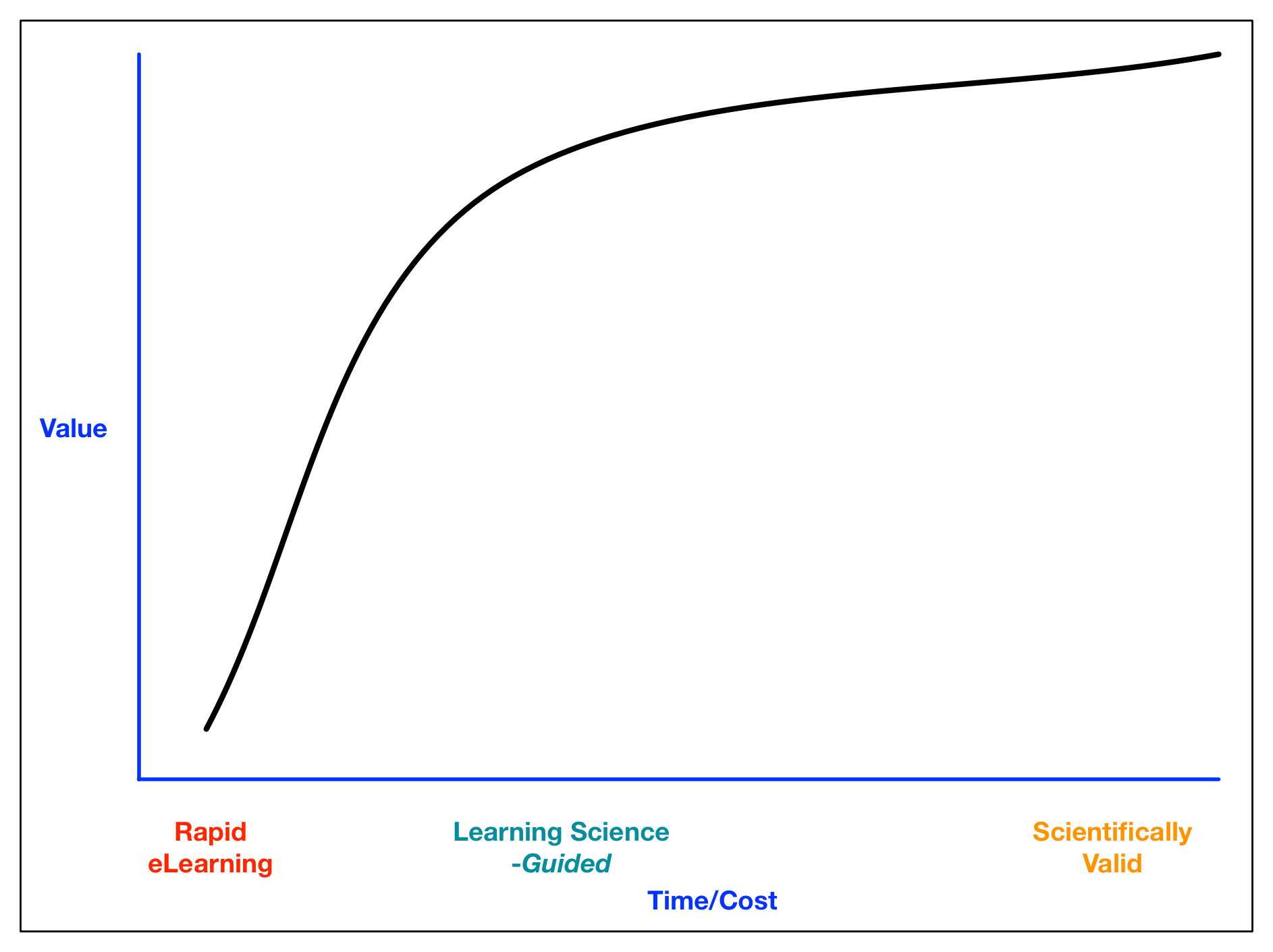
Law of diminishing returns curveI believe that a smart, heuristic approach is plausible.  Using  the typical ‘law of diminishing returns’ curve (and the shape of this curve is open to debate), I  suggest that it’s plausible that there is a sweet spot of design processes that gives you an high amount of value for a pragmatic investment of time and resources.  Conceptually, I believe you can get good outcomes with some steps that tap into the core of learning science without following the letter.  Learning is a probabilistic game, overall, so we’re taking a small tradeoff in probability to meet real world constraints.

What are these steps? Instead of doing a full cognitive task analysis, we’ll do our best guess of meaningful activities before getting feedback from the SME.  We’ll switch the emphasis from knowledge test to mini- and branching-scenarios for practice tasks, or we’ll have them take information resources and use them to generate work products (charts, tables, analyses) as processing.  We’ll try to anticipate the models,  and ask for misconceptions & stories to build in.    And we’ll align pre-, in-, and post-class activities in a pragmatic way.  Finally,  we’ll do a learning equivalent of heuristic evaluation, not do a full scientifically valid test, but we’ll run it by the SMEs and fix their (legitimate) complaints, then run  it with  some students and fix the observed  flaws.

In short, what we’re doing here are   approximations to the full process that includes some smart guesses instead of full validation.  There’s not the expectation that the outcome will be as good as we’d like, but it’s going to be a lot better than throwing quizzes on content. And we can do it with a smart team that aren’t learning scientists  but are informed, in a longer but still reasonable schedule.

I believe we can create transformative learning under real world constraints.  At least, I’ll claim this approach is far more justifiable than the too oft-seen approach of info dump and knowledge test. What say you?

« Previous Page
Next Page »

Clark Quinn

The Company

Search

Feedblitz (email) signup

Never miss a post
Your email address:*
Please wait...
Please enter all required fields Click to hide
Correct invalid entries Click to hide

Pages

  • About Learnlets and Quinnovation

The Serious eLearning Manifesto

Manifesto badge

Categories

  • design
  • games
  • meta-learning
  • mindmap
  • mobile
  • social
  • strategy
  • technology
  • Uncategorized
  • virtual worlds

License

Previous Posts

  • March 2026
  • February 2026
  • January 2026
  • December 2025
  • November 2025
  • October 2025
  • September 2025
  • August 2025
  • July 2025
  • June 2025
  • May 2025
  • April 2025
  • March 2025
  • February 2025
  • January 2025
  • December 2024
  • November 2024
  • October 2024
  • September 2024
  • August 2024
  • July 2024
  • June 2024
  • May 2024
  • April 2024
  • March 2024
  • February 2024
  • January 2024
  • December 2023
  • November 2023
  • October 2023
  • September 2023
  • August 2023
  • July 2023
  • June 2023
  • May 2023
  • April 2023
  • March 2023
  • February 2023
  • January 2023
  • December 2022
  • November 2022
  • October 2022
  • September 2022
  • August 2022
  • July 2022
  • June 2022
  • May 2022
  • April 2022
  • March 2022
  • February 2022
  • January 2022
  • December 2021
  • November 2021
  • October 2021
  • September 2021
  • August 2021
  • July 2021
  • June 2021
  • May 2021
  • April 2021
  • March 2021
  • February 2021
  • January 2021
  • December 2020
  • November 2020
  • October 2020
  • September 2020
  • August 2020
  • July 2020
  • June 2020
  • May 2020
  • April 2020
  • March 2020
  • February 2020
  • January 2020
  • December 2019
  • November 2019
  • October 2019
  • September 2019
  • August 2019
  • July 2019
  • June 2019
  • May 2019
  • April 2019
  • March 2019
  • February 2019
  • January 2019
  • December 2018
  • November 2018
  • October 2018
  • September 2018
  • August 2018
  • July 2018
  • June 2018
  • May 2018
  • April 2018
  • March 2018
  • February 2018
  • January 2018
  • December 2017
  • November 2017
  • October 2017
  • September 2017
  • August 2017
  • July 2017
  • June 2017
  • May 2017
  • April 2017
  • March 2017
  • February 2017
  • January 2017
  • December 2016
  • November 2016
  • October 2016
  • September 2016
  • August 2016
  • July 2016
  • June 2016
  • May 2016
  • April 2016
  • March 2016
  • February 2016
  • January 2016
  • December 2015
  • November 2015
  • October 2015
  • September 2015
  • August 2015
  • July 2015
  • June 2015
  • May 2015
  • April 2015
  • March 2015
  • February 2015
  • January 2015
  • December 2014
  • November 2014
  • October 2014
  • September 2014
  • August 2014
  • July 2014
  • June 2014
  • May 2014
  • April 2014
  • March 2014
  • February 2014
  • January 2014
  • December 2013
  • November 2013
  • October 2013
  • September 2013
  • August 2013
  • July 2013
  • June 2013
  • May 2013
  • April 2013
  • March 2013
  • February 2013
  • January 2013
  • December 2012
  • November 2012
  • October 2012
  • September 2012
  • August 2012
  • July 2012
  • June 2012
  • May 2012
  • April 2012
  • March 2012
  • February 2012
  • January 2012
  • December 2011
  • November 2011
  • October 2011
  • September 2011
  • August 2011
  • July 2011
  • June 2011
  • May 2011
  • April 2011
  • March 2011
  • February 2011
  • January 2011
  • December 2010
  • November 2010
  • October 2010
  • September 2010
  • August 2010
  • July 2010
  • June 2010
  • May 2010
  • April 2010
  • March 2010
  • February 2010
  • January 2010
  • December 2009
  • November 2009
  • October 2009
  • September 2009
  • August 2009
  • July 2009
  • June 2009
  • May 2009
  • April 2009
  • March 2009
  • February 2009
  • January 2009
  • December 2008
  • November 2008
  • October 2008
  • September 2008
  • August 2008
  • July 2008
  • June 2008
  • May 2008
  • April 2008
  • March 2008
  • February 2008
  • January 2008
  • December 2007
  • November 2007
  • October 2007
  • September 2007
  • August 2007
  • July 2007
  • June 2007
  • May 2007
  • April 2007
  • March 2007
  • February 2007
  • January 2007
  • December 2006
  • November 2006
  • October 2006
  • September 2006
  • August 2006
  • July 2006
  • June 2006
  • May 2006
  • April 2006
  • March 2006
  • February 2006
  • January 2006

Amazon Affiliate

Required to announce that, as an Amazon Associate, I earn from qualifying purchases. Mostly book links. Full disclosure.

We use cookies to ensure that we give you the best experience on our website. If you continue to use this site we will assume that you are happy with it.