Learnlets

Secondary

Clark Quinn’s Learnings about Learning

Search Results for: align

Web 2.0 Learning Skills

6 July 2009 by Clark 3 Comments

The Learning Circuit’s blog big question of the month asks:

In a Learning 2.0 world, where learning and performance solutions take on a wider variety of forms and where churn happens at a much more rapid pace, what new skills and knowledge are required for learning professionals?

I have to say that there’s a lot in this.   Taking a performance ecosystem approach, we also need to recognize that the responsibility of the learning role is more than just courses, it’s performance support, social/informal learning, content models, mobile, and more.   How does this play out?

For one, it’s a shift in perspective.   The responsibility needs to be for all organizational learning, not just formal learning.   Who better?   This means understanding information design, usability, and information architecture as well as instructional design.   Also including for mobile, not just classroom and desktop.   Thus, we have expanded content development skills.

There is more, however. As my colleagues and I have been talking, it’s also clear that the role of the learning designer will likely move from exclusively a content developer to likely more time spent as a learning facilitator.   If we start having user-generated content, while we might occasionally be formalizing that, we’ll also need to be facilitating the learning process itself. We’ll have to be understanding how to nurture groups into cohesion, communication, and collaboration: how to catalyze discussions, how to maintain commitment, how to neutralize negativity, and and how to reach out to those who might feel alienated.

As a consequence, we’ll also have to understand organizational culture, the drivers and barriers to individuals feeling safe and valued to contribute. We’ll have to understand incentives, how to moderate behavior, how to align   vision.   It may not be completely within our power to address, but we have to know, recognize, and nurture useful cultural components, and when and how to point out problems to those who can change factors.

We won’t, for at least the short- and medium-term, be able to assume individual learning skills, also.   We’ll have to know what individual and group learning skills are, make those explicit, assess and nurture them, and value them. It will mean letting go, too, as Jane Bozarth points out.

Finally, we’ll have to be smarter about organizational goals, because all of this can’t immediately be done completely for everything, so we’ll have to prioritize.   We’ll have to earn the right to take on these responsibilities by showing that we know how they contribute to the organizational success.

If you don’t get this, we should talk. Developing these skills is critical, and the time to get moving is now.   Is your organization ready?
Minimizing Transformative Disruption

2 July 2009 by Clark 3 Comments

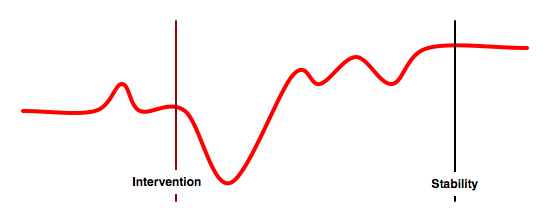
A tweet by @JoshuaKerievsky pointed me to the Satir Change Model, in the context of introducing agile programming. The model purports to capture the disruptive effects of a new idea until it’s internalized, and I find it resonates quite well.   My simplified version looks at it from the point of view of organizational change upon introduction of a new initiative, such as the organizational learning transformations I’m espousing and supporting.

OriginalSatirChangeCurve

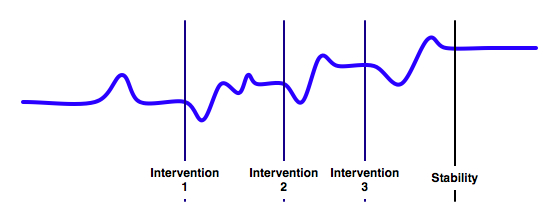
In this simplified version, you can see that an intervention originally creates a decrement in performance, until the intervention takes hold, and then there are some hiccups incurred until the system stabilizes at a new and (hopefully) improved performance outcome.   While we want the improvement, the decrement is something we’d like to minimize.     However, how do we do that?

In researching it a little bit, I came upon a book that discussed using a stepwise approach to minimize it (also in software process improvements), and had a version of the diagram that demonstrated smaller decrements.StepwiseSatirChangeCurve By having smaller introductions that break up the intervention, you decrease the negative effects.   The point is to take small steps that make improvements instead of a monolithic change.
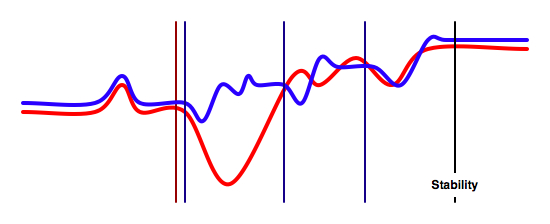
That’s what I’m trying to achieve is  breaking up the organizational transformation implied by the performance ecosystem, and customizing it for an organization by prioritizing steps into next week, next month, next year, etc.   Of course, the diagram is only indicative, not prescriptive, but I trust you recognize what I mean.

The overall approach is to achieve the improvement, but in a staged way customized for a particular organization and context, not a one-size-fits-all approach that really won’t fit anyone.OverlappedSatirChangeCurve The goal is to maximize improvements while minimizing disruption, and doing so in ways that capitalize on previous efforts and existing infrastructure.   To do this really requires understanding how the different components relate: how content models support mobile, how performance support articulates with formal learning and social media, and more.   And, of course, understanding the nuances of the underpinning elements and how they are optimized.
Organizations can’t continue in the status quo of only formal learning, but I reckon many folks aren’t sure where and how to start.   That’s the point of using a framework that points out how the elements interact, and coupling that with an specific organizational assessment.   From there, you can prioritize steps, come up with action plans, be prepared to choose vendors, not have the vendor sell you on what they do best, and more.   You’ve got to have a plan, or where you end up may not be the best place for your organization.

I’m reminded of the Cheshire Cat and Alice:

“Would you tell me, please, which way I ought to go from here?”
“That depends a good deal on where you want to get to,” said the Cat.
“I don’t much care where–” said Alice.
“Then it doesn’t matter which way you go,” said the Cat. ”
–so long as I get SOMEWHERE,” Alice added as an explanation.
“Oh, you’re sure to do that,” said the Cat, “if you only walk long enough.”

So, do have a plan of where you want to get to, as well as an intent to start moving?

Artifacts of reflection

27 June 2009 by Clark 3 Comments

The other day  John Ittelson stopped by for a visit.  I think of him as the guru of video usage in elearning, not least because of the recording studio he built in his house!  He mentioned his use of Flip camcorders, and finally a piece clicked into place that had been floating around in my thoughts.

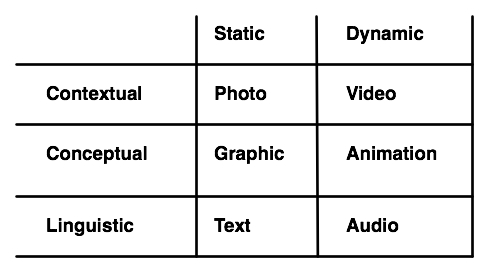
Media PropertiesI’ve had a slight blindspot for photos and video because I peg the ‘conceptual’ meter. I recognize the value, though I don’t play with the files enough (tho’ I took a digital audio/video editing course more than a decade ago, and recently edited home videos for my wife’s birthday).  Photos and videos are really good for contextualizing, and that’s particularly valuable for examples (and practice).

The revelation was about the value of having learners capture information in situ, and sharing this for a variety of reflective opportunities.  The information captured can be performances, products, whatever.  It could also be interviews, or thoughts.

A colleague’s wife used to take an iPod with a microphone to conduct interviews.  Gina Schreck discussed giving groups of employees Flips to make videos of what their business unit does for the org, to share.  John mentioned capturing samples of teaching to share.  Having captures of actual practice is a valuable tool around which to scaffold discussion, and a powerful tool for reflection.  You can capture someone’s stories of best practices, or your own performance to review.

Note that making both other’s and personal captures available opens up the opportunity to learn more with and from others than your own reflective observations will provide, if you can be that open.  As a learning facilitator, you should provide ways for individuals and groups to capture and share thoughts, actions, events, and more.

One of the powerful things in digital performance environments (read: games, er, immersive learning simulations, and virtual worlds as was part of the discussion the other day) is the ability to capture records of action for review, too.  So look at ways to digitally track activity in learning environments (another reason to make the alternative to the right choice to be a reliable misconception!).

Reflection is powerful, and digital tools give us ways to truly leverage that power.  Reflect on that!

Now *that* is leadership

1 June 2009 by Clark 6 Comments

In my recent workshop, an attendee shared a story that I have to pass along.   He works for a company that serves a sector of the marketplace that has been core to US business, and is now in tough times.   Naturally, the employees are concerned about the prospects.

The CEO is sharing, via a blog, his ongoing thoughts on dealing with the issue. Rather than puff pieces for external readers, written by a PR hack, he’s writing authentically for internal consumption about where his thinking is going and what he and the executive team are doing.   He’s not making false promises, and the employee was very clear that there are no clear answers yet, but they’ve insight into how deep the thought processes have been about the situation, and how earnestly (and cleverly) they’re working on solving the issue. He’s even sharing the questions he’s considering.   While all the comments aren’t visible, anyone can provide input and the CEO can react.   This is powerful.

I’ve mentioned before that providing a ‘leading out loud’ record for people to follow is a great mechanism to foster virtual mentorship and share directions, and this is a really valuable way for organizations to communicate.   As Rae Tanner discussed with me yesterday as we walked around DC before the start of the ASTD main conference, imagine an organization where everyone was onboarded with a real understanding of the business (we thought a game would be appropriate), and then were able to follow the ongoing thinking.   Do you think they’d be better equipped to execute, and, better yet, contribute to organizational success? Certainly if it was coupled with a learning culture and rewards aligned with the desired behaviors.

The worskhop attendees easily ‘got’ the value of this scenario; that CEO knows what leadership is about, and is manifesting it in a visionary way.   This is what technology can facilitate. Technology is a tool, but one that provides new affordances for communication and collaboration. The opportunities to improve things individual, organizationally, and societally are awe-inspiring. Now we need to seize the initiative and make really worthwhile things happen. Are you game?

Facing the new learning era

31 May 2009 by Clark 2 Comments

Yesterday I ran my learning technology strategy workshop as a preconference event at ASTD’s International Conference.   I had a crowd of about 16 people who represented a range of experience and responsibilities.   The organizations ranged from academic to industry to information and communication companies.   Some were just starting with elearning, and others had quite a bit under their belt.

elearningvaluenet.jpgWhen I went around the room asking what people were hoping to get out of the day, a lot of mentions of LMS and elearning made me realize that the title of “elearning strategy” had perhaps misled people into thinking this was just about courses online, whereas I was going quite a ways further through my performance ecosystem.   I took some time to explain that my vision of learning was far beyond courses, and included problem-solving, innovation, and more.
I did try to spend more time on eLearning and advanced ID than I’d originally intended, but still felt the rest were things they needed to get their minds areound.   As we got beyond the performance focus stage (after Improved ID and eLearning), it became clear we were in pretty much uncharted territory for most.   I continued on, defining each element, giving examples, and working through the costs and benefits. The attendees, perhaps loosened up by my goofy humor (no situation so bad that a bad pun can’t make it worse), were very good about asking questions and challenging me (I like that, either they or I learn something), to make sure a shared understanding developed.

While it was a lot of ‘me talking’, I did have them self-assess where they were (as one later said, he got tired of saying “no” so often) and broke down the steps into action items they could choose to pull into a plan and prioritize.

The outcome was maybe even better than I’d hoped.   As I asked for what folks might have planned for going back, the first three who shared were completely divergent. One was going to focus on performance support, one was going to review their elearning templates, and one was going to take a stab at social media.   This was just what I had hoped, that they’d take where they were and this broader perspective on what the learning function could be, and find the right next step for themselves.

I also loved reading the evaluation sheets afterwards (careful to not know who said what).   I was thrilled to see folks saying (paraphrasing a repeated sentiment): “I’m in awe of how much there is to think about, but really excited about the potential and opportunity to really have an impact”.   They really felt it was valuable, and that’s always what I hope to achieve.   There’s surely room for improvement, and extending it to put in some activities would be an option, but as it is I couldn’t be happier.

Designing on demand

28 May 2009 by Clark 3 Comments

Yesterday I had the pleasure of working with a team on a grant to use games as a context to conduct high stakes cognitive assessments.   The cognitive tasks for assessment are remarkably abstract, e.g do this particular discrimination task (ie look at a string of four characters and signal if one is a vowel), sometimes while monitoring another situation or as an attention-distractor from another task, but the tasks that they are matched to range from very expensive to life-saving..   The goal is to establish a baseline, and then look for decrements at particular instances before a crucial task, indicating lack of readiness.

The interesting thing is the challenge of placing these tasks in a meaningful context.   It’s creative, and consequently fun.   It’s also collaborative, and when you get divergent contributors in a safe environment, you can really get productive synergy going.   We got together the night before for a meal and some social lubricants, and the next day spent hours in a conference room discussing, whiteboarding and generally designing.

One of the problems is that there have been diverse project specifications from the granting organization, and lack of access to the intended audience. We had some feedback that there should be minimal ‘story’, and very clearly that if the audience doesn’t perceive value, they can ignore the activity completely.   Also, there were some important constraints on how much we could change the core task without invalidating the deep research base.   Fortunately, a background in cog psych as well as having the minds behind the tests with us allowed a reasonable guess.   Still, a bit of a challenge.

We focused in early on the value, and I brought up that if the cognitive activity produces improvements in ability, that it’s training as well as assessment, and the audience cares very much about being able to do the job.   That hadn’t been determined to date, but may be available.   We also talked about marketing the value, and if the assessment can in this case (as it has in the past) serve as a very accurate predictor of performance (e.g. detecting a decrement in performance without prior knowledge), that may provide the necessary motivation.

When it comes to design, I’ve made a claim before that you can’t give me an objective I can’t design a game for (I reserve the right to raise the objective ‘high’ enough, but have yet to be proved wrong; it’s an outcome of the engaging learning framework), and this isn’t an exception. In fact, we came up with numerous possible settings, originally for what we were told of the mission, and then for a more near-term mission.   We also came up with relative degrees of abstraction from real (e.g. closely aligned to real task) to essentially arbitrary (like Tetris has little correlation to real time).   The fact of the matter is, you can embed meaningful tasks in appropriate contexts, and tune into a game no matter what the objective is.   It just takes systematic creativity (not an oxymoron), as in the heuristics I’ve talked about previously in two spots.

Since we don’t yet have access to the audience (though we know who they are), I suggested that we need to mock up several different plausible looks and trial them when they do get access (they’re working on that).   They had talked to some stakeholders, but that’s not reliable, for reasons I related to them.   In the process of designing the Quest game, we talked to the counselors who worked with these ‘at risk’ youth, who suggested this issue was smart shopping and cooking.   Fortunately, we then got to talk to some of the youth themselves, who responded “yeah, that’s important, but what’s really important is…” and proceeded to give us a set of relationships that then became key to the game.   Lesson: don’t just listen to the managers, or just the trainers, or just…all those are important, but they may not be right.

It was easy to consider a number of degrees of story ‘depth’, and visual styles to go with each.   At least, they’re in my head, but I went out and grabbed screenshots of various things that could serve as models.   You want the game mechanics to reflect the cognitive task, but you can wrap a number of different looks round that. We’ll pull together our notes, get some storyboards generated, but we managed to sketch out five separate games for what evidence suggests are likely to be the most important skills.

And that’s the real lesson, that it can be done, reliably and repeatedly.   And that’s important, because if you can’t, then it’s all well and good to talk about the value of games as learning environments, but it’s a waste of time if you don’t have an associated design process.   Fortunately, I can still comfortably say: “learning can, and should, be hard fun“.

Mapping the learning space

20 May 2009 by Clark 6 Comments

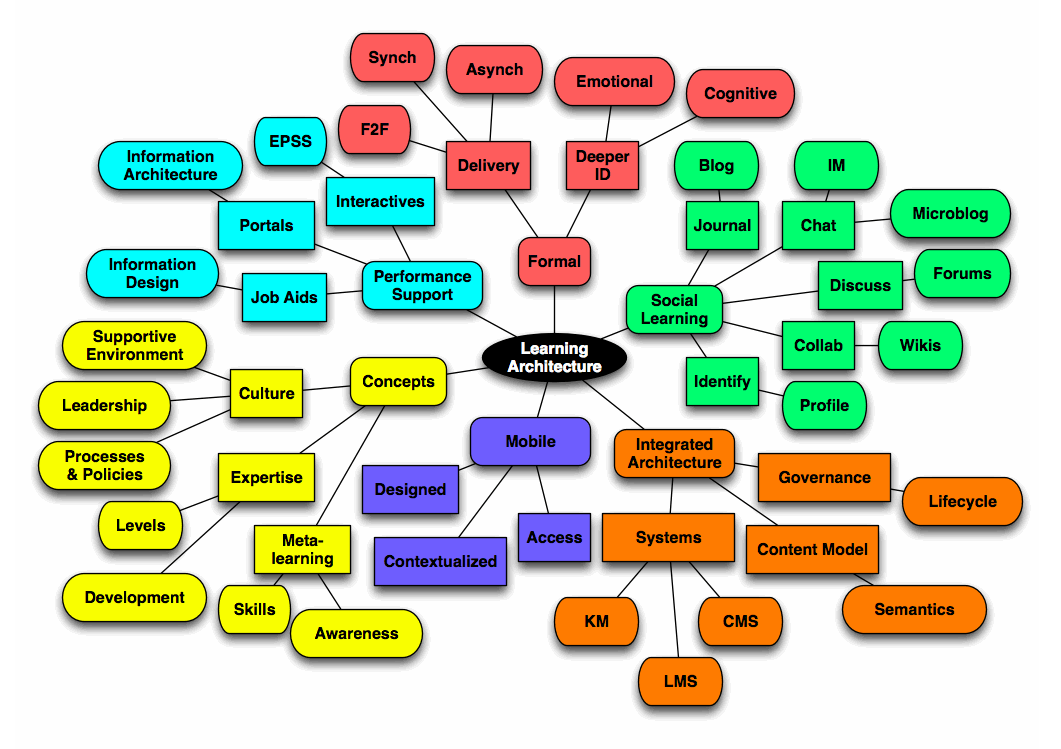
In trialing a mind-mapping tool on my iPhone, I started mapping the ‘performance ecosystem’ space. I carried it over to my desktop tool (not literally, the free version doesn’t seem to export), and started elaborating.   I got to this point, and think it’s not too bad a top-level cut, with the caveats that a) each of those nodes unpacks even further, let alone each leaf, and b) that I haven’t even tried to capture the cross links, e.g. between performance support and mobile, between mobile and content model, etc.

strategicmindmap

Here’s the same as an outline (ok, Stephen? :):

Learning Architecture
❑       Performance Support
▼❑       Job Aids
•       ❑       Information Design
▼❑       Portals
•       ❑       Information Architecture
▼❑       Interactives
•       ❑       EPSS

❑       Formal
▼❑       Delivery
•       ❑       F2F
•       ❑       Synch
•       ❑       Asynch
▼❑       Deeper ID
•       ❑       Emotional
•       ❑       Cognitive

❑       Social Learning
▼❑       Identify
•       ❑       Profile
▼❑       Chat
•       ❑       Microblog
•       ❑       IM
▼❑       Journal
•       ❑       Blog
▼❑       Discuss
•       ❑       Forums
▼❑       Collab
•       ❑       Wikis

❑       Integrated Architecture
▼❑       Content Model
•       ❑       Semantics
▼❑       Governance
•       ❑       Lifecycle
▼❑       Systems
•       ❑       KM
•       ❑       LMS
•       ❑       CMS

❑       Mobile
▼❑       Access
▼❑       Designed
▼❑       Contextualized

❑       Concepts
▼❑       Culture
•       ❑       Leadership
•       ❑       Processes & Policies
•       ❑       Supportive Environment
▼❑       Expertise
•       ❑       Levels
•       ❑       Development
▼❑       Meta-learning
•       ❑       Skills
•       ❑       Awareness

Definitely a ‘learning out loud’ work-in-progress.   Feedback welcome!

Developing Learners

19 May 2009 by Clark 4 Comments

Charles Jennings makes a brilliant observation about how Learning & Development folks are taking the wrong path in his post: When the Game’s Up. He points out that L&D practitioners are focused on Instructor Led Training, and:

ILT may be helpful for some change management and big-picture ‘concept‘ development, but it is demonstrably the least effective and certainly the least efficient approach for most learning that‘s required.

In short, we’re just not doing what we need to be doing.   I was revisting my previous thoughts on slow learning and distributed learning, and I realize we’re missing a major perspective.   We seem to have two extremes on the continuum: the ‘event’ or informal learning.   There’s more.

I had a tour of Q2Learning‘s environment today, courtesy of John Darling, and while I’m not conducting a thorough point by point evaluation, one element struck me as relevant.   Their platform’s ‘DNA’ came from social learnng, but their formal model (client driven) is based upon proficiency, and if not mandating, certainly enables what they call a ‘proficiency’ approach.

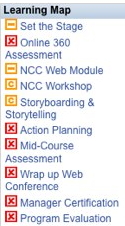
mixedassessmentlearningmapWhat I like about it is it takes a longer term view of skills. The sample he showed (and of course I realize it’s presented in the best light) was a learning map for a course, but with lots of components spread out over time (sample map shown).   There’s a priori assessment, content, activities with managers, etc.; a mix of activity, practice, reflection, just the sort of model we should be designing.   We know spaced practice matters, with reactivation, reflection, etc. It’s also valuable to go   back to the workplace, and then check-in later to see how things are going.   It’s a fuller picture of what learning’s about.

John mentioned some need formal features, such as the ability to assign journals as an activity, and similarly assign posting to a discussion board and then commenting on other posts (and tracking this!).   Given that these were two of three activities I used in my own online course (and mentioned here), I asked about the third activity: assigning group work (e.g. collaborating through a wiki) and handling the submission.   It wasn’t there, but could be added as another of their templates of ‘activities’.

The important thing, to me, is the point that a system to support formal learning should be able to link together and track a sequence of activities that develop a person over time, not just through an ‘event’ perspective.   Integrating the same social tools from the informal side also provides hope that there can be an elegant segue from the formal to the informal.

We agreed that one of the problems on the informal side is assuming that people are skilled at self-learning (or even group learning, I’ll add), and that we shouldn’t take it for granted.

All told, I think it’s an important different perspective on learning to think about developing people along a continuum, not a ‘spray and pray’ approach to learning.   Now, to only get the L&D function to start looking beyond their zone of comfort, and into the area of relevance.   Otherwise, we’d be better off, as Charles suggests, taking the training money and letting them spend it at the pub, at least reducing their stress and developing some morale!

Systems-Thinking, Models, & Chaos

8 May 2009 by Clark 1 Comment

In a conversation I had yesterday, we were talking about how not enough people were using systems-thinking. I realize schools don’t prepare for it sufficiently, but it also made me think about why it’s so necessary.

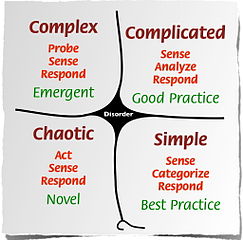
Cynefin_frameworkGetting back to my riff on chaos, if things are getting more random, as such would predict (e.g. in the complex or chaotic quadrants of the Cynefin model), our existing processes are less likely to work.   Off-the-shelf solutions won’t cut it, and you’ll need to be looking for matching patterns that will give you some guidance about how to act.   However, the relevant models may come from unexpected places.   That’s been the source of much innovation, and a motivation for me in my model collecting and generating.

It comes back to reasoning, and one of the most powerful tools we have is analogical reasoning.That’s a model that taps into our cognitive architecture’s orientation towards pattern-matching, and helping pull up a good match.   My Ph.D. was focused on improving analogical reasoning because of the power such reasoning has.

Which is the reason I continue to believe in the power of models.   These are frameworks and tools with analytical power that help explain and predict the world.   (Increasingly, I’m realizing the power of visual representations of such models as well.)

I believe that an experimental attitude and a rich suite of models are the tools that will prevail in the future, comprehending the problem and looking for matching models to see whether they can help, when things are new.   This is the stuff of innovation: it’s blue ocean strategy, it’s when you’re moving into new areas or taking on new responsibilities, it’s the cynefin framework itself.

Some things in the learning field are reasonably well understood (if not widely distributed nor well practiced) such as ID and information architecture.   Others are still emergent: certainly for social media, we’re seeing that it takes time and the advantages of some prior experience; mobile is still emergent; and content models are a new area as well.   The point being, I think that developing a capability for flexible problem-solving is a necessity going forward, and it may take that flexible problem-solving to get there!

Networked organizations

6 May 2009 by Clark Leave a Comment

Last night I went to hear Ross Dawson speak on the Future of the Enterprise.   His points resonated with a lot of what I and my TogetherLearn colleagues have been saying about the changes we’re seeing.   I really do think that some changes are in the air.

chaosfractalRoss reiterated the notion that the current context is a state of increasing change.   Things are moving faster, and the chaotic reality underpinning our existence is being brought into highlight more and more.   He talked about how commoditization is a driving economic factor, the fact that others can reproduce what you create quickly, so there’s incredible pressure to have to build more on top.   I afterward asked him and he supported my contention that optimal execution is only the price of entry, and that continual innovation and delivering a seamless customer experience will be the differentiator.

He asked a series of five questions at the end, and one was how we got people to participate.   Verna Allee suggested leadership would be even more critical. Another attendee thought that companies would have to offer compelling experiences for employees as well.   I do think that helping individuals comprehend the vision, letting them figure out how to achieve the necessary goal, and creating an empowering environment are critical.

Another question had to do with how organizations would be structured going forward.   Ross made a clever reference to how the word ‘corporation’ comes from corpus, or body, and that organizations now were much more a distributed enterprise: networks of employees, suppliers, clients, partners, contractors, etc.   “The organization is just a persistent network.”

A point made was that all that matters are relationships and knowledge, particularly when manufacturing can be ‘on demand’, and that mass participation creates value. If the organization is a network, and all these participants generate the value, organizations have to support networking for knowledge work, getting contributions from empowered learners.   To cope in this age of increasing disruptive influences, it’s critical.

It’s time for organizations to get serious about providing infrastructure that supports workers networking, communicating, collaborating, problem-solving, innovating, learning.   Coupled with a supportive culture and clear vision, it’s the wave of the future.   Ross thought that in five years time, the new organizational imperatives would be clear.   That doesn’t give you a lot of time to get moving, and you really ought to begin last week if you want to be a leader, not a late adopter.

Get moving, or get help!

« Previous Page
Next Page »

Clark Quinn

The Company

Search

Feedblitz (email) signup

Never miss a post
Your email address:*
Please wait...
Please enter all required fields Click to hide
Correct invalid entries Click to hide

Pages

  • About Learnlets and Quinnovation

The Serious eLearning Manifesto

Manifesto badge

Categories

  • design
  • games
  • meta-learning
  • mindmap
  • mobile
  • social
  • strategy
  • technology
  • Uncategorized
  • virtual worlds

License

Previous Posts

  • March 2026
  • February 2026
  • January 2026
  • December 2025
  • November 2025
  • October 2025
  • September 2025
  • August 2025
  • July 2025
  • June 2025
  • May 2025
  • April 2025
  • March 2025
  • February 2025
  • January 2025
  • December 2024
  • November 2024
  • October 2024
  • September 2024
  • August 2024
  • July 2024
  • June 2024
  • May 2024
  • April 2024
  • March 2024
  • February 2024
  • January 2024
  • December 2023
  • November 2023
  • October 2023
  • September 2023
  • August 2023
  • July 2023
  • June 2023
  • May 2023
  • April 2023
  • March 2023
  • February 2023
  • January 2023
  • December 2022
  • November 2022
  • October 2022
  • September 2022
  • August 2022
  • July 2022
  • June 2022
  • May 2022
  • April 2022
  • March 2022
  • February 2022
  • January 2022
  • December 2021
  • November 2021
  • October 2021
  • September 2021
  • August 2021
  • July 2021
  • June 2021
  • May 2021
  • April 2021
  • March 2021
  • February 2021
  • January 2021
  • December 2020
  • November 2020
  • October 2020
  • September 2020
  • August 2020
  • July 2020
  • June 2020
  • May 2020
  • April 2020
  • March 2020
  • February 2020
  • January 2020
  • December 2019
  • November 2019
  • October 2019
  • September 2019
  • August 2019
  • July 2019
  • June 2019
  • May 2019
  • April 2019
  • March 2019
  • February 2019
  • January 2019
  • December 2018
  • November 2018
  • October 2018
  • September 2018
  • August 2018
  • July 2018
  • June 2018
  • May 2018
  • April 2018
  • March 2018
  • February 2018
  • January 2018
  • December 2017
  • November 2017
  • October 2017
  • September 2017
  • August 2017
  • July 2017
  • June 2017
  • May 2017
  • April 2017
  • March 2017
  • February 2017
  • January 2017
  • December 2016
  • November 2016
  • October 2016
  • September 2016
  • August 2016
  • July 2016
  • June 2016
  • May 2016
  • April 2016
  • March 2016
  • February 2016
  • January 2016
  • December 2015
  • November 2015
  • October 2015
  • September 2015
  • August 2015
  • July 2015
  • June 2015
  • May 2015
  • April 2015
  • March 2015
  • February 2015
  • January 2015
  • December 2014
  • November 2014
  • October 2014
  • September 2014
  • August 2014
  • July 2014
  • June 2014
  • May 2014
  • April 2014
  • March 2014
  • February 2014
  • January 2014
  • December 2013
  • November 2013
  • October 2013
  • September 2013
  • August 2013
  • July 2013
  • June 2013
  • May 2013
  • April 2013
  • March 2013
  • February 2013
  • January 2013
  • December 2012
  • November 2012
  • October 2012
  • September 2012
  • August 2012
  • July 2012
  • June 2012
  • May 2012
  • April 2012
  • March 2012
  • February 2012
  • January 2012
  • December 2011
  • November 2011
  • October 2011
  • September 2011
  • August 2011
  • July 2011
  • June 2011
  • May 2011
  • April 2011
  • March 2011
  • February 2011
  • January 2011
  • December 2010
  • November 2010
  • October 2010
  • September 2010
  • August 2010
  • July 2010
  • June 2010
  • May 2010
  • April 2010
  • March 2010
  • February 2010
  • January 2010
  • December 2009
  • November 2009
  • October 2009
  • September 2009
  • August 2009
  • July 2009
  • June 2009
  • May 2009
  • April 2009
  • March 2009
  • February 2009
  • January 2009
  • December 2008
  • November 2008
  • October 2008
  • September 2008
  • August 2008
  • July 2008
  • June 2008
  • May 2008
  • April 2008
  • March 2008
  • February 2008
  • January 2008
  • December 2007
  • November 2007
  • October 2007
  • September 2007
  • August 2007
  • July 2007
  • June 2007
  • May 2007
  • April 2007
  • March 2007
  • February 2007
  • January 2007
  • December 2006
  • November 2006
  • October 2006
  • September 2006
  • August 2006
  • July 2006
  • June 2006
  • May 2006
  • April 2006
  • March 2006
  • February 2006
  • January 2006

Amazon Affiliate

Required to announce that, as an Amazon Associate, I earn from qualifying purchases. Mostly book links. Full disclosure.

We use cookies to ensure that we give you the best experience on our website. If you continue to use this site we will assume that you are happy with it.