Learnlets

Secondary

Clark Quinn’s Learnings about Learning

Search Results for: engagement

Transformation!

20 November 2018 by Clark 1 Comment

butterfly cocoonI’m a fan of the notion of ‘learning experience design’ (not so sure about  platforms;  I need to investigate them more ;).  The idea of integrating effective education and engaging experiences is something I’ve been  on about for a  very long time. And I want to push it a little further. I want to talk about transformation.

What am I talking about? So, I’ve previously referred to Pine & Gilmore’s concept of the Transformation Economy. That is, going beyond experiences (e.g. themed restaurants) to ones that change us. And I argue that’s what we do; we create (or should) experiences that give us new skills, new abilities to  do.  But I want to push it further.

Here I’m talking about deliberately using the idea of transformation as a learning design goal. Not just change, but leveraging the emotions as well as cognition to have the learner not just feel empowered, but transformed!  This may sound like a lofty goal, fine for a TED Talk (just read the book; recommended), but is it practical for elearning?  Well, that’s an interesting question.

Let me spin it another way: I do  not think we should be shooting for an information dump and knowledge test. For two reasons: one is that it’s not inspiring. More importantly, however, it also isn’t effective. You end up with what cognitive scientists call ‘inert knowledge’. You’ll learn it and pass a test on it, but when it’s relevant in practice it won’t even get activated!  Because you’ve never used it in ways like you practice.

I think if we are actively thinking about transformation as a goal, we might do a better job of thinking about the necessary practice and the emotional engagement.  We can focus on thinking “what will lead to the transformation we want”, and “how do we make people want it and celebrate when they’ve made the breakthrough?”  And I think this is a useful perspective.

Even for things like compliance, I’d suggest that we should be having visceral reactions like “Ok, I get it <bad behavior> is pretty heinous”, and “safety  is important, and I commit to following these rules”.  For more important things, you’d like them to feel “yes, I see, this will change how I  do this!”

Yes, it’s ambitious. But why set ourselves limited goals? When I was teaching interface design, I maintained that if I accommodated the engineers lack of background in Psych, I’d get them only so far. If I pushed them, they’d end up farther than if I was conciliatory. Similarly, here, I think we’ll do a better job if we think ‘ambitious’, and end up not as far as we’d like. I’ll suggest that’s better than satisfactorily achieving mediocrity. Most importantly, I truly think we’ll do a better job of design if we strive for transformation.

And, if there’s nothing transformative about what we’re covering, should we really be using our resources?  Let me put it another way: why  shouldn’t we do this? Seriously, I’m asking.  So, what’s your answer?
 

Why Engaging Learning?

24 October 2018 by Clark Leave a Comment

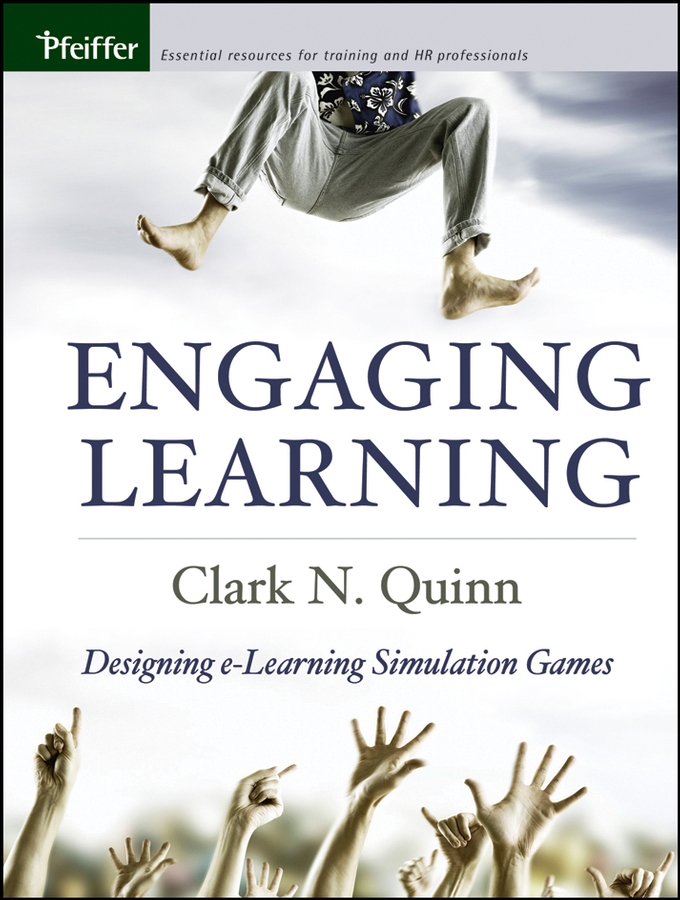
Book coverSomeone asked me what I would say about my first book, Engaging Learning. And, coincidentally, my client just gave some copies to their client as part of our engagement, so I guess there’s still value in it!  And while I recognize it’s now about 13 years old, I really do believe it has relevance. Since they asked…

I saw the connections between computers and learning as an undergraduate, and designed my own major. My first job out of college was designing and programming educational computer games. Long story short: I went back for a Ph.D. in what was effectively ‘applied cognitive science’, but games continued to play a role in my career. And I reflected on it, and ultimately what started as a research agenda manifested as a model for explaining why games work and how to do it. And then when I started consulting, Pfeiffer asked me to write the book.

To be clear, I believe engagement matters.  We learn better when our hearts and our minds are engaged. (That’s the intent of the double meaning of the title, after all.)  Learning sticks when we’re motivated and in a ‘safe’ learning situation.  Learning can, and should, be ‘hard fun’.  However,  if we can’t do it reliably and repeatedly, it’s just a dream. I believe that if we systematically apply the principles in the book, we can do it (systematic creativity is  not an oxymoron ;).

One of the concerns was that things were changing fast even then (Flash was still very much in play, for example ;).  How to write something that wouldn’t be outdated even before it came out?  So I tied it to cognitive principles, as our brains aren’t changing that fast.  Thus, I think the principles in it still hold.  I’ve continued to check and haven’t found anything that undermines the original alignment that underpins designing engaging experiences.

And the book was designed for use. While the first three chapters set the stage, the middle three dig into details. There you’ll find the core framework, examples, and a design process. The design process was focused mostly on adding to what you already do, so as not to be redundant. The final three chapters wrap up pragmatics and future directions.

While ostensibly (and realistically) about designing games, it was really about engagement. For instance, the principles included were applied backwards to branching scenarios, and what I called linear and mini-scenarios. The latter just being better written multiple choice questions!

The book couldn’t cover everything, and I’ve expanded on my thinking since then, but I believe the core is still there: the alignment and the design process in particular. There have been newer books since then by others (I haven’t stayed tied to just games, my mind wanders more broadly ;) and by me, but as with my other books I think the focus on the cognitive principles gives lasting guidance that still seems to be relevant. At a recent event, someone told me that while I viewed mobile as a known, for others it wasn’t. I reckon that may be true for games and engagement as well. If we’re making progress, I’m pleased. So, please, start engaging learning by making engaging learning!

PS, I wrote a Litmos blog post about why engagement matters, as a prelude to a session I’ll be giving at their Litmos Live  online event (Nov 7-8) where I talk about how to do it.


Constraints on activities

23 October 2018 by Clark 2 Comments

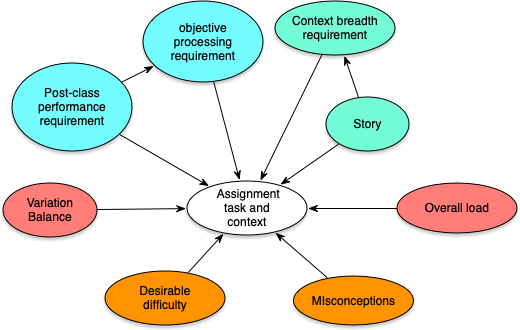
When we design learning activities (per the activity-based learning model), ideally we’re looking to create an integration of a number of constraints around that assignment. I was looking to enumerate them, and (of course) I tried diagramming it.  Thought I’d share the first draft, and I welcome feedback!

Multiple constraints on assignmentsThe goal is an assignment that includes the right type of processing. This must align with what they need to be able to do after the learning experience. Whether at work or in a subsequent class. Of course, that’s factored into the objective for this learning activity (which is part of an overall sequence of learning).

Another constraint is making sure the setting is a context that helps establish the breadth of transfer. The choice should be sufficiently different from contexts seen in examples and other practices to facilitate abstracting the essential elements. And, of course, it’s ideally in the form of a story that the learner’s actions are contributing to (read: resolve). The right level of exaggeration could play an (unrepresented) role in that story.

We also need the challenge in the activity to be in the right range of difficulty for the learner. This is the integration of flow and learning to create meaningful engagement.  And we want to include ways in which learners typically go wrong (read: misconceptions). Learners need to be able to make the mistakes here so we’re trapping and addressing them in the learning situation, not when it could matter.

Finally, we want to make sure there’s enough variation across tasks. While some similarities benefit for both consistency and addressing the objective, variety can maintain interest. We need to strike that balance. Similarly, look at the overall workload: how much are we expecting, and is that appropriate given the other constraints outside this learning goal.

I think you can see that successfully integrating these is non-trivial, and I haven’t even gotten into how to evaluate this, particularly to make it a part of an overall assessment. Yet, we know that multiple constraints help make the design easier (at least until you constrain yourself to an empty solution set ;).  This is probably still a mix of art and science, but by being explicit you’re less likely to miss an element.

We want to align activities with the desired outcome, in the full context.  So, what am I missing?  Does this make sense?


Labels, models, and drives

16 October 2018 by Clark Leave a Comment

In my post last week on engagement, I presented the alignment model from my  Engaging Learning  book on designing learning experiences. And as I thought about the post, I pondered several related things about labels, models, and drives. I thought I’d wrestle with them ‘out loud’ here, and troll (in the old sense) to see what you think.

Some folks have branded a model and lived on that for their career. And, in a number of cases, that’s not bad: they’re useful models and their applicability hasn’t diminished. And while, for instance, I think that alignment model is as useful as most models I’ve seen, I didn’t see any reason to tie my legacy to it, because the principles I like to comprehend and then apply to create solutions aren’t limited to just engagement. Though I wonder if people would find it easier to put the model in practice if it had a label.  The Quinn Engagement model or somesuch?

I’ve also created models around mobile, and about performance ecosystems, and more. I can’t say that they’re all original (e.g. the 4Cs of mobile), though I think they have utility. And some have labels (again, the 4Cs, Least Assistance Principle…) Then the misconceptions book is very useful, but the coverage there isn’t really mine, either. It’s just a useful compendium. I expect to keep creating models. But it’d led to another thought…

I’ve seen people driven to build companies. They just keep doing it, even if they’ve built one and sold it, they’re always on it; they’re serial entrepreneurs. I, for instance, have no desire to do that. There are elements to that that aren’t me.    Other folks are driven to do research: they have a knack for designing experiments that tease out the questions that drive them to find answers. And I’ve been good at that, but it’s not what makes my heart beat faster. I do  like action research, which is about doing with theory, and reflecting back. (I also like helping others become able to do this.)

What I’m about is understanding and applying cognitive science (in the broad sense) to help people do important things in ways that are enabled by new technologies.  Models that explain disparate domains are a hobby. I like finding ways to apply them to solve new problems in ways that are insightful but also pragmatic.   If I create models along the way (and I do), that’s a bonus. Maybe I should try to create a model about applying models or somesuch. But really, I like what I do.

The question I had though, is whether anyone’s categorized ‘drives’.  Some folks are clearly driven by money, some by physical challenges. Is there a characterization?  Not that there needs to be, but the above chain of thought led me to be curious. Is there a typology of drives? And, of course, I’m skeptical if there is one (or more), owing to the problems with, for instance, personality types and learning styles :D. Still, welcome any pointers.

Where’s Clark? Fall 2018/Spring 2019 Events Schedule

2 October 2018 by Clark Leave a Comment

Here’re the events where I’ll be through the last quarter of this year, and into the next. Of course, you can always find out what’s up at the Quinnovation News page… But this is a more likely place for you to start unless you’re looking to talk to me about work.  I hope to see you, virtually or in person, at one of these!

The week of October 22-26, Clark will be speaking (the same week!) at DevLearn on measurement and eLearning science, and at AECT on meta-learning architecture. (Yeah, both in one week…long story.)

On Litmos’ Live Virtual Summit on 7-8 November, Clark will talk Learning Experience. Stay tuned!

Clark will be a guest on Relate’s eLearnChat on 15 Nov.

2019

On the 9th of January, Clark will present The Myths that Plague Us as a webinar for HRDQ-U.

Clark will be presenting in the Modern Workplace Learning track at the LearnTec conference in Karlsruhe, Germany that runs 29-31 January.

Feb 25-27, Clark will serve as host of the Strategy Track at Training Magazine’s annual conference, opening with an overview and closing with a strategy-development session.

Clark will speak to the Charlotte Chapter of ISPI on the Performance Ecosystem on March 14.

At the eLearning Guild’s Learning Solutions conference March 25-28, Clark will be presenting a Learning Experience Design workshop, where we’ll go deep on integrating learning science and engagement.

If you’re at one of these events, please do introduce yourself and say hello (I’m not aloof, I’m just shy; er, ok, at least ’til we get to know one another :).

ONE level of exaggeration

26 September 2018 by Clark 5 Comments

I’ve argued before that we should be thinking about exaggeration in our learning design. And I’ve noticed that it’s a dramatic trick in popular media. But you can easily think of ways it can go wrong. So what would be appropriate exaggeration?

When I look at movies and other story-telling media (comics), the exaggeration  usually is one level.  You know, it’s like real life but some aspect is taken beyond what’s typical. So, more extreme events happen: the whacky neighbor is  maniacal, or the money problems are  potentially fatal, or the unlikely events on a trip are just more extreme.  And this works; real life is mundane, but you go too far and it treads past the line of believability. So there’s a fine line there.

Now, when we’re actually performing, whether with customers or developing a solution, it matters. It’s our  job after all, and people are counting on us.  There’s plenty of stress, because there are probably not enough time, and too much work, and…

However, in the learning situation, you’re just mimicking the real world. It’s hard to mimic the stress that comes from real life. So, I’m arguing, we should be bringing in the extra pressure through the story. Exaggerate!  You’re not just helping a customer, you’re helping the foreign ambassador’s daughter, and international relations are at stake!  Or the person you’re sweet on (or the father of said person) is watching!  This is the chance to have fun and be creative!

Now, you can’t exaggerate everything. You could add extraneous cognitive load in terms of processing if you make it too complex in the details. And you definitely don’t want to change the inherent decisions in the task and decrease the relevance of the learning. To me, it’s about increasing the meaning of the decisions, without affecting their nature. Which may require a bit of interpretation, but I think it’s manageable.

At core, I don’t think I’m exaggerating when I say exaggeration is one of your tools to enhance engagement  and effectiveness. The closer we bring the learning situation to the performance situation, the higher the transfer. And if we increase the meaningfulness of the learning context to match the performance context, even if the details are more dissimilar, I think it’s an effective tradeoff. What do  you think?

Mobile Malarkey

1 August 2018 by Clark 1 Comment

I was called out on a tweet pointing to an article on mobile. And, I have to say, I thought it was pretty underwhelming. It was the ‘old school’ view of mlearning, and I think that the post largely missed the point. So I thought it’d be valuable to walk through the claims. What I’m trying to accomplish is share how my thinking works, and perhaps contaminate you with a wee bit of it too ;). We need to get better at cutting through the hype (part of the debunking skills), and that includes microlearning and mobile malarkey as well.

The post makes four claims for why mobile is on the rise:

  • the advancements in mobile technology
  • the desire for small content
  • more engaging content
  • consumption ‘on the go’

So let’s go through these.  However, first I’m going to challenge the assumption!

Mobile is not ‘on the rise’.  That’s so 2012.  Mobile is well past the ‘new’ stage.  Heck, Google was arguing ‘mobile first’ back in 2010!  Even here in the US, it’s mainstream, and it’s been the ‘goto’ mode in other countries for much longer.

Now, the advancements in mobile technology  are continuing, and impressive.  Things like sensors for contextual information, networking for social connections, new interaction capabilities like pressure-sensitivity, and higher resolution screens and faster processors mean new capabilities.  What the article is talking about, is cutting edge content. Yes, video can be useful ‘on demand’, and interactivity can be powerful.  In context.  But they’re not picking up on that. This is still the ‘get training wherever you are’ mentality.  Mobile is really not about courses!  But maybe they’ll get better..

Next is the chunks. Ok, so I’ve already weighed in on ‘microlearning’.  Yes, small is better. It  does matter whether you’re talking performance support or spaced learning, but small is good. However, this article touts that we prefer smaller chunks (er, yes, and that’s not a good indicator).  And that we benefit from smaller. Yes, but this is still about ‘content consumption’.  Mobile can, and should be more than that.

On to engagement. Here the claim is that these small bits are more engaging, but that we can do interactive things as well. And this is good: mini-scenarios (better written multiple choice), even branching scenarios can lead to better. However, here they’re talking quizzes and infographics. Again, mostly content, and also focused on knowledge, not skills. This isn’t where the emphasis should be. Spaced learning yes, but reactivation – reconceptualization, recontextualization, and reapplication – not content dump and knowledge test.

Finally, it’s about remote workers. Yes, again, contextualization to give the right thing, to the right person, at the right time and place. But no, they’re talking about accessing training where/when/ever. Yes, that’s nice.  But not intrinsically exciting, and definitely not really capitalizing on mobile’s promise.

Look, the real mobile opportunity is about performance support and contextualized learning. Spaced learning is good (though not unique to mobile).  But to argue mobile’s on the rise, and it’s about content, is to misconstrue the state of the industry  and the opportunity. This is obviously a sales pitch for their mobile content delivery, but get clear about what you want from mobile. It’s a platform, so once you start people will expect more. It’s best if you need to think strategically about all that you can do and ensure you’ve seen the full picture before you settle on any one solution.

The ITA Jay Cross Memorial Award for 2018: Mark Britz

5 July 2018 by Clark Leave a Comment

In honor of the colleague, mentor, and friend that brought us together, every year the Internet Time Alliance presents the Jay Cross Memorial Award. The award is for an individual who represents the spirit of continuing informal learning for the workplace. This year, Mark Britz is the deserving recipient.

Jay was a fierce champion of social and informal learning. He saw that most of how we learn to do what we do comes from interacting with others.  As a response to his untimely passing, the remaining members of the ITA decided to honor his memory with an award.  Jane Hart, Harold Jarche, Charles Jennings, & myself each year collectively decide an individual who we think best reflects Jay’s vision. And we announce the recipient on the 5th of July, Jay’s birthday.

Mark has resonated and amplified the message of ongoing learning since we first crossed paths. He has interacted with the ITA members regularly via tweets, blogs, and in person when possible.  And we’ve appreciated his engagement with the ideas and his contributions to our thinking.

I got to know Mark’s thinking a bit better when he wrote a case study based upon his work at Systems Made Simple for the Revolution book (Jay wrote the foreword).  And he’s continued to blog about workplace learning at The Simple Shift with short but insightful posts. Currently part of the team running events for the eLearning Guild, Mark manages to consistently touts views that illuminate thinking about the new workplace.

The situation he cites in that case study is exemplary of this type of thinking. Charged with starting a corporate ‘university’ in an organization that was composed of many experts, he knew that ‘courses’ weren’t going to be a viable approach. Instead, he championed and built a social network that pulled these experts together to share voices. The core L&D role was one of facilitating communication and collaboration, rather than presenting information.

For his continuing work promoting communication, collaboration, and continual learning, we recognize Mark’s efforts with the 2018 Internet Time Alliance Jay Cross Memorial Award.


Microlearning Malarkey

27 June 2018 by Clark 7 Comments

Someone pointed me to a microlearning post, wondering if I agreed with their somewhat skeptical take on the article. And I did agree with the skepticism.  Further, it referenced another site with worse implications. And I think it’s instructive to take these apart.  They are emblematic of the type of thing we see too often, and it’s worth digging in. We need to stop this sort of malarkey. (And I don’t mean microlearning as a whole, that’s another issue; it’s articles like this one that I’m complaining about.)

The article starts out defining microlearning as small bite-sized chunks. Specifically: “learning that has been designed from the bottom up to be consumed in shorter modules.” Well, yes, that’s one of the definitions.  To be clear, that’s the ‘spaced learning’ definition of microlearning. Why not just call it ‘spaced learning’?  

It goes on to say “each chunk lasts no more than five-then minutes.” (I think they mean 10). Why? Because attention. Um, er, no.  I like JD Dillon‘s explanation:  it needs to be as long as it needs to be, and no longer.

That attention explanation?  It went right to the ‘span of a goldfish’. Sorry, that’s debunked (for instance, here ;).  That data wasn’t from Microsoft, it came from a secondary service who got it from a study on web pages. Which could be due to faster pages, greater experience, other explanations. But not a change in our attention (evolution doesn’t happen that fast and attention is too complex for such a simple assessment).  In short, the original study has been misinterpreted. So, no, this isn’t a good basis for anything having to do with learning. (And I challenge you to find a study determining the actual attention span of a goldfish.)

But wait, there’s more!  There’s an example using the ‘youtube’ explanation of microlearning. OK, but that’s the ‘performance support’ definition of microlearning, not the ‘spaced learning’ one. They’re two different things!  Again, we should be clear about which one we’re talking about, and then be clear about the constraints that make it valid. Here? Not happening.  

The article goes on to cite a bunch of facts from the Journal of Applied Psychology. That’s a legitimate source. But they’re not pulling all the stats from that, they’re citing a secondary site (see above) and it’s full of, er, malarkey.  Let’s see…

That secondary site is pulling together statistics in ways that are  thoroughly dubious. It starts citing the journal for one piece of data, that’s a reasonable effect (17% improvement for chunking). But then it goes awry.  For one, it claims playing to learner preferences is a good idea, but the evidence is that learners don’t have good insight into their own learning. There’s a claim of 50% engagement improvement, but that’s a mismanipulation of the data where 50% of people would like smaller courses. That doesn’t mean you’ll get 50% improvement. They also make a different claim about appropriate length than the one above – 3-7 minutes – but their argument is unsound too. It sounds quantitative, but it’s misleading. They throw in the millennial myth, too, just for good measure.

Back to the original article, it cites a figure not on the secondary site, but listed in the same bullet list: “One minute of video content was found to be equal to about 1.8 million written words”.  WHAT?  That’s just ridiculous.  1.8 MILLION?!?!?  Found by who?  Of course, there’s no reference. And the mistakes go on. The other two bullet points aren’t from that secondary site either, and also don’t have cites.  The reference, however could mislead you to believe that the rest of the statistics were also from the journal!

Overall, I’m grateful to the correspondent who pointed me to the article. It’s hype like both of these that mislead our field, undermine our credibility, and waste our resources. And it makes it hard for those trying to sell legitimate services within the boundaries of science.  It’s important to call this sort of manipulation out.  Let’s stop the malarkey, and get smart about what we’re doing and why.  

A solid education platform

19 June 2018 by Clark 4 Comments

In the past couple of days, I’ve come across two different initiatives to improve education. And certainly our education system can stand improvement. However, each one had the same major flaw, and leaves open an opportunity for improvement not to occur. Over a number of engagements I’ve developed the basis of what I think is a necessary foundation for a viable education platform. It’s time to toss it out and see what you all think.

So, one initiative had a proposal of 10 different areas they wanted people to contribute in. This included AI, and personalization, and ‘out of class’ credit, and more. Which is all good, make no mistake! However, nowhere was there the option of ‘a deeper pedagogy’. And that’s a problem. It’s all too easy to chase after the latest shiny object. It makes us feel like we’re both doing something constructive and keeping up with developments. (Not to mention how much fun it is to play with the latest things.) However, gilding bad design is still bad design! We need to make sure the foundation is strong before we go further.

The other initiative has three ways to contribute: lifelong learning, a marketplace, and emerging technology. And, again, the big gap is talking about the pedagogy to begin with.  With a marketplace, you might get some Darwinian selection process, but why not put it out there from the get-go? Otherwise, it’s just cool tinkering around a broken core.

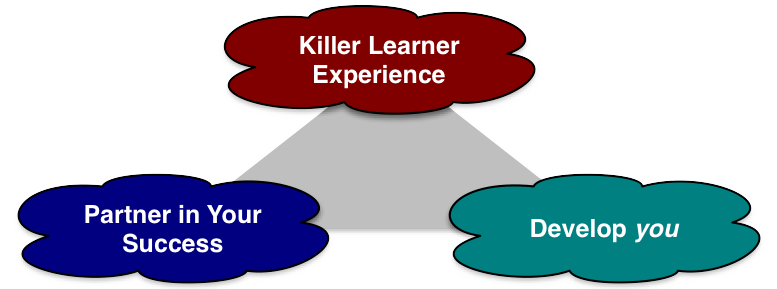
Three partsSo here’s where I pitch my 3 part story. Note that curriculum is broken too (I’m channeling Roger Schank: ‘Only two things wrong with education, what we teach and how we teach it’), and yet I’m not addressing that. Well, only a second layer of curriculum (see below ;). I think the choice of the first level curriculum is a big issue, but that changes depending on level, goals, etc. Here I’m talking about a platform for delivering the necessary elements of a supportable approach:

  1. The first element is a killer learning experience. What do I mean here? I mean an application-based learning approach. Even for so-called theory classes (e.g. typical higher ed), you  do something with this. And the experience is based upon minimal content, appropriate challenge, intrinsic motivation, and more. My claim: this is doable, even when you want to auto-mark as much as possible. Of course, there are still people in the loop.
  2. Which leads to the second element, we as the provider are a partner in your success. It’s not ‘sink or swim’, but instead we’re tracking your progress, intervening when it looks like you’re struggling, and accessible at your time and place. We’re also providing the necessary resources to succeed. And we’re not interested in a curve, we’re competency-based and want everyone to get where they can be.  We’re also making sure you’re getting what you need.
  3. And that’s the third element, we  develop you. That is, we’re not just developing your knowledge of the field, we’re also developing key success skills. That means we’re giving you chances to practice those skills as well,  and tracking them and developing them as well. This includes things like communication, collaboration, design research, and more. So-called 21C skills.

I suggest that with such an approach, and the right curriculum, you’re providing a full suite of what education  should  be about. And, I suggest, we can do this now, affordably. Technology is part of the picture, learning science is part of the picture, and the commitment to do the right thing is part of the picture. Also, I think this is viable at all levels. K12, higher ed, and workplace.

And, I’ll suggest, anything less really isn’t defensible. We have the know-how, we have the tools, all we need is the will. Yet, despite some notable steps in the right direction, we’re really not there. It’s time to put a stake in the ground. Who’s up for it?

« Previous Page
Next Page »

Clark Quinn

The Company

Search

Feedblitz (email) signup

Never miss a post
Your email address:*
Please wait...
Please enter all required fields Click to hide
Correct invalid entries Click to hide

Pages

  • About Learnlets and Quinnovation

The Serious eLearning Manifesto

Manifesto badge

Categories

  • design
  • games
  • meta-learning
  • mindmap
  • mobile
  • social
  • strategy
  • technology
  • Uncategorized
  • virtual worlds

License

Previous Posts

  • March 2026
  • February 2026
  • January 2026
  • December 2025
  • November 2025
  • October 2025
  • September 2025
  • August 2025
  • July 2025
  • June 2025
  • May 2025
  • April 2025
  • March 2025
  • February 2025
  • January 2025
  • December 2024
  • November 2024
  • October 2024
  • September 2024
  • August 2024
  • July 2024
  • June 2024
  • May 2024
  • April 2024
  • March 2024
  • February 2024
  • January 2024
  • December 2023
  • November 2023
  • October 2023
  • September 2023
  • August 2023
  • July 2023
  • June 2023
  • May 2023
  • April 2023
  • March 2023
  • February 2023
  • January 2023
  • December 2022
  • November 2022
  • October 2022
  • September 2022
  • August 2022
  • July 2022
  • June 2022
  • May 2022
  • April 2022
  • March 2022
  • February 2022
  • January 2022
  • December 2021
  • November 2021
  • October 2021
  • September 2021
  • August 2021
  • July 2021
  • June 2021
  • May 2021
  • April 2021
  • March 2021
  • February 2021
  • January 2021
  • December 2020
  • November 2020
  • October 2020
  • September 2020
  • August 2020
  • July 2020
  • June 2020
  • May 2020
  • April 2020
  • March 2020
  • February 2020
  • January 2020
  • December 2019
  • November 2019
  • October 2019
  • September 2019
  • August 2019
  • July 2019
  • June 2019
  • May 2019
  • April 2019
  • March 2019
  • February 2019
  • January 2019
  • December 2018
  • November 2018
  • October 2018
  • September 2018
  • August 2018
  • July 2018
  • June 2018
  • May 2018
  • April 2018
  • March 2018
  • February 2018
  • January 2018
  • December 2017
  • November 2017
  • October 2017
  • September 2017
  • August 2017
  • July 2017
  • June 2017
  • May 2017
  • April 2017
  • March 2017
  • February 2017
  • January 2017
  • December 2016
  • November 2016
  • October 2016
  • September 2016
  • August 2016
  • July 2016
  • June 2016
  • May 2016
  • April 2016
  • March 2016
  • February 2016
  • January 2016
  • December 2015
  • November 2015
  • October 2015
  • September 2015
  • August 2015
  • July 2015
  • June 2015
  • May 2015
  • April 2015
  • March 2015
  • February 2015
  • January 2015
  • December 2014
  • November 2014
  • October 2014
  • September 2014
  • August 2014
  • July 2014
  • June 2014
  • May 2014
  • April 2014
  • March 2014
  • February 2014
  • January 2014
  • December 2013
  • November 2013
  • October 2013
  • September 2013
  • August 2013
  • July 2013
  • June 2013
  • May 2013
  • April 2013
  • March 2013
  • February 2013
  • January 2013
  • December 2012
  • November 2012
  • October 2012
  • September 2012
  • August 2012
  • July 2012
  • June 2012
  • May 2012
  • April 2012
  • March 2012
  • February 2012
  • January 2012
  • December 2011
  • November 2011
  • October 2011
  • September 2011
  • August 2011
  • July 2011
  • June 2011
  • May 2011
  • April 2011
  • March 2011
  • February 2011
  • January 2011
  • December 2010
  • November 2010
  • October 2010
  • September 2010
  • August 2010
  • July 2010
  • June 2010
  • May 2010
  • April 2010
  • March 2010
  • February 2010
  • January 2010
  • December 2009
  • November 2009
  • October 2009
  • September 2009
  • August 2009
  • July 2009
  • June 2009
  • May 2009
  • April 2009
  • March 2009
  • February 2009
  • January 2009
  • December 2008
  • November 2008
  • October 2008
  • September 2008
  • August 2008
  • July 2008
  • June 2008
  • May 2008
  • April 2008
  • March 2008
  • February 2008
  • January 2008
  • December 2007
  • November 2007
  • October 2007
  • September 2007
  • August 2007
  • July 2007
  • June 2007
  • May 2007
  • April 2007
  • March 2007
  • February 2007
  • January 2007
  • December 2006
  • November 2006
  • October 2006
  • September 2006
  • August 2006
  • July 2006
  • June 2006
  • May 2006
  • April 2006
  • March 2006
  • February 2006
  • January 2006

Amazon Affiliate

Required to announce that, as an Amazon Associate, I earn from qualifying purchases. Mostly book links. Full disclosure.

We use cookies to ensure that we give you the best experience on our website. If you continue to use this site we will assume that you are happy with it.