Learnlets

Secondary

Clark Quinn’s Learnings about Learning

Search Results for: engagement

Conferencing reflections

16 December 2015 by Clark Leave a Comment

It turns out that I’ve been to a  lot of conferences this year (8, if my math is right) scattered through the year and around the globe. And over the past decade, I’ve hit a lot more.  And it’s given me some opportunities to contrast and compare some of the tradeoffs that can be made.  So I thought I’d share my thoughts with you.

Now, my perspective starts out a bit different. At these events, I’m speaker, so I see things from a different perspective.  However, I also try to go see sessions as an audience member as well, and I still see the same events.  So I am trying to write this from all perspectives: conference organizer, attendee, speaker, and vendor.  And let me be clear, I’m a learning technology strategist, and my passions are learning, technology, and how to use them together to make things better. So that colors my comments.

Here are the major elements and my thoughts on them:

Keynotes: I am tired of ‘inspirational’ keynotes. I really don’t need to hear some person who climbed a mountain or sailed a sea and their attempts to connect that to learning somehow. I’d rather hear about an issue that affects learning.  Topics about how we think, work, or learn are of interest. Let’s hear about the risks of technology, or some new ones or ways to use them.  Yes, I like compelling speakers, but please give me new thoughts, not random aspiration.

Speakers:  I think it’s unconscionable to have an unprepared speaker who can’t manage time.  It’s even worse on panels or shared sessions where one speaker runs over. It’s just not fair to the other speakers.  It’s also essential that the talk is not a sales pitch, but instead presents real value in ideas or experience. And they should be happy to chat afterward.  It boggles my little mind when someone gets up and clearly hasn’t practiced and checked their timing. It’s appears  I’m somewhat unusual, but I really don’t necessarily feel the critical need to spend most of the time conversing with others. I don’t mind, and even can recommend some interaction, but I want to hear something substantive as well.

Schedule: I like events that have a clear and comprehensible schedule. I want to know exactly what things are at the same time, so I can choose and then vote with my feet if the first choice isn’t working for me.  Having different tracks have different schedules doesn’t work.  And as a speaker and an attendee,  I don’t like short sessions.  Give me at least an hour as a speaker to set the tone, present the topic, talk about the issues and tradeoffs, and talk about the way forward.  Similarly as an audience member, I want suitable depth.  30 minutes just isn’t enough.

Breaks: And then I want a break.  The break should be long enough to potentially chat  with the speaker at the preceding event, get out and find some sustenance, use the facilities, have a conversation or two, and get to the next event.  Workshop breaks can be shorter, as you’re with a group for a half or full day, but for separating concurrent sessions, they need to be sufficiently long.

Events: I love having social events, as a way to have those important serendipitous  conversations. An evening reception after the first day is mandatory.  I like sufficient nibbles to fend off the need to escape to dinner, or dinner actually provided. And for the end of the day, I like social lubricant.  Preferably on demand, not via a limited ration.  It doesn’t have to be a broad selection, but not having to worry about  logistics means my mind is free to focus on conversations.  I assume lunch is provided, of course, and it doesn’t have to be fancy or rich, just healthy, substantive, and reasonably tasty.  Other events, such as mid afternoon treat breaks, and mid morning snack breaks are great.  I really like it if some form of breakfast is available as well.  I think I’m not the only one who prefers to eat little bits over time, not big meals.

Expo Hall: I like to have an exhibition. I like to see what’s around. Yes, I don’t like walking past and being grabbed, but I do like it if I can go up, have an intelligent conversation about the problem solution, and not feel pressured. I like to see the alternatives, and take the temperature of the market. And I like people who might have real needs to be able to explore real solutions.  Having events  in  the expo area  makes sense to me and the vendors.

App: I used to get a PDF of the program and put it on my tablet.  Now I am happy using an app, and it’s become a must-have. I like it when I can choose sessions for my schedule and have reminders.  I like having a stream of information, though it could be via Twitter. I like having an expo map if the expo is of any size at all.  And I don’t really care for  gamification to reward participation.  While I like the engagement of users, it leads to too many frivolous posts.  I really like it if presentation material is  available through the app, and happy to do evaluations that way.

Bookstore: I think a bookstore is important, for several reasons.  For one, you can get a heads up on a speaker before you see them. Or if you miss a session, you can graze what you might have missed.  You might also want to get the works of someone who you really were intrigued by. It’s also a way to see what’s happening in the field.

Rest areas: I don’t really need speaker prep.  Sometimes it may be handy if the event is really big, but the main things is, instead, having good connection to event staff. And I think that’s true for all, not just speakers.  Having places to sit for all attendees means that  anyone needing a break whether social or physical can achieve that end.

People:  The staff makes quite a big difference when they’re knowledgeable and helpful.  This has almost always been the case, but it’s nice to have informed people ready and willing to help.  This is true for vendors as well, having friendly and knowledgeable people trumps having shills who can chat you up but can’t really answer questions.

So, what have I forgotten to address?

I realize that there are different audiences,  purposes, and business models for these events, and so not all things are comparable.  And this is also my opinion, and your motives may differ, but I hope I’ve laid out some of the thinking to help you think about what works for you.  And I hope to see you at a conference sometime!
Non-invasive Brain Surgery

28 October 2015 by Clark Leave a Comment

Changing behavior is hard. The brain is arguably the most complex thing in the known universe. Simplistic approaches aren‘t likely to work. To rewire it, one approach is to try surgery. This is problematic for a several reasons: it‘s dangerous, it‘s messy, and we really don’t understand enough about it. What‘s a person to do?

Well, we do know that the brain can rewire itself, if we do it right. This is called learning. And if we design learning, e.g. instruction, we can potentially change the brain without surgery. However, (and yes, this is my point) treating it as anything less than brain surgery (or rocket science), isn‘t doing justice to what‘s known and what‘s to be done.

The number of ways to get it wrong is long. Information dump instead of skills practice. Massed practice instead of spaced. Rote knowledge assessment. Lack of emotional engagement. The list goes on. (Cue the Serious eLearning Manifesto.) In short, if you don‘t know what you‘re doing, you‘re likely doing it wrong and are not going to have an effect. Sure, you‘re not likely to kill anyone (unless you‘re doing this where it matters), but you‘ll waste money and time. Scandalous.

Again, the brain is complex, and consequently so is learning design. So why, in the name of sense and money, do we treat it as trivial? Why would anyone buy a story that we can achieve anything meaningful by taking content and adding a quiz (read: rapid eLearning)? As if a quiz is somehow going to make people do better. Who would believe that just anyone can present material and learning will occur? (Do you know the circumstances when that will work?) And really, throwing fuzzy objects around the room and ice-breakers will somehow make a difference? Please. If you can afford to throw money down the drain (ok, if you insist, throw it here ;), and don‘t care if any meaningful change happens, I pity you, but I can‘t condone it.

Let‘s get real. Let‘s be honest. There‘s a lot (a lot) of things being done in the name of learning that are just nonsensical. I could laugh, if I didn‘t care so much. But I care about learning. And we know what leads to learning. It‘s not easy. It‘s not even cheap. But it will work. It requires good analysis, and some creativity, and attention to detail, and even some testing and refinement, but we know how to do this.

So let‘s stop pretending. Let‘s stop paying lip-service. Let‘s treat learning design as the true blend of art and science that it is. It‘s not the last refuge of the untalented, it‘s one of the most challenging, and rewarding, things a person can do. When it‘s done right. So let‘s do it right! We‘re performing brain surgery, non-invasively, and we should be willing to do the hard yards to actually achieve success, and then reap the accolades.

OK, that‘s my rant, trying to stop what‘s being perpetrated and provide frameworks that might help change the game. What‘s your take?

The Polymath Proposition

15 October 2015 by Clark 3 Comments

At the recent DevLearn conference, one of the keynotes was Adam Savage.  And he said something that gave me a sense of validation. He was talking about being a polymath, and I think that’s worth understanding.

His point was that his broad knowledge of a lot of things was valuable.  While he wasn’t the world’s expert in any particular thing, he knew a lot about a lot of things.  Now if you don’t know him, it helps to understand that he’s one of the two hosts of Mythbusters, a show that takes urban myths and puts them to the test.  This requires designing experiments that fit within pragmatic constraints of cost and safety, and will answer the question. Good experiment design is an art as well as a science, and given the broad range of what the myths cover, this ends up requiring a large amount of ingenuity.

The reason I like this is that my interests vary broadly (ok, I’m coming to terms with a wee bit of ADD ;).  The large picture is how technology can be designed  to help us think, work, and learn.  This ends up meaning I have to understand things like cognition and learning (my Ph.D. is in cognitive psychology), computers (I’ve programmed and designed architectures at many levels), design (I’ve looked at usability, software engineering, industrial design, architectural design, and more), and organizational issues (social, innovation…). It’s led to explorations covering things like games, mobile, and strategy (e.g. the topics of my books).  And  more; I’ve led development of adaptive learning systems, content models, learning content, performance support, social environments, and so on.  It’s led me further, too, exploring  org change and culture, myth and ritual, engagement and fun, aesthetics and media, and other things I can’t even recall right now.

And I draw upon  models from as many fields as I can.  My Ph.D. research was related to the power of models as a basis for solving new problems in uncertain domains, and so I continue to collect them like others collect autographs or music.  I look for commonalities, and  try to make my understanding explicit by continuing to diagram and write about my reflections.  I immodestly think I draw upon a broad swath of areas. And  I particularly push learning to learn and meta-cognition to others because it’s been so core to my own success.

What I thrive on is finding situations where the automatic solutions don’t apply. It’s not just a clear case for ID, or performance support, or…  Where technology can be used (or used better) in systemic ways to create new opportunities. Where I really contribute is where it’s clear that change is needed, but what, how, and where to start aren’t obvious.  I’ve a reliable track record of finding unique, and yet pragmatic solutions to such situations, including the above named areas I’ve innovated  in.  And it is a commitment of mine to do so in ways that pass on that knowledge, to work in collaboration to co-develop the approach and share the concepts driving it, to hand off ownership to the client. I’m not looking for a sinecure; I want to help while I’m adding value and move on when I’m not.  And many folks have been happy to have my assistance.

It’s hard for me to talk about myself in this way, but I reckon I bring that  polymath ability of a broad background to organizations trying to advance.   It’s been  in assisting their ability to develop design processes that yield better learning outcomes, through mobile strategies and solutions that meet their situation, to overarching organizational strategies that map from concepts to system.  There’s a pretty fair track record to back up what I say.

I am  deep in a lot of areas, and have the ability to synthesize solutions  across  these areas in integrated ways. I may not be the deepest in any one, but when you need to look across them and integrate a systemic solution, I like to think and try to ensure that I’m your guy. I help organizations envision a future state, identify the benefits and costs, and prioritize the opportunities to define a strategy.  I  have operated independently or with partners, but I adamantly retain my freedom  to say what I truly think so that you get an unbiased response from the broad suite of  principles I have to hand.  That’s my commitment to integrity.

I didn’t intend this to be a commercial, but I did like his perspective and it made me reflect on what my own value proposition is.  I welcome your thoughts.  We now return you to your regularly scheduled blog already in progress…

Revolution Roadmap: Assess

23 September 2015 by Clark 3 Comments

Last week, I wrote about a process to follow in moving forward on the L&D  Revolution. The first step is  Assess,  and I’ve been thinking about what that means.   So here, let me lay out some preliminary thoughts.

The first level are the broad categories.  As I’m talking about aligning with how we think, work, and learn, those are the three top areas where I feel we fail to recognize what’s known about cognition, individually and together. As I mentioned yesterday, I’m looking at how we use technology to facilitate productivity in ways specifically focused on helping people learn. But let me be clear, here I’m talking about the big picture of learning – problem-solving, design, research, innovation, etc – as they call fall under the category of things we don’t know the answer to when we begin.

I started with how we think. Too often we don’t put information in the world when we can, yet we know that all our thinking isn’t in our head.  So we can ask :

  • Are you using performance consulting?
  • Are you taking responsibility for resource development?
  • Are you ensuring  the information architecture for resources  is  user-focused?

The next area is working, and here the revelation is that the best outcomes come from people working together.  Creative friction, when done in consonance with how we work together best, is where the best solutions and the best new ideas will come from. So you can look at:

  • Are people communicating?
  • Are people collaborating?
  • Do you  have in place a learning culture?

Finally,  with learning, as the area most familiar to L&D, we need to look at whether we’re applying what’s known about making learning work.  We should start with Serious eLearning, but we can go farther.  Things to look at include:

  • Are  you practicing  deeper learning design?
  • Are you  designing  engagement into learning?
  • Are you developing  meta-learning?

In addition to each of these areas, there are cross-category issues.  Things to look at for each include:

  • Do you have infrastructure?
  • What are you measuring?

All of these areas have nuances underneath, but at the top level these strike me as the core categories of questions.  This is working down to  a finer grain than I  looked at in the book (c.f. Figure 8.1), though that was a good start at evaluating where one is.

I’m convinced that the first step for change is to understand where you are (before the next step, Learn, about where you could be).  I’ve yet to see many organizations that are in full swing here, and I have persistently made the case that the status quo isn’t sufficient.  So, are you ready to take the first step to assess where you are?


Biz tech

22 September 2015 by Clark 2 Comments

One of my arguments for the L&D revolution is the role that L&D  could be playing.  I believe that if L&D were truly enabling optimal execution as well as facilitating continual innovation (read: learning), then they’d be as critical to the organization as IT. And that made me think about how this role would differ.

To be sure, IT is critical.  In today’s business, we track our business, do our modeling, run operations, and more with IT.  There is  plenty of vertical-specific software, from  product design to transaction tracking, and of course more general business software such as document generation, financials, etc.  So how does L&D be as ubiquitous as other software?  Several ways.

First, formal learning software is really enterprise-wide.  Whether it’s simulations/scenarios/serious games, spaced learning delivered via mobile, or user-generated content (note: I’m deliberately avoiding the LMS and courses ;), these things should play a role in preparing the audience to optimally execute and being accessed by a large proportion of the audience.  And that’s not including our tools to develop same.

Similarly, our performance support solutions – portals housing job aids and context-sensitive support – should be broadly distributed.  Yes, IT may own the portals, but in most cases they are not to be trusted to do a user- and usage-centered solution.  L&D should be involved in ensuring that the solutions both articulate with and reflect the formal learning, and are organized by user need not business silo.

And of course the social network software – profiles and locators as well as communication and collaboration tools – should be under the purview of L&D. Again, IT may own them or maintain them, but the facilitation of their use, the understanding of the different roles and ensuring they’re being used efficiently, is a role for L&D.

My point here is that there is an enterprise-wide category of software, supporting learning in the big sense (including problem-solving, research, design, innovation), that should be under the oversight of L&D.  And this is the way in which L&D becomes more critical to the enterprise.  That it’s not just about taking people away from work and doing things to them before sending them back, but facilitating productive engagement and interaction throughout the workflow.  At least at the places where they’re stepping outside of the known solutions, and that is increasingly going to be the case.

Embrace Plan B

17 June 2015 by Clark Leave a Comment

The past two weeks, I’ve been on the road (hence the paucity of posts).  And they’ve been great opportunities to engage around interesting topics, but also have provided some learning opportunities (ahem).  The title of this post, by the way, came from m’lady, who was quoting what a senior Girl Scout said was the biggest lesson she learned from her leader, “to embrace Plan B” ;).

So two weeks ago I was visiting a client working on upping their learning game. This is a challenge in a production environment, but as I discussed many times in posts over the second half of 2014 and some this year, I think there are some serious actions that can be taken.  What is needed are better ways to work with SMEs, better constraints around what makes useful content, and perhaps most importantly what makes meaningful interaction and practice.  I firmly believe that  there are practical ways to get serious elearning going without radical change, though some initial hiccups  will be experienced.

This past week I spoke twice. First on a broad spectrum of learning directions to a group that was doing distance learning and wanted to take a step back and review what they’d been doing and look for improvement opportunities. I covered deeper learning, social learning, meta-learning, and more. Then I went beyond and talked about 70:20:10, measurement,  games and simulations, mlearning, the performance ecosystem, and more.  I then moved  on to a separate (and delightful) event in Vancouver to promote the Revolution.

It was the transition between the two events last week that threw me. So, Plan A was to fly back home on Tuesday, and then fly on to Vancouver on Wed morning.   But, well, life happened.  All my flights were delayed (thanks, American) on my flight there and back to the first engagement, and both of the first flights such that I missed the connection. On the way out I just got in later than I expected (leading to 4.5 hours sleep before the long and detailed presentation).  But on the way back, I missed the last connecting flight home.  And this had several consequences.

So, instead of spending Tuesday night in my own bed, and repacking for the next day, I spent the night in the Dallas/Fort Worth airport.  Since they blamed it on weather (tho’ if the incoming flight had been on time, it might’ve gotten out in time to avoid the storm), they didn’t have any obligation to provide accommodation, but there were cots and blankets available. I tried to pull into a dark and quiet place, but most of the good ones were taken already. I found a boarding gate that was out of the way, but it was bright and loud.  I gave up after an hour or so and headed off to another area, where I found a lounge where I could pull together a couple of armchairs and managed to doze for 2.5 or so hours, before getting up and on the hunt for some breakfast.  Lesson: if something’s not working, change!

I caught a flight back home in just enough time to catch the next one up to Vancouver. The problem was, I wasn’t able to swap out my clothes, so I was desperately in need of some laundry.  Upon arriving, I threw one of the shirts, socks, etc into a sink and gave them a wash and hung them up. (I also took a shower, which was not only a necessity after a rough night but a great way to gather myself and feel a bit more human).  The next morning, as I went to put on the shirt, I found a stain!  I couldn’t get up in front of all those people with a stained shirt.  Plan B was out the door. Also, the other shirt had acquired one too!  Plan C on the dust heap. Now what?  Fortunately, my presentation was in the afternoon, but I needed to do something.

So I went downstairs and found a souvenir shop in the hotel, but the shirts were all a wee bit too loud.  I didn’t really want to pander to the crowd quite so egregiously. I asked at the hotel desk if there was a place I could buy a shirt within walking distance, and indeed there was.  I was well and truly on Plan D by this time.  So I hiked on out to a store and fortunately found another shirt I could throw on.  Lesson: keep changing!

I actually made the story part of my presentation.  I made  the point that just like in my case, organizations need not only optimal execution of the plans, but then also the ability to innovate if the plan isn’t working.  And L&D  can (and should) play a role in this.  So, help your people be prepared to create and embrace Plan B (and C and…however many adaptations they need to have).

And one other lesson for me: be better prepared for tight connections to go awry!

Got Game?

28 April 2015 by Clark 1 Comment

Why should you, as a learning designer, take a game design workshop?  What is the relationship between games and learning?  I want to suggest that there are  very  important reasons why you should.

Just so you don’t think I’m the only one saying it, in the decade since I wrote the book  Engaging Learning:  Designing e-Learning Simulation Games, there have been a large variety of books on the topic. Clark Aldrich has written three, at least count. James Paul Gee has pointed out how the semantic features of games match to the way our brains learn, as has David  Williamson Shaeffer.  People like Kurt Squire, Constance Steinkuhler, Henry Jenkins, and Sasha Barab have been strong advocates of games for learning. And of course Karl Kapp has a recent book on the topic.  You could also argue that Raph Koster’s A Theory of Fun is another vote given that his premise is that fun  is learning. So I’m not alone in this.

But more specifically, why get steeped in it?  And I want to give you three reasons: understanding engagement, understanding practice, and understanding design.  Not to say you don’t know these, but I’ll suggest that there are depths which you’re not yet incorporating into your learning, and  you could and should.  After all, learning  should be ‘hard fun’.

The difference between a simulation and a game is pretty straightforward.  A simulation is just a model of the world, and it can be in any legal state and be taken to any other.  A self-motivated and effective self-learner can use that to discover what they need to know.  But for specific learning purposes, we put that simulation into an initial state, and ask the learner to take it to a goal state, and we’ve chosen those so that they can’t do it until they understand the relationships we want them to understand. That’s what I call a scenario, and we typically wrap a story around it to motivate the goal.  We can tune that into a game.  Yes, we turn it into a game, but by tuning.

And that’s the important point about engagement. We can’t call it game; only our players can tell us whether it’s a game or not. To achieve that goal, we have to understand what motivates our learners, what they care about, and figure out how to integrate that into the learning.  It’s about not designing a learning event, but designing a learning  experience.  And, by studying how games achieve that, we can learn how to take our learning from mundane to meaningful.   Whether or not we have the resources and desire to build actual games, we can learn valuable lesssons to apply to any of our learning design. It’s the emotional element most ID leaves behind.

I also maintain that, next to mentored live practice, games are the best thing going (and individual mentoring doesn’t scale well, and live practice can be expensive both to develop but particularly when mistakes are made).  Games  build upon that by providing deep practice; embedding important decisions in a context that makes the experience as meaningful as when it really counts.  We use game techniques to heighten and deep the experience, which makes it closer to live practice, reducing transfer distance. And we can provide repeated practice.  Again, even if we’re not able to implement full game engines, there are many important lessons to take to designing other learning experiences: how to design better multiple choice questions, the value of branching scenarios, and more.  Practical improvements that will increase engagement and increase outcomes.

Finally, game designers use design processes that have a lot to offer to formal learning design. Their practices in terms of information collection (analysis), prototyping and refinement, and evaluation are advanced by the simple requirement that their output is such that people will actually pay for the experience.  There are valuable elements that can be transferred to learning design even if you aren’t expecting to have an outcome so valuable you can charge for it.

As professionals, it behooves us to look to other fields with implications that could influence and improve our outcomes. Interface design, graphic design, software engineering, and more are all relevant areas to explore. So is game design, and arguably the most relevant one we can.

So, if you’re interested in tapping into this, I encourage you to consider the game design workshop I’ll be running for the ATD Atlanta chapter on the 3rd of June. Their price is fair even if you’re not a chapter member, and it’s great deal if you are.  Further, it’s a tried and tested format that’s been well received since I first started offering it. The night before, I’ll be busting myths at the chapter meeting.  I hope I’ll see you there!

Road trip(s)!

16 April 2015 by Clark 1 Comment

Several events are coming up that I  should mention (“coming to a location near you!”):

If you’re anywhere near  Austin, you should check out the upcoming eLearning Symposium  May 7 and 8. I’m speaking  on the L&D  Revolution  I’m trying to incite, and then offering a half day  workshop to help you get your strategy going.  There’s a nice slate of other speakers to help you dig deeper into elearning.

I’ll also be speaking on Serious eLearning at Callidus Cloud Connections in Las Vegas May 11-13.  If you’re into Litmos, or thinking about it, it’s the place to be.

If you’re near Atlanta, I’ll be busting learning myths in an evening session  for the ATD Chapter on the 2nd of June, and then running a learning game  workshop on the 3rd.  You’ll find out more about learning and engagement; you can  and should  add game elements to your learning design.  I’m serious when I say that “learning can, and should, be hard fun“.

And  I’ll be touting the needed L&D  Revolution up in Vancouver June 11, keynoting the CSTD Symposium.  There’s a great line up of talks to raise your game.

I  would love to meet  you at one of these events; hope to see you there (or there, or there, or there).

Engage, yea or nay?

17 February 2015 by Clark 10 Comments

In a recent chat, a colleague I respect said the word ‘engagement’  was anathema.  This surprised me, as I’ve been quite outspoken about the need for engagement (for one small example, writing a book about it!).  It may be that the conflict is definitional, for it appeared that my colleague and another respondent viewed engagement as bloating the content, and that’s not what I mean at all. So I thought I lay out what  I  mean when I say engaging, and why I think it’s crucial.

Let’s be clear what I  don’t mean.  If you think by engagement it’s adding in extra stuff, we’re using a very different definition of engagement.  It’s not about tarting up uninteresting stuff with ‘fun’ (e.g. racing themed window dressing on knowledge test).  It’s not about putting in unnecessary unrelated imagery, sounds, or anything else.  Heck, the research of Dick Mayer at UCSB shows this actually hinders learning!

So what do I mean?  For one thing, stripping away any ‘nice to have’ or unnecessary info.  Lean is engaging!  You have to focus on what really will help the learners,  and in ways that they get.  And they do.  And then help them in the ‘in the ways they get’ bit.

You need contextualized practice.  Engaging is making the context meaningful to the learners.  You need contextualization (e.g research by John Bransford on anchored cognition), but arbitrary contextualization isn’t as good as intrinsically interesting contexts.  This isn’t window dressing, since you need to be doing it anyway, but do it. And in a minimal style (as de Saint-Exupery said: “Perfection is finally attained not when there is no longer anything to add but when there is no longer anything to take away…”).

You want compelling examples. We know that examples lead to better learning (ala, for instance John Sweller’s work on cognitive load), but again, making them meaningful to the learners is critical. This isn’t window dressing, as we need them, but they’re better if they’re well told as intrinsically interesting stories.

Finally, we need to introduce the learning.  Too often we do this in ways that the learner doesn’t get the WIIFM (What’s In It For Me).  Learners learn better when they’re emotionally open to the content instead of uninterested. This may be a wee bit more, but we can account for this by getting rid of the  usual introductory stuff.  And it’s worth it.

Now, let’s be clear, this is for when we’ve deemed formal learning as necessary. When the audience is practitioners who know what they need and why it’s important, then giving them ‘just the facts’, performance support, is sufficient.  But if it’s new skills they need, when you need a learning experience, then you want to make it engaging. Not extrinsically, but intrinsically.  And that’s not more in quantity, it’s not bloated, it’s more in quality, in minimalism for content and maximal for immersion.

Engaging learning is a good thing, a better thing than not, the right thing.  I’m hoping it’s just definitional, because I can’t see the contrary argument unless there’s confusion over what I mean.  Anyone?

The Grail of Effective and Engaging Learning Experiences

10 February 2015 by Clark 2 Comments

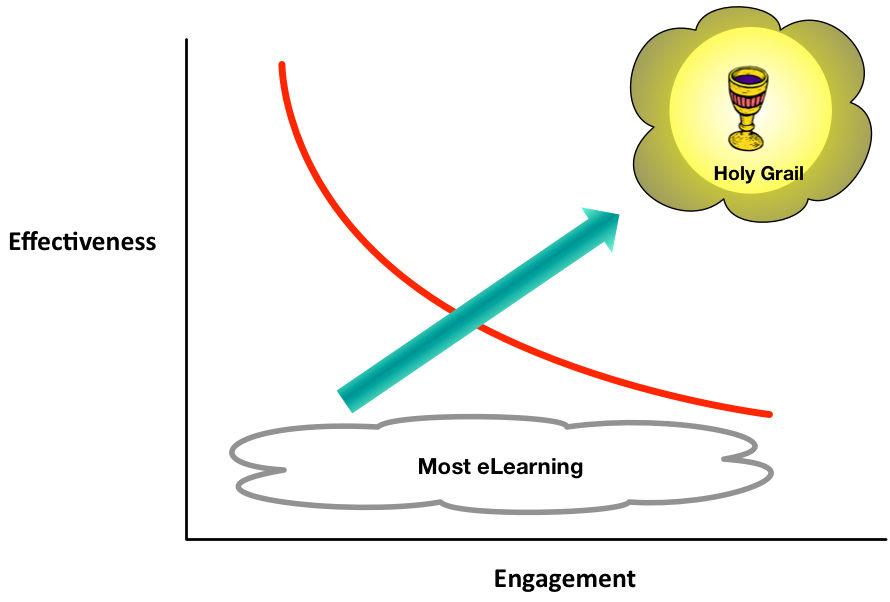
There’s a considerable gap between what we can be doing, and what we are doing.  When you look at what’s out there, we see that there are several way in which we fall short of the mark.  While there are many dimensions that  could be considered, for the sake of simplicity let’s characterize the two important ones as effectiveness of our learning and the engagement of the experience.  And I want to characterize where we are and where we could be, and the gaps we need to bridge.

GrailEffectiveEngagingLearningIf we map the space, we see that the lower left is the space of low engagement  and low effectiveness.  Too much elearning resides there.  Now, to be fair, it’s easy to add engaging media and production values, so the space of typical elearning does span from low to high engagement. Moving up the diagram, however, towards increasing effectiveness, is an area that’s less populated.  The red line separates the undesirable areas from the space we’d like to start hitting, where we begin to have some modicum of both effectiveness  and  engagement, moving towards the upper right.  This space is relatively sparsely populated, I’m afraid.  And  while there are instances  of content that do increase the effectiveness, there’s little that really hits the ultimate goal, the holy grail, with a fully integrated effective and engaging experience is achieved.

How do we move in the right direction? I’ve talked before about trying to hit the sweet spot of maximal effectiveness within pragmatic constraints.  Certainly from an effectiveness standpoint, you should be looking at the components of the Serious eLearning Manifesto.  To get effective learning, you need a number of elements, for instance:

  • meaningful practice: practice aligned with the real world task
  • contextualized practice: learning across contexts that support transfer
  • sustained practice: sufficient and increasingly challenging practice to develop the skills to the necessary level
  • spaced practice: practice spread out over  time (brains need sleep to learn more than a certain threshold)
  • real world consequences providing feedback  coupled with scaffolded  reflection
  • model-based guidance: the best guide for practice is a conceptual basis (not rote information)
  • appropriate examples: that show the concepts being applied in context

Some of these elements, also contribute to engagement, as well as others.  Components include:

  • learning-centered  contexts: problems learners recognize as important
  • learner-centered contexts: problems  learners want to solve
  • emotionally engaging introductions: hooking learners in viscerally as well as cognitively
  • adapted challenge: ramping up the challenge appropriately to avoid both boredom and frustration
  • unpredictability: maintaining the learner’s attention through  surprise
  • meaningfulness: learners playing roles they want to be in
  • drama and/or humor

The integration of these elements was the underlying premise behind Engaging Learning, my book on integrating effectiveness and engagement, specifically on making meaningful practice, e.g. serious games.  Serious games are one way to achieve this end, by contextualizing practice as decisions in a meaningful environment and using a game engine to adapt the  challenge and providing essentially unlimited practice.

Other approaches achieve much of this effectiveness in different ways. Branching scenarios are powerful approximations to this by showing consequences in context but with limited replay, and so are constructivist and problem-based learning pedagogies. This may sound daunting, but with practice, and some shortcuts, this is doable.

For example, Socratic Arts has a powerful online pedagogy that leverages media and a constructivist pedagogy in a relatively simple framework. The learner is given ‘assignments‘ that mirror real world tasks, via emails or videos of characters playing roles such as a boss.  The outputs required similarly mimic work products you might find in this area. Scaffolding is available in a couple of ways. For one, there are guidelines about Videos of experts and documents are available as resources, to support the learner in getting the best outcome.  While it’s low on fancy visual design,  it’s effective because it’s closely aligned to the needed skills post-learning.  And the cognitive challenge is pitched at the right level to engage the intellect, if not the aesthetics.  This is a cost-effective balance.

The work I did with the Wadhwani Foundation hit a slightly different spot in trying to get to the grail.  I didn’t have the ability to work quite as tightly with the SMEs from the get-go, and we didn’t have the ability to simulate the hands-on tasks as well as we’d like,  but we did our best to infer real tasks and used low-tech simulations and scenarios to make it effective.  We did use more media, animations and contextualized videos, to make the experience more engaging and effective as well.

The point being that we can start making learning more effective and engaging in practical ways. We need to make it effective, or why bother?  We should make it engaging, to optimize the outcomes and not insult our learners. And we can.  So why don’t we?

« Previous Page
Next Page »

Clark Quinn

The Company

Search

Feedblitz (email) signup

Never miss a post
Your email address:*
Please wait...
Please enter all required fields Click to hide
Correct invalid entries Click to hide

Pages

  • About Learnlets and Quinnovation

The Serious eLearning Manifesto

Manifesto badge

Categories

  • design
  • games
  • meta-learning
  • mindmap
  • mobile
  • social
  • strategy
  • technology
  • Uncategorized
  • virtual worlds

License

Previous Posts

  • March 2026
  • February 2026
  • January 2026
  • December 2025
  • November 2025
  • October 2025
  • September 2025
  • August 2025
  • July 2025
  • June 2025
  • May 2025
  • April 2025
  • March 2025
  • February 2025
  • January 2025
  • December 2024
  • November 2024
  • October 2024
  • September 2024
  • August 2024
  • July 2024
  • June 2024
  • May 2024
  • April 2024
  • March 2024
  • February 2024
  • January 2024
  • December 2023
  • November 2023
  • October 2023
  • September 2023
  • August 2023
  • July 2023
  • June 2023
  • May 2023
  • April 2023
  • March 2023
  • February 2023
  • January 2023
  • December 2022
  • November 2022
  • October 2022
  • September 2022
  • August 2022
  • July 2022
  • June 2022
  • May 2022
  • April 2022
  • March 2022
  • February 2022
  • January 2022
  • December 2021
  • November 2021
  • October 2021
  • September 2021
  • August 2021
  • July 2021
  • June 2021
  • May 2021
  • April 2021
  • March 2021
  • February 2021
  • January 2021
  • December 2020
  • November 2020
  • October 2020
  • September 2020
  • August 2020
  • July 2020
  • June 2020
  • May 2020
  • April 2020
  • March 2020
  • February 2020
  • January 2020
  • December 2019
  • November 2019
  • October 2019
  • September 2019
  • August 2019
  • July 2019
  • June 2019
  • May 2019
  • April 2019
  • March 2019
  • February 2019
  • January 2019
  • December 2018
  • November 2018
  • October 2018
  • September 2018
  • August 2018
  • July 2018
  • June 2018
  • May 2018
  • April 2018
  • March 2018
  • February 2018
  • January 2018
  • December 2017
  • November 2017
  • October 2017
  • September 2017
  • August 2017
  • July 2017
  • June 2017
  • May 2017
  • April 2017
  • March 2017
  • February 2017
  • January 2017
  • December 2016
  • November 2016
  • October 2016
  • September 2016
  • August 2016
  • July 2016
  • June 2016
  • May 2016
  • April 2016
  • March 2016
  • February 2016
  • January 2016
  • December 2015
  • November 2015
  • October 2015
  • September 2015
  • August 2015
  • July 2015
  • June 2015
  • May 2015
  • April 2015
  • March 2015
  • February 2015
  • January 2015
  • December 2014
  • November 2014
  • October 2014
  • September 2014
  • August 2014
  • July 2014
  • June 2014
  • May 2014
  • April 2014
  • March 2014
  • February 2014
  • January 2014
  • December 2013
  • November 2013
  • October 2013
  • September 2013
  • August 2013
  • July 2013
  • June 2013
  • May 2013
  • April 2013
  • March 2013
  • February 2013
  • January 2013
  • December 2012
  • November 2012
  • October 2012
  • September 2012
  • August 2012
  • July 2012
  • June 2012
  • May 2012
  • April 2012
  • March 2012
  • February 2012
  • January 2012
  • December 2011
  • November 2011
  • October 2011
  • September 2011
  • August 2011
  • July 2011
  • June 2011
  • May 2011
  • April 2011
  • March 2011
  • February 2011
  • January 2011
  • December 2010
  • November 2010
  • October 2010
  • September 2010
  • August 2010
  • July 2010
  • June 2010
  • May 2010
  • April 2010
  • March 2010
  • February 2010
  • January 2010
  • December 2009
  • November 2009
  • October 2009
  • September 2009
  • August 2009
  • July 2009
  • June 2009
  • May 2009
  • April 2009
  • March 2009
  • February 2009
  • January 2009
  • December 2008
  • November 2008
  • October 2008
  • September 2008
  • August 2008
  • July 2008
  • June 2008
  • May 2008
  • April 2008
  • March 2008
  • February 2008
  • January 2008
  • December 2007
  • November 2007
  • October 2007
  • September 2007
  • August 2007
  • July 2007
  • June 2007
  • May 2007
  • April 2007
  • March 2007
  • February 2007
  • January 2007
  • December 2006
  • November 2006
  • October 2006
  • September 2006
  • August 2006
  • July 2006
  • June 2006
  • May 2006
  • April 2006
  • March 2006
  • February 2006
  • January 2006

Amazon Affiliate

Required to announce that, as an Amazon Associate, I earn from qualifying purchases. Mostly book links. Full disclosure.

We use cookies to ensure that we give you the best experience on our website. If you continue to use this site we will assume that you are happy with it.