Michio Kaku keynoted the DevLearn keynote today. With his signature phrase,”in the future…”, he covered new techs and made tentative connections to learning.
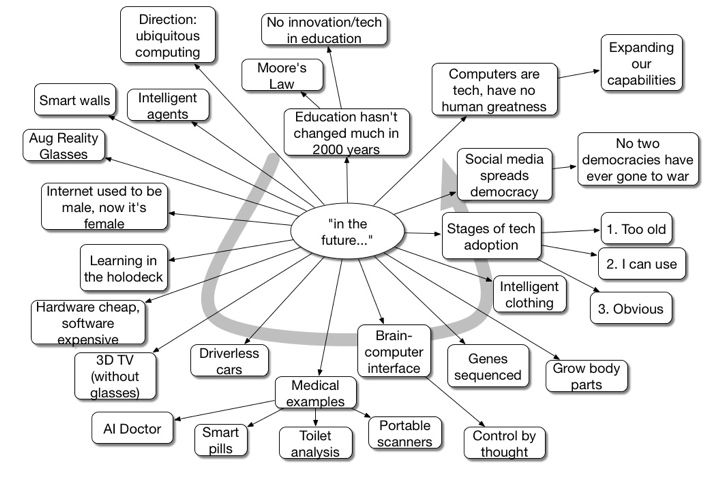
Michio Kaku keynoted the DevLearn keynote today. With his signature phrase,”in the future…”, he covered new techs and made tentative connections to learning.
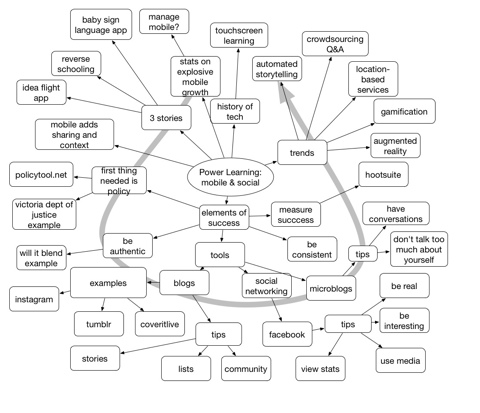
This morning’s mLearnCon keynote was by journalist Amber MacArthur. She talked about the intersection of mobile and social, though mostly talking the social side. Definitely a fun presentation with lots of humorous examples.
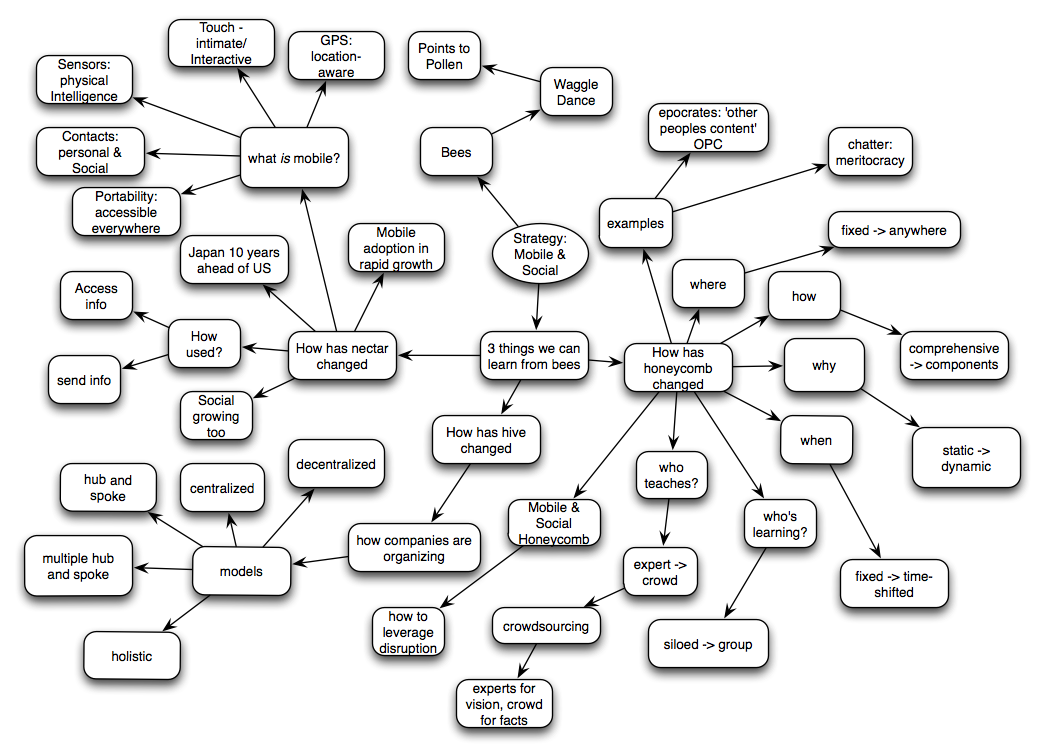
Jeremiah Owyang, analyst at Altimeter, keynoted the opening day of the eLearning Guild’s mLearnCon conference. He talked about the intersection of mobile and social, talking mobile definitions, organizational structures, and core transitions, using a metaphor of bees.
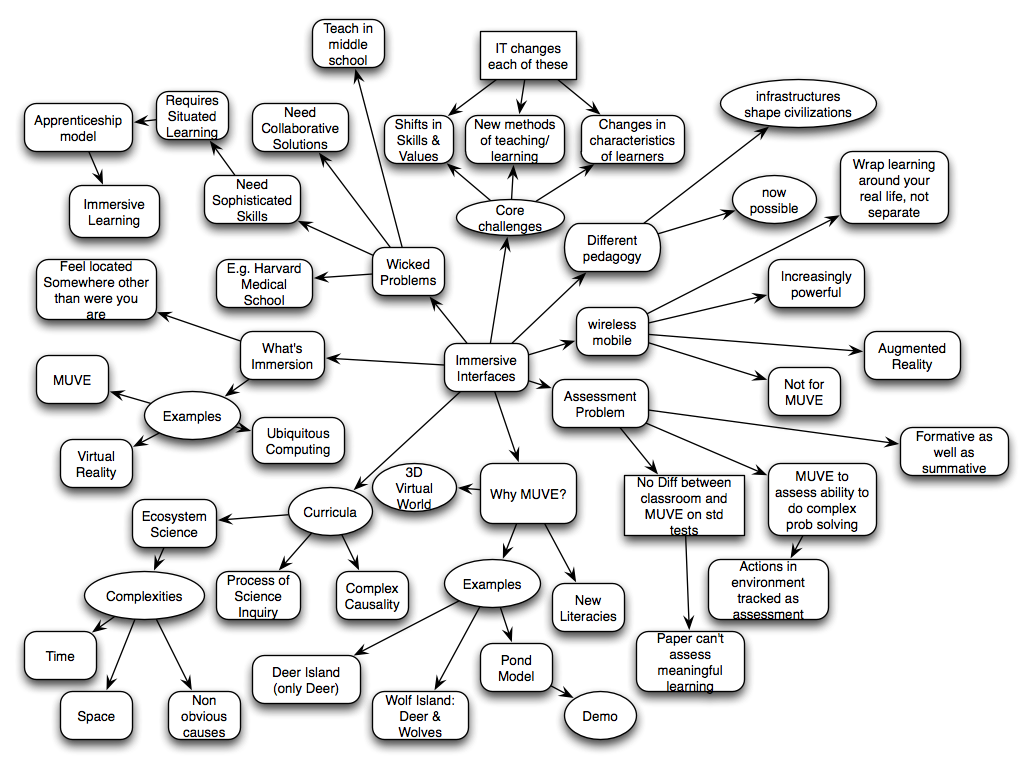
Chris Dede opened the Innovations in eLearning keynote with a speech that very much resonated with me and reflected things I’ve been blogging about here since Learnlets started, but has had the opportunity to build. His closing comment is intriguing: “infrastructures shape civilization”.
He talked about teaching skills to deal with wicked problems and developing new literacies, using MultiUser Virtual Environments.
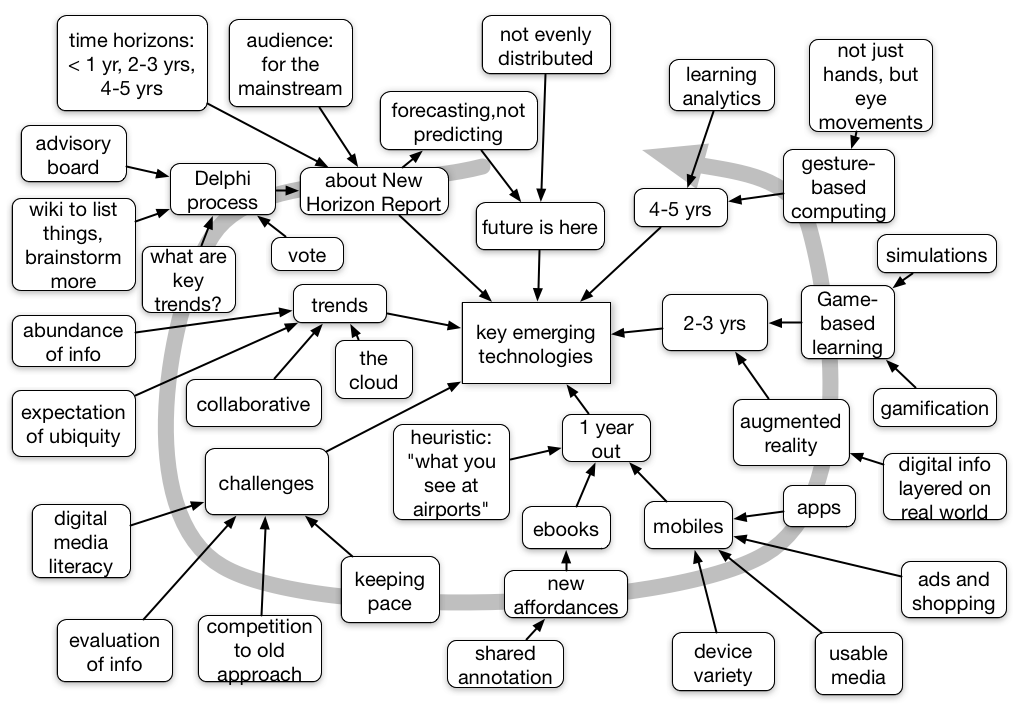
This evening I had the delight to hear Alan Levine present the New Media Consortium’s New Horizon Report for 2011 to the ASTD Mt. Diablo chapter. As often happens, I mindmapped it. Their process is interesting, using a Delphi approach to converge on the top topics.
For the near term (< 1 year), he identified the two major technologies as ebooks and mobile devices (with a shoutout for my book: very kind). For the medium term (2-3 years), he pointed to augmented reality and game-based learning (though only barely touching on deeply immersive simulations, which surprised me). For the longer term (4-5 years), the two concepts were gesture-based computing and learning analytics.
A very engaging presentation.
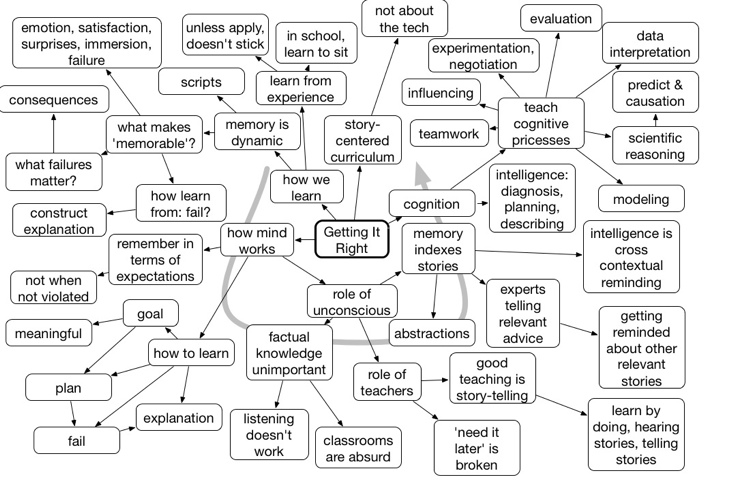
Today, Roger Schank keynoted the Learning Technologies UK conference, talking about cognitive science and learning. Obviously, I was in large agreement. And, as usual, I mid mapped it:
Today, one of my heroes, Alan Kay, gave a keynote to the Innovations in eLearning conference. The mindmap can’t convey the broad range, but to get it out there…

In response to my recent mindmap of Andrew McAfee’s conference keynote (one of a number of mindmaps I’ve done), I got this comment:
Does the diagram work as a useful way of encapsulating the talk for someone who was there? Because, speaking as someone who wasn‘t, I find it almost entirely content-free. Just kind of a collection of buzz-phrases in thought bubbles, more or less randomly connected.
I‘m not trying to criticise his talk – which obviously I didn‘t hear – or his points – which I still have no idea about – but the diagram as a method of conveying information is a total failure to this sample size of one. Possibly more useful as a refresher mechanism for people who got the talk in its original form?
Do mindmaps work for readers? Well, I have to admit one reason I mindmap is completely personal. I do it to help me process the presentation. Depending on the speaker, I can thoughtfully reprocess the information, or sometimes just take down interesting comments, but there are several benefits: In figuring out the ways to link, I’m capturing the conceptual structure of the talk (really, they’re concept maps), and I’m also occupying my personal bandwidth enough to allow me to focus on the talk without my mind chasing down one path and missing something. Er, mostly…
Then, for a second category, those who actually heard the talk, they might be worthwhile reflection and re-processing. I’d welcome anyone weighing in on that. I don’t have access to someone else’s example to see whether it would work for me.
Then, there are the potential viewers, like the commenter, for whom it’s either possible or not to process any coherent idea out of the presentation. I looked back at the diagram for McAfee’s keynote, and I can see that I was cryptic, missing some keywords in communicating. This was for two reasons: one, he was quick, and it was hard to get it down before he’d moved on. Two, he was eloquent, and because he was quick I couldn’t find time to paraphrase. And there’s a more pragmatic reason; I try to constrain the size of the mindmap, and I’m always rearranging to get it to fit on one page. That effort may keep me more terse than is optimal for unsupported processing.
I will take issue with “more or less randomly connected”, however. The connections are quite specific. In all the talks I’ve done this for, there have been several core points that are elaborated, in various ways by talk, but each talk tends to be composed of a replicated structure. The connections capture that structure. For instance, McAfee repeatedly took a theme, used an example to highlight it, then derived a takehome point and some corollaries. There would be ways to more eloquently convey that structure (e.g. labeled links, color coding), but the structure isn’t always laid out beforehand (it’s emergent), and is moving fast enough that I couldn’t do it on the fly.
I could post-process more, but in the most recent two cases I wanted to get it up quickly: when I tweeted I was making the mindmap, others said they were eager to see it, so I hung on for some minutes after the keynotes to get it up quickly. McAfee himself tweeted “dang, that was FAST – nice work!”
I did put the arrow in the background to guide the order in which the discussion came, as well, but apparently it is too telegraphic for the non-attendee. It happens I know the commenter well, and he’s a very smart guy, so if he’s having trouble, that’s definitely an argument that the raw mindmap alone is not communicative, at least not without perhaps some post-processing to make the points clear.
Really valuable to get the feedback, and worthwhile to reflect on what the tradeoffs are and who benefits. It may be that these are only valuable for fellow attendees. Or just me. I may have to consider a) not posting, b) slowing down and doing more post-processing, or…? Comments welcome!
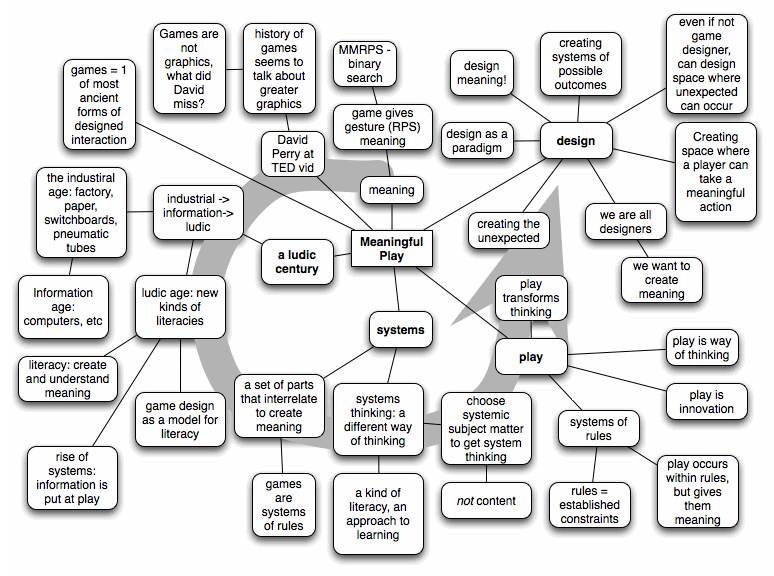
Eric Zimmerman spoke eloquently on games as the second day keynote at DevLearn. In it, he talked about how systems thinking was important, how games are systems of rules and consequently develop systems thinking. He talked about how our play brings meaning to the rules, and that creating spaces of possible outcomes allow us to explore.
He ended up advocating that we design for possibilities of unexpected outcomes to create meaning for our learners. Cammy Bean has blogged the presentation too.
I’ve written about writing before, but I don’t think I’ve talked about designing a workshop. Yet, that’s what I’m doing right now, and so I’m also reflecting. Which, of course, is very ‘meta’, because reflection is one of the topics of the workshop! Still, I’m pondering what’s different about designing a workshop versus writing, whether book or article or… So here’re some thoughts.
First, as is the case with writing a book (at least for me) is the process of creating the structure. I outline what I’m doing (even both outlined it and separately created a mindmap, to see what overlaps and gaps I found). For instance, I initially saw this as five separate events, spaced out. When I got into it, putting meat onto the bones as the saying goes, I realized that I wanted to combine three and four. So now there are four separate bits.
Then, as is the case with writing, too, I realize I’m alternating between top-down and bottom-up. Which is demonstrably what designers do, but…it’s interesting to break the myth of the waterfall design. I generate low-level elements, which makes me rethink and restructure bits, which means I need to go down into the details some more.
It’s also the case that I can disappear into design for too long (fortunately, the ribs came out ok). I personally go in bursts. I will get going and time will fly by, and then I hit a wall and just have to stop and take a break. It also is mentally taxing, and I find my thoughts become difficult until I take some time off.
And, I recognize it will take several passes. Already I’ve made ‘todo’s for two specific post-hoc passes. First, I’m getting the ideas and the structure right. Then, I want to go back and make sure I’ve put in all the good ideas, hints/tips/tricks, and all that ensures there’s real value in what I’m doing. Finally, I want to make a third pass that ensures I’m helping the audience process the content successfully. That is, getting them to rephrase the ideas into their own words (a form of reflection).
The latter of which is, specifically, what’s at least partly unique to a workshop versus a book. Yes, I’m making it interactive in the first pass by asking an opening question for each section to get folks creating their own thoughts before I present mine, so as to activate and also to generate any improvements that can come from them. While I think I have plenty of relevant background, I’ve not enough hubris to think that there won’t be ideas that are better than mine. I learn when I run workshops, too!
One of the important things here is to develop real new abilities, not just to present ideas. Learning science tells us we need repeated practice, and that’s definitely got to be part of what this workshop does. So, not only do I want some scaffolded practice in the session, but there’s also ‘homework’ where attendees apply the current idea to their own work and share the learnings therefrom in between sessions. (Research emerging from our work at Elevator 9 suggests that when this is done – and it’s hard to do – the results are better.)
The goal is a workshop that delivers real learning, and real value. I don’t want to just make money selling ideas and good feelings. That’s too frequently what we see (*cough* leadership development *cough*), but that’s not what will lead to long term benefit. And I do care about that (perhaps too much! ;). So, there are some thoughts on designing a workshop. What haven’t I made clear? What am I missing?
(And no thanks to Apple for losing my templates and making me create them anew. Ahem.)